Many radiation related cancers to come, as Japan confirms Fukushima worker’s radiation caused cancer
“Thyroid cancer is commonly developed as a result of acute exposure to radioactive iodine 131, a product of nuclear fission…”
The British journalist also highlighted that the scientists have failed to mention that other radioactive elements emitted in the accident pose even more of a threat to the population’s health (in particular, 17.5 percent Cesium-137 and 38.5 percent Cesium 134).
 Fukushima: Hundreds of Radiation-Related Cancer Cases on the Way in Japan, http://sputniknews.com/asia/20151023/1029014961/fukushima-radiation-cancer-threat-japan.html, 23 Oct 15 The Japanese government has recently admitted that a worker at the Fukushima nuclear plant contracted cancer as a consequence of radiation exposure of 2011, British journalist Oliver Tickell points out, warning that there are many more cases on the way.
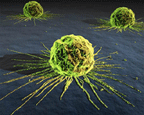 The Japanese government has officially confirmed that a worker at the Fukushima nuclear plant has contracted radiation-related cancer: the man has been diagnosed with acute myelogenous leukaemia.
“But that single ‘official’ cancer case is just the beginning. New scientific research indicates that hundreds more cancers have been and will be contracted in the local population. A 30-fold excess of thyroid cancer has been detected among over 400,000 young people below the age of 18 from the Fukushima area,” British journalist, author and health and environment issue campaigner Oliver Tickell wrote in his article for The Ecologist, citing a report entitled “Thyroid Cancer Detection by Ultrasound Among Residents Ages 18 Years and Younger in Fukushima, Japan: 2011 to 2014.”
The highest incidence rate ratio, using a latency period of 4 years, was observed in the central middle district of the prefecture compared with the Japanese annual incidence (incidence rate ratio = 50; 95% confidence interval [CI] = 25, 90),” the report read.
Tickell noted that during a first screening for thyroid cancer held four years after the Fukushima catastrophe among 298,577 youths, the disease was registered 50 times more frequently among those who lived in the most heavily irradiated zones than among other Japanese youth.
During a second screening carried out in April 2014 among 106,068 young people who lived in less contaminated areas of the Fukushima prefecture, the disease was 12 times more common than for the main population.
“Thyroid cancer is commonly developed as a result of acute exposure to radioactive iodine 131, a product of nuclear fission. Because iodine concentrates in the thyroid gland, thyroid damage including cancer is a characteristic marker of exposure to nuclear fallout,” Tickell elaborated, adding that iodine-131 constituted about 9.1 percent of the radioactive material released during the Fukushima disaster.
Quoting the report, Tickell called attention to the fact that “the incidence of thyroid cancer is high by comparison with the Chernobyl nuclear disaster in 1986,” beating the drums over the possibility of a growing cancer threat in the region in the next four-five years.
That is not all, the British journalist added, emphasizing that the real exposure doses for residents could have been higher than had been reported by the authorities and the World Health Organization.
“We could infer a possibility that exposure doses for residents were higher than the official report or the dose estimation by the World Health Organization, because the number of thyroid cancer cases grew faster than predicted in the World Health Organization’s health assessment report,” the authors of the report underscored, as quoted by Tickell.
The British journalist also highlighted that the scientists have failed to mention that other radioactive elements emitted in the accident pose even more of a threat to the population’s health (in particular, 17.5 percent Cesium-137 and 38.5 percent Cesium 134).
“These longer-lived beta-emitters (30 years and two years respectively) present a major long-term hazard as the element is closely related to potassium and readily absorbed into biomass and food crops,” Tickell stressed.
The author bemoaned the fact the Japanese people also face a danger posed by “long lived alpha emitters like plutonium 239 (which has a half-life of 24,100 years) which is hard to detect.”
“Even tiny nano-scale specks of inhaled plutonium entering the lungs and lymphatic system can cause cancer decades after the event by continuously ‘burning’ surrounding tissues and cells,” Oliver Tickell warned.
Fukushima worker’s leukaemia confirmed as caused by radiation
 Fukushima worker diagnosed with leukaemia after shocking radiation leak at nuclear plant, news.com.au OCTOBER 20, 2015 A FORMER Fukushima nuclear plant worker has been diagnosed with radiation-linked cancer, making him the first such confirmation more than four years after the worst atomic accident in a generation.
An official with the health ministry said the ex-employee, who was in his thirties while working at the plant following the 2011 crisis, has developed leukaemia. He is now 41 years old, local media reported.
“The case has met the criteria” to link his illness to the accident, the official told a Tokyo press briefing on condition of anonymity, adding that other possible causes have been ruled out.
“This person went to see a doctor because was not feeling well. That was when he was diagnosed with leukaemia.” The ministry revealed few details about the man, but said he had worked at a destroyed building that housed one of the crippled reactors.
The man, who wore protective equipment during more than a year spent at Fukushima, will be awarded compensation to pay for his medical costs and lost income, the official said, without elaborating on the amount.
Three similar cases of cancer in plant workers are still awaiting confirmation of a link to the accident…….
The announcement Tuesday will likely further inflame widespread public opposition to nuclear power……..
The case was likely to deal another blow to Prime Minister Shinzo Abe’s unpopular attempt to switch on Japan’s stable of atomic reactors………http://www.news.com.au/world/asia/fukushima-worker-diagnosed-with-leukaemia-after-shocking-radiation-leak-at-nuclear-plant/story-fnh81fz8-1227576166328
Media blackout on US sailors made ill by Fukushima radiation
 Total blackout of Fukushima truth by U.S. media; sailors suffer and die while denial continues October 21, 2015, by: J. D. Heyes (NaturalNews) Nearly four years after a major tsunami created the massive tidal wave that destroyed much of Japan’s Fukushima nuclear power complex in the northern part of the country, spewing radioactive waste into the air and surrounding Pacific Ocean, the truth about the after-effects of that disaster continue to reside in the shadows.
For example, one of the most under-reported stories of all pertaining to the disaster — and one that should be of particular interest to Americans — is the fate of a number of crewmembers aboard the USS Ronald Reagan, the U.S. Navy carrier sent to assist Japanese military and civilian authorities in the immediate aftermath of the quake…….
It was Morales’ endocrinologist who asked her the question that made her start to wonder about Fukushima and about the “official line” regarding radiation exposure. He asked if she had been aboard the Reagan during Tomodachi, and she said she had.
The endocrinologist then said he had also removed six thyroid glands from other sailors aboard the Reagan, and it was then that Morales put together her own poor health and her participation in the operation.
Retired Navy Lt. Steve Simmons knows. He, too, has been suffering from illness since serving aboard the Reagan during Tomodachi.
Dozens more sickened
“There are individuals out there who are in very similar situations to myself… progressive muscle weakness that starts in their legs and starts to ascend. There are individuals out there who have developed different forms of cancer, leukemia, children of service members born with birth defects because of their service over there,” he said in a recent interview.
You can see the full interview here.
Others have also come forward. In December 2013, Fox News reported that, at the time, a total of 49 Reagan sailors had developed cancers, thyroid issues and other problems related to radiation exposure:
In a lawsuit filed against Tokyo Electric Power Company (TEPCO), the plaintiffs claim the power company delayed telling the U.S. Navy the tsunami had caused a nuclear meltdown, sending huge amounts of contaminated water into the sea and, ultimately, into the ship’s water system.
That full report is here.
The Daily Kos, citing a report from Al Jazeera, put the number of sailors sickened at 51.
Sources:…….
http://www.naturalnews.com/051651_Fukushima_Navy_sailors_media_blackout.html#ixzz3pcQ4Fsio
The public recognition of a radiation-cancer threat may lead to high compensation payments
Japan Acknowledges First Possible Radiation Casualty at Fukushima Nuclear Plant The public recognition of a radiation-cancer threat may lead to high compensation payments TOKYO, Oct 20 (Reuters) – Japan on Tuesday acknowledged the first possible casualty from radiation at the wrecked Fukushima nuclear power plant, a worker who was diagnosed with cancer after the crisis broke out in 2011.
The health ministry’s recognition of radiation as a possible cause may set back efforts to recover from the disaster, as the government and the nuclear industry have been at pains to say that the health effects from radiation have been minimal.
It may also add to compensation payments that had reached more than 7 trillion yen ($59 billion) by July this year…….
The male worker in his 30s, who was employed by a construction contractor, worked at Tokyo Electric Power Co’s Fukushima Daiichi plant and other nuclear facilities, a health ministry official said.
Of total radiation exposure of 19.8 millisieverts (mSv), the worker received a dose of 15.7 (mSv) between October 2012 and December 2013 working at Fukushima, said the official.
While the exposure amount was lower than the annual 50 mSv limit for nuclear industry workers, the government had decided it cannot be ruled out that the worker’s leukaemia was a result of radiation, the official said.
Tokyo Electric is also facing a string of legal cases seeking compensation over the disaster.
Inside the plant, Tepco has struggled to bring the situation under control. It is estimated removing the melted fuel from the wrecked reactors and cleaning up the site will cost tens of billions of dollars and take decades to complete. ($1 = 119.4200 yen) (Reporting by Kiyoshi Takenaka; Writing by Aaron Sheldrick; Editing by Nick Macfie) http://www.scientificamerican.com/article/japan-acknowledges-first-possible-radiation-casualty-at-fukushima-nuclear-plant/
Fukushima insect study shows there is no safe low level of ionising radiation
 The researchers found that caterpillars that ate radioactive leaves pupated into mutated butterflies that did not live as long, compared with caterpillars that ate non-radioactive leaves. These mutations and increased mortality were seen even in butterflies that consumed only very small doses of radioactive cesium.
Deaths and mutations spike around Fukushima; no safety threshold for radioactive cesium exposure http://theunhivedmind.com/wordpress3/deaths-and-mutations-spike-around-fukushima-no-safety-threshold-for-radioactive-cesium-exposure/October 16, 2015 theunhivedmind Deaths and mutations spike around Fukushima; October 16, 2015 by: David Gutierrez, staff writer
http://www.naturalnews.com/051581_fukushima_radiation_nuclear_power.html
Plants in the area around Fukushima, Japan are widely contaminated with radioactive cesium, which is 
producing mutation and death in local butterflies, according to a study conducted by researchers from the University of the Ryukyus, Okinawa and published in the journal Scientific Reports.
The butterflies were found to experience severe negative effects at all detectable radiation levels, even very low ones.
“We conclude that the risk of ingesting a polluted diet is realistic, at least for this butterfly, and likely for certain other organisms living in the polluted area,” the researchers wrote.
Insects hard hit
The researchers note that although the 2011 meltdown of the Fukushima Daiichi Nuclear Power Plant released “a massive amount of radioactive materials … into the environment,” few studies have looked at the biological effects of this disaster. Researchers have, however, measured elevated radiation levels in the polluted area, and have chronicled the accumulation of radioactive material in both wild and domestic plant and animal life in the region.
Studies have also suggested that insects may be particularly hard-hit by the increased radiation. One study found an increase in morphological abnormalities (physical deformities) in gall-forming aphids. Another found that insect abundance has decreased in the affected region, particularly butterfly abundance. Continue reading
Film ‘The Martian” gets it really wrong about ionising radiation
Here Are The Biggest Health Risks To Humans In Space, Gizmodo MADDIE STONE12 OCTOBER 2015 “…….Radiation And now we get to my One Big Problem with the science of The Martian. OK, we get it: Mark Watney has an extraordinarily sunny disposition and bowels of steel. (Seriously, who can eat protein squares for two years straight and still, you know, fertilize the potatoes?) But nothing can save Watney from the inconvenient truth that Mars has no ozone layer. That means the surface is awash in ultraviolet radiation — the same stuff we use to sterilize hospital clean rooms. And UV loves to rip, shatter, and mutate DNA. As far as we can tell, all life forms are susceptible to its burn.
 Giving Mark Watney cancer on Mars probably wouldn’t have made too much sense from a narrative perspective. But radiation is something we worry about on the ISS and it’s certainly something we’ll have to consider if and when we send humans to Mars.
There are a few types of harmful radiation zipping about in outer space. There’s UV, which is several hundred times stronger in orbit than it is beneath Earth’s atmosphere. During Kelly’s year in space, he’s soaking up roughly the same amount of extra radiation (0.16 sieverts) that a regular cigarette smoker does over the course of a year. (For comparison, 1 sievert of radiation is associated with a 5.5 per cent increase in the risk of fatal cancer, and the background daily radiation dose on Earth is on the order of 10 micro-sieverts, or 0.00001 sieverts.)
That’s not great, but it’s also not that bad. The radiation danger gets a lot worse when you leave the protection of Earth’s magnetosphere.
During the trip from Earth to Mars, astronauts will be exposed to other flavours of radiation: namely, high energy subatomic particles from the sun, the Milky Way galaxy and beyond. It’s these solar energetic particles and galactic cosmic rays that we’re most worried about, because they ravage biological tissue very quickly. As an instrument aboard the Curiosity Rover recently revealed, even the shortest round-trip from Earth to Mars could dose our astronauts with 0.66 sieverts of radiation — the equivalent of a whole-body CT scan every five or six days.
Certain materials, including aluminium and polyethylene plastics, can block or slow down radiation, but Shelhamer warns that shielding ourselves could backfire. Slowing down a high-energy cosmic ray could afford it more opportunity to collide with other particles and create dangerous secondary particles. “A particle of galactic radiation might be better off going fast…. if it’s moving slowly, it has the opportunity to create more damage,” he said. “It’s a very tricky situation, and we don’t have a good handle on the extent of the risk and what can we do about it.”
If one thing is clear, it’s that our ability to safely put humans on Mars — no less keep them alive on the radiation-riddled surface — depends very much on whether we can solve this problem.
The Biggest Danger to Humans in Space……“As the Chief Scientist whose job is to oversee this whole thing, the thing that concerns me most is the one danger that we haven’t yet thought of,” Shelhamer said. “What’s the biggest risk? It’s the radiation that causes a mutation in a pathogen when your immune system is compromised, and the medication on board doesn’t work because your metabolism has shifted. It’s the interaction of factors nobody considered.”…..
References
Effects of Prolonged Spaceflight on Human Skeletal Muscle. NASA, 2015.
Gifford, S. Calculated Risk: How Radiation Rules Manned Mars Exploration. Astrobiology Magazine, 2014. http://www.gizmodo.com.au/2015/10/here-are-the-biggest-health-risks-to-humans-in-space/
Don’t be fooled: science shows that low dose ionising radiation harms living organisms
Radiation Impact Studies: Chernobyl and Fukushima, Dissident Voice, by Robert Hunziker / September 23rd, 2015 Some nuclear advocates suggest that wildlife thrives in the highly-radioactive Chernobyl Exclusion Zone, animals like it, and not only that, a little radiation for anybody and everybody is harmless and maybe good, not bad. This
may seem like a senseless argument to tackle were it not for the persistence of positive-plus commentary by nuke lovers. The public domain deserves better, more studied, more crucial answers.
Fortunately, as well as unfortunately, the world has two major real life archetypes of radiation’s impact on the ecosystem: Chernobyl and Fukushima. Chernobyl is a sealed-off 30klm restricted zone for the past 30 years because of high radiation levels, whereas PM Abe’s government in Japan has already started returning people to formerly restricted zones surrounding the ongoing Fukushima nuclear melt-down.
The short answer to the supposition that a “little dab of radiation is A-Okay” may be suggested in the title of a Washington Blog d/d March 12, 2014 in an interview of Dr. Timothy Mousseau, the world-renowned expert on radiation effects on living organisms. The hard answer is included further on in this article.
Dr. Mousseau is former Program Director at the National Science Foundation in Population Biology, Panelist for the National Academy of Sciences’ Panels on Analysis of Cancer Risks in Populations Near Nuclear Facilities and GAO Panel on Health and Environmental Effects from Tritium Leaks at Nuclear Power Plants, and a biology professor – and former Dean of the Graduate School, and Chair of the Graduate Program in Ecology – at the University of South Carolina.
The title of the Washington Blog interview is:
“Chernobyl and Fukushima Studies Show that Radiation Reduces Animal and Plant Numbers, Fertility, Brain Size and Diversity… and Increases Deformities and Abnormalities”
Dr. Mousseau made many trips to Chernobyl and Fukushima, making 896 inventories at Chernobyl and 1,100 biotic inventories in Fukushima. His mission was to test the effects of radiation on plants and animals. The title of his interview (above) handily serves to answer the question of whether radiation is positive for animals and plants. Without itemizing reams and reams of study data, the short answer is: Absolutely not! It is not positive for animals and plants, period.
Moreover, low doses of radiation, aka “radiation hormesis”, is not good for humans, as advocated by certain energy-related outlets. Data supporting their theory is extremely shaky and more to the point, flaky.
Furthermore, according to the Cambridge Philosophical Society’s journalBiological Reviews, including reported results by wide-ranging analyses of 46 peer-reviewed studies published over 40 years, low-level natural background radiation was found to have small, but highly statistically significant, negative effects on DNA and several measures of good health.
Dr. Mousseau, with co-author Anders Møller of the University of Paris-Sud, examined more that 5,000 papers involving background radiation in order to narrow their findings to 46 peer-reviewed studies. These studies examined plants and animals with a large preponderance of human subjects.
The scientists reported significant negative effects in a range of categories, including immunology, physiology, mutation and disease occurrence. The frequency of negative effects was beyond that of random chance.
There is no threshold below which there are no effects of radiation.
With the levels of contamination that we have seen as a result of nuclear power plants, especially in the past, and even as a result of Chernobyl and Fukushima and related accidents, there’s an attempt in the industry to downplay the doses that the populations are getting, because maybe it’s only one or two times beyond what is thought to be the natural background level…. But they’re assuming the natural background levels are fine. And the truth is, if we see effects at these low levels, then we have to be thinking differently about how we develop regulations for exposures, and especially intentional exposures to populations, like the emissions from nuclear power plants…… http://dissidentvoice.org/2015/09/radiation-impact-studies-chernobyl-and-fukushima/
Study shows there is no safe low level of ionising radiation
Radiation Impact Studies: Chernobyl and Fukushima, Dissident Voice, by Robert Hunziker / September 23rd, 2015
“…….A consortium of researchers coordinated by the International Agency for Research on Cancer (IARC) in Lyon, France, examined causes of death in a study of more than 300,000 nuclear-industry workers in France, the United States and the United Kingdom, all of whom wore dosimeter badges.1
The workers received on average just 1.1 millisieverts (mSv) per year above background radiation, which itself is about 2–3 mSv per year from sources such as cosmic rays and radon. The study confirmed that the risk of leukemia does rise proportionately with higher doses, but also showed that this linear relationship is present at extremely low levels of radiation.
The study effectively “scuppers the popular idea that there might be a threshold dose below which radiation is harmless.”

Even so, the significant issue regarding radiation exposure for humans is that it is a “silent destroyer” that takes years and only manifests once damage has occurred; for example, 200 American sailors of the USS Reagan have filed a lawsuit against TEPCO et al because of radiation-related illnesses, like leukemia, only four years after radiation exposure from Fukushima….. http://dissidentvoice.org/2015/09/radiation-impact-studies-chernobyl-and-fukushima/
Fukushima children and adolescents have unusually high rates of thyroid cancer
 Thyroid Cancer Detection by Ultrasound Among Residents Ages 18 Years and Younger in Fukushima, Japan: 2011 to 2014. http://journals.lww.com/epidem/Abstract/publishahead/Thyroid_Cancer_Detection_by_Ultrasound_Among.99115.aspx by Tsuda, Toshihide; Tokinobu, Akiko; Yamamoto,
 Eiji; Suzuki, Etsuji Epidemiology: Post Author Corrections: October 5, 2015 Open Access Published Ahead-of-Print
Methods: After the release, Fukushima Prefecture performed ultrasound thyroid screening on all residents ages <=18 years. The first round of screening included 298,577 examinees, and a second round began in April 2014. We analyzed the prefecture results from the first and second round up to December 31, 2014, in comparison with the Japanese annual incidence and the incidence within a reference area in Fukushima Prefecture.
Results: The highest incidence rate ratio, using a latency period of 4 years, was observed in the central middle district of the prefecture compared with the Japanese annual incidence (incidence rate ratio = 50; 95% confidence interval [CI] = 25, 90). The prevalence of thyroid cancer was 605 per million examinees (95% CI = 302, 1,082) and the prevalence odds ratio compared with the reference district in Fukushima Prefecture was 2.6 (95% CI = 0.99, 7.0). In the second screening round, even under the assumption that the rest of examinees were disease free, an incidence rate ratio of 12 has already been observed (95% CI = 5.1, 23).
Conclusions: An excess of thyroid cancer has been detected by ultrasound among children and adolescents in Fukushima Prefecture within 4 years of the release, and is unlikely to be explained by a screening surge.
This is an open-access article distributed under the terms of the Creative Commons Attribution-Non Commercial-No Derivatives License 4.0 (CCBY-NC-ND), where it is permissible to download and share the work provided it is properly cited. The work cannot be changed in any way or used commercially.
Examining Nuclear Regulatory Commission’s deceptive article about ending the cancer research
 Examining the Reasons for Ending the Cancer Risk Study as given in article by USA’s Nuclear Regulatory Commission 6 Oct 15 Garry Morgan, U.S. Army Medical Department, Retired Director Health and Radiation Monitoring BEST/MATRR a local chapter of BREDL
http://www.matrr.org
One word describes this article – FALLACY. The Nuclear Regulatory Commission’s (NRC) mission to protect the public is compromised by politicians supported by Nuclear Special Interest Groups such as the NEI, Nuclear Energy Institute, applying pressure to decrease funding to the NRC. You are supporting the nuclear industry not the public. The NRC is not an agency which has separated itself from undue political and industry influences and pressures.
A report of radiological contamination and its health effects could have been completed with less expense than $8 million dollars, accurately. The nuclear industry and the United States Government has much to hide regarding the failures to protect the public at large and in communities surrounding all nuclear facilities – this includes the uranium mining communities, the fuel facility communities, the nuclear hazardous waste communities, nuclear weapons communities and all nuclear reactor facility communities.
The nuclear industry and the regulator does not report real time ionizing radiation from emission sources from any active nuclear facility; reporting is based on averages reported annually from nuclear facility locations. This type of reporting is skewered, and lacks scientific credibility due to not reporting emissions in a real time monitoring program with accurate radiological assessments from real time monitoring reports along with community resident health evaluations.
Non-profit institutional examination of nuclear emissions and community health is demonstrating an entirely different story from that which the nuclear industry and the NRC reports. When there is contradictory evidence disputing the nuclear industry and the NRC, the NEI hires nuclear industry paid persons to contradict any information assimilated from private non-profit sources, regardless if the information is actually an accurate compilation from government sources with professional data assimilation and analysis. Example – The Browns Ferry Report <http://best-matrr.org/pdfs/AL_BFN_Report_2013-final-dig2.pdf>http://best-matrr.org/pdfs/AL_BFN_Report_2013-final-dig2.pdf
The examination of dispersal of radiological contaminating materials in East Tennessee presents a horror story of cancer, declining health and radionuclide contamination of the environment of East Tennessee communities along the Tennessee River and its’ tributaries. The citizens of East Tennessee have become a sacrificial group since the beginnings of the nuclear age in 1945. Unfortunately, the Department of Energy (DOE) and the NRC are participants in this horror story of the atomic age, placing the money gained from atomic death industry before peoples health and welfare – shame on you. Shame on the NRC, DOE, and the many nuclear and nuclear defense industries for your continued deceit.
This is the million pound weight in the room – the continuous deceit and placing money before human health in civilian nuclear and nuclear contractor programs, besides the continuous building of highly radioactive nuclear waste materials. The deceit demonstrated is a continuous failure to uphold Human Reliability Standards which is a cornerstone of any nuclear program, the failure due to deceit is tantamount to a disaster awaiting an outcome. http://public-blog.nrc-gateway.gov/2015/10/06/examining-the-reasons-for-ending-the-cancer-risk-study/comment-page-1/#comment-1617512>
Pediatric Thyroid Cancer after the Fukushima Accident
Press Conference: Toshihide Tsuda, Professor of Okayama Univeristy, October 08, 2015, “Pediatric Thyroid Cancer after the Fukushima Accident”
Toshihide Tsuda
Professor, Graduate School of
Environmental and Life Science, Okayama University
Language: The speech and Q & A will be in Japanese with English interpretation
Almost five years after the triple meltdown at the Fukushima Daiichi nuclear power plant, attention is turning to the possible long-term health effects radiation exposure has had on local people, particularly children.
A large-scale thyroid ultrasound screening examination is underway in Fukushima Prefecture, covering about 370,000 children who were 18 or younger at the time of the accident.
Despite evidence of much higher rates of juvenile thyroid cancer in the prefecture compared with the pre-accident incidence rate, local medical authorities and the central government claim that the Fukushima disaster is not the cause.
They point to the evacuation of tens of thousands of people in the immediate aftermath, and the ban on the sale of locally produced milk and other produce. The authorities, backed by prominent international experts, claim the increased rate of thyroid cancer is due to the highly sensitive ultrasound equipment being used to test Fukushima children.
But in a significant challenge to that thesis, Toshihide Tsuda, professor of environmental epidemiology at Okayama University, believes the excess occurrence of juvenile thyroid cancer is not due merely to the screening effect, but is the consequence of exposure to radiation. http://www.fccj.or.jp/events-calendar/press-events/icalrepeat.detail/2015/10/08/3459/30/press-conference-toshihide-tsuda-professor-of-okayama-univeristy.html
Astronauts would get cancer from ionising radiation in space
Movie fact check: Could Martian explorer survive radiation?, Genetic Literacy Project,
Clara Moskowitz | October 5, 2015 | Scientific American In the newly released The Martian, a stranded astronaut must figure out how to survive on the Red Planet after being accidentally left behind when the rest of his crew escapes a violent dust storm. Explorer Mark Watney spends many months trying to make water, grow food and send an SOS signal back to Earth. Most of the tools he uses in the film are based on existing or in-development technology.
The one major exception is the radiation-blocking material that allows Watney to spend much of his days outside his habitat, on the surface of a planet that lacks Earth’s atmosphere and is thus bathed in significantly higher levels of damaging radiation.“In the book they have this really thin, light, flexible material that blocks all radiation,” says Andy Weir, author of the book The Martian on which the film was based. “There’s nothing even remotely like that in the real world. That was the magic I gave him so the story would progress. Otherwise Mark would have different kinds of cancer.”…….http://www.geneticliteracyproject.org/2015/10/05/movie-fact-check-martian-explorer-survive-radiation/
On the trip to Mars, astronauts’ brains would experience lethal levels of cosmic radiation.
 An Inconvenient Radiation tucson.com By David Galbraith THE ARIZONA DAILY STAR , 5 Oct 16 Mars waxes large in our current imagination. Matt Damon provides a compelling performance as an astronaut botanist stranded on the Red Planet, in a Ridley Scott film lauded for its scientific accuracy. The future in space shines bright, it seems. But is this really so?……..
Why do we need protection? The most energetic cosmic rays pack a punch of a 56 mile‐per‐hour baseball. Just as a body can be damaged by a baseball, so a cell can be damaged by a cosmic ray. How much damage can it do? Scientists have recently tested this question, exposing mice to amounts of radiation that would be experienced by astronauts during a trip to Mars which has very little atmosphere and minimal protection from cosmic rays. Extensive destruction of the brains of these mice was seen, with drastic deterioration in cognitive tests.
Our astronauts have already described interactions with cosmic rays during brief trips to the moon, reporting random flashes of light, a consequence of the explosive interaction of a cosmic ray with the cells in the retina. During the much longer trip to Mars, and the establishment of a permanent colony there, the brains of the astronauts will experience lethal levels of cosmic radiation.
An alternative, and very simple explanation of Fermi’s paradox, is that the universe is a sterilizing system: cosmic rays prevent access of living organisms, alien or human, to our immediate space neighborhood and beyond. Accepting and coming to terms with this disturbing concept will have far‐ reaching consequences, both practical, political, philosophical, and, perhaps, theological. The only things that remain shining, as we keep looking up, are the inaccessible stars, and my father’s ironic gift, the faint Cerenkov radiation in the night sky formed by cosmic rays. http://tucson.com/news/opinion/column/guest/an-inconvenient-radiation/article_8c30548b-a593-51c9-b9b6-042787fe4f67.html
Afraid about radiation, but afraid to speak out: Fukushima mothers
 Reluctant to speak, Fukushima moms admit fear of radiation, pressure from families, Japan Times, BY MEGAN GREEN, 29 Sept 15 STAFF WRITER To stay or to flee. Mothers in Fukushima Prefecture had to make harsh decisions for their families after the nuclear disaster of March 2011. More than four years on, they still have to.
Those who remain there live in constant fear for their children’s health. But choosing to flee opened them to accusations of being bad wives who abandoned their relatives, community and husbands tied to jobs.
It is a no-win situation for those who face the decision to stay or go, because they may be unable to live up to the ideal of a ryosai kenbo (good wife, wise mother).
“Consciously or subconsciously, women are aware of the role we are expected to play in a family. After the earthquake and nuclear disaster, however, everything changed,” said Yukiko (not her real name), a mother and voluntary evacuee in her 30s. “I can’t live up to those expectations any more, and society judges me.”
All women interviewed for this story spoke on condition of anonymity.
As the crisis at the Fukushima No. 1 nuclear power plant began to play out, Tokyo Electric Power Co. established a 20-km no-go zone around the site, outside of which the government said conditions were safe. Many did not believe the assertion.
Yuriko, a woman in her 70s who lives in the city of Minamisoma, Fukushima Prefecture, believes the zone restrictions divided the community.
“Some people trusted the government’s word and continued to live here, but others couldn’t stand living every day in fear and moved out,” Yuriko said. “Nobody knew what to believe and communities have fallen apart.”
The fear of radiation, rumors and media reports about the safety of local food prompted many mothers just outside the no-go zone to evacuate voluntarily for the sake of their children’s health. Some moved to neighboring prefectures, including Iwate and Miyagi, and others made the great leap south to Tokyo.
“To be honest, I didn’t have much knowledge about the nuclear reactors in Fukushima. But I did know how deadly high exposures of radiation could be,” said Yuko, in her 30s, who has a 6-year-old daughter. “I evacuated to Tokyo within a week of the disaster. My husband stayed in Fukushima, but I was determined to leave to prioritize the safety of my daughter.”
In many cases, voluntary evacuees like Yuko are mothers who fled with their children while their husbands remained in Fukushima to work………….. http://www.japantimes.co.jp/news/2015/09/29/national/social-issues/reluctant-speak-fukushima-moms-admit-fear-radiation-pressure-families/#.VgsUZOyqpHx
Mururoa Nuclear Radiation Report Scheduled for October
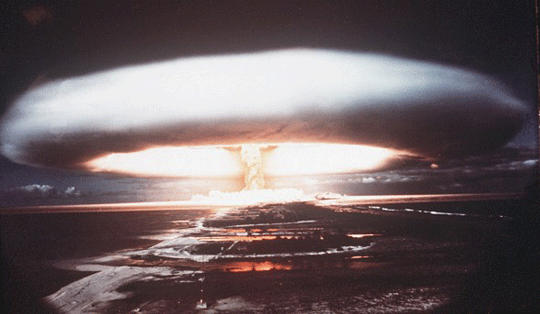 Mururoa Nuclear Radiation Report Scheduled for October http://www.scoop.co.nz/stories/PO1509/S00409/mururoa-nuclear-radiation-report-scheduled-for-october.htm
30 September 2015,
An independent report into likely exposure and risk from radiation during the New Zealand government’s 1973 two-frigate protest against French nuclear testing at Mururoa is expected to be released to MNVG Inc in October. 42 years after the event.
The report was commissioned by Veterans Affairs New Zealand (VANZ) in August and is being carried out by Crown research agency Environmental Science and Research Ltd, .it is addressing three issues:• the external dose rate to veterans from nuclear testing; • the internal (perhaps also external) dose rate from seawater used in ships; • hereditary effect on offspring.
Described as “a scientific report written with consideration of a non-specialist/technical audience”, the report is the result of sustained efforts over the last two years by the Mururoa Nuclear Veterans Group Inc (MNVG Inc) MNVG Inc President, Wayne O’Donnell, says the group – formed in 2013 and registered as a legal society – has been monitoring the health of the veterans, their children and grandchildren, and is establishing a trust fund to enable the medical testing of the veterans’ children and grandchildren, and to help those in need.
He says the report stems from the MNVG Inc’s meetings with Veterans Affairs Minister Craig Foss and VANZ in May. Following that meeting, Foss directed VANZ to commission an independent examination of the issues.
O’Donnell says Foss and Head of Veterans Affairs New Zealand, Jackie Couchman – both relatively new to their positions – have proved far more receptive and open to looking at the issues than their predecessors.
He says the group hopes the results of this work “will establish the truth of the genetic transfer of illnesses related to the nuclear exposure encountered by the crews”.
“We wanted to get it recognised as an issue, and ideally, to get help from the Government in funding research and establishing a Health Trust Fund.”
New Zealand’s protest in 1973 attracted international attention and helped force the French to switch to underground testing.
Around 500 crew, observers (including a government minister, Fraser Colman) and news media sailed aboard HMNZS Canterbury and HMNZS Otago to witness two atmospheric nuclear tests at Mururoa Atoll. HMAS Supply, with a crew of 200 plus, was also deployed into the radiated waters by the Royal Australian Navy to replenish the frigates with Fuel and Food during the deployment. To date these Australian Sailors have not been recognised or offered Health Assistance in relation to their deployment by the Australian Government.
A number of Mururoa veterans – and some of their children – have died at an early age.
MNVG Inc says there has also been a significant number of miscarriages, stillborn children, and children born with deformities or health problems.
The group has been searching for veterans and their descendants to contribute to the research. However, the search has been complicated by the lack of complete data on who was on board the frigates. While MNVG Inc have a full list for Canterbury, no such list can be found within NZDEF Records or archives for Otago.
Contact has been lost with some of the widows and children of those who have died, says O’Donnell. “We need to make contact with these people so that they can be informed of any findings, be part of the testing but most of all receive the duty of care they are entitled to. We also need to record any medical issues suffered by the generational children of the nuclear veterans. Not just now but in future generations.”
At the end of June 2015, 93 veterans who served at Mururoa were receiving a War Disablement Pension under the Veterans’ Support Act. A list of “conclusively presumed conditions” supports veterans of Pacific testing. A veteran diagnosed with a disability on the list is entitled to free medical treatment.
“This number of 93 is minimal, why ?, simply because many Veterans do not know what they are entitled to and there has been no proactive action taken to locate and inform them in the past. Some of our shipmates are simply living with their health issues and eventually dying, totally unaware of the Duty of Care they are entitled to”, Says O’Donnell.
Until now the New Zealand government has taken the position that the available evidence indicated Mururoa veterans were not exposed to harmful doses of ionising radiation in the frigates, neither of which came within 20 nautical miles – the minimum safe distance – of a detonation. However they did sail thru the contaminated cloud and fallout on more than one occasion and drew contaminated water into the ships.
O’Donnell, who was a navy marine engineer and diver, says it is not just a matter of direct exposure to radiation. He says seawater was collected and desalinated to provide drinking water, and food was stored in lockers on the upper deck in direct exposure to any and all fallout and salt water contamination..
“This water had been radiated for years and years. The testing of samples showed that it had high levels. We were ingesting it”.
He says the concern should be whether radiation was involved, not how much: “Any radiation is too much.”
Mururoa Nuclear veterans and families have been waiting 42 years and look forward to the report and further communications with both the Government and VANZ.
1 This Month


No Nuclear in Cwm Llynfi! Stop the nuclear power station near Maesteg.


4 August – WEBINAR – Hiroshima & Nagasaki: Nuclear Bombs Never Again
Tuesday, Aug. 4 at 5 pm PT / 8 pm ET.
Aug 5, 2026 10:00 AM in Australia/Melbourne
Join the Nuclear Bombs Never Again webinar on August 4th at 5pm Pacific Time / 8pm Eastern Time / 9am Japan Standard Time.
Cross generational voices at the intersection of Japan-Korea-US policy and militarization will share their lived experiences, nuclear impacts in these contexts, anti-war strategies, and actions you can take to advocate for a world with Nuclear Bombs Never Again. This 75-minute event is co-hosted by WILPF US and Korea Peace Now.

22,000+ miles voyaging for nuclear disarmament
and a radiation-free environment https://vfpgoldenruleproject.org/
To see nuclear-related stories in greater depth and intensity – go to https://nuclearinformation.wordpress.com
-
Archives
- July 2026 (323)
- June 2026 (287)
- May 2026 (306)
- April 2026 (356)
- March 2026 (251)
- February 2026 (267)
- January 2026 (308)
- December 2025 (358)
- November 2025 (359)
- October 2025 (375)
- September 2025 (257)
- August 2025 (319)
-
Categories
- 1
- 1 NUCLEAR ISSUES
- business and costs
- climate change
- culture and arts
- ENERGY
- environment
- health
- history
- indigenous issues
- Legal
- marketing of nuclear
- media
- opposition to nuclear
- PERSONAL STORIES
- politics
- politics international
- Religion and ethics
- safety
- secrets,lies and civil liberties
- spinbuster
- technology
- Uranium
- wastes
- weapons and war
- Women
- 2 WORLD
- ACTION
- AFRICA
- Atrocities
- AUSTRALIA
- Christina's notes
- Christina's themes
- culture and arts
- Events
- Fuk 2022
- Fuk 2023
- Fukushima 2017
- Fukushima 2018
- fukushima 2019
- Fukushima 2020
- Fukushima 2021
- general
- global warming
- Humour (God we need it)
- Nuclear
- RARE EARTHS
- Reference
- resources – print
- Resources -audiovicual
- Weekly Newsletter
- World
- World Nuclear
- YouTube
-
RSS
Entries RSS
Comments RSS
 nuclear-news