Iodine-129 waste used to track ocean currents for 15,000 km after discharge from nuclear plants
In connection to the article I wrote last August 3, 2017 “Radioactive Contamination of Oceans: Sellafield, La Hague, Fukushima” https://dunrenard.wordpress.com/2017/08/03/radioactive-contamination-of-oceans-sellafield-la-hague-fukushima/
This study is about radioactive 129I travelling the equivalent of a third of the way round the globe, a 15,000 km journey, legally released since 20 years from nuclear fuel reprocessing plants in the UK and France. Of course as usual, in complete disregard of recent studies about the dangerosity of low dose,They emphasise that the radioactivity levels found in the North Atlantic are extremely low and not considered dangerous.
This study still is letting us envisage the travel of the Fukushima Daiichi nuclear plant numerous radioactive contaminants which have been dispersed since March 2011, which still are being dispersed and will be additionally dispersed into the Pacific Ocean.
Radioactive 129I has travelled the equivalent of a third of the way round the globe, since being released from nuclear fuel reprocessing plants in the UK and France. The iodine’s 15,000 km journey begins in the nuclear plants at Sellafield and La Hague and continues via the Arctic Ocean and then southward via the Grand Banks towards Bermuda, where it is found at very low concentrations about 20 years later. This tracer has been used to provide the most complete up-to-date, high-accuracy mapping of the oceanic currents that transport CO2 and other greenhouse gases from the atmosphere to the abyssal depths of the deep North Atlantic Ocean. These results are being presented at the Goldschmidt geochemistry conference in Paris.

Radioactive contaminants have been legally released for more than half a century from the nuclear reprocessing plants at Sellafield (UK) and La Hague (France). Scientists have recently begun to use the radioactive 129iodine (129I) as a way of tracking the movement of ocean currents. They emphasise that the radioactivity levels found in the North Atlantic are extremely low and not considered dangerous.
“What we have found is that by tracing radioactive iodine released into the seas off the UK and France we have been able to confirm how the deep ocean currents flow in the North Atlantic. This is the first study to show precise and continuous tracking of Atlantic water flowing northward into the Arctic Ocean off Norway, circulating around the arctic basins and returning to the Nordic seas in what we call the “Arctic loop”, and then flowing southward down the continental slope of North America to Bermuda at depths below 3000 m” said lead researcher Dr John N. Smith (Bedford Institute of Oceanography, Canada).
The research is part of the international GEOTRACES project, which aims to use geochemical markers to follow ocean currents, and so provide precise estimates of transit times and mixing rates in the North Atlantic and Arctic Oceans. So far the 129I has been measured as far south as Puerto Rico, but the researchers assume that it will continue to flow southward into the South Atlantic and eventually spread throughout the global ocean.
Dr Smith continued, “These currents have previously been studied using dissolved CFCs (Chlorofluorocarbons) – the molecules which used to be used in fridges until banned in 1989. However, CFCs undergo ocean-atmosphere exchange which means that surface water is continually replenished with CFCs during the arctic leg of the journey, whereas the 129I plume retains the initial imprint of its input history over a long period of years. Further, 129I is relatively easy to detect at extremely low levels using accelerator mass spectrometry methods which gives us a large measurement advantage in terms of the signal to noise ratio. Since we know exactly where the 129I comes from and when it entered the ocean, for the first time we can be absolutely sure that detecting an atom in a particular place is as a specific result of the currents”.
“In many ways this is a bit like the old ‘stick in a stream’ game we used to play as kids – what people call ‘Pooh sticks’ in England – where you would drop a buoyant object in the water and observe where it comes out. Of course, it would be much better if these markers were not in the ocean at all, but they are, and we can use them to do some important environmental science”.
Commenting, Dr Núria Casacuberta Arola (ETH, Zurich) said:
“The work performed by John Smith and colleagues in recent years has greatly contributed to the understanding of water circulation, especially in the North Atlantic and Arctic Ocean. The advantage of using 129I as a transient tracer in oceanography is the long half-life (15.7 My) of this isotope compared to the circulation times, and the fact that it is largely soluble in seawater. Now, major efforts are also devoted to find other artificial radionuclides with similar sources and behaviour than 129I (e.g. 236U, 237Np) so that the more tools we have, the better we will understand the ocean circulation. Recent advances in mass spectrometry (ICP-MS and AMS) allow today for very low detection limits so that we can measure very low concentrations of these isotopes in deep ocean waters”.
https://phys.org/news/2017-08-129i-track-ocean-currents-km.html#jCp
Climate change: its effects on health
 How Climate Change Could Already Be Affecting Your Health,
 HealthLine, by Gillian Mohney on August 17, 2017
Linear accelerators – a much safer way to obtain medical isotopes, than from nuclear reactors
Cobalt-60 radiation machines are one of the many tools doctors have used in the treatment of cancer for the past 50 years. In North America, nearly all of these units have been replaced with more advanced technology called linear accelerators, which do not contain radioactive material and provide medically superior treatment. In developing countries, the cobalt-60 radiation machines remain prevalent. They are cost-effective and appealing in states with limited or intermittent electricity supplies and other physical infrastructure as well as a shortage of medical and technical expertise.
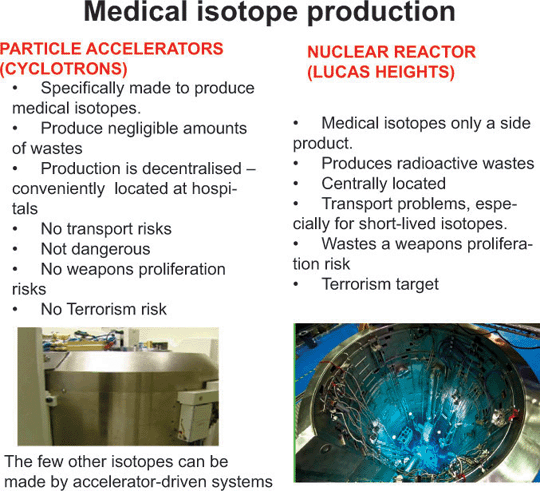
Iraq still has two cobalt-60 machines, according to the International Atomic Energy Agency, having already transitioned to linear accelerators for its 10 other treatment machines. But as Mosul made clear, using even one or two of these radiation machines comes with security risks. If the wrong people, such as members of the Islamic State or another terrorist group, got hold of cobalt-60, they could potentially create a dirty bomb or a radiation exposure device. With more than 70 percent of all cancer deaths now occurring in developing countries, the problem of balancing cancer treatment with security risks will only get worse.
The surest way to prevent terrorists from acquiring these materials, while not limiting people’s access to necessary cancer treatment, is to phase out cobalt-60 radiation machines and replace them with linear accelerators. The U.S. National Nuclear Security Administration, which is in charge of efforts to secure potentially dangerous radioactive material, has been supporting this approach for several years. To do so, developing countries need better technology and treatment environments, not only to support this transition away from cobalt-60 machines but to improve cancer treatment overall. Continue reading this article in World Politics Review

Cancer and other health problems still being caused because of past nuclear explosions
Nuclear explosions from the past are still causing cancer and health problems today https://www.businessinsider.com.au/nuclear-explosion-fallout-cancer-health-effects-2017-8?r=US&IR=T, KEVIN LORIA AUG 18, 2017
Will potassium iodide protect you from nuclear fallout?
 Verify: Will potassium iodide protect you from nuclear fallout?http://www.abc10.com/news/local/verify/verify-will-potassium-iodide-protect-you-from-nuclear-fallout/464777998 In 1999, the World Health Organization released guidelines on the use of potassium iodide, citing the exposure of children to radiation after the Chernobyl disaster.
Pennsylvania to give out potassium tablets to communities near nuclear power stations
State Asks Residents Close to Nuclear Plants to Have Pills https://www.usnews.com/news/best-states/pennsylvania/articles/2017-08-15/state-asks-residents-close-to-nuclear-plants-to-have-pills
Pennsylvania Gov. Tom Wolf is reminding Luzerne County residents to stock up on potassium iodide pills in case of an emergency at the Talen Energy nuclear power plant. Aug. 15, 2017 SALEM, Pa. (AP) — Pennsylvania Gov. Tom Wolf is reminding Luzerne County residents to stock up on potassium iodide pills in case of an emergency at the Talen Energy nuclear power plant.
How USA’s Argonne National Laboratory abused a small Australian boy, with plutonium injections
 Paul Langley, https://www.facebook.com/paul.langley.9822/posts/10213752429593121CAL-2, 14 Aug 17, 5 yr-old Simon Shaw and his mum. Simon was flown from Australia to the US on the pretext of medical treatment for his bone cancer. Instead, he was secretly injected with plutonium to see what would happen. His urine was measured, and he was flown back to Australia.
Though his bodily fluids remained radioactive, Australian medical staff were not informed. No benefit was imparted to Simon by this alleged “medical treatment” and he died of his disease after suffering a trip across the world and back at the behest of the USA despite his painful condition. The USA merely wanted a plutonium test subject. They called him CAL-2. And did their deed under the cover of phony medicine.
“Congress of the United States, House of Representatives, Washington, DC 20515-2107, Edward J. Markey, 7th District, Massachusetts Committees, [word deleted] and Commerce, Chairman Subcommittee on Telecommunications and Finance, Natural Resources, Commission on Security and Cooperation in Europe] MEMORANDUM To: Congressman Edward J. Markey From: Staff Subject: The Plutonium Papers Date: 4/20/94
Staff Memo on Plutonium Papers
The medical file for Cal-2 also contains correspondence seeking follow-up from Argonne National Laboratory in the 1980s. Cal-2 was an Australian boy, not quite five years old, who was flown to the U.S. in 1946 for treatment of bone cancer. During his hospitalization in San Francisco, he was chosen as a subject for plutonium injection. He returned to Australia, where he died less than one year later.
Document 700474 is a letter from Dr. Stebbings to an official at the Institute of Public Health in Sydney, Australia, in an attempt to reach the family of Cal-2. This letter reports that the child was “injected with a long-lived alpha-emitting radionuclide.” Document 700471 is a letter from Dr. Stebbings to New South Wales, Australia (names and town deleted), inquiring about recollections of the boy’s hospitalization in 1946. The letter notes that, “those events have become rather important in some official circles here,” but provides few details to the family.
A hand-written note on the letter reports no response through October 8, 1987. Considering the history on the lack of informed consent with these experiments, it is surprising that the letters to Australia failed to mention the word “plutonium.”
The Australian news media has since identified Cal-2 as Simeon Shaw, the son of a wool buyer in New South Wales, and information on the injection created an international incident. The information in the medical file does indicate that at a time when Secretary Herrington told you that no follow-up would be conducted on living subjects, the Department of Energy was desperately interested in conducting follow-up on a deceased Australian patient.
In an effort to determine the full extent of follow-up by the Department after 1986, your staff has requested, through the Department’s office of congressional affairs, the opportunity to speak with Dr. Stebbings, Dr. Robertson, and any other officials who may have been involved in the follow-up. So far, that request has been unsuccessful. It remains an open question as to what was the full extent of follow-up performed in the 1980s, and whether the efforts then would facilitate any further follow-up on subjects now. It seems appropriate for the Interagency Working Group to address these questions as its efforts continue.”
Source: National Security Archives, George Washington University, http://www.gwu.edu/…/…/mstreet/commeet/meet1/brief1/br1n.txt
See also ACHRE Final Report.
NO MORE DUAL USE ABUSE OF AUSTRALIANS MR PRESIDENT. STOP FUNDING SYKES AND FLINDERS UNIVERSITY IN THE DOE QUEST FOR CHEAP CLEANUP OF URANIUM CONTAMINATED SITES.
Mr. President, you are wrong if you think you can do the same again re hormesis funding in Australia as the USA did with CAL-2. We have not forgotten and do not trust you or your paid agents in Australian universities such as Flinders.
Very few veterans of Gulf War approved for health claims
Report: VA office denies 90 percent of Gulf War claims, Santa Fe New Mexican, The Associated Press, 13 Aug 17, ALBUQUERQUE — A Veterans Affairs office in New Mexico during the 2015 fiscal year denied more than 90 percent of benefit claims related to Gulf War illnesses, marking the ninth-lowest approval rating among VA sites nationwide, according to a federal report.
The U.S. Department of Veterans Affairs’ Albuquerque office denied 592 of 640 Gulf War illness claims in 2015, which is the latest yearly data available, The Albuquerque Journal reported earlier this week.
The report released in June from the Government Accountability Office found approval rates for Gulf War illness claims are one-third as high as for other disabling conditions. The Gulf War illness claims also took an average of four months longer to process…….http://www.santafenewmexican.com/news/local_news/report-va-office-denies-percent-of-gulf-war-claims/article_d2865b60-6a15-5877-a134-7b47ce5266d0.html
By the end of the century, extreme weather could kill 150,000 people each year in Europe
Extreme weather could kill 150,000 people each year in Europe by the end of the century, say scientists. Hundreds of millions of people will be exposed to deadly weather events by 2100, researchers warn, Independent, Andrew Griffin Science Reporter @_andrew_griffin 5 Aug 17 , More than 150,000 people could die as a result of climate change each year in Europe by the end of the century, shocking new research has found.
The number of deaths caused by extreme weather events will increase 50-fold and two in three people on the continent will be affected by disasters, the study – that serves as a stark warning of the deadly impact of global warming – found.
The research by European Commission scientists lays out a future where hundreds of thousands of people die from heatstroke, heart and breathing problems, and flash flooding. It describes a world where droughts bring food shortages, people are at an increased risk of being killed by disease and infection, and the countryside is ravaged by wildfires.
Hanford workers inhaled radioactive plutonium – new tests show
 Tests show Hanford workers inhaled radioactive plutonium, On June 8 approximately 350 Hanford workers were ordered to “take cover” after alarms designed to detect elevated levels of airborne radioactive contamination went off. It was quickly determined that radioactive particles had been swept out of a containment zone at the plutonium finishing plant (PFP) demolition site. The work is considered the most hazardous demolition project on the entire nuclear reservation.
At the time Hanford officials called the safety measure “precautionary.” Officials from the U.S. Dept. of Energy, which owns Hanford, and the contractor in charge of the demolition, CH2M Hill, downplayed the seriousness of the event with statements including, it appeared “workers were not at risk”, “(the alarm went off) in an area where contamination is expected” and there was “no evidence radioactive particles had been inhaled” by anyone.
The KING 5 Investigators have discovered those statements are incorrect. An internal CH2M Hill email sent to their employees on July 21 was obtained by KING. It states that 301 (test kits) have been issued to employees and of the first 65 workers tested, a “small number of employees” showed positive results for “internal exposures” (by radioactive plutonium).
Sources tell KING the “small number of employees” is twelve. Twelve people out of 65 is 20 percent. Still outstanding are 236 tests. A communication specialist with CH2M Hill sent a statement that more positive results are expected. “We expect additional positive results because analytical tests like a bioassay can detect radiological contamination at levels far lower than what field monitoring can detect,” said Destry Henderson of CH2M Hill Plateau Remediation Company.
Several veteran Hanford workers were surprised by the number of people with internal contamination from a single event.
“I’ve worked there for 27 years and I’ve never seen this many people contaminated internally,” said one employee with radiation expertise who did not want to be identified………
Hanford workers said they are not concerned about the small dose of radiation detected, but about the contamination inside the body from plutonium. All radiation is not created equal.Radiation from an x-ray, air flight or a microwave are different and far less dangerous types than the kind emitted by plutonium inside the body. Unlike x-rays, air travel or microwaves, plutonium emits alpha radiation, which is the most destructive type to inhale or ingest.
“Alpha particles damage or destroy DNA and can cause cancer,” said Kaltofen.
“If I get a chest x-ray or CT scan, that’s a different type of radiation,” said Dr. Erica Liebelt, Medical and Executive Director of the Washington Poison Center. “These people’s risk could be quite low because that number was very very small. (But) you have concerns about (alpha) radiation disrupting the cells and causing genetic disruption in the cells and cellular damage. And that’s what causes the increased risk for cancers in three organs: lungs, liver, and bone,” said Liebelt, who is also a board certified toxicologist……http://www.king5.com/news/local/hanford/tests-show-hanford-workers-inhaled-radioactive-plutonium/461574180
In remote Asia, solar power is transforming the lives of women
 Climate News Network 1st Aug 2017, A solar revolution is transforming the lives of women in the remotest parts of Asia. They no longer have to wait decades to be connected to a power grid but are able today to exploit the huge potential of the abundant sunshine.
In societies where women normally play a subservient role and spend much of their time on menial chores, solar businesses are creating a new breed of female entrepreneur who are bringing electricity to their villages.
In the last two years two schemes designed to encourage women to bring the solar revolution to parts of rural India and Nepal have won international Ashden Awards, which bring the organisations involved
£20,000 (US$26,360) each in prize money and a lot of guidance to improve
and extend their businesses. http://climatenewsnetwork.net/women-take-control-solar-revolution/
Bill for compensation for Mohave County residents made ill by exposure to radiation
Bill hopes to compensate Mohave County residents impacted by nuclear tests http://www.12news.com/news/local/arizona/bill-hopes-to-compensate-mohave-county-residents-impacted-by-nuclear-tests/461398687, A bill introduced Friday aims to help people in Mohave County, Arizona, who have health problems because of the government’s nuclear testing in Nevada.
Radioactive Contamination of Oceans: Sellafield, La Hague, Fukushima
Frankly speaking, I find it amazing that the people and the media talk so much about Fukushima Daiichi having leaked contaminated water into the Pacific Ocean since March 2011, and about Tepco possible future release of the tritiated water accumulated on site into the Pacific Ocean.
Whereas nobody ever talks about how much contaminated water the Sellafield nuclear fuel reprocessing site on England’s west coast has been releasing into the Irish Sea (then from there flowing into the Atlantic Ocean), and how much contaminated water the La Hague nuclear fuel reprocessing site on France west coast has been releasing into the English Channel (then from there flowing into the Atlantic Ocean.
If you think that Fukushima Daiichi is contaminating the Pacific Ocean since 2011, why are aren’t you aware that Sellafield and La Hague have been contaminating the Atlantic Ocean for decades already?
Both sites having large pipes underwater going far from the land into the sea, both releasing their contaminated water at sea now for decades, with the gracious authorization of the IAEA.
https://en.wikipedia.org/wiki/Sellafield
https://en.wikipedia.org/wiki/La_Hague_site
It might be because few people actually know about it, or because it is easier to point the finger to somebody else far away than at home. Of course it also serves the political and economic interests of both England and France to make their people mindful of what’s happening over there in Fukushima while keeping them blind about what’s happening in their own backyards, their media editors knowing very well what issues are to be avoided as too sensitive to be handled.
Of course I am not saying that the radioactive contamination of the Pacific Ocean by Fukushima Daiichi should not be published, not looked into, not adressed.
What I am saying is that the radioactive contamination of the Atlantic by Sellafield and La Hague in parallel should be also published, looked into, as much adressed, not swept under the carpet, and the people well informed about it, especially as this has been going on for decades authorized by the IAEA.
A few related articles about Sellafield :
“There is more radioactive plutonium in the sediments off the Sellafield plant in the Irish Sea than at the underwater Russian Novaya Zemlya nuclear weapons test site, according to Greenpeace.
The environmental group yesterday released further data arising from its ongoing survey of the Irish Sea. It has been measuring radioactive contamination in sediments and seaweed along British and Irish coasts for several weeks. Last week it visited Dundalk bay, retrieving seaweed as part of this activity. The data released yesterday related to the plutonium and caesium content of sediment taken adjacent to a Sellafield waste-discharge pipe two kilometres off the Cumbrian coast.”
June 1988 : Irish Sea radioactivity `worse than at nuclear site’ https://www.irishtimes.com/news/irish-sea-radioactivity-worse-than-at-nuclear-site-1.161463
“A record number of radioactive hotspots have been found contaminating public beaches near the Sellafield nuclear complex in Cumbria, according to a report by the site’s operator.
As many as 383 radioactive particles and stones were detected and removed from seven beaches in 2010-11, bringing the total retrieved since 2006 to 1,233. Although Sellafield insists that the health risks for beach users are “very low”, there are concerns that some potentially dangerous particles may remain undetected and that contamination keeps being found.”
July 2012 : Record number of radioactive particles found on beaches near Sellafield https://www.theguardian.com/environment/2012/jul/04/radioactive-particles-beaches-sellafield
“Greenpeace has warned that the dumping of the reprocessing plant’s liquid waste has made the Irish Sea among the most contaminated waters in the world, even though Ireland itself produces no nuclear energy. Irish fishermen have been angered by catches of unsaleable mutated fish and by findings that they have been exposed to low-level radiation.”
Jan 2014 : Irish free to sue British nuclear operators over contamination http://www.independent.co.uk/news/uk/home-news/irish-free-to-sue-british-nuclear-operators-over-contamination-9039178.html
“Radioactive waste from the Sellafield nuclear plant in Cumbria is contaminating shellfish hundreds of kilometres away on the west coast of Scotland, according to a new scientific study.
Scottish researchers discovered traces of radioactive carbon discharged from Sellafield in the shells of mussels, cockles and winkles as far north as Port Appin in Argyll, 160 miles from the notorious nuclear plant.”
December 2015 : Scottish shellfish are contaminated by radioactive waste from Sellafield http://www.heraldscotland.com/news/14157272.Scottish_shellfish_are_contaminated_by_radioactive_waste_from_Sellafield/
A few related articles about La Hague :
According to the ACRO, in general, “there is more tritium in the Channel than in the Pacific waters near the Fukushima power station”. (They certainly should know as they regualarly monitor and analyze the contamination near La Hague, and they have repeatedly traveled to Fukushima to cooperate with the Iwaki Mother’s Radiation Lab to measure contamination there). http://www.lemonde.fr/planete/article/2013/03/28/concentration-anormale-en-tritium-relevee-dans-la-mer-a-proximite-de-la-hague_3149613_3244.html#UGUVieKghcxVdjVv.99
“The tritium rejected at La Hague is 1,000 times higher than what is allowed at the nearby Flamanville nuclear plant.” https://www.franceculture.fr/emissions/lsd-la-serie-documentaire/lombre-des-centrales-nucleaires-44-des-poubelles-radioactives
Conclusion from my friend Pierre Fetet (Fukushima’s blog) :
“There are several differences between La Hague and Fukushima (for Sellafield, I do not know enough):
At La Hague, for example, there is an authorization to reject 50,000 billion Bq of Tritium per day.
While in Fukushima, it is not known at all how much is continuously discharged into the sea in terms of radioactivity, except that it is 300 tons per day of contaminated water and that is not authorized by anyone.
The big difference is that in France that crime is allowed but confidential and that in Fukushima that crime is suffered and mediatized.
But you’re right Hervé, people are not aware and remain uninformed of what is really going on.”
For information: Releases by La Hague
 Annual Radionuclide Releases Report in terabecquerel (1 terabecquerel = 1 000 000 000 000 becquerels )
Special credits to Pierre Fetet and Javale Gola
Harm from inhaled radioactive dust: new evidence from Hiroshima’s teenagers of 1945
 Extent of A-bomb dust inhalation in 1945 underestimated: researchers https://mainichi.jp/english/articles/20170731/p2a/00m/0na/004000cJuly 31, 2017 (Mainichi Japan)HIROSHIMA — The prevalence of acute symptoms among teenage soldiers exposed to dust particles as they helped out with relief operations in the aftermath of the 1945 U.S. atomic bombing of Hiroshima has been found to be at least 10 times higher than those who were unexposed, it has been learned.
The findings came to light following a questionnaire conducted in February last year by a team of researchers including Megu Otaki, a professor emeritus of statistics at Hiroshima University, covering 142 former army cadets aged between 15 and 19 at the time of the atomic bombing.
The army cadets were gathered together outside Hiroshima on the day the bomb was dropped — Aug. 6, 1945 — before venturing into the city to assist with relief operations between noon and around 5 p.m. In the 2016 questionnaire, the former cadets were asked questions about operation content and locations, inhalation of dust particles, as well as their subsequent health conditions — eliciting responses from 64 of them in total.
In its decision on the effects of internal exposure from inhaling dust particles tainted with radioactive materials, the Japan-U.S. research organization Radiation Effects Research Foundation said that, “The amount in this case is low enough to be ignored.” This decision has been used by the Japanese government in recognizing A-bomb survivors as suffering from A-bomb related diseases.
However, Otaki states that, “It is very likely that the acute symptoms and the disorders that A-bomb victims later developed were mainly caused by internal exposure to radiation (from dust particles). The impact (of the dust particles) has been underestimated.”
The survey found that the frequency of acute symptoms such as hair loss and diarrhea was 11.7 times higher in the group (21 people) exposed to dust particles while operating within a 2-kilometer radius of the bomb’s hypocenter than those who weren’t exposed at locations 2 kilometers or more away (22 people, including some unknown). Similarly, the frequency of acute symptoms was also found to be 5.5 times higher among those who were exposed to dust particles more than 2 kilometers away from ground zero (9 people) than those who weren’t exposed. In addition, there were more cases of people developing cancer and leukemia among the groups exposed to the dust particles.
Commenting on these results, Otaki says, “Although the sample size is small, the conditions of the subjects such as age, health conditions, and the length of relief operation time are almost the same, meaning the data is very reliable.”
In addition, upon re-examining data released by the foundation in 2001 — which showed the relationship between estimated radiation dose and the frequency of chromosomal abnormalities in 3,042 atomic bomb victims — it has become clear that the radiation dose received by victims who were indoors is possibly 30 percent higher than initially thought. Based on this, the team of researchers has concluded that, “It is very likely that people developed chromosomal abnormalities after being exposed to radiation by inhaling dust particles upon going back into damaged buildings.”
With regard to residual radiation and internal exposure to radiation, the foundation has previously concluded that compared to the initial levels of radiation emitted at the time of the explosion, the residual radiation values are lower, making residual radiation “less of a threat to people’s health.” Based on this conclusion, the foundation devised a formula for calculating the estimated exposed dosage deriving only from the initial radiation, which the government has used to recognize “A-bomb related diseases.”
However, there has been a string of judicial rulings determining that the extent of internal exposure has been underestimated, based on examinations of symptoms and experiences of plaintiffs involved in “A-bomb related disease” certification lawsuits.
With this kind of reality in mind, Otaki says, “There are concerns that atomic bomb victims who should have been supported have actually been abandoned. We must reconsider the calculation method.”
Hundreds of thousands of deaths will be due to climate change induced air pollution
This paper highlights that climate change will increase human mortality through changes in air pollution. These health impacts add to others that climate change will also cause, including from heat stress, severe storms and the spread of infectious diseases. By impacting air quality, climate change will likely offset the benefits of other measures to improve air quality.
Climate change set to increase air pollution deaths by hundreds of thousands by 2100The Conversation, Guang Zeng,Atmospheric Scientist, National Institute of Water and Atmospheric Research, Associate Professor, Department of Environmental Sciences and Engineering , University of North Carolina – Chapel Hill August 1, 2017 Climate change is set to increase the amount of ground-level ozone and fine particle pollution we breathe, which leads to lung disease, heart conditions, and stroke. Less rain and more heat means this pollution will stay in the air for longer, creating more health problems.
Our research, published in Nature Climate Change, found that if climate change continues unabated, it will cause about 60,000 extra deaths globally each year by 2030, and 260,000 deaths annually by 2100, as a result of the impact of these changes on pollution.
This is the most comprehensive study to date on the effects of climate change on global air quality and health. Researchers from the United States, the United Kingdom, France, Japan and New Zealand between them used nine different global chemistry-climate models.
Most models showed an increase in likely deaths – the clearest signal yet of the harm climate change will do to air quality and human health, adding to the millions of people who die from air pollution every year.
Stagnant air
Climate change fundamentally alters the air currents that move pollution across continents and between the lower and higher layers of the atmosphere. This means that where air becomes more stagnant in a future climate, pollution stays near the ground in higher concentrations.
Ground-level ozone is created when chemical pollution (such as emissions from cars or manufacturing plants) reacts in the presence of sunlight. As climate change makes an area warmer and drier, it will produce more ozone.
Fine particles are a mixture of small solids and liquid droplets suspended in air. Examples include black carbon, organic carbon, soot, smoke and dust. These fine particles, which are known to cause lung diseases, are emitted from industry, transport and residential sources. Less rain means that fine particles stay in the air for longer.
While fine particles and ozone both occur naturally, human activity has increased them substantially………
Our models show that premature deaths increase in all regions due to climate change, except in Africa, and are greatest in India and East Asia.
Using multiple models makes the results more robust than using a single model. There is some spread of results amongst the nine models used here, with a few models estimating that climate change may decrease air pollution-related deaths. This highlights that results from any study using a single model should be interpreted with caution.
Australia and New Zealand are both relatively unpolluted compared with countries in the Northern Hemisphere. Therefore, both ozone and fine particle pollution currently cause relatively few deaths in both countries. However, we found that under climate change the risk will likely increase.
This paper highlights that climate change will increase human mortality through changes in air pollution. These health impacts add to others that climate change will also cause, including from heat stress, severe storms and the spread of infectious diseases. By impacting air quality, climate change will likely offset the benefits of other measures to improve air quality. https://theconversation.com/climate-change-set-to-increase-air-pollution-deaths-by-hundreds-of-thousands-by-2100-81830
1 This Month
Chernobyl: The Lost Tapes – A good documentary on Chernobyl on SBS available On Demand for the next 3 weeks– https://www.sbs.com.au/ondemand/tv-program/chernobyl-the-lost-tapes/2352741955560

of the week–London Campaign for Nuclear Disarmament

Tell the Ukrainian Government to Drop Prosecution of Peace Activist Yurii Sheliazhenko
To see nuclear-related stories in greater depth and intensity – go to https://nuclearinformation.wordpress.com
-
Archives
- April 2026 (139)
- March 2026 (251)
- February 2026 (268)
- January 2026 (308)
- December 2025 (358)
- November 2025 (359)
- October 2025 (376)
- September 2025 (257)
- August 2025 (319)
- July 2025 (230)
- June 2025 (348)
- May 2025 (261)
-
Categories
- 1
- 1 NUCLEAR ISSUES
- business and costs
- climate change
- culture and arts
- ENERGY
- environment
- health
- history
- indigenous issues
- Legal
- marketing of nuclear
- media
- opposition to nuclear
- PERSONAL STORIES
- politics
- politics international
- Religion and ethics
- safety
- secrets,lies and civil liberties
- spinbuster
- technology
- Uranium
- wastes
- weapons and war
- Women
- 2 WORLD
- ACTION
- AFRICA
- Atrocities
- AUSTRALIA
- Christina's notes
- Christina's themes
- culture and arts
- Events
- Fuk 2022
- Fuk 2023
- Fukushima 2017
- Fukushima 2018
- fukushima 2019
- Fukushima 2020
- Fukushima 2021
- general
- global warming
- Humour (God we need it)
- Nuclear
- RARE EARTHS
- Reference
- resources – print
- Resources -audiovicual
- Weekly Newsletter
- World
- World Nuclear
- YouTube
-
RSS
Entries RSS
Comments RSS
 nuclear-news