by Sam KnightEnvironmental regulators are telling local officials that it’s okay for the public to be exposed to radiation equivalent to “5,000 chest x-rays,” according to critics.
The EPA issued a public guidance in September, advising local officials to respond to a possible nuclear emergency by claiming that 5,000-10,000 millirems exposure “usually result[s] in no harmful health effects.” The watchdog group Public Employees for Environmental Responsibility (PEER) said past studies funded by the US government declared that level to be highly carcinogenic.
“National Research Council of the National Academy of Sciences, and EPA itself, have long estimated that 10,000 millirems could be expected to induce excess cancers in every 86th person exposed,” PEER said on Monday.
The non-profit criticized the agency for failing to cite which “radiation safety experts” it used to justify the declaration.
The EPA also didn’t say how long a human should be safe, when exposed to radiation at the 5,000-10,000 millirem range. It did note, however, that 75,000 millirem exposure “in a short amount of time (usually minutes too hours)” can cause acute radiation sickness.
“Although cancer has been associated with high doses of radiation received over short periods of time, the cancers usually do not appear for many years, even decades,” the guidance noted, ominously.
PEER Executive Director Jeff Ruch said the threshold cited by the agency could lead to a dangerous hands-off approach, should catastrophe strike.
“This signals that in the event of a Fukushima-type accident EPA will allow public consumption of radiation-contaminated drinking water for months,” Ruch said.
“Dr. Strangelove is alive and lurking somewhere in the corridors of EPA,” he added.
PEER noted that it is planning on suing the EPA to challenge the legality of the radiation exposure claims. The group said that the guidance violates the Safe Drinking Water Act.
The agency advice on radiation exposure–a supplement to a “Protective Action Guide”–was crafted, in its own words, “to help emergency planners prepare public communications prior to and during” radiological and nuclear emergencies.
In January, just before President Obama left office, the EPA issued the initial Protective Action Guide. It set the allowable threshold for the general population at 500 millirems, and the threshold for babies, children, and pregnant and nursing women at 100 millirems.
“Some commenters…believe the proposed PAG was too conservative and that EPA should consider establishing the PAG in the 2,000 to 10,000 [millirem] range,” the agency said in January, in the Federal Register.
PEER was critical of these limits, reacting to them by saying they also violated Safe Drinking Water Act rules.
“For decades, EPA had taken the position that ‘There is no known safe amount of radiation,’” the watchdog said on Monday.
A wide range of radioactive material was dumped cavalierly on site during the Second World War and the decades that followed: plutonium, uranium, thorium, cesium, polonium, strontium, and other dangerous materials. On site today, buried with that steel ball, is what is assumed to be irradiated graphite and almost 4,000 tons of radioactive radium-226, the largest repository in the western hemisphere, representing a staggering quantity of radiation.
—isotopes of plutonium, uranium, cesium, polonium, and other elements that are produced only inside nuclear reactors and by nuclear explosions—
It was known as the Radiological Warfare, or RW, program, and under its auspices scientists studied what materials could best be weaponized, what health consequences they would have on an enemy,
Are the remains of an experimental reactor buried on the Niagara Falls storage site?
This is going to seem complicated and take a long way to get where it’s going. So here’s the gist, right upfront: Possibly, in Lewiston, are buried the remnants of an experimental nuclear reactor dating from the 1940s. This reactor would have been part of a secret program to weaponize poisonous materials—a program with roots in the study of poison gases in the First World War and whose culmination is found today in the use of depleted uranium munitions around the world.
Sure, it sounds like a plot inspired by Dr. Strangelove. But read on.
Amid the radioactive slurry and scrap interred in the 10-acre interim containment facility at the Niagara Falls Storage Site in Lewiston is a curiosity: a hollow industrial steel ball, 38 feet in diameter.
You won’t find that house-sized steel ball on any waste materials manifest, at least not on any manifest released to the public by the US Army Corp of Engineers, which is the site’s caretaker, or the US Department of Energy, which owns the site and the hazardous waste buried there.
The ball exists in aerial photographs taken of the site in the mid 1940s, however, and it appears to have been rediscovered in a 2002 electric resistivity underground imaging study performed by defense contracting giant SAIC.
In those aerial photos, the ball sits some distance from the main cluster of buildings; the nearest structure is a concrete silo, which eventually became a receptacle for high-energy radium wastes, a legacy of local industry’s central role in the Manhattan Project and the Atomic Energy Commission, which produced the first atomic bombs.
The Army Corps say there is no documentary record of the ball having been removed from the site. And the 2002 electric imaging scans suggest that a steel sphere, 38 feet in diameter, just like the one in the photos, is buried about a quarter mile from the ball’s original location, on the developed portion of a vast, former federal reservation called the Lake Ontario Ordnance Works. The LOOW came online officially in 1942, a 7,500-acre facility cobbled together from farm fields by the Department of War. Its initial use, according to the site’s official history, was a TNT factory. That factory closed, however, after nine months, at the height of the Second World War. The factory and all its infrastructure—miles of massive pipes, a water and power grid sufficient to sustain a city of 100,000 people, dozens of industrial buildings—were declared surplus.
The LOOW’s actual uses have been a mystery, whose plots and subplots have been revealed slowly and grudgingly by an unforthcoming federal government. ……..
Various sectors of the vast compound became dumping grounds for toxic radiological and chemical waste produced in Niagara Falls factories, as well as laboratories and reactors nationwide, working first on the atom bomb project and later on other Atomic Energy Commission and defense- and intelligence-related projects. A wide range of radioactive material was dumped cavalierly on site during the Second World War and the decades that followed: plutonium, uranium, thorium, cesium, polonium, strontium, and other dangerous materials. On site today, buried with that steel ball, is what is assumed to be irradiated graphite and almost 4,000 tons of radioactive radium-226, the largest repository in the western hemisphere, representing a staggering quantity of radiation.
Beginning in 1980, these wastes—originally dumped in open pools, seeping out of corroded barrels, or just piled on open ground—were consolidated by the DOE into a temporary containment structure on the 119-acre Niagara Falls Storage Site.
The existence on the LOOW of particularly exotic transuranics (that is, above uranium on the periodic table) and fission materials—isotopes of plutonium, uranium, cesium, polonium, and other elements that are produced only inside nuclear reactors and by nuclear explosions—has begged an explanation for decades. The Army Corps says that these transuranics and fission materials arrived at the LOOW with waste from the Navy’s Knolls Atomic Power Laboratory near Schenectady. But the waste from Knolls doesn’t explain all the transuranics and fission materials found on the LOOW, according to some experts, and it doesn’t explain how widespread and how much.
That steel sphere buried among this collection of radiological waste suggests another, simpler explanation: Could that steel ball—a Hortonsphere, named for the inventor of the process of its fabrication—been a component in an early model of an experimental ball-and-pile reactor? One in which exotic materials were created or irradiated, all in the service of a federal weapons program that sought to find new and lethal applications of the materials created in Niagara Falls for the Manhattan Project and beyond?
“I’d have to say yes,” says Tedd Weyman, of the Uranium Medical Research Centre, based in Toronto.
Occam’s Razor
Weyman is a physicist and his group, UMRC, studies the effects of uranium, transuranium elements, and radionuclides produced by the process of uranium decay and fission. UMRC is especially interested in the health effects of depleted uranium, whether it enters the environment as a result of munitions use or as waste.
Weyman examined the aerial photographs of the ball and silo, the list of transuranics and fission materials found on site, and the electric imaging scan that seemed to show that same ball from the photos buried alongside radioactive waste. He reviewed documents that describe the history of the LOOW site and of Niagara Falls industry over the past 60 or so years: the metals and chemicals and devices created in nearby factories, the experimental programs undertaken by defense and intelligence agencies beginning in the 1940s. He considered the size of the Hortonsphere, which he said is consistent with a ball reactor, and its placement in relation to the silo, which is consistent with the pile in a ball and pile reactor—that is, the source of the reactor’s “fuel” and critical reactions.
Weyman then listened to the explanations the Army Corps offered for the ball and the transuranics and fission products: that the ball was used to store anhydrous ammonia used in making TNT and the transuranics and fission products came from Knolls. He concluded that an on-site reactor was a far simpler explanation.
“They’re fission products,” Weyman says of the residues found on site…..
On the subject of the history of the LOOW site and the environmental dangers it poses, the Army Corps has been less than reliable when discussing the documentary evidence. In 2000, for example, when offered evidence that plutonium-tainted waste from medical experiments conducted at the University of Rochester had been buried on the LOOW site, the Corps denied such evidence existed. Eventually, they allowed both that the evidence existed and that the plutonium-tainted waste had been found on site…….
Occam’s Razor is the principle that the simplest explanation is most often the correct one. There’s that anomaly, exactly the diameter of the ball in question, which is exactly the size and manufacture of a ball reactor vessel. It is interred alongside radioactive waste. It originally sat near a silo, which once stored radioactive waste; a 1944 photo of the site looks like a photo of a ball and pile reactor of that era. And there are transuranics and fission materials buried nearby, as well as irradiated graphite, whose nature, quantity, and location aren’t completely explained by the Knolls hypothesis.
“If it quacks, is it not a duck?” Weyman says. “It’s quacking pretty loud.”……….
It was known as the Radiological Warfare, or RW, program, and under its auspices scientists studied what materials could best be weaponized, what health consequences they would have on an enemy, how best to deliver and disperse radioactive materials to a battle zone, and how much to use. This research was more secretive, but here too the expertise of local industries proved valuable. In a brochure from the postwar era, Bell Aircraft (later Bell Aerospace) bragged of its research in area weapons: that is, devices that disperse materials across a battlefield. Niagara Sprayer (a.k.a. FMC, the Middleport company that manufactured Agent Orange) created specialized compounds and nozzles for spraying agricultural metals, powders, and insecticides.
And over at the LOOW site, there was a mammoth federal reserve on which exotic radioactive wastes were accumulating.
Bob Nichols, the San Francisco-based writer who came to the same conculsion as Weyman about the ball buried on the NFSS, specializes in the history of this second track of research. He draws a straight line that connects the radiological warfare program to American research into poison gases, such as mustard gas and chlorine gas (both of which were produced in Niagara County), during the First World War; that line passes through the Manhattan Project along the way, and continues to the present-day use of depleted uranium munitions, which release a cloud of poisonous ceramicized uranium particles as a form of gas when they vaporize on impact.
Nichols explains that the first track—the building of more and better nuclear weapons—created vast stores of radiological waste materials. “The question back then was what on earth to do with it,” he said………
Whatever took place on the former LOOW site in the first decades of the Cold War may have evolved and—like so many local industries—moved away. But its legacy is in the dirt, air, and water. It’s interred under that clay cap. It’s in the region’s higher-than-expected rates of cancer, diabetes, and other illnesses. History should matter to the Corps as much as it matters to those who live in its aftermath.
More than 600 thyroid cancer patients living near nuclear power plants in the country came together earlier this week, calling on the government to keep its construction of new nuclear power plants halted.
They also asked the government to help them cope with their ordeals. Their calls came while the public debate on the construction of two Shin-Kori reactors is at its peak.
“Nuclear power plants are government projects,” a group of thyroid cancer patients and activists said in a press conference at the National Assembly, Wednesday. “We have contributed to the national growth by enduring many side effects of nuclear power plants. Now that we’re sick, we’re left to fight for survival alone.”
There are two ongoing lawsuits raised by the thyroid patients against Korea Hydro & Nuclear Power Co., the operator of the nuclear power plants, and Wednesday’s calls also meant to push the courts which are expected to deliver verdicts within this year.
One was filed in 2012 by a family of three ― a father, mother and son suffering colorectal cancer, thyroid cancer and a developmental disability, respectively. The lower court ruled partially in favor of the family, stating thyroid cancer had been caused by exposure to radioactive iodine from the power plant. The case is currently being reviewed by an appeals court.
The other lawsuit was filed in 2015 by 618 thyroid patients against the operator, demanding recognition and compensation. The patients are awaiting a verdict. What they want from the government are the following. For long-term action, they want no nuclear power plants so there will be no more such patients in Korea,” said Choi Soo-young, a Korean Federation for Environmental Movement activist. “For a short-term solution, they want to relocate themselves and want the government to pay for it.”
Exposure to radioactive iodine is one of the main causes of thyroid cancer.
A couple of epidemiological surveys in Korea have also found a high number of thyroid cancer patients in the areas close to nuclear power plants in Korea. Yet, the KHNP disputed this, saying the high number was a result of overtreatment.
Korea’s 24 nuclear power plants generate almost 30 percent of the nation’s electricity. Eighteen of them are concentrated in the southeastern region of Busan, Ulsan and Gyeongju.
“We want our voices to be heard by the group of citizens who are debating the new nuclear power plant construction. No more new nuclear power plants should be allowed,” Choi said. The group of almost 500 citizens is starting the three-day major debate on Friday in the final phase of the three-month-long debate. A decision on whether to resume the construction of the Shin-Kori reactors is expected on Oct. 20.
ground crews who washed down planes that flew through the cloud soon began falling sick and low levels of radiation were detected all over Australia.
In 2007 it was found nuclear veterans had the same DNA damage as Chernobyl survivors.
Wives had three times the normal numbers of miscarriage and children 10 times more birth defects.
The secrets behind Britain’s first atomic bomb – and the heartbreaking aftermath The detonation of the plutonium bomb in 1952 was hailed a national success, but many of the servicemen involved were left permanently damaged by the fallout BY SUSIE BONIFACE, MIRROR UK, 6 OCT 2017
A blinding flash, an eerie silence, and then the sky cracked.
The sound reached those watching at the same time as the blast – a scorching 600mph wind carrying with it the long, grumbling roar of the worst weapon known to humankind.
It was 65 years ago this week – 9.30am local time on October 3, 1952 – that Britain detonated its first nuclear bomb .
Winston Churchill was jubilant, the scientists bursting with pride. But on a tiny island off Australia the cost of the radioactive fallout from Operation Hurricane had yet to be counted.
Many of the servicemen present that day went on to suffer heartbreaking consequences.
Royal Engineer Derek Hickman, now 84, was there. He says: “We had no protective clothing. You wore shorts and sandals and if you remembered your bush hat, that was all you had.” The blast took place on HMS Plym, an old frigate anchored 300 yards off Trimouille, one of the Monte Bello islands. Troops and scientists lived and worked for months on a small fleet that accompanied her on her final mission.
Derek remembers: “They ordered us to muster on deck – I was on HMS Zeebrugge – and turn our backs to the Plym. We put our hands over our eyes and they counted down over the Tannoy.
“There was a sharp flash and I could see the bones in my hands like an X-ray. Then the sound and the wind and they told us to turn and face it. We watched the mushroom cloud just melt away. They gave us five photos as a memento.
“All that was left of the Plym were a few pieces of metal that fell like rain and her outline scorched on the sea bed.”………
In 1951 Australia agreed the blast could take place at Monte Bello. ….
Thousands of UK and Aussie servicemen saw the mushroom cloud disperse before dozens of planes flew through it to collect dust samples.
The press had been given a viewing tower 55 miles away. The Mirror announced: “This bang has changed the world”.
No official statement was made until October 23 when PM Churchill told the Commons: “All concerned are to be warmly congratulated on the successful outcome of an historic episode.”
But ground crews who washed down planes that flew through the cloud soon began falling sick and low levels of radiation were detected all over Australia.
James Stephenson, 85,remembers being given an unexplained posting to Abergavenny. The former Royal Engineers soldier says: “We went for training and they started weeding us out, removing lads they thought were Communist sympathisers or not up to it.
“Nobody told us what it was about. When we embarked in Portsmouth we had to load machinery ourselves, they wouldn’t let the dockers do it.”James left with the first wave of vessels in January 1952. They were followed six months later by HMS Plym carrying the bomb.
Derek explains: “It was a plutonium bomb – the dirtiest. A few years later I went to the doctor and mentioned Monte Bello.
“He asked if I was married. I said ‘Yes’ and he replied ‘My advice is never have children’. He wouldn’t say why.”
It was a warning Derek, now living alone in Crediton, Devon, couldn’t ignore. He says: “My wife wanted children and in the end I walked away from the marriage.
“She never blamed me but it’s the worst thing I’ve ever done. Since then I’ve discovered my friends’ wives suffered many miscarriages and their children had deformities.
“It’s given me a small comfort that at least we avoided that.”
In 2007 it was found nuclear veterans had the same DNA damage as Chernobyl survivors.
Wives had three times the normal numbers of miscarriage and children 10 times more birth defects. James, from Taunton, Devon, had two healthy children. But he was lucky.
He says: “I know people whose children were born with organs outside their bodies. It made me worry about my grandchildren. Thank God they’re fine.”
Hurricane had an explosive yield of 25 kilotons – 15 kilotons had flattened Hiroshima and killed 126,000. But less than four weeks later the US detonated a hydrogen bomb 400 times more powerful than Hurricane.
The UK was back out in the cold and would not be accepted at the nuclear top table until 1958 when it finally developed its own H-bomb.
In all 22,000 servicemen took part in Britain’s nuclear tests which ended only in 1991. Derek and James are among the 2,000 or so who survive and are still coming to terms with the chain reaction unleashed at Monte Bello.
James says: “Nobody really knew what they were doing, not us or the scientists. It was just a job we had to do.”
The Monte Bello islands are now a wildlife park but visitors are warned not to stay for more than an hour or take home the fragments of metal that can still be found – radioactive pieces of a long-forgotten Royal Navy warship that unleashed a hurricane. http://www.mirror.co.uk/news/uk-news/secrets-behind-britains-first-atomic-11300935
Thousands of UK and Aussie servicemen saw the mushroom cloud disperse before dozens of planes flew through it to collect dust samples.
The press had been given a viewing tower 55 miles away. The Mirror announced: “This bang has changed the world”.
No official statement was made until October 23 when PM Churchill told the Commons: “All concerned are to be warmly congratulated on the successful outcome of an historic episode.”
In the face of multiple environmental hazards and issues radon often gets overlooked, partially because radon is what one can call a silent killer
Educating the public about radon and their ill effects and ways of preventing it is a must as there is not much awareness about this in the public –despite many northern states in the USA having high concentrations. Part of this education effort involves indoor testing.
Public funding and radon poisoning, what’s the link?https://mahb.stanford.edu/blog/radon-public-funding/ Morgan, Jessica | October 5, 2017 It has only been a short while since the news of drastic budget trimming on various EPA projects by President Donald Trump’s government came out; however, it is already obvious that it will have a long-term effect on the environment.
The proposed 25-30% cut in EPA’s budgets can severely affect several climate programs that were nurtured under President Obama’s rule, and many other initiatives and projects that support clean air and water. These initiatives were introduced for the well-being of the public to a large extent in the future. This move can also shut the doors for the Indoor Air Radon Program and State Indoor Radon Grants.
The main goal of the Indoor Air Radon Program is minimizing and preventing radon-related lung cancer nationally. The EPA provides grant funds to States and tribes. These funds help finance their radon risk reduction programs. The recipients of the funds must provide a minimum of 40% in matching funds. The SIRG or States Indoor Radon Grant funds are however not available to individuals or homeowners.
The SIRG program was started in 1988 and has been consistent in supporting the State efforts to reduce Radon exposure-related health risks. The SIRG program from time to time has been revising the SIRG guidance by removing the obsolete administrative and technical guidance and updating with latest modifications that address a renewed emphasis on program priorities, documenting results, and results reporting.
Those who receive funds from SIRG are expected to follow the agency’s strategic goals and all their projects and activities must be aligned accordingly. The strategic goals include,
Local government to adopt building codes that require radon-reducing features and initiate those building new homes to add these radon-reducing features where appropriate.
Have real estate dealers test the property for radon exposure before striking a deal. Also, have homeowners test their homes for radon exposure and have it fixed.
Have existing school buildings check for radon exposure and get it fixed appropriately. Building new schools with radon-reducing features.
Conducting projects and activities that bring awareness to the public about the above three strategies which include promoting action by consumers, real estate professionals, state and local building code officials, schools officials, non-profit public health organizations, professional organizations partnerships.
Cutting down the EPA budget can directly affect the SIRG program as it is essential to continue the State radon programs. With the budget cut down, SIRG cannot run an effective program.
In the face of multiple environmental hazards and issues radon often gets overlooked, partially because radon is what one can call a silent killer. It is a gas which is odorless, tasteless, and colorless. When radium or uranium present in the soil, rock, or water breaks down or decays, it releases radon. Radon itself does not cause any harmful effects as it travels to the surface of the ground and dilutes in the air outdoors. The problem is when the gas accumulates indoor in a building it might not have room for an escape of dilution and further decays –radon can enter a house through cracks in foundations, floors, well water, etc. The decayed radon creates radon progeny, which are radioactive particles that attach to dust particles indoors. When a person inhales this radioactive gas, it can damage the cells in the lung tissue and leads to lung cancer.
Usually there will be two copies of DNA repair enzymes in many people that can repair the damage; however, a few less fortunate people may have just one copy of these DNA repair enzymes which might not be sufficient enough to repair the damages and can lead to lung cancer. This is the reason why even though an entire family is living in a radon-exposed environment, only one or two might be affected by it.
Radon is measured in picocuries per liter of air, and the recommended level is 4 pCi/L. In comparison, the outdoor level of radon is just 0.4 pCi/L. If a house or a building has radon above the recommended levels then proper actions need to be taken. Modern technology is able to bring down the radon level indoors to 2 pCi/L or lower.
Educating the public about radon and their ill effects and ways of preventing it is a must as there is not much awareness about this in the public –despite many northern states in the USA having high concentrations. Part of this education effort involves indoor testing. There are short term tests that last for 90 days as well as long-term tests that last for more than 90 days to confirm the levels. There are also test kits available. If it is confirmed that your home is exposed to radon, mitigation steps can be taken by professional contractors who have expertise in this field. The contractor will gauge your house and recommend the exact mitigation system that your house will need. There are different methods like soil suction which involves sub-slab suction, sump holds suction, drain tile suction, and block wall suction. Other methods are heat recovery ventilators, home pressurization, well water aeration, sealing radon entry locations, etc.
Reductions in federal funding for the Indoor Air Radon Program and States Indoor Radon Grant hamstrings many of the radon risk reduction and education programs, raising the likelihood that low-income households will not be able to afford testing and mitigation. Whether your government supports you or not, you can learn more about the harmful risks of radon and the steps you can take to make your house safer for you and your family. To learn more about radon, go through this infographic from PropertEco which explains about radon gas and its ill effects.
The MAHB Blog is a venture of the Millennium Alliance for Humanity and the Biosphere. Questions should be directed to joan@mahbonline.org
These tablets also don’t eliminate all risks of nuclear disaster. Other radioactive substances, like cessium or plutonium, can be released in a nuclear disaster, and the iodine tablets will do nothing against that.
DUTCH GOVT. DISTRIBUTES IODINE TABLETS IN PROVINCES NEAR NUCLEAR PLANTS https://nltimes.nl/2017/10/03/dutch-govt-distributes-iodine-tablets-provinces-near-nuclear-plantsBy Janene Pieters on October 3, 2017 From this week the Dutch Ministry of Public Health is distributing iodine tablets in provinces located near nuclear plants. The pills are intended to protect against a certain type of radiation should there be a nuclear disaster. According to the Ministry, around 3 million people in large parts of the regions of Oost-Nederland, Noord-Nederland, Noord-Brabant, Zuid-Holland, Zeeland and Limburg will receive a packet of pills in the mail by the end of next week, the Volkskrant reports.
Iodine pills wil be sent to all children under the age of 18 who live within 100 kilometers of a nuclear plant. Within a radius of 20 kilometers from a plant, all people up to the age of 40 will get a packet of pills. Pregnant women can buy them from a pharmacy. If a nearby nuclear plant leaks radioactive material for any reason, the people living around it will receive a notification telling them to drink the iodine tablets.
The pills are intended to protect against a form of thyroid cancer, to which young people are particularly vulnerable during a nuclear disaster. The cancer develops when the thyroid gland absorbs radioactive iodine. By drinking the iodine tablets first, the thyroid absorbs all the iodine it can from the tablets and has no more room for radioactive iodine. Any iodine absorbed from the nuclear cloud will simply pass through the body.
While there are international guidelines for distributing iodine tablets around nuclear plants, each EU country can decide for itself how and whether they distribute the tablets. A few years ago Belgium decided to distribute iodine due to citizens’ concerns about the safety of nuclear power plants Doel and Tihange. In 2014, the Dutch government decided to “harmonize” the policy so that Dutch citizens can have the same protection as German and Belgian people living near nuclear power plants, according to the newspaper. This measure is taken as a precaution, and not in response to a threat of nuclear disaster.
These tablets also don’t eliminate all risks of nuclear disaster. Other radioactive substances, like cessium or plutonium, can be released in a nuclear disaster, and the iodine tablets will do nothing against that.
According to Wim Turkenburg, atomic physicist and energy professor at Utrecht University, the best thing to do after a nuclear disaster is to stay inside until the nuclear cloud dissipated. “Don’t go get your children from school, but leave them there”, he said to the Volkskrant. He also stressed that nuclear disasters are very rare, especially in the reactors located close to the Netherlands. “The nuclear plants here are more striclty checked than in Fukushima and Chernobyl.”
Radiation in uranium mines People working in nuclear power plants face considerable health hazards.http://www.millenniumpost.in/opinion/radiation-in-uranium-mines-264457?utm_source=web-social-share&utm_partner=mpost&utm_campaign=share&utm_medium=facebookArun Mitra | 2 Oct 2017, Nuclear energy is being projected as the panacea for the energy crisis in our country. It is true that we have acute shortage of electricity which is so essential for development. But there has been debate around the globe whether nuclear energy is the answer. There is evidence to prove that It is fraught with dangers right from digging of its ore – the uranium, to its transport to the nuclear power plants, hazards involved in its utilisation in nuclear facilities and lastly its waste management. There have been many accidents worldwide in the nuclear facilities which have been of extremely serious nature. The Three Mile island accident in 1979, the Chernobyl accident in 1986 and the Fukushima nuclear disaster in 2011. In India, too, several low-level accidents have occurred but they have gone unreported because there is no transparency in the nuclear energy industry and it is not covered under the RTI act.
A large number of workers are involved at every step of nuclear energy. Since nuclear energy is directly linked to radiations, it is important to examine if the workers or their families living in and around these facilities have any associated health problems. The Indian Doctors for Peace and Development (IDPD) had conducted a study on the health status of indigenous people around Jadugoda uranium mines situated in Jharkhand. The study was conducted under the leadership of Dr Shakeel Ur Rahman, who at present the General Secretary of IDPD.
All mining operations have related occupational health and safety hazards. Uranium mines present another hazard to workers and to members of the public. That is a radiation hazard. There are three types of exposure paths in the surrounding of uranium mine. Uranium mining and milling operations produce dust and gas (radon) having radioisotopes that are inhaled by miners and deliver internal radiation.
Through the ingestion of uranium series radioisotopes, transported in surface waters discharged from the mine delivering an internal radiation. The gamma-ray exposure by approaching tailing ponds or mine-tailings. The population living around the Jadugoda uranium mines was found to be suffering from following health effects:
Congenital Deformities: The investigation showed that babies from mothers, who lived near the uranium mining operation area, suffered a significant increase in congenital deformities. While 4.49 per cent mothers living in the study villages reported that children with congenital deformities were born to them, only 2.49 per cent mothers in reference villages fell under this category. The study when seen in this background reveals that people with disabilities in the study villages are significantly more than the all India average. Moreover, increased number of children in the study villages are dying due to congenital deformities. Out of mothers who have lost their children after birth, 9.25 per cent in the study villages reported congenital deformities as the cause of death of their children as compared to only 1.70 per cent mothers in the reference villages. The result shows that children born to mothers who lived near uranium mining operational area are more likely to die due to congenital deformities.
Primary Sterility: For the study purpose, the criteria of primary sterility were laid down to be a married couple not having conceived for at least three years after the marriage, and not using any method of contraception. The result shows that while 9.60 per cent of couples in study villages have not conceived even after three years of marriage, only 6.27 per cent of couples from reference villages fell under this category. The finding demonstrates that couples living near uranium mining operational area are approximately 1.58 times more vulnerable to primary sterility.
Cancer: On being asked the cause of last death in the household, 2.87 per cent households in the study villages attributed the cause of death to be cancer, whereas, 1.89 per cent households in reference village fell under this category. The study reveals that cancer as a cause of death among people living near uranium mining operational area is significantly high.
Life Expectancy: The study shows that increased numbers of people living near uranium mining operational area are dying before completing 62 years of age. The average life expectancy in the state of Jharkhand is 62 years. The study shows that 68.33 per cent the of deaths in the study villages were happening before attaining 62 years of age, whereas 53.94 per cent deaths were reported in reference villages under this category. The findings are discerning and the difference is significant. Other variables: The study tried to look at a few other health variables as well, like prevalence of spontaneous abortion among married women, stillbirths, and chronic lung diseases. The prevalence of all these health variables was definitely more in the study villages as compared to reference village, but the results were statistically not significant. (Dr. Arun Mitra is a leading ENT specialist based in Ludhiana. He is the Senior Vice-President of Indian Doctors for Peace and Development (IDPD) and is presently a member of the core committee of Alliance of Doctors for Ethical Health care in India. Views expressed are personal.)
Those words were spoken to me by the Russian human rights lawyer, Nadezhda Kutepova. For years she, with her NGO, Planet of Hopes, defended people who suffer in one of the most radioactively polluted places on this planet: the area surrounding the nuclear waste and reprocessing complex, Mayak, in Russia’s Southern Urals. Kutepova continues to stand up for her people from Paris where she has been exiled to because she was no longer safe in her home town. She made the comment when we were discussing the latest radiation measurement findings that Greenpeace published this week.
The people around Mayak are suffering from the third biggest nuclear catastrophe in history: The Kyshtym disaster that happened 60 years ago today. The radioactive pollution from Mayak continues to this day.
The Kyshtym Disaster is named after the nearest known town on the map. In 1957 a mistake in the reprocessing plant led to an explosion that contaminated 20,000 square kilometres – an area that did not appear on any map. Nor did the nearby town of Chelyabinsk, which was a so-called “secret” or “closed town” for Mayak nuclear complex workers. It is also Kutepova’s birth place. Around 270,000 people were directly affected by the disaster.
Only in the 1990s, after the fall of the Soviet Union, did the true impact of the accident become apparent. Only then did the Russian nuclear industry, now known as Rosatom, take some responsibility. Only after Kutepova started supporting local victims and photographer, Robert Knoth, who recorded the the lives of those affected, did Rosatom concede to evacuating those who suffered most.
Well, kind of.
First of all, not everyone in the village was moved. Some of the people’s documents were not in order. They had to stay in a ghost town without services. And five other villages were not evacuated at all.
The pollution from Mayak never really stopped, either. Radioactive waste-water continues to be dumped in ponds around and connected to the Techa river. In all the local villages Greenpeace Russia found highly elevated strontium-90 levels. The same levels as found in the evacuated village of Muslyumovo.
Rosatom already acknowledged several times that water is seeping out of the ponds into the Techa river system. And the people of Muslyumovo and it’s surroundings are still depending on that water for their gardens. Still, Rosatom continues to dump its waste into the ponds. But, they are not called “ponds” anymore. They are now called “special industrial ponds”, “objects of nuclear energy use”, and the dumping is called “inserting liquid radioactive waste for storage”.
Mayak is everywhere. Rosatom may be polluting a Mayak near you: by reprocessing spent nuclear fuel from your nearby nuclear power station, by building a nuclear power station that will later send its spent fuel to Russia for reprocessing, or by loading your neighbouring nuclear plant with reprocessed uranium fuel from Mayak.
Rosatom’s operation in Mayak illustrates that the nuclear industry is not interested in people. After all, 60 years since the disaster the people around Mayak are “a sort of radioactive waste”.
Jan Haverkamp is an expert consultant nuclear energy and energy policy for GreenpeaceCentral and Eastern Europe and part of Greenpeace’s Radiation Protection Advisors team.
The analysis revealed a spike in strontium-90 levels in children born between 1954 and 1955. This coincided with a period of extensive nuclear testing that started in 1953. Among these children, strontium-90 levels were also found to be higher in those who were bottle-fed compared to those who were breastfed.
This observation further emphasized that the children were absorbing the radioactive element from the environment — picture acres of dairy farms showered with rain that has just passed through kilometers of atmosphere containing radioactive dust.
Experiments explained: Baby Tooth Survey In June 1963, shortly after publishing the first phase of the study, Dr. Eric Reiss, one of the main participating scientists, presented the findings in testimony before the American Senate committee. Two months later, the Partial Test Ban Treaty (PTBT) between the United States, the Soviet Union, and Britain was signed. This agreement prevented countries from performing test detonations of nuclear weapons, except for those conducted underground.
During a second phase of the study, a 50 per cent decline in strontium-90 was seen in children born in 1968, thanks in part to the PTBT that Franklin and her team helped bring about.
ZAHRA DANAEI/THE VARSITY, Humanity has been fundamentally transformed by the discovery of nuclear radiation and radioactive chemical elements. Marie and Pierre Curie discovered radium in the late 1890s, following Henri Becquerel’s discovery of radioactivity. Since then, World War I has led to the advent of the first X-ray machine, which treated injured soldiers, and World War II has brought upon the development of weapons of mass destruction.
Not long after, scientists began collecting radioactive baby teeth on American land: the unexpected aftermath of harnessing the unprecedented power of nuclear radiation.
One of those scientists was Ursula Franklin, the first female to receive the University Professor distinction at U of T in 1984. Franklin was an academic, an educator, a prolific writer, a highly vocal and active pacifist and feminist, but also held the lesser known titles of metallurgist, archaeometrist, practicing Quaker, and Holocaust survivor.
It is perhaps the result of her impactful social activism and visionary writings on war, globalism, social justice, and technology that some attention has been drawn away from Franklin’s scientific achievements.
One such accomplishment was a high-profile study that started in 1958. In collaboration with a number of scientists, Franklin investigated the impact of ground nuclear weapon testing, which had begun in the early 1940s in prelude to the attack on Japan at the end of World War II. Radioactive elements, one of which was strontium-90, had been released for the first time into the environment due to this nuclear weapon testing. Strontium-90 chemically resembles the important nutritional element calcium, leading to its incorporation along with calcium into the bones and teeth of developing unborn babies, which continues even after their birth.
Over the course of the 12-year study, the team collected more than 300,000 shed baby teeth, mostly from children in St. Louis, Missouri. The researchers incinerated and pulverized the teeth before extracting and analyzing its composite minerals.
The analysis revealed a spike in strontium-90 levels in children born between 1954 and 1955. This coincided with a period of extensive nuclear testing that started in 1953. Among these children, strontium-90 levels were also found to be higher in those who were bottle-fed compared to those who were breastfed.
This observation further emphasized that the children were absorbing the radioactive element from the environment — picture acres of dairy farms showered with rain that has just passed through kilometers of atmosphere containing radioactive dust.
In June 1963, shortly after publishing the first phase of the study, Dr. Eric Reiss, one of the main participating scientists, presented the findings in testimony before the American Senate committee. Two months later, the Partial Test Ban Treaty (PTBT) between the United States, the Soviet Union, and Britain was signed. This agreement prevented countries from performing test detonations of nuclear weapons, except for those conducted underground.
During a second phase of the study, a 50 per cent decline in strontium-90 was seen in children born in 1968, thanks in part to the PTBT that Franklin and her team helped bring about.
Using radioactive iodine as a follow-up treatment to thyroid cancer surgery increases the risk of a patient developing acute myeloid leukemia and having a poorer outcome, a study reports.
Studies have shown that the risk of a patient with another cancer developing acute myeloid leukemia, or AML, increases after radiation.
Researchers decided to study cases of well-differentiated thyroid cancer, or WDTC, that doctors had treated either with surgery or with surgery followed by radioactive iodine. The team looked at cases in a U.S. cancer database known as Surveillance Epidemiology and End Results, or SEER.
They found 148,215 patients with WDTC diagnosed between 1973 and 2014. Fifty-five percent had had surgery alone and 45 percent surgery plus radioactive iodine, or RAI.
Forty-four patients developed acute myloid leukemia after surgery, compared with 56 who received surgery plus radioactive iodine. After adjusting for age, sex, and year of thyroid cancer diagnosis, researchers discovered that patients who had both surgery and RAI were 5.6 times more likely to develop AML than the general population, where AML occurs at a lower rate. The risk peaked in the first three years after treatment with RAI.
In addition to radioactive iodine treatment, tumor stage and patients’ age were predictors of acute myeloid leukemia.
Another finding was that the prognosis was worse for the thyroid cancer patients who developed AML after radioactive iodine therapy than for those who developed AML spontaneously. Patients treated with RAI survived a median of 1.2 years, compared with 3.5 years for those who developed AML spontaneously.
In addition, thyroid cancer patients who had surgery plus RAI, then developed AML, did not survive nearly as long thyroid cancer patients who were successfully treated and did not develop AML.
“RAI treatment is associated with an increased risk of developing AML in WDTC survivors,” the researchers wrote. “RAI-related AML has a poor survival, similarly to t-AML that arises after radiotherapy or chemotherapy. Considering young patient ages at WDTC diagnosis and high survival rates, the rates of AML in WDTC survivors are likely to continue to rise.”
http://www.enn.com/ecosystems/article/52701 From: University of Victoria September 29, 2017, For the first time since 2011, peak contamination levels in Pacific Canadian waters from Japan’s Fukushima Daiichi nuclear disaster are known, says a University of Victoria scientist who has been monitoring levels since the meltdown of three reactors at the plant.
Releases of radioactive elements from the Fukushima Daiichi Nuclear Power Plant accident in 2011 were the largest unplanned discharges of radioactivity into the ocean. The disaster, triggered by a 15-metre tsunami caused by a magnitude-9 earthquake, created widespread concern over the potential impact on marine life and human health.
“Contamination from Fukushima never reached a level where it was a significant threat to either marine or human life in our neighborhood of the North Pacific,” says UVic chemical oceanographer Jay Cullen.
Recent earthquakes near North Korea’s nuclear test site have raised questions as to how far radioactive material would travel if an underground atomic explosion triggers a leak.
A magnitude 3.2 earthquake was detected near the test site on Saturday, according to the Associated Press. The U.S. Geological Service (USGS) registered the quake at a magnitude 3.5.
“The quake is small enough to suspect that it could have been caused by a tunnel collapse, and satellite data shows there have been many landslides in the area since the nuclear test,” Hong Tae-kyung, a professor at the department of Earth System Sciences at Yonsei University, told the AP.
However, Korea’s Meteorological Administration believed the earthquake to be natural.
This string of earthquakes raises questions on how far the wind would carry dangerous radiation if a leak occurs.
Non-tropical systems would be the driving force for where radiation would travel. These systems generally travel in a west to east manner with some fluctuations to the north and south.
“As a weak front passes through North Korea early this week, winds around 4,000 feet (1,219 meters) will begin to pick up from the west to northwest at 20-30 mph,” AccuWeather Senior Meteorologist Alan Reppert said.
Any radiation that would be released into the atmosphere during the second half of the week would push towards northern Japan, possibly towards Hokkaido and far northern Honshu, to the north of Tokyo.
Reppert added “The only major city this would affect is Sapporo, as this would be north of Sendai.”
Any radiation would likely stay fairly close to the ground for the first day or two following a possible leak, before gradually rising higher into the atmosphere.
Beyond the passage through Japan, any possible radiation could travel close to southeastern Russia, the Aleutian Islands or head into the North Pacific Ocean away from any land masses.
This general steering flow will likely persist through the week with slight day-to-day variation.
If a leak occurs, health hazards would not only be limited to those who are outside without the proper protection.
“The big concern is the underground water will be contaminated, polluting the plants and animals, and finally the people who consume animal meat will be seriously impacted,” Wei Shijie, a former worker on nuclear weapons in China, told The Telegraph.
After the Chernobyl nuclear reactor melted down on April 26, 1986, some dogs and cats left behind survived and began to breed. More than 400 animals were spayed and neutered in the first year of the clinic’s operation at the former reactor, which ended earlier this month.
The laws governing the exclusion zone around Chernobyl strongly advise people to avoid feeding or touching the dogs, due to the risk of contamination. Not only is the dogs’ fur potentially loaded with radioactive particles, but their food and water is contaminated. The radioactive molecules they ingest may also linger in their bodies.
“We could find areas in their bones where radioisotopes had accumulated. We could survey the bones and we could see the radioactivity in them,” a Clean Futures Fund co-founder, Lucas Hixson, told Newsweek. The program funds medical treatment for locals in addition to running the spay and neuter program at the power plant and in the neighboring city.
“These dogs run through [contaminated areas] and it gets stuck on their coat and on the end of their noses and their feet.”
There are nearly 1,000 dogs in the area around the power plant. Only a few dozen cats live in the highly contaminated areas that the dogs frequent.
Hixson has been traveling to Chernobyl for about five years, initially as a radiation specialist. “I go over there expecting to do my work, and I step off the train at the power plant and there’s a dog in my face. Honestly, it was one of the last things I expected to see at Chernobyl,” he said.
To keep the veterinary hospital as free from radioactive contamination as possible, dogs that come to the facility are examined and washed down until their levels of radioactivity are deemed safe.
Despite the potential risk, Hixson said he’s continued to interact with the dogs. “There is a fair amount of handling that happens. This is a natural reaction between humans and dogs,” he said. “You can’t help yourself.”
“They’re not hazardous to your immediate health and wellbeing. But anytime you go pet the dogs, go wash your hands afterwards before you eat.”
Clean Futures Fund got approval from the Ukranian government for its operations. Other partners include SPCA International, Dogs Trust and two U.S. universities, including Worchester Polytechnic Institute and the University of South Carolina.
Hixson also noted the local workers have welcomed the team. “I remember there was a lot of skepticism when we showed up,” he said. “But after about two or three days of us catching dogs, processing them, releasing them, the attitude immediately changed,” he said. “I can’t thank them enough for everything they did.”
Even if every dog and cat in Chernobyl is sterilized and vaccinated, the wider stray dog issue in Ukraine means that more dogs could move into the contaminated area and Clean Futures Fund’s efforts could be somewhat for naught. Ultimately, Hixson would like to work with the Ukranian government on a wider rescue program to get the dogs out of the area and into homes.
He will be returning in November to measure the impact of the program, which is expected to run for five years. The next spay and neuter clinic will happen next summer.
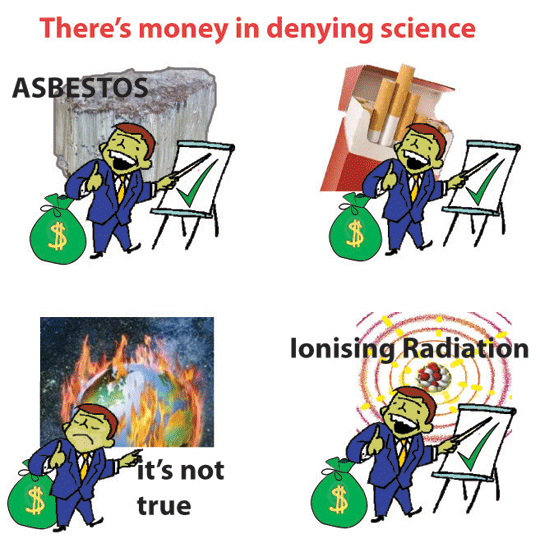
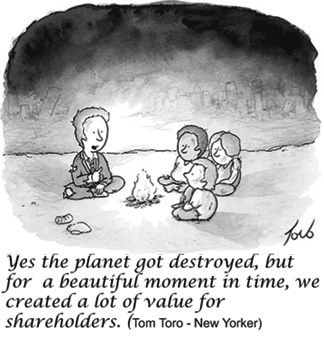
Climate deniers want to protect the status quo that made them rich
Sceptics prefer to reject regulations to combat global warming and remain indifferent to the havoc it will wreak on future generations , Guardian, John Gibbons, 22 Sept 17 From my vantage point outside the glass doors, the sea of grey hair and balding pates had the appearance of a golf society event or an active retirement group. Instead, it was the inaugural meeting of Ireland’s first climate denial group, the self-styled Irish Climate Science Forum (ICSF) in Dublin in May. All media were barred from attending.
Its guest speaker was the retired physicist and noted US climate contrarian, Richard Lindzen. His jeremiad against the “narrative of hysteria” on climate change was lapped up by an audience largely composed of male engineers and meteorologists – mostly retired. This demographic profile of attendees at climate denier meetings has been replicated in London, Washington and elsewhere.
How many people in the room had children or indeed grandchildren, I wondered. Could an audience of experienced, intelligent people really be this blithely indifferent to the devastating impacts that unmitigated climate change will wreak on the world their progeny must inhabit? These same ageing contrarians doubtless insure their homes, put on their seatbelts, check smoke alarms and fret about cholesterol levels.
Why then, when it comes to assessing the greatest threat the world has ever faced and when presented with the most overwhelming scientific consensus on any issue in the modern era, does this caution desert them? Are they prepared quite literally to bet their children’s lives on the faux optimism being peddled by contrarians?
“We have been repeatedly asked: ‘Don’t you want to leave a better Earth for your grandchildren,’” quipped the comedian and talk show host John Oliver. “And we’ve all collectively responded: ‘Ah, fuck ’em!’” This would be a lot funnier were it not so close to the bone.
Climate Change (Abbreviated): Last Week Tonight with John Oliver (HBO)
Short-termism and self-interest is part of the answer. A 2012 study in Nature Climate Change presented evidence of “how remarkably well-equipped ordinary individuals are to discern which stances towards scientific information secure their personal interests”.
This is surely only half the explanation. A 2007 study by Kahan et al on risk perception identified “atypically high levels of technological and environmental risk acceptance among white males”. An earlier paper teased out a similar point: “Perhaps white males see less risk in the world because they create, manage, control and benefit from so much of it.” Others, who have not enjoyed such an armchair ride in life, report far higher levels of risk aversion…….
Facing up to climate change also means confronting the uncomfortable reality that the growth-based economic and political models on which we depend may be built on sand. In some, especially the “winners” in the current economic system, this realisation can trigger an angry backlash.
This at last began to make sense of these elderly engineers crowding into hotel rooms to engage in the pleasant and no doubt emotionally rewarding group delusion of imagining climate change to be some vast liberal hoax.
In truth, the arguments hawked around by elderly white male climate deniers like Fred Singer, William Happer and Nigel Lawson among others are intellectually threadbare, pockmarked with contradictions and offer little more than a cherry-picked parody of how science actually operates. Yet this is catnip for those who choose to be deceived.
It is, however, deeply unfair to tar all elderly white men as reckless and egotistical; notable exceptions include the celebrated naturalist David Attenborough……
“Climate change casts a long shadow over the development efforts of our country,” said Darren Henfield, the minster of foreign affairs of the Bahamas, during a UNGA meeting on Hurricane Irma. “The implications of rising sea levels and atmospheric temperatures signal dire consequences for low-lying island states like the Bahamas.” Henfield said that the costs of rebuilding after Irma will be “exorbitant, in the tens of millions,” and he estimates similar damage related to Hurricane Maria.
The impact of climate change on global health is also becoming increasingly clear. At the end of last week, the United Nations released a report showing that global hunger is on the rise; 38 million more people were affected in 2016 than in 2015. Climate change and the spread of violent conflicts are responsible, the report says. Other research has linked climate change to increased respiratory problems, poor nutrition, the spread of infectious disease and even anxiety.
Leaders at the UN say that while more countries are explicitly calling out these risks to health now than in the past, there’s still more work to do. “I think it’s clear quite a few countries, particularly in the developing world where air pollution is high, see that there is an opportunity to reduce climate change and improve health,” said Nick Nuttall, spokesperson for the United Nations Framework Convention on Climate Change (UNFCCC) during an interview Wednesday. “But the issue still has a ways to go.”
The recent tragic weather events have provided an opening for those conversations. “These hurricane or flooding events have huge implications for water quality,” says Nuttall, citing the risk for things like sewage and other chemicals to get into floodwater and spread. The risk for mosquito-borne diseases ranging from dengue fever to Zika can increase as floods recede, leaving breeding grounds for mosquitoes and other insects.
“Major health benefits come from acting on climate change, both direct and indirect,” says Nuttall. Preventing deforestation limits flooding, which cuts back on the number of pests like mosquitoes that can accumulate and spread diseases, he says.


 By Kim Se-jeong, 12 Oct 17,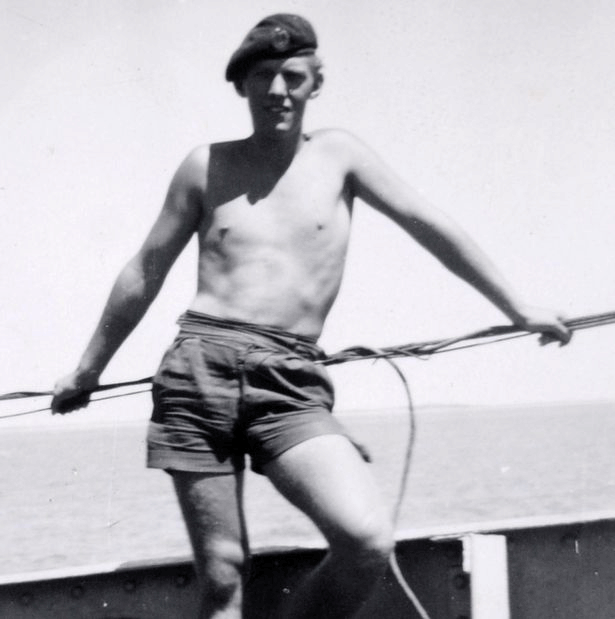





 nuclear-news