New PSU study links 1979 TMI accident to thyroid cancer
Brett Sholtis, bsholtis@ydr.com York Daily Record, June 12, 2017 A new Penn State College of Medicine study has found a link between the 1979 Three Mile Island accident and thyroid cancer cases in southcentral Pennsylvania.
The study marks the first time the partial meltdown can be connected to specific cancer cases, the researchers have said.
The findings may pose a dramatic challenge to the nuclear energy industry’s position that radiation released had no impact on human health.
The study was published Monday in the medical journal Laryngoscope, one day before Exelon Corp. announced that Three Mile Island would close in 2019. It’s likely to come as another blow to a nuclear power industry already struggling to stay profitable.
Exelon officials declined to comment on the findings, pointing out that it doesn’t own the damaged reactor and wasn’t running the plant during the accident…….
thyroid cancer caused by low-level radiation has a different “mutational signal” than most thyroid cancer, Goldenberg said. He and his colleagues used molecular research that had been pioneered after the Chernobyl nuclear disaster to find that genetic signal. …..
The next step is to expand the study by tapping into resources from other regional hospitals, he said.
More than 3,600 people died from causes such as illness and suicide linked to the aftermath of the tragedy. OVER 180 TEENAGERS and children have been found to have thyroid cancer or suspected cancer following the Fukushima nuclear accident, new research has found.
A magnitude 9.0 quake – which struck under the Pacific Ocean on 11 March 2011 – and the resulting tsunami caused widespread damage in Japan and took the lives of thousands of people……..
Cancer concerns
The accident at the nuclear power station in 2011 has also raised grave concerns about radioactive material released into the environment, including concerns over radiation-induced thyroid cancer.
Ultrasound screenings for thyroid cancer were subsequently conducted at the Fukushima Health Management Survey.
The observational study group included about 324,000 people aged 18 or younger at the time of the accident. It reports on two rounds of ultrasound screening during the first five years after the accident.
Thyroid cancer or suspected cancer was identified in 187 individuals within five years – 116 people in the first round among nearly 300,000 people screened and 71 in the second round among 271,000 screened.
The overwhelming common diagnosis in surgical cases was papillary thyroid cancer – 149 of 152 cases.
Worker death
In May, Japan announced for the first time that a worker at the stricken Fukushima nuclear plant has died after being exposed to radiation, Japanese media reported.
The man aged in his 50s developed lung cancer after he was involved in emergency work at the plant between March and December 2011, following the devastating tsunami.
The Japanese government has paid out compensation in four previous cases where workers developed cancer following the disaster, according to Jiji news agency.
However, this was the first time the government has acknowledged a death related to radiation exposure at the plant, the Mainichi daily reported.
The paper added the man had worked mainly at the Fukushima No. 1 nuclear plant and other atomic power stations nationwide between 1980 and 2015.
Following the disaster, he was in charge of measuring radiation at the plant, and he is said to have worn a full-face mask and protective suit.
Researchers forecast more disease and disaster as the planet warms.
ROWAN WALRATH AND REBECCA LEBER, NOVEMBER 28, 2018 A report released Wednesday by the Lancet Countdown calls climate change “the biggest global health threat of the 21st century,” and warns that if it is not addressed, disease, poor air quality, and food insecurity will threaten millions of people.
The report, written by a team of international researchers, focuses on several climate-related impacts, including extreme heat and its effect on labor productivity and the spread of disease. In 2017, 153 billion hours of labor were lost due to heat—an increase of more than 62 billion hours since 2000. This correlates with a rise in exposure to heat waves and extreme weather events such as hurricanes and wildfires that have already made thousands of climate refugees and are expected to create millions more.
Many of those refugees, one of the report’s author notes, are American. In a press call on Tuesday, Renee Salas, a doctor of emergency medicine at Massachusetts General Hospital and lead author of the Lancet Countdown US Brief, described a recent experience close to home. “I had a patient who came from Puerto Rico, came with bag of luggage, bag of medication she hasn’t taken in days. She was truly a climate refugee who was in my emergency department,” Salas said. “I can’t think of a population more at risk of health effects than a displaced individual.”
Even small changes in temperature and precipitation can result in large changes in the transmission of vector-borne and water-borne diseases, the report notes. In 2016, there were significant increases in the the capacity for insect-borne bacteria and viruses—especially those that cause dengue fever, cholera, and malaria—to be transmitted. (This finding was echoed in last week’s federal climate assessment, which found that climate change would “alter the geographic range and distribution of disease-carrying insects and pests” in the United States.)
Meanwhile, the world’s capacity to grow food also appears to be under threat. An examination of agricultural yields shows declines in every region; 30 countries produced less food in recent years.
The Lancet Countdown’s report does include cause for hope. More electric vehicles were on the road in a 2017 than ever before, and investment in renewable energy has significantly increased, while coal consumption continues to decline. China is responsible for many of these changes. It claims more than 40 percent of all electric cars sold, and it is leading in the installation of renewable energy sources.
Yet spending on climate change adaptation remains well below the amount outlined by the 2015 Paris Agreement, which President Donald Trump has announced the United States will not abide by. And only 3.8 percent of that spending is dedicated to human health. Former Environmental Protection Agency Administrator Gina McCarthy, now the director of the Center for Climate, Health and the Global Environment at Harvard University, says it is crucial to recognize the impacts of climate change on health. She describes visiting California in the midst of the recent wildfire that spread smoke across the state. “It was so clear to see people with masks on literally walking on the streets of San Francisco and downtown Palo Alto,” McCarthy says. “This didn’t look like the United States of America.”
Fine particulate matter—what the masks McCarthy saw Californians wearing are designed to filter out—accounted for nearly 3 million premature deaths in 2015, according to the report. Pollution has actually worsened in nearly three-quarters of the world’s cities since 2010. Road fuel use increased by 2 percent from 2013 to 2015, and cycling—a main alternative to driving in cities—made up less than 10 percent of commutes.
The report, which is aimed at health professionals, argues that they must do more to educate the public about climate change. The impacts of inaction, the report’s authors write, cannot be overstated. As McCarthy notes, “I don’t think people question a diagnosis from their physicians just because a president decides he might not believe in something. This is not about a belief system. This is about science and facts.”
A security guard at Los Alamos National Laboratory has been seeking compensation for fellow lab workers who’ve become ill, but the government has repeatedly denied the petition and he’s still waiting for a final answer. by Rebecca Moss, Santa Fe New Mexican Nov. 30 Ten years ago, a Los Alamos National Laboratory security guard named Andrew Evaskovich submitted a petition seeking compensation for fellow nuclear lab workers diagnosed with cancer linked to radiation. The government has repeatedly recommended denying the petition, despite evidence of continuing safety and recordkeeping problems at Los Alamos. And today, Evaskovich is still waiting for an answer. (Read our investigation.)
October 2000: Congress creates a program to compensate nuclear workers who’ve become sick after being exposed to hazardous levels of radiation or toxic chemicals. The law allows groups of workers to petition the government for easier access to compensation if their worksite has not kept adequate worker health records. The process has yet to help workers who started after 1996, when labs had to begin meeting higher safety standards.
2000 to 2004: Government inspectors find continuing worker safety problems at Los Alamos. A top official writes that Los Alamos labs’ “corrective actions have not been effective in preventing the recurrence of the radiological and safety basis violations.”
March 2006: Internal government memos are revealed showing a plan to deny petitions seeking special compensation for workers whose exposure records are missing or were destroyed, as a way to keep the costs down.
January 2008: A government watchdog report finds numerous incidents of “unusually high, unexplained dosage readings for workers” at Los Alamos.
April 2008: Evaskovich files a petition seeking compensation for ill Los Alamos workers employed between 1976 and 2005 who may not have adequate records of radiation exposure, based on his research showing problems with lab safety and recordkeeping.
January 2009: The National Institute for Occupational Safety and Health, or NIOSH, recommends for the first time that Evaskovich’s petition be denied, saying Los Alamos records’ show the lab had a health and safety program and was monitoring workers.
February 2009: A government advisory board disagrees and tells NIOSH to continue studying the petition.
July 2009: Workers are exposed to radioactive arsenic-74 at two areas of the lab, violating radiation safety practices in part because personnel “did not recognize the extremely high beta radiation dose rate associated with the arsenic.” Los Alamos is later fined for the incident.
July 2010: In response to a different petition, the government provides easier access to benefits for workers employed at Los Alamos prior to 1975.
August 2012: NIOSH reverses course and says that workers employed prior to 1996 should be eligible for compensation as a group since they “may have accumulated substantial chronic exposures through intakes of inadequately monitored radionuclides.” It also says it needs to continue studying those who started work in subsequent years.
February 2014: Lab workers improperly pack nuclear waste, which causes a drum to burst at an underground nuclear waste facility in Carlsbad, New Mexico. The accident exposes more than 20 workers to radiation and is one of the costliest nuclear accidents in Department of Energy history.
August 2015: The DOE cites Los Alamos for six violations, with issues going back a decade, including a near-runaway chain reaction.
April 2017: NIOSH once again recommends denying Evaskovich’s petition for Los Alamos workers, saying the stricter rules implemented in 1996 meant the lab didn’t have systemic problems after that.
July 2017: Independent consultants disagree. The lab “did not magically” have the ability to follow the rules in 1996 just because the government said it had to, said one of the consultants who had been hired to provide technical advice to the government’s advisory board.
October 2018: NIOSH again recommends that Evaskovich’s petition be denied, saying it has plenty of documents to estimate workers’ radiation exposure, even if they weren’t individually monitored by the lab.
The Department of Energy and NIOSH both say that nuclear sites are safer and have done a better job monitoring workers since the new rules were implemented in 1996. Los Alamos spokesman Kevin Roark said that workers are closely monitored for radiation exposure and that the lab complies with all federal requirements.
Ill Hanford workers, of which there have been far too many dating back far too long to be considered a coincidence, have toiled for decades amid a radioactive bouillabaisse of chemicals related to the federal Energy Department’s cleanup of the nuclear site.
But until Washington state officials stepped up last year and did the right thing by ensuring that workers filing health claims would have an easier time winning compensation, these workers had to prove to the federal government that their variety of cancers and neurological and respiratory ailments were unequivocally caused by what, literally, was a toxic work environment.
It was a burden of proof too daunting for workers, often of little economic means to fight aggressive Energy Department lawyers setting down layers of bureaucratic hurdles. The state was right to champion the plight of sickened employees, even if some in the business and insurance lobby felt the state law was too sweeping in scope.
Under the new law, signed by Gov. Jay Inslee earlier this year, workers’ medical conditions are assumed to be caused by radiological exposure at Hanford – unless convincing evidence can be made showing other causal factors. That, essentially, flipped the so-called burden of proof from the workers to the federal government.
Since then, 28 of the 34 claims reviewed by the state Department of Labor and Industries have been approved, the state agency reported. That’s a far cry from the near blanket denials — five times the rate of other worker comp claims to the state, according to the advocacy group Hanford Challenge — under the previous policy guidelines set forth by the DOE.
But this week, the Justice Department delivered a rebuke to the state — and, by proxy, its workers who spent their careers cleaning up the chemical mess left over from plutonium production for nuclear weapons. In a letter sent to Inslee, the DOJ asserts the state’s law aiding worker claims violates the Supremacy Clause of the U.S. Constitution. The federal government, in short, does not believe a state has the right to “directly regulate” a federal agency. Washington’s new law, therefore, is said to “discriminate” against the federal government and its contractors.
Really? If there’s any discrimination at play here, it’s the Energy Department’s long-standing policy of making it burdensome for sickened workers to receive due compensation.
If the state does not settle with the federal government — presumably halting its practice of giving Hanford workers the benefit of the doubt in health claims — the DOJ will take legal action.
In small villages along the eastern coast of Bangladesh, researchers have noticed an unexpectedly high rate of miscarriage. As they investigated further, scientists reached the conclusion that climate change might be to blame. Journalist Susannah Savage went into these communities to find out more.
“….in a small village on the east coast of Bangladesh… While miscarriages are not out of the ordinary, scientists who follow the community have noticed an increase, particularly compared to other areas. The reason for this, they believe, is climate change….
“Nothing grows here anymore,” says Al-Munnahar. Not many years ago – up until the 1990s – these swamp lands were paddy fields. If rice production back then was not profitable, it was at least viable. Not anymore. Rising waters and increasing salinity have forced the wealthiest among the villagers to change to shrimp farming or salt harvesting. Today, few paddy fields remain.
“This is climate change in action,” says Dr Manzoor Hanifi, a scientist from the International Centre for Diarrhoeal Disease Research Bangladesh (ICDDRB), a research institute. “The effect on the land is visible, but the effect on the body: that we don’t see.”
Brine and bribery
ICDDRB have been running a health and demographic surveillance site in and around the district of Chakaria, near Cox’s Bazaar, for the last thirty years, enabling them to detect even small changes in the health of the communities they monitor.
Over the last few years, many families have left the plains and moved inland, into the forest hill area—mostly those with enough money to bribe forest wardens…….
In particular, women inland are less likely to miscarry. ……..
Moreover, when comparing the whole Chakaria region to Matlab, another area monitored by ICDDRB, in a part of Bangladesh far removed from the coast, the scientists also saw a noticeable difference.
In Chakaria, 11% of pregnancies end in miscarriage. In Matlab it is 8%.
This difference, the scientists believe, is to do with the amount of salt in the water the women drink – the increase of which is caused by climate change.
Families with no choice
Sea levels are rising, in part because of the melting of icecaps, but also because the earth’s rising temperature affects atmospheric pressure: even a small change in this causes an inverse effect on the sea level.
“With a one millibar decrease in atmosphere pressure,” says Dr Hanifi, “the sea level rises by ten millimetres: a series of depressions in atmospheric pressure can cause a considerable rise in water levels in shallow ocean basins.”
When sea levels rise, salty sea water flows into fresh water rivers and streams, and eventually into the soil. Most significantly, it also flows into underground water stores – called aquifers – where it mixes with, and contaminates, the fresh water. It is from this underground water that villages source their water, via tube wells.
The water that the village pump in Failla Para spews out is a little red in colour. It is also full of salt. This does not stop villagers drinking from the pump, though – nor from bathing in it and washing and cooking their food in it.
The World Health Organization (WHO) recommends that people consume no more than 5g of salt per day. In Chakaria, those living in the coastal zone consume up to 16g per day – over three times what those in the hilly areas do.
In countries like the UK, health campaigns have cautioned against excessive salt consumption for years. It causes hypertension, increasing the risk of strokes and heart attacks, and, among pregnant women, miscarriages and preeclampsia.
These Bangladeshi families have no idea of the health risk from the water they are drinking, and even if they did, they have little choice……….
At the moment, the chance of miscarriage for women like Sharmin and Al-Munnahar is only slightly elevated. But unless something is done, says Dr Hanifi, “this will only get worse, as Bangladesh feels the effects of climate change more and more.”
As a low-lying country, full of flood plain land, Bangladesh is particularly vulnerable to changes caused by global warming.
SA nuclear radio-isotope production facility back in business, but… Money Web, 22 Nov 18
Earlier shutdown resulted in shortages to SA’s government hospitals, global market.
Mike Rycroft / 22 November 2018 The Nuclear Energy Corporation of South Africa (Necsa) NTP production facility at Pelindaba, which produces medical nuclear radio-isotopes and associated products and services, is back in partial operation after approval to restart was given by South Africa’s National Nuclear Regulator (NNR).
The facility is the main supplier of medical nuclear radio-isotopes such as Molybdenum-99 in Africa, and one of only four such facilities globally. As a result of safety procedure lapses, the plant was shut down in November 2017, which lasted almost a full year. Several attempts had been made in the interim to restart the plant, but without success.
The process of rectifying shortcomings and bringing the operating and safety procedures in line with the requirements of the NNR has been marred by what appears to be conflict between NTP and its parent company, the Necsa……..
The initial shutdown occurred in November 2017 as a result of procedural errors. It appears that calibration of hydrogen sensors, an important component in the safety chain, had not been carried out correctly, and that records were not being kept properly. This was considered to be a critical safety issue, and the plant was shut down by the NNR.
An investigation was held which resulted in the suspension of a number of NTP staff. Following a number of further senior executive and staff replacements, suspensions and reinstatements, Necsa placed its own employees in charge of the plant, who then attempted to rectify the problems and restart the production facility.
………Several incidents occurred which caused restarts to be halted or abandoned. One example that has been cited is the institution of various changes to parameters which were unrelated to the cause of problems. The reasons for Necsa’s actions in this regard are unclear……
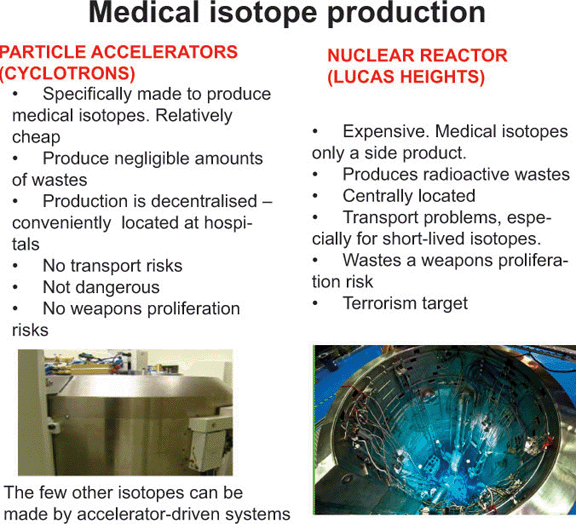
following an announcement during the recent Brics Summit in Sandton of a cooperation agreement in the field of nuclear medicine between NTP and Rusatom, the nuclear medical subsidiary of Russian state-owned nuclear company Rosatom, there are some questions as to whether a second or replacement nuclear research reactor will be built. NTP said that the current global production over-capacity of medical radio-isotopes does not justify a second nuclear research reactor, since the Safari-1 reactor at Pelindaba still has between 15 and 20 years of life, and this could be extended still further. The Safari-1 nuclear reactor produces medical nuclear radio-isotopes by bombarding target plates of low-enriched uranium with neutrons.
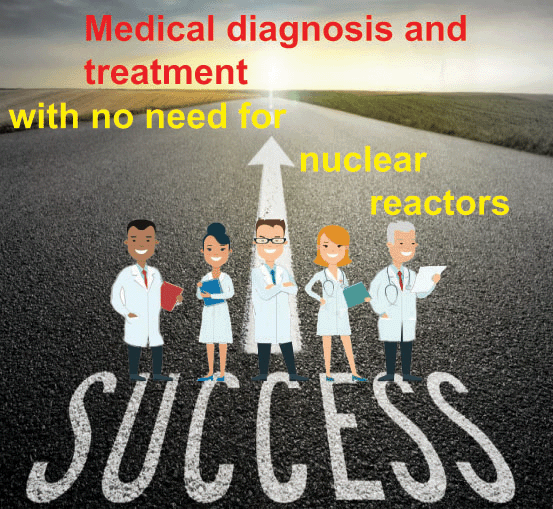
Furthermore, medical nuclear radio-isotopes can also be produced by particle accelerators such as cyclotrons, which could make the consDtruction of second or replacement nuclear research reactor unnecessary, the company said.
There are also concerns regarding the financial health of Necsa. The Auditor-General has raised ongoing concerns about inadequate financial provisions by Necsa for decommissioning and dismantling costs for the Safari-1 reactor end-of-life.
Figural memory is mainly located in the right brain hemisphere, and the association with cell phone radiation exposure was more pronounced in adolescents using the mobile phone on the right side of the head. “This may suggest that indeed RF-EMF absorbed by the brain is responsible for the observed associations, ” said Martin Röösli, Head of Environmental Exposures and Health at Swiss TPH.
It took just one year’s worth of cell phone radiation exposure to damage the part of the brain that interprets images and shapes — and right-handed teens are worse affected.
Swiss radiation expert Martin Röösli studied the phone habits of 700 adolescents between the ages of 12 and 17, before making them do memory tests.
The conclusion of the study states, “Our findings for a cohort of Swiss adolescents require confirmation in other populations but suggest a potential adverse effect of RF-EMF brain dose on cognitive functions that involve brain regions most exposed during mobile phone use.”
According to John Coates, CEO of RF Safe Corporation, “RF Safe headsets with air tube technology are designed to keep potentially harmful radiation away from your head. Using an air-tube to conduct the sound to your head, there are NO electrical components conducting sound to your head. Much like a Doctors stethoscope, only an air tube is used to conduct sound to the earpiece.”
“It is important parents recognize that children have smaller brains, thinner skulls, softer brain tissue, and a higher number of rapidly dividing cells, which makes them more susceptible to damage from cell phone exposure than adults,” Coates, said.
RF Safe has a focus that supports forward progress of the wireless industry and governmental agencies in standardization for safer cell phones with a goal of accelerating the pace that cell phone users are properly informed and able to attain safer wireless technologies “at the point of sale.”
ABOUT RADIO FREQUENCY SAFE – CELL PHONE RADIATION SAFETY
RF SAFE is a world-leading provider of cell phone radiation protection accessories and informational safety data. Since 1998 RF (Radio Frequency) Safe has been dedicated to evolving the wireless industries safety standards, by engaging in the business of design, testing, manufacture, and sale of safety technologies to mitigate harmful effects of cell phone radiation. SOURCE RF Safe Markets Insider and Business Insider Editorial Teams were not involved in the creation of this post.
Britain’s nuclear bomb test legacy of early deaths and deformed children, Mirror, By Susie Boniface 14 NOV 2018
The horrific story behind the UK’s nuclear experiments have been told in full for the first time. After the horrors of the Second World War, it was deemed necessary for Britain to have a weapon that could unleash hell.
When atom bombs were dropped on Japan in 1945, LIFE magazine reported: “People’s bodies were terribly squeezed, then their internal organs ruptured…….
Of the 22,000 scientists and servicemen who took part in radioactive experiments in Australia and the South Pacific, just a handful are alive.
Their families report cancers, rare medical problems, high rates of miscarriage – and deformities, disability and death for their children – and their grandchildren.
Now, the full story of Britain’s nuclear experiments has been told for the first time in a new Mirror website that details not only the scientific, military and political battles, but the human fallout.
DAMNED features top-secret documents, eyewitness accounts and searing testimonies.
The site takes its name from an editorial written in 2002 by Mirror editor Richard Stott, who thundered: “How many more generations of the damned will our politicians allow to suffer before they accept the calamities of their predecessors and the consequences of their own cowardice?”
In May, the Mirror called for an award for the veterans and Defence Secretary Gavin Williamson has ordered a medal review.
DAMNED begins with Operation Hurricane in 1952, when Britain exploded its first atomic bomb, covers the Minor Trials in South Australia, which left the landscape littered with plutonium debris for decades, and reports on Operation Grapple in 1958 when the UK detonated its biggest weapon.
It also details the human cost and shows how every other nuclear nation on Earth came to accept and recognise their nuclear heroes – leaving Britain the only one to deny a duty of care………
In May, the Mirror called for an award for the veterans and Defence Secretary Gavin Williamson has ordered a medal review……….
By: Leo Shane III WASHINGTON — An appeals court will force Veterans Affairs officials to identify how many troops may have been exposed to radioactive debris from a 1966 plane crash, a move that supporters hope will be the precursor to a class-action lawsuit against the department for overdue benefits.
On Tuesday, the U.S. Court of Appeals for Veterans Claims made the unusual ruling demanding the records’ release six weeks after VA lawyers argued the information is nearly impossible to obtain, given aging and missing military records from the accident.
But the court, by a 6-3 ruling, gave the department 30 days to determine the number of military personnel assigned to the accident clean-up, the number of veterans who have applied for benefits connected to the event, and the number who have been denied compensation. That information will be used to decide how a lawsuit on the benefits denial may proceed.
Veterans involved in the accident have been unsuccessfully petitioning VA on their case since the mid-1970s, after a host of strange cancers and other illnesses began appearing among individuals involved.
In January 1966, seven airmen were killed and four more injured when a B-52 crashed into a KC-135 during a refueling mission off the coast of Spain. The B-52 was carrying four nuclear weapons at the time of the accident, and two of them exploded near the town of Palomares, spreading radioactive plutonium over hundreds of acres.
U.S. officials quickly ordered military personnel into the area to collect contaminated debris, crops and soil in an effort to repair the damage. But veterans involved in that cleanup say they were given no protective clothing or respiratory devices, and told very little about the potential long-term health effects from exposure to the nuclear material.
Earlier this year, the appeals court ruled in a separate case that veterans can file suit against the Department of Veterans Affairs as a class rather than individuals, in limited circumstances.
Since then, legal experts have been monitoring a host of lawsuits before the court to see which could be the first class recognized, a move which will set important precedents for future legal cases.
The three judges who argued against the records request in the Palomares lawsuit said the move would effectively force VA to justify the need for a class-action lawsuit against itself, and that the majority ignored concerns that Defense Department records for the incident may not exist.
But the majority opinion noted that no final decision on whether to recognize a class of Palomares has been made, and data on the denied benefits is the sole property of VA, inaccessible in any way for outsiders.
Plaintiffs in the lawsuit have contended that more than 1,600 veterans should be eligible for disability benefits related to the toxic exposure, but VA thus far has denied their requests because not enough scientific evidence exists to classify all of the health problems as service-related illnesses.
Nuclear fallout: $15.5 billion in compensation and counting
They built our atomic bombs; now they’re dying of cancer
Nearly 33,500 former nuclear site workers died due to radiation exposure- report
Nuclear Fallout: This story produced in partnership with ProPublica and the Santa Fe New Mexican. (Richly illustrated with photographs, videos, charts, documents interactive map) Wave 3, By Jamie Grey and Lee Zurik|November 12, 2018 LOS ALAMOS, NEW MEXICO (InvestigateTV)– Clear, plastic water bottles, with the caps all slightly twisted open, fill a small refrigerator under Gilbert Mondragon’s kitchen counter. The lids all loosened by his 4- and 6-year old daughters because, at just 38, Mondragon suffers from limited mobility and strength. He blames his conditions on years of exposure to chemicals and radiation at the facility that produced the world’s first atomic bomb: Los Alamos National Laboratory.
Gilbert Mondragon, 38, pulls the cap off a plastic water bottle that had been twisted open by his young daughters. He hasn’t the strength for those simple tasks anymore and blames his 20-year career at the Los Alamos National Lab. He quit this year because of his serious lung issues, which he suspects were caused by exposures at the nuclear facility. (InvestigateTV/Andy Miller)
Mondragon is hardly alone in his thinking; there are thousands more nuclear weapons workers who are sick or dead. The government too recognizes that workers have been harmed; the Department of Labor administers programs to compensate “the men and women who sacrificed so much for our country’s national security.”
But InvestigateTV found workers with medical issues struggling to get compensated from a program that has ballooned ten times original cost estimates. More than 6,000 workers from Los Alamos alone have filed to get money for their medical problems, with around 53 percent of claims approved.
The Los Alamos lab, the top-secret site for bomb design in 1943, has had numerous safety violations and evidence of improper monitoring, federal inspection reports show. Continue reading →
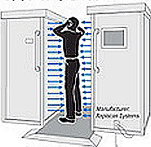
Body-scanned inmates will get radiation exposure stats, NY Post By Rich Calder and Tamar Lapin, November 8, 2018 “………The city Health Department has issued new regulations that would allow inmates to learn how much radiation they’ve absorbed from body scans in the clink.Upon request, the Correction Department would have to provide them with their “total accumulated radiation exposure,” according to a legal notice issued by the city Thursday.
The regulation was in response to a new state law authorizing correction officers to again use high-powered body scanners to spot nonmetal objects — such as ceramic knives — in the possession of inmates.
As part of the law, the Health Department had to implement rules to make sure the scanners are safe — including “setting annual exposure limits and mandates for training and signage.”……
The Correction Department thought it had the problem solved in 2012 and 2013, after it purchased five “airport-style” body scanners with ionizing radiation that picked up every imaginable kind of weapon and contraband.
But after a year’s use, the scanners were shelved when it was discovered they violated a little-noticed state law that said “ionizing radiation” may not be “applied to human beings” except by licensed medical personnel for a medical purpose…….. The new state law wipes out the scanner-use medical restriction…….https://nypost.com/2018/11/08/body-scanned-inmates-will-get-radiation-exposure-stats/
Is a Little Radiation Good For You? Trump Admin Steps Into Shaky Science, Discover Magazine, By Nathaniel Scharping | October 5, 2018
For decades, studies have shown that even low doses of radiation are harmful to humans.
This week, the Associated Press reported that the Trump administration may be reconsidering that. The Environmental Protection Agency seemed to be looking at raising the levels of radiation considered dangerous to humans based on a controversial theory rejected by mainstream scientists. The theory suggests that a little radiation might actually be good for our bodies. In April, an EPA press release announced the proposal and included supporting comments from a vocal proponent of the hypothesis, known as hormesis. It prompted critical opinion pieces and sparked worry among radiation safety advocates.
EPA’s decision to move away from the radiation dose model widely accepted by the scientific mainstream. But by Friday, the EPA backed away from Calabrese’s stance in comments to Discover.
The debate cuts to the heart of the debate over the effects of low doses of radiation and reveals how difficult it is to craft clear guidelines in an area where scientific evidence is not clear cut.
Radiation Debate
When radiation damages our DNA, the body steps in to make repairs. Hormesis suggests that hitting the body with a little more radiation should kick our defensive mechanisms into overdrive. According to proponents of the theory, this results in the production of anti-oxidants and anti-inflammatory compounds that reduce our risk for cancer and heart disease, among other things. That’s why hormesis backers want the EPA to raise the level of acceptable radiation, pointing out that it would also save millions in safety costs.
It sounds convincing, and proponents have dozens of studies to point to that they say back up their claims. But, there’s never been a large-scale human study of hormesis. And while studies of low-dose radiation are very hard to do, so far, most suggest that radiation is indeed bad for us, at any dose.
“Large, epidemiological studies provide substantial scientific evidence that even low doses of radiation exposure increase cancer risk,” says Diana Miglioretti, a professor in biostatistics at the University of California, Davis in an email. “Risks associated with low-doses of radiation are small; however, if large populations are exposed, the evidence suggests it will lead to measurable numbers of radiation-induced cancers.”
Long-term studies of Hiroshima and Nagasaki bombing survivors show higher cancer risks. Marshall Islanders exposed to radiation from atomic bomb tests suffered a higher risk of thyroid disease. And patients who get CT scans, which deliver a dose of radiation equal to thousands of X-rays, saw cancer risks go up afterward. Researchers also found that radiation from childhood CT scans can triple the risk of leukemia and, at higher doses, triple the risk of brain cancers as well. Another found that low-dose radiation increased the risk of breast cancer among some some women.
And large-scale reviews of the evidence for hormesis find that it is decidedly lacking. Two studies, one in 2006 by the National Research Council, and another in 2018 by the National Council and Radiation Protection and Measurements looking at 29 studies of radiation exposure find no evidence for hormesis, and reiterate that the evidence points toward radiation being bad for us even at low doses.
Scientific Uncertainty
It’s difficult to study low doses of radiation, though, and that’s where much of the controversy comes from. At doses below a few hundred millisieverts (mSv), a radiation unit that accounts for its effects on the body, it becomes extraordinarily hard to separate out the effects of radiation from other things like lifestyle or genetics. Research on the effects of these small radiation doses often use data sets involving thousands of people to compensate for the minimal effect sizes, but even then it’s often not enough to be certain what’s happening.
“Data collected at low doses (defined by the scientific community [as] exposures less than 100 mSv) suffers from a ‘signal to noise’ problem which limits our ability to conclusively state effects one way or another,” says Kathryn Higley, head of the school of nuclear science and engineering at Oregon State University in an email.
A single CT scan delivers anywhere from 1 to 15 mSv, but some patients need many scans during the course of their treatment, increasing the total dose. Workers cleaning up after the Fukushima meltdown received radiation doses above 100 mSv in some cases. And current U.S. standards limit radiation workers to no more than 50 mSv of exposure per year.
Many studies indicate that there are dangers at that level, but it’s often an assumption. Those studies base their suppositions on what’s called the linear no-threshold model, which extrapolates more reliable data from studies of higher doses of radiation to lower doses. Though it may be an educated guess, for decades large-scale studies have indicated this is true.
……….. The EPA in recent days appeared to back away from the suggestion that it supported hormesis. The agency released a statement in response to the APstory affirming that it intends to continue using the linear no-threshold model when constructing radiation guidelines, something that contradicts Calabrese’s comments in the April press release.
“The proposed regulation doesn’t talk about radiation or any particular chemicals. EPA’s policy is to continue to use the linear-no-threshold model for population-level radiation protection purposes which would not – under the proposed regulation that has not been finalized – trigger any change in that policy,” said an EPA spokesman in response to a request for comment.
Radiologist Rebecca Smith-Bindman says the vast bulk of the evidence suggests even small amounts of radiation are harmful. We shouldn’t base our policies on an unproven theory, she adds.
“There is extensive evidence that ionizing radiation will cause cancer,” says Smith-Bindman, a professor of radiology at the University of California, San Francisco in an email exchange. “These data come from a range of different sources, including epidemiological data (such as studies of patients who have received diagnostic and therapeutic radiation and from environmental exposures and accidents), from animal studies and from basic science studies. While it is more difficult to precisely quantify the exposures — which will vary by many factors, such as age at exposure, and source of radiation, etc. — there is no uncertainty among the scientific community that radiation will cause cancer.”
She says that pointing to issues with the linear no-threshold model misses the point. Though it may not be totally accurate at very low doses, she says it’s unfair to use that uncertainty to cast doubt on data about radiation where there’s solid evidence.
…….. Miglioretti says “Based on the large body of evidence to date, I believe that revising the regulations to increase allowable radiation exposure limits will lead to an increase in the number of radiation-induced cancers in this country.”
That’s in line with what multiple experts Discover contacted believe — that radiation can harm even at low doses and raising limits would endanger the public, though the increase in risk would likely be small.
It’s not clear at the moment whether the EPA proposal to raise limits will pass, though it does follow in the footsteps of other Trump administration proposals to weaken safety standards. At the moment, it’s unclear what the effects on the public if the EPA raises radiation limits.
“Perhaps it might make nuclear power plants less expensive to build. It might lower the cost of cleanup of radioactively polluted sites,” says David Brenner, director of the Center for Radiological Research at Columbia University in an email. “But [it] begs the question of whether cleanup to a less rigorous standard is desirable.” http://blogs.discovermagazine.com/crux/2018/10/05/epa-trump-administation-radiation-guidelines/#.W99ZFtIzbGg
DOE proposes reclassifying high-level nuclear waste, could send more to WIPP Adrian C Hedden, Carlsbad Current-Argus Nov. 2, 2018A proposal to re-characterize high-level nuclear waste could bring more waste to the Waste Isolation Pilot Plant.
The U.S. Department of Energy posted a notice in the federal register in October, requesting public comment on the potential change.
If approved, the DOE would change how it labels high level waste (HLW), allowing some of the waste resulting from processing nuclear fuel to be characterized as either low-level or transuranic (TRU) waste.
If the waste is deemed low-level, it can be disposed of at the generator site, or in a surface-level facility………
When the HLW is held at the site, the federal government pays for the facility’s utilities, costing tax payers billions of dollars a year, Heaton said.
Some of that money could be saved, he said, if the waste was moved.
“A lot of would pass the waste acceptance criteria at WIPP,” Heaton said. “It would extend the life of WIPP for sure. ………
Don Hancock, director of the Nuclear Waste Program at the Southwest Research and Information Center said the proposal is not only illegal, but hypocritical.
He said HLW is defined numerous times in laws passed by the U.S. Congress, and the DOE’s proposal would circumvent congressional powers.
“What it seems like they’re proposing is illegal,” he said. “They say they get to rewrite the law, not Congress. They’re a lot of opposition to this nationally.”
Hancock also said that if waste is truly less dangerous than previously thought, it could be safely kept where it is.
If it’s more dangerous to keep the waste at the generator sites, Hancock said the DOE should petition for more repositories.
All HLW must be sent to a geologic repository, per federal law, excluding WIPP which is licensed for TRU waste.
Aside from re-characterizing HLW as TRU waste, Hancock said the proposal was also intended to get around the law requiring HLW to go underground, by re-characterizing it as low-level waste.
“There was a consensus that there should be multiple geologic repositories,” Hancock said. “There should be multiple places in the U.S. where you can have safe repositories. That didn’t happen.”
Canada to build advanced medical isotope centre, WNN 02 November 2018 Canada is to invest more than CAD50 million (USD38 million) on a new centre for advanced medical isotope research and development. The centre will be on the campus of Triumf, the national laboratory for particle physics, at the University of British Columbia.
Canadian Prime Minister Justin Trudeau yesterday announced federal funding for the Institute for Advanced Medical Isotopes (IAMI) during a visit to Triumf.
The 2500-square-metre state-of-the-art facility will house a new TR-24 medical cyclotron, a cyclotron control room and six laboratories. It will also have technical rooms, quality control laboratories, office space, and electrical control rooms.
The construction of the facility is valued at CAD31.8 million, Triumf said. “With additional equipment and philanthropic funding, the total value of the IAMI project will be more than CAD50 million,” it added.
The government of Canada will contribute CAD10,232,310 to the project through the Investing in Canada infrastructure plan. The Province of British Columbia has contributed CAD12,250,000, Triumf is contributing CAD5,352,638 and, through fundraising initiatives, BC Cancer and the University of British Columbia are each contributing CAD2 million.
“IAMI promises to secure a local supply of several important medical isotopes, including critical imaging isotope technetium-99m (Tc-99m), and to enable Canadian access to the global Tc-99m market,” Triumf said. Canada is already a leader in the global medical isotope market – worth some USD3 billion – and contributes more than 50% of the world’s raw material for medical isotope supply.
Announcing the federal funding, Trudeau said: “The Institute for Advanced Medical Isotopes will be a state-of-the-art facility where industry leaders and academics can work together to push the boundaries of research and discover new ways to protect and improve our health. We will continue to invest in cutting-edge research and facilities – like the Institute for Advanced Medical Isotopes – to ensure Canada remains a world leader in medical research and innovation.”………http://www.wor
Join the Nuclear Bombs Never Again webinar on August 4th at 5pm Pacific Time / 8pm Eastern Time / 9am Japan Standard Time.
Cross generational voices at the intersection of Japan-Korea-US policy and militarization will share their lived experiences, nuclear impacts in these contexts, anti-war strategies, and actions you can take to advocate for a world with Nuclear Bombs Never Again. This 75-minute event is co-hosted by WILPF US and Korea Peace Now.










 nuclear-news