Next type of coronavirus may be on its way
|
The next coronavirus may already be circulating in bats, study suggests, Philadelphia Inquirer, by Tom Avril, July 29, 2020 While the exact origin of the coronavirus remains murky, scientists have been racing to determine how it jumped from animals to humans so they can prevent another pandemic. The next one could just be a matter of time, a study published this week suggests. The authors said a virus with similar ability to infect humans may already be out there, carried by a type of bats known for having horseshoe-shaped “leafs” on their noses. Scientists made that prediction after constructing a family tree of the coronavirus — tracing its ancestry by comparing its genetic code with that of other coronaviruses found in bats, humans, and a scaly animal called the pangolin. The lineage of the virus that causes COVID-19 appears to have branched off from its closest viral relatives about 40 to 70 years ago, the authors wrote in Nature Microbiology. And other viruses in the same branch of the family likely share a similar ability to latch onto cells in human airways, said Maciej F. Boni, a Pennsylvania State University biologist and lead study author. “It’s very likely there are lots of other lineages that nobody knows about, because nobody has sampled, that are circulating quietly in bats,” he said. “Potentially all of them could have this ability to infect human cells.”…… by using a battery of statistical techniques, the scientists identified three genetic regions in the coronavirus that appeared to have remained intact for decades. They identified the same three regions in another coronavirus that came from a bat found in Yunnan, a province in southern China near Laos. That virus cannot infect humans but is otherwise highly similar to the one causing the pandemic, which was first identified in human patients in the city of Wuhan. The two viruses seem to have branched apart in the family tree sometime in the 1960s, and almost certainly have undiscovered cousins with the potential to infect humans, said Boni, who collaborated with scientists in Europe and China……. By itself, the presence of similar coronaviruses in bats would not mean another pandemic is imminent, said Kevin Olival, vice president for research at EcoHealth Alliance, a nonprofit that works with scientists worldwide to protect people and animals from infectious disease……. What is not in dispute is that viruses have been jumping from animals to humans for centuries, and that it will happen again. And coronaviruses carried by bats are a prime suspect. Similar predictions have been made before — such as in 2013, when a Science magazine article was headlined “Bats May Be Carrying the Next SARS Pandemic.”
Sure enough, as the world now knows too well, that came true. https://www.inquirer.com/health/coronavirus/covd19-bats-china-virus-origin-penn-state-rna-genetics-20200729.html |
|
The WHO says coronavirus is a once-in-a century crisis that will impact lives for decades
Deaths from coronavirus as at early August 2020
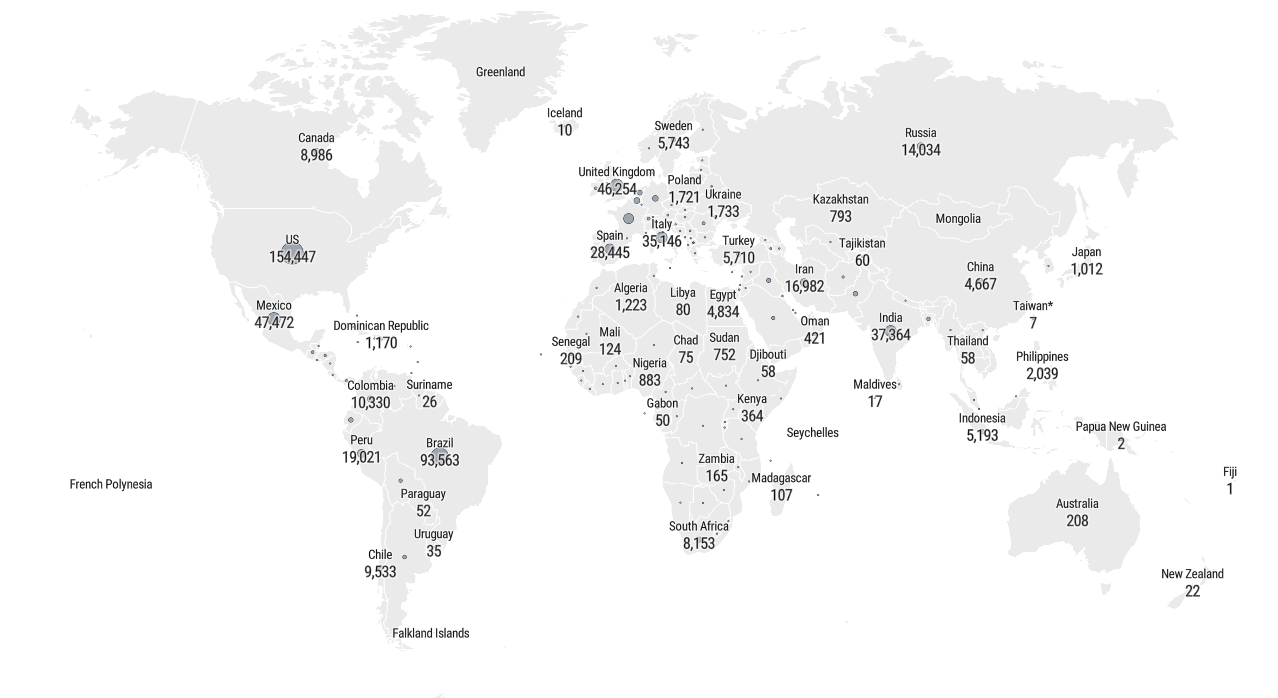
The WHO says coronavirus is a once-in-a century crisis that will impact lives for decades, SBS World News, 2 Aug 20, The World Health Organization committee “highlighted the anticipated lengthy duration of this COVID-19 pandemic”.
The World Health Organization has warned the coronavirus pandemic is likely to be “lengthy” after its emergency committee met to evaluate the crisis six months after sounding the international alarm.
The committee “highlighted the anticipated lengthy duration of this COVID-19 pandemic”, the WHO said in a statement, and warned of the risk of “response fatigue” given the socio-economic pressures on countries.
The panel gathered Friday for the fourth time over the coronavirus crisis, half a year on from its January 30 declaration of a public health emergency of international concern (PHEIC) – the WHO’s highest level of alarm………
Warning over crisis fatigue
Several countries around the world have imposed strict lockdowns in a bid to control the spread of the respiratory disease, plunging economies into sharp contraction.
The committee urged the WHO to provide nuanced, pragmatic guidance on COVID-19 management “to reduce the risk of response fatigue in the context of socio-economic pressures”.
The panel urged the WHO to support countries in preparing for the rollout of proven therapeutics and vaccines.
Warning over crisis fatigue
Several countries around the world have imposed strict lockdowns in a bid to control the spread of the respiratory disease, plunging economies into sharp contraction.
The committee urged the WHO to provide nuanced, pragmatic guidance on COVID-19 management “to reduce the risk of response fatigue in the context of socio-economic pressures”.
The panel urged the WHO to support countries in preparing for the rollout of proven therapeutics and vaccines.
It called for improved understanding of the epidemiology and severity of COVID-19, including its long-term health effects.
And the committee wanted more light shed on the dynamics of the virus, such as “modes of transmission, shedding, potential mutations; immunity and correlates of protection”.
The near six-hour gathering was hosted at the WHO’s headquarters in Geneva, with some participants joining via video-link.
The committee will reconvene within the next three months……..https://www.sbs.com.au/news/the-who-says-coronavirus-is-a-once-in-a-century-crisis-that-will-impact-lives-for-decades
The potential for a new coronoavirus, with bats as a possible transmitter
The next coronavirus may already be circulating in bats, study suggests, by Tom Avril, Philadelphia Inquirer, While the exact origin of the coronavirus remains murky, scientists have been racing to determine how it jumped from animals to humans so they can prevent another pandemic.
The next one could just be a matter of time, a study published this week suggests. The authors said a virus with similar ability to infect humans may already be out there, carried by a type of bats known for having horseshoe-shaped “leafs” on their noses.
Scientists made that prediction after constructing a family tree of the coronavirus — tracing its ancestry by comparing its genetic code with that of other coronaviruses found in bats, humans, and a scaly animal called the pangolin.
The lineage of the virus that causes COVID-19 appears to have branched off from its closest viral relatives about 40 to 70 years ago, the authors wrote in Nature Microbiology. And other viruses in the same branch of the family likely share a similar ability to latch onto cells in human airways, said Maciej F. Boni, a Pennsylvania State University biologist and lead study author.
“It’s very likely there are lots of other lineages that nobody knows about, because nobody has sampled, that are circulating quietly in bats,” he said. “Potentially all of them could have this ability to infect human cells.”……
by using a battery of statistical techniques, the scientists identified three genetic regions in the coronavirus that appeared to have remained intact for decades. They identified the same three regions in another coronavirus that came from a bat found in Yunnan, a province in southern China near Laos.
That virus cannot infect humans but is otherwise highly similar to the one causing the pandemic, which was first identified in human patients in the city of Wuhan. The two viruses seem to have branched apart in the family tree sometime in the 1960s, and almost certainly have undiscovered cousins with the potential to infect humans, said Boni, who collaborated with scientists in Europe and China…….
By itself, the presence of similar coronaviruses in bats would not mean another pandemic is imminent, said Kevin Olival, vice president for research at EcoHealth Alliance, a nonprofit that works with scientists worldwide to protect people and animals from infectious disease…….
What is not in dispute is that viruses have been jumping from animals to humans for centuries, and that it will happen again.
And coronaviruses carried by bats are a prime suspect.
Sure enough, as the world now knows too well, that came true. https://www.inquirer.com/health/coronavirus/covd19-bats-china-virus-origin-penn-state-rna-genetics-20200729.html
As Dept of Energy officials enthuse over nuclear in space, they show their disdain for health and safety in pandemic
Here we see 9 DOE officials all close to each other – bugger social distancing. Typical nuclear enthusiasts, 7 men confident, think they’re invincible? next to them , the two token women, wearing masks – they have some grasp of the need for safety and public health measures in the pandemic.

US Ramps Up Planning for Space Nuclear Technology AIP, NASA and the Department of Energy are expanding their collaboration as part of a broader White House push to develop nuclear power systems for space applications. The initiative comes as NASA faces key decisions on what fuel sources and technology development paths to pursue.
Now, NASA, DOE, and the White House want nuclear power to play a much larger role in space exploration as plans take shape for a sustained human presence on the Moon and subsequent crewed journeys to Mars……….
The American Nuclear Society hosted a debate on the topic at its annual meeting in June. While the society has generally supported the use of space nuclear power and propulsion in the past, it has decided to develop a position statement by spring 2021 on whether to favor the use of LEU.
Among the participants was Rep. Bill Foster (D-IL), a former Fermilab physicist, who argued that proceeding with HEU ( Highly Enriched Uranium)would set a dangerous precedent. “If all of the spacefaring nations start using HEU reactors in space, then this would involve utilization of a significant amount of weapons grade material,” he remarked…….
Alan Kuperman, a policy scholar affiliated with the Nuclear Proliferation Prevention Project, pointed to U.S. efforts since the 1970s to minimize the use of HEU in civilian applications, arguing they are “based on the logic of no exceptions.”
“If we say, ‘well, we’re going to have exceptions,’ then other countries are going to say, ‘well, we want exceptions too,’ and then the whole thing falls apart,” he remarked……..https://www.aip.org/fyi/2020/us-ramps-planning-space-nuclear-technology
Bill in USA Senate to help nuclear workers made ill by radiation exposure
 Bill would expand access to comp for federal nuclear site workers https://www.businessinsurance.com/article/20200731/NEWS08/912335900/Bill-would-expand-access-to-comp-for-federal-nuclear-site-workers#, Angela Childers, July 31, 2020
A bill introduced in the U.S. Senate Wednesday would help workers at federal radioactive sites obtain workers compensation for work-related cancers and other health issues.
S.B. 4363, introduced Wednesday by Sen. Patty Murray (D-Washington), would establish an occupational disease presumption for employees at the U.S. Department of Energy’s Radioactive Waste Management Complex.
The bill is aimed at helping cleanup workers at Washington State’s Hanford Nuclear Site and other nuclear sites more easily claim workers compensation benefits when they suffer from medical conditions as a result of exposure to toxic substances, Sen. Murray’s office said Thursday in a news release.
While the state of Washington created a presumption law for Hanford workers in 2018, the federal legislation would cover workers at other Energy Department nuclear sites. The Hanford site is a 560-square-mile federally operated site known for having manufactured plutonium used in one of the atomic bombs dropped on Japan in 1945.
The U.S. Department of Justice filed a lawsuit in late 2018 over the state’s presumption law, claiming that the law discriminated against the federal government and its Energy Department contractors and aimed to directly regulate the federal government by imposing extra cleanup costs on the decommissioned site. However, a federal judge dismissed the lawsuit in June 2019.
The bill has been referred to the Senate Committee on Health, Education, Labor and Pensions.
Pandemic slows down nuclear construction, increases costs
 Coronavirus company news summary – EDF says construction delays likely – Nuclear plant bill ramps up for Georgia Power, https://www.power-technology.com/uncategorised/coronavirus-company-news-summary-edf-says-construction-delays-likely-nuclear-plant-bill-ramps-up-for-georgia-power/ 31 July 20
The ongoing Covid-19 pandemic has increased Georgia Power’s share of the costs for the Vogtle nuclear plant by nearly $150m. However, the company still intends to complete the construction of Units 3 and 4 as per schedule by November 2021 and November 2022, despite the disruptions caused by the pandemic.
EDF has acknowledged that coronavirus has slowed down construction and maintenance of its nuclear power plant fleet in France and the UK. , A statement by EDF said the risk of delays in commissioning of the UK’s Hinkley Point C plant is “high”. In France, all construction activities at the Flamanville 3 EPR project were suspended between mid-March and early-May, which could result in further delays and additional costs.
Singareni Collieries Company has revealed plans to build 800MW of solar power projects in the southern Indian state of Telangana. The plan encompasses building 500MW of floating solar capacity on large water bodies.
The AES Corporation has made a strategic investment of nearly $8.6m in Australian solar technology innovator 5B to accelerate the adoption of solar energy. It claims 5B’s MAVERICK design allows customers to leverage a higher number of solar resources at three-times the pace, while providing up to two times more energy within the same footprint of traditional solar facilities.
“..clear evidence of excess cancer risk from low dose ionizing radiation…..”

DCEG 13th July 2020, An international team of experts in the study of cancer risks associated with low-dose ionizing radiation published the monograph, “Epidemiological studies of low-dose ionizing radiation and cancer: Summary bias assessment and meta-analysis,” in the Journal of the National Cancer Institute on July 13, 2020. It is well established that ionizing radiation causes cancer through direct DNA damage. The general public are exposed to low doses of ionizing radiation from medical exposures like computed tomography (CT) scans, naturally occurring radiation (emitted from bedrock with the earth’s crust and cosmic rays emitted by the sun), and occupational exposures to medical, aircrew and nuclear workers.
A key question for low-dose exposures is how much of the damage can be repaired and whether other mechanisms, including inflammation, also play a role. This critical question has been long debated for radiation protection standards. After combing data from 26 epidemiological studies the authors found clear evidence of excess cancer
risk from low dose ionizing radiation: 17 of 22 studies showed risk for solid cancers and 17 of 20 studies showed risk for leukemia. The summary risk estimates were statistically significant and the magnitude of risk(per unit dose) was consistent with studies of populations exposed to higher doses. https://dceg.cancer.gov/news-events/news/2020/low-dose-monograph?s=09
New CT scan method lowers radiation exposure
New CT scan method lowers radiation exposure, Science Daily
- Date: July 23, 2020
- Source: University College London
- Summary:
- A CT scan technique that splits a full X-ray beam into thin beamlets can deliver the same quality of image at a much reduced radiation dose, according to a new study. The technique, demonstrated on a small sample in a micro CT scanner, could potentially be adapted for medical scanners and used to reduce the amount of radiation millions of people are exposed to each year.
-
A CT scan technique that splits a full X-ray beam into thin beamlets can deliver the same quality of image at a much reduced radiation dose, according to a new UCL study.
The technique, demonstrated on a small sample in a micro CT scanner, could potentially be adapted for medical scanners and used to reduce the amount of radiation millions of people are exposed to each year.
A computerised tomography (CT) scan is a form of X-ray that creates very accurate cross-sectional views of the inside of the body. It is used to guide treatments and diagnose cancers and other diseases.
Past studies have suggested CT scans may cause a small increase in lifelong cancer risk because their high-energy wavelengths can damage DNA. Although cells repair this damage, sometimes these repairs are imperfect, leading to DNA mutations in later years……… https://www.sciencedaily.com/
Plutonium particles from Fukushima a bigger problem than previously thought

 Plutonium Particles Scattered 200km From Fukushima Nuclear Disaster Site, Scientists Say https://theswaddle.com/plutonium-particles-scattered-200km-from-fukushima-nuclear-disaster-site-scientists-say/, By Aditi Murti, Jul 22, 2020 Plutonium fragments may have spread more than 200km via caesium microparticle compounds released during the 2011 Fukushima Daiichi nuclear power plant disaster in Japan. These findings are according to research done on the region’s soil samples, published in Science of The Total Environment, by an international group of scientists.
With loss of biodiversity will come new pandemics
|
To prevent the next deadly disease, we must stop harming nature
The coronavirus pandemic proves it: By damaging the planet, we have sapped nature’s power to protect humanity from diseases. National Geographic, BY ENRIC SALA 22 Jul 20, SINCE MY CHILDHOOD by the Mediterranean Sea, I’ve been enchanted by the diversity of life on our planet and eager to learn all I could about it. I’ve spent much of my career studying the ocean food web, where in the course of natural events the smallest of the small are consumed by larger and larger predators, often ending in us. But scientists know there is more to the story, and I’ve been humbled to see life on our planet brought to a standstill by a tiny virus. From a Wuhan, China, “wet market” where freshly butchered meat and live wild animals are sold for food and medicine, the virus likely was transmitted in late 2019 via wildlife to humans. And in a matter of months, COVID-19 has felled hundreds of thousands of Homo sapiens, Earth’s preeminent predator. Writing about this for my new book, I was deeply saddened: The virus has struck people I knew, in Europe and around the world. But this pandemic is a powerful argument for something I believe unequivocally: that biodiversity is necessary for human health, and ultimately, human survival. People have been acquiring harmful viruses and bacteria from contact with animals in the wild for millennia. As humans relentlessly encroach upon wild habitats and compete with animals for water, food, and territory, there’s bound to be more physical contact, yielding more conflict—and more contagion. A 2020 study explored the link between the abundance of species that carry such zoonotic viruses and the likelihood of spillover to humans. Researchers combed the scientific literature, obtained data on 142 zoonotic viruses, and found that rodents, primates, and bats carried more of these viruses than other species. The researchers also found that the risk of virus transmission to humans was highest from animals that are more abundant, because they have adapted to human-dominated environments. What about risks from the creatures in the ocean, which is more than 70 percent of the planet? Does our exploitation of ocean life also threaten human health? I discovered the answer during our exploration of some of the most remote islands in the central Pacific…………
We are all in this together, all species on the planet. So what can we do? While the world has stepped up to help those in need during the COVID-19 outbreaks, we might also start thinking about how to prevent the next zoonotic pandemic.
We have seen, again and again, that even though we don’t know what most of them do, all wild animals have important jobs that keep our biosphere running. If we’ve learned anything from our study of natural ecosystems as it applies to these recent diseases, it’s that instead of exterminating wild animals to stop the passage of disease to people, we should do the opposite: We should safeguard the natural ecosystems that are their homes and, if needed, help set them back on their path to maturity through rewilding.
If we degrade habitats, animals become stressed and shed more viruses. On the other hand, habitats with diverse microbial, plant, and animal species harbor less disease. Biodiversity dilutes any viruses that emerge and provides a natural shield that absorbs the fallout from pathogens. Clamping down on the illegal trade of wildlife, ending deforestation, protecting intact ecosystems, educating people about the risks of consuming wildlife, changing the way we produce food, phasing out fossil fuels, and transitioning to a circular economy: These are the things we can and must do. https://www.nationalgeographic.com/magazine/2020/09/pristine-seas-enric-sala-we-must-stop-harming-nature-to-prevent-deadly-disease-coronavirus/
|
|
We underestimate the long term effects of the pandemic

|
Bad News about the Pandemic: We’re Not Getting Back to Normal Any Time Soon
Thinking that we might is an example of what psychologists call “anchoring bias”, Scientific American , By Gleb Tsipursky on July 18, 2020 “……….. we tend to vastly underestimate both the possibility and impact of a disaster striking us. Moreover, we will rush to get back to normal even when we should be preparing for the aftershocks or continuation of the disaster.We know that the best way to deal with COVID-19 conclusively involves finding a vaccine. It usually takes a decade or more to develop one, as a result of the high costs of research and the safety regulations around the approval process. Fortunately, government, market and philanthropic forces have combined to channel extensive funding toward developing vaccines and minimizing the approval process standards to the bare minimum needed to ensure safety and effectiveness. Still, while over a hundred organizations launched projects to develop vaccines, and several have created a viable prototype, it will take many months for the vaccine to go through human trials. In the ideal scenario, if one of the first several vaccines does successfully make it through trials and proves highly effective without any unacceptable side effects—a very big if—we might have a vaccine approved for widespread use by summer of 2021. What then? Well, we need to mass-produce the vaccine, to distribute it to the most vulnerable among us, and eventually to give it to everyone. Producing enough vaccine for only, say, the 100 million most vulnerable Americans would itself take a few months. You also have the obstacle of distributing it and actually vaccinating people, as well as dealing with anti-vaxxer sentiments, so add another few months. That brings us into the start of 2022 on a highly optimistic timeline. But given the fact that only a very small percentage of all vaccines make it through the trials, we shouldn’t expect that we’ll get so wonderfully lucky, considering the possibilities of either unacceptable side effects or insufficient effectiveness. More realistically, it might be not until 2023–24 when we get a sufficiently safe and effective vaccine. Now, this information was known as early as February. However, the normalcy bias makes it very difficult for us to imagine that our world can turn upside down so quickly. In early 2020, it was extremely uncomfortable for political and business leaders, and ordinary citizens, to even begin to imagine that it wouldn’t be until early 2022—and more realistically 2024–25—that we could, with incredible luck, expect to vanquish COVID-19. This is despite clear statements from the best scientific experts to that effect……… we won’t get anywhere if we don’t face the facts. We need to acknowledge that COVID-19 fundamentally disrupted our world, turning it upside down in a few short weeks in February and March 2020. Regrettably, it will not disappear; believing that it will helped get us mired so deep in this mess, making the U.S. outbreak one of the worst in the world in terms of deaths per capita. Next, we need to understand and evaluate where each of us has fallen into these biases, and to evaluate the pain we cause ourselves by doing so. Then, we need to consider the long-term impacts realistically, and plan for a scenario that addresses the likelihood of major disruptions. So, prepare to deal with waves of restrictions and loosenings for the long haul, especially as it’s likely that the coronavirus will get worse in the fall, as weather gets colder and we spend more time indoors. Remember, even if you made some bad decisions in the past, you always have the opportunity to make better decisions going forward to survive and thrive through the pandemic. https://www.scientificamerican.com/article/bad-news-about-the-pandemic-were-not-getting-back-to-normal-any-time-soon/ |
|
Fukushima may have scattered plutonium widely
Fukushima may have scattered plutonium widely, Physics World 20 Jul 2020 Tiny fragments of plutonium may have been carried more than 200 km by caesium particles released following the meltdown at the Fukushima Daiichi nuclear power plant in Japan in 2011. So says an international group of scientists that has made detailed studies of soil samples at sites close to the damaged reactors. The researchers say the findings shed new light on conditions inside the sealed-off reactors and should aid the plant’s decommissioning……..
Mapping plutonium spread
To date, plutonium from the accident has been detected as far as 50 km from the damaged reactors. Researchers had previously thought that this plutonium, like the caesium, was released after evaporating from the fuel. But the new analysis instead points to some of it having escaped from the stricken plant in particulate form within fragments of fuel “captured” by the CsMPs…….
Implications for decommissioning
The researchers note that previous studies have shown that plutonium and caesium are distributed differently in the extended area around Fukushima, which suggests that not all CsMPs contain plutonium. However, they say that the fact plutonium is found in some of these particles implies that it could have been transported as far afield as the caesium – up to 230 km from the Fukushima plant.
As regards any threat to health, they note that radioactivity levels of the emitted plutonium are comparable with global counts from nuclear weapons tests. Such low concentrations, they say, “may not have significant health effects”, but they add that if the plutonium were ingested, the isotopes that make it up could yield quite high effective doses.
With radiation levels still too high for humans to enter the damaged reactors, the researchers argue that the fuel fragments they have uncovered provide precious direct information on what happened during the meltdown and the current state of the fuel debris. In particular, Utsunomiya points out that the composition of the debris, just like that of normal nuclear fuel, varies on the very smallest scales. This information, he says, will be vital when it comes to decommissioning the reactors safely, given the potential risk of inhaling dust particles containing uranium or plutonium.
The research is reported in Science of the Total Environment. https://physicsworld.com/a/fukushima-may-have-scattered-plutonium-widely/
Global surge in Covid-19 infections, over 600.000 deaths
Coronavirus deaths top 600,000 worldwide as pandemic infections surge. 9 news, By Associated Press Jul 20, 2020 The coronavirus pandemic has found fresh legs around the world, as confirmed deaths pass 600,000 and countries from the US to South Africa to India struggle to contain a surge of new infections.
Radioactive Contamination of Europe
Free News 17th July 2020, An international consortium of scientists has specified a map of
concentrations of cesium and plutonium radionuclides in soils in
Switzerland and several neighboring countries. Using an archive of European
soil samples, a team of researchers led by Catherine Meisburger from the
University of Basel was able to track down the sources of radioactive
fallout between 1960 and 2009.
This study was published in the journal
Scientific Reports. On the new map of radioactive contamination of the
soil, there are not only Switzerland but also several neighboring countries
– France, Italy, Germany and Belgium. The map is based on a new
calculation method, namely the use of the ratio of cesium to plutonium.
These two radionuclides were released during military nuclear tests in the
1960s. Additional cesium fell into some countries during the Chernobyl
accident in 1986.
https://freenews.live/a-new-map-of-radioactive-contamination-of-the-soil-with-cesium-and-plutonium/
1 This Month

of the week – Shut Down Drone Warfare!


Tell the Ukrainian Government to Drop Prosecution of Peace Activist Yurii Sheliazhenko

Petition to revoke the licensing of the Near Surface Nuclear Disposal Facility (NSDF) at Chalk River. https://www.ourcommons.ca/petitions/en/Petition/Details?Petition=e-7247
To see nuclear-related stories in greater depth and intensity – go to https://nuclearinformation.wordpress.com
-
Archives
- April 2026 (91)
- March 2026 (251)
- February 2026 (268)
- January 2026 (308)
- December 2025 (358)
- November 2025 (359)
- October 2025 (376)
- September 2025 (257)
- August 2025 (319)
- July 2025 (230)
- June 2025 (348)
- May 2025 (261)
-
Categories
- 1
- 1 NUCLEAR ISSUES
- business and costs
- climate change
- culture and arts
- ENERGY
- environment
- health
- history
- indigenous issues
- Legal
- marketing of nuclear
- media
- opposition to nuclear
- PERSONAL STORIES
- politics
- politics international
- Religion and ethics
- safety
- secrets,lies and civil liberties
- spinbuster
- technology
- Uranium
- wastes
- weapons and war
- Women
- 2 WORLD
- ACTION
- AFRICA
- Atrocities
- AUSTRALIA
- Christina's notes
- Christina's themes
- culture and arts
- Events
- Fuk 2022
- Fuk 2023
- Fukushima 2017
- Fukushima 2018
- fukushima 2019
- Fukushima 2020
- Fukushima 2021
- general
- global warming
- Humour (God we need it)
- Nuclear
- RARE EARTHS
- Reference
- resources – print
- Resources -audiovicual
- Weekly Newsletter
- World
- World Nuclear
- YouTube
-
RSS
Entries RSS
Comments RSS
 nuclear-news