Doctors report on radiation and the nuclear danger
 Radiation is silent and invisible and the potential for long-term serious health effects are concepts that are difficult to grasp by the lay person. The need to educate the public could undermine the, until now, strongly projected assurance by both nuclear operators and government agencies, that nuclear power is safe…..
RECOMMENDATIONS: According to the new PSR report: “The past experience with catastrophic nuclear accidents and their frequency indicates that no country is prepared physically or financially to deal with the short and long term effects. As opposed to natural disasters, experience has shown us that nuclear catastrophes do not remain isolated but tend to become global problems affecting us all. Such preparations in the U.S. will likely be useless if a similar accident happens in countries such as North Korea, Pakistan, or other countries that have nuclear power reactors but no emergency plans. In reality, there is no cure once these events have happened; the only options are mitigation and palliation. In the absence of a cure, prevention is the only option.”
 Physicians for Social Responsibility PSR Report: U.S. First Responders, Medical Infrastructure not Prepared for Fukushima-Level Reactor Crisis in the United States Market Watch, WASHINGTON, March 6, 2012 – One Year After Japanese Disaster, Little or No Movement Seen in U.S. to Improve Response Capability; Complicating Factors: Growing Population Near Nuclear Sites, Aging Reactors & Lack of Gov’t Coordination.
One year after the Fukushima reactor crisis in Japan, no meaningful progress has been achieved in improving the ability of first responders and medical professionals to react to a disaster on a similar scale in the United States, according to a major new report from Physicians for Social Responsibility (PSR). Continue reading
Epidemic of cancer from nuclear bomb testing in Marshall Islands
 “Today we are witnessing an exploding epidemic of cancer cases,” … “Cancers, birth anomalies and other radiogenic diseases make a compelling argument for the United States to reopen the nuclear issue,”
RMI CRITICIZES U.S. OVER NUCLEAR COMPENSATION PACIFIC ISLANDS REPORT Pacific Islands Development Program/East-West CenterWith Support From Center for Pacific Islands Studies/University of Hawai‘i
‘Exploding epidemic of cancer cases,’ $2 billion in unpaid claims
By Giff Johnson SAIPAN, CNMI (Marianas Variety, March 6, 2012) – Marshall Islanders accused the United States government of refusing to provide adequate nuclear test compensation on the 58th anniversary of the largest American hydrogen bomb test that exposed thousands of islanders to radioactive fallout. Continue reading
United Nations Scientific Committee on the Effects of Atomic Radiation
The committee, known as UNSCEAR, will publish a report in May 2013 that aims to give an analysis of radiation dosages among citizens and forecast health risks in the coming decades

 Children Wait for UN Radiation Study After Fukushima Crisis, Bloomberg By Yuriy Humber and Tsuyoshi Inajima March 05, 2012 As five-year-olds charge through the corridors of a kindergarten in northeast Japan at lunchtime, teacher Junko Kamada says she is still unsure if their food is safe a year after the Fukushima nuclear accident.
Since the March 11 earthquake and tsunami wrecked the Fukushima plant, about 100 kilometers (62 miles) south of the Sakuragi Hanazono kindergarten in Tagajo city, parents of the 198 children have been seeking assurances that the school lunches are free of radiation…..
wait at least another 14 months for a unified view on food contamination when the United Nations Scientific Committee on the Effects of Atomic Radiation issues the first global and independent assessment of the Fukushima nuclear accident. Continue reading
$100 dollars a day: workers face radiation risks at Fukushima nuclear plant
it’s really important to reduce the amount of radiation that each individual gets and to do that, we need to bring in more people.” Bringing in more workers is going to be hard. Already, 167 workers have exceeded their lifetime radiation exposure limit of 100 milliseverts.
Safety fears at Fukushima Daiichi nuclear plant 03/05/2012 By majiroxnews TOKYO — Low pay and overwork could trigger a shortage of workers at Japan’s Fukushima Daiichi nuclear power plant. The Tokyo Occupational Safety and Health Center warned this week of thesedangers – with workers at the crippled site earning as little as 100 dollars a day.
After the March 11, 2011, earthquake and tsunami crippled Japan’s Fukushima Daiichi nuclear power plant, conditions of the workers seem to be plummeting. Continue reading
Older breast cancer patients should not be getting so much radiation treatment
 Radiation still used despite evidence of little benefit to some older breast cancer patients, Health Canal, 6 March, 12 http://www.healthcanal.com/cancers/27253-Radiation-still-used-despite-evidence-little-benefit-some-older-breast-cancer-patients.html By Karen N. Peart – Even though a large clinical study demonstrated that radiation has limited benefit in treating breast cancer in some older women, there was little change in the use of radiation among older women in the Medicare program, Yale School of Medicine researchers report in the March Journal of Clinical Oncology. “We were surprised by these results,” said lead author Dr. Cary P. Gross, associate professor of internal medicine at Yale School ofMedicine. “Clinical trials are considered the gold standard of medical research and in this case the trial was influential enough to lead to a change in treatment guidelines. We expected it to have more of an impact on clinical care at the bedside.” Continue reading
Tighter radiation limits for food in Japan
Under the revised regulations, the upper limit on foods such as meat, vegetables and fish will be set at 100 becquerels per kilogram. The limit will be 50 becquerels per kg for milk and infant food and a maximum of 10 becquerels for drinking water.
At present, the levels are set at 500 becquerels per kg for the majority of foodstuffs and 200 becquerels for milk, dairy produce and water. There is presently no specific figure for infant food. Continue reading
Ionising radiation – a top cause of cancer
 Epidemiological studies also helped clarify the dangers of radiation exposure. First, studies of fruitflies in the 1920s indicated that ionizing radiation, X-rays, gamma rays and ultraviolet light could cause genetic mutations. Then, in the largest epidemiological study of the effects of radiation on humans, researchers began following Japanese survivors of the atomic bombs dropped on Hiroshima and Nagasaki in the Second World War.
Since the war, researchers have been comparing the number and type of cancers in the Hiroshima survivors with similar people not exposed to the bombs. They found that the Hiroshima survivors are at greater risk for cancer than the general population.
One way to prevent cancer is to limit exposure to a carcinogen.
Cancer: Solving an age-old problem, Nature, Barbara Dunn, Nature 1 March 2012 “……..Some scientists consider cancer to be a recent phenomenon, arguing that it was relatively rare in ancient times. Over the past century, population-based cancer incidence has increased dramatically.
These higher rates are probably due to two factors: first, we are living longer; and second, our modern age has increased our exposure to cancer-causing chemicals in our environment and to radiation through X-rays, plane travel and other sources….. Continue reading
Cancer in India’s nuclear workers – the other side of nuclear power’s rosy picture
After being in denial for years, last month the selfsame Department of Atomic Energy for the first time admitted that the deaths of its employees and their dependents at the Kalpakkam nuclear site were caused by multiple myeloma, a rare form of bone marrow cancer linked to nuclear radiation.
Not that the DAE willingly divulged the information – it came to light in response to a Right to Information (RTI) inquiry from October 2011, … one can only wonder what other reports the DAE is sitting on
 The Darker Reality of India’s Nuclear Power Goals, By John Daly Oilprice.com 26 February 2012 India is betting heavily on nuclear power to meet its surging energy needs. While India currently has six nuclear power plants (NPPs) with 20 reactors generating 4,780 megawatts, seven other reactors are under construction and are expected to generate an additional 5,300 megawatts.
This current rate of nuclear power generation pales into insignificance with New Delhi’s future plans, Continue reading
Plight, and flight, of Fukushima’s farming communities
anti-nuclear activists and parents who are continuing to lobby for better protection standards for children in Fukushima insist they will not be satisfied until the government takes steps to evacuate the entire younger generation to fully safe areas.
More than 100,000 people, mostly younger people, have left Fukushima to escape radiation contamination. ….The mass migration is bound to affect agriculture production
Trust Deficit – Worst Fallout of Fukushima, By Suvendrini Kakuchi TOKYO, Feb 22, 2012 (IPS) “……..The past few months have seen the government scrambling to regain public trust with food grown in Fukushima and the neighbouring areas by scraping away contaminated top soil from local farms. Continue reading
Exposure of Fukushima residents to radiation
 Fukushima residents exposed to up to 23 millisieverts of radiation Mainichi Daily News, 22 Feb 12, FUKUSHIMA (Kyodo) — The Fukushima Prefecture government said Monday that the residents of three municipalities located near the crippled Fukushima Daiichi nuclear power plant are estimated to have been exposed to up to 23 millisieverts of radiation in the four months after the accident triggered by the March 11 earthquake and tsunami.
“As annual radiation exposure of up to 100 millisieverts poses no specific cancer risks, the estimated radiation is unlikely to cause any adverse health effects,” Fukushima Medical University Vice President Shunichi Yamashita told a press conference. “It is important to reduce future radiation exposure as much as possible.”
While the allowable radiation exposure limit is ordinarily set at 1 millisievert per year, the International Commission on Radiological Protection has recommended an emergency limit of 20 to 100 millisieverts……. “The high-level radioactive contamination indicates that humans should not be allowed to live near the car park,” said Kobe University Professor Tomoya Yamauchi, who conducted a radiation test on the soil.
The crisis at the Fukushima Daiichi plant has resulted in heavy concentrations of radioactive substances at various locations in Minamisoma. The civic group said its discovery indicates that a fact-finding survey is urgently required throughout the city. http://mdn.mainichi.jp/mdnnews/news/20120220p2g00m0dm146000c.html
Radiation danger in medical whole body CT scans
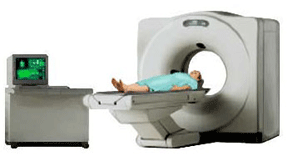 the findings suggest that pan-scanning may be 26 times as likely to harm patients in the long run as to immediately help them in the acute care setting…. the results should serve as warning for the emergency department physician against ordering pan-scans for lower-risk patients
CT Pan-Scans Raise Radiation Dose Without Improving Results, Medscape Today, James Brice, February 21, 2012— An Australian study of emergency department imaging practices has raised radiation safety concerns and new arguments about the clinical benefits of whole-body computed tomography (CT) imaging for the initial emergency department evaluation of critically injured patients. Continue reading
Top medical isotope can be produced without nuclear reactor
 Nuclear medicine has long been touted as a selling point for nuclear power – a kin do healthy fig leaf put over a n unhealthy, toxic industry. – Christina Macpherson
Nuclear Reactors Not Needed to Make the Most Common Medical Isotope, Science Now by Robert F. Service on 20 February 2012, In recent years, hospitals worldwide have been grappling with short supplies of technetium-99 (Tc-99), the most commonly used radioisotope in medical imaging scans. But help may be at hand: A team of Canadian researchers reported today that they’ve made critical progress in developing a stable new supply of the isotope.
Tc-99 is currently produced in nuclear reactors fueled with highly enriched uranium, which has raised concerns that the nuclear fuel could be intercepted by terrorists to make a nuclear weapon. The new setupproduces Tc-99 with a medical cyclotron, thereby eliminating proliferation concerns. But economic and technical considerations may make it more practical for shoring up Tc-99 supplies in Canada than in the United States. Continue reading
The problem of radiation treatment also causing breast cancer
 Radiation generates cancer stem cells from less aggressive breast cancer cells UCLA Newsroom, By Kim Irwin February 14, 2012 Breast cancer stem cells, thought to be the sole source of tumor recurrence, are known to be resistant to radiation therapy and don’t respond well to chemotherapy.
Now, researchers with the UCLA Department of Radiation Oncology at UCLA’s Jonsson Comprehensive Cancer Center report for the first time that radiation treatment, despite killing half of all tumor cells during every treatment, transforms other cancer cells into treatment-resistant breast cancer stem cells.
The generating of these breast cancer stem cells counteracts the otherwise highly efficient radiation treatment…… Continue reading
The human consequences of uranium mining
“The most difficult part for the victims of uranium exposure is to prove that their symptoms are directly related to the work they were doing in those mines,” Hecht said. Due to this difficulty, workers do not receive any compensation.
Lecture tackles global uranium trade, The Brown Daily Herald. Alissa Haddaji, February 17, 2012 To understand the consequences of global uranium trade in Africa, the intricate interaction between political lobbying, government and human interests must be explored, said Gabrielle Hecht, professor of history at the University of Michigan, in a lecture hosted by the science and technology studies program Thursday.
The presentation — held in Smith-Buonanno 106 — was part of the program’s lecture series “Nothing Can Go Wrong: Rethinking Nuclear Energy in the 21st Century” and introduced themes from Hecht’s forthcoming book, “Being Nuclear: Africans and the Global Uranium
Trade.” …. Continue reading
Ionising radiation puts medical specialists at risk of rare brain cancer
‘Cardiologists exposed to radiation susceptible to tumors’, Jerusalem Post, By JUDY SIEGEL-ITZKOVICH02/15/2012 Israelis publish evidence of brain cancer as occupational hazard for certain medical specialists.

Interventional cardiologists around the world have expressed concern over the findings of an Israeli colleague’s medical journal report suggesting aggressive brain cancer – especially on the left side of the head – may be an occupationalhazard from their exposure to ionizing radiation. Continue reading
1 This Month
26 April – Chernobyl: Inside the Meltdown airs on National Geographic on Sunday 26th April from 4pm

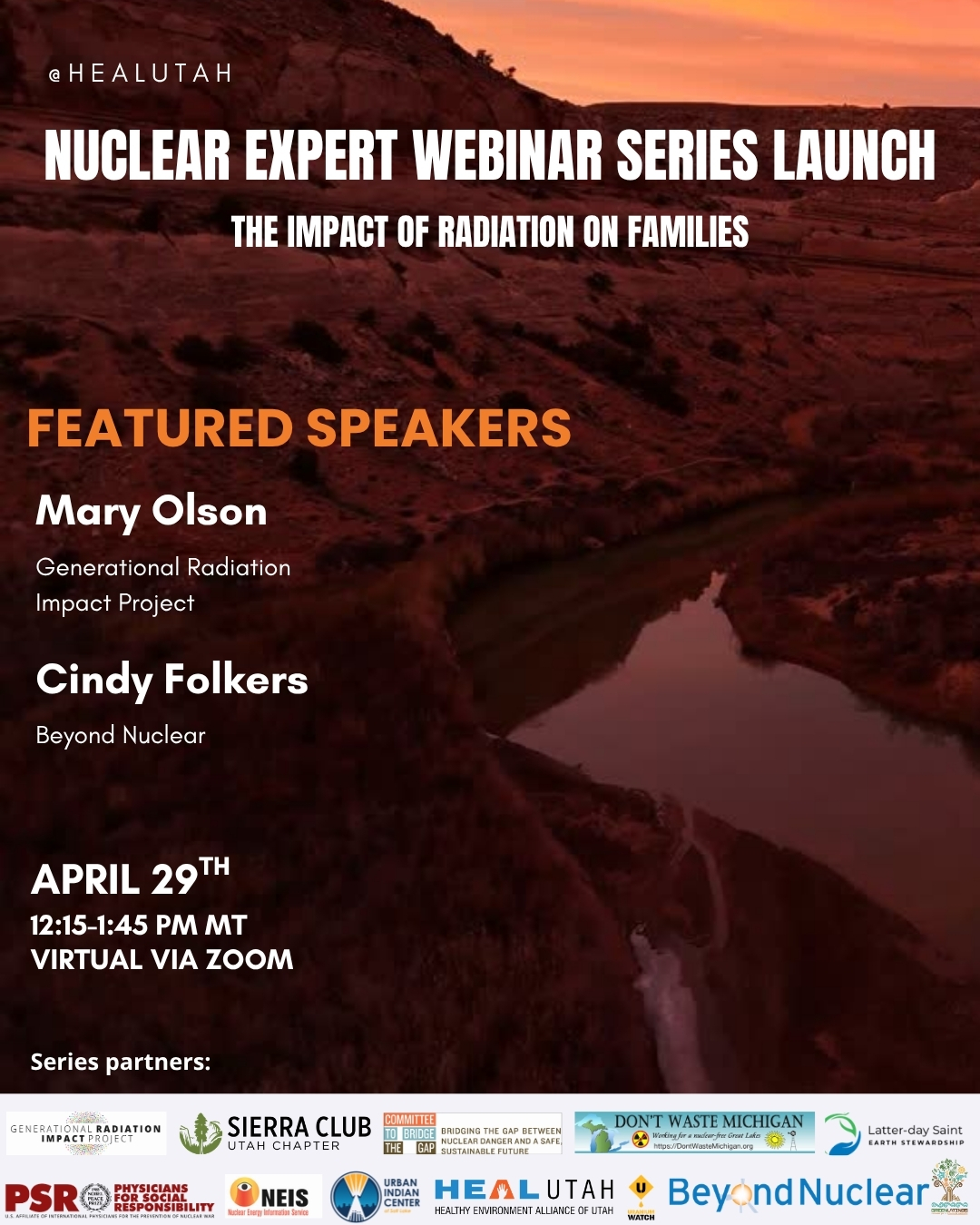
29 April – Nuclear Expert Webinar #1 – Radiation Impacts on Families with Mary Olson and Cindy Folkers
- 12:15 PM MT – 1:45 PM MT
- Location: Virtual – REGISTER TODAY

4 May -West Suburban Peace Coalition to discuss Iran war at May Educational Forum
Monday, May 4, 7:00 – 8:00 PM Central Standard Time
Title: : How Trump’s Narrative Tries to Shape the Reality of the War on Iran.
Contact Walt Zlotow, zlotow@hotmail.com 630 442 3045 for further information
14 May – online event From Bombs to Data Centres: the Face of Nuclear Colonialism
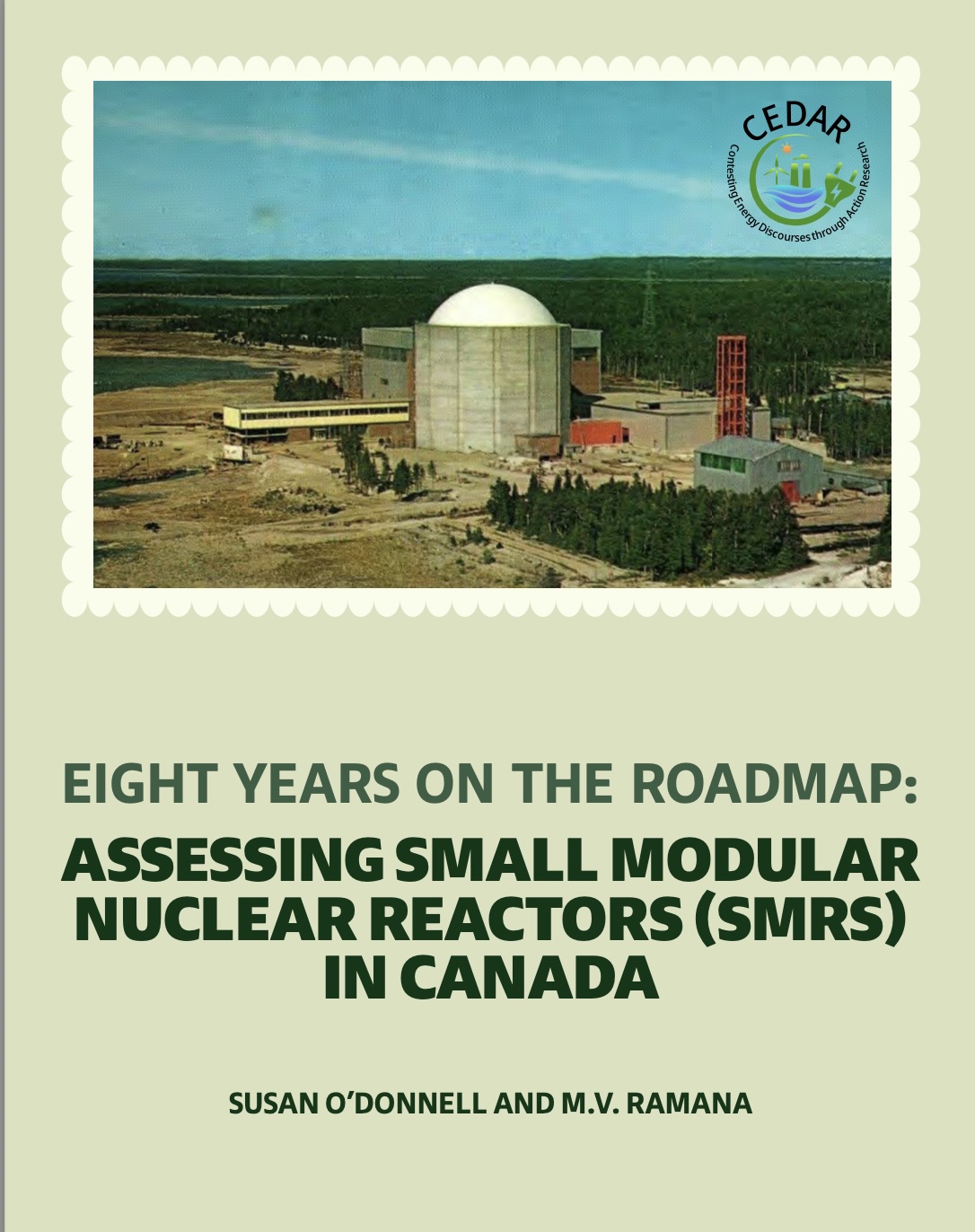

Pine Ridge Uranium is the real threat, not Tehran- Tell Burgum: Stop the Extraction.
Chernobyl: The Lost Tapes – A good documentary on Chernobyl on SBS available On Demand for the next 3 weeks– https://www.sbs.com.au/ondemand/tv-program/chernobyl-the-lost-tapes/2352741955560
To see nuclear-related stories in greater depth and intensity – go to https://nuclearinformation.wordpress.com
-
Archives
- April 2026 (288)
- March 2026 (251)
- February 2026 (268)
- January 2026 (308)
- December 2025 (358)
- November 2025 (359)
- October 2025 (376)
- September 2025 (257)
- August 2025 (319)
- July 2025 (230)
- June 2025 (348)
- May 2025 (261)
-
Categories
- 1
- 1 NUCLEAR ISSUES
- business and costs
- climate change
- culture and arts
- ENERGY
- environment
- health
- history
- indigenous issues
- Legal
- marketing of nuclear
- media
- opposition to nuclear
- PERSONAL STORIES
- politics
- politics international
- Religion and ethics
- safety
- secrets,lies and civil liberties
- spinbuster
- technology
- Uranium
- wastes
- weapons and war
- Women
- 2 WORLD
- ACTION
- AFRICA
- Atrocities
- AUSTRALIA
- Christina's notes
- Christina's themes
- culture and arts
- Events
- Fuk 2022
- Fuk 2023
- Fukushima 2017
- Fukushima 2018
- fukushima 2019
- Fukushima 2020
- Fukushima 2021
- general
- global warming
- Humour (God we need it)
- Nuclear
- RARE EARTHS
- Reference
- resources – print
- Resources -audiovicual
- Weekly Newsletter
- World
- World Nuclear
- YouTube
-
RSS
Entries RSS
Comments RSS
 nuclear-news