Ionising radiation – a top cause of cancer
 Epidemiological studies also helped clarify the dangers of radiation exposure. First, studies of fruitflies in the 1920s indicated that ionizing radiation, X-rays, gamma rays and ultraviolet light could cause genetic mutations. Then, in the largest epidemiological study of the effects of radiation on humans, researchers began following Japanese survivors of the atomic bombs dropped on Hiroshima and Nagasaki in the Second World War.
Since the war, researchers have been comparing the number and type of cancers in the Hiroshima survivors with similar people not exposed to the bombs. They found that the Hiroshima survivors are at greater risk for cancer than the general population.
One way to prevent cancer is to limit exposure to a carcinogen.
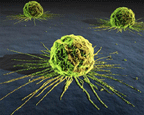 Cancer: Solving an age-old problem, Nature, Barbara Dunn, Nature 1 March 2012 “……..Some scientists consider cancer to be a recent phenomenon, arguing that it was relatively rare in ancient times. Over the past century, population-based cancer incidence has increased dramatically.
These higher rates are probably due to two factors: first, we are living longer; and second, our modern age has increased our exposure to cancer-causing chemicals in our environment and to radiation through X-rays, plane travel and other sources…..
All types of malignant cancer arise from changes or mutations in a
cell’s DNA that allow it to divide indefinitely2. Normally, cell
division is tightly controlled by signals within and between cells. A
cancer cell breaks free from this system of checks and balances. The
deadliest changes occur when cancer cells break away from their tissue
of origin, travel through the body, lodge in a distant tissue and
begin growing again. This process, called metastasis, is responsible
for nine out of ten deaths from cancer.
Garbling the genetic code
All multicellular organisms rely on cooperation and communication
among their cells. What causes the body’s cells to stop cooperating as
they do in cancer?….
Cancer results from mutations in genes that normally control growth,
division and DNA repair and cell death. How do these mutations occur?
Sometimes it’s accidental: when a cell replicates, part of the genetic
code is ‘misspelled’. At other times, environmental factors, such as
chemicals and radiation, or viruses can damage DNA. Chemical and
biological mutagens may insert themselves into the DNA or damage the
DNA so that when the cell replicates, its genetic code is forever
changed…..
Soot, bombs and cigarettes
How do we know there are things around us that cause cancer? In the
eighteenth century, Percivall Pott, an English physician, noticed that
several of his patients were chimney sweeps with cancer of the scrotum
(later identified as squamous cell carcinoma, a type of skin
cancer)…..
Epidemiological studies also helped clarify the dangers of radiation
exposure. First, studies of fruitflies in the 1920s indicated that
ionizing radiation, X-rays, gamma rays and ultraviolet light could
cause genetic mutations. Then, in the largest epidemiological study of
the effects of radiation on humans, researchers began following
Japanese survivors of the atomic bombs dropped on Hiroshima and
Nagasaki in the Second World War. Since the war, researchers have been
comparing the number and type of cancers in the Hiroshima survivors
with similar people not exposed to the bombs. They found that the
Hiroshima survivors are at greater risk for cancer than the general
population. In one study of more than 10,000 survivors, the most
commonly diagnosed cancers occurred in the lung, colon, breast,
thyroid and bladder, as well as the blood (leukaemia). Building on
this knowledge, researchers are now monitoring people exposed to the
2011 nuclear-reactor meltdown in northern Japan for cancer and other
radiation-related illnesses……
Preventing cancer
Can we stop cancer before it starts? Dozens of studies suggest that
preventing some cancers has become a real possibility. One way to
prevent cancer is to limit exposure to a carcinogen. This approach
worked for those young chimney sweeps in nineteenth century England.
It is also clear that not smoking cigarettes reduces lung cancer risk.
Ten years after quitting, a former smoker has only about half the risk
of lung cancer compared with someone who still smokes…..
http://www.nature.com/nature/journal/v483/n7387_supp/full/483S2a.html
No comments yet.
1 This Month



26 September – International Day for the Total Elimination of Nuclear Weapons


PLEASE OPPOSE HR 8255 AND S.3639 – bills would accelerate satellite deployment, with no environmental review or safeguards – https://ncstd5li.quorum.us/campaign/169331/
To see nuclear-related stories in greater depth and intensity – go to https://nuclearinformation.wordpress.com
-
Archives
- September 2026 (269)
- August 2026 (330)
- July 2026 (355)
- June 2026 (287)
- May 2026 (306)
- April 2026 (356)
- March 2026 (251)
- February 2026 (267)
- January 2026 (308)
- December 2025 (358)
- November 2025 (359)
- October 2025 (375)
-
Categories
- 1
- 1 NUCLEAR ISSUES
- business and costs
- climate change
- culture and arts
- ENERGY
- environment
- health
- history
- indigenous issues
- Legal
- marketing of nuclear
- media
- opposition to nuclear
- PERSONAL STORIES
- politics
- politics international
- Religion and ethics
- safety
- secrets,lies and civil liberties
- spinbuster
- technology
- Uranium
- wastes
- weapons and war
- Women
- 2 WORLD
- ACTION
- AFRICA
- Atrocities
- AUSTRALIA
- Christina's notes
- Christina's themes
- culture and arts
- Events
- Fuk 2022
- Fuk 2023
- Fukushima 2017
- Fukushima 2018
- fukushima 2019
- Fukushima 2020
- Fukushima 2021
- general
- global warming
- Humour (God we need it)
- Nuclear
- RARE EARTHS
- Reference
- resources – print
- Resources -audiovicual
- Weekly Newsletter
- World
- World Nuclear
- YouTube
-
RSS
Entries RSS
Comments RSS


Leave a comment