The Work and Spend trap – how we all fell for the consumerist con
One analysis at the University of Melbourne sought to discover the reasons why people are increasingly compelled to work more than 50 hours a week.
The correct answer was consumerism. It was the “work-and-spend” trap, an endless cycle characterised by the desire for higher living standards, linked with greater levels of debt that can only be managed by working longer and harder.
 A frenzy of consumerism http://www.theage.com.au/small-business/blogs/work-in-progress/a-frenzy-of-consumerism-20121207-2ayut.html#ixzz2EgEa2wIK The Age, December 7, 2012 James Adonis There was something quite tragic about There was something quite tragic about the Click Frenzy
frenzy, wasn’t there? The same could be said about the Black Friday stampedes in the US, It’s tasteless consumerism to the max, turning ordinary people into ravenous and mindless shoppers, with flow-on effects in the workplace.
But first, let’s go back to 1929. In an article written for Nation’s Business magazine, Charles Kettering – a director of General Motors Research – opined on the need for companies to keep consumers dissatisfied. The moment people are happy with what they have, “almost immediately hard times would be upon us”, he wrote.
And so it is that marketers persevere with advertising to convince us we’re not sexy enough, popular enough, smart enough, or (whatever) enough, unless we purchase what they’re selling. Continue reading
Multiple radiation symptoms in Japanese fronm areas around Fukushima
Newspaper: Door-to-door surveys revealed clusters of Fukushima residents with persistent nose bleeds, diarrhea — Fallout refugees talk about bizarre rashes, high fevers, more http://enenews.com/newspaper-fukushima-fallout-refugees-talk-about-bizarre-rashes-high-fevers-blood-noses-is-it-too-late-to-evacuate
December 8th, 2012
Kids exposed to radiation had rash, bloody nose, fever, etc., and brave mothers moved them to Okinawa. theage.com.au/world/escape-t…
7 Dec 12
Source: The Age (Australia)
Author: Jane Barraclough
Date: December 6, 2011 (Update: Please note report is from 2011)
As radiation hot spots emerge in Tokyo and nuclear contamination plagues the country, some Japanese are fleeing to the Okinawa island chain to avoid the fallout from Fukushima. But is it too late?
[…] 30 other refugees [in Okinawa] from around the mainland — mostly mothers with young children — share the same anxieties. They talk about bizarre rashes, high fevers, blood noses and government and industry failures “they can never forgive”.
[…] door-to-door surveying in non-evacuated areas 60 kilometres from the plant revealed clusters of residents with persistent nose bleeding and diarrhoea. The same symptoms were also found among Tokyo residents.
Hiroshima survivor Dr Shuntaro Hida, who runs a non-profit hospital for Chernobyl and Hiroshima atomic bomb victims, assessed 50 patients at a one-off clinic in the middle of the year.
“People presented with purple spots, nose bleeding, high fevers, diarrhoea, aching bones, and extreme fatigue, ” he says. […]
After seeing patients at the clinic with multiple radiation symptoms, Hida is concerned about radiation in Tokyo. […]
Fukushima workers with high internal radiation doses
 High thyroid radiation doses in 178 Fukushima workers Asahi Shimbun, December 01, 2012
By YURI OIWA Dozens of workers received potentially cancerous doses of radiation to
their thyroid glands during recovery work at the Fukushima No. 1 nuclear power plant, according to data submitted to the World Health
Organization.
Tests on workers suspected of having high whole-body internal doses
found 178 individuals whose thyroid glands displayed doses greater
than 100 millisieverts, the generally accepted threshold for a raised
risk of thyroid cancer.
The highest recorded dose was 11,800 millisieverts, a level that would
give a correspondingly high probability of thyroid cancer.
Plant operator Tokyo Electric Power Co. submitted the data on thyroid
tests for 522 workers—both its own staff and contractors—to the WHO
upon request. ….
The WHO assessed the probability of these people developing thyroid
cancer by reviewing medical records from the Hiroshima and Nagasaki
atomic blasts. It calculated the risk for people in three separate age
categories—aged 20, 40 or 60 at the time of exposure.
It said a 20-year-old who receives a dose of 11,800 millisieverts will
be 34 times more likely to develop thyroid cancer within 15 years.
…..
“Some epidemiological studies suggest that radiation exposure can
increase the risk of thyroid cancer for people aged 40 or older, too,”
said Yoshio Hosoi, a professor at Hiroshima University’s Research
Institute for Radiation Biology and Medicine. “In addition tochildren, adults need to receive continued tests if their thyroid
gland radiation doses are 100 millisieverts or higher.”
TEPCO said it plans to offer workers thyroid gland ultrasound
examinations free of charge if their whole-body radiation doses are 50
millisieverts or higher.
However, at least one expert said that may not include all people at risk.
“There is a possibility that the thyroid gland radiation dose is 100
millisieverts even if the whole-body dose is only 5 millisieverts,”
said Saburo Murata, deputy director of Hannan Chuo Hospital.
Murata called on TEPCO to release all past test results—and those of
tests in the future.
http://ajw.asahi.com/article/0311disaster/life_and_death/AJ201212010050
Dysfunctional science has led to complacency about how bad Fukushima really is
the international scientific community has failed us and become the promoter of “Dysfunctional Science.”
“Science is at a tipping point because, having fragmented into specialties and sub-specialties, it is no longer equipped to deal with falsifying data. The barricades of technical jargon and self-serving politics prevent the specialists from seeing what would be all too obvious from a higher vantage point. Such a system is averse to outside challenges by ‘those who transcend the conventional,’ and leading authorities feel free to ignore them….

Few universities have shown the courage to insist on a broad and balanced picture of present knowledge or an even-handed comparison of theoretical assumptions and available alternatives. To apply such basic standards today would risk discrediting entire departments” (30).
Nuclear energy, which provides only 2.5 percent of global primary energy needs, is the most dangerous experiment humanity has ever undertaken. The time to end the insanity is now (31). Between reducing consumption, rearranging society in a less consumer intensive form, and implementing an array of alternative energy schemes, our problems could be solved
 Underestimating Japan’s Nuclear Disaster By Richard Wilcox theintelhub.com November 30, 2012 “………Postmodern Postmortem Denial Syndrome The college aged students I teach in Japan are in denial and do not want to talk about Fukushima. Some have even give pro-nuclear presentations in class! Indeed, many are keenly aware of the nuclear dangers and are critical of nuclear power, but others have fatalistic attitudes. Some students told me their parents who live in Fukushima or near there are worried and angry about the situation, but if you ask the average person in Tokyo about the issue, they would probably just shrug their shoulders. People do not like having bad news pointed out to them or having their noses rubbed in radioactive debris. If they feel, or the mass media helps them to believe, that they are far enough away from the problem, they can convince themselves that it is not worth worrying about.
Escapism and distraction is the name of the game. Japanese TV variety shows can only be described as narcissistic, self-absorbed, childish, silly and often substance-less nonsense. This is great for creating a dumbed-down and subservient society but not good for long term sustainability. A thriving democracy depends upon a well informed public. The situation is similar in many countries.
What is the psychological dimension for understanding how a society can become so complacent while life-threatening dangers stare us in the face? Like a beautiful but beguiling snake that has been trampled upon, the venom released from the bite of its fangs can be deadly to the victim.
An apt illustration of our cognitive dissonance comes from journalist David McNeil, who endured the 311 nuclear crisis in Tokyo and notes with irony, “[t]hroughout the worst week of the crisis, a diligent clerk at my local video store phoned daily to remind me that I had failed to return a DVD” (27). Even though the country had been nearly brought to its knees, it was business as usual. Political analyst, Dean Hendersen, notes an historical aspect of this behavior:
“By indoctrinating people as to the omnipotence of the Emperor and of the need to make sacrifices in his name, the Japanese become in many ways the most exploited people on the planet- working long hours, never questioning their supervisors, singing company songs and drinking only with company cohorts after hours. Any resistance to this fascism is instantly branded anti-Japanese behavior. The perpetrator is considered mentally disturbed. Rather than challenge this state terror regime, most Japanese have learned to suppress their feelings…” (28).
The cultural underpinnings that led to the nuclear disaster are explained by Professor Shaun O’Dwyer, who studies modern Confucianism.
“There are two important habitual attitudes in postwar Japanese and East Asian governance that are arguably Confucian. There is paternalism on the part of governments, legitimized by the efficiency of a highly educated, meritocratic bureaucracy; and (until recently) reciprocating loyalty from citizens, grounded in a faith in the moral and intellectual ability of their leaders to work for their good.
6 elderly anti nuclear women found guilty, in Massachusetts court case
 6 Yankee protesters convicted of trespassing http://www.seattlepi.com/news/article/6-women-go-on-trial-
 for-nuclear-protest-4068991.php , November 27, 2012 BRATTLEBORO, Vt. (AP) — A jury has found six Massachusetts women guilty of trespassing at the Vermont Yankee nuclear power plant last year to protest the continued operation of the reactor.
Police say the women, all members of the Shut It Down Affinity Group, traveled to the nuclear plant’s gate in Vernon on Aug. 30, 2011, used a chain and padlock to lock the entrance gate and chained themselves to the fence, while officials were busy with the aftermath of Tropical Storm Irene.
It’s one of about 22 protests the group has mounted against the reactor’s continued operation in recent years.
In court, the woman, who range in age from 69 to 93, represented themselves and raised concerns about the ecological and health effects of the facility.
The Arafat investigation, and how polonium poisoning works
If investigators find elevated levels of polonium-210 similar to those found on Arafat’s clothes, it would point to poisoning as a likely cause of death
Tirawi did not specify when results would be announced, but he says it could take months.
 Arafat’s bones could reveal polonium poisoning, November 2012 by Jacob Aron http://www.newscientist.com/article/dn22536-arafats-bones-could-reveal-polonium-poisoning.html The body of Yasser Arafat is set to be exhumed tomorrow in an effort to determine whether his death in 2004 was caused by polonium-210 poisoning. Tests earlier this year found unusually high levels of the radioactive materialon the former Palestinian leader’s clothes and toothbrush, but it’s still unclear whether Arafat was murdered. Could tests on his bones eight years after his death finally solve the mystery?
Why is Arafat’s death such a puzzle?
When Arafat died at a French military hospital, his doctors could not establish a cause of death. Medical records obtained by The New York Times in 2005 suggest he died from a stroke resulting from a bleeding disorder caused by an unknown infection. But Swiss scientists working with the Al Jazeera news organisation tested a urine stain on Arafat’s underwear for radioactive polonium-210 and found that it measured 180 millibecquerels (mBq). They also found 54 mBq on his toothbrush. A control garment belonging to Arafat measured just 6.7 mBq.
Those results were deemed inconclusive, as Arafat’s possessions could have been contaminated after his death. However, after hearing a deposition from Arafat’s widow, Suha, French prosecutors decided to open a murder inquiry in August that is still ongoing.
What is polonium-210, and what can it do to the body? Continue reading
Fukushima radiation health effects: officials are lying
 In Post-Fukushima Japan, Civil Society Turns up Heat on
  Officials Global Issues, by Kim-Jenna Jurriaans (United Nations), November 27, 2012 Inter Press Service“……..when asked about a link to radiation exposure, Dr. Shinichi Suzuki, a researcher at Fukushima Medical University and who headed the survey, suggested to German TV channel ZDF that the findings may instead reflect Japanese children’s seafood-rich diet.
“Suzuki is lying to the Japanese people,” Dr. Yurika Hashimoto, a pediatrician with 15 years’ experience, told IPS. “People are not believing them anymore.”.
Hashimoto made no secret of her distrust in much of the information issued by government and the highest ranks of themedical establishment. Recently, to limit her own exposure to radiation, she relocated to Osaka from Tokyo, where she was trained and once ran her clinic.
Diarrhea, nose bleeds, skin infections and conjunctivitis are among a plethora of symptoms she has increasingly seen in her patients, both in and outside of the Fukushima prefecture, since the March 2011 disaster.
When she brings these symptoms to other doctors, however, patients are frequently ridiculed or ignored, according to Hashimoto. ……. http://www.globalissues.org/news/2012/11/27/15359
Over 60,000 homes near Illinois nuclear plants to get Potassium Iodide pills
IEMA Offering Potassium Iodide to Residents within 10 Miles of Nuclear Power Plants SPRINGFIELD (WIFR) 27 Nov 12-– The Illinois Emergency Management Agency (IEMA) today announced plans to begin offering free Potassium Iodide (KI) pills to residents living within a 10-mile radius of the state’s six operating nuclear power plants. Continue reading
Japan’s inadequate response to its Fukushima radiation victims
U.N. envoy: Japan should do more for nuclear victims, Asahi Shimbun November 27, 2012 THE ASSOCIATED PRESS A United Nations rights investigator said Nov. 26 that Japan hasn’tdone enough to protect the health of residents and workers affected by the Fukushima nuclear accident.
Anand Grover, U.N. special rapporteur on the right to health, said the government has adopted overly optimistic views of radiation risks and has conducted only limited health checks after the partial meltdowns at several reactors at the Fukushima No.1 nuclear power plant caused by an earthquake and tsunami in 2011.
Several investigations, including one conducted by a parliament-appointed panel, have criticized the government for alleged cover-ups and delays in disclosing key radiation information, causing evacuees to be unnecessarily exposed to radiation. That has also
caused deep-rooted public distrust of the government and nuclear industry. Continue reading
Japan’s displaced people fear to ever return to radiation contaminated areas
In response to a questionnaire sent to Okuma’s evacuees by the town hall in September, only 11 percent of the 3,424 households that responded said they wanted to go back, while 45.6 percent said they had no intention of ever returning, mostly because of radiation fears.
Hopes of Home Fade Among Japan’s Displaced By MARTIN FACKLER NYT, : November 25, 2012 AIZU-WAKAMATSU, Japan — As cold northerly winds sprinkle the first snow on the mountains surrounding this medieval city, those who fled here after last year’s Fukushima nuclear disaster are losing hope that they will ever return to their old homes. Continue reading
World Health Organisation grudgingly admits that radiation raises cancer risk in children
 WHO forecasts no significant increase in cancer patients in Fukushima, Asahi Shimbun, By YURI OIWA, 25 Nov 12 “……..for children, who are deemed more susceptible to radiation exposure than adults, the increases varied sharply depending on the location.
The incidence rate for 1-year-old girls in Namie for developing thyroid cancer by the age of 16 grew 9.1 times from 0.004 percent before the accident to 0.037 percent, according to the WHO report. That means 3.7 1-year-old girls out of 10,000 living in the town will
develop thyroid cancer, compared with 0.4 girls before the accident.
For 1-year-old boys in Namie, the likelihood of developing leukemia was predicted to go up 1.8 times from 0.03 percent before the accident.
The thyroid cancer rate for 1-year-olds in Iitate, another town near the stricken nuclear plant, grew 5.9 times, while the rate in the prefectural capital of Fukushima increased 3.7 times.
The risks posed to fetuses were considered the same as those for 1-year-olds.
The report also said the chances of young people exposed to low-level radiation developing benign tumors or cysts will likely rise, and it urged continued monitoring of their health even though the tumors and cysts are unlikely to become cancerous…..
Some health experts hailed the WHO report for spelling out the health risks in numbers.
Residents in Fukushima Prefecture became skeptical of the repeated reassurances by the central government and the Fukushima prefectural government that their health would probably not be affected if their radiation exposure was 100 millisieverts or less.
Radiation no problem on Mars, but it’ll get you on the way there
 Mars is safe from radiation – but the trip there isn’t New Scientist, 21 November 2012 by Joanna Carver and Victoria Jaggard You needn’t fry on Mars. Readings from NASA’s Curiosity rover suggest radiation levels on the Red Planet are about the same as those in low Earth orbit, where astronauts hang out for months on the International Space Station.
A Mars visit would still be dangerous though, due to the years-long return trip. Continue reading
Thyroid disorders in 42% of Fukushima’s children
German TV: 42% of Fukushima children now with thyroid disorders — Official blames too much seafood? (VIDEO) http://enenews.com/german-tv-42-of-fukushima-children-now-with-thyroid-disorders-official-blames-too-much-seafood-video German TV channel ZDF’s segment on the Fukushima Health Survey translated by SimplyInfo:
November 19th, 2012 More than 42% of 57,000 tested children have nodules or cyst, reports Dr. Suzuki who leads the examinations. In Chernobyl they found only 0.1 – 1%. nobody of the experts asks for the reasons. […] He explains the results mainly by improved diagnosis methods, but people don’t believe him. […] There are no refererence [sic] studies, Dr. Suzuki tells us, and maybe the children simply took too much iodine or seafood. He doesn’t know if this has something to do with radiation. “We are mainly here to inform the parents of the results of our study.” But what do such results mean to parents without proper explanations? The official handling of the disaster is more than questionable. Many people have completely lost trust in government and believe that the disaster is played down to protect the mighty nuclear industry of Japan.
Anxiety over radiation causes young Japanese to emigrate
Foreigners tended to assume Japan had bounced back from the triple disaster, and in some areas that was true. But many Japanese now had, for the first time, a deep distrust of their government. The extent of the radiation release from the Fukushima plant, and the barrage of significant aftershocks, have been sources of stress for the Japanese
a woman in her early 40s, said she wanted to take her family to Australia or New Zealand because of the danger of radiation from the Fukushima disaster and the prospect of another quake.
some radiation-conscious and well-researched New Lifers have even questioned Australia as a destination because it has a nuclear reactor
Quake, nuke, economy fears chase Japanese overseas BY: RICK WALLACE, TOKYO CORRESPONDENT The Australian November 20, 2012 NEW figures reveal the number of Japanese leaving their homeland for a life abroad has more than tripled in the wake of last year’s earthquake, tsunami and nuclear accident. The number of Japanese living abroad jumped by more than 40,000 in the year to October last year, according to the latest Ministry of Foreign Affairs figures – more than three times the normal rate of growth.
Next year the number is likely to climb further, Continue reading
Radiologists plan for conservative use of medical radiation – Image Wisely
 Image Wisely urges nuclear medicine docs to take the pledge Dot Med News, November 20, 2012 by Brendon Nafziger , DOTmed News Associate Editor A campaign by radiologists to encourage health care providers to expose patients to less ionizing radiation is urging nuclear medicine doctors and technicians to take the pledge.
Image Wisely announced Wednesday that it worked with the Society of Nuclear Medicine and Molecular Imaging, its technologist section, and the American Society of Nuclear Cardiology to create online documents to help providers use the lowest dose of radiopharmaceuticals
necessary to take a scan. …..
The campaign asks providers to agree to a four-point pledge: to perform nuclear medicine procedures only when clinically indicated; individualize administered doses; take steps to minimize radiation dose; and become familiar with the radiopharmaceutical’s recommended
administered activity. …
The pledge can be taken by radiologists, technologists, referring physicians, imaging facilities and medical associations. As of this writing, 15,881 pledges have been taken, according to the
organization.
The Image Wisely campaign was created by the American College of Radiology, the Radiological Society of North America, the American Association of Physicists in Medicine and the American Society of Radiologic Technologists. http://www.dotmed.com/news/story/19948/
1 This Month

22 June – Virtual Event –Climate Change: New Data, New Debate

Monday, June 22, 2026 2:30 p.m. – 3:15 p.m. CT
YouTube. Register here

Protect Sazan Island from the Trump family! https://secure.avaaz.org/campaign/en/protect_sazan_island_from_the_trump_family_loc/?bqFCVab&v=174511&cl=22707147157&_checksum=5e9dde668860e8231c33699735e16a1fbf22ab2cb01da50c999fe8732b9775ef&utm_source=email&utm_medium=blast_email&utm_campaign=174511
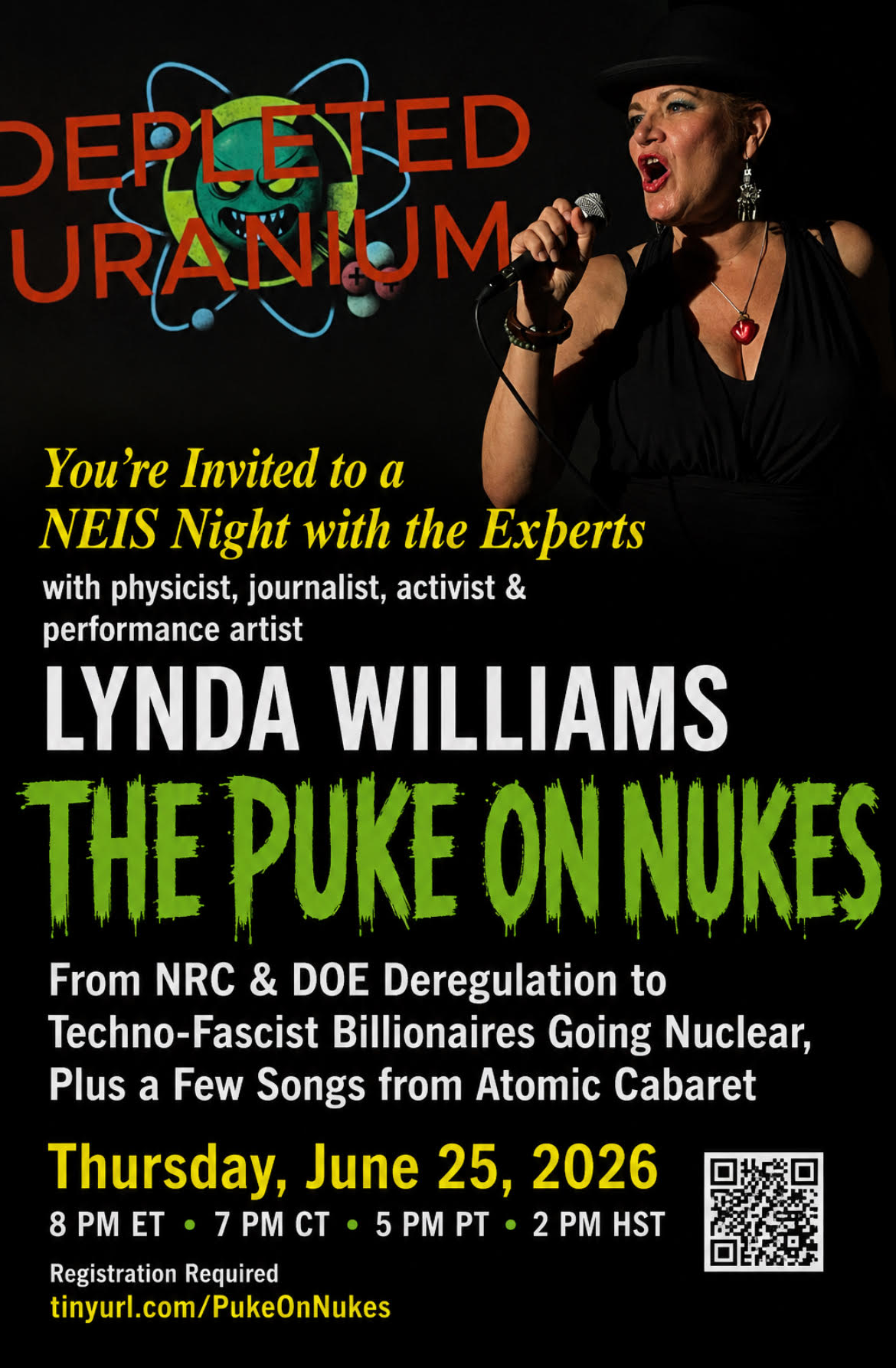
25 June- THE PUKE ON NUKES
Thursday, June 25, 2026
7pm Central Time (8pm ET, 6pm MT, 5pm PT) UTC – 5
From NRC & DOE Deregulation to Techno-Fascist Billionaires Going Nuclear, Plus a Few Songs from Atomic Cabaret REGISTER
26 June – Radiation Trainwreck at the NRC / Join the Protect Better Campaign – https://us02web.zoom.us/meeting/register/4ZlZ5_qLSHGiLSCg8FF6Bg#/registration

Cuba Is Not a Failed State – It Is a Besieged State
PETITION: “Global Appeal to Endorse Palestinian Right of Return of Refugees”
To see nuclear-related stories in greater depth and intensity – go to https://nuclearinformation.wordpress.com
-
Archives
- June 2026 (211)
- May 2026 (306)
- April 2026 (356)
- March 2026 (251)
- February 2026 (268)
- January 2026 (308)
- December 2025 (358)
- November 2025 (359)
- October 2025 (376)
- September 2025 (257)
- August 2025 (319)
- July 2025 (230)
-
Categories
- 1
- 1 NUCLEAR ISSUES
- business and costs
- climate change
- culture and arts
- ENERGY
- environment
- health
- history
- indigenous issues
- Legal
- marketing of nuclear
- media
- opposition to nuclear
- PERSONAL STORIES
- politics
- politics international
- Religion and ethics
- safety
- secrets,lies and civil liberties
- spinbuster
- technology
- Uranium
- wastes
- weapons and war
- Women
- 2 WORLD
- ACTION
- AFRICA
- Atrocities
- AUSTRALIA
- Christina's notes
- Christina's themes
- culture and arts
- Events
- Fuk 2022
- Fuk 2023
- Fukushima 2017
- Fukushima 2018
- fukushima 2019
- Fukushima 2020
- Fukushima 2021
- general
- global warming
- Humour (God we need it)
- Nuclear
- RARE EARTHS
- Reference
- resources – print
- Resources -audiovicual
- Weekly Newsletter
- World
- World Nuclear
- YouTube
-
RSS
Entries RSS
Comments RSS
 nuclear-news