The staggeringly huge problem of Los Alamos’ radioactive contamination

 ‘Los Alamos will never be clean’, Local News, Santa Fe New Mexican, By Staci Matlock 13 July 15 “……….The scientists knew this canyon was contaminated back in the 1950s and ’60s,” said Greg Mello, a former inspector with the state Environment Department and now a partner in the nuclear watchdog Los Alamos Study Group with his wife, Trish. “Their children played here.”
As people this year commemorate the 70th anniversary of the first atomic bomb, which helped lead to the end of World War II, often left out of the conversation is the legacy of environmental waste left behind from the making of that bomb and the thousands that followed.
Acid Canyon is among more than 2,000 dumpsites around the lab’s 43-square-mile property and thousands of other dumpsites at 108 locations in 29 states around the nation where waste from the Manhattan Project and subsequent nuclear weapons research was discharged, tossed or buried.

Efforts to clean up the contamination have taken decades and billions of dollars. The work isn’t finished yet, and it may never be complete in some places. Millions of cubic meters of hazardous waste still await cleanup, along with hundreds of contaminated buildings demolished or awaiting demolition at Savannah River in South Carolina, the Hanford plutonium processing plant along Washington’s Columbia River, Los Alamos and a dozen other sites.
A legacy of waste
Air, land, water and people all were exposed to hazardous and radioactive waste products while scientists and engineers were producing the Trinity test bomb and subsequent nuclear weapons.
Uranium miners, scientists, lab technicians and people living near research facilities or test sites around the United States during the heyday of the Manhattan Project were exposed to the highest immediate levels of radiation. They’ve sought compensation from the federal government for a litany of maladies and cancers related to their work on nuclear weapons.
The waste dumped in canyons, buried in unlined trenches or discarded in out-of-the-way places has represented longer-term hazards to people living in or near places where the components of nuclear weapons were processed. In the 1980s, the U.S. Department of Energy and the Army Corps of Engineers began cleaning up the waste sites around the country.
The danger from the waste depends on its radioactivity and how much of it people or animals are exposed to. People regularly are exposed to some level of radiation, which occurs naturally in the environment, such as uranium in soil and radon gas. The legacy waste adds to natural radiation levels in the environment and, left untreated, can increase the risks of cancers and other health problems.
At Los Alamos, lab workers dumped waste in trenches and pits, including those at Area G, a 63-acre dumpsite that opened in 1957. This includes thousands of cubic feet of low-level and mixed transuranic waste such as old lab coats, tools and other debris.
Nuclear waste is exempt from many federal environmental laws such as the Clean Water Act. The New Mexico Environment Department, after a court battle, gained some measure of regulatory control over the lab’s legacy waste only because it is mixed with other hazardous chemical waste. Under an agreement with the state, the lab in 2014 was on track to remove 3,706 cubic meters of hazardous and radioactive waste stored in above-ground containers and ship it to the nation’s only underground nuclear waste repository near Carlsbad when a lab container ruptured at the underground facility, halting operations.
A lab official said last year LANL still had thousands of cubic feet of contaminated waste left in 35 pits and 200 shafts at Area G. “The main concern is that Area G is smack dab over the regional aquifer,” said Scott Kovac, of Nuclear Watch New Mexico, noting the groundwater table is between 900 and 1,000 feet below the surface.

The Department of Energy and state environment officials are grappling with whether the increasing costs of cleanup at the lab and at other legacy waste sites outweighs the health risks of leaving waste where it is and capping it. Mello, who issued the first notice of violation to the lab for noncompliance with federal hazardous waste regulations in 1984, contemplated the trade-off: “Los Alamos will never be clean. It will always have tons of buried waste. Whether the waste is a health hazard is debatable.”
Costs of nuclear cleanup
The legacy costs of the Trinity Site test and the Cold War can be counted in human and environmental price tags……….
“It is costing a lot of money, taking a lot of time, and we’re leaving behind a lot of workers who have suffered,” Alvarez said.
Uranium miners and millers developed lung cancer and kidney cancers, among other illnesses. Scientists and other workers exposed to radiation from above-ground tests developed cancers of the lung, thyroid, esophagus, stomach and pancreas, as well as leukemia and other maladies.
More than 107,141 nuclear research workers and their families have received some of more than $11.6 billion in compensation and medical coverage as of July 5, according to the U.S. Department of Labor. More than a fourth of workers filing claims have cancer types recognized by the federal government as ones that can be caused by exposure to radioactive materials.
More than 4,900 former Los Alamos National Laboratory workers from World War II to the present have received $566 million for health problems related to their work at the lab……..
The costs of cleaning up legacy waste continue to climb. The Department of Energy’s life-cycle environmental liability for thousands of contaminated facilities and management of massive quantities of radioactive waste rose to $427 billion in 2014 from $297 billion in 2006, according to the agency’s fiscal report. The life cycle includes all of the department’s liabilities until the waste is finally cleaned up to federal standards — a process still years away in some locations.
The estimated liability for the legacy waste is higher than the combined state budgets of New Mexico, Texas, California, Arizona and Colorado.
The total life-cycle costs of managing environmental cleanup of legacy waste at Los Alamos were estimated at $2.9 billion in the Department of Energy’s fiscal year 2016 budget request to Congress. For Hanford, it is $63 billion, and for the Savannah River site, it is $71 billion.
“We keep on spending and yet the estimated environmental liability keeps growing,” said Jay Coghlan, executive director of Nuclear Watch New Mexico…………. Contact Staci Matlock at 986-3055 or smatlock@sfnewmexican.com. Follow her on Twitter @StaciMatlock. http://www.santafenewmexican.com/news/local_news/los-alamos-will-never-be-clean/article_a3cc7ce1-8af0-5113-8f38-5d4aa673fd7a.html
Mysterious die-off of whales in the pacific: US scientists test for radiation
TV: US scientists testing for radiation in dead whales as mysterious die-off in Pacific continues — Now 14 carcasses reported, expert warns “death toll could still rise” — “Whales may have consumed something toxic… trying to find an explanation for this unusual event” (VIDEO) http://enenews.com/tv-scientists-testing-radiation-mysterious-whale-die-pacific-continues-14-carcasses-reported-expert-warns-death-toll-could-rise-whales-consumed-toxic-trying-find-explanation-unusual-event-video?utm_source=feedburner&utm_medium=email&utm_campaign=Feed%3A+ENENews+%28Energy+News%29
KTUU, Jul 10, 2015 (emphasis added): 5 more dead whales found in Alaska waters since June; total 14 dead; Researchers try to understand mysterious whale deaths… Kate Wynne, a Marine Mammal Specialist for the Alaska Sea Grant Marine Advisory Program, told Channel 2 News that since the June 18 announcement of the nine dead fin whales, four humpback whales and another fin whale have been found dead. According to Wynne, the five whales appeared to have been dead for the same amount of time as the previously discovered whales… After the first two whales were discovered… it triggered a response from numerous agencies… “The good news is that this has gotten a lot of us to talk toeach other, and be alert,” Wynne said… Wynne thinks the whales may have consumed something toxic… Tests on tissue from one of the whales have proven negative for domoic acid, a biotoxin, and results on two other tests, for Paralytic Shellfish Poisoning (PSP) and Cesium-137 radioactivity, are still pending.
Alaska Dispatch News, Jul 10, 2015: More whales found dead in southern Alaska waters – Scientists investigating the mysterious deaths of nine endangered fin whales… report that the death toll has increased… five additional whales — one fin whale and four humpbacks — have been reported… So far, the only sample taken from any of the dead animals… came back negative for domoic acid, a toxin that is produced by algae… Results from other tests are still pending… [Scientists] have been trying to find an explanation for the unusual event. Wynne said it’s possible the toll could still rise. “The number of now-rotten carcasses may continue to climbas more people travel around the area and submit reports of carcasses they see,” she said.
AP, Jul 11, 2015: More whale carcasses found in Gulf of Alaska… [Wynne] said it’s possible that more carcasses will be reported as people continue to travel around the area.
AP, Jul 11, 2015: Whale deaths in Gulf of Alaskapuzzle scientists – More dead whales have been found in the Gulf of Alaska following the sightings of nine fin whale carcasses… five additional dead whales [were reported] over the past several weeks, including four humpbacks and one fin whale… Wynne says it’s possible that more whale carcasses could be reported soon.
CBC, Jul 11, 2015: Reports of whale carcasses off Alaska raise whale death toll to 14; Scientists don’t know what’s been killing humpback and fin whales
Watch a report from ABC San Diego on NOAA scientists on the way to study whales in Alaska
Cesium 137 & Cesium 134 detected in seaweed on the West Coast of British Columbia

We have new clear precise lab results that seaweed on the West Coast of BC has both Cesium 137 and Cesium 134 radiation in it. PLEASE stop eating from the Pacific. Results are from a test sample sent in from my friend Jeff whose use of a Geiger Counter on seaweed showed distinctly elevated readings. He sent the samples to labs and these were the results.
The final result is in for the seaweed sample you sent us on June 16, 2015.
137Cs = 0.5 +/- 0.3 Bq/kg
134Cs = 0.3 +/- 0.3 Bq/kg
The 137Cs is above the limit of detection. The 134Cs is at the detection,limit which is generally considered a nondetect.
While the amount of radio cesium was low it held up after repeated analyses. Although the result is a low detect, it is nevertheless one of the few samples that shows any radioactive cesium in west coast seaweed samples. Time will tell if it is part of a trend.
Source: Mimi German from Radcast.org
Global silence on developing radiation crisis in the oceans
 Fukushima: The Extinction-Level Event That No One Is Talking About, Collectively Conscious, July 15 by Satyapriya Source: dougmichaeltruth.wordpress.com “……….Roughly 72% of the Earth is made up of water, and if you look at a global map, you can see that all of the world’s oceans are connected; it’s essentially one ocean. So what happens when two of the planet’s large bodies of water are rendered lifeless? Since roughly 90% of Earth’s life is contained in the oceans, and two-thirds of the planet is water, what happens when the oceans die? What happens when we can no longer fish the oceans for food? The answer is simple: When the planet’s oceans die, all life on Earth will follow, but who cares? There’s a game on tonight, or some stupid shitcom that insults the intelligence.
What level of cognitive dissonance is adhered to that causes people to look away from painful truths? How is it that people can convince themselves that everything is just fine when we are staring our very extinction in the face? How many actually give a shit? Far too few unfortunately. The fact that the world’s top scientists have no idea how to contain the radiation at Fukushima speaks volumes about what happens when a species develops technologically yet does not operate with wisdom. They destroy themselves.
Has humanity made its decision that it will simply bow down and allow the few, through psychopathy and corporate greed to drive the planet into its very extinction? Is it game over for life on planet Earth?

We are certainly headed in that direction, but why would I want to face this painful truth and find my center when Miley Cyrus is on TV sucking off a blow up doll in her latest piece of shit video?
The time for humanity to collectively wake up and come together is here and now! We can no longer put off the mess for future generations to mop up because at the rate we are going, the planet will be unable to support life and very may well become a dead rock resembling Mars. This is where we stand as a species. Does this sound paranoid? Maybe, but that does not negate the fact that it’s true! So as we bow our heads in quiet approval, our home is being destroyed and your children’s futures are being stolen right from under them. Sleep on, everything is OK, and raise your glass to the extinction of humanity! http://collectivelyconscious.net/articles/fukushima-the-extinction-level-event-that-no-one-is-talking-about/
US Department of Energy’s dilemma over radioactive White Oak Lake
 What to do with DOE’s radioactive lake? http://www.knoxnews.com/news/local-news/what-to-do-with-does-radioactive-lake_89372659 Frank Munger, Jul 10, 2015 More than 30 years ago, when the magnitude of pollution problems on the U.S. Department of Energy’s Oak Ridge reservation was just becoming apparent, White Oak Lake was dubbed the nation’s — if not the world’s — most radioactively polluted body of water.
The 25-acre lake was created during the World War II Manhattan Project to collect radioactive discharges from Oak Ridge National Laboratory’s nuclear operations. The construction of White Oak Dam backed up White Oak Creek and prevented the nuclear wastes from flowing directly into the Clinch River and downstream reservoirs.
Much of the worst stuff settled into the lake’s sediments. That, of course, reduced the potential exposures to downstream dwellers, but it created an environmental problem all its own.
For decades, as the DOE-funded cleanup of Oak Ridge sites has progressed, there has been an often-asked, never-answered question: What to do with White Oak Lake?
The good news is that large-scale capping and closure projects in ORNL’s old burial grounds — where tons and tons of hot wastes were dumped — have greatly reduced the seepage of radioactive materials into the basin that empties into the lake. Over time, the radioactivity in the sediments of White Oak Lake has, via the process of radioactive decay, gradually diminished.
Where once there were thousands of curies of radioactivity — notably cesium-137, which has a half-life of about 30 years — that total is probably a few hundred or maybe less by now. But the lake is still a big hazard that requires attention. The dam is regularly inspected and maintained to reduce the chances of failure, and the water released over the dam is monitored continuously.
Years ago, regulators declared the DOE would be held accountable for the environmental degradation and at some point would probably be forced to drain the lake, clean up the radioactive muck and return the area to its pre-war condition.If so, it’s expected to be one of the last DOE-sponsored cleanup actions in Oak Ridge.
Based on a federal facility agreement with the EPA and the Tennessee Department of Environment and Conservation, the DOE is supposed to provide a range of alternatives to “remediate” the lake by 2036.
However, Chris Thompson, TDEC’s Oak Ridge overseer, said recent projections of future cleanup funding indicate the decision on White Oak Lake may be delayed until 2048. Mike Koentop, executive officer of the DOE’s cleanup program, said there are ever-changing budget projections, but the DOE currently plans to submit a final proposal for the lake in 2036. Senior Writer Frank Munger may be reached at 865-342-6329.
Ugly Australians, like Paladin Energy, linked to 100s of deaths in uranium mining in Malawi and Namibia
There is a very strong perception that when Australian mining companies come here they take every advantage of regulatory and compliance monitoring weaknesses, and of the huge disparity in power between themselves and affected communities, and aim to get away with things they wouldn’t even think of trying in Australia,”
 Australian miners linked to hundreds of deaths, injuries in Africa, SMH, July 11, 2015 -Will FitzgibbonAustralian mining companies are linked to hundreds of deaths and injuries in Africa, which can go unreported at home. Some of the Australian Securities Exchange-listed companies include state governments as shareholders. One company recorded 38 worker deaths over an eleven-year period.
 In Malawi, litigation continues against Paladin Africa Limited, a subsidiary of Perth-based Paladin Energy, and its subcontractor after an explosion disfigured one worker with such heat that his skin shattered when touched by rescuers. Two others died in the same incident.
Other allegations include employees in South Africa hacking a woman with a machete and Malian police killing two protesters after a mine worker reportedly asked authorities to dislodge a barricade on the road to the mine.
An investigation by the International Consortium of Investigative Journalists, in collaboration with 13 African reporters, uncovered locally-filed lawsuits, violent protests and community petitions criticising some Australian companies. Continue reading
Beautiful but deserted Pacific Runit Island with its hazardous radiation tomb
Deadly dome of gorgeous Pacific island leaking radioactive waste news.com.au , JULY 07, 2015 A PICTURESQUE coral atoll that lies northeast of Australia in the Pacific Ocean harbours a deadly secret.
A giant, concrete dome filled with radioactive waste looms above Runit Island, and it’s leaking. Locals call it “The Tomb”.
Runit (or Cactus) dome was used for Cold War nuclear testing by the US government for 10 years from 1948. There were 42 tests in total on Enewetak Atoll, including 22 explosions on platforms, barges and underwater in the space of just three months in 1958, just before a moratorium on atomic testing.
In the late 1970s, an estimated 73,000 cubic metres of contaminated topsoil was deposited in the Cactus nuclear test crater beneath the dome, according to a report commissioned by the US government.
It was only supposed to be a temporary measure — but the dome remains.
Scientists now fear that a major storm, typhoon or other natural disaster coulddamage the 46cm-thick concrete dome, releasing nuclear waste into the sea, The Guardian reports.
The US Department of Energy insists cracks in the dome are merely cosmetic, a result of drying and shrinking of the half-submerged dome, but there are plans for repairs. The 2013 report states that this is to satisfy local concerns, but adds that rainwater could infiltrate through the cracks, possibly affecting groundwater flow and “radionuclide migration into the marine environment”.

Inhabitants of Runit were resettled on nearby Enewetak Island in 1980. Even in the early days, concerns were raised over human exposure to radiation through locally grown food, with resettlers resorting to cans of spam, Columbia University’s Michael Gerrard wrote last year in The New York Times.
Runit remains uninhabited, home only to abandoned bunkers and cables, but locals still visit to fish and salvage scrap metal. It sounds dangerous, but impoverished Marshall Islanders say they have no choice.
And just because Runit is remote, doesn’t mean other countries are totally immune from its influence. A report published in the Environmental Science and Technology journal last year traced plutonium found in Guangdong province in the South China Sea back to the Marshall Islands…….. Continue reading
Deep in the ocean, the true scale of global warming is hidden
 Have the oceans been HIDING the true scale of global warming? http://sidharamp.blogspot.com.au/ Nasa warns heat hasn’t disappeared, it’s just been buried in the sea
- Scientists looked at a layer of the oceans between 300 and 1,000ft
- They found it has been accumulating more heat than first thought
- Study looked at direct ocean temperature data for more accurate results
- Previous attempts to explain the temperature trends have relied heavily on climate model results which are less able to deal with short-term data
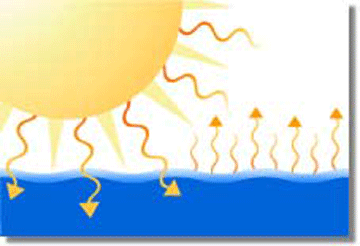
HOW OCEANS CAN BURY HEAT
The Ugly Australians, And Other Miners, Leaving Health and Environmental Damage in Namibia
[Paladin’s] Langer Heinrich Uranium mine[Namibia] …
Craton Mining and Exploration [copper] is a subsidiary of Australian-based International Base Metals…..
Rio Tinto owns Rössing Uranium Mine…
[Australian] Deep Yellow Limited (DYL) the Aussinanis uranium project.
Aussies in toxic trail By Shinovene Immanuel, Ndanki Kahiurika 10 July 15 http://www.namibian.com.na/indexx.php?id=28936&page_type=story_detail&category_id=1#sthash.TJSxEgQV.P3bN2nwk.uxfs&st_refDomain=blogs.icerocket.com&st_refQuery=/search?tab=buzz&fr=h&q=uranium+Australia NAMIBIA, a mining frontier for decades, continues to struggle with mining companies which subject workers to dangerous working conditions.
TROUBLING
What ICIJ uncovered and pieced together suggests a troubling track record on the part of Australian companies in the rush for Africa’s minerals, including practices that would be impermissible, even unthinkable, in Australia and other parts of the developed world.
ICIJ found that, at the end of 2014, there were more than 150 Australian-listed active mining companies with recorded properties in Africa. Other estimates, using different criteria, put the number even higher.
Australian companies have 49 mining licences in Namibia; two of those companies are operational.
Even though Australian firms run successful mining companies which contribute to Namibia’s economy and workplace conditions have improved compared to two decades ago, there are still questions about the safety of workers.
Thousands of people, including village chiefs, former employees, human rights defenders and government agencies across Africa have taken Australian companies, their subsidiaries and their contractors to court for alleged negligence, unfair dismissal and eviction or pollution, according to court submissions and judgements unearthed from more than a dozen countries.
Investigation at last into radioactive pollution of Johannesburg, from uranium mining

“[Johannesburg] is undoubtedly the most uranium-contaminated city in the world,”
Bench Marks, which receives support from UK charity Christian Aid, is mid-way through a three-year impact assessment of pollution levels in an around Johannesburg’s Soweto district. By systematically tracking air and water contamination, Bench Marks hopes to provide a scientific basis for the alleged health impacts of the tailings
Radioactive city: how Johannesburg’s townships are paying for its mining past, Guardian, Oliver Balch , 6 July 15
Much of the waste from 600 abandoned mines around South Africa’s largest city is piled high next to residential communities – most of which are poor and black Plaatjies is one of tens of thousands in Johannesburg’s impoverished townships who are paying a high cost for the city’s rich mining past. More than 600 abandoned mines surround South Africa’s largest city, with much of their waste now piled up high next to residential communities – most of which are poor and black.
Residents here fear the wind most. When it blows, fine particles from these man-made dumps are carried up into the air and deposited on to residents’ homes. It is no ordinary dust, either: the residue of decades of mining, it can contain traces of everything from copper and lead to cyanide and arsenic.
“During August and September, the dust is terrible. You stop cleaning the floor after a while. It’s just useless,” says Plaatjies.
In the local clinic, respiratory cases such as tuberculosis and asthma are ubiquitous across all age groups, says Musa Mbatha, chairman of the clinic’s civic committee. Rashes and skins diseases are commonplace, too.
“People can’t afford to buy food every day, so they leave the food and it gets contaminated,” Mbatha adds. “The government said that it would do a survey of the health impacts of the mining dust, but until today it hasn’t happened.”
An even more dangerous pollutant is lurking in Johannesburg’s mine dumps, however: radioactive waste. According to one university study, an estimated 600,000 metric tonnes of radioactive uranium are buried in waste rock in and around Johannesburg – around three times what was exported during the Cold War. Continue reading
Increased ionising radiation in Chernobyl area, following wildfires
 Radiation spike recorded after Chernobyl wildfire, International Business Times, Tom Porter
July 2, 2015 Nuclear inspectors have recorded a significant increase in radiation in the Chernobyl exclusion zone, after wildfires tore through forest near the devastated nuclear power station.
Radiation recordings in the Polesskoye settlement, which was abandoned after the 1986 nuclear reactor explosion, show air contaminated with 10 times the normal levels of deadly cesium-137, The State Nuclear Regulatory Inspectorate of Ukraine announced.
Cesium-137 is one of the most dangerous elements released in a nuclear explosion, and can cause leukemia after accumulating in the body……..
Ukranian capital Kiev lies only 132 km (82m) downwind of the current blaze, and Minsk, capital of Belarus, 342 km (213 m) north-west. The surrounding region is now largely deserted after the Soviet government resettled 116,000 people in the wake of the disaster.
“The real problem would be if the wind strength increased and fire got out of control. If there are very strong winds and they were blowing from east to west – as does happen in summer – it could be a risk to Europe,” he said.
Baverstock said that in the wake of the disaster, Cesium-137 was absorbed into the soil, and from, there into organic matter including tree bark and leaves. In forest fires, the chemical can be released into the atmosphere again, and can cause cancer to those who inhale it, or enter the food chain if ingested by animals.
Reports indicated that the fire is currently some distance from the main reactor, which is covered by a crumbling concrete dome, or the Red Forest, the 10 km zone around the reactor, believed to be one of the most radioactively contaminated areas in the world……..http://www.ibtimes.co.uk/radiation-spike-recorded-after-chernobyl-wildfire-1508955
Firefighters working around the clock as wildfires rage near Chernobyl nuclear site
Wildfires Once Again Rage Nearby the Chernobyl Nuclear Site https://news.vice.com/article/wildfires-once-again-rage-nearby-the-chernobyl-nuclear-site By VICE News July 1, 2015 A fire is raging across half a square mile of drought-stricken land surrounding the remains of the Chernobyl nuclear power plant in Ukraine, the site of one of the worst nuclear disasters in history. It’s the second fire to hit the area since late April. After a reactor exploded at the plant in 1986, authorities established an 18-mile exclusion zone that remains off-limits to most people today. Some parts of the zone remain highly contaminated.Ukraine’s State Emergency Situations Service reported early Tuesday that the fire was within the exclusion zone, according to the Ukrainian news service Interfax. But the country’s Minister of Ecology and Natural Resources later told reporters the fire is burning outside of the zone. He added that the blaze started due to drought.
The fire started Monday night and was still burning Tuesday morning, the Associated Pressreported.
Firefighters are working 24 hours a day amidst strong winds, according to a post on the emergency service’s Facebook page. Radiation levels are within normal, the agency said.
In late April, the largest forest fire in Ukraine since 1992 came within 12 miles of the Chernobyl plant.
In February, researchers warned that fires nearby Chernobyl “pose a high risk of redistributing radioactivity.” And, say scientists, wildfires in the area could become more frequent and more intense due to climate change.
Radiation effects on Fukushima’s birds are getting worse
Mousseau said the reason comes down to the long-term impact of the radiation. “It takes multiple generations for the effects of mutations to be expressed in natural populations,” he said
 Near site of Fukushima disaster, birds still in peril, By MICHAEL CASEY CBS NEWS April 16, 2015, Four years after the Fukushima disaster, birds are becoming a rarity around the damaged nuclear site.
A study in the Journal of Ornithology found that half the populations of 57 bird species had suffered declines. Studying birds over three years at 400 sites, University of South Carolina biologist Tim Mousseau and his colleagues found that the numbers continue to decline over time – even as the radiation threat drops.
“There are dramatic reductions in the number of birds that should be there based on the overall patterns,” Mousseau told CBS News. “In terms of barn swallows in Fukushima, there had been hundreds if not thousands in many of these towns where we were working. Now we are seeing a few dozen of them left. It’s just an enormous decline.”
In addition to barn swallows, the great reed warbler, Japanese bush warbler and the meadow bunting have been the hardest hit………
Mousseau also has been among researchers leading a project that compares the environmental impact of Fukushima to that of Chernobyl, the scene in 1986 of the worst accident at a nuclear plant. As the director of the Chernobyl + Fukushima Research Initiative, he looked at the impact of birds in both places.
In a second paper in the Journal of Ornithology this month, Mousseau and his longtime collaborator Anders Moller of the French National Centre for Scientific Research found that migratory birds appear to fare worse around Chernobyl than year-round residents. The opposite is true in Fukushima…….
Around Fukushima, Mousseau predicts the worst may not be over.
“The relationship between radiation and numbers started off negative the first summer, but the strength of the relationship has actually increased each year,” Mousseau says. “So now we see this really striking drop-off in numbers of birds as well as numbers of species of birds. So both the biodiversity and the abundance are showing dramatic impacts in these areas with higher radiation levels, even as the levels are declining.”
Mousseau said the reason comes down to the long-term impact of the radiation.
“It takes multiple generations for the effects of mutations to be expressed in natural populations,” he said, referring to effects such as shorter life spans and reduced fertility. “At some point, there will be a balance of the negative effects of mutations and immigration of fresh, new birds. We just don’t know enough to say when a balance will be reached.” http://www.cbsnews.com/news/fukushima-disaster-taking-a-toll-on-birds/
Radiation legacy of atomic bomb research
LAST SECRET OF THE ATOM BOMB, Who What Why, 30 June 15 In August 2005, the New York Police Department, with the Department of Energy, conducted an anti-terrorism radiation flyover survey. The survey was intended to provide a baseline of radiological activity, in order to catch a suspicious construction of a dirty bomb.
They didn’t find a dirty bomb—but there was plenty of radiological activity. Surveyors found 80 radioactive locations in the city—one of them being Great Kills Park in Staten Island, one of the city’s five boroughs. The Park is a popular place near a suburban enclave inhabited by cops, firefighters and other unsuspecting residents. The Park, more than 500 acres of woods surrounding softball and soccer fields and a marina, was constructed from garbage dumped in the bay between 1944 and 1946. Unregulated and illegal dumping has a long history in New York City.
Children Are Especially Vulnerable Continue reading
Radioactive Polonium from Fukushima has contaminated Southeast USA
 NASA Experts: Southeast US hit by “anomalously high” levels of polonium from Fukushima — Never seen before, except during volcanic events — Fallout also detected in Mississippi river — Polonium releases kept secret in past nuclear disasters; Death estimates would skyrocket if included http://enenews.com/nasa-experts-anomalously-high-levels-polonium-found-southeastern-after-fukushima-explosions-never-recorded-before-except-during-volcanic-events-fallout-detected-mississippi-river-polonium-rel?utm_source=feedburner&utm_medium=email&utm_campaign=Feed%3A+ENENews+%28Energy+News%29
Journal of Environmental Radioactivity, W. Yang and L. Guo, NASA Stennis Space Center and Univ. of Southern Mississippi Dept. of Marine Science, 2012 (emphasis added): Depositional fluxes and residence time of atmospheric radioiodine (131I) from the Fukushima accident
- The Fukushima Dai-ichi nuclear power plant explosions… emitted vast quantities of radioactive materials into the environment… radioiodine (131I)… 134Cs and 137Cs are of special concern to people because they could trigger dangerous health effects
- However, data on time series depositional fluxes are still lacking, preventing… prediction of the scope of dispersion especially in North America
- Following the Fukushima accident, a high level of 131I was first detected on March 23 in a dry deposition sample at [NASA’s space center]
- After this initial fallout, the 131I depositional flux increased up to ten- to twenty-foldduring the following two weeks, varying from 218 mBq/m^2/day to 463 Bq/m^2/day
- Concurrent high rainfall and high 131I fluxes were observed at the SSC site… from 97 to 337 mBq/L with an average of 217 mBq/L
- In addition to precipitation samples, 131I was also detectable in surface waters from the Pearl River in Mississippi, with an activity of 6.7 mBq/L
- Interestingly, the 210Po/210Pb ratios of the fallout samples during the peak 131I fallout period were anomalously high… Before and after the Fukushima accident, the environmental 210Po/210Pb ratio in precipitation samples varied from 0.02 to 0.09 with anaverage of 0.06 at the SSC in southern Mississippi… However, the 210Po/210Pb ratioduring the Fukushima fallout was up to 1.5 on March 23…
- To date, excess 210Po in the atmosphere was only reported for high temperature activities such as volcanic eruptions or degassing… Therefore, the anomalously high 210Po/210Pb ratios observed in the southern US were mostly derived from theFukushima Dai-ichi nuclear plant explosions which could have resulted in the fractionation of environmental 210Po and 210Pb and thus the preferential release of volatile 210Po into the atmosphere. Indeed, the anomalous 210Po/210Pb ratios were accompanied by the peak fallout of 131I… indicating that the Fukushima nuclear plant explosions mainly contributed to the anomaly in the 210Po/210Pb ratio…
- it seemed that regions reachable by 131I transport within two weeks from Fukushima would receive much more fallout…
New Scientist, Mar 1983: 25 years since the nuclear accident at Windscale… Attention has centred [on] radioactive iodine… the National Radiological Protection Board (NRPB) said the iodine-131 may have killed 13… However, the damage to health may have been much more severe… Indeed, it could represent the worst environmental disaster that Western Europe has known this century… re-examination of the data… reveals that one crucial isotope released in the fire has been ignored… there was one isotope released in the accident that is highly mobile [with] a high take-up by the human body… this was only revealed this week by the NRPB after New Scientist’s inquiries… It is polonium… polonium could give… a total dose to the UK of 5 million man-rems… the death figures may have to be revised significantly upwards… The figures suggest that some 1200 excess cases of leukaemia may have been caused in Britain by the Windscale accident. Since leukaemia deaths account for some 15 per cent of cancers attributable to nuclear accidents, the total toll of cancer deaths suggested is 8000… Clearly further investigations into the whole of the Windscale accident must be urgently pursued. The British are in effect now the nuclear laboratory of the world.
Woods Hole’s Ken Buesseler and others have cited polonium-210 levels in seafood tested for Fukushima radionuclides, for example: “Doses from eating fish are very low off US, and in fact 500 times greater from a natural radionuclide, polonium-210, but no one worries about 210Po.”
1 This Month



26 September – International Day for the Total Elimination of Nuclear Weapons


PLEASE OPPOSE HR 8255 AND S.3639 – bills would accelerate satellite deployment, with no environmental review or safeguards – https://ncstd5li.quorum.us/campaign/169331/
To see nuclear-related stories in greater depth and intensity – go to https://nuclearinformation.wordpress.com
-
Archives
- September 2026 (269)
- August 2026 (330)
- July 2026 (355)
- June 2026 (287)
- May 2026 (306)
- April 2026 (356)
- March 2026 (251)
- February 2026 (267)
- January 2026 (308)
- December 2025 (358)
- November 2025 (359)
- October 2025 (375)
-
Categories
- 1
- 1 NUCLEAR ISSUES
- business and costs
- climate change
- culture and arts
- ENERGY
- environment
- health
- history
- indigenous issues
- Legal
- marketing of nuclear
- media
- opposition to nuclear
- PERSONAL STORIES
- politics
- politics international
- Religion and ethics
- safety
- secrets,lies and civil liberties
- spinbuster
- technology
- Uranium
- wastes
- weapons and war
- Women
- 2 WORLD
- ACTION
- AFRICA
- Atrocities
- AUSTRALIA
- Christina's notes
- Christina's themes
- culture and arts
- Events
- Fuk 2022
- Fuk 2023
- Fukushima 2017
- Fukushima 2018
- fukushima 2019
- Fukushima 2020
- Fukushima 2021
- general
- global warming
- Humour (God we need it)
- Nuclear
- RARE EARTHS
- Reference
- resources – print
- Resources -audiovicual
- Weekly Newsletter
- World
- World Nuclear
- YouTube
-
RSS
Entries RSS
Comments RSS

