Persistence of radioactive caesium in ocean floor near Fukushima Daiichi
 Nuclear Accident: Cesium contamination persists in ocean floor near Fukushima Daiichi site http://www.sciencedirect.com/science/article/pii/S0265931X1530031X Journal of Environmental Radioactivity Volume 148, October 2015, Pages 92–110
Highlights
- • The majority of radiocesium is transported in the particulate fraction.
- • The contribution of the dissolved fraction is only relevant in base flows.
- • Significant transfer of particulate-bound radiocesium occurs during heavy rainfall.
- • Radiocesium deposited in floodplains may be remobilized, inducing contamination.
- • Transdisciplinary approach is required to quantify radiocesium transfers.
- Abstract The devastating tsunami triggered by the Great East Japan Earthquake on March 11, 2011 inundated the Fukushima Dai-ichi Nuclear Power Plant (FDNPP) resulting in a loss of cooling and a series of explosions releasing the largest quantity of radioactive material into the atmosphere since the Chernobyl nuclear accident. Although 80% of the radionuclides from this accidental release were transported over the Pacific Ocean, 20% were deposited over Japanese coastal catchments that are subject to frequent typhoons. Among the radioisotopes released during the FDNPP accident, radiocesium (134Cs and137Cs) is considered the most serious current and future health risk for the local population.
- The goal of this review is to synthesize research relevant to the transfer of FDNPP derived radiocesium from hillslopes to the Pacific Ocean. After radiocesium fallout deposition on vegetation and soils, the contamination may remain stored in forest canopies, in vegetative litter on the ground, or in the soil. Once radiocesium contacts soil, it is quickly and almost irreversibly bound to fine soil particles. The kinetic energy of raindrops instigates the displacement of soil particles, and their bound radiocesium, which may be mobilized and transported with overland flow. Soil erosion is one of the main processes transferring particle-bound radiocesium from hillslopes through rivers and streams, and ultimately to the Pacific Ocean. Accordingly this review will summarize results regarding the fundamental processes and dynamics that govern radiocesium transfer from hillslopes to the Pacific Ocean published in the literature within the first four years after the FDNPP accident.The majority of radiocesium is reported to be transported in the particulate fraction, attached to fine particles. The contribution of the dissolved fraction to radiocesium migration is only relevant in base flows and is hypothesized to decline over time. Owing to the hydro-meteorological context of the Fukushima region, the most significant transfer of particulate-bound radiocesium occurs during major rainfall and runoff events (e.g. typhoons and spring snowmelt). There may be radiocesium storage within catchments in forests, floodplains and even within hillslopes that may be remobilized and contaminate downstream areas, even areas that did not receive fallout or may have been decontaminated.
- Overall this review demonstrates that characterizing the different mechanisms and factors driving radiocesium transfer is important. In particular, the review determined that quantifying the remaining catchment radiocesium inventory allows for a relative comparison of radiocesium transfer research from hillslope to catchment scales. Further, owing to the variety of mechanisms and factors, a transdisciplinary approach is required involving geomorphologists, hydrologists, soil and forestry scientists, and mathematical modellers to comprehensively quantify radiocesium transfers and dynamics. Characterizing radiocesium transfers from hillslopes to the Pacific Ocean is necessary for ongoing decontamination and management interventions with the objective of reducing the gamma radiation exposure to the local population.
International Research Team studies Fukushima contaminants in seafloor sediments
Examining the fate of Fukushima contaminants, Science Daily,
Fraction of buried, ocean sediment uncovered by typhoons, carried offshore by currents August 18, 2015, Woods Hole Oceanographic Institution
- Summary:
- An international research team reports results of a three-year study of sediment samples collected offshore from the Fukushima Daiichi Nuclear Power Plant. The research aids in understanding what happens to Fukushima contaminants after they are buried on the seafloor off coastal Japan. Scientists found that a small fraction of contaminated seafloor sediments off Fukushima are moved offshore by typhoons that resuspend radioactive particles in the water.
- An international research team reports results of a three-year study of sediment samples collected offshore from the Fukushima Daiichi Nuclear Power Plant in a new paper published August 18, 2015, in the American Chemical Society’s journal,Environmental Science and Technology.
The research aids in understanding what happens to Fukushima contaminants after they are buried on the seafloor off coastal Japan.
Led by Ken Buesseler, a senior scientist and marine chemist at the Woods Hole Oceanographic Institution (WHOI), the team found that a small fraction of contaminated seafloor sediments off Fukushima are moved offshore by typhoons that resuspend radioactive particles in the water, which then travel laterally with southeasterly currents into the Pacific Ocean.
“Cesium is one of the dominant radionuclides that was released in unprecedented amounts with contaminated water from Japan’s Fukushima Daiichi nuclear power plant following the March 11, 2011, earthquake and tsunami,” says Buesseler. “A little over 99 percent of it moved with the water offshore, but a very small fraction–less than one percent–ended up on the sea floor as buried sediment.”
“We’ve been looking at the fate of that buried sediment on the continental shelf and tracking how much of that contaminated sediment gets offshore through re-suspension from the ocean bottom,” he adds.
The research team, which included colleagues from the Japan Agency for Marine-Earth Science and Technology and the Japan Atomic Energy Agency, analyzed three years’ worth of data collected from time-series sediment traps……….
-
“The total transport is small, though it is readily detectable. One percent or less of the contaminated sediment that’s moving offshore every year means things aren’t going to change very fast,” Buesseler says. “What’s buried is going to stay buried for decades to come. And that’s what may be contributing to elevated levels of cesium in fish–particularly bottom-dwelling fish off Japan.”
While there were hundreds of different radionuclides released from the Fukushima Daiichi Nuclear Power Plant during the disaster, after the initial decay of contaminants with half lives (the time it takes for one half of a given amount of radionuclide to decay) less than days to weeks, much of the attention has remained focused on cesium-137 and-134– two of the more abundant contaminants. Cesium-134 has a half-life of a little over two years, and so any found in the ocean could come only from the reactors at Fukushima. Cesium-137 has a half-life of roughly 30 years and is also known to have entered the Pacific as a result of aboveground nuclear weapons tests in the 1950s and ’60s, providing a benchmark against which to measure any additional releases from the reactors.
In October, Buesseler and the research team will return to Japan to redeploy more sediment traps. The continued study will help estimate how long it takes to decrease the level of radiocesium in seafloor sediments near the Fukushima Daiichi Nuclear Power Plant.
Story Source:
The above post is reprinted from materials provided by Woods Hole Oceanographic Institution. Note: Materials may be edited for content and length. http://www.sciencedaily.com/releases/2015/08/150818112431.htm
Tianjin explosion highlights need to prioritise environment over economic growth
 Tianjin blast must trigger real change in China, The Age, August 18, 2015 Hopefully, the thundering fireballs and devastation at Tianjin have shocked China’s authorities – and others in the world
China’s economic advances have come at a terrible cost to its environment.
The evidence is in its air, in the rivers and coastal waters, and in the vast tracts of farmlands so contaminated with heavy metals and pesticides that some senior offi- cials have warned they should never be used for food production. In 2014, a report by China’s Ministry of Environmental Protection noted almost 20 per cent of the country’s arable land is polluted.
Criminally lax regulations, corruption and widespread failures to enforce breaches of environmental laws add to the woes and fuel justifiable anger among Chinese people. But more than any other environmental disaster in China (and there have been far too many), the series of explosions that ripped through the major port of Tianjin last week galvanised attention on the awful risks of elevating profit goals and economic advancement above the environment and citizens’ safety……….. http://www.theage.com.au/comment/the-age-editorial/tianjin-blast-must-trigger-real-change-in-china-20150817-gj19t1.html#ixzz3jClGQ9na
Nuclear nations raise “allowable” limits of ionising radiation – knowing that this is unsafe
 damchodronma, 15 Aug 15, This is why the policy of nuclear nations is to raise ‘allowable’ limits for nuclear workers and the population generally when there are accidents… and since Atomic Age began. Contamination gets worse, it is worse for all life, but nothing about it is really safe or acceptable. It’s propaganda.
“The evidence from the Chernobyl affected territories reveals the real-world consequences of a simple and terrible new discovery: that the effects of low dose internal irradiation cause subtle changes in the genome that result in an increase in the general mutation rate. … first seen in cells in the laboratory. The Chernobyl evidence, shows that this seems to be true for all species, for plants and
animals and humans. It has profound implications that go beyond radiation protection and risk models.
“Krysanov …find that mice living in the high irradiation zone, 22 generations after the initial exposure, are MORE radiosensitive than mice living in lower exposure areas. The same effect is reported for plants by Grodzhinsky who wryly points out that plants cannot exhibit the ‘radiophobia’ that many of the Chernobyl effects have been blamed on. This flies in the face of current ideas about genetic selection.
“The effects of genomic instability are apparent in the evidence of massive harm to the organs and systems of living creatures at low doses of internal exposure, resulting in a kind of radiation ageing associated with random mutations in all cells. At the higher doses in the ‘liquidators’, after some years, their bodies seem to simply fall apart. In an astonishing statement we hear from Yablokov that in Moscow 100% of the liquidators are sick, in Leningrad 85%. These are men that ran like hares into the radiation fields with improvised lead waistcoats cut from roofs and who, by stabilising the situation at the reactor, saved Europe from a nuclear explosion equivalent to 50 Hiroshima Bombs – an outcome that would have made most of it uninhabitable. They are forgotten.
[THEY SIMPLY FALL APART]
“WHOLE BIOLOGICAL SYSTEMS COLLAPSE; at the cell level, at the tissue level and at the population level. Burlakova and Nazarov describe these subtle effects at lower doses of internal irradiation in laboratory cell systems and also people, Grodzhinsky shows the effects in plants, – higher for internal exposures than external, Krysanov shows the effects in wild animals and Yablokov and the Nesterenkos in the children and adults living and continuing to live in the contaminated territories. The effects clearly operate at what are presently thought to be vanishingly low doses.”
“ECRR Chernobyl: 20 Years On” (2006) pg 2
ECRR = European Committee on Radiation Risk
Dr. Chris Busby, Scientific Secretary wrote Introduction.
co-edited with Dr. Alexey Yablokov
http://life-upgrade.com/DATA/chernobylebook.pdf
Spanish http://ciaramc.org/ciar/boletines/cr_bol226.htm
Nuclear bomb testing has resulted in radioactive polonium in seafoods
Kiwis exposed to radiation in seafood – study http://www.3news.co.nz/nznews/kiwis-exposed-to-radiation-in-seafood—study-2015081507#axzz3ipQ2JViV Saturday 15 Aug 2015 New Zealanders who eat a lot of seafood may be exposing themselves to radiation and putting their health at risk, a study suggests.

Researchers found seafood such as mussels, paua and oysters contained concentrated levels of radiation.
Those at particular risk were sub-populations for whom fish consumption was culturally important and those relying of fishing and shellfish collection to feed their families, the study’s authors said in an article released on Friday.
“Seafood has importance to the New Zealand population as a source of nutrition consumed in considerable amounts by some sectors of the community,” they said.
“Chemical contaminants in seafood can therefore lead to significant health burdens to the population and it is an important public health function to identify the contaminants of concern and characterise their exposure.”
Researchers measured levels of radioactive caesium and polonium in 36 kinds of seafood.
Levels of caesium were of minimal dietary concern, but levels of polonium could “contribute significantly to the dietary does of ionising radiation for high seafood consumers, although the magnitude varies considerably depending on the composition of seafood species consumed,” the researchers said.
They found levels in New Zealand were the same as found in other countries, which suggested the radiation was a worldwide result of global nuclear testing rather than the 2011 Fukushima incident.
Radiation levels were higher in seafood than other foods, they said.
The study by Andrew Pearson, Sally Gaw, Nikolaus Hermanspahn and Chris Glover was published in the Journal of Environmental Radioactivity earlier this year.
SEAFOOD WITH HIGHER CONCENTRATED RADIATION LEVELS:
- Slapjack tuna
- greenshell mussels
- paua
- queen scallop
- rock lobster
- Bluff oyster
- littleneck clams
Judge’s ruling prioritises uranium industry over Grand Canyon’s health and environment
TAKE ACTION: Tell President Obama to protect the Grand Canyon from mining and share the message on Facebook
This uranium project could haunt the Grand Canyon region for decades to come,” said Katie Davis with the Center for Biological Diversity. “Uranium mining leaves a highly toxic legacy that endangers human health, wildlife and the streams and aquifers that feed the Grand Canyon. It’s disappointing to see the Forest Service prioritizing the extraction industry over the long-term protection of a place as iconic as the Grand Canyon.”
‘Beyond Unacceptable’: Judge OKs Uranium Mine at Grand Canyon s underground aquifers. Slamming ruling, conservationists warn of irreversible contamination of the canyon’s underground aquifers.By Reynard Loki / AlterNet August 12, 2015 In June, the Grand Canyon was named one of the “Most Endangered Places” in America by the National Trust for Historic Preservation. But the designation came just two months too late to possibly influence U.S. District Court Judge David Campbell. In April, he denied a request by the Havasupai tribe and a coalition of conservation groups to halt new uranium mining next to Grand Canyon National Park, just six miles from the Grand Canyon’s South Rim.
“We are very disappointed with the ruling by Judge Campbell in the Canyon Mine case,” said Havasupai Chairman Rex Tilousi. “We believe that the National Historic Preservation Act requires the Forest Service to consult with us and the other affiliated tribes before they let the mining company damage Red Butte, one of our most sacred traditional cultural properties.” He said that the Havasupai Tribal Council would appeal the decision.
Cleaning Up Contamination? Next to Impossible Continue reading
“Trillions of becquerels of radioactive material still flowing into sea” at Fukushima
 Officials: “Trillions of becquerels of radioactive material still flowing into sea” at Fukushima — Map shows nuclear waste coming up from bottom of ocean far offshore — Japan TV Journalist: “Contaminated seawater will circulate around globe… disaster like a huge cloth expanding everyday” (VIDEO) http://enenews.com/officials-trillions-becquerels-radioactive-material-flowing-sea-fukushima-map-shows-nuclear-waste-flowing-bottom-ocean-offshore-japan-tv-journalist-contaminated-seawater-will-circulate-around-gl?utm_source=feedburner&utm_medium=email&utm_campaign=Feed%3A+ENENews+%28Energy+News%29
Interview with NHK journalist Morley Robertson, by the Center for Remembering 3.11, published Jun 30, 2012 (emphasis added): I begin with the radiation leakage. Radiation leakage exerts a long term effect on the environment. It contaminates our food chain, the groundwaterand the ocean. And the contaminated seawater will circulate around the globe. We never know how much this will impact on the environment… We’ll never able to study such issues with empirical certainty… [Due to nuclear testing] we have already accumulated “hidden losses” of radiation damage… how much is the [Fukushima] cesium in relation to that?… I believe we should enjoy delicious food rather than worrying about the food. I enjoyed the town’s delicacy… I didn’t mind about how the beef was produced or where it came from. As long as it is tasty, it is no problem for me. With regard to radiation, I have become more optimistic. My hypothesis is that it’s no use worrying about radiation. For people in Fukushima, they have a lot to worry about their future, like damaged reputation… One reason why we have relied on nuclear plants is because we didn’t know about the facts… We need to face the facts… Rad-waste from the nuclear cycle is said to be unsolvable even after 2.5 million years.
Part II of Robertson’s Interview, published Jun 30, 2012: In 1974, then PM Tanaka declared, “Let ‘s go nuclear!”… we were issued credit cards to buy electric goods to consume the extra electricity… It is OK to say that everything was just a lie… and 3/11 happened. So we must study everything. It isno longer about what to do with Onagawa nuclear power plant, Miyagi or Tohoku. This is about what to do with Japan. This has been revealed by our vulnerability to the accident… So when we talk about “disaster“, it’s like a huge wrapping cloth expanding everyday.
- NHK: Morley is a journalist… working in the fields of television, radio, and lecture meetings… he studied at the University of Tokyo and Harvard University.
- Robertson’s Wikipedia entry (translated from Japanese by Microsoft): In 1968, because of father’s job moved to… Hiroshima [to work] on Atomic Bomb Casualty Commission [and] undertook study of atomic bomb patients.
TEPCO, updated Mar 10, 2015: Fukushima Daiichi Contaminated Water Issue FAQ — Q1Please explain the impact of the leaked radioactive materials on the sea. [Answer:] TEPCO announced that underground water including radioactive materials had leaked into the port… It has been implied that trillions of becquerels of radioactive materials are still flowing into the sea; however, the concentration of radioactive materials in the sea is at a level that meets the Guidelines for Drinking-water Quality, except for some areas…
TEPCO, Apr 28, 2015: Comprehensive risk review was implemented, considering all the possible risks that might have an impact outside the Fukushima Daiichi NPS site… Thepaths through which water could leak outside the site: …
- Sources of risk — Trenches… Pits… Tanks… Accumulated water inside reactor buildings… Contamination inside the port
- Leakage routes — Ground surface… Drainage channels… Underground (groundwater)
- Destination of the contaminated material… The Sea: Unit 1-4 water intake channel… Inside the port… Outside the port
Radioactive area of Chernobyl again on fire
 Chernobyl exclusion zone on fire again http://www.rt.com/news/311976-
 chernobyl-exclusion-
zone-fire/ 9 Aug, 2015 As many as 32 hectares of new wildfires have been registered in the exclusion zone close to the Chernobyl nuclear power plant, report Ukraine’s emergency services report. Firefighters are battling new fires that have flared up in the Kiev region.
The fires started in three locations close to the villages of Zamostye and Kovshilovka in the Ivankovsky area. As of 7am on Sunday, the fires have been reportedly localized, with firefighters continuing to extinguish burning dry grass and forest cover.
Shortly afterwards, Ukraine’s Ministry of Emergency Situations reported that another forested area, known as Chernobylskaya Pushcha, had caught fire.
“The fire has spread to the abandoned villages of Kovshilovka and Buda Varovichi, located in the exclusion and unconditional (mandatory) resettlement zones,” the ministry said on their website.
The situation has now been brought under control.
Forest fires in Chernobyl’s exclusion zone began in April this year. The head of the State Emergency Service of Ukraine Nikolay Chechetkin said that up to 70 percent of all the wildfires in Chernobyl exclusion zone are due to arson.
Experts warned that radioactive nuclides absorbed by the foliage around Chernobyl nuclear power plant from the soil contaminated as a result of the 1986 disaster can easily be released into the air and have a cumulative negative effect on the health of those who breathe in particles.
While firefighters were dealing with wildfires near Chernobyl from April through to July, the Kiev authorities gave assurances that there was no radiation threat. Territory engulfed by fires in the exclusion zone had reached 400 hectares by the beginning of May.
READ MORE: Chernobyl fire: Kiev claims no radiation threat, experts ring alarm bells
However, locals recalling the 1986 catastrophe fear that just as then officials are concealing the truth.
If the trees, which have been absorbing radioactivity for almost 30 years, are on fire, then radioactive elements “may spread with wind over long distances,” Yury Bandazhevsky, a scientist working on the sanitary consequences of the Chernobyl disaster, said in May.
READ MORE: ‘No one tells us the truth’: Locals near Chernobyl fear radiation, Kiev says fire put out
USA government makes rules on ionising radiation in water more lax
 EPA raises permissible levels of radiation in drinking water https://thewrongblogg.wordpress.com/2015/08/04/epa-raises-permissible-levels-of-radiation-in-drinking-water/ The White House has given final approval for dramatically raising permissible radioactive levels in drinking water and soil following “radiological incidents,” such as nuclear power-plant accidents and dirty bombs. The final version, slated for Federal Register publication as soon as today, is a win for the nuclear industry which seeks what its proponents call a “new normal” for radiation exposure among the U.S population, according Public Employees for Environmental Responsibility (PEER).
Issued by the Environmental Protection Agency, the radiation guides (called Protective Action Guides or PAGs) allow cleanup many times more lax than anything EPA has ever before accepted. These guides govern evacuations, shelter-in-place orders, food restrictions and other actions following a wide range of “radiological emergencies.” The Obama administration blocked a version of these PAGs from going into effect during its first days in office. The version given approval late last Friday is substantially similar to those proposed under Bush but duck some of the most controversial aspects: Continue reading
US Nuclear plants doing Problem Evaluation Reports on ‘complex and urgent’ situation of water seepage
Gov’t: Erosion is “undermining foundation” of major dam upstream of US nuclear plants — “Extensive network” of seepage paths found — “Water flowing through from multiple sources & multiple directions” — Nuclear plants doing Problem Evaluation Reports on ‘complex and urgent’ situation (VIDEO) http://enenews.com/govt-erosion-undermining-foundation-major-dam-upstream-nuclear-plants-extensive-network-seepage-paths-discovered-water-flowing-multiple-sources-multiple-directions-nuclear-plants-doing-proble?utm_source=feedburner&utm_medium=email&utm_campaign=Feed%3A+ENENews+%28Energy+News%29
TVA’s Boone Dam repair announcement, Jul 30, 2015 (emphasis added):
- 2:30 — The location of this sinkhole and the presence of the sediment… really raised the possibility of a safety concern with the dam… The initial investigation showed that we had internal erosion. A phenomenon called ‘piping’ where voids from water flowing through the dam — more of a stream-like effect — than just seepage. Internal erosion is one of the leading causes of dam failures around the world. So we knew that we had to do something here to protect the safety of the public… particularly downstream risk… Around the clock inspectors [are] keeping surveillance on the dam [and we have] sensors to monitor movements that might occur in the dam itself.
- 4:00 — One of the key findings so far is that water is flowing through the foundation from multiple sources, and in multiple directions. It’s actually seeping through porous rock — rainwater upstream, through porous rock, through the dam…
- 9:15 — There’s still a lot of unknowns as we move into the project.
- 21:30 — There’s only 3 companies in the world that do this kind of remediation.That’s the complexity we’re talking about.
- 24:00 — Reporter: You said that water was coming from multiple sources and moving in multiple directions. To the people who are watching… I would think they would think that seems like an impossible task to do. There are some… in this community who think… that Boone Dam can’t be fixed… Is there a possibility that these solutions that you’re proposing won’t work?
TVA’s Boone Dam Investigation and Analysis Summary: [There is] “internal erosion,” in which voids develop within a dam and/or its foundation because of the action of flowing groundwater… one of the leading causes of dam failures… March of 2015, TVA discovered a well-developed, complex network of groundwater seepage paths coming from sources other than the reservoir… surface runoff flows underneath the dam and is a leading contributor to the observed seepage and sinkhole… Further investigation has confirmed that deterioration of the cutoff trench has occurred as seepage flows continue to undermine the foundation of the embankment dam… If left unaddressed, continued internalerosion may lead to enlargement of the network of voids at which time a large influx of water into the voids could cause rapid acceleration of internal erosion and eventual breaching of the dam. Due to the complex and urgent nature of the situation at Boone Dam, TVA has complemented its own dam safety engineers with nationally recognized experts… In its current state, the dam cannot be relied upon to serve the functions for which it was constructed. In the unlikely event of a dam failure, risks to the public wouldinclude: … loss of critical infrastructure [and] potential loss of life… [We are] engaging local and state emergency management officials… developing specific plans to address potential emergencies and conducting mock exercises to execute those plans. TVA has also initiated efforts to reinforce downstream facilities in a way that will minimize potential risks from an unlikely failure of Boone Dam.
TVA’s Boone Dam Weekly Update, Jun 23, 2015: Our investigation has shown that more water is seeping through the foundation of the dam than would typically be expected. A contributor to the seepage is the high water table from the area just east of the dam. Both sources of seepage and subsequent erosion have created an extensive network of seepage paths beneath the dam… TVA Dam Safety experts [are] working to understand the extent of the seepage and erosion…
Sequoyah Nuclear Plant – NRC Integrated Inspection Report (pdf), Feb 4, 2015: For the five operability evaluations described in the problem evaluation reports (PERs) listed below, the inspectors evaluated the technical adequacy of the evaluations… The inspectors completed five samples [including] PER 952079 – Functional Evaluation of Boone Dam Sinkhole.
Watts Bar Nuclear Plant – NRC Integrated Inspection Report (pdf), Feb 9, 2015: The inspectors reviewed the operability evaluations affecting risk-significant mitigating systems listed below [including] PER 952103 for the discovery of a sinkhole and tailwater sediment at the Boone Dam.
If South Australia gets nuclear facilities, they’ll be endangered by increasing wildfires
If the radiation leak lasts more than a few hours, there is no viable safe plan. If the radiation plume passes, the ground will probably still be contaminated
Wildfires also threaten Nuclear Waste and Nuclear Waste Shipments
 Wildfires and Nuclear Don’t Mix: Lessons from San Onofre and Chernobyl to Australia https://wordpress.com/read/post/feed/4410547/762849951 [good
photos] miningawareness 27 July 15 As the deadline looms (3 Aug.) for comments regarding the risks of the nuclear fuel chain for South Australia – whether uranium mining, which is already occurring, or any proposed additions (uranium enrichment, nuclear energy, nuclear waste), foremost in everyone’s minds should be the
risk of Bushfires (Wildfires), as well as endangerment to the Great Artesian Basin (GAB) aquifer, upon which so much of Australia is dependent for water, and which is being depleted, and most assuredly contaminated, by uranium and other mining:https://miningawareness.wordpress.com/2015/07/25/nuclearcommissionsaust-have-your-say-for-the-future-of-south-australia-submissions-close-soon-july-theme/ (Australia’s uranium mining “generates less than 0.2 per cent of national export revenue and accounts for less than 0.02 per cent of jobs in Australia.”http://www.conservationsa.org.au/images/Nuclear_Royal_Commission_issues.pdfMeanwhile it is laying waste to the land and provided nuclear fuel for Fukushima)
“The Australian climate is generally hot, dry and prone to drought. At any time of the year, some parts of Australia are prone to bushfires with the widely varied fire seasons reflected in the continent’s different weather patterns. For most of southern Australia, the danger period is summer and autumn.” http://www.ga.gov.au/scientific-topics/hazards/bushfire/basics/where
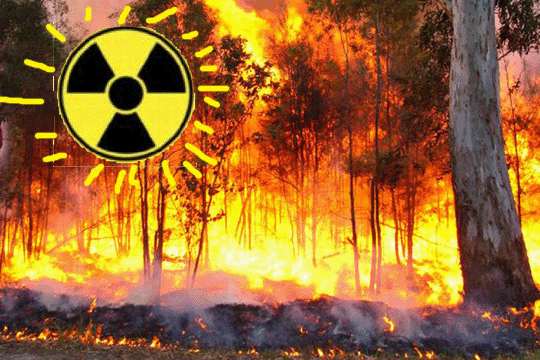
2015 Wildfires Near Chernobyl http://www.mns.gov.ua/news/40286.html
In April of this year, and again from the end of June into mid July, hundreds of firefighters in the Ukraine bravely battled fires in the area of the Chernobyl nuclear power station. Smoldering peat fires were the hardest to put out.
http://www.mns.gov.ua/news/40286.html
While this represents a serious danger to Europe, it received shockingly little media coverage. Continue reading
Environmental factors, not genes, cause cancer, as history shows
 Scientists suggest that cancer is purely man-made http://phys.org/news/2010-10-scientists-cancer-purely-man-made.html#jCp October 14, 2010 (PhysOrg.com) –– Cancer is a modern, man-made disease caused by environmental factors such as pollution and diet, a study by University of Manchester scientists has strongly suggested.
The study of remains and literature from ancient Egypt and Greece and earlier periods – carried out at Manchester’s KNH Centre for Biomedical Egyptology and published in Nature Reviews Cancer – includes the first histological diagnosis of cancer in an Egyptian mummy.
Finding only one case of the disease in the investigation of hundreds of Egyptian mummies, with few references to cancer in literary evidence, proves that cancer was extremely rare in antiquity. The disease rate has risen massively since the Industrial Revolution, in particular childhood cancer – proving that the rise is not simply due to people living longer. Continue reading
Effects of Fukushima radiation on pale grass blue butterfly
The biological impacts of the Fukushima nuclear accident on the pale grass blue butterfly / 福島原子力発電所事故のヤマトシジミへの生物学的影響 http://csrp.jp/posts/654
Atsuki Hiyama, Chiyo Nohara, Seira Kinjo, Wataru Taira, Shinichi Gima, Akira Tanahara & Joji M. Otaki
AffiliationsContributionsCorresponding author
Scientific Reports 2, Article number: 570 doi:10.1038/srep00570
Received 06 June 2012 Accepted 24 July 2012 Published 09 August 2012 Updated online 06 August 2013
Corrigendum (August, 2013)
The collapse of the Fukushima Dai-ichi Nuclear Power Plant caused a massive release of radioactive materials to the environment. A prompt and reliable system for evaluating the biological impacts of this accident on animals has not been available. Here we show that the accident caused physiological and genetic damage to the pale grass blue Zizeeria maha, a common lycaenid butterfly in Japan. We collected the first-voltine adults in the Fukushima area in May 2011, some of which showed relatively mild abnormalities. The F1 offspring from the first-voltine females showed more severe abnormalities, which were inherited by the F2 generation. Adult butterflies collected in September 2011 showed more severe abnormalities than those collected in May. Similar abnormalities were experimentally reproduced in individuals from a non-contaminated area by external and internal low-dose exposures. We conclude that artificial radionuclides from the Fukushima Nuclear Power Plant caused physiological and genetic damage to this species.
http://www.nature.com/srep/2012/120809/srep00570/full/srep00570.html
Hiyama A, Nohara C, Kinjo S, Taira W, Gima S, Tanahara A, Otaki JM. (2012)
The biological impacts of the Fukushima nuclear accident on the pale grass blue
butterfly. Scientific Reports 2: 570. DOI: 10.1038/srep00570
Published on 9 August 2012
要旨
福島第一原子力発電所の崩壊は環境への放射性物質の大規模な放出を引き起こした。この事故の動物への生物学的影響を評価する迅速で信頼に足る実験系は現在のところ報告されていない。我々はここに、この事故が日本で普通に見られる鱗翅目シジミチョウ科ヤマトシジミへの生理的・遺伝的損傷の原因となっていることを示した。第一化の成虫を福島地域で 2011 年 5 月に採集したところ、そのうちいくつかは比較的軽度の異常を示した。第一化の雌から産まれた F1 には親世代より高い異常が観察された。この異常は次世代 F2 に遺伝した。2011 年 9 月に採集した成虫の蝶には 5 月に採集されたものに比べ、より過酷な異常が観察された。同様の異常は、非汚染地域の個体において、外部および内部の低線量被曝により、実験的に再現された。我々は、福島原子力発電所由来の人工放射性核種がこの生物種に生理的・遺伝的損傷を引き起こしたと結論する。
http://w3.u-ryukyu.ac.jp/bcphunit/Hiyama_et_al_2012_verJP.pdf
India’s Mayapuri residents concerned about ionising radiation in scrap machinery
Mayapuri haunted by radiation fears of 2010, Mohit Sharma, Hindustan Times, New Delhi Jul 21, 2015
Fear of a radiation leak is haunting businessmen and residents of Mayapuri, who claim that that authorities have failed to keep a check on the large scale dismantling of machines that go on in the area.

RK Gupta, the general secretary of the Mayapuri-Rewariline industrial welfare association says that while the content of scrap, vehicles and other items brought for dismantling are dubious and remain unverified, open dismantling of machines poses the danger of a repeat of radiation incident that occurred in the area five years ago………http://www.hindustantimes.com/newdelhi/mayapuri-haunted-by-radiation-fears-of-2010/article1-1371431.aspx
Is Fukushima radiation affecting Arctic wildlife?
UNIVERSITY OF ALASKA SCIENTISTS: FUKUSHIMA RADIATION MAY BE MAKING ALASKA SEALS  SICK http://www.infowars.com/university-of-alaska-scientists-fukushima-radiation-may-be-making-alaska-seals-sick/ Washington’s Blog January 26, 2014
American sailors on the USS Reagan got really sick after having snowball fights with radioactive snow blowing off of the coasts of Fukushima. University of Alaska professors Doug Dasher, John Kelley, Gay Sheffield, and Raphaela Stimmelmayr theorize that radioactive snow might have also caused Alaska’s seals to become sick er plant resulting in a major nuclear accident that included a large release of airborne radionuclides into theenvironment.
Within five days of the accident atmospheric air masses carrying Fukushima radiation were transiting into the northern Bering and Chukchi seas. During summer 2011 it became evidentto coastal communities and wildlife management agencies that there was a novel disease outbreak occurring in several species of Arctic ice-associated seals. Gross symptoms associated with the disease included lethargy, no new hair growth, andskin lesions, with the majority of the outbreak reports occurring between the Nome and Barrow region. NOAA and USFWS declared an Alaska Northern Pinnipeds Usual Mortality Event (UME) in late winter of 2011.
The ongoing Alaska 2011 Northern Pinnipeds UME investigation continues to explore a mix of potential etiologies (infectious, endocrine, toxins, nutritious etc.), including radioactivity. Currently, the underlying etiology remains undetermined [i.e. scientists don’t yet know what caused the seals’ sickness, but they think it might have been Fukushima radiation]. We present results on gamma analysis (cesium 134 and 137) of muscle tissue from control and diseased seals, and discuss wildlife health implications from different possible routes of exposure to Fukushima fallout to ice seals. Continue reading
1 This Month


No Nuclear in Cwm Llynfi! Stop the nuclear power station near Maesteg.


4 August – WEBINAR – Hiroshima & Nagasaki: Nuclear Bombs Never Again
Tuesday, Aug. 4 at 5 pm PT / 8 pm ET.
Aug 5, 2026 10:00 AM in Australia/Melbourne
Join the Nuclear Bombs Never Again webinar on August 4th at 5pm Pacific Time / 8pm Eastern Time / 9am Japan Standard Time.
Cross generational voices at the intersection of Japan-Korea-US policy and militarization will share their lived experiences, nuclear impacts in these contexts, anti-war strategies, and actions you can take to advocate for a world with Nuclear Bombs Never Again. This 75-minute event is co-hosted by WILPF US and Korea Peace Now.

22,000+ miles voyaging for nuclear disarmament
and a radiation-free environment https://vfpgoldenruleproject.org/
To see nuclear-related stories in greater depth and intensity – go to https://nuclearinformation.wordpress.com
-
Archives
- July 2026 (332)
- June 2026 (287)
- May 2026 (306)
- April 2026 (356)
- March 2026 (251)
- February 2026 (267)
- January 2026 (308)
- December 2025 (358)
- November 2025 (359)
- October 2025 (375)
- September 2025 (257)
- August 2025 (319)
-
Categories
- 1
- 1 NUCLEAR ISSUES
- business and costs
- climate change
- culture and arts
- ENERGY
- environment
- health
- history
- indigenous issues
- Legal
- marketing of nuclear
- media
- opposition to nuclear
- PERSONAL STORIES
- politics
- politics international
- Religion and ethics
- safety
- secrets,lies and civil liberties
- spinbuster
- technology
- Uranium
- wastes
- weapons and war
- Women
- 2 WORLD
- ACTION
- AFRICA
- Atrocities
- AUSTRALIA
- Christina's notes
- Christina's themes
- culture and arts
- Events
- Fuk 2022
- Fuk 2023
- Fukushima 2017
- Fukushima 2018
- fukushima 2019
- Fukushima 2020
- Fukushima 2021
- general
- global warming
- Humour (God we need it)
- Nuclear
- RARE EARTHS
- Reference
- resources – print
- Resources -audiovicual
- Weekly Newsletter
- World
- World Nuclear
- YouTube
-
RSS
Entries RSS
Comments RSS
 nuclear-news