Call on President Obama to protect precious groundwater from uranium mining in Grand Canyon
Huffington Post, 24 Nov 15, [Good maps] “…….The mining industry’s statement counts on readers to be ignorant
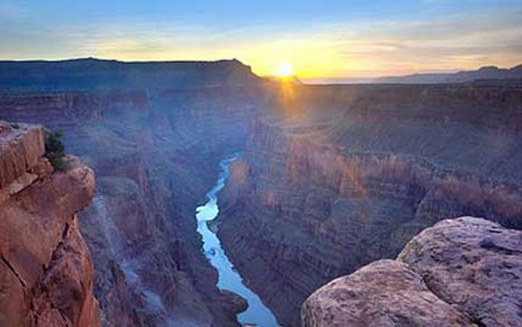 of the fact that federal and state agencies do not require wells to measure water pollution more than a thousand feet underground, where uranium mining threatens aquifers that feed springs deep within the Grand Canyon. No monitoring means contamination is undetected: out of sight, out of mind.
 But that’s changing as the U.S. Geological Survey pieces together samples taken from existing wells and places where groundwater flows downward into the Grand Canyon. These show that mining has already polluted 15 springs and five wells within the Grand Canyon’s watershed with toxic levels of uranium.
As I’ve said with regards to oil and gas development, one well contaminated or one person made sick is one too many. The same is true for uranium mining, making the situation around the Grand Canyon a disaster where we can least afford one.
In 2012, this sorry history led my friend and fellow Coloradan, Interior Secretary Ken Salazar, to impose a 20-year ban on new uranium mining in the watersheds that drain directly into the Grand Canyon. His action came in response to thousands of new mining claims filed in the preceding decade. Science and prudence also guided his decision, coupled with the knowledge that nearly $1 billion in annual economic activity is generated by this greatest of earth’s geological treasures.
Need for Permanent Ban on Grand Canyon Uranium Mining
The bill aims to protect 1.7 million acres of historical tribal homeland, including water sources and sacred sites.
Unfortunately, there’s almost no chance that the legislation will gain approval in today’s gridlocked Congress. But the 1906 Antiquities Act gives the president unilateral authority to set aside federal lands as protected national monuments to stop the looting of archaeological sites and for reasons of “historic or scientific interest.”
I’ve long believed we will be judged by the nation we leave to future generations. After all, we don’t inherit the earth from our parents — we borrow it from our children. The president should act now to protect the Grand Canyon from irresponsible development around this national treasure.
The National Mining Association may not be willing to stop digging — literally or figuratively — but the president owes it to us all to help them.
Florida citrus fruitys show trace levels of Fukushima radioactive cesium-137
 Trace levels of radioactive cesium-137 from Fukushima now being detected in Florida citrus fruits https://glblgeopolitics.wordpress.com/2015/11/18/trace-levels-of-radioactive-cesium-137-from-fukushima-now-being-detected-in-florida-citrus-fruits/
Posted by aurelius77 on November 18, 2015 (NaturalNews) Radioactive cesium from the 2011 Fukushima disaster is still being detected in citrus and other plants as far away as Florida, according to a report sent to the U.S. Nuclear Regulatory Commission (NRC).
In March 2011, multiple nuclear meltdowns took place at the Fukushima Daiichi plant in Japan. The explosions ejected massive amounts of radioactive material into the environment, most notably radioactive cesium isotopes. In the weeks after the disaster, winds carried airborne radionuclides to every corner of the globe. Most of the radioactivity, however, settled into the Pacific Ocean.
Levels consistent since 2011
The report is Duke Energy Florida’s Annual Radiological Environmental Operating Report to U.S. NRC, dated May 5. It notes that immediately following the Fukushima disaster, radioactive iodine and cesium from the plant were detected in Florida vegetation.
“The Japanese event also affected broad leaf vegetation sample media throughout the year as long-lived radionuclides (Cs-137) were released at Fukushima multiple times,” the report reads.
“The vegetation measurements in 2014 are still affected by the Fukushima event due to the long-lived radionuclides deposited. The vegetation control sample station located in Orlando, Fl. is also experiencing similar Cs-137 deposition on the broad leaf sample media.”
According to the report, levels of Cs-137 have remained relatively constant in the samples tested over the past four years. This is to be expected, because that radionuclide has an incredibly long half-life.
In 2012, 13 of 24 samples taken tested positive for Cs-137, up to 172 pCi/kg (a picocurie is a unit of radiation; approximately 27 pCi is equivalent to one Bequerel [Bq], a common unit of radioactivity). Samples taken in Orlando tested at levels up to 201 pCi/kg.
California beach had extreme radiation from San Onofre nuclear station – documents reveal
Extreme Radiation On California Beach Leads Nuclear Inspectors To Abandon Duties; Radioactive Waste Threatens Locals, Environment, health freedom alliance, 16 Nov 15 Documents released as part of secret negotiations over the future of the San Onofre Nuclear Generating Stations near San Diego reveal that the now-shuttered plant was lax with security, exposing workers to dangerous levels of radioactivity from leaks and improperly disposing of nuclear waste.
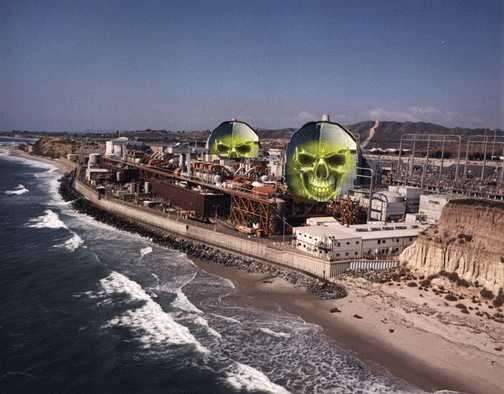
In January 2012, one of the two generators at San Onofre sprang a small leak, and the plant was shuttered. An investigation eventually revealed that the leak had been caused by vibrations in steam generators that occurred as a result of a flawed generator design. Plant operator Southern California Edison said it is pursuing a claim against generator manufacturer Mitsubishi Heavy Industries as well as Mitsubishi Nuclear Energy Systems.
In June 2013, plant operator Edison decided to permanently close the plant rather than incur the costs of safely restarting it. The future of the plant grounds and all of the toxic waste stored there remains up in the air.
“Probably worse than we think”
In September, an investigation by the NBC TV affiliate in San Diego, KNSD-TV Channel 7, revealed that radioactive equipment from the plant had been stored on both sides of Interstate 5, including along the beach. The investigation, which reviewed documents released to individuals negotiating with Edison over the future of the 25-acre site, also revealed that Edison had covered up evidence of radiation leaks from the plant.
The documents showed that radiation levels at the plant had regularly been so high that Nuclear Regulatory inspectors often refused to perform routine radiation surveys, fearing for their safety. Continue reading
Diablo Canyon nuclear plant – the industry’s last stand in California

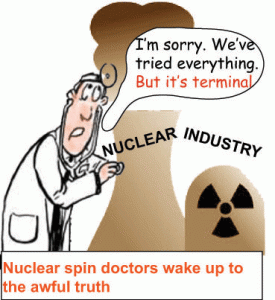 Nuclear power’s last stand in California: Will Diablo Canyon die?, SF Chronicle, By David R. Baker
The first of its two operating licenses from the federal government expires in 2024, the second a year later. Federal regulators are weighing whether to renew those licenses and keep Diablo humming through 2045. PG&E, however, appears to be having second thoughts.
And any extension will involve a fight. The plant sits within a maze of earthquake faults, all of them discovered after construction began in 1968. Seismic safety fears have dogged the nuclear industry in California for more than 50 years, forcing PG&E to abandon plans for one of its first reactors…… Continue reading
“Worst accidental radioactive pollution of Pacific Ocean” hasn’t moved US to test seafood
Nuclear Power: Dead in the Water it Poisoned, CounterPunch, by JOHN LAFORGE NOVEMBER 5, 2015 “………..Radiation exposure and contamination should concern everyone because by all accounts the volume of  radioactive materials discharged to the Pacific Ocean by Fukushima is the single greatest radioactive contamination of the sea ever observed. [27] An estimated 27 “peta-becquerels” (27 million billion becquerels) of cesium-137 had already leaked or been deliberately dumped into the Pacific by October 2011. A becquerel represents one atomic disintegration/second.
Last July, Tokyo Electric Power Co., which owns the Fukushima wreckage, acknowledged that an additional 300 tons-a-day of highly contaminated water is leaking into the Pacific from the six-reactor station — and has been since the beginning of the disaster almost three years ago. The American Medical Association — following the revelation of massive ongoing leaks — called on the US government to “monitor and fully report the radioactivity levels of edible species sold in the United States.”[28]
Yet at present, US seafood is not regularly tested for cesium contamination, in spite of the large numbers of fish and other foods that have been found contaminated by Fukushima isotopes — including blue fin[29] and albacore tuna[30] caught off the US West Coast, grapefruit from Florida, and prunes, almonds, pistachios and oranges from California.[31]
In this context, a coalition of public health and environmental groups petitioned the FDA in early summer demanding a drastic reduction in the amount of radioactive cesium allowed in food. The petition by members of the Fukushima Fallout Awareness Network (FFAN) declared that the arbitrarily high 1,200 becquerels-per-kilogram (Bq/kg) US limit is “ridiculous.” The standard is between 120 times to 24 times weaker than Japan’s.
The petition demands that US foods have no more than 5 Bq/kg of cesium-137 and -134, and that all food be tested and labeled with its cesium content. The FFAN reports that the devastated Fukushima reactors continue to leak more than 10 million becquerels of cesium-134 and cesium-137 per hour into the environment, “with no sign of stopping.” The network said it was “alarmed” at the lack of testing currently in place to meet the threat of radioactive contamination in food. Because cesium-134 has a hazardous life of about 10-20 years, and cesium-137 has a hazardous life of about 300-600 years, the FFAN said, the threat of food contamination “is a long-term issue that deserves immediate attention………”http://www.counterpunch.org/2015/11/05/nuclear-power-dead-in-the-water-it-poisoned/
Scientists confirm “elevated” raadioactivity levels in honey near nuclear power station
Radioactive honey found near nuclear power station, Rt.com 2 Nov, 2015 Honey contaminated with nuclear waste has been found near a disused power station in Scotland, scientists have confirmed, with samples of the product testing positive for “elevated” radioactivity. The samples showed levels of radioactive caesium-137 that are 14 times higher than samples of honey from elsewhere in the UK, prompting scientists to call for an investigation into wider contamination at the site.
The plant, which closed in 1994, no longer produces nuclear energy. It is still in the process of being decommissioned, however.
Independent nuclear energy consultant John Large said bees are an important barometer of environmental health.“Bees are key indicators of what is happening in the environment. They forage in a three-mile radius around the hive and anything in the soil is drawn up into plants and into the nectar they collect.
“This reading is within the limit for human consumption, but caesium-137 should not be turning up in honey at all,” he added.
The results are included in the government’s Radioactivity In Food and the Environment report, published last week…….https://www.rt.com/uk/320505-nuclear-plant-honey-contamination/#.VjfDMS3IGhs.twitter
Southern Ocean fast becoming acidic, with abrupt effects on the marine food chain
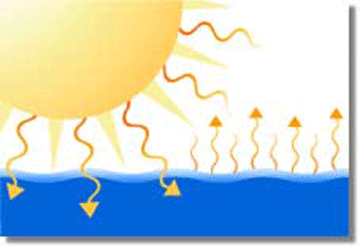 Abrupt changes in food chains predicted as Southern Ocean acidifies fast: study [excellent pictures] http://www.smh.com.au/environment/climate-change/abrupt-changes-in-food-chains-predicted-as-southern-ocean-acidifies-fast-study-20151030-gknd2g.html November 3, 2015 Peter Hannam Environment Editor, The Sydney Morning Herald The Southern Ocean is acidifying at such a rate because of rising carbon dioxide emissions that large regions may be inhospitable for key organisms in the food chain to survive as soon as 2030, new US research has found.
Tiny pteropods, snail-like creatures that play an important role in the food web, will lose their ability to form shells as oceans absorb more of the CO2 from the atmosphere, a process already observed over short periods in areas close to the Antarctic coast.
Ocean acidification is often dubbed the “evil twin” of climate change. As CO2 levels rise, more of it is absorbed by seawater, resulting in a lower pH level and reduced carbonate ion concentration. Marine organisms with skeletons and shells then struggle to develop and maintain their structures.
Using 10 Earth system models and applying a high-emissions scenario, the researchers found the relatively acidic Southern Ocean quickly becomes unsuited for shell-forming creatures such as pteropods, according to a paper published Tuesday in Nature Climate Change.
“What surprised us was really the abruptness at which this under-saturation [of calcium carbonate-based aragonite] occurs in large areas of the Southern Ocean,” Axel Timmermann, a co-author of the study and oceanography professor at the University of Hawaii told Fairfax Media. “It’s actually quite scary.”
Since the Southern Ocean is already close to the threshold for shell-formation, relatively small changes in acidity levels will likely show up there first, Professor Timmermann said: “The background state is already very close to corrosiveness.”
Below a certain pH level, shells of such creatures become more brittle, with implications for fisheries that feed off them since pteropods appear unable to evolve fast enough to cope with the rapidly changing conditions.
“For pteropods it may be very difficult because they can’t run around without a shell,” Professor Timmermann said. “It’s not they dissolve immediately but there’s a much higher energy requirement for them to form the shells.”
Given the sheer scale of the marine creatures involved, “take away this biomass, [and] you have avalanche effects for the rest of the food web”, he said.
As carbon dioxide levels rise, the impacts seen in the Southern Ocean – and its counterpart regions in the northern hemisphere – can be expected to spread closer to the equator.
Scientists anticipate that a halt in the increase in greenhouse gases will take time to have an impact on slowing the warming of the planet. However, a faster response can be expected in the oceans to any slowing in the pace of acidification.
“The corrosiveness of the water is a very strong function of the atmospheric C02 and there is not much of a delay [to any changes]”, Professor Timmermann said.
The paper’s release comes about four weeks before delegates from almost 200 nations are expected to gather in Paris, France to negotiate a new global treaty to curb carbon emissions.
Fukushima insect study shows there is no safe low level of ionising radiation
 The researchers found that caterpillars that ate radioactive leaves pupated into mutated butterflies that did not live as long, compared with caterpillars that ate non-radioactive leaves. These mutations and increased mortality were seen even in butterflies that consumed only very small doses of radioactive cesium.
Deaths and mutations spike around Fukushima; no safety threshold for radioactive cesium exposure http://theunhivedmind.com/wordpress3/deaths-and-mutations-spike-around-fukushima-no-safety-threshold-for-radioactive-cesium-exposure/October 16, 2015 theunhivedmind Deaths and mutations spike around Fukushima; October 16, 2015 by: David Gutierrez, staff writer
http://www.naturalnews.com/051581_fukushima_radiation_nuclear_power.html
Plants in the area around Fukushima, Japan are widely contaminated with radioactive cesium, which is 
producing mutation and death in local butterflies, according to a study conducted by researchers from the University of the Ryukyus, Okinawa and published in the journal Scientific Reports.
The butterflies were found to experience severe negative effects at all detectable radiation levels, even very low ones.
“We conclude that the risk of ingesting a polluted diet is realistic, at least for this butterfly, and likely for certain other organisms living in the polluted area,” the researchers wrote.
Insects hard hit
The researchers note that although the 2011 meltdown of the Fukushima Daiichi Nuclear Power Plant released “a massive amount of radioactive materials … into the environment,” few studies have looked at the biological effects of this disaster. Researchers have, however, measured elevated radiation levels in the polluted area, and have chronicled the accumulation of radioactive material in both wild and domestic plant and animal life in the region.
Studies have also suggested that insects may be particularly hard-hit by the increased radiation. One study found an increase in morphological abnormalities (physical deformities) in gall-forming aphids. Another found that insect abundance has decreased in the affected region, particularly butterfly abundance. Continue reading
Precious Groundwater in Drought Areas Threatened by Uranium Mining
Why Are We Allowing Uranium Miners to Pollute Groundwater in Drought Zones?
 Uranium mining threatens aquifers that could provide the drought-stricken West with emergency water supplies. BRIAN PALMER OCT 16, 2015 Mining uranium, the fuel for nuclear reactors, is a dirty business. Following World War II, mining companies extracted millions of tons of uranium from Navajo tribal lands in the West, contaminating homes and water supplies in the process. It went on for decades, and Navajo miners developed lung cancer at very high rates.
Today, even as the United States nuclear power industry struggles to survive, uranium mining continues. The techniques are more modern, but conservationists say the threat could be just as insidious: polluting water supplies in drought-ridden parts of the country where drinking water is already alarmingly scarce.
New rules proposed by the federal government last year could help reduce the threat—although industry is fighting to weaken them, along with its Republican allies in Congress. And critics say the proposed regulations might not be strong enough anyhow. Ironically, this might all be happening to extract a resource we barely need anymore—at the risk of one that we most certainly do……..
The industry must now work with what geologists call “roll-fronts.” These are relatively thin uranium deposits that formed deep underground over the course of thousands of years. Typically just 10 to 30 feet in height—too small to be harvested by human miners—the roll-fronts can only be extracted by chemical means.
The process used today is called in situ recovery, or ISR, mining. (Opponents use the more chemically descriptive phrase “in situ leaching,” or ISL.) The mining company drills four or five holes, called injection wells, and then pumps down a mix of an oxidizing agent (often hydrogen peroxide or simple oxygen) and water. Pressure from the constant influx of fluid forces the solution to percolate through the uranium-rich layer of Earth toward another hole, called the production well, which carries it up to the surface. At this point, the company reverses the chemical reaction that dissolved the uranium, using a separate chemical to precipitate the metal out of the water. The water, now stripped of most of the uranium, heads back into the well to continue the cycle…….

In reality, ISR mining isn’t so tidy, and the few peer-reviewed studies available suggest that leaching uranium out of rocks contaminates the surrounding groundwater for decades. As Western states deal with increasing levels of drought, that’s a problem…….
Remediation is water- and time-intensive, but does it work? The answer is pretty disturbing: No one knows. There have been only a handful of major studies on the efficacy of the uranium-mining remediation process. Continue reading
What a nuclear apocalypse would do to the Earth’s atmosphere
The Unknown Danger of Nuclear Apocalypse, Foreign Policy Journal, by Dr. Stoyan Sarg October 9, 2015
The nightmare scenario of nuclear war may actually be more frightening than you could ever have imagined. Life on the Earth is in danger of total destruction like never before. An apocalypse caused not by a natural event but from human behavior due to a scientific misconception. What is that? It is the incorrect concept about space, adopted a hundred years ago. Despite the accumulated evidence about this misconception, the status quo is kept by the established authorities in favor of powerful forces so as not to jeopardize their global interests. For people not aware of this issue, it may seem unimportant. However, it leads to a very dangerous strategy taken by politicians and military adventurers. With the new cold war tension and the present nuclear arsenals, life on Earth is endangered from an apocalyptic event that is not predicted by contemporary science due to the mentioned above misconception……..

The continuing scandal of Russia’s Mayak nuclear contamination – whistleblower seeks asylum in France

 A Russian antinuclear activist asks for asylum in France Mediapart , October 2, 2015, by Amélie Poinssot and Michel de Pracontal, As the head of the NGO Planet of Hope [Planeta Nadezhd], Nadejda Koutepova has fought for fifteen years for the victims of radioactive contamination in the Urals, near the Maiak factory which, in 1957, gave the world its first nuclear catastrophe. In July, she was forced by circumstances to dissolve the NGO and leave Russia. This Friday, October 2nd, as Francois Hollande receives Vladimir Putin in Paris, she is asking for asylum in France.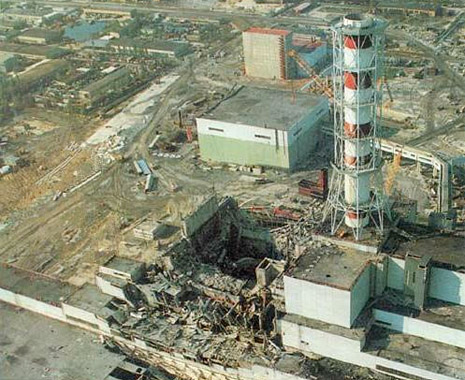
Nadejda Koutepova speaks out on the hidden scandal of the Mayak radioactive contamination
A Russian antinuclear activist asks for asylum in France Mediapart , October 2, 2015, by Amélie Poinssot and Michel de Pracontal, The revelation, decades later
Japan’s coastal population: risks from radiation ignored by govt and IAEA
UK research clearly shows that coastal zone populations are exposed to doses of marine radioactivity under the following set of environmental parameters:
- resident in coastal zones up to at least 200kms downstream of a source of liquid radioactive discharges to sea
- resident in coastal zones adjacent to coastal waters with high suspended sediment loadings
- resident in coastal zones adjacent to extensive fine sediment inter tidal/sub tidal sediment deposits (salt marsh, mud flats etc)
- resident in coastal zones subject to prevailing onshore winds and storm or tidal conditions generating marine aerosols, sea spray and coastal inundation
- resident in coastal zones where such parameters (A to D above) have, elsewhere, been shown to enable/facilitate the penetration of marine radioactivity for across the shoreline and up to 10 miles inland from the coast.

Fukushima: Japanese government and IAEA ignore radiation risks to coastal population http://www.theecologist.org/News/news_analysis/2985454/fukushima_japanese_government_and_iaea_ignore_radiation_risks_to_coastal_population.html Tim 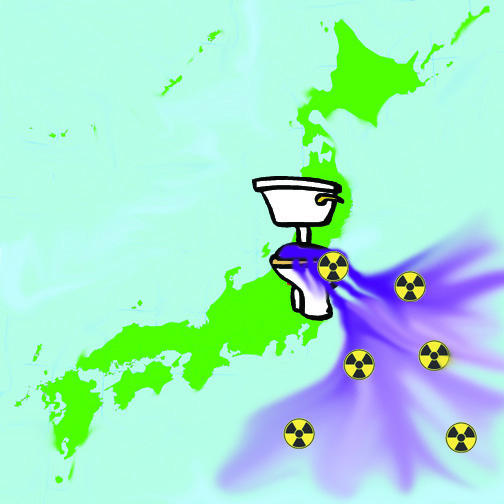 Deere-Jones 28th September 2015
Radiation can be carried long distances by marine currents, concentrated in sediments, and carried in sea spray 16km or more inland, writes Tim Deere-Jones. So Fukushima poses a hazard to coastal populations and any who eat produce from their farms. So what are the Japanese Government and IAEA doing? Ignoring the problem, and failing to gather data.
Review of the official Japanese marine monitoring programme reveals that the Japanese government is turning a blind eye to the risks of marine radiation from the stricken Fukushima site.
The strategy it has adopted, with the support of the IAEA, consistently ignores the latest evidence about the way marine radioactivity behaves in inshore marine environments and the potential radiological risks to coastal populations.
This strategy is based on a flawed hypothesis, developed by the nuclear industry through the late 1940s and early 1950s, when both oceanography and the study of the behaviour and fate of radioactivity in marine environments were in their absolute infancy.
As a result, the principal conclusions on the marine impact of the Fukushima event put forward in recent reports from the IAEA, the Government of Japan and it’s relevant agencies, minimise the environmental and public health negatives and emphasise a range of hypothetical ‘positives’.
This is a major flaw because the empirical evidence from ‘non-aligned’ research in the UK is that coastal communities are subjected to highly enriched doses of marine radioactivity through pathways of exposure, and from environmental parameters, which will not be analysed and researched under current Fukushima monitoring plans.
As a result, significant public health impacts of the event will not be documented, nor will important data about the way Fukushima marine radioactivity behaves at the coastline.
Failing to gather the evidence of coastal radiation Continue reading
Saskatchewan plan to clean up neglected Gunnar uranium mine site
Plan for cleaning up uranium tailings ready for approval BY ALEX MACPHERSON, THE STARPHOENIX SEPTEMBER 28, 2015 The cleanup of a derelict northern Saskatchewan uranium mine could move one step closer this week.
The Saskatchewan Research Council (SRC) — which is overseeing the multi-million-dollar Gunnar Remediation Project on behalf of the provincial government — will present its plan to cover the site’s three tailings deposits at a Canadian Nuclear Safety Commission (CNSC) hearing in Ottawa on Wednesday.
Canada’s nuclear watchdog will consider evidence presented by all interested parties, including the SRC and northern First Nations, before making its decision, which is expected in about six weeks, a CNSC spokesman said Monday…..
After Gunnar ceased production in 1963, the open pit and underground works were flooded with water from Lake Athabasca. The mine was abandoned the following year with little other decommissioning work.
“There was no Department of Environment when those mines were abandoned,” said Ann Coxworth, a nuclear chemist and member of the Saskatchewan Environmental Society board. “At the time, there was, I would say, rather limited understanding of the hazards of leaving those tailings in an unmanaged condition.”
The absence of baseline studies and the insidious effects of radioactive contamination make assessing the Gunnar site’s environmental impact difficult, but it’s clear the work needed to be done, Coxworth said.
“We know that it can’t be cleaned up. (But) the situation can certainly be improved.”……..
Jack Flett, regulatory affairs coordinator for the Athabasca Chipewyan First Nation, said he hopes work on the Gunnar site continues.
“For me, it’s water,” he said, noting that the northern Alberta First Nation is downstream of the Gunnar mine. “Water is everything. Water is life.”….. http://www.thestarphoenix.com/technology/plan+cleaning+uranium+tailings+ready+approval/11397802/story.html
Radium isotopes in coal ash – from its thorium and uranium content
- Avner Vengosh
- Heileen Hsu-Kim
- Nancy Lauer DURHAM, N.C. — A new Duke University-led study has revealed the presence of radioactive contaminants in coal ash from all three major U.S. coal-producing basins.The study found that levels of radioactivity in the ash were up to five times higher than in normal soil, and up to 10 times higher than in the parent coal itself because of the way combustion concentrates radioactivity.
The finding raises concerns about the environmental and human health risks posed by coal ash, which is currently
 unregulated and is stored in coal-fired power plants’ holding ponds and landfills nationwide.
“Until now, metals and contaminants such as selenium and arsenic have been the major known contaminants of concern in coal ash,” said Avner Vengosh, professor of geochemistry and water quality at Duke’s Nicholas School of the Environment. “This study raises the possibility we should also be looking for radioactive elements, such as radium isotopes and lead-210, and including them in our monitoring efforts.”
- Radium isotopes and lead-210 occur naturally in coal as chemical by-products of its uranium and thorium content. Continue reading

1 This Month


No Nuclear in Cwm Llynfi! Stop the nuclear power station near Maesteg.


4 August – WEBINAR – Hiroshima & Nagasaki: Nuclear Bombs Never Again
Tuesday, Aug. 4 at 5 pm PT / 8 pm ET.
Aug 5, 2026 10:00 AM in Australia/Melbourne
Join the Nuclear Bombs Never Again webinar on August 4th at 5pm Pacific Time / 8pm Eastern Time / 9am Japan Standard Time.
Cross generational voices at the intersection of Japan-Korea-US policy and militarization will share their lived experiences, nuclear impacts in these contexts, anti-war strategies, and actions you can take to advocate for a world with Nuclear Bombs Never Again. This 75-minute event is co-hosted by WILPF US and Korea Peace Now.

22,000+ miles voyaging for nuclear disarmament
and a radiation-free environment https://vfpgoldenruleproject.org/
To see nuclear-related stories in greater depth and intensity – go to https://nuclearinformation.wordpress.com
-
Archives
- July 2026 (332)
- June 2026 (287)
- May 2026 (306)
- April 2026 (356)
- March 2026 (251)
- February 2026 (267)
- January 2026 (308)
- December 2025 (358)
- November 2025 (359)
- October 2025 (375)
- September 2025 (257)
- August 2025 (319)
-
Categories
- 1
- 1 NUCLEAR ISSUES
- business and costs
- climate change
- culture and arts
- ENERGY
- environment
- health
- history
- indigenous issues
- Legal
- marketing of nuclear
- media
- opposition to nuclear
- PERSONAL STORIES
- politics
- politics international
- Religion and ethics
- safety
- secrets,lies and civil liberties
- spinbuster
- technology
- Uranium
- wastes
- weapons and war
- Women
- 2 WORLD
- ACTION
- AFRICA
- Atrocities
- AUSTRALIA
- Christina's notes
- Christina's themes
- culture and arts
- Events
- Fuk 2022
- Fuk 2023
- Fukushima 2017
- Fukushima 2018
- fukushima 2019
- Fukushima 2020
- Fukushima 2021
- general
- global warming
- Humour (God we need it)
- Nuclear
- RARE EARTHS
- Reference
- resources – print
- Resources -audiovicual
- Weekly Newsletter
- World
- World Nuclear
- YouTube
-
RSS
Entries RSS
Comments RSS
 nuclear-news