Fukushima nuclear station area has drastic mass death of species
 “Mass death” of species found around Fukushima nuclear plant — Gov’t: They “seem to have disappeared… Little or no reproductive success… It is evident biota around the power plant has been affected since the nuclear accident”http://enenews.com/mass-death-species-found-around-fukushima-nuclear-plant-govt-disappeared-little-reproductive-success-evident-biota-around-power-plant-affected-nuclear-accident?utm_source=feedburner&utm_medium=email&utm_campaign=Feed%3A+ENENews+%28Energy+News%29
Yomiuri Shimbun, Feb 7, 2016 (emphasis added): The National Institute for Environmental Studies (NIES) revealed that the total number of sessile species, such as barnacles and snails, has been decreasing significantly along the coast within 10 kilometers south of the Fukushima No. 1 nuclear power plant… [T]here is the possibility that the mass death of sessile specieswas influenced by radioactive materials released into the sea…
National Institute for Environmental Studies, Feb 2016 (underlining by NIES): NIES has conducted field surveys in the intertidal zones of eastern Japan to investigate the ecological effects of the serious accident at the Fukushima Daiichi Nuclear Power Plant… The number of intertidal species decreased significantly with decreasing distance from the power plant… no rock shell (Thais clavigera) specimens were collected near the plant, from Hirono to Futaba Beach (a distance of approximately 30 km) in 2012. The collection of rock shell specimens at many other sites hit by the tsunami suggests that the absence of rock shells around the plant in 2012 might have been caused by the nuclear accident in 2011. Quantitative surveys in 2013 showed that the number of species and population densities in the intertidal zones were much lower at sites near, or within several kilometers south of, the plant than at other sites… especially in the case of Arthropoda (e.g., barnacles). There is no clear explanation for these findings, butit is evident that the intertidal biota around the power plant has been affected since the nuclear accident…
Study funded by the Government of Japan, Feb 2016: Surveys in 2012… The number of intertidal species decreased significantly with decreasing distance from the power plant… The three animal species… 1 km south of FDNPP, were a barnacle… and two herbivorous snails… The sizes… were very small [and] densities were very low… No rock shell (Thais clavigera) specimens were found at 8 of the 10 sites in Fukushima Prefecture within a radius of 20 km of FDNPP… the area without rock shells extended… approximately 30 km… Surveys in 2013… Population densities of sessile organisms at Tomioka fishing port and Okuma were less than one-tenth to about one-fourth those at other sites… The total wet-weights in each intertidal zone at Okuma were much lower than those at other sites… it is unlikely that the absence of rock shells around FDNPP was caused only by the tsunami. The absence of rock shells at sites close to FDNPP… suggests that reproduction and recruitment did not occur there, or were less successful… [I]t is still unknown why adult rock shells living there disappeared or why rock shells had little or no reproductive success there… [I]t is also notable that barnacles seem to have disappeared from Kuboyaji, north of FDNPP…
Alarming levels of radioactivity in groundwater at Indian Point nuclear station
 Indian Point nuclear facility operator reports ‘alarming levels’ of radioactivity in plant’s groundwater; some wells increase 65,000% New York Daily News, BY DENIS SLATTERY NEW YORK DAILY NEWS, February 7, 2016,
Radioactive water overflowed into the groundwater at the upstate Indian Point nuclear power plant, officials said Saturday.
Gov. Cuomo said the plant’s operator, Entergy, reported “alarming levels” of radioactivity at three monitoring wells, with one well’s radioactivity increasing nearly 65,000%………
The site, roughly 35 miles north of New York City, has been under increased scrutiny from Cuomo and other officials following several incidents. In December, Cuomo ordered an investigation into Indian Point after a series of unplanned shutdowns, citing potential risks to both the city and surrounding suburbs.
Cuomo said the “latest failure at Indian Point is unacceptable.”
According to Neil Sheehan, a spokesman for the Nuclear Regulatory Commission, the leak occurred after a drain overflowed during a maintenance exercise while workers were transferring water containing high levels of radioactive contamination.
A sump pump that would normally filter the water into another treatment system was out of service, Sheehan said.
Other state officials also blasted the controversial nuclear facility’s most recent mishap.
Assemblywoman Ellen Jaffee (D-Suffern)said she was concerned not only for the surrounding community but also for the “impact this radioactive water may have on public health and our environment,” Jaffee added…….http://www.nydailynews.com/new-york/radioactive-water-leaks-groundwater-indian-point-article-1.2522670
Life after Fukushima and Chernobyl nuclear disasters with Prof. T. Mousseau
 Comparing fukushima and Chernobyl concerning raionuclide distribution and Isotopic variations on Land and effects on the environment. New studies by Timothy Mousseu and his team.
Tim was interviewed and he gave us an overall look at the situation and compares the 2 nuclear disasters for us. Link to Timothy Mousseau cricket.biol.sc.edu/Mousseau/Mousseau.html
Link to podcast here;
Strontium and Plutonium isotopes
“Most of the those other isotopes in are very small quantities relative to the cesium that were released – that were very different to the Chernobyl situation where huge quantities of Strontium, about equal Cesium and Strontium were released along with several isotopes of of Plutonium, The Plutonium is in the process of decaying into Americium and (that) is more radioactive than Plutonium apparent”
Strontium in Fukushima Prefecture
In Japan the the Strontium was not volatised as did Cesium and Iodine and it did not travel far (on Land) but large quantities of Strontium are still being released by the ground water at the plant and and from the cooling water leaking into the ocean.
Contamination of the Nursery areas in the deep ocean and off the coast of Japan?
On the 4th February 2016 a Press conference was held in the Foriegn Correspondents Club in Japan calling for more research funding to be done concerning the Human health effects of the Fukushima nuclear disaster and we find a similar problem faced by epidemiologists and researchers to the lack of interest and therefore funding in this area. During the interview with Timothy we touched on research funding issues in a variety of areas relevant to the nuclear disaster including the aquatic environment.
Timothy responded to a question put to him saying that only some studies have been done (to his knowledge) on the bottom feeding fish and that these fish had been found to high contamination but that very other few studies have been done. He went on to say;
“surveillance work to determine wether fish can be consumed rather than the biological impacts (and) ecological impacts of the fish themselves, this is one of the important questions and that is one of the interests we have as a group.”
He went on to say that the issues for thre authorities are that;
“Whether or not —“ The fish are below regulatory limits for export, that is the main – you know- economic driver of interest but the biological drive is almost nil as far as I can tell”
Terrestrial (land) contamination issues on wildllife, plant and micro–organisms

Of the limited research happening in this area, Tims and his team is at the forefront in developing novel and creative ways to ascertain the effects from the nuclear disaster. Usng their experience gleaned from the radiological effected areas of Chernobyl (with the help of Anders Pape Møller, CNRS, University of Paris-Sud) and applying this invaluable eperience on the highly effected areas on the mountain sides and hills sorrounding the Fukushima city to the coastal areas including Namie and IItate areas of Fukushima and some less contaminated areas for comparison studies.
These studies have resulted in some 8 to 9 primary papers on birds and Insects. Also, new research on Rodents is about to be released and cameras have been set up in various locations studying large mamals such as pigs and monkeys.
Oze National Park in southern Fukushima Prefecture and Northern Chiba Prefecture (north of Tokyo)
On the search for clean areas for comparison studies, Tim said that he was disapointed. He looked at the huge and remote Oze national Park as a possible localtion (largly situated in the Chiba Prefecture but his radiation readings were more than 10 times normal at 0.5 mcSv/h (compared to the contaminated research area with 30 – 40 and 50 mcSv/h in the hills sorrounding Fukushima City.
we talked about the effects of sediment transfer from the mountains down through the lakes and forests of Oze Park. Tim then mentioned a Typhoon he witnessed that stripped large areas of soil into the rivers and was concerned of the effects in the extensive lake system in Oze Park and the result of contamination making its way to the river outflows on the coast and effects on the fisheries. Asked as to wether any studies were being done he said that in the last year (some 5 years after the nuclear accident) many geollogists from around the world were vying for funding to commence studies in “the next year or two” studying such issues but presently;
“I don`t know of any studies being done” he said
The issue of funding was mentioned here and that the Japanese government seemed only interested in funding studies for issues around food and health issues (link to issues around health studies being grossly limited here
(courtesy of FFCJ www.youtube.com/watch?v=e58yF8zZQ9w )
Only a handful of scientists can afford to do these studies he went on to say. And I mentioned that TEPCO owned the larger share of this PNational Park. (Some findings concerning the issues and info on Oze National Park here www.opednews.com/articles/Does-Tepco-ow… )
Discussing the pros and cons of the peer review process
He said that it is always a consttant battle
“.. and I suppose its a really positive aspect of the peer review process”
On the pitfalls of the process he mentioned that for some decades finding sufficiently knowledgeable and open minded reviewers to consider “creative studies” is difficult. He went onto say that he and dis colleagues have managed to submit and have accepted some 80 papers in the last ten years concerning Chernobyl and Fukushima.
Funding issues for research and analysis
Here we discussed Ken Buesslers citizen crowd funding campaign for testing water off the west coast USA.
Tim noted that his costs come to some hundreds of thousands of dollars a year and that Kens study was very limited due to the cost of transportation of samples and costs for sampling etc. Kens was limited by the lack of funding raised concerning this campaign and pointed out that the costs are not fully covered by the monies raised.
“its a limited effort and doesnt in any way provide the level of info to address the bigger question but, that said, he has done a fabulous job with what he has got to do it”
I hen asked Tim if such a scheme might be implimented in Japan, he said
“You dont want the middle schoolers collecting radioactive dirt do you?”
Also, getting permission to work in these contaminated areas is difficult and omly open to professional research activities.
The new Japanese Secrets Law brought in at the end of 2013
On this he said that (aside form legal issues) there is “alot of self censorship in Japan to do with this disaster”
But he said that locals in Fukshima Prefecture have been incredibly helpful giving food, finacial support and property for laboratory analysis.
“There is an incidious form of censorship going on that most people are not tuned intoit and thats the fact that if you dont fund science – the resouces for research – it doesnt get done and (by) consequesnce questions are not asked and certainly not answered”
Lack of funding is the biggest form of censorship with this disaster.
He went on to say that on funding issues;
“I haven`t had a much luck with som of the conventional (funding) sources”
Chernobyl, new mice study
Last week Tim said he produced a study showing hightened prevelance of cataracts in the eyes of mice.
and that this was corroborated with an earlier study on birds.
Finding clues and evidence on previous relevant biosphere studies to date
A meta analysis is being done on previous studies looking into plant, animals and bacteria are adpting or evolving, on some level or other. Looking at all the evidence (including the issue of high U.V. radiation found on earth millions of years ago). His conclusions seem to point to the facts that the evolutionary response was “actually negative” and this report should be out in about a month. His earlier study on birds with Black pigment showed that some resiliance in a small amount of bird species was due to them using antioxidents to protect from gentic damage but that some cost. This might limit the lower antioxident levels left in these birds might cause problems for them to find mates and deal with environmental changes (such as climate change)
“Organisms can use these antioxidents to the mutational load OR use it to advertise to a mate or defend itself against some other diseases but there is this ultimate trade off that limits the success in one way or another”
Thermal regulation might be another factor due to this imbalance he said.
Chernobyl Heart – Fukushima heart?
We discussed pin holes found in babies even today in the contaminated areas of Belarus, Ukraine and Russia. Tim said that it is recognised that there are well documented cardio vascular damage in the areas of contamination and that he would check out this problem in the near future using samples he has collected already. (A previous article I have looked at some statistics and posits on this www.opednews.com/articles/The-manipulat…)
Issues on the decontamination and Top soil removal
We also discussed the issues of the damage to the environment by removing the living soil around houses and roads to reduce the geiger readings (dose). Tim also said that only limited top soil is removed and
“.. a superficial attempt to provide this appearencce of reduced contamination but it is not a solution to the area”
He went onto point out that the leaves and branches that fall will eventually cover these areas that are cleaned and a radioactive build up will re occour over time. He is running similar test into the issue found in Chernobyl with micro organisms not survivng and causing forest debris to build up (and causing wildfires etc). He is not sure if the levels and isotopic types found in Fukushima are going to cause the same problem that was found in Chernobyl but that he would know when an experiment he is running is concluded in the next few months or so.
Low dose ionising radiation takes its toll on living organisms – Timothy Mousseau
 Even low radiation dose can take toll: scientist http://www.chinapost.com.tw/taiwan/national/national-news/2016/01/27/457138/Even-low.htm By Enru Lin, The China Post TAIPEI, Taiwan–Animals exposed to even low doses of radiation suffer a higher incidence of physical abnormalities, a world-leading ecologist said in Taipei on Tuesday. Timothy Mousseau, an ecologist at the University of South Carolina, is a pioneering expert on what radiation does to organisms.
For decades, he and his research team have studied Chernobyl, Ukraine — site of the world’s worst nuclear disaster in 1986 — and Fukushima in Japan.
Their studies found that radiation exposure had significant effects on local populations, for instance causing tumors, small brain sizes, sterility and cataracts in birds in Chernobyl.
No Safe Dose?
Findings indicate that radiation, even at low doses, can increase mortality rates and the incidence of physical abnormalities.
“There is no threshold below which there is no effect on organisms,” Mousseau said.
“We need to be very concerned not only about the consequences of nuclear accidents, but also the regular day-to-day operations of nuclear power plants, where radiation is released on a regular basis.”
Call for Taiwan Research
Mousseau was speaking on invitation at a press briefing and forum at the Legislative Yuan, where he was joined by three Democratic Progressive Party (DPP) lawmakers including Tien Chiu-chin (田秋堇).
At the event, anti-nuclear activists called on the central government to commission an independent research team to study effects on people who live near Taiwan’s three operating nuclear power plants.
Birds, Butterflies First
Mousseau said his data suggested that some organisms were far more sensitive to radiation than others.
Studies from Chernobyl and Fukushima showed that the first significant effects of radiation occurred in the same taxonomic groups.
“Birds and butterflies are the two most sensitive groups — we saw immediate large responses in birds and butterflies in Fukushima,” he said.
Other animals, such as grasshoppers and spiders, are less susceptible to the effects of radiation.
On Humans
Meanwhile, there is insufficient research on the human population to make convincing assessments on the impact of low dose radiation.
Mousseau said that in the U.S., studies are thwarted when researchers can’t access the relevant health records.
“There are privacy issues related to health records that are so strong in the United States, and there is a lack of organization of the registries. That makes it very difficult to do solid, hard science,” he said.
Community and environmental impact of the Jaitapur nuclear power project
 France Peddles Unsafe Nuclear Reactors to India, Drawing Protest , 29 January 2016 By Kumar Sundaram, Truthout | News Analysis “………the concerns of the local community in Jaitapur go beyond the cost of the project. Jaitapur is located in the stunningly beautiful Konkan region, replete with verdant plateaus, magical mountains and undulating hills, lagoons, creeks, the open sea and infinite greenery. The NPCIL has labeled nearly 65 percent of the land as “barren,” despite the fact that Konkan is one of the world’s 10 “biodiversity hotspots,” sheltering over 5,000 species of flowering plants, 139 of mammals, 508 of birds and 179 of amphibians, including 325 globally threatened species.

Altogether, the nuclear park would jeopardize the livelihoods of 40,000 people. The annual turnover of Jaitapur’s fishing villages is about $2.2 million. In Nate Village alone, there are 200 big trawlers and 250 small boats. Nearly 6,000 people depend directly on fishing and over 10,000 are dependent on ancillary activities.
The community is apprehensive that the elaborate security arrangements around the project would block the fisherfolks’ use of the two creeks of Jaitapur and Vijaydurg. The fish population will also be affected since the nuclear plant would release a massive 52 billion liters of hot water into the Arabian Sea daily, raising the local sea temperature by 5 to 7 degrees Celsius.
Jaitapur has highly fertile land, which produces rice and other cereals, and arguably the world’s most famous mango, the Alphonso. Cashews, coconuts, kokum, betel nuts, pineapples and other fruits are found in abundance. The land is also quite productive in terms of its use for cattle-grazing and rain-fed agriculture.
The environmental impact assessment (EIA) for Jaitapur, conducted by the government-run National Environmental Engineering Research Institute (NEERI), did not even look into the crucial aspects of radiological releases, decommissioning and nuclear waste, besides summarily neglecting the vital issues of ecosystems and livelihoods, terrestrial ecosystems and farming, mangrove forests and the fragile marine ecology and fisheries in the region.
NEERI admits it does not have any expertise in radiation-related issues and it just mentioned in its report that all the stipulations of the government’s nuclear regulator would be followed. The then-minister for environment and forests, Jairam Ramesh, had himself termed these EIA assessments a joke. Even that environmental clearance, granted on 35 absurdly weak conditions, was given only for a period of five years, which lapsed as of November 2015. Citizens groups and independent experts have demanded a fresh EIA in place of an extension……… http://www.truth-out.org/news/item/34627-france-peddles-unsafe-nuclear-reactors-to-india-drawing-protest
Radiation in Tokyo’s water at higher level than in Fukushima’s

 NRA’s data shows contamination level in Tokyo tap water higher than Fukushima by 24 percent http://fukushima-diary.com/2016/01/nras-data-shows-contamination-level-in-tokyo-tap-water-higher-than-fukushima-by-24-percent/ Iori Mochizuki According to NRA (Nuclear Regulation Authority), Cs-134/137 density in Tokyo tap water is 24% higher than Fukushima.
The report was released on 10/30/2015, titled as “Readings of radioactivity level in drinking water by prefecture” to cover from July to September in 2015.
From this report, only 0.0015 Bq/Kg of Cs-137 was detected in Fukushima drinking water. Cs-134 was not supposed to be detected. On the other hand, 0.00036 Bq/Kg of Cs-134 and 0.0015 of Bq/Kg were detected from Tokyo drinking water.
The measurement of Cs-134 is due to Fukushima accident.
NRA comments each data is based on the reports from prefectures.
It is not mentioned by Fukushima prefectural government why Cs-134 was not detected in their drinking water.
Global warming is happening fast in the world’s oceans
 World’s oceans warming at increasingly faster rate, new study finds
Ocean water has absorbed more than 90% of the excess heat and nearly 30% of the carbon dioxide generated by human consumption of fossil fuels,Guardian, Oliver Milman, 19 Jan 16, The world’s oceans are warming at a quickening rate, with the past 20 years accounting for half of the increase in ocean heat content that has occurred since pre-industrial times, a new study has found.
US scientists discovered that much of the extra heat in the ocean is buried deep underwater, with 35% of the additional warmth found at depths below 700 meters. This means far more heat is present in the far reaches of the ocean than 20 years ago, when it contained just 20% of the extra heat produced from the release of greenhouse gases since the industrial revolution.
The paper, published in Nature Climate Change, sheds further light on the vast quantities of heat being absorbed by the world’s oceans.
Ocean water, which has a much higher heat capacity than air, has absorbed more than 90% of the excess heat and nearly 30% of the carbon dioxide generated by human consumption of fossil fuels. The vast Southern Ocean sucked up 1.2bn tonnes of carbon in 2011 alone – which is roughly equivalent to the European Union’s annual carbon output…….
As the oceans warm, storm intensity increases and aquatic species are forced from their traditional ranges. Absorption of carbon dioxide has also made the oceans 30% more acidic, which is when the pH of the water drops, making it harder for creatures such as coral, oysters and mussels to form the shells and structures that sustain them.
Scientists have already declared that a third global coral bleaching event is currently underway, where corals whiten and die off due to extreme heat. An analysis of more than 620 studies last year found that the food chains of the world’s oceans are at risk of collapse due to climate change, overfishing and localized pollution. http://www.theguardian.com/environment/2016/jan/18/world-oceans-warming-faster-rate-new-study-fossil-fuels
Radiation hazards in planned uranium mining in the Karoo, South Africa
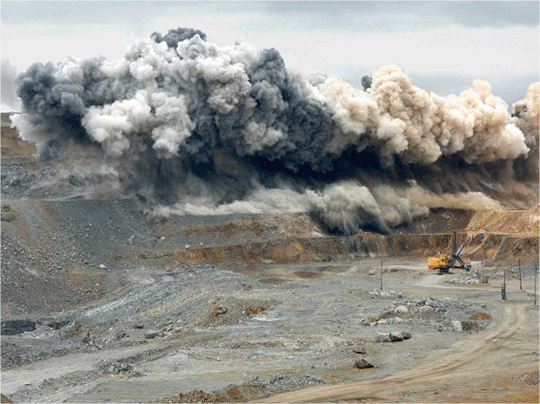 Uranium Mining Threatens the Karoo, Karoo Space, 18 Jan 16 By Dr Stefan Cramer Images sourced by Dr Stefan Cramer “…..According to its documents, Tasman RSA Mines today controls exclusive prospecting rights over more than 750 000 hectares in a circle of nearly 200 kilometres around Beaufort West.
About 32 000 hectares are directly owned under freehold by the company. Local farmers find it hard to resist purchase offers, as farming in this part of the Karoo is particularly difficult due to low rainfall and poor soils.
Unlike in fracking, farms are permanently damaged by uranium opencast mining………
So far the company has not indicated whether they would use ‘in-situ-leaching’, a particularly dangerous but low-cost method. Here, large quantities of leaching agent are injected underground. The uranium is dissolved and recovered in well fields.
The uranium deposits are scattered over large zone of 200 by 300 kilometres which will necessitate trucking of ores over poorly constructed dust roads for hundreds of kilometres to reach the Central Processing Plant.
For this plant, the company has already applied for a water licence to abstract annually 700 million litres of groundwater annually, roughly half of the total water consumption of the Central Karoo Municipality.
It is still unclear what will happen with the contaminated waste water. A discharge of radioactive waste water into the aquatic environment, above or below ground, would be illegal under South Africa’s strict Water Act.
Most probably contaminated slimes will be delivered to large settling ponds, like those around Johannesburg, from which the remaining water will evaporate. This leaves behind a soft and unstable pile of contaminated soil which can be easily mobilised by the strong prevailing winds in the Karoo into large dust dispersal.
Already today, the environment around Beaufort West is contaminated close to the previous mine sites. First field studies by the author show unprotected nuclear wastes with 10 to 20 times the background radiation.
Dust and Radiation – Two Deadly Impacts
The devastating impacts of uranium mining on people, especially the mine workers, and the environment have been well research and documented. Several studies of large number of cases and with exposure over many years (Wismut AG in the former East Germany, theColorado-Plateau in the USA, and Saskatchewan in Canada, have established a particular direct relationship between occupational exposure to uranium and its decay products and lung diseases.
Mining uranium ore in the Karoo will invariably create huge plumes of contaminated dust. Dust clouds are unavoidable during drilling, blasting and transporting.
Dust suppression by spraying water is only partially effective and creates new problems with contaminated slimes, adding to the environmental cost of groundwater abstraction……..http://karoospace.co.za/uranium-mining-threatens-the-karoo/
Impact of Radiation on Wildlife of Fukushima
Biologist Timothy Mousseau’s Lecture at Fukushima on Jan 11, 2016
” Impact of Radiation on Wildlife of Fukushima”
中継の視聴をのがしてしまったので、のちほど視聴してみます。
生物学の視点から。
The Anthropocene – have we started a new geological age – with carbon emissions and nuclear radiation?
With fossil fuels and nuclear tests, humans may have started a new geological age http://qz.com/589665/with-fossil-fuels-and-nuclear-tests-humans-may-have-started-a-new-geological-age/ Aamna Mohdin@aamnamohdin A geological epoch is a time period that leaves a distinctive mark in sediments and rocks that can be seen millions of years later. And now, it seems humans have left their mark on the Earth.
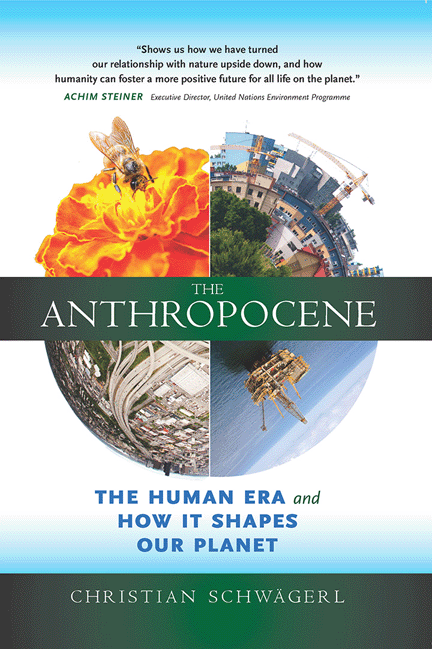
There’s also the ubiquitous spread of a number of new materials such as plastic and concrete to consider. But the “most widespread and globally synchronous anthropogenic signal is the fallout from nuclear weapons testing,” researchers noted in the paper. “Thermonuclear weapons tests generated a clear global signal from 1952 to 1980, the so-called ‘bomb spike’.”
The study is by no means the final say on the matter. The International Commission on Stratigraphy (ICS) has debated the issue for many years, and it’s ultimately up to them to accept the start of the Anthropocene as a geological epoch.
Worst nuclear contamination is former plutonium plant in Hanford, USA
 HANFORD NUCLEAR RESERVATION: America’s Fukushima December 30, 2015 by State of the Nation America’s Atomic Time Bomb: Hanford Nuclear Waste Still Poses Serious Risks By Marc Pitzke in New York Spiegel Online International
The disaster at Fukushima has raised questions around the world about nuclear safety. But contamination is much worse in the Pacific Northwest of the United States. The former plutonium plant in Hanford, Washington is one of the most contaminated places on earth, and still decades from being cleaned up.
The lambs were born without eyes or mouths. Some had legs that had grotesquely grown together; others had no legs at all. Many were stillborn. Thirty-one were lost in a single night.
On a pasture nearby, a cow was found dead, stiff and with its hooves bizarrely stretched up into the whispering wind. Down by the river, men of the Yakama tribe pulled three-eyed salmon from the Columbia. Trout were covered in cancerous ulcers.
And then the babies started getting sick.
It was in the spring of 1962 that farmer Nels Allison first noticed something was ominously wrong. “Son of a bitch,” he said to his wife. Sheep were always “the first to lie down and die” when something was amiss on Allison’s farm near Basin City, a rural town near the Columbia River in the far northwestern corner of the continental United States. He started referring to that deadly night “the Night of the Little Demons.”
Although the Allisons have long since passed away, the shock endures. As chronicled by journalist Michael D’Antonio in his 1993 book Atomic Harvest, their tale is one of thousands of horror stories that took place in the area surrounding Hanford, Washington, the site of America’s first full-scale plutonium production facility. The site haunts the locals to this day — and imperils them.
Hanford is America’s original atomic sin. At this giant facility sprawled over 586 square miles (1,517 square kilometers), a four-hour drive southeast of Seattle into the vast emptiness of Eastern Washington, the United States once produced most of its nuclear raw materials for the Cold War. Though it was decommissioned in 1988, it remains the most contaminated location in the entire Western Hemisphere.
The US Department of Energy (DOE) recently revised its timetable for Hanford’s decontamination, the biggest environmental cleanup in American history. The end date was moved back, once again. It now hopes to finally wrap up this Herculean task by September 2052 — more than 108 years after Hanford was opened……..http://stateofthenation2012.com/?p=28115
Scientists used X ray images to prove the ecosystem damage from ionising radiation

 The X-Ray Images That Showed Midcentury Scientists How Radiation Affects an Ecosystem http://www.slate.com/blogs/the_vault/2015/12/28/how_midcentury_ecologists_used_x_ray_radioautographs_to_see_how_radiation.html By Laura J. Martin In June 1947, biologists from the University of Washington collected a wrasse from the waters around Bikini Atoll, squished it against a photographic plate, and took an x-ray. The resulting image shocked them. Almost an entire year had passed since the United States had detonated “Able” and “Baker,” two fission bombs, at the atoll. The scientists involved in the Bikini Scientific Resurvey were certain that the expansive Pacific Ocean would have quickly diluted and dispersed any radioactive products from the 1946 detonations.
And yet here, in dazzling white, was radiation revealed. Bikini Atoll’s biota had absorbed the products of the explosions. More curious, still: the radioactivity was not distributed evenly across a fish’s body. It seemed to be concentrated in the digestive system.
The U.S. Atomic Energy Commission was the main funder of ecological research in the United States from World War II until the 1970s. Between 1946 and 1962, the United States exploded 105 atomic and nuclear weapons in these inhabited Pacific atolls, changing their ecology, as well as the science of ecology itself. During this time the Commission continued to contract ecologists from the University of Washington and other institutions to return to the proving grounds.
The first studies done by the University of Washington Radiation Ecology laboratory—assembled by the Manhattan Project under strict confidentiality in 1943—had reflected the Manhattan Project’s belief that the major hazard of atomic technology was prolonged exposure to external sources of highly penetrative gamma radiation. The biologists burned specimens to ash and then passed those ashes through a Geiger counter. But during the Bikini Scientific Resurvey, they decided to employ a relatively new and more efficient method, “radioautography,” based on the assumption that a radioactive sample placed against photographic film would produce a brighter or darker image, depending on how much radiation reacted with the film.
Over the next two decades, such radioautographs led to the emergence of the idea that radiation is “biomagnified” as it moves up the food chain. This concept wouldprove essential to convincing legislators to ban DDT and restrict other pollutants. Interconnections among species—the objects of abstract flow charts in the 1930s —became brilliantly visible.
A number of other photos from the Pacific Surveys can be viewed at the University of Washington’s Digital Collection at this link.
Laura J. Martin is an environmental historian. She is a Ziff Environmental Fellow at the Harvard University Center for the Environment and a postdoc in the Department of the History of Science. Visit her website or find her on Twitter.
USA: Your town’s radiation levels this week
 Fukushima Update: “Your Radiation This Week, BEFORE IT’S NEWS, Dec 19 to Dec 26, 2015″ By Bob Nichols
Normal Radiation is 5 to 20 CPM. 50 CPM is an alert level.
RADIATION CPM* • TIMES NORMAL BACKGROUND LEVEL • CITY, STATE • TYPE (
Baby Pulse Spikes Rad Monitors in US: ..……
Did USA’s Dept of Environmental Protection ignore hazardous radiation from gas drilling?
Report revives debate over risks of radiation from drilling waste, State Impact Pennsylvania DECEMBER 28, 2015 BY JON HURDLE Concern over whether oil and gas drilling waste emits radiation at unhealthy levels in Pennsylvania has resurfaced with the publication of a report alleging the Department of Environmental Protection ignored hazardous radioactivity from the industry when it issued its own study on the issue almost a year ago.
The environmental group Delaware Riverkeeper Network said on Dec. 16 that DEP “turned a blind eye” to the dangers of radioactivity from gas wells, landfills, and sites where gas is being used, and accused the department of publishing a “fatally flawed and misleading” report last January on Technologically Enhanced Naturally Occurring Radioactivity (TENORM).
The DRN report, written by Dr. Marvin Resnikoff, a consultant on radioactive waste issues, said DEP failed to act on evidence of radium, a leading cause of lung cancer, leaking from landfills where oil and gas waste is dumped; failed to adequately regulate the transport of brine or wastewater transport, and did not accurately sample the radioactivity of various waste products…….https://stateimpact.npr.org/pennsylvania/2015/12/28/report-revives-debate-over-risks-of-radiation-from-drilling-waste/
Radioactivity in seafoods, especially from Russia, found in South Korea
| Study finds 5.3% of domestic and Russian seafood contains radioactive material http://english.hani.co.kr/arti/english_edition/e_international/723574.html By Kim Young-dong, staff reporter Please direct questions or comments to [english@hani.co.kr |
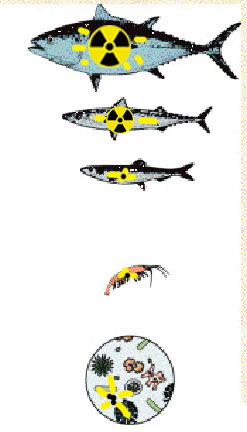
 Dec.26,2015 Highest rates of Ce-137 detected in Russian cod, though overall rate for domestic and imported seafood actually down 1.4% from last year
Radioactive material was discovered at detectable levels in domestic and Russian seafood products, a recent study confirms.
The news comes amid growing concerns about radiation contamination in seafood products entering the country since the 2011 disaster at Japan’s Fukushima I Nuclear Power Plant. In response, environmental groups are calling for more intensive inspections of seafood for radioactivity.
The findings were announced on Dec. 23 after a study by three groups: the Institute for Environment & Community Development Studies (IECDS), the Korea Radiation Watch Center, and the Gwangju chapter of the Korean Federation for Environmental Movement. Analysis of 150 samples of mackerel, pollock, cod, kelp, and sea mustard taken from discount stores and markets in Seoul, Busan, and Gwangju between March and November showed the presence of radioactive cesium-137 in eight of them, or 5.3%.
Cesium-137 is considered one of the chief examples of a radioactive isotope detected in the process of artificial nuclear fission, with an acceptable standard of 100 becquerels per kilogram.
The isotope was found in samples of pollock and cod from Russia and domestic mackerel and kelp at levels of 0.37 to 1.09 becquerels per kilogram. The highest rate of detection was for Russian cod at 13%, followed by Russian pollock at 11.5%, Korean kelp at 7.7%, and Korean mackerel at 3.3%.
By place of origin, Russian products showed the highest detection rate at 13.3% (six out of 45 samples), compared to a 3.2% rate for domestic products (two out of 63 samples). No radioactive material was found in other imported seafood.
The overall Ce-137 detection rate for domestic and imported seafood was down slightly from a similar survey conducted last year, falling from 6.7% to 5.3%. But the rate for Russian products showed a slight increase from 13% last year to 13.3% in 2015.
“The radioactive material detection rate for Russian products was quite high. We need greater monitoring and more stringent standards,” said IECDS researcher Min Eun-ju. “We also need to figure out the cause behind the radioactive material detected in Korean sea grasses and take appropriate steps,” Min added.
Min also weighed in on the South Korean government’s current plans to consider lifting import bans on seafood from eight Japanese prefectures. “If that happens, there will be no way to stop the import of seafood contaminated with radioactivity. We should be beefing up our standards, not loosening them, and we should be responding forcefully to the Japanese government’s complaint with the World Trade Organization,” she said.
Ce-137 has a half-life of over thirty years and is known to cause radiation exposure within the body as it accumulates in muscles and subcutaneous fat. The details of its effects on the human body from exposure through accumulation of small amounts remain unknown. By Kim Young-dong, staff reporter Please direct questions or comments to [english@hani.co.kr]
1 This Month


No Nuclear in Cwm Llynfi! Stop the nuclear power station near Maesteg.


4 August – WEBINAR – Hiroshima & Nagasaki: Nuclear Bombs Never Again
Tuesday, Aug. 4 at 5 pm PT / 8 pm ET.
Aug 5, 2026 10:00 AM in Australia/Melbourne
Join the Nuclear Bombs Never Again webinar on August 4th at 5pm Pacific Time / 8pm Eastern Time / 9am Japan Standard Time.
Cross generational voices at the intersection of Japan-Korea-US policy and militarization will share their lived experiences, nuclear impacts in these contexts, anti-war strategies, and actions you can take to advocate for a world with Nuclear Bombs Never Again. This 75-minute event is co-hosted by WILPF US and Korea Peace Now.
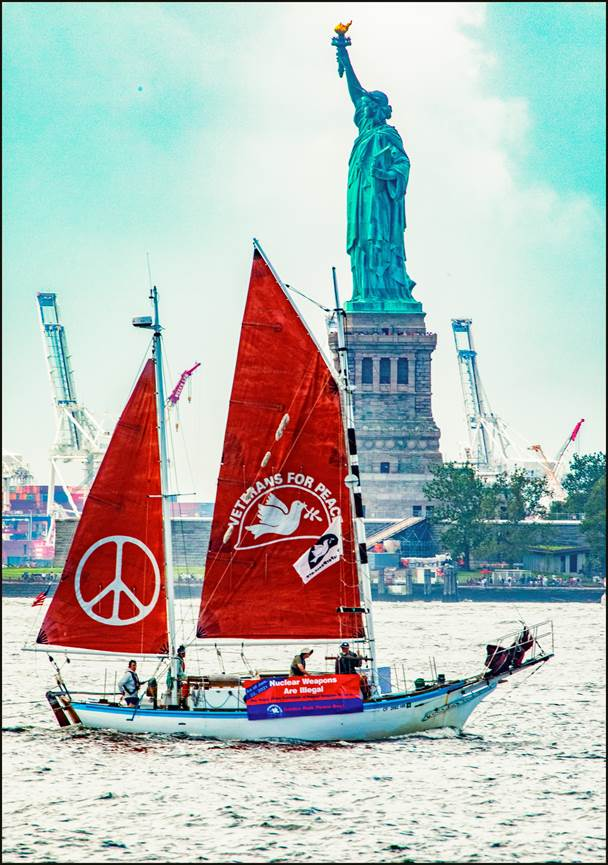
22,000+ miles voyaging for nuclear disarmament
and a radiation-free environment https://vfpgoldenruleproject.org/
To see nuclear-related stories in greater depth and intensity – go to https://nuclearinformation.wordpress.com
-
Archives
- July 2026 (332)
- June 2026 (287)
- May 2026 (306)
- April 2026 (356)
- March 2026 (251)
- February 2026 (267)
- January 2026 (308)
- December 2025 (358)
- November 2025 (359)
- October 2025 (375)
- September 2025 (257)
- August 2025 (319)
-
Categories
- 1
- 1 NUCLEAR ISSUES
- business and costs
- climate change
- culture and arts
- ENERGY
- environment
- health
- history
- indigenous issues
- Legal
- marketing of nuclear
- media
- opposition to nuclear
- PERSONAL STORIES
- politics
- politics international
- Religion and ethics
- safety
- secrets,lies and civil liberties
- spinbuster
- technology
- Uranium
- wastes
- weapons and war
- Women
- 2 WORLD
- ACTION
- AFRICA
- Atrocities
- AUSTRALIA
- Christina's notes
- Christina's themes
- culture and arts
- Events
- Fuk 2022
- Fuk 2023
- Fukushima 2017
- Fukushima 2018
- fukushima 2019
- Fukushima 2020
- Fukushima 2021
- general
- global warming
- Humour (God we need it)
- Nuclear
- RARE EARTHS
- Reference
- resources – print
- Resources -audiovicual
- Weekly Newsletter
- World
- World Nuclear
- YouTube
-
RSS
Entries RSS
Comments RSS
 nuclear-news