Kazakhstan’s unfinished, unfixed, problem of radioactivity at Semipalatinsk
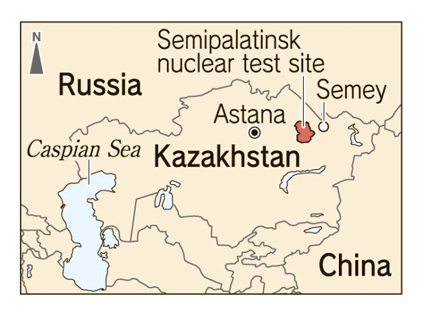 The continuing danger of Semipalatinsk http://thebulletin.org/continuing-danger-semipalatinsk9969 6 OCTOBER 2016 Magdalena Stawkowski During the Cold War, the Semipalatinsk Nuclear Test Site in Kazakhstan was the Soviet Union’s primary nuclear weapons testing ground. Between 1949 and 1989, more than 450 nuclear bombs were exploded above and below ground on its once secret, 7,000-square-mile territory. In the post-Soviet period,Kazakhstan has attracted much international praise for its “extraordinary leadership” and “courage” in closing Semipalatinsk, for giving up its nuclear weapons stockpile, and for helping to create a nuclear weapon free zone in Central Asia. Kazakhstan has also been celebrated for having an extraordinary record in advancing nuclear security and thus was judged to be perfectly suited to host an international fuel bank for low-enriched uranium. The Obama administration has described Kazakhstan’s president, Nursultan Nazarbayev, as “really one of the model leaders in the world” on non-proliferation and nuclear safety issues.
These commendations are perhaps overly enthusiastic. They exaggerate Kazakhstan’s commitment to nuclear safety; actually, Kazakhstan’s leadership has done little to address pressing humanitarian issues at Semipalatinsk, failing to provide adequate funding for environmental clean up and adequate security for the site itself. How can the world talk about nuclear safety in Kazakhstan when it is the only place on Earth where thousands of people still live in and around an atomic test site? How can there be safety, when residual radioactivity and environmental damage are a normal part of life for people who live there? Nuclear security should mean more than the physical protection of nuclear materials. Nuclear security must also mean the physical protection of individual citizens from radioactivity.
Today, most of the abandoned Semipalatinsk territory is accessible to anyone who wishes to enter. Except for a 37-mile area “exclusion zone” at the Degelen Mountain complex, guarded by drones and other surveillance equipment, few signs indicate radiation danger. For the thousands living nearby, it is no secret that the former nuclear testing area is poorly secured. I have been conducting anthropological fieldwork in the region since 2009, living in Koyan, a remote village on the nuclear test site’s border. I know first hand the ease with which people make use of the territory. (“Koyan” and “Tursynbek,” the name of an ethnographic interlocutor mentioned later in this article, are pseudonyms, used to protect village residents and the interlocutor following the convention of confidentiality spelled out in the American Anthropological Association Code of Ethics on professional responsibility).
Koyaners, like most everyone else living in and around Semipalatinsk, use the test site in a number of ways: They drive across the dusty steppe during warmer months to visit relatives in nearby villages. In July and August, men, women, and children come back from the site, buckets brimming with wild strawberries they have picked from its shallow valleys. Many graze their herds of sheep, goats, horses, and cows on the Semipalatinsk pastures, sometimes near craters formed by underground explosions. Many of these places are known to contain radioactive “hot spots,” but since the area around Koyan is mostly unmarked, no one in the village is certain where the hot spots are. Koyaners are not privy to this information, because no one in the government shares it with them.
On a hot, sunny day in July 2015, Tursynbek, a burly stockbreeder and miner in his mid-50s, decided we should go out and measure radiation on our own. As we got in the car, he complained that when he has had a chance to ask scientists, who occasionally do research in the area, if there is radiation, they dismiss his concerns by saying, “There is nothing here; no radiation.” I made sure to bring my Geiger counter on this trip, and a short car ride later I was looking down from the rim of a nuclear crater, trying to hear the Geiger counter readings Tursynbek was shouting. His camouflage jacket was barely visible on the steep pitch, among the tall grasses; a rather sizeable water hole was beyond, inside the crater. He scanned the ground for radioactivity, his white paper sanitary mask pulled down under his chin, rather than over his mouth. The sanitary mask was meant to protect against small particles of plutonium or other radioisotopes that are dangerous when inhaled but can be stopped by a sheet of paper. But Tursynbek was not afraid. Tursybek knows this area well; he was born in Koyan and has decades of experience raising livestock, sheep, goats, cows, and horses, which includes grazing them on the test site.
Still, he had never been here on this kind of mission. As he climbed out, he eagerly used the Geiger counter to check the wreckage of the atomic landscape: trenches, mangled barbed wire enclosures, scattered cement blocks with clusters of electrical cables jutting from them. The frantic clicking of the Geiger counter disturbed the otherwise calm summer afternoon. Not far from us, Kazakhstan’s Institute of Radiation Safety and Ecology (IRSE) wazik (van) carrying “geologists,” as the scientists are known to Koyaners, passed by. “They have never shared any of this information with us,” Tursynbek said motioning to the van and pointing at the .700 milliRem per hour reading displayed by the counter.
Normal background is between .008-.015 milliRem/hr. According to the US Nuclear Regulatory Commission (NRC), Americans receive an average radiation dose of about 620 milliRem per year. Half of this dose comes from naturally occurring radiation found in soil, rocks (uranium), and air (radon). The other half comes from man-made sources, like radiation therapy, x-rays, and nuclear power plants. At the crater, five weeks is enough time to receive the average yearly dose of radiation described by the NRC. In one year that dose is equal to 6,136 milliRem.
Looking around the abandoned test site, it is almost never obvious what went on here, except at a few key experimental locations, which have decaying cement structures and other visible points of interest. The once high levels of security have long since disappeared. Yet for 40 years various technical sites at Semipalatinsk were used to experiment with different types of nuclear explosions. At “Ground Zero” for example, 116 aboveground tests were conducted, as part of a full-scale experiment designed to record damage done to animals (sheep, goats, cows, and pigs), plants and soil, building construction, military equipment, and people living in settlements found near the site. At other technical areas, more than 300 underground nuclear explosions were used to test their peaceful applications. Several of these high-yield tests produced nuclear craters and contaminated much of the area nearby.
Near the nuclear crater Tursynbek and I visited, only a small and badly faded radiation warning sign clung to a mangled barbed wire enclosure that once provided some level of protection. The plight of people who suffered from radiation exposure during the Soviet-era is well known in the country and abroad, even if the level of radioactive pollution and its impact on human health are hotly disputed, in local and international peer-reviewed scientific journals.
In an August 2015 editorial for the Bulletin of Atomic Scientists, Kazakhstan’s ambassador to the United States, Kairat Umarov, highlighted the fate of 1.5 million Kazakh citizens whose lives continue to be affected by nuclear testing. He wrote with the optimism of a man hoping to promote a nuclear-weapons-free world. But Umarov ignored an obvious fact: The Nazarbayev government, lacking financial resources, has done very little to address the security problems at Semipalatinsk and has not spent a penny to clean up the area. Praise of the nation’s leadership for making Kazakhstan a non-nuclear state has come at a price: It has overshadowed and limited conversations about lack of oversight of Semipalatinsk and the toxic mess that the Soviet nuclear testing program left behind and continues to endanger thousands of citizens living in the area. Given this unresolved and underreported situation at Semipalatinsk, the international community should offer financial help and expertise for the cleanup of Semipalatinsk, or at the very least help with cordoning off the most contaminated areas of the site.
China’s graphite mining communities pay heavy health toll, to supply modern technological devices
Inhaling particulate matter can cause an array of health troubles, according to health experts, including heart attacks and respiratory ailments.
But it’s not just the air. The graphite plant discharges pollutants into local waters…

IN YOUR PHONE, IN THEIR AIR A trace of graphite is in consumer tech. In these Chinese villages, it’s everywhere.Washington Post, Story by Peter Whoriskey Photos by Michael Robinson Chavez Videos by Jorge Ribas October 2, 2016 At night, the pollution around the village has an otherworldly, almost fairy-tale quality.
“The air sparkles,” said Zhang Tuling, a farmer in a village in far northeastern China. “When any bit of light hits the particles, they shine.”
By daylight, the particles are visible as a lustrous gray dust that settles on everything. It stunts the crops it blankets, begrimes laundry hung outside to dry and leaves grit on food. The village’s well water has become undrinkable, too.
Beside the family home is a plot that once grew saplings, but the trees died once the factory began operating, said Zhang’s husband, Yu Yuan.
“This is what we live with,” Zhang said, slowly waving an arm at the stumps.
Zhang and Yu live near a factory that produces graphite, a glittery substance that, while best known for filling pencils, has become an indispensable resource in the new millennium. It is an ingredient in lithium-ion batteries.
Smaller and more powerful than their predecessors, lithium batteries power smartphones and laptop computers and appear destined to become even more essential as companies make much larger ones to power electric cars.
The companies making those products promote the bright futuristic possibilities of the “clean” technology. But virtually all such batteries use graphite, and its cheap production in China, often under lax environmental controls, produces old-fashioned industrial pollution.
At five towns in two provinces of China, Washington Post journalists heard the same story from villagers living near graphite companies: sparkling night air, damaged crops, homes and belongings covered in soot, polluted drinking water — and government officials inclined to look the other way to benefit a major employer.
After leaving these Chinese mines and refiners, much of the graphite is sold to Samsung SDI, LG Chem and Panasonic — the three largest manufacturers of lithium-ion batteries. Those companies supply batteries to major consumer companies such as Samsung, LG, General Motors and Toyota.
Apple products use batteries made by those companies, too Continue reading
In these Chinese villages – graphite IN THE AIR, IN THE WATER
IN YOUR PHONE, IN THEIR AIR A trace of graphite is in consumer tech. In these Chinese villages, it’s everywhere. Washington Post, Story by Peter Whoriskey Photos by Michael Robinson Chavez Videos by Jorge Ribas October 2, 2016 “………IN THE AIR, IN THE WATER
Despite the name, only a small portion of a lithium-ion battery consists of lithium. Graphite is used to make the negative electrode and represents about 10 to 15 percent of the cost of a typical lithium-ion battery, according to analysts.
The demand for graphite has risen in parallel with the demand for more-powerful laptops, tablets and phones.
Ten years ago, for example, the battery of the best-selling Motorola Razr had a capacity of 680 milliamp-hours. Today, the batteries in the best-selling smartphones have three or four times that.
Lyu Guoliang, senior engineer at the graphite business association in Jixi, said the demand for graphite rose very rapidly in 2010, driven by the demand for lithium-ion batteries.
Graphite for batteries must be refined to high levels of purity, and the flakes must be reformed into tiny spherical or potato-like particles. This extra refining means that the refined graphite is worth 10 times as much as the raw material, said Lyu, and that made the business particularly attractive.
But without proper controls, mining and refining can cause pollution in two ways — by air and by water.
Graphite powder can quickly become airborne dust, drifting for miles. Without systems of tarps and fans to keep it under control, the resulting fine-particle pollution can cause an array of breathing difficulties, such as aggravating lung disease or reducing lung function, and has been linked to heart attacks in people with heart disease, according to the U.S. Environmental Protection Agency.
Graphite operations can also lead to pollution because their chemicals leak into local waters. According to industry sources, the purifying process, especially in China, is commonly done with acids, often hydrofluoric acid, a highly toxic substance.
This method is cheaper than the one used in other countries, where the graphite is purified by “baking,” — that is, heating it up. Riddle, of Asbury Carbons, said refining graphite that way is better for the environment but adds about 15 percent to the price. He said that for the past 20 years his company has insisted on purchasing only graphite refined this way.
“We had hoped more companies and users would follow our lead, but this has not been the case,” Riddle said.
Tracing your battery’s graphite
The lithium-ion battery industry has a massively complicated supply chain. Each consumer company has dealt with multiple suppliers — and their suppliers have dealt with multiple suppliers. This shows some of the connections within the industry. See companies’ responses to Washington Post’s investigation.
WAR AGAINST POLLUTION’
The Chinese government has shown increasing concern about the nation’s environmental woes.
After decades of extraordinary economic growth, the country’s air has become an acute health danger. A million or more Chinese die prematurely every year because of outdoor air pollution, according to multiple estimates, including the report known as the Global Burden of Disease, part of a project run out of the University of Washington. One of the critical groups of pollutants in the Chinese air is “particulate matter” — dust, soot, smoke — a category that includes the air pollutants emitted from graphite plants.
Meanwhile, water quality in China has deteriorated, too. In 2015, the portion of the country’s groundwater supplies classified as “bad” or “very bad” stood at over 60 percent, according to China Water Risk, a nonprofit group that tallies figures from China’s Ministry of Environmental Protection. More than a quarter of China’s key rivers were deemed by the government as “unfit for human contact,” according to the group.
According to a report on graphite mining shown on state-run CCTV, the rivers in Jixi show levels of lead and mercury that are many times the national limit. Given the array of industry in the area, however, it is impossible to say how much of the lead and mercury come from the graphite industry.
“We will resolutely declare war against pollution as we declared war against poverty,” Premier Li Keqiang announced in 2014.
About three years ago, the country’s environmental efforts focused on the graphite industry, and records indicate that more than a dozen companies were issued citations by provincial and city officials, mostly in Heilongjiang and Shandong provinces, where most of China’s graphite business is done.
For example, Aoyu, which operates the plants near Lyu Shengwen and Liu Fulan in Mashan, was cited for not controlling the dust and the water pollution. It was fined roughly $7,500 for those infractions and asked to make improvements, according to a database of government records kept by the Institute of Public and Environmental Affairs (IPE), a Beijing-based nonprofit.
Likewise, BTR faced similar enforcement efforts for air and water pollution.
So, too, has Hensen, a graphite producer in Shandong province that sells to BTR, according to its manager, who did not respond to emailed questions regarding the water pollution.
Guo, the BTR spokeswoman, said that the plant in question has been improved and won the approval of the local government. She attributed the complaints to the fact that BTR is an environmental leader within the industry. As a result, she said, “we think it is normal . . . that someone attacks BTR by improper means. . . . BTR will talk with local people. . . . We would like to prove to them that BTR doesn’t make pollution on the water and crops.”
An Aoyu official hung up on a reporter seeking comment about the pollution.
But not all of the graphite factories appear to have been targeted by the crackdown. For two of the five factories visited by Post journalists, no records of any government citations could be found in the IPE database.
And even at those places where polluters were cited by the government, neighbors said that if any improvements were made, they were short-lived or not substantial enough to clean up the problem. Villagers said some factories employ pollution prevention measures — such as tarps to keep graphite from flying away, or actions to prevent toxic sewage from flowing into local waters — only when the environmental officials are present.
“It was worse last year, but it’s still bad,” Li Jie said in Liumao. “Everything is mai tai.” The trouble, residents and some industry representatives said, is that while the government wants to protect the environment, they also want to protect the jobs at the graphite factories.
Hou Lin, 30, works at the Aoyu plant in Mashan as a safety manager. He walked by as some farmers were complaining to reporters about the pollution.
“The company pollutes a lot,” he agreed. “But people need to have jobs.”……………..Story by Peter Whoriskey. Photos by Michael Robinson Chavez. Videos by Jorge Ribas. Graphics by Lazaro Gamio andTim Meko. Design by Matt Callahan, Emily Chow and Chris Rukan. https://www.washingtonpost.com/graphics/business/batteries/graphite-mining-pollution-in-china/
Chinese villagers intimidated by graphite plant owners in collusion with local authorities
IN YOUR PHONE, IN THEIR AIR A TRACE OF GRAPHITE IS IN CONSUMER TECH. IN THESE CHINESE VILLAGES, IT’S EVERYWHERE. WASHINGTON POST, STORY BY PETER WHORISKEY PHOTOS BY MICHAEL ROBINSON CHAVEZ VIDEOS BY JORGE RIBAS OCTOBER 2, 2016 “…….BEING WATCHED
One of the main obstacles in clearing the pollution, villagers said, is the powerful alliance between local government officials and the owners of the graphite plants. The officials, the villagers said, protect the factories from environmental complaints.
At three of the five villages visited by Post journalists in May and June, a village official either tried to attend interviews or soon after inquired of the interviewees what had transpired in the interviews. Moreover, plant managers and party officials sometimes discouraged journalists from speaking with villagers.
After Post journalists visited the Haida Graphite plant in Pingdu, for example, a plant employee jumped in a car to follow their taxi off the property and through the village streets.
The taxi stopped twice in the village so The Post could interview more people. At each stop, the driver of the Haida car approached to within a few feet and blared the car horn continuously, making talking to villagers impossible. The driver relented only when The Post’s taxi left the area. Asked to comment later about the pollution complaints, a Haida official accused a Post reporter of “espionage” and refused to answer questions.
Similarly, after The Post visited a BTR graphite factory in Jixi, two cars with several men inside began following the reporters’ taxi. Three times, over several miles, the taxi pulled over to let them pass. Each time, the following cars pulled over and stopped behind the Post taxi. Confronted, the men in the cars told reporters that it was just a coincidence that they had stopped at the same time that the taxi did. The men said they were mapping out a bicycle race.
The intimidation has an effect on villagers.
Not far from the Hensen graphite plant in Laixi is a small factory that makes women’s underwear. Han Wenbing, 48, is the owner. A large man, proud of his workshop, he was eager to talk about the graphite pollution.
He readily invited reporters into his home, showing the dust quickly gathering on his kitchen table and showing how his well water, which had been fine for drinking, now is topped with a gray film.
But as he made his case against the graphite plant, his wife grew nervous — and then angry. To speak out would only cause trouble with the plant manager and village officials, she warned her husband.
“Yes, there is absolutely an impact [from the graphite], but we don’t want to be on TV,” she said. “This could offend the boss of the company, which could affect our lives. You [reporters] wash your hands and walk away, but we live here.”
Han nevertheless wanted to make his complaints known. Once his wife acquiesced, he offered to point out a field that showed some of the worst effects of the pollution. The field had been used by small farmers, he said, but industrial runoff had affected the soil so much that “not even the weeds can grow.”………Story by Peter Whoriskey. Photos by Michael Robinson Chavez. Videos by Jorge Ribas. Graphics by Lazaro Gamio andTim Meko. Design by Matt Callahan, Emily Chow and Chris Rukan. https://www.washingtonpost.com/graphics/business/batteries/graphite-mining-pollution-in-china/
Rising demand for lithium, and the pollution resulting from this
IN YOUR PHONE, IN THEIR AIR A TRACE OF GRAPHITE IS IN CONSUMER TECH. IN THESE CHINESE VILLAGES, IT’S EVERYWHERE. WASHINGTON POST, STORY BY PETER WHORISKEY PHOTOS BY MICHAEL ROBINSON CHAVEZ VIDEOS BY JORGE RIBAS OCTOBER 2, 2016 “……DEMAND RAMPS UP
While U.S. consumers may seem uninvolved in — and untouched by — the Chinese pollution, the truth is more complicated.
The U.S. demand for cheap goods helps keep the Chinese factories going. More than a quarter of the emissions of two key pollutants in China — sulfur dioxide and nitrogen oxides — arose from the production of goods for export, according to research published in 2014 in the Proceedings of the National Academy of Sciences. The largest share of exports goes to the United States.
Moreover, the same researchers found that some of the pollution in China reaches the United States — the air pollution drifts across the ocean and raises ozone levels in the western part of the country, according to the study.
“Outsourcing production to China does not always relieve consumers in the United States . . . from the environmental impacts of air pollution,” according to the authors of the study, which was conducted by a consortium of scientists from China and the United States.
Now the rise of the electric-car industry promises a huge surge in the lithium-ion battery business.
Making batteries big enough to power cars will cause a daunting leap in demand. A laptop requires just a handful of the familiar, thin, cylindrical lithium-ion batteries known as “18650s.” A smartphone requires even less. But a typical electric car requires thousands of times the battery power.
Today, the best known “gigafactory” for electric-car batteries is the one being built by Tesla in the Nevada desert — a plant the company says will produce 500,000 electric-car batteries annually. But it’s just one of many. About a dozen other battery gigafactories are being planned around the world.
This is “not just a Tesla story,” said Simon Moores, managing director of Benchmark Mineral Intelligence, a firm that tracks demand and assesses prices for raw materials in the industry. “The demand is rising everywhere, especially in China.” Todd C. Frankel and Yanan Wang in Washington and Xu Jing contributed to this report.
Britain sited 2 nuclear power plants on eroding shingle beach
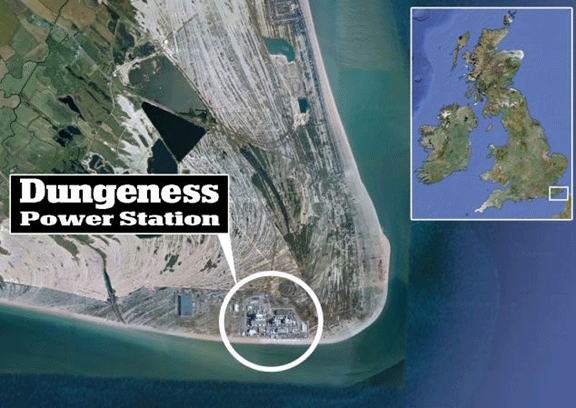
Miss Sian Farrell | October 2, 2016 I have been following the various stories related to nuclear power and its problems ever since the Chernobyl event in 1986. I thought I knew about pretty much all of them. But then I found out that Britain has the largest shingle beach in Europe. It’s over 8 square miles in size and because of the fast moving tides and river currents, around 90,000 cubic meters of shingle are washed from its western shore to its eastern shore each year. Its lighthouse is regularly moved because of this problem.
This is the same shingle beach (western side) on which our government chose to site, not one, but TWO nuclear power plants. Contractors move 30,000 tons of shingle (less than a third of what is lost), back in front of Dungeness each year because of this erosion.
This Is for me, a shocking and disturbing revelation!
Nuclear power station has been leaking radioactive waste ‘for months’, says Environment Agency “……The Evironment Agency confirmed that levels of tritium were normal elsewhere in Dungeness B’s surroundings and added that the power station is allowed to discharge tritium in the environment under permit……. http://www.dailymail.co.uk/news/article-2311217/Nuclear-power-station-leaking-radioactive-waste-months-says-Environment-Agency.html#ixzz4M0Kjsu6A
Danger of radioactive groundwater leak at Kashiwazaki-Kariwa nuclear power plant.
JCP reveals risk of contaminated water leakage at Kashiwazaki-Kariwa NPP http://www.japan-press.co.jp/modules/news/index.php?id=9945 September 16, 2016
The JCP investigation team consisting of JCP Dietmembers, Fujino Yasufumi (Lower House) and Takeda Ryosuke (Upper House), on September 15 visited the Kashiwazaki-Kariwa NPP to examine its safety measures.
The group investigated Nos. 6 and 7 reactors, which the Nuclear Regulation Authority is examining TEPCO’s application for restart, and sites of subsidence damage caused by liquefaction due to the 2007 Chuestu Offshore Earthquake.
It has come to light that the amount of groundwater being used at the Kashiwazaki-Kariwa NPP is much larger than the amount at other NPPs in Japan. However, TEPCO explained to the JCP group that it has no idea why so much groundwater is being pumped into the nuclear power station. After the investigation, JCP member of the House of Representatives Fujino Yasufumi said to reporters, “The utility has yet to implement measures to control its use of groundwater.” Given the fact that at the Fukushima nuclear power plant, TEPCO is struggling with a serious leakage of radioactively-contaminated water which is caused by groundwater entering the crippled NPP, it is unacceptable for the power company to bring the Kashiwazaki-Kariwa power station back online.
Professor Emeritus of Seismology at Niigata University Tateishi Masaaki, who joined the JCP investigation team, pointed out that the NRA should examine the amount of groundwater used at the NPP and asses the seismic capacity of wells pumping up the groundwater.”
The world had better pay attention NOW – to soaring ocean temperatures
Soaring ocean temperature is ‘greatest hidden challenge of our generation’
IUCN report warns that ‘truly staggering’ rate of warming is changing the behaviour of marine species, reducing fishing zones and spreading disease, Guardian, Oliver Milman. 6 Sept 16, The soaring temperature of the oceans is the “greatest hidden challenge of our generation” that is altering the make-up of marine species, shrinking fishing areas and starting to spread disease to humans, according to the most comprehensive analysis yet of ocean warming.
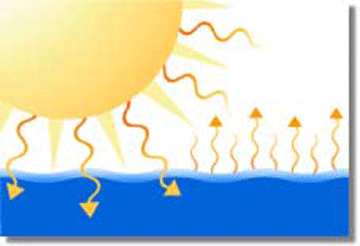
The oceans have already sucked up an enormous amount of heat due to escalating greenhouse gas emissions, affecting marine species from microbes to whales, according to an International Union for Conservation of Nature (IUCN) reportinvolving the work of 80 scientists from a dozen countries.
The profound changes underway in the oceans are starting to impact people, the report states. “Due to a domino effect, key human sectors are at threat, especially fisheries, aquaculture, coastal risk management, health and coastal tourism.”…..
The scale of warming in the ocean, which covers around 70% of the planet, is “truly staggering”, the report states. The upper few metres of ocean have warmed by around 0.13C a decade since the start of the 20th century, with a 1-4C increase in global ocean warming by the end of this century.
The ocean has absorbed more than 90% of the extra heat created by human activity. If the same amount of heat that has been buried in the upper 2km of the ocean had gone into the atmosphere, the surface of the Earth would have warmed by a devastating 36C, rather than 1C, over the past century.
At some point, the report says, warming waters could unlock billions of tonnes of frozen methane, a powerful greenhouse gas, from the seabed and cook the surface of the planet. This could occur even if emissions are drastically cut, due to the lag time between emitting greenhouse gases and their visible consequences.
Warming is already causing fish, seabirds, sea turtles, jellyfish and other species to change their behaviour and habitat, it says. Species are fleeing to the cooler poles, away from the equator, at a rate that is up to five times faster than the shifts seen by species on land.
Even in the north Atlantic, fish will move northwards by nearly 30km per decade until 2050 in search of suitable temperatures, with shifts already documented for pilchard, anchovy, mackerel and herring.
The warming is having its greatest impact upon the building blocks of life in the seas, such as phytoplankton, zooplankton and krill. Changes in abundance and reproduction are, in turn, feeding their way up the food chain, with some fish pushed out of their preferred range and others diminished by invasive arrivals.
With more than 550 types of marine fishes and invertebrates already considered threatened, ocean warming will exacerbate the declines of some species, the report also found…….
Ocean acidification, where rising carbon dioxide absorption increases the acidity of the water, is making it harder for animals such as crabs, shrimps and clams to form their calcium carbonate shells.
The IUCN report recommends expanding protected areas of the ocean and, above all, reduce the amount of heat-trapping gases pumped into the atmosphere.
“The only way to preserve the rich diversity of marine life, and to safeguard the protection and resources the ocean provides us with, is to cut greenhouse gas emissions rapidly and substantially,” said Inger Andersen, director general of the IUCN.https://www.theguardian.com/environment/2016/sep/05/soaring-ocean-temperature-is-greatest-hidden-challenge-of-our-generation
Climate change is affecting the marine ecosystem – krill disappearing from Antarctic waters
 Whales, seals and penguins could be hurting as this tiny creature–fundamental to the food web–declines, Scientific American By Andrea Thompson, Climate Central on August 29, 2016
They may be small, but krill—tiny, shrimp-like creatures—play a big role in the Antarctic food chain. As climate change warms the Southern Ocean and alters sea ice patterns, though, the area of Antarctic water suitable for krill to hatch and grow could drop precipitously, a new study finds.
Most Antarctic krill are found in an area from the Weddell Sea to the waters around the Antarctic Peninsula, the finger of land that juts up toward South America. They serve as an important source of food for various species of whales, seals and penguins. While those animals find other food sources during lean years, it is unclear if those alternate sources are sustainable long-term.
Over the past 40 years, populations of adult Antarctic krill have declined by 70 to 80 percent in those areas, though researchers debate whether that drop is due to the effects of climate change, a rebound in whale populations after the end of commercial whaling or some combination of those pressures.
Because of its key role in the regional food chain, scientists are concerned about the impacts that future climate change may have on the krill population and the larger Antarctic ecosystem.
In the new study published in the journal Geophysical Research Letters, Andrea Piñones and Alexey Fedorov examined how expected changes in ocean temperatures and sea ice coverage might affect krill during their earliest life stages when they are most vulnerable to environmental conditions.
Krill has a complex, regimented life cycle that requires a delicate balance of conditions. …..
While warmer ocean temperatures help the krill hatch faster, declines in sea ice area, delayed sea ice formation, and a drop in phytoplankton populations meant that overall, the habitat suitable for young krill could decline by up to 80 percent, they found………http://www.scientificamerican.com/article/krill-are-disappearing-from-antarctic-waters/
Radioactive waste from oil and gas fracking found in landfill
Radioactive Waste Found at Oil Field Landfill in North Dakota, Oil Price By Irina Slav – Sep 01, 2016, North Dakota has had a problem with the inappropriate disposal of this radioactive waste for years. This time, the State Health Department of North Dakota is probing an oilfield waste landfill operated by IHD Solids Management after the detection of a significant amount of illegal radioactive matter.
The radioactive material was detected twice in two separate inspections that took place in May and June. Now the HD has ordered a third-party inspection of the landfill and instructed the operator to remove 950 tons of waste and take it out of the state, after radioactivity checks of all 12 oilfield waste landfills in the state revealed levels of between 5 and 80 picocuries, the latter standing 30 picocuries above the new maximum allowed for oilfield waste…….
The company will not be fined for the transgression because it dealt with the problem by removing the suspicious waste, as did two other landfill operators in North Dakota, Secure Energy and Gibson Energy. They too had to remove over-radioactive material from their landfills and ship it to special nuclear waste facilities.
Prudently, if not a tad belatedly, North Dakota will soon start requiring oilfield waste landfill operators to verify the radioactivity level of every load that arrives, rather than taking the word of the company generating the waste for it.
The waste from oil and gas wells include uranium, thorium, radium, a radioactive isotope of potassium, as well as isotopes of lead and polonium. These are naturally occurring elements that are brought to the surface through fracking. http://oilprice.com/Latest-Energy-News/World-News/Radioactive-Waste-Found-at-Oil-Field-Landfill-in-North-Dakota.html
American Fukushima rescue ships still contaminated with radiation
16 US ships that aided in Operation Tomodachi still contaminated with radiation, By MATTHEW M. BURKE | STARS AND STRIPES March 13, 2016 CAMP FOSTER, Okinawa — Sixteen U.S. ships that participated in relief efforts after Japan’s nuclear disaster five years ago remain contaminated with low levels of radiation from the crippled Fukushima Dai-ichi nuclear power plant, top Navy officials told Stars and Stripes.
In all, 25 ships took part in Operation Tomadachi, the name given for the U.S. humanitarian aid operations after the magnitude-9.0 earthquake and subsequent tsunami on March 11, 2011. The tsunami, whose waves reached runup heights of 130 feet, crippled the Fukushima plant, causing a nuclear meltdown.
In the years since the crisis, the ships have undergone cleanup efforts, the Navy said, and 13 Navy and three Military Sealift Command vessels still have some signs of contamination, mostly to ventilation systems, main engines and generators……
The Navy has acknowledged that the Reagan passed through a plume of radiation. Navy images showed sailors with their faces covered, scrubbing the deck of the Reagan with soap and water as a precautionary measure afterward. The Reagan and sailors stayed off the coast of Japan for several weeks to aid their Japanese allies.
The multibillion-dollar ship, projected to last at least 50 years after its launch in 2001, then was taken offline for more than a year for “deep maintenance and modernization” at the Puget Sound Naval Shipyard and Intermediate Maintenance Facility in Bremerton, Wash., according to Navy officials…….
Sailors who performed the work said it entailed entering spaces deep within the ship, testing for high levels of radiation, and if it was found, sanding, priming and painting the areas. They say there were given little to no protective gear, a claim that the Navy denies……
Eight Reagan sailors, claiming a host of medical conditions they say are related to radiation exposure, filed suit in 2012 against the nuclear plant’s operator, the Tokyo Electric Power Co. The suit asserts that TEPCO lied, coaxing the Navy closer to the plant even though it knew the situation was dire. General Electric, EBASCO, Toshiba Corp. and Hitachi were later added as defendants for allegations of faulty parts for the reactors.
A spokesman for TEPCO declined to comment for this story because of the sailors’ lawsuit, which was slated to go forward pending appeals in the U.S. 9th Circuit Court of Appeals.
The illnesses listed in the lawsuit include genetic immune system diseases, headaches, difficulty concentrating, thyroid problems, bloody noses, rectal and gynecological bleeding, weakness in sides of the body accompanied by the shrinking of muscle mass, memory loss, leukemia, testicular cancer, problems with vision, high-pitch ringing in the ears and anxiety.
The list of sailors who have joined the lawsuit, which is making its way through the courts, has grown to 370…….
Shinzo Kimura — a professor at Dokkyo Medical University in Japan who has studied radiation exposure from Hiroshima and Nagasaki to Chernobyl and, now, Fukushima — said it wasn’t too early for sailors to show symptoms of exposure-related conditions. Doctors have seen conditions in children living near the plant that surfaced earlier than would normally be expected.
Kimura, hired by the Nihonmatsu city government for his expertise in the field, was the first scientist on the ground taking readings in the wake of the Fukushima disaster. He said each person and the way their body is affected by radiation is different.
While unable to definitively say if the sailors were sickened by the radiation, Kimura reasoned that the levels aboard the Reagan were high enough to cause illnesses. Otherwise, he said, why go through the bother of repeated cleanings to lower radiation levels?
“It is impossible to speculate or calculate how much the doses were before the two decontamination works,” he said. “The U.S. military is very good at risk-management. Considering that, it is assumed that decontaminations were conducted twice because the levels were not favorable.”
sumida.chiyomi@stripes.com http://www.stripes.com/news/16-us-ships-that-aided-in-operation-tomodachi-still-contaminated-with-radiation-1.399094
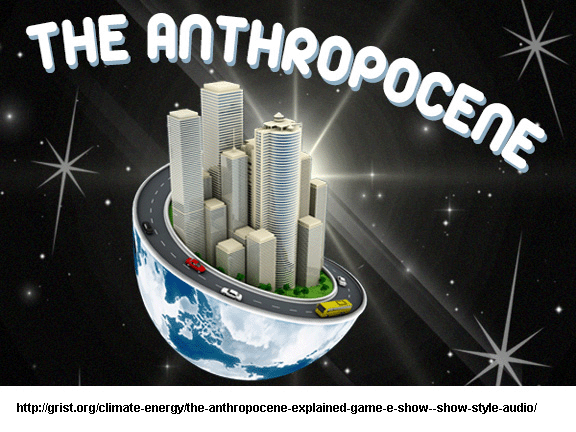
Nuclear bombing – the start of the Anthropocene Epoch
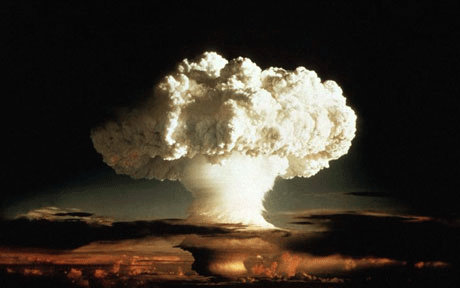
Nuclear bombs transformed the planet and set off the Age of Humans, geologists say, WP By Sarah Kaplan August 29 16, Around 1950, as atomic bombs fell on empty deserts, crowded cities and island atolls; as highways carved concrete paths across the planet; as populations exploded; as consumption skyrocketed; and as the average global temperature began its dangerous upward creep in earnest, Earth entered the epoch of humans.
Monday, members of the group presented their findings at the annual International Geological Congress in Cape Town, South Africa…….https://www.washingtonpost.com/news/speaking-of-science/wp/2016/08/29/scientists-believe-the-age-of-humans-began-in-1950-now-they-have-to-prove-it/
The Anthropocene epoch is here
The Anthropocene epoch: scientists declare dawn of human-influenced age Experts say human impact on Earth so profound that Holocene must give way to epoch defined by nuclear tests, plastic pollution and domesticated chicken, Guardian, Damian Carrington, 29 Aug 16, Humanity’s impact on the Earth is now so profound that a new geological epoch – the Anthropocene – needs to be declared, according to an official expert group who presented the recommendation to the International Geological Congress in Cape Town on Monday.
The new epoch should begin about 1950, the experts said, and was likely to be defined by the radioactive elements dispersed across the planet by nuclear bomb tests, although an array of other signals, including plastic pollution, soot from power stations, concrete, and even the bones left by the global proliferation of the domestic chicken were now under consideration.
The current epoch, the Holocene, is the 12,000 years of stable climate since the last ice age during which all human civilisation developed. But the striking acceleration since the mid-20th century of carbon dioxide emissions and sea level rise, the global mass extinction of species, and the transformation of land by deforestation and development mark the end of that slice of geological time, the experts argue. The Earth is so profoundly changed that the Holocene must give way to the Anthropocene………
To define a new geological epoch, a signal must be found that occurs globally and will be incorporated into deposits in the future geological record. For example, the extinction of the dinosaurs 66m years ago at the end of the Cretaceous epoch is defined by a “golden spike” in sediments around the world of the metal iridium, which was dispersed from the meteorite that collided with Earth to end the dinosaur age.
For the Anthropocene, the best candidate for such a golden spike are radioactive elements from nuclear bomb tests, which were blown into the stratosphere before settling down to Earth. “The radionuclides are probably the sharpest – they really come on with a bang,” said Zalasiewicz. “But we are spoiled for choice. There are so many signals.”
Other spikes being considered as evidence of the onset of the Anthropocene include the tough, unburned carbon spheres emitted by power stations. “The Earth has been smoked, with signals very clearly around the world in the mid-20th century,” said Zalasiewicz.
Other candidates include plastic pollution, aluminium and concrete particles, and high levels of nitrogen and phosphate in soils, derived from artificial fertilisers. Although the world is currently seeing only the sixth mass extinction of species in the 700m-year history of complex life on Earth, this is unlikely to provide a useful golden spike as the animals are by definition very rare and rarely dispersed worldwide.
In contrast, some species have with human help spread rapidly across the world. ……..https://www.theguardian.com/environment/2016/aug/29/declare-anthropocene-epoch-experts-urge-geological-congress-human-impact-earth
Desalinising water for drinking, by use of a Solar-powered Pipe

Solar-powered Pipe desalinizes 1.5 billion gallons of drinking water for
California, http://inhabitat.com/solar-powered-pipe-desalinizes-1-5-billion-gallons-of-clean-drinking-water-for-california/ Inhabitat, by Tafline Laylin, 29 aug 16 The infrastructure California needs to generate energy for electricity and clean water, which will be significant, need not blight the landscape. Designs like The Pipe demonstrate how the provision of public services like these can be knitted into every day life in a healthy, aesthetically-pleasing way. A finalist of the 2016 Land Art Generator Initiative design competition for Santa Monica Pier, the solar-powered plant deploys electromagnetic desalination to provide clean drinking water for the city and filters the resulting brine through on-board thermal baths before it is reintroduced to the Pacific Ocean.
According to Khalili Engineers, their design, a long gleaming thing visible from Santa Monica Pier, is capable of generating 10,000 MWh each year, which will in turn produce 4.5 billion liters (or 1.5 billion gallons) of drinking water. Given the current drought throughout California, and the dearth of water in general, a variety of urban micro generators such as this can complement utility-scale energy generation.
“What results are two products: pure drinkable water that is directed into the city’s primary water piping grid, and clear water with twelve percent salinity. The drinking water is piped to shore, while the salt water supplies the thermal baths before it is redirected back to the ocean through a smart release system, mitigating most of the usual problems associated with returning brine water to the sea.”
The winners of LAGI 2016 will be announced on October 6, 2016 at Greenbuild 2016. + LAGI 2016: Santa Monica + Khalili Engineers
Rocky Flats’ dangerous radioactive legacy
The concerns are not limited to the refuge itself. There is plenty of plutonium offsite, thanks to a combination of sloppy practices onsite and the high winds for which the area is notorious. In 2010, one researcher discovered high concentrations of plutonium in dust in the crawl space under a local home. Researchers have concluded that smoke from a series of fires and plutonium blown from waste holding areas were probably the main sources. Peer-reviewed studies have found high rates of lung and brain cancers, leukemia, and other diseases among workers at the plant.
We are left with a conundrum: Is Rocky Flats a brilliant urban wildlife resource, or a dangerous radioactive legacy? The weird but inescapable truth is that it is both.
Rocky Flats: A Wildlife Refuge Confronts Its Radioactive Past, Environment 36016 AUG 2016: REPORT
The Rocky Flats Plant outside Denver was a key U.S. nuclear facility during the Cold War. Now, following a $7 billion cleanup, the government is preparing to open a wildlife refuge on the site to the public, amid warnings from some scientists that residual plutonium may still pose serious health risks.by fred pearce “…….In a previous life, Rocky Flats was a secret place, where over almost four decades Dow Chemical and Rockwell International, as contractors working for the U.S. government, turned plutonium from military reactors into an estimated 70,000 grapefruit-sized triggers at the heart of hydrogen bombs. Few installations were as important during the Cold War as the Rocky Flats Plant, which operated from 1952 to 1989. And by all accounts, preventing plutonium pollution of the surrounding environment, including that of the people of Denver, was low on the list of priorities…… Continue reading
1 This Month



26 September – International Day for the Total Elimination of Nuclear Weapons


PLEASE OPPOSE HR 8255 AND S.3639 – bills would accelerate satellite deployment, with no environmental review or safeguards – https://ncstd5li.quorum.us/campaign/169331/
To see nuclear-related stories in greater depth and intensity – go to https://nuclearinformation.wordpress.com
-
Archives
- September 2026 (269)
- August 2026 (330)
- July 2026 (355)
- June 2026 (287)
- May 2026 (306)
- April 2026 (356)
- March 2026 (251)
- February 2026 (267)
- January 2026 (308)
- December 2025 (358)
- November 2025 (359)
- October 2025 (375)
-
Categories
- 1
- 1 NUCLEAR ISSUES
- business and costs
- climate change
- culture and arts
- ENERGY
- environment
- health
- history
- indigenous issues
- Legal
- marketing of nuclear
- media
- opposition to nuclear
- PERSONAL STORIES
- politics
- politics international
- Religion and ethics
- safety
- secrets,lies and civil liberties
- spinbuster
- technology
- Uranium
- wastes
- weapons and war
- Women
- 2 WORLD
- ACTION
- AFRICA
- Atrocities
- AUSTRALIA
- Christina's notes
- Christina's themes
- culture and arts
- Events
- Fuk 2022
- Fuk 2023
- Fukushima 2017
- Fukushima 2018
- fukushima 2019
- Fukushima 2020
- Fukushima 2021
- general
- global warming
- Humour (God we need it)
- Nuclear
- RARE EARTHS
- Reference
- resources – print
- Resources -audiovicual
- Weekly Newsletter
- World
- World Nuclear
- YouTube
-
RSS
Entries RSS
Comments RSS

