Greenpeace exposes high radiation risks in Fukushima village as govt prepares to lift evacuation order http://www.newkerala.com/news/fullnews-228867.htmlTokyo/ New Delhi, Feb 21: The Japanese government will soon lift evacuation orders for 6,000 citizens of Iitate village in Fukushima prefecture where radiation levels in nearby forests are comparable to the current levels within the Chernobyl 30km exclusion zone – an area that more than 30 years after the accident remains formally closed to habitation.
Seventy-five percent of Iitate is contaminated forested mountains, a Greenpeace statement claimed..
A survey team led by Greenpeace Japan recently found radiation dose rates at houses in the village of Iitate well above long-term government targets, with annual and lifetime exposure levels posing a long-term risk to citizens who may return. Evacuation orders will be lifted for Iitate no later than March 31, 2017, to be followed one year later by the termination of compensation payments.
The relatively high radiation values, both inside and outside houses, show an unacceptable radiation risk for citizens if they were to return to Iitate. Citizens returning to their irradiated homes are at risk of receiving radiation equivalent to one chest X-ray every week. This is not normal or acceptable, said Ai Kashiwagi, energy campaigner with Greenpeace Japan .
As Japan nears the six year anniversary of the nuclear disaster, the Japanese government last week confirmed that it has not yet conducted any assessments of lifetime exposure risks for citizens if they were to return to Iitate.
Recent reports suggest that the cost of cleaning up of Fukushima plant would cost more than 12lakh crores. If a developed country like Japan, known for its processes and systems, is finding it too difficult to handle the disaster, it makes little sense for India to go ahead and sign up for four more reactors at Kudankulam and elsewhere. In the words of George Santania Those who cannot remember the past are condemned to repeat it, says G. Sundarrajan of Poovulagin Nanbargal.
Life can never go back to normal for people living near nuclear power plants. But clearly, the world has failed to learn its lessons from nuclear accidents like those in Chernobyl and Fukushima. India, for instance, seems determined to add on to its nuclear power capacity despite putting the lives of millions of people at risk, says Nandikesh Sivalingam, climate and energy campaigner, Greenpeace India.
The fact remains that nuclear power is neither safe nor economical, and that India is grossly ill-prepared to handle a nuclear disaster. This was pointed out by Red Alert, a Greenpeace India report that released last year.
Last years Indo-Japan nuclear deal also negated the lessons learnt from Fukushima.
The deal to buy six AP1000 reactors was more of a last ditch effort to save Westinghouse/Toshiba from imminent meltdown. Now, after the meltdown, the future of the six nuclear reactors has put a question mark on the economic viability of nuclear power. Its reported that the cost of building these six reactors will be three to six times greater than the cost of building a solar photovoltaic plant of the same capacity.
It should also be noted that India is currently in a situation of surplus power witnessing massive installed overcapacity in the electricity sector. With the solar tariffs going down to record low levels, Indias energy needs for the next ten years can be fulfilled by cleaner and safer sources of energy in the form of solar and wind.
Greenpeace India stand by the victims of Fukushima who are being forced to return to the accident site for economic reasons. India must learn from the Fukushima disaster and its long lasting impacts on peoples lives and livelihoods and move away permanently from highly risky and economically unviable nuclear energy to safer, greener and cheaper energy sources like solar and wind.
Greenpeace has launched a public petition in solidarity with the Fukushima survivors campaigning for the restitution/protection of their human rights.
French nuclear agency: Mystery radioactive residue over Europe raises concern TornosNews.gr21.02.2017Concerns have spread in Europe about a potential nuclear “incident” following a recent report by a French nuclear watchdog agency – the Institute for Radiological Protection and Nuclear Safety (IRSN), the French national public expert in nuclear and radiological risks – that radioactive Iodine-131 had been observed across much of northern and central Europe. Since the isotope has a half-life of only eight days, the detection was an indication of a rather recent release. As the Barents Observer added, “where the radioactivity is coming from is still a mystery.” The emission was rumored to have originated close to the Arctic circle, with some speculating that a nuclear test of emergency had taken place in Russia in January and the fallout then spread to Norway and onward to Europe:
“Iodine-131 a radionuclide of anthropogenic origin, has recently been detected in tiny amounts in the ground-level atmosphere in Europe. The preliminary report states it was first found during week 2 of January 2017 in northern Norway. Iodine-131 was also detected in Finland, Poland, Czech Republic, Germany, France and Spain, until the end of January”, the French Institute de Radioprotection et de Süreté Nucléaire wrote in a press release.
Adding an air of mystery to this alleged “incident” was the spotting of the “Constant Phoenix”, which as we first reported, arrived on Friday in the UK’s Mildenhall airbase from Florida. The WC-135 Constant Phoenix has been used in the past to determine whether nuclear tests or detonations have taken place in any given region. The WC-135 is a derivative of the Boeing C-135 transport and support plane. Two of these aircraft are in service today out of the ten examples operated since 1963. The aircraft are flown by flight crews from the 45th Reconnaissance Squadron from Offutt Air Force Base while mission crews are staffed by Detachment 1 from the Air Force Technical Applications Center.
‘Forest cities’: the radical plan to save China from air pollution, Guardian 18 Feb 17
Stefano Boeri, the architect famous for his plant-covered skyscrapers, has designs to create entire new green settlements in a nation plagued by dirty air When Stefano Boeri imagines the future of urban China he sees green, and lots of it. Office blocks, homes and hotels decked from top to toe in a verdant blaze of shrubbery and plant life; a breath of fresh air for metropolises that are choking on a toxic diet of fumes and dust.
Last week, the Italian architect, famed for his tree-clad Bosco Verticale (Vertical Forest) skyscraper complex in Milan, unveiled plans for a similar project in the eastern Chinese city of Nanjing.
The Chinese equivalent – Boeri’s first in Asia – will be composed of two neighbouring towers coated with 23 species of tree and more than 2,500 cascading shrubs. The structures will reportedly house offices, a 247-room luxury hotel, a museum and even a green architecture school, and are currently under construction, set for completion next year.
But Boeri now has even bolder plans for China: to create entire “forest cities” in a country that has become synonymous with environmental degradation and smog.
“We have been asked to design an entire city where you don’t only have one tall building but you have 100 or 200 buildings of different sizes, all with trees and plants on the facades,” Boeri told the Guardian. “We are working very seriously on designing all the different buildings. I think they will start to build at the end of this year. By 2020 we could imagine having the first forest city in China.”
Boeri described his “vertical forest” concept as the architectural equivalent of a skin graft, a targeted intervention designed to bring new life to a small corner of China’s polluted urban sprawl. His Milan-based practice claimed the buildings would suck25 tons of carbon dioxide from Nanjing’s air each year and produce about 60 kg of oxygen every day.
“It is positive because the presence of such a large number of plants, trees and shrubs is contributing to the cleaning of the air, contributing to absorbing CO2 and producing oxygen,’ the architect said. “And what is so important is that this large presence of plants is an amazing contribution in terms of absorbing the dust produced by urban traffic.”
Boeri said, though, that it would take more than a pair of tree-covered skyscrapers to solve China’s notorious pollution crisis. “Two towers in a huge urban environment [such as Nanjing] is so, so small a contribution – but it is an example. We hope that this model of green architecture can be repeated and copied and replicated.”
If the Nanjing project is a skin graft, Boeri’s blueprints for “forest cities” are more like an organ transplant. The Milan-born architect said his idea was to create a series of sustainable mini-cities that could provide a green roadmap for the future of urban China.
It is extraordinary that some French wine producers are accompanying the Australian and French nuclear promoters spruiking the benefits of nuclear waste dumping to the community in the Barndioota region of South Australia. Not only are many vital questions unanswered as ENuFF SA (Everyone for a Nuclear Free Future SA) has shown, but this propaganda campaign completely ignores both the opposition to nuclear waste dumping, in France and the radioactive danger to France’s Champagne vineyards
“The Champagne producers are facing two nuclear timebombs – one already leaking at Soulaine, and one planned at Bure. The wine producers in the Rhone region stood up to the nuclear state in France and won. The Champagne region needs to act fast before it’s too late,” said Fred Marillier of Greenpeace France. “The French Government must stop this madness. The new facility must not accept any more waste, and an immediate investigation launched into how to stop further contamination of ground water.”
Radioactive waste leaking into Champagne Water Supply, Levels set to rise warns Greenpeace, Greenpeace 30 May, 2006 Greenpeace today revealed that France’s iconic sparkling wine, Champagne, is threatened by radioactive contamination leaking from a nuclear waste dumpsite in the region. Low levels of radioactivity have already been found in underground water less than 10 km from the famous Champagne vineyards.
Problems at the dumpsite, including water migration leading to fissures in the storage cells have been reported to French nuclear safety agency in recent weeks (1). Greenpeace has written to the Comita des Producteur de Champagne to warn them that their production risks contamination, as experienced by dairy farmers in la Hague, Normandy.
The waste dump, Centre Stockage l’Aube (CSA) in Soulaine eastern France, contains mostly waste from Electricite de France (EdF) and AREVA, but also includes foreign nuclear waste disposed of illegally under French law (2). Every week nuclear waste is trucked across France to the Champagne site. Once full, the dumpsite will be one of the world’s largest with over 1 million cubic meters of waste, including plutonium and other radionuclides.
ANDRA, the national nuclear waste agency operating the site, stated that it would not release any radioactivity into the environment when given permission for the dumpsite in the late 1980’s. Greenpeace research released last week showed levels of radioactivity leaking from another dumpsite run by ANDRA in Normandy were up to 90 times above European safety limits in underground water used by farmers, and that the contamination was spreading into the countryside (3). The Champagne site will receive a total of 4 thousand terabequerels of tritium; more than three times the amount of tritium waste as the dumpsite in Normandy.
“We have been told for decades that nuclear dumpsites will not leak and that the best standards are being applied. In reality the dumpsite in Normandy is a disaster, and radioactivity is already leaking from the dumpsite in Champagne,” said Shaun Burnie nuclear campaigner at Greenpeace International. “The authorities know they have a problem in Champagne already, with mistakes in the design. This is only the beginning of the problem, the bigger picture is that France has a nuclear waste crisis out of control that is threatening not only the environment and public health but also the economy of the Champagne region.”
In addition to the problems with the waste stores at the site, Greenpeace has learnt recently that French nuclear safety agency DGSNR has written to AREVA seeking clarification of the type of waste being disposed of at the Champagne site (4).
In addition to the low and intermediate waste site, a new high-level waste dumpsite is being planned in Bure also in the Champagne region, in which the most radioactive material in France would be deposited. Plans to build a high level waste facility in the Rhone Valley were scrapped a few years ago after strong opposition by the wine producers due to the threat to their vines and wine production.
“The Champagne producers are facing two nuclear timebombs – one already leaking at Soulaine, and one planned at Bure. The wine producers in the Rhone region stood up to the nuclear state in France and won. The Champagne region needs to act fast before it’s too late,” said Fred Marillier of Greenpeace France. “The French Government must stop this madness. The new facility must not accept any more waste, and an immediate investigation launched into how to stop further contamination of ground water.”……http://www.greenpeace.org/international/en/press/releases/radioactive-waste-leaking-into/
This cycling in the aquifer may result in the persistent plumes of uranium contamination found in groundwater, something that wasn’t captured by earlier modeling efforts.
A recent study helps describe how uranium cycles through the environment at former uranium mining sites and why it can be difficult to remove.
Decades after a uranium mine is shuttered, the radioactive element can still persist in groundwater at the site, despite cleanup efforts.
A recent study led by scientists at the Department of Energy’s SLAC National Accelerator Laboratory helps describe how the contaminant cycles through the environment at former uranium mining sites and why it can be difficult to remove. Contrary to assumptions that have been used for modeling uranium behavior, researchers found the contaminant binds to organic matter in sediments. The findings provide more accurate information for monitoring and remediation at the sites.
The results were published in the Proceedings of the National Academy of Sciences.
In 2014, researchers at SLAC’s Stanford Synchrotron Radiation Lightsource (SSRL) began collaborating with the DOE Office of Legacy Management, which handles contaminated sites associated with the legacy of DOE’s nuclear energy and weapons production activities. Through projects associated with the Uranium Mill Tailings Radiation Control Act, the DOE remediated 22 sites in Colorado, Wyoming and New Mexico where uranium had been extracted and processed during the 1940s to 1970s.
Uranium was removed from the sites as part of the cleanup process, and the former mines and waste piles were capped more than two decades ago. Remaining uranium deep in the subsurface under the capped waste piles was expected to leave these sites due to natural groundwater flow. However, uranium has persisted at elevated levels in nearby groundwater much longer than predicted by scientific modeling………
“For the most part, uranium contamination has only been looked at in very simple model systems in laboratories,” Bone says. “One big advancement is that we are now looking at uranium in its native environmental form in sediments. These dynamics are complicated, and this research will allow us to make field-relevant modeling predictions.”In an earlier study, the SLAC team discovered that uranium accumulates in the low-oxygen sediments near one of the waste sites in the upper Colorado River basin. These deposits contain high levels of organic matter — such as plant debris and bacterial communities.During this latest study, the researchers found the dominant form of uranium in the sediments, known as tetravalent uranium, binds to organic matter and clays in the sediments. This makes it more likely to persist at the sites. The result conflicted with current models used to predict movement and longevity of uranium in sediments, which assumed that it formed an insoluble mineral called uraninite.
Different chemical forms of the element vary widely in how mobile they are — how readily they move around — in water, says Sharon Bone, lead author on the paper and a postdoctoral researcher at SSRL, a DOE Office of Science User Facility.
Since the uranium is bound to organic matter in sediments, it is immobile under certain conditions. Tetravalent uranium may become mobile when the water table drops and oxygen from the air enters spaces in the sediment that were formerly filled with water, particularly if the uranium is bound to organic matter in sediments rather than being stored in insoluble minerals.
“Either you want the uranium to be soluble and completely flushed out by the groundwater, or you just want the uranium to remain in the sediments and stay out of the groundwater,” Bone says. “But under fluctuating seasonal conditions, neither happens completely.”
This cycling in the aquifer may result in the persistent plumes of uranium contamination found in groundwater, something that wasn’t captured by earlier modeling efforts.
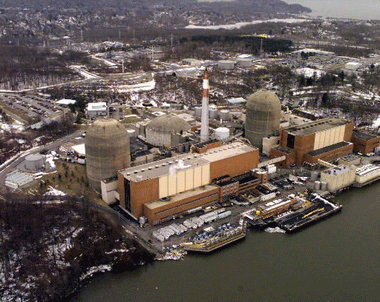
So said State Assemblyman Fred W. Thiele Jr. (I-SagHarbor) on the agreement to close the Indian Point nuclear power plants, which sit 30 miles from Times Square, less than 50 miles from western Suffolk and 84 miles from Shelter Island — as the crow flies and radioactivity spreads.
These aged, problem-plagued nuclear plants have constituted a huge danger for the most densely populated area of the United States.
“This closure will put New York State on the fast track to expanding its renewable energy portfolio,” Mr. Thiele said. “By shifting our focus to green, renewable energy, we can grow our economy, create jobs and safeguard the health and safety of residents and state’s natural resources for generations to come.”
Governor Andrew Cuomo has long been calling for the plants to be shut down, and in announcing the agreement on January 9, he called the two-reactor Indian Point facility a “ticking time bomb.” Under the agreement, Indian Point 2 will close by April 2020 and Indian Point 3 by April 2021.
For decades, environmentalists and safe-energy organizations have been active in working to shut down the plants. Riverkeeper, the environmental organization, has been deeply involved. Its president, Paul Gallay, along with top New York State officials led by the governor, signed the agreement with the nuclear plants’ owner, New Orleans-based Entergy.
After the signing, Mr. Gallay described Indian Point as the “biggest existential threat to the region.” These strong words were confirmed years ago by the U.S. Nuclear Regulatory Commission in an analysis of the consequences of a meltdown with breach of containment (a “China Syndrome” accident) at every nuclear power plant in the U.S.
The 1982 report, “Calculation of Reactor Accident Consequences” or CRAC2 (it’s available on-line), considers “peak early fatalities,” “peak early injuries,” “peak cancer deaths” and “scaled cost billions in 1980 dollars.”
For Indian Point 2, the analysis, done at the U.S. Department of Energy’s Sandia National Laboratories, projects peak early fatalities — 46,000; peak early injuries — 141,000; peak cancer deaths — 13,000; and scaled cost in billions — $274 billion, which in today’s dollars would be $1 trillion. For Indian Point 3, it calculates peak early fatalities — 50,000; peak early injuries — 167,000; peak cancer deaths — 14,000; scaled cost in billions — $314 billion. “Scaled cost” includes “lost wages, relocation expenses, decontamination costs, lost property” and a portion of the U.S. rendered uninhabitable for centuries because of radioactivity.
These aren’t just numbers, but represent people’s lives lost, injuries, those left with cancer and part of the planet ruined.
Said Robert F. Kennedy Jr., vice chairman of Riverkeeper: “The agreement marks a milestone in America’s historic transition from a dirty, dangerous energy system to clean, safe, wholesome, local and patriotic power supply.”
New York State and the environmental and safe-energy groups won the battle of Indian Point by using a similar tactic we on Long Island used to prevent the Shoreham nuclear power plant from going into commercial operation, and to prevent the Long Island Lighting Company (LILCO) from building seven to 11 nuclear plants here. The strategy involved getting around federal “pre-emptions” on nuclear power.
The promoters of nuclear power arranged in the 1950s for a supportive federal government to have “pre-emption” over states and localities on most nuclear plant issues. On Long Island, a strategy of grassroots activists with support of elected officials was to use the state’s power of eminent domain. The Long Island Power Act was enacted in 1985 giving the state the authority, if LILCO persisted with Shoreham and its other nuclear plant projects, to seize its assets and eliminate it. There was no federal “pre-emption” preventing that. And LILCO gave up.
On Indian Point, environmental activists and the state zeroed in on denying Entergy the State Pollutant Discharge Elimination System (SPDES) permit that allowed the plants to discharge 2.5 billion gallons of water a day into the Hudson. This “once-through” cooling system released radioactive poisons into the river and has been killing massive amounts of fish. There was no federal “pre-emption” preventing this SPDES strategy. Another important factor causing Entergy to give up is that competitive power systems are now less expensive than nuclear, including renewable energy with safe solar and offshore wind power playing a huge role.
There are post-agreement complaints by some about replacing the electricity Indian Point generated. That’s baloney. There are alternatives. We can easily have energy we can live with.
You can’t live in a museum’: the battle for Greenland’s uranium, Guardian, Maurice Walsh, 28 Jan 17A tiny town in southern Greenland is fighting for its future. Behind it sits one of the world’s largest deposits of uranium. Should a controversial mine get the green light?
………….Since 2009, the island has been an “autonomous administrative division” within Denmark, giving its 56,000 inhabitants control over local resources. The idea of full independence within a generation or two is the dominant theme of local politics – even if the price of breaking free would be an annual Danish subsidy worth some £7,500 a head……
in 2013, the government granted four times the number of exploration licences approved in 2003 – so has the pressure to repeal a 1988 ban on uranium mining: this prevented the extraction of uranium, as well as any minerals that might have uranium as a byproduct. In 2013, after a debate that divided the country, Greenland’s parliament voted narrowly to repeal the ban.
Kvanefjeld, near Narsaq, is one of many potential mines. Last month, an Australian company was given the green light to begin construction of a zinc and lead mine on the northern coast; there are currently 56 active licences to exploremining for gold, rubies, diamonds, nickel, copper and other minerals elsewhere.
But uranium has made Kvanefjeld the most controversial project, and the focus of a debate about whether this is the economic path that Greenland should pursue. (The most common argument raised against is the danger that radioactive dust will fall on neighbouring settlements and farmland.) An Australian-owned company, Greenland Minerals and Energy (GME), has spent nearly £60m developing a plan for an open pit mine here. It was due to submit an environmental impact assessment by the end of 2016, but the deadline has been extended……….
In a move that sounds counterintuitive, GME is promoting its mine as a contribution to the new global green economy. According to the company, 80% of the commercial deposits in Kvanefjeld are rare earth minerals, commonly used in wind turbines, hybrid cars and lasers; uranium accounts for only 10%. “The market for rare earth minerals is deciding this,” says operations manager Ib Laursen. “Everybody is looking for them. Instead of Greenland being a passive receiver of global warming from the western world, it could contribute to green technology.”
It is a clever pitch. Greenland’s ice sheet has become the benchmark measurement for the march of global warming; research published in September showed that ice loss is accelerating more rapidly than previously feared. Greenland is also the emblematic victim of climate change: Inuit hunters and fishermen are called on in international conferences, to describe how their traditional lifestyles are being destroyed by warming seas.
But what the rest of the world see as creeping ruination, local politicians see as an opportunity. The melting ice sheet will make some minerals more accessible, and reveal others that are so far unknown.
……….Most of the world’s rare earth minerals come from China (six state-owned enterprises control nearly 90% of the planet’s supply), and the scale of environmental degradation there has given open pit mining a bad reputation. Concerned locals in Greenland invoke images of wasted landscapes and pools of toxic and radioactive waste, gleaned from a Google search. Similarly, the history of uranium mining has been one of blithe disregard for the environment……
Laursen.presents his mine as an environmentally friendly alternative to Chinese mines, modelled on international standards of best practice. He says the fears of radioactive dust floating over south Greenland are groundless. The crushed rock discarded once the minerals have been extracted, known as tailings, will be turned into slurry and carried in a pipeline to the bottom of a nearby lake. “It would never surface as dust,” Laursen says: the lake will be sealed in perpetuity by an impermeable dam……..
Frederiksen (sheep farmer) was alert to the dangers of radioactive dust because he had studied sheep farming in Norway in the mid-90s, when animals there were still affected by the fallout from Chernobyl. The scientists said they would remove dust from the mine by sprinkling it with water. “Well, water is usually frozen here in the winter,” Frederiksen tells me now, “so I asked them, ‘How are you going to have water to sprinkle then?’ And they said they would answer that when the environmental impact assessment arrived. When someone asked if it was possible to have no pollution in a mining area, the elderly man told us there had never been mining without pollution.” Frederiksen and Lennert believe most of the sheep farmers oppose the mine, but they avoid too many conversations about it just in case: polarisation risks harmony, and they might need each other in difficult times……….
In the past two elections, the people have decided, by voting for parties that support the uranium mine. Now, Qujaukitsoq says, it is a decision for the government. “Are we hesitant? No. We have no reservations about creating jobs.” For him it is the only way of saving Narsaq from stagnation. Whatever image the rest of the world cherishes, one thing is clear: Greenland will make its own way in the age of climate change.
NOAA’s latest report arrives, predicting worst-case scenario of 8 feet of rise by century’s end, just as Donald Trump takes office with pro-fossil fuel policies. New federal estimates say global sea levels could rise faster than previously thought, and the rise may be even worse in many coastal regions of the United States.
The report was delivered just as President Donald Trump took office, immediately working to undo President Barack Obama’s climate policies. On his inauguration day, pages mentioning climate change on whitehouse.gov were removed. Trump has promised policies to increase fossil fuel development in the U.S., and to undo Obama’s major emissions-cutting initiative, the Clean Power Plan.
Sea level rise will likely be worse in some regions of the U.S. because of ocean currents, wind patterns and settling sediments. The authors examined six scenarios with a range of probabilities in an effort to help state and local governments plan for sea level rise. Under all of them, the Northeast should expect higher waters than much of the rest of the globe. The Pacific Northwest and Alaska would likely experience lower-than-average increases under the best-case scenarios.
“The ocean’s not flat,” said William V. Sweet, one of the authors and a scientist at NOAA. “It’s not going to rise like water in a bathtub.”
The six scenarios are based on United Nations models of future greenhouse gas emissions, depending on whether countries rapidly slash pollution or continue burning fossil fuels as usual. The authors determined that the worst-case rise of more than 8 feet has only a 0.1 percent chance of occurring by 2100, even under a business-as-usual emissions scenario, but a rise of more than 1.5 feet is near certain with high emissions.
The increase in the estimates for global sea rise was partly due to new research on the Antarctic ice sheet, which is melting faster and appears to be more fragile than previously estimated, suggesting that some of the more pessimistic scenarios are increasingly likely.
The report also warned that moderate coastal flooding will become 25 times more likely with a 14-inch rise in the seas. That level could come anytime from 2030 to 2080 for most coastal cities, depending on their location and the world’s emissions. It would mean that a flood that now comes once every five years would be expected five times a year.
Sea levels have already risen by more than 8 inches globally since 1880, with 3 inches coming since 1993. Tidal flooding “has increased by an order of magnitude over the past several decades,” the report says, “turning it from a rare event into a recurrent and disruptive problem.”
The authors note that 2 million Americans would likely see their homes permanently flooded if sea levels rise 3 feet. Twice that increase would inundate the homes of 6 million. Only the rosiest scenarios would avoid a 3-foot rise by 2100. The effects of global warming, of course, will continue long beyond that year.
“Even if society sharply reduces emissions in the coming decades,” the authors write, “sea level will most likely continue to rise for centuries.”
FPL Wins Battle to Store Radioactive Waste Under Miami’s Drinking Water Aquifer, Miami New Times, BY JERRY IANNELLI JANUARY 16, 2017 Environmental activists have started a petition urging Florida lawmakers to prevent FPL from storing waste underground.South Florida sits atop two gigantic underground stores of water: the Biscayne and Floridan Aquifers. Miamians get most of their drinking water from the upper Biscayne Aquifer, while the government has used the lower portion of the Floridian to dump waste and untreated sewage — despite the fact that multiple studies have warned that waste could one day seep into the drinking water.
According to NRC documents, CASE’s petition was dismissed for being filed “inexcusably late” in FPL’s application process.
“This was thrown out on procedural grounds,” says CASE’s president, Barry J. White. “The science is still there.”
CASE had filed a petition with the U.S. Nuclear Regulatory Commission, but the NRC on Friday threw out CASE’s complaint, saying the environmental group had filed too late in FPL’s approval process.
The fight stems from the energy company’s plan to build two nuclear reactors at the controversial Turkey Point Nuclear Generating Station south of Miami by roughly 2030. The towers might not be operational for a decade or two, but that doesn’t mean the public should stop paying attention to them. FPL is submitting numerous proposals about the project to the government.
As part of that package, FPL told the U.S. Nuclear Regulatory Commission that it plans to store contaminated water used to clean the reactors, as well as radioactive waste (“radwaste”) in the Boulder Zone. In October, the NRC issued a report, stating FPL’s plan would pose “no environmental impacts” to the South Florida environment.
Roughly a month later, on November 28, CASE filed a legal petition demanding that the NRC hold a hearing on FPL’s radioactive waste plan. CASE alleges the government failed to address a host of concerns about the power company’s plan.
By TATSUYUKI KOBORI/ Staff Writer January 11, 2017 Coral bleaching has killed 70.1 percent of the nation’s largest coral reef as of the end of 2016, up from 56.7 percent just a few months earlier, the Environment Ministry said.
Warmer seawater temperatures last summer are believed to have caused coral bleaching to spread to 90 percent of the Sekiseishoko coral reef in Okinawa Prefecture…….http://www.asahi.com/ajw/articles/AJ201701110028.html
At both poles, “a wave of new record lows were set for both daily and monthly extent,” according to the analysis.
In recent years, Arctic sea ice has been hit particularly hard.
“It has been so crazy up there, not just this autumn and winter, but it’s a repeat of last autumn and winter too,” says Mark Serreze, director of the NSIDC.
In years past, abnormal warmth and record low sea ice extent tended to occur most frequently during the warmer months of the year. But for the past two years, things have gotten really weird in the colder months.
In 2015, Serreze says, “you had this amazing heat wave, and you got to the melting point at the North Pole on New Years Eve. And we’ve had a repeat this autumn and winter — an absurd heat wave, and sea ice at record lows.”
Lately, the Southern Hemisphere has been getting into the act. “Now, Antarctic sea ice is very, very low,” Serreze says.
From the NSIDC analysis:
Record low monthly extents were set in the Arctic in January, February, April, May, June, October, and November; and in the Antarctic in November and December.
Put the Arctic and the Antarctic together, and you get his time series of daily global sea ice extent, meaning the Arctic plus Antarctic:
As the graph [on original] shows, the global extent of sea ice tracked well below the long-term average for all of 2016. The greatest deviation from average occurred in mid-November, when sea ice globally was 1.50 million square miles below average.
For comparison, that’s an area about 40 percent as large as the entire United States.
The low extent of sea ice globally “is a result of largely separate processes in the two hemispheres,” according to the NSIDC analysis.
For the Arctic, how much might humankind’s emissions of greenhouse gases be contributing to the long-term decline of sea ice? The graph above [on original] , based on data from a study published in the journal Science, “links Arctic sea ice loss to cumulative CO2emissions in the atmosphere through a simple linear relationship,” according to an analysis released by the NSIDC last December. Based on observations from the satellite and pre-satellite era since 1953, as well as climate models, the study found a linear relationship of 3 square meters of sea ice lost per metric ton of CO2 added to the atmosphere.
That’s over the long run. But over a shorter period of time, what can be said? Specifically, how much of the extreme warmth and retraction of sea ice that has been observed in autumn and winter of both 2015 and 2016 can be attributed to humankind’s emissions of greenhouse gases?
“We’re working on it,” Serreze says. “Maybe these are just extreme random events. But I have been looking at the Arctic since 1982, and I have never seen anything like this.”
US delays cleanup rule at uranium mines amid GOP criticism
Federal GOP legislators from Wyoming have said a rule was an unnecessary burden for the uranium industry NBC5 Jan 5, 2017 CHEYENNE, Wyo. —
Federal officials withdrew a requirement for companies to clean up groundwater at uranium mines across the U.S. and will reconsider a rule that congressional Republicans criticized as too harsh on industry.
The plan that the U.S. Environmental Protection Agency put on hold Wednesday involves in-situ mining, in which water containing chemicals is used to dissolve uranium out of underground sandstone deposits. Water laden with uranium, a toxic element used for nuclear power and weapons, is then pumped to the surface. No digging or tunneling takes place.
The metal occurs in the rock naturally but the process contaminates groundwater with uranium in concentrations much higher than natural levels. Mining companies take several measures to prevent tainted water from seeping out of the immediate mining area…….
Along with setting new cleanup standards, the rule would have required companies to monitor their former in-situ mines potentially for decades. The requirement was set for implementation but now will be opened up for a six-month public comment period.
EPA officials didn’t immediately respond to a request for comment Thursday.
Environmentalists and others say uranium-mining companies have yet to show they can fully clean up groundwater at a former in-situ mine. Clean groundwater should not be taken for granted, they say, especially in the arid and increasingly populated U.S. West.
“We are, of course, disappointed that this final rule didn’t make it to a final stage,” said Shannon Anderson with the Powder River Basin Resource Council. “It was designed to address a very real and pressing problem regarding water protection at uranium mines.”
The EPA rule is scheduled for further consideration in President-elect Donald Trump’s administration.
— In the last days of the Obama Administration, the U.S. Environmental Protection Agency is about to dramatically increase allowable public exposure to radioactivity to levels thousands of times above the maximum limits of the Safe Drinking Water Act, according to documents the agency surrendered in a federal lawsuit brought by Public Employees for Environmental Responsibility (PEER). These radical rollbacks cover the “intermediate period” following a radiation release and could last for up to several years. This plan is in its final stage of approval.
The documents indicate that the plan’s rationale is rooted in public relations, not public health. Following Japan’s Fukushima meltdown in 2011, EPA’s claims that no radioactivity could reach the U.S. at levels of concern were contradicted by its own rainwater measurements showing contamination from Fukushima throughout the U.S. well above Safe Drinking Water Act limits. In reaction, EPA prepared new limits 1000s of times higher than even the Fukushima rainwater because “EPA experienced major difficulties conveying to the public that the detected levels…were not of immediate concern for public health.”
When EPA published for public comment the proposed “Protective Action Guides,” it hid proposed new concentrations for all but four of the 110 radionuclides covered, and refused to reveal how much they were above Safe Drinking Water Act limits. It took a lawsuit to get EPA to release documents showing that –
The proposed PAGs for two radionuclides (Cobalt-60 and Calcium-45) are more than 10,000 times Safe Drinking Water Act limits. Others are hundreds or thousands of times higher;
According to EPA’s own internal analysis, some concentrations are high enough to deliver a lifetime permissible dose in a single day. Scores of other radionuclides would be allowed at levels that would produce a lifetime dose in a week or a month;
The levels proposed by the Obama EPA are higher than what the Bush EPA tried to adopt–also in its final days. That plan was ultimately withdrawn; and
EPA hid the proposed increases from the public so as to “avoid confusion,” intending to release the higher concentrations only after the proposal was adopted. The documents also reveal that EPA’s radiation division even hid the new concentrations from other divisions of EPA that were critical of the proposal, requiring repeated efforts to get them to even be disclosed internally.
“To cover its embarrassment after being caught dissembling about Fukushima fallout on American soil, EPA is pursuing a justification for assuming a radioactive fetal position even in cases of ultra-high contamination,” stated PEER Executive Director Jeff Ruch, noting that New York Attorney General Eric Schneiderman has called for the PAGs to be withdrawn on both public health and legal grounds. “The Safe Drinking Water Act is a federal law; it cannot be nullified or neutered by regulatory ‘guidance.’”
Despite claims of transparency, EPA solicited public comment on its plan even as it hid the bulk of the plan’s effects. Nonetheless, more than 60,000 people filed comments in opposition.
“The Dr. Strangelove wing of EPA does not want this information shared with many of its own experts, let alone the public,” added Ruch, noting that PEER had to file a Freedom of Information Act lawsuit to force release of exposure limits. “This is a matter of public health that should be promulgated in broad daylight rather than slimed through in the witching hours of a departing administration.”
Fukushima Radiation Looms. No Nuclear Power Plant On Planet Earth! “The Incompatibility of Radiation with Human Life” By Eiichiro OchiaiGlobal Research, January 05, 2017.…………… Approximately 450 nuclear power reactors are presently on this earth. In the nuclear power production of electricity, only one third of the heat produced in a reactor is converted into electricity, and the remainder two third of heat is released into the surrounding. A typical 1giga watt reactor will release 4.7 x 10¹⁶ joule of heat into the environment per year. This much heat will bring 100 million tons of water at zero degree to boiling. This is with a single nuclear reactor. The nuclear power reactors are excellent environmental heaters. Hundreds of such reactors are operating on this earth. But this fact is ignored in the argument of the nuclear power being environmentally clean. This is not the only reason for the nuclear reactors being unclean.
In addition, this typical reactor of 1 giga (thousand mega) watt of capacity (electricity) produces in a year radioactive material equivalent to about 1000 Hiroshima atomic bombs. In 2015, the total amount of electricity produced by nuclear reactors was 2,441 BkWh (billion kilo watt hours: data [7]), which is 8.79 x 10¹⁸ joule. It was produced by about 280 nuclear reactors of 1 giga watt capacity. So they produced radioactive material approximately equivalent to 280,000 Hiroshima bombs. In addition, they released 1.3 x 10¹⁹ joule of heat into the environment. These are the values for just one year. Nuclear power reactors have been operating the last forty years, though not always this many.
Anyway, an enormous amount of radioactive material has been made on the earth. How much of it has been released into the environment is not easy to estimate. They have come out into the environment through the tests of the nuclear weapons, use of depleted uranium bombs, the routine release of some radioactive material from the nuclear facilities under normal conditions and others, in addition to the accidents at nuclear facilities. The effects of the released radioactive material have been amply observed and reported, and yet are not shared with the majority of humankind. We mention here only a few cases, and refer them to a few major sources. The nuclear weapon explosion tests in the atmosphere affected the people in the eastern side, Utah, of the test site in Nevada (1951-1960, ref [8]). Chernobyl nuclear reactor accident in the present Ukraine (1986) was one of the worst nuclear facility accidents, and people are still suffering [9]. Fukushima nuclear power plant disaster (2011) cause by the huge earthquake along with tsunami is far from settled, and health effects are only now becoming manifest [10]. These incidents represent the notion that the nuclear power is “not clean” at all, rather it is the dirtiest……http://www.globalresearch.ca/fukushima-radiation-looms-no-nuclear-power-plant-on-planet-earth-the-incompatibility-of-radiation-with-human-life/5566712
The biggest environmental battles facing the Trump administration Some flashpoints for environmental activists relating to climate change that are likely to erupt in the first few months of Donald Trump’s presidency, Guardian, Mazin Sidahmed, Nicole Puglise and Oliver Milman, 6 Jan 17,Donald Trump is likely to face unprecedented opposition from environmental groups during his presidency as activists prepare to battle the new administration on a number of fronts across the US.
While environmentalists clashed with Barack Obama over the Keystone and Dakota Access oil pipelines, these fights could pale in comparison to the array of grievances Trump will face overwater security, fracking and climate change.
The president-elect has vowed to approve the Keystone pipeline, which Obama blocked, and “very quickly” resolve the Dakota Access project, currently held up by the federal government after months of protests by Native Americans. Trump has pledged to remove “roadblocks” to oil, gas and coal developments and threatened to end all climate and clean energy spending.
Opposition to this agenda has already begun in earnest, following a prediction by former vice-president Al Gore that there will be a “huge upsurge” in environmental activism, stoked by the new administration’s plans to cut science funding, remove the US from the Paris climate deal and appoint Scott Pruitt as administrator of the Environmental Protection Agency – an agency he has sued multiple times as Oklahoma attorney general.
What will be the first actions Trump takes as president?
350.org, an international environmental organization, pledged to make January a month of a resistance against Trump’s cabinet picks. On 9 January, the organization will mobilize its chapters in all 50 states to stage protests at senators’ district offices. It will be the beginning of what they say will be a sustained protest throughout the year.
In New York City in December, the Sierra Club protested Pruitt’s nomination by projecting an image of rising seas and the words “Don’t Trump the planet” on to the side of the Trump Building on Wall Street. It’s the opening salvo of what is likely to be a war of attrition waged by America’s largest environmental group, which has drawn in more monthly donors in the weeks since Trump’s election than it has in the past four years.
“If Trump keeps choosing to drag us backwards to the dirty energy of the past, he will find unfettered opposition every step of the way,” said Michael Brune, executive director of the Sierra Club.
Here are some of the flashpoints for environmental activists protesting issues relating to climate change happening around the country now and likely to erupt in the first few months of Trump’s presidency:
Eminent domain in Iowa
South of Standing Rock, the sprawling Dakota Access pipeline faces another dispute. Landowners in Iowa are challenging the government seizure of their land to build the pipeline………
Divestment movement on campus
Campuses across the country have been pushing universities to divest from from the fossil fuel industry over the past few years. Organizers are hoping the environmental threats posed by Trump’s cabinet nominations of energy industry leaders will further galvanize the movement……..