Massive amountsof heat being stored in the oceans
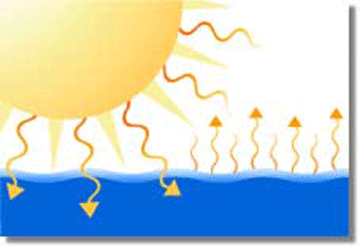 The world’s oceans are storing up staggering amounts of heat — and it’s even more than we thought, by Chelsea Harvey, Energy & Enviornment, Washington Post, Mar 10, 2017 The world is getting warmer every year, thanks to climate change — but where exactly most of that heat is going may be a surprise.
As a stunning early spring blooms across the United States, just weeks after scientists declared 2016 the hottest year on record , it’s easy to forget that all the extra warmth in the air accounts for only a fraction of the heat produced by greenhouse gas emissions. In fact, more than 90 percent of it gets stored in the ocean. And now, scientists think they’ve calculated just how much the ocean has warmed in the past few decades.
A new study, out Friday in the journal Science Advances, suggests that since 1960, a staggering 337 zetajoules of energy — that’s 337 followed by 21 zeros — has been added to the ocean in the form of heat. And most of it has occurred since 1980.
“The ocean is the memory of all of the past climate change,” said study co-author Kevin Trenberth , a senior scientist at the National Center for Atmospheric Research.
The world’s oceans are storing up staggering amounts of heat — and it’s even more than we thought https://www.skepticalscience.com/2017-SkS-Weekly-Digest_10.html
The Trump and Congressional Republican Assault on Our Environment
 The Real Lowdown: The Trump and Congressional Republican Assault on Our Environment, Vol. 3 https://www.nrdc.org/experts/nrdc/real-lowdown-trump-and-congressional-republican-assault-our-environment-vol-3 March 03, 2017 NRDC Nearly halfway through his first 100 days, President Donald Trump is on track to set a record for putting Americans’ health and our environment at risk.
In recent days, we’ve seen Trump issue an order to keep streams and rivers flowing with toxic chemicals, add a trio of polluters’ allies to his cabinet, hint of eviscerating the U.S. Environmental Protection Agency, and telegraph he’ll soon start to try to unravel our country’s best chance to curb dangerous climate change: the popular Clean Power Plan.
Cabinet nominees
The GOP-led Senate staffed up Trump’s cabinet of polluters by confirming Ryan Zinke at the U.S. Department of the Interior, threatening public lands; Rick Perry at Energy, jeopardizing clean energy; and Scott Pruitt, the polluters’ lawyer, at the EPA.
After Pruitt was sworn in, his old office in Oklahoma released—on court orders—thousands of e-mails confirming his critics’ worst fears. They showed he worked hand in glove as attorney general with fossil fuel lobbyists and dirty energy companies to try to block the EPA’s clean air and clean water rules as well as other health protections. Pruitt also used private e-mail to communicate with his AG staff, even though he told the Senate he did not.
The newly minted administrator, speaking before the Conservative Political Action Committee on February 25, promised to roll back environmental protections in an “aggressive way” and told his appreciative audience that calls to completely eliminate the EPA are “justified.”
NRDC is fighting back
A few days before, NRDC filed a Freedom of Information Act request for materials and communications related to a press release the EPA issued announcing Pruitt as the new agency administrator. In the press release, the EPA endorsed statements calling itself “tone deaf,” “rogue,” and “one of the most vilified agencies in the ‘swamp’ of overreaching government.” Such statements are “unheard of and extremely alarming,” says Aaron Colangelo, codirector of litigation at NRDC. “We want to know who and what is motivating the agency’s new leader to undermine the EPA’s mission before he even gets started.”
On February 28, Trump addressed a joint session of Congress for the first time as president, where he outline an agenda that purportedly would create jobs and lift the economy. In response, NRDC President Rhea Suh penned a blog on the website The Hill, noting that the speech left unsaid “his unmitigated assault on the nation’s environment and public health.”
Slashing the EPA budget
Words and deeds don’t always match up. In his address to Congress, Trump promised to “promote clean air and clean water.” But he declined to mention this: Behind the scenes, he’s cooking up a budget plan that, according to news reports, includes a 24 percent cut to the EPA, the guardian of our air and water and environment. If approved, his plan would cripple the agency founded by Richard Nixon in 1970. NRDC President Rhea Suh warned: “Slashing the EPA’s budget will be dangerous to our health and the well-being of our children.”
Love that dirty water
Trump loves that dirty water. He has signed away safeguards that protected streams and downstream communities from coal-mining pollution. And he recently signed an executive order dubbed the “Dirty Water Rule” because it begins the rollback of the Obama-approved Clean Water Rule to protect wetlands and drinking water sources for more than 117 million Americans. Suh declared: “We will stand up to this reckless assault. We’ll stand up for clean water and a healthy future for all Americans.”
Moving ahead with pipelines
In that same address to Congress, Trump boasted about clearing the way for construction of the Keystone XL tar sands pipeline, which would threaten drinking water and our climate, and the Dakota Access Pipeline, disregarding concerns from indigenous people about its impact on their communities. Trump also touted a directive he issued that new American pipelines be made with American steel—except a few days later he exempted KXL from his “buy American” requirements.
Pruitt steps away from limiting methane emissions
Just days into his job, Pruitt yanked an Obama administration directive from last November requiring thousands of oil and gas companies to report a broad range of information about their operations’ emissions of methane, a potent greenhouse gas. Pruitt acted just one day after 11 state attorneys general asked the EPA to suspend the requirement, which had been part of a long-term plan to limit wasteful and climate-harming methane emissions.
Drilling on public lands
Even before Zinke took office, the Department of the Interior abruptly stopped enforcing a rule that closed a loophole the fossil fuel industry has used to lower the royalties for extracting oil on public lands (by artificially depressing the market value of that oil). Taxpayers, according to estimates, have lost as much as $30 billion with this scheme.
Orders coming to derail climate action
Trump could, as early as next week, issue an executive order undermining or eliminating the Clean Power Plan, the centerpiece of President Obama’s climate action agenda. The plan sets the first national emissions limits on the nation’s power plants, the largest source of the dangerous carbon pollution that is driving climate change.
Reopening public lands to coal mining
Trump also is expected to sign an order lifting an Obama administration moratorium on new coal leasing on public lands. This ignores poll findings of strong support for conservation rather than development among residents of the Rocky Mountain states, home to large tracts of public lands.
NRDC has prepared a list of other far-ranging threats posed by the new administration. And we will be vigilantly monitoring and reporting on its assault on the environment through Trump Watch.
Paul Ehrlich impressed by the Vatican’s commitment to saving the global environment
 Vatican Visit, MAHB, Ehrlich, Paul R. | March 7, 2017 I was somewhat apprehensive about taking my invited place at the workshop on biological extinction of the Pontifical Academies of Science and Social Sciences at the end of February. Right wing Catholic websites were loaded with outrage and lies about my invitation, and that of John Bongaarts from the Population Council, and more than 10,000 people had signed petitions to get me (or us) excluded.
My apprehension was unnecessary. The view of the Academies, backed by the Vatican, was that “all voices should be heard.” The workshop, arranged by my old friends and colleagues Peter Raven and Partha Dasgupta, was one of the most productive and informative I have ever attended. It was an assembly of stars, and everyone was treated with dignity, respect, and fine hospitality. The presidents of the two Academies, Werner Arber and Margaret Archer, and their Chancellor Msgr. Marcelo Sánchez Sarondo were open and friendly. The papers (which will be published commercially), were (with a single exception) excellent, as was most of the discussion. Everyone emphasized the grave danger extinctions pose both to human life-support systems and the ethical duties of humanity to preserve “the creation” –the only life-forms we know of in the universe. There was essentially complete agreement that the drivers of the now-underway sixth mass extinction were human overpopulation, overconsumption by the rich, and inequity (poverty)…….
The Catholic Church is the only one with scholarly academies charged with providing unbiased information. As a result, for example, it has led the way in the battle against climate denial and long ago accepted the overwhelming evidence for evolution. In a civilization facing existential risks, it should be praised and supported for this attitude toward science.http://mahb.stanford.edu/blog/vatican-visit/
Italy’s thorium contamination resulting from military operations
 Subject: Alarming levels of thorium-232 at the military firing range lying between Cordenons, San Quirino, Vivaro and San Giorgio della Richinvelda, in the province of Pordenone http://www.europarl.europa.eu/sides/getDoc.do?pubRef=-//EP//TEXT+WQ+E-2014-000031+0+DOC+XML+V0//EN Subject: Alarming levels of thorium-232 at the military firing range lying between Cordenons, San Quirino, Vivaro and San Giorgio della Richinvelda, in the province of Pordenone http://www.europarl.europa.eu/sides/getDoc.do?pubRef=-//EP//TEXT+WQ+E-2014-000031+0+DOC+XML+V0//EN
The Italian Army operates a military firing range lying between the districts of Cordenons, San Quirino, Vivaro and San Giorgio della Richinvelda in the province of Pordenone, in the vicinity of the River Cellina and the River Meduna, and the drills carried out at this firing range have led to the area becoming radioactively contaminated. |
||||||
| As has been reported by the press, in late December 2013 the Commander of the 132nd Ariete Armoured Division in Cordenons, the Commander-in-Chief of the Italian Army, the offices of the region of Friuli-Venezia Giulia, the province of Pordenone and the affected districts, the prefect of Pordenone, and lastly Local Health Authority (ASS) No 6, were all sent the results of tests that had been carried out by the Friuli-Venezia Giulia provincial department of the Italian Regional Environmental Protection Agency (ARPA), which showed alarming levels of thorium-232 in the area.
Thorium-232 is a notoriously radioactive metal, which emits particles that are six times more hazardous to human health than those released by depleted uranium. It is at its most toxic between around 20 and 25 years after use. More specifically, out of the eight targets (the shells of armoured tanks used for firing practice) tested by the ARPA, four were found to contain thorium-232 at markedly higher levels than those that generally occur naturally; these levels were therefore unnatural, and presumably attributable to military firing operations. In all likelihood, such levels are the legacy left behind by the drills carried out at the site in the 1980s and 1990s: between 1986 and 2003, the Italian Army’s units were equipped with ‘Milan’ shoulder-fired anti-tank missiles, which emitted thorium-232(1). The ARPA has indicated that it will shortly carry out more extensive tests in the area. It is recalled that, as a result of the area’s geological make-up, materials tend to trickle down to the lowest layers, which makes their future recovery appear rather difficult. Consequently, there is an acute risk that the ‘Magredi’ region, and the rocky terrain that makes it so distinctive, will be devastated; what is more, the area is protected as both a site of Community importance and a Special Protection Area within the meaning of the Habitats Directive (92/43/EEC) and the Birds Directive (2009/147/EC), due to the wide variety of flora and fauna present there(2). 1. Is the Commission aware of this contamination? 2. Can it report whether any similar cases have occurred in the EU, how they were tackled and whether the areas affected were restored to their original state? 3. What initiatives does it intend to implement in order to prevent similar episodes from occurring in the EU, and in particular to prevent the contamination of aquifers?
|
||||||

Trump administration attacks climate and lead cleanup programmes
 Trump’s EPA budget proposal targets climate, lead cleanup programs Reuters, | WASHINGTON, 5 Mar 17
The White House is proposing to slash a quarter of the U.S. Environmental Protection Agency’s budget, targeting climate-change programs and those designed to prevent air and water pollution like lead contamination, a source with direct knowledge of the proposal said on Thursday.
President Donald Trump has long signaled his intention to reverse former Democratic President Barack Obama’s climate-change initiatives. But the Republican president has vowed his planned overhaul of green regulation would not jeopardize America’s water and air quality.
The 23-page 2018 budget proposal, which aims to slice the environmental regulator’s overall budget by 25 percent to $6.1 billion and staffing by 20 percent to 12,400 as part of a broader effort to fund increased military spending, would cut deeply into programs like climate protection, environmental justice and enforcement.
Politico and other news outlets reported the staff and overall budget cuts earlier, but the source disclosed new details on the impact the cuts would have on programs and grants to states.
Environmentalists slammed the proposed cuts, which must be approved by the Republican-led Congress.
The agency did not immediately respond to a request for comment on the budget proposal or its counter proposal. The White House said it had no comment.
Under the proposal, which was sent to the EPA this week, grants to states for lead cleanup would be cut 30 percent to $9.8 million, according to the source, who read the document to Reuters.
Grants to help Native American tribes combat pollution would be cut 30 percent to $45.8 million. An EPA climate protection program on cutting emissions of greenhouse gases like methane that contribute to global warming would be cut 70 percent to $29 million.
The proposal would cut funding for the brownfields industrial site cleanup program by 42 percent to $14.7 million. It would also reduce funding for enforcing pollution laws by 11 percent to $153 million………http://www.reuters.com/article/us-usa-trump-epa-budget-idUSKBN1692XA?feedType=RSS&feedName=topNews
Experts gather at Vatican conference with call to avoid ‘biological extinction
At the Vatican, a call to avoid ‘biological extinction’ ‘http://www.environmentalhealthnews.org/ehs/news/2016/feb/biological-extinction-ehrlich-dasgupta Nothing less than a reordering of our priorities based on a moral revolution can succeed.’
Download Partha Dasgupta’s and Paul Ehrlich’s working paper on the sixth great extinction here.Feb. 27, 2017 By Environmental Health News Staff
Experts in biodiversity and extinction are gathering at the Vatican this week to discuss biological extinction—and how to save the natural world on which we all depend.
The conference focuses on the alarming signs, from various branches of science, that we are outstripping out planet’s ability to sustain us. It follows on Pope Francis’ 2015 encyclical, Laudato Si, calling for better care and concern for “our Common Home,” as well as an Intergovernmental Panel on Climate Change report suggesting we are on a course to destroy up to 40 percent of biodiversity on Earth by century’s end.
The conference is co-sponsored by the Pontifical Academy of Science and the Pontifical Academy of Social Science.
“Our desire for enhanced consumption grows more rapidly than our population, and Earth cannot sustain it,” the sponsors say. “Nothing less than a reordering of our priorities based on a moral revolution can succeed in maintaining the world in such a way as to resemble the conditions we have enjoyed here.”
Among those presenting during the three day conference are Partha Dasgupta of Cambridge University and Paul Ehrlich of Stanford University, who make the case that we are experiencing the sixth mass extinction of plant and animal life the globe has seen—with considerable consequences for humanity.
The authors have given Environmental Health News permission to post a draft of their paper online. It’s a working paper for the Pontifical Academy workshop and will be revised before eventual publication. You can download it here.
“In sum, the driving force of extinction, the ultimate cause of the current sixth mass extinction crisis is much too high a level of aggregate consumption – produced by human numbers multiplied by too high a level of consumption among the rich,” they write. “But demand cannot exceed supply indefinitely.”
“Translated into the language of equity, humanity’s enormous success in recent decades is very likely to have been a down payment for future failure.”
Rapid spread of ocean acidification in the Arctic
International team reports ocean acidification spreading rapidly in Arctic Ocean, EurekAlert, 28 Feb 17, UNIVERSITY OF DELAWARE Ocean acidification (OA) is spreading rapidly in the western Arctic Ocean in both area and depth, according to new interdisciplinary research reported in Nature Climate Changeby a team of international collaborators, including University of Delaware professor Wei-Jun Cai.
The research shows that, between the 1990s and 2010, acidified waters expanded northward approximately 300 nautical miles from the Chukchi slope off the coast of northwestern Alaska to just below the North Pole. Also, the depth of acidified waters was found to have increased, from approximately 325 feet to over 800 feet (or from 100 to 250 meters).

“The Arctic Ocean is the first ocean where we see such a rapid and large-scale increase in acidification, at least twice as fast as that observed in the Pacific or Atlantic oceans,” said Cai, the U.S. lead principal investigator on the project and Mary A.S. Lighthipe Professor of Earth, Ocean, and Environment at UD.
“The rapid spread of ocean acidification in the western Arctic has implications for marine life, particularly clams, mussels and tiny sea snails that may have difficulty building or maintaining their shells in increasingly acidified waters,” said Richard Feely, NOAA senior scientist and a co-author of the research. Sea snails called pteropods are part of the Arctic food web and important to the diet of salmon and herring. Their decline could affect the larger marine ecosystem.
Among the Arctic species potentially at risk from ocean acidification are subsistence fisheries of shrimp and varieties of salmon and crab.
Other collaborators on the international project include Liqi Chen, the Chinese lead principal investigator and scientist with the Third Institute of Oceanography of State Oceanic Administration of China; and scientists at Xiamen University, China and the University of Gothenburg, Sweden, among other institutions…….
Arctic ocean ice melt in the summer, once found only in shallow waters of depths less than 650 feet or 200 meters, now spreads further into the Arctic Ocean.
“It’s like a melting pond floating on the Arctic Ocean. It’s a thin water mass that exchanges carbon dioxide rapidly with the atmosphere above, causing carbon dioxide and acidity to increase in the meltwater on top of the seawater,” said Cai. “When the ice forms in winter, acidified waters below the ice become dense and sink down into the water column, spreading into deeper waters.”https://www.eurekalert.org/pub_releases/2017-02/uod-itr022717.php
Scott Pruitt appointed as EPA chief in order to destroy EPA? : his emails revealed
 Thousands of Scott Pruitt’s Emails Just Hit the Internet. Here Are the Wildest, Scariest Bits. http://www.motherjones.com/environment/2017/02/new-epa-head-scott-pruitts-emails-reveal-close-ties-fossil-fuel-interests
The new EPA chief had a “very cozy” relationship with fossil fuel.
The close relationship between Scott Pruitt, the new administrator of the Environmental Protection Agency, and fossil fuel interests including the billionaire Koch brothers has been highlighted in more than 7,500 emails and other records released by the Oklahoma attorney general’s office on Wednesday.
The documents show that Pruitt, while Oklahoma attorney general, acted in close concert with oil and gas companies to challenge environmental regulations, even putting his letterhead to a complaint filed by one firm, Devon Energy. This practice was first revealed in 2014, but it now appears that it occurred more than once.
The emails also show that American Fuel and Petrochemical Manufacturers, an oil and gas lobby group, provided Pruitt’s office with template language to oppose ozone limits and the renewable fuel standard program in 2013. AFPM encouraged Oklahoma to challenge the rules, noting: “This argument is more credible coming from a state.” Later that year, Pruitt did file opposition to both of these regulations.
The letters also show the cozy relationship between Pruitt and the American Legislative Exchange Council (Alec), the influential US lobbying network of Republican politicians and big businesses, and other lobby groups sponsored by the Koch brothers, the billionaire energy investors who have spent decades fighting against environmental regulation.
Alec has consistently challenged the science on climate change and fought against tougher environmental regulation. Companies including Google, Ford and Enterprise Rent-a-Car have quit Alec in protest of its climate change activities.
The emails contain correspondence between Pruitt’s executive assistant and Amy Anderson, Alec director and Oklahoma membership contact, about Pruitt’s appearance at a May 2013 Alec board meeting in Oklahoma City.
That meeting attracted more protesters than attendees, with 600 firefighters, teachers, environmentalists and church leaders carrying signs reading “ALEC is Not OK” and chanting: “Backroom deals are Alec’s game / Sweetheart deals for corporate gain.”
Pruitt addressed a workshop entitled “Embracing American Energy Opportunities: From Wellheads to Pipelines”.
The emails state that Pruitt spoke “on state primacy in oil and gas regulation and the EPA’s sue & settle modus operandi”. The lunch meeting was sponsored by Koch Industries, a major Alec sponsor.
Pruitt was congratulated for his work on pushing back against the EPA by another Koch-backed pressure group.
“Thank you to your respective bosses and all they are doing to push back against President Obama’s EPA and its axis with liberal environmental groups to increase energy costs for Oklahomans and American families across the states,” said one email sent to Pruitt and an Oklahoma congressman in August 2013 by Matt Ball, an executive at Americans for Prosperity, a nonprofit group also funded in part by the Kochs. “You both work for true champions of freedom and liberty!” the note said.
Last week, an Oklahoma judge ordered that emails from a January 2015 open records request be released by Tuesday. A further batch of emails is due to be turned over next week. The Center for Media and Democracy, which has made nine separate open records requests for Pruitt’s emails, said it will attempt to obtain all of the sought-after communications without exceptions.
Pruitt was confirmed as EPA administrator on Friday. Democrats had sought to delay the Senate vote until the emails were released but were unsuccessful.
“The emails show a very cozy relationship between Pruitt’s office and particularly Devon Energy, as well as other coal, oil and gas companies,” said Nick Surgey, research director at the Center for Media and Democracy.
“Pruitt is the world’s top environmental regulator now and these emails raise serious conflict of interest concerns. He has very close ties to fossil fuel firms and has shown himself to be generally opposed to the rules the EPA has to protect the environment.”
Pruitt’s appointment as EPA chief has been vigorously opposed by environmental groups, Democrats and even some EPA staff as antithetical to the agency’s mission. More than 700 former EPA employees wrote to senators to urge them to vote against Pruitt, while some current staff in Chicago took part in protests against him. This effort did little to budge the mathematics of the Senate, with only one Republican, Susan Collins of Maine, voting against Pruitt.
Following the confirmation, the EPA put out a press release listing those that “cheer” Pruitt’s appointment. They include Republican representatives and lobbyists for mining, farming and grazing, who were quoted in the EPA’s own release calling the agency “rogue” and “one of the most vilified agencies in the ‘swamp’ of overreaching government”.
The former Oklahoma attorney general, a Republican, has described himself as a “leading advocate against the EPA’s activist agenda” and sued the regulator 14 times over pollution regulations relating to mercury, smog, methane and sulfur dioxide. Fossil fuel companies or lobbyists, a frequent source of Pruitt’s past donations, joined with him in 13 of these cases against the EPA.
A staunch opponent of what he sees as federal overreach, Pruitt said following his appointment that “citizens don’t trust the EPA is honest” with its scientific work, particularly around climate change. Pruitt has said he accepts the planet is warming but has questioned the degree of human influence over this, despite the volumes of scientific literature on the impact of greenhouse gases.
In his first speech at EPA headquarters in Washington on Tuesday, Pruitt praised career employees and promised to “listen, learn and lead”. He said regulators such as the EPA “ought to make things regular. Regulators exist to give certainty to those that they regulate.”
He added: “I believe that we as a nation can be both pro-energy and -jobs, and pro-environment. We don’t have to choose between the two.”
John O’Grady, an EPA environmental scientist and head of a union that represents 9,000 agency staff, said that Pruitt came across “very professionally and conciliatory, he didn’t come out heavy handed”.
But O’Grady said that many staff are nervously waiting for the administration’s agenda to unfold, with Donald Trump expected to sign executive orders that aim to do away with the EPA’s effort to reduce greenhouse gases and regulate America’s expanse of waterways.
“Mr Pruitt isn’t a proponent of addressing climate change or of a strong EPA, so it won’t surprise me when they start to whittle away at what we do as an agency,” O’Grady told the Guardian. “I’m wondering when the hammer is going to fall.”
Europe’s wild boars posing a radioactive problem
Wild boars roam Czech forests – and some of them are radioactive http://www.reuters.com/article/us-czech-boars-idUSKBN1611G0 Reporting by Robert Muller and Jiri Skacel, editing by Larry King Feb 22, 2017 The Czech Republic has an unusual problem this winter with its wild boar meat, a local delicacy. The boars are radioactive.
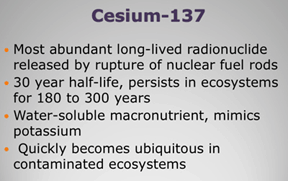 The mushrooms can absorb high levels of the radioactive isotope Caesium 137. And three decades ago the nuclear catastrophe at Chernobyl released a fair amount of Caesium 137 that eventually drifted down on the Sumava mountains.
Now the boars are eating the mushrooms, and ingesting the Caesium 137 along with them. That’s making their meat radioactive, Jiri Drapal at the State Veterinary Administration told Reuters.
“It is more or less a seasonal issue,” Drapal said.
But it’s a long season. The half life of Caesium 137 is 30 years – that is, it takes 30 years for the radioactivity of the isotope to fall to half its original value. Then another 30 to fall to half again, and so on. The boars could be glowing for quite a while.
“We can expect to find (affected) food for a number of years from now,” Drapal said.
And that could cause some problems with the supply of boar meat, which is popular in the Czech Republic. It often shows up on restaurant menus in goulash, a thick stew of meat, sauce and dumplings.
Any boar that ends up as goulash ought to be safe. Every wild animal hunted, not only boars, must be inspected before its meat can get to customers. Radioactive meat is banned from circulation, Drapal said.
That’s the good news. The bad news is that 614 animals were inspected from 2014 to 2016, and 47 percent were above the limit – almost half.
The semi-good news is that even meat from radioactive animals would be a health hazard only in large doses, Drapal said. You would have to eat it several times a week for couple of months, to get sick, he said.
Climatologists explain threat of drastic cooling in North Atlantic
Drastic cooling in North Atlantic beyond worst fears, scientists warn https://www.theguardian.com/environment/2017/feb/24/drastic-cooling-north-atlantic-beyond-worst-fears-scientists-warn
Climatologists say Labrador Sea could cool within a decade before end of this century, leading to unprecedented disruption, reports Climate News Network, Guardian, Alex Kirby , 25 Feb 17, For thousands of years, parts of northwest Europe have enjoyed a climate about 5C warmer than many other regions on the same latitude. But new scientific analysis suggests that that could change much sooner and much faster than thought possible.
Climatologists who have looked again at the possibility of major climate change in and around the Atlantic Ocean, a persistent puzzle to researchers, now say there is an almost 50% chance that a key area of the North Atlantic could cool suddenly and rapidly, within the space of a decade, before the end of this century.
That is a much starker prospect than even the worst-case scientific scenario proposed so far, which does not see the Atlantic ocean current shutdown happening for several hundred years at least.
A scenario even more drastic (but fortunately fictional) was the subject of the 2004 US movie The Day After Tomorrow, which portrayed the disruption of the North Atlantic’s circulation leading to global cooling and a new Ice Age.
To evaluate the risk of extreme climate change, researchers from the Environnements et Paléoenvironnements Océaniques et Continentaux laboratory (CNRS/University of Bordeaux, France), and the University of Southamptondeveloped an algorithm to analyse the 40 climate models considered by the Fifth Assessment Report.
The findings by the British and French team, published in the Nature Communications journal, in sharp contrast to the IPCC, put the probability of rapid North Atlantic cooling during this century at almost an even chance – nearly 50%.
Current climate models foresee a slowing of the meridional overturning circulation (MOC), sometimes known also as the thermohaline circulation, which is the phenomenon behind the more familiar Gulf Stream that carries warmth from Florida to European shores. If it did slow, that could lead to a dramatic, unprecedented disruption of the climate system.
In 2013, drawing on 40 climate change projections, the IPCC judged that this slowdown would occur gradually, over a long period. Its findings suggested that fast cooling of the North Atlantic during this century was unlikely.
But oceanographers from EU emBRACE had also re-examined the 40 projections by focusing on a critical spot in the northwest of the North Atlantic: the Labrador Sea.
The Labrador Sea is host to a convection system ultimately feeding into the ocean-wide MOC. The temperatures of its surface waters plummet in the winter, increasing their density and causing them to sink. This displaces deep waters, which bring their heat with them as they rise to the surface, preventing the formation of ice caps.
The algorithm developed by the Anglo-French researchers was able to detect quick sea surface temperature variations. With it they found that seven of the 40 climate models they were studying predicted a total shutdown of convection, leading to abrupt cooling of the Labrador Sea by 2C to 3C over less than 10 years. This in turn would drastically lower North Atlantic coastal temperatures.
But because only a handful of the models supported this projection, the researchers focused on the critical parameter triggering winter convection: ocean stratification. Five of the models that included stratification predicted a rapid drop in North Atlantic temperatures.
The researchers say these projections can one day be tested against real data from the international OSnap project, whose teams will be anchoring scientific instruments within the sub-polar gyre (a gyre is any large system of circulating ocean currents).
If the predictions are borne out and the North Atlantic waters do cool rapidly over the coming years, the team says, with considerable understatement, climate change adaptation policies for regions bordering the North Atlantic will have to take account of this phenomenon.
Future sea level rise studies by NASA project – Oceans Melting Greenland (OMG)
 OMG measurements of Greenland give us a glimpse of future sea rise https://www.skepticalscience.com/omg-greenland-sea-level-rise.html 24 February 2017 by John Abraham If you meet a group of climate scientists, and ask them how much sea levels will rise by say the year 2100, you will get a wide range of answers. But, those with most expertise in sea level rise will tell you perhaps 1 meter (a little over three feet). Then, they will immediately say, “but there is a lot of uncertainty on this estimate.” It doesn’t mean they aren’t certain there will be sea level rise – that is guaranteed as we add more heat in the oceans. Here, uncertainty means it could be a lot more or a little less.
Why are scientists not certain about how much the sea level will rise? Because there are processes that are occurring that have the potential for causing huge sea level rise, but we’re uncertain about how fast they will occur. Specifically, two very large sheets of ice sit atop Greenland and Antarctica. If those sheets melt, sea levels will rise hundreds of feet.
Parts of the ice sheets are melting, but how much will melt and how fast will the melting occur? Are we talking decades? Centuries? Millennia? Scientists really want to know the answer to this question. Not only is it interesting scientifically, but it has huge impacts on coastal planning.
One reason the answer to this question is illusive is that melting of ice sheets can occur from above (warm air and sunlight) or from below (warm ocean waters). In many instances, it’s the melting from below that is most significant – but this melting from below is really hard to measure.
With hope we will have a much clearer sense of ice sheet melting and sea level rise because of a new scientific endeavor that is part of a NASA project – Oceans Melting Greenland (OMG). This project has brought together some of the best oceanographers and ice experts in the world. The preliminary results are encouraging and are discussed in two recent publications here and here.
In the papers, the authors note that Greenland ice loss has increased substantially in recent decades. It now contributes approximately 1/3 to total sea level rise. The authors want to know whether this contribution will change over time and they recognize that underwater processes may be the most important to study. In fact, they note in their paper:
Specifically, our goal is improved understanding of how ocean hydrographic variability around the ice sheet impacts glacial melt rates, thinning and retreat.
In plain English, they want to know how water flow around Greenland affects the ice melt.
Their experiments are measuring a number of key attributes. First, yearly changes in the temperature of ocean water near Greenland. Second, the yearly changes to the glaciers on Greenland that extend into the ocean waters. Third, they are observing marine topography (the shape of the land underneath the ocean surface).
The sea floor shape is quite complicated, particularly near Greenland. Past glaciers carved deep troughs in the sea floor in some areas, allowing warm salty water to reach huge glaciers that are draining the ice sheet. As lead OMG investigator Josh Willis said:
What’s interesting about the waters around Greenland is that they are upside down. Warm, salty water, which is heavy, sits below a layer of cold, fresh water from the Arctic Ocean. That means the warm water is down deep, and glaciers sitting in deep water could be in trouble.
As the warm water attacks marine glaciers (glaciers that extend into the ocean), the ice tends to break and calve, retreating toward land. In some cases, the glaciers retreat until their grounding line coincides with the shore. But in other cases the undulating surface allows warm water to wear the glacier underside for long distances and thereby increase the risk of large calving events.
Oftentimes, when glaciers near the coast break off they uncork other ice that can then more easily flow into the oceans.
Global action is needed, NOW, to defeat the out-of-control Fukushima nuclear disaster.
Over the past few weeks, the Japanese have attempted to send their Scorpion robot into the damaged containment vessel areas. These attempts have resulted in the rapid destruction of these specially designed radiation-detecting robots — but not before measurements were made… reliable measurements, that indicate radiation leaking at 530 seiverts per hour. Such readings were described as “unimaginable.” Why? Because human death is likely at just 10 seiverts per hour of radiation exposure.
This is all current news — yet our national media and federal government will not investigate it, talk about it, or help in developing a strategy to defeat the problem.
There is no greater clear and present danger to the future of humanity and other life on this earth than the out-of-control Fukushima disaster.
If we get to work on the problem, I am absolutely confident that our human ingenuity and resourcefulness will defeat it. We are, in our human potentiality, that good — if we will only do it.
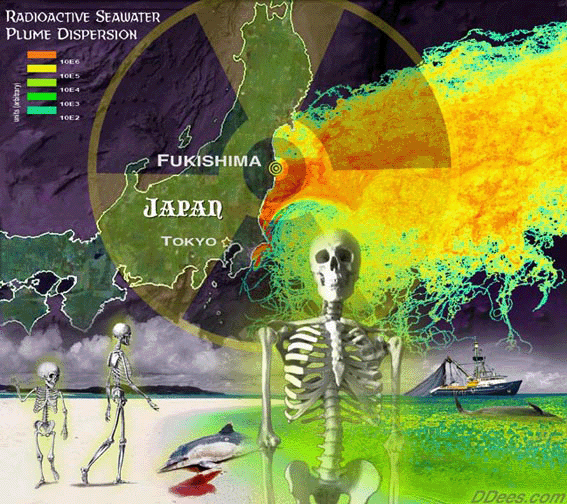
The Ongoing Fukushima Disaster http://pagosadailypost.com/2017/02/23/essay-the-ongoing-fukushima-disaster/ BY · FEBRUARY 23, 2017
The material of the melted cores, called corium, has sunk down into the earth below their shattered former containment vessels, and resides within the shallow water table below — which results in an ongoing flow of radioactive material pouring into the ocean. Apparently, there is no existing technological solution to this issue, and there are increasing measurements of radioactive material within the vast Pacific Ocean and all along the western coasts of the North and South American continents.
The Federal Government of the United States does not (publicly) monitor such radiation inflows, and therefore, any information about the contamination comes from various activities funded by crowd-source financing of various private and public-good organizations, etc.
This I find somewhat odd — in that the United States has, in recent days, deployed their radiation-sniffing jet to fly about over Europe in the hopes of identifying the source of highly abnormal radioactive particles of Iodine-131 that have been wafting about upon the winds since (apparently) early January 2017. At this moment, there is no explanation. So… we’ll deploy United States taxpayer resources to help track down the source of a European Iodine-131 leak — which, incidentally, has a half-life of about eight days — and will discuss the problem publicly … but we won’t (publicly) monitor our western coasts and air for an ongoing radiation catastrophe now six years old, emitting radioactive particles with half-lives of thousands of years. The Federal Government of the United States won’t even talk about it.
Is the idea (or attitude) then that since we have no ability to arrest or fix the unrelenting Fukushima poisoning of our planetary environment, that we will just not talk about or acknowledge it in a public way? Are we going to continue to buy the demonstrably false notion put forth by the U.S. government that the vast waters of the Pacific ocean will act to “dilute” the radioactive poison over time — when it is a scientific fact that radioactive particles are not “dilutable” and are, instead, cumulative?
Are we going to continue to disassociate the massive die-offs and poisoning of ocean life from the obvious source, the cumulative effects of Fukushima radiation? Are we going to continue to enjoy our seafood because the Federal Government says that the radioactive levels within it are “within safe limits”? Are we going to continue to label people like myself (of which there are many) as “conspiracy theorists” and uneducated alarmists who have been expressing concern over the Fukushima catastrophe since it occurred — people like me who know from objective observed and scientific fact that all is not well with what is going on (or not going on) at Fukushima?
Over the past few weeks, the Japanese have attempted to send their Scorpion robot into the damaged containment vessel areas. These attempts have resulted in the rapid destruction of these specially designed radiation-detecting robots — but not before measurements were made… reliable measurements, that indicate radiation leaking at 530 seiverts per hour. Such readings were described as “unimaginable.” Why? Because human death is likely at just 10 seiverts per hour of radiation exposure.
This is all current news — yet our national media and federal government will not investigate it, talk about it, or help in developing a strategy to defeat the problem. I would submit that the ongoing Fukushima environmental catastrophe is — by far — the most urgent danger to humanity that we face. This is not a localized Japanese problem — it is a world-wide environmental emergency that is getting worse every day.
If humanity does not have the current technology to defeat this problem, then we need to get our best and brightest minds together from across the world and develop technology to defeat it, immediately. It is absolutely unacceptable and irresponsible for the world to simply ignore what it going on — indeed, it is eventually suicidal. If President Trump does not begin to openly talk about the ongoing global emergency threat of Fukushima and advocate for a solution, then I, for one, will publicly part ways with him — on this issue alone.
There is no greater clear and present danger to the future of humanity and other life on this earth than the out-of-control Fukushima disaster. All other issues of debate and controversy are small potatoes in comparison. President Trump needs to rally support for an effective response on this—indeed, the sheer gravity of the destruction being done to the world provides a superb opportunity to bring together a truly unified global response to an issue that threatens humanity. Japan does not have the resources or technological ability to solve this problem by itself — and no individual nation does, or could. Just as if humanity found itself mortally in danger from a source beyond the Earth and would therefore unify to defeat it, so too must it view the Fukushima situation as a mortal danger to humanity from within.
If we get to work on the problem, I am absolutely confident that our human ingenuity and resourcefulness will defeat it. We are, in our human potentiality, that good — if we will only do it.
Trump’s associates and USA conservatives to wage war on environmentalists
Conservatives predict ‘real war’ with environmentalists http://www.eenews.net/stories/1060050477 Amanda Reilly, E&E News reporter Greenwire: Thursday, February 23, 2017 People who question the science of climate change today told conservative activists they were looking forward to using their bigger platform during the Trump administration to roll back U.S. EPA regulations on greenhouse gas emissions.
At the annual Conservative Political Action Conference, a panel of prominent global warming skeptics said one of their top targets was the Obama administration’s 2009 endangerment finding, the basis for EPA’s greenhouse gas regulations.
“It’s going to be a real war with environmentalists, no question about that,” said Steve Milloy, who says he served on President Trump’s EPA transition but was not listed on the administration’s official landing team for the agency. “There’s going to be a lot of litigation. But we’re going to move EPA in the right direction.”
Milloy said “nothing’s made me prouder than the fact that Donald Trump is now president” because Republicans as a whole had been lukewarm in their support of climate skeptics prior to Trump, who once called climate change a Chinese hoax.
The Energy & Environment Legal Institute sponsored the panel this morning in one of the side ballrooms at CPAC, happening outside Washington. Appearing on the panel with Milloy were James Delingpole and Tony Heller. All three have questioned whether human-caused climate change is occurring.
Delingpole, an executive editor at the Breitbart News Network, likened environmentalism to a religion and recycling advocates to a “cult.” The environmental movement, he told the conservative audience, was full of “control freaks” looking for a scientific justification “to tax us, to regulate us, to control our lives.”
Heller, who also goes by the pseudonym Steven Goddard, accused the government of faking statistics to make people believe in “absurd” and “fake news” climate change.
He claimed that conservatives who don’t believe in climate change have been treated like women who were accused of being witches in the 1600s. “Right now, conservatives get blamed for every bad weather event and for climate change, right. It’s our fault,” he said. “But hundreds of years ago, it was witches who were blamed for it.”
‘Scumbags’
The treatment of people who don’t believe in man-made warming is about to change during the Trump administration, Delingpole said. “The people who portray people like us as selfish, greedy, nature-hating scumbags — no. They are the scumbags. We are the good guys,” Delingpole said. “Thank goodness, thanks to Donald Trump, the tide’s turned, and we are about to witness that.”
Along with questioning federal climate change science, panelists also said they were skeptical of EPA research on everything from air pollution to pesticides. Milloy, who led a crusade against EPA’s risk assessment of secondhand smoke, said he hoped the Trump administration would completely end scientific research at the agency, accusing it of paying for “the science it wants.”
An agency “can’t be responsible for producing science and then regulating” based on that science, Milloy said.Being selected to EPA’s transition team was “a dream come true after fighting EPA for 25 years,” he said.
Conservatives are starting to see the fruits of the advice of that transition team, beginning with the confirmation of former Oklahoma Attorney General Scott Pruitt as EPA administrator, he said.
Under the Trump administration, Milloy said, warming skeptics would get to participate in debates over killing President Obama’s key climate policies, including the endangerment finding, which the Supreme Court upheld in 2014.
“The endangerment finding needs to be repealed,” he said. “If it’s not, then President Trump is going to be forced to issue his own climate policy.”
John Walke, clean air director at the Natural Resources Defense Council, slammed the panel in a series of tweets.
“This is alt-reality, folks,” he said.
Twitter: @apeterka Email: areilly@eenews.net
Radiation ‘sniffer plane’ over Europe
 A radiation ‘sniffer plane’ is reportedly searching for the source of a cloud of nuclear isotopes floating across Europe, news.com.au FEBRUARY 23, 2017 A CLOUD of radioactive particles is floating across Europe — and no one knows where it came from. First detected in mid-January, spikes in the level of a radioactive isotope called Iodine-131, have been recorded all the way from Norway to Spain.
Iodine-131 (I-131) is produced by nuclear fission in nuclear explosions, power reactors, and industrial and medical isotope facilities.
It has led some to ponder whether Russia has begun secretly conducting nuclear weapons tests. One of the Soviet Union’s largest atomic bomb testing grounds was on the island of Novaya Zemlya, deep in the Arctic Circle, off the coast of Norway.
While nuclear monitoring organisations believe this theory is unlikely, what has caused the radioactive plume remains a mystery.
The US military has now dispatched a nuclear ‘sniffer plane’ to the UK, that can detect and analyse radiation.Although the US military deny it, some believe its mission is to track down the source of the spikes.
The alarm was first raised in January by the IRSN, the French Radioprotection and Nuclear Safety Institute. The public body said the cloud of I-131 had first been detected in northern Norway in the second week of January. Norway’s remote north, above the Arctic Circle, borders Russia.
The isotope was subsequently detected in Finland, Poland, the Czech Republic, Germany, France and finally in Spain, as the wind carried it from the north of Europe to the continent’s south west…….
The converted military jet is nicknamed the ‘sniffer’ or ‘weather bird’ by its crews who are kept to a minimum when radiation is suspected in the atmosphere to avoid danger to personnel on board the aircraft.
Two scoops on the side of the plane suck in gases which are then trapped on filters. Crew on the aircraft then analyse the particles to check for radioactivity.
A positive identification of I-131 by the plane is one of the telltale signs of a nuclear explosion. But other key indicators, such as non-natural seismic activity, have not been reported casting doubt on whether an explosion is the leak’s cause.
In addition, no other radioactive material has been picked up
The Comprehensive Test Ban Treaty Organisation, which polices various Governments’ commitments to not test nuclear weapons, said that while I-131 had been recorded it was within “local historical levels”.
“If a nuclear test were to take place that releases I-131 it would also be expected to release many other radioactive isotopes. No other nuclear fission isotopes have been measured at elevated levels in conjunction with I-131 in Europe so far,” the organisation said in a statement this week…….http://www.news.com.au/technology/science/a-radiation-sniffer-plane-is-reportedly-searching-for-the-source-of-a-cloud-of-nuclear-isotopes-floating-across-europe/news-story/c26dcf8452b829c64a48ab8f65eeffed
Effect of air pollution might have masked mid-20th Century sea ice loss
Air pollution may have masked mid-20th Century sea ice loss https://www.sciencedaily.com/releases/2017/02/170223124327.htm February 23, 2017
- Source:
- American Geophysical Union
- Summary:
 Humans may have been altering Arctic sea ice longer than previously thought, according to researchers studying the effects of air pollution on sea ice growth in the mid-20th Century.
-
Humans may have been altering Arctic sea ice longer than previously thought, according to researchers studying the effects of air pollution on sea ice growth in the mid-20th Century. The new results challenge the perception that Arctic sea ice extent was unperturbed by human-caused climate change until the 1970s.
Scientists have observed Arctic sea ice loss since the mid-1970s and some climate model simulations have shown the region was losing sea ice as far back as 1950. In a new study, recently recovered Russian observations show an increase in sea ice from 1950 to 1975 as large as the subsequent decrease in sea ice observed from 1975 to 2005. The new observations of mid-century sea ice expansion led researchers behind the new study to the search for the cause.
The new study supports the idea that air pollution is to blame for the observed Arctic sea ice expansion. Particles of air pollution that come primarily from the burning of fossil fuels may have temporarily hidden the effects of global warming in the third quarter of the 20th Century in the eastern Arctic, the researchers say.
These particles, called sulfate aerosols, reflect sunlight back into space and cool the surface. This cooling effect may have disguised the influence of global warming on Arctic sea ice and may have resulted in sea ice growth recorded by Russian aerial surveys in the region from 1950 through 1975, according to the new research.
- “The cooling impact from increasing aerosols more than masked the warming impact from increasing greenhouse gases,” said John Fyfe, a senior scientist at Environment and Climate Change Canada in Victoria and a co-author of the new study accepted for publication in Geophysical Research Letters, a journal of the American Geophysical Union.
To test the aerosol idea, researchers used computer modeling to simulate sulfate aerosols in the Arctic from 1950 through 1975. Concentrations of sulfate aerosols were especially high during these years before regulations like the Clean Air Act limited sulfur dioxide emissions that produce sulfate aerosols.
The study’s authors then matched the sulfate aerosol simulations to Russian observational data that suggested a substantial amount of sea ice growth during those years in the eastern Arctic. The resulting simulations show the cooling contribution of aerosols offset the ongoing warming effect of increasing greenhouse gases over the mid-twentieth century in that part of the Arctic. This would explain the expansion of the Arctic sea ice cover in those years, according to the new study.
Aerosols spend only days or weeks in the atmosphere so their effects are short-lived. The weak aerosol cooling effect diminished after 1980, following the enactment of clean air regulations. In the absence of this cooling effect, the warming effect of long-lived greenhouse gases like carbon dioxide has prevailed, leading to Arctic sea ice loss, according to the study’s authors.
The new study helps sort out the swings in Arctic sea ice cover that have been observed over the last 75 years, which is important for a better understanding of sea ice behavior and for predicting its behavior in the future, according to Fyfe.
-
The new study’s use of both observations and modeling is a good way to attribute the Arctic sea ice growth to sulfate aerosols, said Cecilia Bitz, a sea ice researcher at the University of Washington in Seattle who has also looked into the effects of aerosols on Arctic ice. The sea ice record prior to satellite images is “very sparse,” added Bitz, who was not involved in the new study.
Bitz also points out that some aerosols may have encouraged sea ice to retreat. Black carbon, for instance, is a pollutant from forest fires and other wood and fossil fuel burning that can darken ice and cause it to melt faster when the sun is up — the opposite effect of sulfates. Also, black carbon emissions in some parts of the Arctic are still quite common, she said.
Story Source:
Materials provided by American Geophysical Union.
1 This Month



26 September – International Day for the Total Elimination of Nuclear Weapons


PLEASE OPPOSE HR 8255 AND S.3639 – bills would accelerate satellite deployment, with no environmental review or safeguards – https://ncstd5li.quorum.us/campaign/169331/
To see nuclear-related stories in greater depth and intensity – go to https://nuclearinformation.wordpress.com
-
Archives
- September 2026 (257)
- August 2026 (330)
- July 2026 (355)
- June 2026 (287)
- May 2026 (306)
- April 2026 (356)
- March 2026 (251)
- February 2026 (267)
- January 2026 (308)
- December 2025 (358)
- November 2025 (359)
- October 2025 (375)
-
Categories
- 1
- 1 NUCLEAR ISSUES
- business and costs
- climate change
- culture and arts
- ENERGY
- environment
- health
- history
- indigenous issues
- Legal
- marketing of nuclear
- media
- opposition to nuclear
- PERSONAL STORIES
- politics
- politics international
- Religion and ethics
- safety
- secrets,lies and civil liberties
- spinbuster
- technology
- Uranium
- wastes
- weapons and war
- Women
- 2 WORLD
- ACTION
- AFRICA
- Atrocities
- AUSTRALIA
- Christina's notes
- Christina's themes
- culture and arts
- Events
- Fuk 2022
- Fuk 2023
- Fukushima 2017
- Fukushima 2018
- fukushima 2019
- Fukushima 2020
- Fukushima 2021
- general
- global warming
- Humour (God we need it)
- Nuclear
- RARE EARTHS
- Reference
- resources – print
- Resources -audiovicual
- Weekly Newsletter
- World
- World Nuclear
- YouTube
-
RSS
Entries RSS
Comments RSS

