Marine heatwaves are increasing in their frequency and duration at an accelerating rate in many parts of the world, especially around Australia, a team of international scientists has found.
The number of oceanic heatwave days a year has increased by 54 per cent in the past century globally, the researchers determined, using data of sea-surface temperatures from long-established sites and satellites.
“We have seen an increasing trend in the frequency and duration [of marine heatwaves], and that trend has accelerated in the past 30 years or so,” said Lisa Alexander, associate professor at University of NSW’s Climate Change Research Centre, and an author of the paper published in Nature Communications on Wednesday.
Rather than a precursor, the number of heatwave days may even be an underestimate of what is to come as the planet warms, Professor Alexander said. “We could see it accelerated even more, given what we’ve seen recently,” she said.
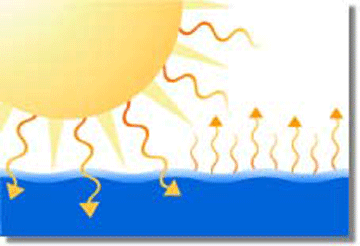
Episodes of extreme heat over land have been studied more closely than those beneath the waves. Oceans, though, not only absorb about 93 per cent of the additional heat being trapped by rising greenhouse gas levels, they are also the main driver of the Earth’s climate.
Thank goodness we have the oceans as this massive sink [for both heat and carbon dioxide] but they are also changing too, and we tend to forget that,” said Sarah Perkins-Kirkpatrick, an author of the paper and also a researcher at the UNSW CCRC.
Dr Perkins-Kirkpatrick likened the oceans to the tropics, where temperatures typically move within a narrow band. Even moderate increases can have big impacts on humans and ecosystems alike.
The paper, which defined heatwaves as at least five consecutive days with sea-surface temperatures in the top 10 per cent of warmth over a 30-year period, found such events were on the increase in most parts of the world.
Global hot spots
Australia was home, along with the north Pacific and north Atlantic, of some of the global ocean hot spots.
While coral bleaching from extended heat over the Great Barrier Reef and elsewhere in recent years had drawn international attention, many other regions had seen “substantial ecological and economic impacts”, as fishing and tourism industries they support were hit, the paper said.
For instance, an extreme event off the Western Australia coast in 2011 led to large-scale effects in the Ningaloo region. Kelp forests south of Ningaloo were hammered and are yet to recover.
“You only need to have that one event to have this complete shift in the ecological environments,” Dr Perkins-Kirkpatrick said, noting such changes have tended to be less dramatic on land.
“Will it ever change back? Have we reached the point of no return for certain marine environments?” she said. “There are a lot of unknowns there, but it’s quite concerning.”
Coral bleaching events have garnered much of the attention but many other marine species, including kelp forests off Tasmania, can be vulnerable to changing conditions.
“[Corals] are the sort of poster child for ecological change, and other systems aren’t maybe as pretty to look at,” Professor Alexander said. “But [others] are equally as important in the ecosystems and food chains”.
Tasman Sea heat
The westward boundaries of the continents tend to be where oceans are warming fastest, including off the east Australian coast.
The Tasman Sea had experienced an increase in heatwave events even before this past summer’s record burst, that fell outside the researchers’ period of study.
In a special climate statement released last month by the Bureau of Meteorology and New Zealand’s National Institute of Water and Atmospheric Research, the agencies found the south Tasman Sea recorded sea-surface anomalies of as much as 2.12 degrees last December and 1.96 degrees in January.
Those readings were compared with a 1981-2010 baseline – and broke the record for those months by about a degree – an unusual departure from the norm for ocean readings.
EPA letter reveals Navy’s downplay of radioactive soil in SF’s Bayviewhttp://abc7news.com/realestate/epa-letter-reveals-navys-downplay-of-radioactive-soil-in-sfs-bayview/3335396/, A letter the EPA sent to the U.S. Navy in December reveals the Navy far understated just how much radioactive soil needs to be cleaned up at the Hunters Point Shipyard., by Kate Larsen, Thursday, April 12, 2018 SAN FRANCISCO (KGO) —
A letter the EPA sent to the U.S. Navy in December reveals the Navy far understated just how much radioactive soil needs to be cleaned up at the Hunters Point Shipyard.This week, the Public Employees for Environmental Responsibility published a letter to the Navy. In it, the EPA says they found 90 and 97 percent of the soil samples on two major land parcels suspect compared to the Navy, which only recommended resampling 15 and 49 percent of those samples.
RELATED: Neighbors outraged after toxic soil confirmed in SF’s Bayview
“They’re dodging the truth,” said Bradley Angel, Executive Director for Greenaction for Health and Environmental Justice. “But it’s time for accountability and better cleanup.”
Angel has been working on the shipyard cleanup for more than a decade.
“This federal superfund site, one of the most contaminated sites in the nation is our San Francisco Bay, not just Bayview Hunters Point. It’s leaking into the Bay,” Angel added.
It was clear that nobody wanted to answer questions,” said Michelle Pierce, Executive Director for Bayview Hunters Point Community Advocates.On Wednesday night, she attended what she thought would be a presentation and question-answer session from the Navy, but that never happened. RELATED: Radioactive spill cleared in Antioch
“They had a corner station, a desk set up with a laptop and you could do a video public statement and that’s what they called giving public comment,” Pierce told ABC7 News.
Pierce also says City Hall needs to take interest in the health of the Bayview Hunters Point community, not just the transfer of the contaminated land for more housing.
Supervisor Malia Cohen said Thursday that she’ll be introducing a hearing to look into ongoing allegations of mismanagement and false tests.
Plans for Welsh nuclear power plant delayed by concerns over seabirds, Next stage of planning process for Anglesey site postponed as effect on tern colonies is assessed, Guardian, Adam Vaughan, 9 Apr 18,
Plans for a nuclear power station on the Welsh island of Anglesey have been delayed by concerns over the plant’s impact on colonies of protected seabirds.
The proposed twin reactors at Wylfa were given the green light by the UK’s nuclear regulator in December, with backers hoping to win financial support from the government.
Horizon Nuclear Power, a subsidiary of the Japanese conglomerate Hitachi, told planning authorities it would submit its planning application for the Wylfa plant by the end of March, which it called a “major milestone”.
But the company postponed submitting the development consent order because it needs to thrash out the impact building the power station will have on colonies of sandwich, Arctic and common terns.
Nearby Cemlyn nature reserve is home to thousands of sandwich terns, which account for about fifth of the birds’ UK population and is the biggest on the country’s west coast.
Wildlife groups are concerned about the effect of noise and light from the power station’s construction, as well as a reduction in food for the birds to forage on. Land clearance for the vast site is also expected to displace potential predators, such as rats and foxes.
Chris Wynne, a senior reserve officer at North Wales Wildlife Trust, said: “We are looking at a range of ecological impacts at one of the most significant tern colonies in the UK.”
Two weeks ago, I gave a keynote presentation about anthropogenic climate disruption (ACD) at a large sustainability conference in Chico, California. During the question-and-answer session following my talk, a student asked me what I thought the world would look like by 2050. His question stopped me in my tracks. I had to pause and take a deep breath, to prepare myself emotionally for what I had to tell him.
Here is the gist of what I said: Based on years of research for my forthcoming book, The End of Ice, along with my work compiling these monthly climate disruption dispatches for four years now, I know that by 2050, we will be inhabiting a dramatically different planet. I believe we will already have tens — if not hundreds — of millions of climate refugees from sea-level rise and conflicts born of lack of food and water. What we currently call extreme weather events (massive floods, droughts, hurricanes) will have long since become the norm. In the US, growing food in the Midwest and the central valley of California will be extremely difficult, if not largely impossible, due to shifting weather patterns of rainfall and drought. Some swaths of the world, including the Gulf states in the Middle East and parts of the US Southwest, will be largely uninhabitable due to simply being too hot. Greenland and the Antarctic will both be experiencing dramatically advanced melting, and most of the glaciers in the contiguous 48 US states will have long since ceased to exist. And given that we are officially already amidst the Sixth Mass Extinction Event of the planet, which humans triggered, the biological annihilation that comes with this is happening apace.
This portrait might seem far-fetched to some. But to understand that this is our future, all we need to do is look at what is already happening around the planet.
Unchecked ACD — which appears likely to continue, since governments (particularly that of the United States) are not preparing to undertake the kinds of drastic mitigation measures that might have any impact — will dramatically degrade global fish catch over the coming centuries, and may well reduce total oceanic plant life for a millennium, according to a recent study. The study also noted that these changes cannot be reversed until the climate cools.
The amount of warming humans have already caused on Earth is, according to a recent study, likely already enough to melt more than one-third of all the world’s glaciers outside of Antarctica and Greenland, regardless of ongoing efforts to reduce fossil fuel emissions. The study analyzed the lag between global temperature increases and the retreat of glaciers and found a relatively slow response of glaciers to planetary warming. Researchers noted that it will take until 2100, at least, to see any benefits from serious mitigation efforts over the next decades — assuming those efforts actually happen. One of the scientists involved in the study told Carbon Brief that this glacier loss is already “baked in” to the system and has been overlooked, which essentially means “we really are on course to obliterate many of these mountain landscapes.”
Meanwhile, a recently published World Wildlife Fund report has predicted catastrophic losses in the world’s forests: As much as 60 percent of the plants and half of all the animals are predicted to disappear by 2100. if temperatures rise by more than 1.5 degrees Celsius (1.5°C). The scientific consensus states that a 1.5°C rise is a given; in fact, some prominent scientists believe an increase of 3.2°C by 2100 is most likely, given current national commitments. If emissions remain unchanged, which is the current actual trajectory, a 4.5°C rise is the forecast. It is worth noting that oil giants BP and Shell are planning on 5°C of planetary warming by 2050.
Taking all this information in is necessary if we are to see the world clearly and live our lives accordingly.
Earth
The World Bank recently warned that if dramatic intervention doesn’t occur on the ACD front, 140 million people across three regions (sub-Saharan Africa, South Asia, Latin America) of the Earth will become refugees between now and 2050.
An example of one of the factors driving such mass movement of people can be found in California, where a recent report citing nearly 90 different studies found that warming temperatures could alter where key crops grow across that state. Bearing in mind that California produces roughly two-thirds of all the produce in the US, the report notes that ACD could decrease the yield of some of the crops grown in California by as much as 40 percent by 2050.
In Vermont, warming temperatures, particularly during the winter, are causing extreme weather events and unpredictable rainfall, which experts recently warned was making forests across that state particularly vulnerable to ACD. Boreal forests and moose populations will be the hardest hit, warned the study.
The world’s northernmost regions have not escaped extreme weather. The Svalbard Global Seed Vault, known as the Doomsday Vault, was created to protect the world’s seeds in the event of cataclysmic ACD impacts or nuclear war, whichever comes first. Disturbingly, it is now in need of an upgrade, thanks to ACD. Norway, which built and maintains the vault, is having to invest $13 million to upgrade the vault to make room for more seeds and make it more resilient, given a recent flooding event there. Last year, flooding at the entrance of the vault prompted the Norwegian government to begin looking into the upgrade, which is now going to move forward.
Bad news also abounds for Earth’s animal species. A recently published study in the journal Nature Climate Change showed that Antarctica’s king penguins could be extinct by 2100, due primarily to ACD impacts and overfishing.
In Florida, research revealed recently that nearly all the sea turtles being born there are female, due to higher temperatures. Obviously, if this trend continues, which it almost assuredly will, there will be no more sea turtles in Florida.
Meanwhile over in Europe, the authors of a recent report out of France’s National Museum of Natural History and the National Centre for Scientific Research showed a “catastrophic” decline in France’s bird populations. The trend signals the possibility of Europe’s farmland turning into desert, a situation that would ultimately threaten all human beings. The scientists warned of a wider crisis of biodiversity — or lack thereof — across that continent, with ACD impacts and pesticides to blame. This comes on the heels of concerning news of a 76 percent decline in the abundance of flying insects in Germany over the last 27 years.
Water
As is often the case in the spring, the watery realms of the planet are where the ACD impacts are most evident.
Widespread ongoing winter drought across the US, from Kansas, Oklahoma and Missouri to the Dakotas, Texas and California, have many farmers worried about this year being a repeat of 2012, the worst drought in the US since the Dust Bowl. At present, the winter drought is worse than it was in 2012.
The problem extends beyond those states. In Colorado, at the time of this writing, snow would need to fall at 200 percent of the state’s average through the end of April for its snowpack to catch up to normal. Water managers there are keeping a leery eye on reservoirs as summer looms on the horizon.
Colorado is not an anomaly. Snowpack across the Western US has been dramatically lower than it was a century ago. A recent study showed the average snowpack in the west has dropped by nearly one-third since 1915. That is equivalent to the decrease we’d see from permanently draining Nevada’s Lake Mead, the single largest man-made reservoir in the US.
Changing weather patterns and warmer year-round temperatures have scientists in Western Canada — a place you wouldn’t think needs to worry about water issues — worried about running out of water in the future. For example, in 2017 there was a record amount of snowfall in one region, but even all that snow was still not enough to prevent a drought on the southern part of the prairies below it. The changing climate there also means the snowpack is melting faster and earlier than usual, which means that water is moving through river basins faster and leaving them dry before the end of summer.
On the other side of the world, New Zealand is experiencing similar concerns. Its alps have become incredibly barren, as a recent aerial survey shows how the loss of snow there is now being called “extreme.”
A recently released UN report on the state of the world’s water warned that more than 5 billion people could suffer water shortages by 2050 due largely to ACD and increasing demand.
Furthermore, extreme weather events like major floods and extreme rainfall events have surged more than 50 percent this decade alone, and are now happening four times more often than they were in just 1980, according to a recent paper.
Meanwhile, seas continue to rise. A recent NOAA report warned that sea level rise will rapidly worsen flooding that is already happening in coastal communities around the US. The report warned that some cities will see flooding on a daily basis by 2100.
Adding to this, another recent study showed that lakes on the Greenland Ice Sheet are now forming further inland, meaning they are now potentially threatening to speed up ice flow once they drain to the glacial floor.
In Antarctica the news is no better. The absence of sea ice near that continent over the past six weeks (as of the time of this writing) has deeply concerned scientists conducting research there.
In addition to paying attention to large, continental changes, it’s important to take note of ACD-driven shifts on the level of microorganisms. A recent report showed that excessive rates of carbon dioxide (CO2) affect the health of critical microorganisms in the oceans, which could potentially undermine the base of vital marine food chains. This is happening largely due to ocean acidification, a result of ACD.
Fire
Given the low snowpack levels across much of the Western US, this summer is already expected to be another above-average wildfire season for much of that part of the country. Since snowpack functions as a water source through much of the summer, when warmer temperatures cause it to melt off faster than normal, drier conditions ensue.
Meanwhile in Australia, more than 70 homes and buildings have been destroyed in a fast-moving bushfire in New South Wales, while separate fires destroyed 18 properties in Victoria. Local authorities there described the fires as the worst of Australia’s summer season thus far.
As is always the case with extreme weather events, none of these fires can be solely attributed to ACD. However, climate disruption’s impacts are a key contributing factor to how often they occur, as well as to their intensity.
Air
In Australia, a new study reveals that the country’s record-setting 2012 heat wave was responsible for the destruction of roughly 1,000 square kilometers of seagrass meadows. which had acted as a repository for CO2. When the meadows were destroyed, the disaster released as much as 9 million tons of CO2 into the atmosphere.
Meanwhile, nearby New Zealand experienced its hottest summer on record last year. It definitively broke with normal temperatures, clocking in at a shocking 2.1°C above the past 35-year average temperature.
Back in the US, USGS data has revealed how spring has arrived much earlier than normal for much of the country, a clear indicator of how ACD is continuing to shift overall climate patterns.
In the Arctic, in fact, spring is beginning an average of 16 days earlier now than it did just one decade ago. A study in the journal Scientific Reports noted an increase in the number of warm temperature records in the spring, along with changes to the timing of bird migrations, flowers blooming and other seasonal indicators.
What makes this even more disconcerting is the fact that scientists have found a direct and strong link between warmer Arctic temperatures and abnormally high snowfall amounts and frigid temperatures further south of that region. So, for example, the severe weather that has been impacting the northeastern US this spring, is linked directly to the ACD-related warm wave happening across the Arctic region.
Lastly in this section, but perhaps most importantly, thawing Arctic permafrost is now likely to release more methane than previously expected. Methane is a far more potent greenhouse gas than CO2, as it is 100 times stronger over a 10-year time scale. The new study found that waterlogged wetland soils will produce considerably more methane than previously predicted.
Denial and Reality
There is never a dull moment in the Trump administration’s land of ACD-denial.
A recent and excellent article published at The Conversation outlined the four primary methods used by this administration to deny or hide the reality of ACD. These methods are, according to the article: making documents more difficult to find on government websites, burying web pages, altering language, and silencing the science. Truthout’s Mike Ludwig also detailed how ACD, as a threat to the US, has literally “gone missing” under Trump.
Meanwhile, the cabinet continues to be filled with ACD deniers. One of the more recent additions has been hardline climate denier Mike Pompeo as Secretary of State, who along with having longstanding close ties to the Koch brothers, in 2013 said during a C-SPAN interview: “There are scientists who think lots of different things about climate change. There’s some who think we’re warming, there’s some who think that the last 16 years have shown a pretty stable climate environment.”
A Trump administration official even went so far recently as to say that USGS scientists went “outside their wheelhouse” by writing that ACD has “dramatically reduced” glaciers in Montana. One of the scientists who bore this attack responded, “This is what we do…. It is our wheelhouse.”
Trump administration US Energy Secretary, Rick Perry, who thinks wearing thick-framed glasses makes him appear more intelligent, recently said that international efforts to reduce fossil fuel use were “immoral.”
On the reality front, thousands of scientists from the 22 Commonwealth countries have urged that stronger government action on ACD needs to be taken if there is hope to keep planetary warming lower than 2°C.
Underscoring that urgency, global demand for energy increased by 2.1 percent in 2017 — more than twice the previous year’s rate, according to the International Energy Agency. According to the same agency, energy-related CO2 emissions also increased by 1.4 percent during 2017, reaching a historic high of 32.5 gigatons.
Despite glaring warning signs from around the planet, governments around the world are not taking dramatic measures to mitigate ACD impacts. In fact, the US government continues to refuse to even acknowledge that those impacts exist. The world’s most powerful forces are taking a business-as-usual approach, as we are hurtled deeper into the Sixth Mass Extinction event.
Antarctica retreating across the sea floor, EurekAlert , UNIVERSITY OF LEEDS , 3 April 18 Antarctica’s great ice sheet is losing ground as it is eroded by warm ocean water circulating beneath its floating edge, a new study has found.
Research by the UK Centre for Polar Observation and Modelling (CPOM) at the University of Leeds has produced the first complete map of how the ice sheet’s submarine edge, or “grounding line”, is shifting. Most Antarctic glaciers flow straight into the ocean in deep submarine troughs, the grounding line is the place where their base leaves the sea floor and begins to float.
Their study, published today in Nature Geoscience, shows that the Southern Ocean melted 1,463 km2 of Antarctica’s underwater ice between 2010 and 2016 – an area the size of Greater London.
The team, led by Dr Hannes Konrad from the University of Leeds, found that grounding line retreat has been extreme at eight of the ice sheet’s 65 biggest glaciers. The pace of deglaciation since the last ice age is roughly 25 metres per year. The retreat of the grounding line at these glaciers is more than five times that rate.
Toxic Townships: Landfill Leak Raises Concerns, http://unewsonline.com/2018/03/28/toxic-townships-landfill-leak-raises-concerns/Riley Mack, Staff Writer, 28 Mar 18, The world’s oldest nuclear weapons’ waste could be in the air, the soil or even within homes. What seemed like a wonderful place to raise children has turned into a nightmare for the citizens of the St. Louis suburbs. These families are living just miles from the West Lake Landfill, which was given the Superfund status in the 90s: A title received only by the most contaminated areas in the country. With little help from the government, residents are dying due to rare cancers that come from exposure to what appears to be toxic elements. Their homes were unknowingly a part of the birth of the atomic age. It all began in 1942, when St. Louis was selected as a center for holding uranium in order to assemble the first atomic bomb.
Following recent media attention toward groups like Just Moms STL, a documentary called “Atomic Homefront” that was released in 2017, publicized the issue and ultimately gained attention for the community by showcasing personal stories. One community member within the documentary named Anna Vasilenok states in a public meeting that she moved from Chernobyl in order to relieve her family of this type of tragedy, then went on to tearfully recall all the family members she lost from cancer due to the nuclear disaster. She asked the government officials within the meeting “Do you want that for your children? Who will pay for all the expenses of cancer?”
Staring into the sympathizing audience surrounding her, Vasilenok said “the government has to be held responsible,” and that the government officials they had elected only had interests in their own money. The community “can’t be quiet anymore,” she vehemently declared.
Like Vasilenok, the Just Moms STL group speaks volumes for this issue and surpasses their namesake with their important mission. The early days of this society was a Facebook page where worried community members posted their grievances and advice on the situation. When the conditions of the environment escalated, so did the responsibilities of the group. Dawn Chapman, a forthright activist and co-founder of the group states that cleaning up the St. Louis area is their task bebeen a pivotal role in the intervention of media (and therefore, policymakers) to create real change for their community. They even extended their activism to marching in Washington when Gina McCarthy, a former administrator for the EPA, wouldn’t answer their emails.
Unfortunately, the Just Moms STL organization’s suspicions were correct. In August 2015, soil was found to be contaminated with Thorium 230 at St. Cin Park, a popular playground for children and high schoolers in the Hazelwood area.
The community arranged an emergency meeting with local officials, where they learned that the parks are still open for families and children to visit; enraged, community members stepped forward to challenge these representatives. One man announces that “the original point where [the waste] had come from took [his] father” and now, “this park has taken [his] son” — all of this taking place in the parks where the gates are still wide open.
Hazelwood Parks City Manager Matthew Zimmerman disconcertedly stated back to the distraught families, “If we didn’t have parks there, then where would the children go?” As of January 2018, it has been declared that all companies liable for the dumping owe an expected cost of $236 million, which is a large increase from the project fund of $24.5 million in previous years. Although not enough to form a buy-out option for those who need the funds to move out of their contaminated homes, it is physical and monetary action that is heavily needed for these residents. It will partially excavate tons of radioactive waste from the Republic Landfill in St. Louis over the next five years.
Ironically, a large sign posted in front of Republic Landfill’s site brightly states that “Customer satisfaction is the key to our success!” Whether this is the satisfaction of the community members, or of their own greedy agenda is up to the lawmakers to decide.
Leaked Memo: EPA Shows Workers How To Downplay Climate Change
Point 5: Suggest that humans are only responsible “in some manner.”, HuffPost, By Alexander C. Kaufman , 30 Mar 18The Environmental Protection Agency on Tuesday evening sent employees a list of eight approved talking points on climate change from its Office of Public Affairs ― guidelines that promote a message of uncertainty about climate science and gloss over proposed cuts to key adaptation programs.
An internal email obtained by HuffPost ― forwarded to employees by Joel Scheraga, a career staffer who served under President Barack Obama ― directs communications directors and regional office public affairs directors to note that the EPA “promotes science that helps inform states, municipalities and tribes on how to plan for and respond to extreme events and environmental emergencies” and “works with state, local, and tribal government to improve infrastructure to protect against the consequences of climate change and natural disasters.”
But beyond those benign statements acknowledging the threats climate change poses are talking points boiled down from the sort of climate misinformation EPA Administrator Scott Pruitt has long trumpeted.
“Human activity impacts our changing climate in some manner,” one point reads. “The ability to measure with precision the degree and extent of that impact, and what to do about it, are subject to continuing debate and dialogue.”
The other states: “While there has been extensive research and a host of published reports on climate change, clear gaps remain including our understanding of the role of human activity and what we can do about it.”
The email was sent under the subject line: “Consistent Messages on Climate Adaptation.” ………
The delivery of the talking points comes a week after Pruitt announced plans to restrict the agency’s use of science in writing environmental rules, barring the use of research unless the raw data can be made public for other scientists and industry to scrutinize. That directive would disqualify huge amounts of public health research conducted on the condition that subjects’ personal information will remain private. Two former top EPA officials called the move an “attack on science” in a New York Times op-ed published Monday.
Last year, the EPA reassigned the four staffers in the policy office who worked on climate adaptation, shuttered its program on climate adaptation and proposed eliminating funding for programs that deal with rising seas and warming temperatures.
Pruitt personally oversaw efforts to scrub climate change from EPA websites, and staunchly defended President Donald Trump’s decision last June to withdraw the United States from the Paris climate accord. In October, Pruitt proposed repealing the Clean Power Plan, one of the only major federal policies to reduce greenhouse gas emissions.
The agency had also suggested zeroing out funding for most of its major climate and regional science grant programs, only to see Congress reject most of the cuts in the budget bill passed last week.
The assertions made in the new EPA talking points are not rooted in science. Ninety-seven percent of peer-reviewed research agrees with the conclusion that emissions from burning fossil fuels, deforestation and industrial farming are enshrouding the planet in heat-trapping gases, and are the primary causes of rising planetary temperatures. A research review published in November 2016 found significant flaws in the methodologies, assumptions or analyses used by the 3 percent of scientists who concluded otherwise.
In 1989, Russia Left a Nuclear Submarine Dead in the Ocean (Armed with Nuclear Weapons) National Interest , Kyle Mizokami , 27 Mar 18
Komsomolets sank in 5,250 feet of water, complete with its nuclear reactor and two nuclear-armed Shkval torpedoes. Between 1989 and 1998 seven expeditions were carried out to secure the reactor against radioactive release and seal the torpedo tubes. Russian sources allege that during these visits, evidence of “unauthorized visits to the sunken submarine by foreign agents” were discovered.
In the mid-1980s, the Soviet Union constructed a super submarine unlike any other. Fast and capable of astounding depths for a combat submersible, the submarine Komsomolets was introduced in 1984, heralded as a new direction for the Soviet Navy.
Five years later, Komsomolets and its nuclear weapons were on the bottom of the ocean, two-thirds of its crew killed by what was considered yet another example of Soviet incompetence.
The history of the Komsomolets goes as far back as 1966. A team at the Rubin Design Bureau under N. A. Klimov and head designer Y. N. Kormilitsin was instructed to begin research into a Project 685, a deep-diving submarine. The research effort dragged on for eight years, likely due to a lack of a suitable metal that could withstand the immense pressures of the deep. In 1974, however, the double-hulled design was completed, with a titanium alloy chosen for the inner hull.
Project 685, also known as K-278, was to be a prototype boat to test future deep-diving Soviet submarines. The Sevmash shipyard began construction on April 22, 1978 and the ship was officially completed on May 30, 1983. The difficulty in machining titanium contributed to the unusually long construction period.
K-278 was 360 feet long and forty feet wide, with the inner hull approximately twenty-four feet wide. It had a submerged displacement of 6,500 tons, and the use of titanium instead of steel made it notably lighter. It had a unique double hull, with the inner hull made of titanium, that gave it its deep-diving capability. The inner hull was further divided into seven compartments, two of which were reinforced to create a safe zone for the crew, and an escape capsule was built into the sail to allow the crew to abandon ship while submerged at depths of up to 1,500 meters.
……….On April 7, 1989, while operating a depth of 1266 feet, Komsomolets ran into trouble in the middle of the Norwegian Sea. According to Norman Polmar and Kenneth Moore, it was the submarine’s second crew, newly trained in operating the ship. Furthermore, its origins as a test ship meant it lacked a damage-control party.
A fire broke out in the seventh aft chamber, and the flames burned out an air supply valve, which fed pressurized air into the fire. Fire suppression measures failed. The reactor was scrammed and the ballast tanks were blown to surface the submarine. The fire continued to spread, and the crew fought the fire for six hours before the order to abandon ship was given.
………. Only four men had been killed in the incident so far, but after the submarine sank many men succumbed to the thirty-six-degree (Fahrenheit) water temperatures. After an hour the fishing boats Alexi Khlobystov and Oma arrived and rescued thirty men, some of whom later succumbed to their injuries. Of the original sixty-nine men on board the submarine when disaster struck, forty-two died, including Captain First Rank Vanin.
Komsomolets sank in 5,250 feet of water, complete with its nuclear reactor and two nuclear-armed Shkval torpedoes. Between 1989 and 1998 seven expeditions were carried out to secure the reactor against radioactive release and seal the torpedo tubes. Russian sources allege that during these visits, evidence of “unauthorized visits to the sunken submarine by foreign agents” were discovered.
Kyle Mizokami is a defense and national security writer based in San Francisco who has appeared in the Diplomat, Foreign Policy, War is Boring and the Daily Beast. In 2009 he cofounded the defense and security blog Japan Security Watch. You can follow him on Twitter: @KyleMizokami.
Vancouver Sun 12th March 2018,A radioactive metal from the Fukushima nuclear plant disaster in Japan has
been discovered in the Fraser Valley, causing researchers to raise the
alarm about the long-term impact of radiation on B.C.’s west coast.
Examination of a soil sample from Kilby Provincial Park, near Agassiz, has
for the first time in this province found Cesium 134, further evidence of
Fukushima radioactivity being transported to Canada by air and water. http://www.vancouversun.com/news/Toxic+waters+Nuclear+radiation+found+pose+health+concerns/9606269/story.html
Reactor’s neighbours alarmed over radioactive toxins in river, Report details dumping water contaminated with tritium PCBs, other toxins from Rolphton, Ont., site By Julie Ireton, CBC NewsMar 21, 2018 Indigenous communities, environmental groups and other concerned citizens who monitor toxic waste are increasingly concerned about the dumping of radioactive matter and other contaminants into the Ottawa River from an inactive nuclear reactor northwest of the capital.
A scientific report released in February details the dumping of thousands of litres of water contaminated with radioactive tritium, PCBs and other toxins into the river from the inactive nuclear power demonstration (NPD) reactor in Rolphton. Ont., about 200 kilometres from Ottawa.
The contaminants are at levels above Ontario and Canadian surface water quality standards, according to the report.
It was written by geoscientist Wilf Ruland, who was retained by the Algonquin Anishinabeg Nation Tribal Council to review the proposed decommissioning of the demonstration reactor.
Radioactive tritium dumped
“The site is so close to the Ottawa River, only being 100 metres [away], and for us the environment and the water are two of our priorities,” said Norm Odjick, the tribal council’s director general.
In the report, Ruland notes releases of contaminated water into the river “appear to have been ongoing for decades and [continue] to the present day.”
“The regulatory guidelines for surface water quality were vastly exceeded in the contaminated water being dumped untreated into the Ottawa River from the NPD facility in 2015.”
Ottawa Riverkeeper Meredith Brown said radioactive tritium has been dumped into and diluted by the river, but cannot be filtered out or treated like other toxins.
……. Ole Hendrickson, a scientist and researcher for the group Concerned Citizens of Renfrew County and Area, questions the safety of the discharge limits for the facility.
Regulations vs. impact
“Aquatic organisms are being exposed to very high concentrations of toxic substances, and there’s nothing to stop boaters from drawing and filtering river water near the discharge point for drinking,” Hendrickson said.
Hero rescues pets from Fukushima nuclear wasteland
The 3/11 kitten that wasn’t The “forbidden life” of those caring for abandoned animals in Fukushima, Beyond Nuclear , By Linda Pentz Gunter, 20 March 18 “………. countless animals were indeed abandoned in Japan due to the natural disasters and the forced exile of those living too close to the stricken nuclear plant. Some international rescue groups did go in to try to help, but early on found conditions and access restrictions challenging if not prohibitive.
However, there were also individuals and groups in Japan who were not willing to sit back and watch animals starve. In addition to the rescue operations, a spay-neuter organization began work to prevent the inevitable proliferation of pets who, if they had survived at all, had now become strays. Shelters were eventually built with funds donated by supporters.
But there were some, chronicled in several remarkable films, who either never left, or who quickly returned to Fukushima Prefecture, with one sole purpose in mind: to look after the animals. Their charges soon multiplied and for some, it has become a full-time vocation.
In a 2013 ITN short news segment, we are introduced to 58-year old Keigo Sakamoto, who had already established an animal sanctuary in Nahara, just over 12 miles from the Fukushima plant. He was one who refused the order to evacuate, then found himself completely trapped within the zone, cut off from supplies. He survives on the generosity of individuals and stores outside the zone where he regularly collects discarded food and other supplies essential to keeping his animals — and himself — alive.
Then there are farmers who returned to save their livestock. One such, 53-year old Naoto Matsumura, is featured in the 18-minute Vice documentary, Alone in the Zone. He lives in what was then the ghost town of Tomioka — whose station reopening story we featured last week. But Matsumura could not accept the idea that dogs, cows, goats, ducks and even ostriches should be cast off without a care.
At first he evacuated with his family, fearing all the reactors were going to blow. But when his family faced rejection by relatives who said they were “contaminated”, and the hassle of evacuation shelters became unendurable, he returned home alone. And stayed. “I couldn’t leave the animals behind,” he said. “I am opposed to killing off the animals in the zone.”
Feeding them, and refusing to sign the “death warrant” requirement from the government, will, he hopes, spare them from slaughter. “So many of their fellow cattle died in pain,” he said, recalling the tragedy of cows left in barnes to starve. “To me, animals and people are equal.” ……https://beyondnuclearinternational.org/2018/03/16/the-3-11-kitten-that-wasnt/
With Russia building floating nuclear reactors and possibly testing nuclear-powered cruise missiles, there are good reasons for this training.The Drive, BY JOSEPH TREVITHICKMARCH 20, 2018The U.S. military, along with other federal and state authorities, has been training to respond to potentially dangerous releases of radioactive material in and around the Arctic. Though there is no clear indication of a direct link between Russia’s reported tests of nuclear-powered missiles or expanding use of nuclear power in the region, it is hard not to see these exercises in connection with those developments.
Earlier in March 2018, members of the U.S. National Guards from 10 different states arrived at the Donnelly Training Area, situated near the U.S. Army’s Fort Greely in Alaska. Alaska state authorities and members of Canada’s reserve 39 Canadian Brigade Group joined the exercise, nicknamed Arctic Eagle 2018, as well.
The drills included a number of different mock crises, including an overturned fuel truck creating a hazardous material spill, the potential for attacks on the Trans Alaskan Pipeline System, and even cyber attacks. But especially notable was a scenario involving the need to locate a crashed satellite and contain the radiological material it had deposited across a wide area as it plummeted to earth. ………
t’s definitely no secret that the U.S. military has become increasing interested in preparing for potential conflicts and other contingencies above and near the Arctic Circle in recent years. As global climate change has shrunk the polar ice cap and otherwise reduced the amount of ice buildup that occurs during certain parts of the year, the region has become increasingly important economically and various countries, especially Russia, have moved to enforce their territorial claims.
“The growing concerns regarding the increased number of nations competing for Arctic resources are well justified,” U.S. Air Force General Lori Robinson, head of U.S. Northern Command, which oversees operations in the region, and the designated “Advocate for Arctic Capabilities” within the Pentagon, reiterated to members of Congress during a hearing in February 2018. “Diminishing sea ice provides opportunities for significantly expanded access to a region that had previously been inaccessible to all but a handful of northern nations.”
…….. the idea of a crashing satellite creating a radiological disaster isn’t an entirely fictional scenario. In 1978, the Soviet Union’s Kosmos 954 reconnaissance satellite, which had a nuclear reactor as its power source, crashed into Canadian territory, touching off an international incident and prompting an expensive response and clean-up operation.
….. U.S. military and other agencies practicing specifically to handle a radiological incident in the region seems even more noteworthy in light of a number of recent events. Most importantly are Russian claims that it has been testing a cruise missile with theoretically unlimited range that uses a nuclear reactor-powered propulsion system in the Arctic. Anonymous U.S. government officials have since told various media outlets that this is true, but that the weapons have been crashing, potentially spreading radioactive material and components.
…… The Russians have also been dramatically expanding their use and plans to employ small and mobile nuclear reactors to support activities in the Arctic.
……..If any of these nuclear power systems were to fail, it could potentially cause a serious radiological incident that would impact both the United States and Canada. The same procedures American military and other government personnel have been training to employ in response to a crashed satellite would undoubtedly be applicable in those situations, too.
Iraq, 15 years On: A Toxic US Legacy,March 18, 2018, by Middle East EyeFifteen years ago this month, the United States spearheaded a fantastically bloody war on Iraq as part of its ongoing effort to ensure the Iraqi nation’s perpetual misery. Common Dreams, by Belén Fernández, Fifteen years ago this month, the United States spearheaded a fantastically bloody war on Iraq ….
Increasing rates of cancer and birth defects …..
Consider, for instance, Cockburn’s 2010 article for The Independent, headlined “Toxic legacy of US assault on Fallujah ‘worse than Hiroshima'”. In it, he outlined the results of a study by British scientist Chris Busby and colleagues Malak Hamdan and Entesar Ariabi on the increase in reports of cancer, birth defects, infant mortality and other forms of suffering in the Iraqi city of Fallujah, the focus of a particularly vicious US assault.
To be sure, as one of the top polluters on the entire planet, the US military has never been thrilled about acknowledging what would appear to be obvious: that saturating the environment with toxic materials will have repercussions on both environmental and human health, including the health of the United States’ own warriors, as underlined by the afflictions affecting veterans of the Vietnam War and first Gulf War, among other imperial escapades.
According to Mozhgan Savabieasfahani, an award-winning toxicologist based in Michigan, “around six billion bullets were expended into the Iraqi environment” between 2002 and 2005 alone – which, along with bombs, have led to “public contamination with … toxic metals”.
Depleted uranium: a long-term hazard
But the US military arsenal extends far beyond traditional guns and bombs. In 2012, Robert Fisk wrote about a 14-month-old Iraqi named Sayef who had a severely enlarged head, was blind, paralysed and unable to swallow. Noting that much blame for the rise in congenital birth defects in Fallujah had been directed at the United States’ use of white phosphorus there, Fisk was nonetheless forced to include the caveat: “No one, of course, can produce cast-iron evidence that American munitions have caused the tragedy of Fallujah’s children.”
Yet the possibility of a cause-and-effect relationship becomes more and more difficult to deny. Already in 2009, the Guardian had reported that doctors in Fallujah were “dealing with up to 15 times as many chronic deformities in infants” as the previous year, such as a baby born with two heads.
In 2013, Al Jazeera quoted Sharif al-Alwachi of the Babil Cancer Centre in southern Iraq, who attributed escalating cancer rates since 2003 on the US military’s use of depleted uranium (DU) weapons. Al Jazeera also threw in the following uplifting note: “The remaining traces of DU in Iraq represent a formidable long-term environmental hazard, as they will remain radioactive for more than 4.5 billion years.”
Indeed, DU constitutes a can of worms unto itself. A 2016 Washington Spectator essay titled “Irradiated Iraq,” by Washington, DC-based investigative journalist Barbara Koeppel, remarks on the convenient US classification of its own uranium weapons as “conventional” when in fact “they are radioactive and chemically toxic”.
Destructive capacity
This is the same US, of course, that goes into warmongering hissy-fits each and every time the word “radioactive” comes up in the context of Iran while also engaging in countless other varieties of hypocritical rampage.
Koeppel cites former United Nations weapons inspector Scott Ritter‘s observation: “The irony is we invaded Iraq in 2003 to destroy its non-existent WMD [weapons of mass destruction]. To do it, we fired these new weapons, causing radioactive casualties.”
Luckily for the US, there are plenty of members of the national media and wider domestic landscape willing to succumb to the notion that DU is simply Something We Don’t Talk About; you might even say the issue itself is radioactive.
Others, however, have wholeheartedly embraced the destructive wonders of DU, as was the case with a US special operations soldier I spoke with earlier this year. This young man had just completed tours of duty in Iraq and Syria, where the US recently came under criticism for its renewed use of DU; he expressed dismay that sectors of the international community had failed to appreciate the effectiveness of the weaponry in question.
Back in 2001, the International Committee of the Red Cross offered some watered-down thoughts on DU, gently suggesting that international humanitarian law “prohibit[s] weapons, means or methods of warfare of a nature to cause superfluous injury or unnecessary suffering, which have indiscriminate effects or which cause widespread, long-term and severe damage to the natural environment”…..https://www.commondreams.org/views/2018/03/18/iraq-15-years-toxic-us-legacy
Thousands of containers with radioactive waste were dumped in the Kara Sea during Soviet times. Now, Russia’s Federal Agency for Fishing believes it’s a good idea to start fishing. By Thomas Nilsen March 15, 2018
“We shall present soon a program on development of promising fishing in the Kara Sea,” said Sergey Golovanov at the 5th international conference of fishing in the Arctic, organized in Murmansk this week. He is quoted by news agency TASS.
Golovanov is head of the Science and Education Department with the Federal Agency for Fisheries and has a background from PINDRO, the Marine research institute in Murmansk.
According to Gulovanov, the Kara Sea’s advantage for the fishing industry is that it is a shelf sea, it does not border any territorial waters of other nations. “This is why Russia can have own fishing regulations there,” he said according to TASS.
In 2013, a Norwegian-Russian joint study expedition to the dump-site of K-27 concluded that it is feasible to lift the ill-fated submarine from the seabed. Although dumped 30 years ago, the hull of the submarine is intact.
Several other areas of the Kara Sea were also visited by the science expedition.
Nuclear weapons testing
Additional to the nuclear waste dumped across the Kara Sea, the waters are also next to the Soviet Union’s largest testing area for nuclear weapons. At Novaya Zemlya, 79 nuclear- and hydrogen bombs where detonated in the atmosphere between 1955 and 1962. In the period from 1963 to 1990 another 35 warheads were tested in tunnels under ground. Today, most of Novaya Zemlya is closed off miitary area.
At the conference in Murmansk, nothing was said about the Kara Sea being the main dumping ground for nuclear waste during Soviet times. No other oceans worldwide have more dumped radioactive waste than Russia’s Arctic Kara Sea.
Here, there, everywhere
17 ships and barges loaded with radioactive waste are dumped here. So are 17,000 containers with radioactive waste. Even worse, along the east coast of Novaya Zemlya is 16 nuclear reactors dumped, six of them with spent uranium fuel still on board.
With the breakup of the Soviet Union, both the military Northern Fleet and the civilian icebreakers stopped dumping waste at sea.
Entire nuclear sub dumped in 1982
On shallow waters in the Stepovogo Bay on the southeast coast of Novaya Zemlya, an entire nuclear-powered submarine, the K-27, was dumped in 1982.
The submarine had then been laid-up for more than 15 years after one of the two troublesome reactors suffered a severe leakage of radioactive gasses and inadequate cooling causing extensive fuel element failures.
Dumping the entire submarine at sea was done in what the Soviet reactor engineers and scientists believed would be a safe way to avoid leakages of radionuclides into the marine environment.
The two on board reactors are liquid-metal cooled and contain spent nuclear fuel, 800 kilograms of uranium to be precise.
Both Russian and Norwegian radiation experts have repeatedly warned that failing to lift the submarine eventually one day will cause leakages of radioactivity into the Kara Sea. A worst-case scenario has even pointed to the danger of an uncontrolled chain reaction that could be triggered inside the reactor in case sea water one day starts to leak in through the protecting cover that today isolates the compartment holding the two reactors.
In 2013, a Norwegian-Russian joint study expedition to the dump-site of K-27 concluded that it is feasible to lift the ill-fated submarine from the seabed. Although dumped 30 years ago, the hull of the submarine is intact.
Several other areas of the Kara Sea were also visited by the science expedition.
Nuclear weapons testing
Additional to the nuclear waste dumped across the Kara Sea, the waters are also next to the Soviet Union’s largest testing area for nuclear weapons. At Novaya Zemlya, 79 nuclear- and hydrogen bombs where detonated in the atmosphere between 1955 and 1962. In the period from 1963 to 1990 another 35 warheads were tested in tunnels under ground. Today, most of Novaya Zemlya is closed off miitary area.
Seven years after the Fukushima, Japan nuclear disaster began, forcing evacuations of at least 160,000 people, research has uncovered significant health impacts affecting monkeys living in the area and exposed to the radiological contamination of their habitat.
Shin-ichi Hayama, a wild animal veterinarian, has been studying the Japanese macaque (Macaca fuscata), or snow monkey, since before the Fukushima nuclear disaster. Now, his research has shown that monkeys in Fukushima have significantly low white and red blood cell counts as well as a reduced growth rate for body weight and smaller head sizes.
Hayama, who began his macaque research in 2008, had access to monkeys culled by Fukushima City as a crop protection measure. He continued his work after the Fukushima nuclear explosions. As a result, he is uniquely positioned to discover how low, chronic radiation exposure can affect generations of monkeys.
The macaque is an old world monkey native to Japan, living in the coldest climates of all of the non-human primates. Like humans, macaques enjoy a good soak in the mountain hot springs in the region. It is even said that they have developed a “hot tub culture” and enjoy time at the pools to get warm during winter.
However, snow monkeys and humans share more than a love of hot springs. Human DNA differs from rhesus monkeys, a relative of the snow monkey, by just 7%. While that 7% can mean the difference between building vast cities to living unsheltered and outdoors, for basic processes like reproduction, these differences begin to fade. Consequently, what is happening to the macaques in Fukushima should send a warning about the implications for human health as well, and especially for evacuees now returning to a region that has been far from “cleaned up” to any satisfactory level.
Hayama’s research group has published two studies, each comparing data before and after the nuclear catastrophe began, and also between exposed and unexposed monkey populations. In a 2014 study, researchers compared monkeys from two regions of Japan, one group of monkeys from the Shimokita region, 400 Km north of Fukushima, and a second group of monkeys from contaminated land in Fukushima.
The monkeys in Fukushima had significantly low white and red blood cell counts. Other blood components were also reduced. The more a radioactive isotope called cesium was present in their muscles, the lower the white blood cell count, suggesting that the exposure to radioactive material contributed to the damaging blood changes. These blood levels have not recovered, even through 2017, meaning that this has become a chronic health issue.
Changes in blood are also found in people inhabiting contaminated areas around Chernobyl. Having a diminished number of white blood cells, which fight disease, can lead to a compromised immune system in monkeys as well as people, making both species unable to fight off all manner of disease.
Hayama followed up his 2014 study with another in 2017 examining the differences in monkey fetus growth before and after the disaster. The researchers measured fetuses collected between 2008 and 2016 from Fukushima City, approximately 70 km from the ruined reactors. Comparing the relative growth of 31 fetuses conceived prior to the disaster and 31 fetuses conceived after the disaster revealed that body weight growth rate and head size were significantly lower in fetuses conceived after the disaster. Yet, there was no significant difference in maternal nutrition, meaning that radiation could be responsible.
Smaller head size indicates that the fetal brain was developmentally retarded although researchers could not identify which part was affected. The mothers’ muscles still contained radioactive cesium as in the 2014 study, although the levels had decreased. These mothers had conceived after the initial disaster began, meaning that their fetuses’ health reflects a continuing exposure from environmental contamination. This study mirrors human studies around Chernobyl that show similar impacts as well as research from atomic bomb survivors. Studies of birds in Chernobyl contaminated areas show that they have smaller brains.
Although Hayama has approached radiation experts to aid with his research, he claims they have rejected it, saying they don’t have resources or time, preferring to focus on humans. But humans can remove themselves from contaminated areas, and many have chosen to stay away despite government policies encouraging return. Tragically, monkeys don’t know to leave, and relocating them is not under discussion, making study of radiation’s impact on their health vital to inform radiation research on humans, the environment, and any resettlement plans the government of Japan may have.
Hayama presented his work most recently as part of the University of Chicago’scommemoration of the 75th Anniversary of the first man-made controlled nuclear chain reaction. His work follows a long, important, and growing line of research demonstrating that radiation can not only damage in the obvious ways we have been told, but in subtle, yet destructive ways that were unexpected before. The implications for humans, other animals, and the environment, are stark. Cindy Folkers is the radiation and health specialist at Beyond Nuclear.









 nuclear-news