One of the more serious impacts of human-caused climate disruption occurs when seawater absorbs excess carbon dioxide from the atmosphere. When this occurs, the carbon dioxide reacts with the water to form carbonic acid, which then ultimately reduces its pH level. For much of the marine life in the oceans, the consequences of this will be dire.
“Animals that have a calcium carbonate shell such as, corals, coralline algae, pteropods, bivalves and gastropods are negatively affected by ocean acidification,” said Richard Feely, a senior scientist with the National Oceanic and Atmospheric Administration’s (NOAA) Pacific Marine Environmental Laboratory. “In some cases, their shells are weakened or actually dissolve while the animal is still alive. Fish behavior is also impacted by ocean acidification such that some species lose their ability to navigate or avoid predators.”………
As oceans absorb increasing amounts of our industrial emissions of CO2, their pH is expected to drop to a staggering 7.7 pH by 2100, according to professor of marine chemistry Aleck Wang at the Woods Hole Oceanographic Institution. Wang told National Geographic that by 2100, “you are going to start seeing calcium carbonate shells dissolve. It’s not going to be that far away.”
Most scientists studying the impacts of ocean acidification agree that by killing off the types of organisms Feely mentioned (corals, oysters, types of phytoplankton, etc.), major portions of the oceanic food chain could be greatly impacted.
Feely told Truthout that key marine organisms and ecosystem services face contrasting risks from the combined effects of ocean acidification, warming and sea level rise, and that even under the most stringently controlled CO2 emissions scenario, warm water corals and mid-latitude bivalves “are considered to be at high risk by 2100.”
“Under our current rate of CO2 emissions, most marine organisms are expected to have very high risk of impacts by 2100 and many by 2050,” Feely said. “These results are consistent with evidence of biological responses during high-CO2 periods in the geological past. Impacts to the ocean’s ecosystem services follow a parallel trajectory.”
……… According to Feely, high latitude and upwelling regions of the oceans are already “seriously affected by ocean acidification,” and he said that he and his colleagues are “already observing dissolution of pteropod shells in the Arctic and Southern Oceans, and also upwelling regions along the West Coast of North America.”
………Feely’s deepest concerns about ocean acidification are that so many ecosystem processes that humans depend on for food and survival are already impacted by both oceanic warming and acidification, and the risks of these impacts to these services only increases with continued CO2 emissions, which currently show little signs of slowing down.
“[The impacts] are predicted to remain moderate for the next several decades for most services under stringent emission reductions,” Feely said. “But the business-as-usual scenario would put all ecosystem services at high or very high risk over the same time frame.”
A 2015 study warned that ocean acidification could cause dramatic changes to phytoplankton, the basis of the entire oceanic food web.
Vatican’s former legal chief says canon law should include care of creation, CRUX, Elise Harris, CNA, Jul 18, 2018, ROME– The Vatican’s former top advisor on canon law has made a public call to insert legal obligations for the care of creation into the Church’s universal canon law – making it a legal duty for Catholics not only “not to harm” the environment, but to improve it.
According to veteran Vatican watcher Andrea Tornielli, Cardinal Francesco Coccopalmerio, former head of the Pontifical Council for Legislative Texts, made the proposal during a July 12 event in Rome titled “Dialogue on Catholic Investments for the Energy Transition.”
During the closed-door discussion, representatives from the Vatican and Catholic organizations spoke about how to invest responsibly towards a transition to renewable energies.
In an interview with Vatican Insider, Coccopalmerio discussed canons 208-221 of the Church’s Code of Canon Law, which enumerate “Obligations and rights of all the faithful.”
This section “outlines an ‘identikit’ of the faithful and of their life as a Christian,” the cardinal said, but noted that nothing is mentioned “about one of the most serious duties: That of protecting and promoting the natural environment in which the faithful live.”
The proposal he outlined, which he suggested could be submitted to the pope but considered by his former department, would be to ask for a new canon to be added to the obligations of all the faithful, specifically treating environmental responsibility………
Drawing inspiration from Laudato Si’, Francis’s 2015 encyclical on the environment, participants at the event agreed on the Catholic Program of Disinvestment, sponsored by the Catholic Climate Movement, which urges ecclesial institutions to make a public commitment to move away from financial investments in fossil fuels.
Ken Raskin, 16 July 18 People forget about the Green run From Hanford. The Green Run occurred, when the government purposely let loose one of the largest plumes, of radionuclide poison in history, into South East Washington, using everyone there as test rats. A whole graveyard of miscarried and hopelessly deformed babies, from the aftermath of the radionuclide genocide, can be found in Walla Walla, Washington.
Since then, tons and tons more of radioactive waste have accumulated at Hanford, to be stored, or await the bogus vitiriolization-gaslighting lie. A lie that has gone on for 50 years, that will mever happen. Untold amounts of the the most toxic crud known to man, lethal at billionths of a gram, have leaked into the surrounding areas and the Columbia River.
More of the worst radionuclide waste known :cesium 137, plutonium, uranium poisons, and many more radionuclide wastes have accumutalted at hanford from the HOKEY PROMISE OF vitrification.
If one considers atrocities, like the green run, at Hanford, Hanford is far worse than Mayak.
Our ethnocentric , evil monkey nucleoapes, will not admit it. It is always Russia or chernobyl etc . That is the worst nuclear abomination on the planet. That is in spite of the fact, that the US military and govt detonated more than a thousand nuclear bombs in mureica, on its own citizens.
There is so much old highly radioactive waste, from the cold war and nuclear waste, from the reactors by Hanford, as well as the new shit constantly pouring in. There is a major radiation incident at Hanford, every few months now.
From Wikipedea The “Green Run” was a secret U.S. Government release of radioactive fission products on December 2–3, 1949, at the Hanford Site plutonium production facility, located in Eastern Washington. Radioisotopes released at that time were supposed to be detected by U.S. Air Force reconnaissance. Freedom of Information Act (FOIA) requests to the U.S. Government have revealed some of the details of the experiment.[1] Sources cite 5,500 to 12,000 curies (200 to 440 TBq) of iodine-131 released,[1][2][3] and an even greater amount of xenon-133. The radiation was distributed over populated areas, and caused the cessation of intentional radioactive releases at Hanford until 1962 when more experiments commenced.[3]
There are some indications contained in the documents released by the FOIA requests that many other tests were conducted in the 1940s prior to the Green Run, although the Green Run was a particularly large test. Evidence suggests that filters to remove the iodine were disabled during the Green Run.[3][4]
The project gets its name from the processing of uranium at Hanford, WA in an open loop/water cooled nuclear reactor for the sole purpose of irradiating the Uranium-238 producing the fissile Plutonium-239. Due to other unwanted highly radioactive decay products being formed, normal batch processing would take place 83 to 101 days after reactor extraction to allow the radioactive isotopes to decay before extracting the fissile Plutonium-239 in a safe manner for the 30,000 nuclear weapons amassed and now MOX fuel during the cold war by the United States. For the Green Run test, a batch was fresh from the reactor with only a scheduled 16-day decay period and then was vented into the atmosphere prematurely. The unfiltered exhaust from the production facility was therefore much more radioactive than during a normal batch.
Oral history
Leland Fox says that his father was in the military and was bivouacked on the banks of the Wenatchee River during the Green Run:
…and people with radiation suits walked around and moved the little colored flags as the radiation was detected. The cooking was done outdoors and they slept near the beach. The Officers did not stay long except to give orders and drive away. Almost everyone that my father knew was there has died of cancer. My father had chronic lymphocytic leukemia and died from the complications of lung cancer. The Feds said that the leukemia can not be caused by iodine-131 but his doctor, Dr. Bonnie Takasugi of Burien WA, said that it most probably was.[citation needed]
Health Physicist Carl C. Gamertsfelder, Ph.D. described his recollections as to the reasons for the Green Run by attributing it to the intentions of the Air Force to be able to track Soviet releases.
Herb Parker called me to request that I, and the groups that I supervised, cooperate with the Air Force in the conduct of an experiment which became known as the Green Run… And we didn’t recommend, we wouldn’t have recommended, that they operate it. We told them that. They wanted to run anyway, and they did run.”
Abnormal bugs found around Swiss nuclear power plants http://www.beyondnuclear.org/home/2018/7/11/abnormal-bugs-found-around-swiss-nuclear-power-plants.html A new study, believed to be the first to investigate health effects on insects near operating nuclear power plants, has found a highly significant twofold increase in morphological malformations on true bugs in the 5 km vicinity of three Swiss nuclear power stations.
The study — Morphological Abnormalities in True Bugs (Heteroptera) near Swiss Nuclear Power Stations — was conducted by Alfred Körblein, a physicist and authority on the health impacts of low-dose radiation, and Cornelia Hesse-Honegger, who has studied and painted insects affected by the Chernobyl nuclear accident. (You can read more about Hesse-Honegger’s work here.) Earlier studies on wildlife around Chernobyl and Fukushima found large and highly statistically significant incidences of radiation-induced mutation rates. Due to its ecological design, however, the Swiss study cannot answer the question whether the effect is caused by radiation from nuclear power plants. However, given the results, the researchers are calling for future studies to confirm their findings. Read the study.
EPA’s new leader lobbied for Colorado uranium company on Bears Ears . Scott Pruitt resigned on Thursday https://durangoherald.com/articles/230585 By Mark Harden As Originally Reported by Colorado Politics, July 6, 2018
The man who will replace Scott Pruitt at the helm of the U.S. Environmental Protection Agency – at least temporarily – is a former lobbyist who represented a Colorado uranium company.
Andrew Wheeler was narrowly confirmed by the Senate as EPA’s deputy administrator in April despite opposition from environmentalists and most Senate Democrats. He will step in as acting administrator on Monday following Thursday’s resignation of Pruitt in the face of a storm of controversy over his conduct in office.
Wheeler, 53, could serve as acting administrator for more than a year without further Senate action.
As NPR’s Rebecca Hersher noted in a March report, Wheeler “has spent much of his career working for less oversight from the agency” he will now lead.
Between 2009 and this year, Wheeler was a consultant and lobbyist, often representing large energy companies.
Wheeler has worked as a registered lobbyist for, among others, a major uranium mining company – Energy Fuels Resources Inc. – based in Colorado. Last year, the company lobbied to shrink Bears Ears National Monument.
Colorado Public Radio’s Stephanie Wolf reported last December that the Lakewood-based company – also known as Energy Fuels Inc. – “owns a conventional uranium processing mill and a mine just outside the original boundaries of Bears Ears,” and that the company wrote a letter to the U.S. Department of the Interior, which runs Bears Ears, “expressing concerns that operations might be disrupted or limited by the monument’s original boundaries.”
Fortune magazine says that “while working as a lobbyist, Wheeler worked, along with Interior Secretary Ryan Zinke, to open part of Utah’s Bears Ears National Monument for uranium mining.”
Bears Ears was established in late 2016 by then-President Barack Obama near the end of his term in office. Its original size was 1.35 million acres.
The May 25, 2017, letter to the Interior Department from Mark Chalmers, Energy Fuels’ chief operating officer, says:
“We are concerned that the presence of a new national monument literally adjacent to the privately-owned land acquired specifically for constructing and operating a uranium and vanadium processing facility could affect existing and future mill operations.”
The Washington Post reported last December that:
“Energy Fuels Resources did not just weigh in on national monuments through public-comment letters. It hired a team of lobbyists at (law firm) Faegre Baker Daniels – led by Andrew Wheeler … – to work on the matter and other federal policies affecting the company. It paid the firm $30,000 between Jan. 1 and Sept. 30, according to federal lobbying records, for work on this and other priorities. The company’s vice president of operations, William Paul Goranson, joined Wheeler and two other lobbyists, including former congresswoman Mary Bono (R-Calif.), to discuss Bears Ears in a July 17 (2017) meeting with two top Zinke advisers.
President Donald Trump, whose administration has been promoting expansion of nuclear energy as a means to produce electricity, last December reduced the size of Bears Ears monument by 85 percent. At the time, Chalmers issued a statement saying the company has “no intention of mining or exploring anywhere within the originally designated (Bears Ears monument).”
Wheeler also has represented Xcel Energy, Colorado’s largest power utility, which has invested heavily in renewable energy.
A new warning for dangerous levels of radiation in the Vromos Bay near Chernomorets was issued by the health authorities. In Bulgarian and English, a new plate warns that the sandy strip is dangerous, a BBC report showed.
Radiation contamination is high – in individual areas up to 50 times the norm. However, access to the beach is not prohibited, the risk of using it is the responsibility of the people on holiday.
Ore mined decades ago from the nearby Rosen mine were high in uranium. Part of the waste water is discharged into the bay.
“The difference in the content of radionuclides in the sand and in the soil along the sand strip in relation to this terrain compared to the other terrains we are exploring all along the Black Sea is here between 5 and 50 times.” The life of these radioisotope elements until decay is considerable, it exceeds 90-100 years, “explained Verginia Tsanova – Deputy Director, RZI – Burgas.
The effect of staying for a long time on the sand is not immediate, but it can be seen in years, warn health authorities. Small children also risk swallowing sand.
“It has a carcinogenic effect, and it leads to genetic mutations in the genital cells, from there to the offspring, which is extremely dangerous for young people and for pregnant women,” Tsanova added.
Verginia Tsanova stressed that there is no way to ban the use of the beach. “It’s people’s choice, we just have to warn them,” she said.
The beach is without a concessionaire and is preferred by families with children.
A forgotten community The little town in Niger keeping the lights on in France, Beyond Nuclear By Lucas Destrijcker & Mahadi Diouara, 1 July 18 Reprinted with kind permission from African Arguments
Welcome to Arlit, the impoverished uranium capital of Africa.
From Niamey, the capital of the landlocked West African nation of Niger, we call ahead to a desert town in the remote north of the country.
“Journalists? On their way here? It’s been a while”, we hear down the phone from our contact. “We welcome you with open arms, but only on the pretence that you’re visiting to interview migrants on their way to Algeria. If they find out you’re poking your nose in their business, it’s a lost cause.”
That same evening, the public bus jolts as it sets off. Destination: the gates of the Sahara.
The stuffy subtropical heat gradually fades into scorching drought and plains of seemingly endless ochre sands. About two days later, we pass through a gateway with “Arlit” written on it in rusty letters.
The town of about 120,000 inhabitants is located in one of the Sahel’s most remote regions, not far from the Algerian border. The surrounding area is known to be the operating territory of numerous bandits and armed groups, including Islamist militants. It is like an island in the middle of the desert, an artificial oasis with only one raison d’être: uranium………
approximately 150,000 tonnes of uranium have been extracted by the majority state-owned French company Areva, which is now one of the largest uranium producers in the world. The two mines around Arlit – Somaïr and Cominak – account for around a third of the multi-billion-dollar company’s total global production.
France uses this uranium to generate nuclear power, some of which is sold on to other European countries. According to Oxfam, over one-third of all lamps in France light up thanks to uranium from Niger.
However, in contrast to France, Niger has failed to see similar benefits. The West African country has become the world’s fourth largest producer of uranium, which contributes tens of millions to the nation’s budget each year. Yet it has remained one of the world’s poorest and least developed countries, with almost half its 20 million population living below the poverty line. Its annual budget has typically been a fraction of Areva’s yearly revenue.
The main reason for this is the deal struck between Areva and Niger. The details have not been made public, but some journalists and activists such as Ali Idrissa, who campaigns for more transparency in the industry, have seen the agreement. Amongst other things, the documents suggest that the original deal generously exempted Areva from customs, export, fuel, materials and revenue taxes………
Apart from criticising the Nigerien government for not spending its uranium revenue where it is most needed – such as in health care, education and agriculture – Idrissa ( Ali Idrissa, who campaigns for more transparency in the industry ) emphasises the bigger geopolitical picture: “Don’t forget that Niger isn’t just negotiating with a regular company, but with the French state. Their development aid, military and political support means that we cannot ignore our former coloniser. Our dependency from France goes hand in hand with crooked business deals.”
Forgotten in the desert
Exhausted from the long journey to Arlit, we’re received in the dingy office of Mouvement Unique des Organisations de la Société Civile d’Arlit (MUOSCA), a local umbrella group for environmental and humanitarian NGOs.
“If either Areva or the government were to find out you’re poking your nose in their business, they’ll go to any length to make your work very difficult”, says MUOSCA’s director Dan Ballan Mahaman Sani as he wipes the sweat from his brow. “Besides that, Westerners are attractive targets in this region.”
Indeed, there is a history of Islamist militant attacks and kidnappings in the area, including some directly targeting Areva. In 2010, seven of the company’s employees were abducted, including five French nationals. In 2013, an attack on the Somaïr mine left one dead and 16 injured.
While the world held its breath as armed groups stepped up operations in the region, Areva, managed to extract over 4,000 tons of uranium, up from two years before, without too much trouble.
Dan Ballan says this illustrates how far the Nigerien uranium industry stands apart from the country’s social environment and how isolated Arlit has become especially amidst regional insecurity.
“International NGOs or UN agencies don’t exist here, and Areva has nothing to fear from the Nigerien government,” he says. “We’re literally a forgotten community, completely left to the mercy of the multinational.”
Finding water
According to Dan Ballan and others, the uranium mining industry has taken a huge toll on Arlit and the region. While Areva has a multi-billion-dollar turnover, the majority of people here live in a patchwork of corrugated iron shelters on sandstone foundations. Poverty is rife. Power outages lasting two or more days are regarded as normal.
Moreover, while the uranium mines consume millions of litres each day, only a small proportion of Arlit’s Nigerien population enjoy running water. A 2010 Greenpeace study estimated that 270 billion litres of water had been used by the mines over decades of operations, draining a fossil aquifer more than 150 metres deep. The depletion of these ancient water reserves has contributed to desertification and the drying up of vegetation.
The water in Arlit, however, is not only scarce. Researchers over the years also suggest that, along with the soil and air, it contains alarming levels of radiotoxins.
Bruno Chareyon, director of the French Commission for Independent Research and Information on Radiation (CRIIAD), has been measuring radioactivity in and around Arlit for over a decade. His studies from 2003 and 2004 suggested that the drinking water contains levels of uranium at ten to hundred times the World Health Organisation’s recommended safety standards.
“Despite these findings, Areva has stated continuously that they haven’t measured any excess radioactivity during their biannual examinations,” he says.
In 2009, Greenpeace conducted their own tests and found that five of six examined wells – all used to get drinking water – contained excess radioactivity as well as traces of toxins such as sulphates and nitrates.
……… Toxic waste
At the bustling local market in Arlit, down some meandering alleyways, there are the normal wares, but among them one finds some more peculiar items: large industrial cogs; parts of metal cranes; digging equipment; and even a dump truck.
“All of these are cast-downs from the mines,” says Dan Ballan. “Useless material finds its way to local merchants, who recuperate it and sell it on. Most of them have no idea of the risks.”
CRIIRAD readings of goods at the market from 2003 and 2004 showed radioactivity levels at up to 25 times the maximum standards. “People buy radioactive material to cook with, build their homes with, or raise their children with,” says Dan Ballan…….
Greenpeace and CRIIRAD confirm that radioactive dust spreads far and wide, sometimes to hundreds of kilometres away. But contrary to claims of a “superfast decay”, they say that while some products have half-lives of just days, others have half-lives of tens of years.
Furthermore, researchers say that radioactive waste is not simply dispersed. “The same radioactive rubble was used in Arlit on more than one occasion for landfills or building roads and homes”, alleges Chareyron. In 2007, CRIIRAD found that some road surfaces had radioactive values over a hundred times standard values.
………. Living with uranium
It is not difficult to come across Arlit residents suffering from serious health problems. ………..
The only hospitals in Arlit are run by Areva, with all the medical staff on the company payroll. The government provides no healthcare here. At the Cominak facility, Dr Alassane Seydou claims to have never diagnosed someone with a disease that could be linked to radiation or toxins. He says that in more than 40 years, not a single case of cancer has been discovered. “All employees are systematically examined, but we haven’t encountered any strange diseases,” he claims.
In 2005, the French law association Sherpa launched an investigation into Areva’s activities in Arlit. Speaking to them, one former employee at Somaïr hospital alleged that patients with cancer had been knowingly miscategorised as having HIV or malaria. The surgeon-in-chief at the hospital denied those claims.
There have been no official, large-scale health studies conducted in Arlit, but some smaller-scale studies give an indication of the prevalence of illness among residents and former Areva employees.
In 2013, the Nigerien organisation Réseau Nationale Dette et Développement interviewed 688 former Areva workers. Almost one quarter of them had suffered severe medical issues, ranging from cancer and respiratory problems to pains in their joints and bones. At least 125 had stopped work because of these health issues.
A similar survey was carried out on French former employees around the same time. In 2012, Areva was found culpable in the death of Serge Venel, an engineer in Arlit from 1978-1985. A few months before his passing, doctors had found that his cancer was caused by the “breathing of uranium particles”. The case went to court, with the judge ordering Areva to pay compensation for its “inexcusable fault”. Before the court of appeals, only the Cominak mine was found responsible.
Following the verdict, Venel’s daughter, Peggy Catrin-Venel, founded an organisation to protect the rights of former Areva employees. As part of this project, she managed to trace around 130 of about 350 French workers who had lived in Arlit at the same time as her father. 60% of those she was able to find information on had already died, most of them from the same cancer as her father.
Standing up
Catrin-Venel continues to fight against Areva, but she is not alone. As shown in the documentary Uranium, L’héritage Empoisonné, Jacqueline Gaudet is also standing up to the company.
She founded the organisation Mounana after she lost her father, mother and husband all to cancer in the space of just a few years. Her husband and father had worked at an Areva uranium mine in Gabon, while her mother lived there in a house built from mining rubble. Their cancers were reportedly caused by excessive exposure to radon, which is released during uranium extraction. In collaboration with lawyers from Sherpa and Doctors of the World, Gaudet’s organisation works to collect testimonies from former employees in order to build cases.
For Michel Brugière, former director of Doctors of the World, it’s still unthinkable that so many employees of the French state-owned company could fall ill like this. Speaking in the documentary, he commented: “How can one allow one’s staff to live and work in such a polluted environment? This is unbelievable. It’s reminiscent of long gone abuses.”
In the same vein, Greenpeace describes Arlit as a forgotten battlefield of the nuclear industry. “There are few places where the catastrophic effects of uranium mining on nearby communities and the environment are felt more distinctly than in Niger”, said researcher Andrea Dixon.
Back in Arlit, the stories of French former employees standing up to Areva are well-known. But the struggle for Nigerien workers to get recognised is even steeper than in Europe. “Both the legal system and the financial means to stand up for our rights are lacking”, says Dan Ballan. “In a couple of years, the uranium reserves will be depleted and Areva will leave, however the pollution and underdevelopment will stay behind.”
He may be right, but Areva will not be going far. About 80km away, a third and enormous new Nigerien uranium mine called Imouraren is being developed. “Lacking any perspective of another job, the workers will eventually move
wherever the mine is”, says the local activist……..
Ken 26 June 18 Only is it much much worse and, more insidious. There are multiple deadly cesium 137 like rdionuclides in Northern Japan. There are thousands of times more life extinguishing radionuclides as evil and potent as the 19 gms of cesium137 in brazil, that destroyed a community and several generations of families.
It is in the water, the soil, the food, the air, the people, their houses, the animals, the plants, their cars. It is everywhere.in Japan.
From the Beyond Nuclear story abput the cesium 137 tragedy in Brazil:
On September 13, 1987, Brazilian scrap metal dealer, Devair Ferreira, unwittingly opened Pandora’s box. Out spilled a bright blue crystalline powder that fell glowing to the floor. Fascinated by the magical iridescence, Ferreira invited family members to his home to see the mysterious substance for themselves. They were entranced. They touched it and passed it around to other friends and relatives.
What none of them knew was that they had just set in motion Latin America’s worst nuclear accident. The blue powder was cesium chloride, encased inside a cesium-137 teletherapy unit that had been left behind in an abandoned cancer treatment hospital in the City of Goiânia, the capital of the State of Goiás. Two jobless youngsters had picked it up, pulled out the heavy lead cylinder containing 19 grams of cesium-137, and sold it to Ferreira.
Ferreira, and his friends and family, soon became sick. His brother Ivo took some of the powder to his house where his six-year old daughter Leide played with the glowing radioactive crystals on the floor just before dinner. When she ate boiled eggs with her contaminated fingers, the deadly cesium-137 entered her body. Twenty two Ferreira family members had direct contact with the cesium-137. But they unwittingly went on to contaminate others.
It is amazing how much damage, 19 gr
Of this evil blue shit cesium 137 did in this town in Brazil. The shit, like cobalt 60, strontium 90, iridium is such a strong gamma emitter it has to be tightly contained in a thick lead box. Yet tons of it and other shit was blown all over japan by the reactor explosions.Decontamination of houses and streets in Goiânia
At least 40 people were hospitalized, and by October 28 four had died. They were Ivo’s daughter Leide and Devair Ferreira’s wife Gabriela — who had first sounded the alarm about the sudden mysterious sicknesses in her extended family — along with two of Devair’s employees.
All of those affected were at first treated at the local hospital like regular patients and were allowed to circulate freely through the city, contaminating others they met, as well as the doctors and nurses who cared for them. For 16 days, no one knew that the cause of their sickness was radiation exposure.
When it finally came to light, Brazil’s National Nuclear Energy Commission sent a team to Goiânia, to quarantine and isolate those contaminated and to start the clean-up.
A total of 112,800 people remained isolated in the Olympic Stadium of Goiânia until December 1987, and were examined there for radiation by the CNEN. Radiation technicians ultimately registered a total of 249 contaminated people, 129 of them with cesium-137 in their body, a man-made isotope produced in nuclear reactors that, when ingested, binds with muscle and irradiates people internally.
According to the government of Goiás and the International Atomic Energy Agency (IAEA), Goiânia’s cesium-137 accident claimed only four lives, but the Goiás Public Prosecutor’s Office and the Association of Cesium Victims (AVCesio) say that at least 1,400 people were contaminated and that 66 have died as of 2017.
After the Fukushima nuclear disaster in Japan,Time magazine produced a list of 12 of the Worst Nuclear Disasters. Goiânia was one of them. Yukiya Amano, director general of the IAEA,pointed out in a March 25, 2012 Washington Postcolumn, that the Goiânia incident “involved the unintended release of radioactivity, but it remains the best real-world indicator of what could happen on a larger scale if terrorists were to detonate a dirty bomb in a large city or at a major public event.”
On September 13, 1987, Brazilian scrap metal dealer, Devair Ferreira, unwittingly opened Pandora’s box. Out spilled a bright blue crystalline powder that fell glowing to the floor. Fascinated by the magical iridescence, Ferreira invited family members to his home to see the mysterious substance for themselves. They were entranced. They touched it and passed it around to other friends and relatives.
What none of them knew was that they had just set in motion Latin America’s worst nuclear accident. The blue powder was cesium chloride, encased inside a cesium-137 teletherapy unit that had been left behind in an abandoned cancer treatment hospital in the City of Goiânia, the capital of the State of Goiás. Two jobless youngsters had picked it up, pulled out the heavy lead cylinder containing 19 grams of cesium-137, and sold it to Ferreira.
Ferreira, and his friends and family, soon became sick. His brother Ivo took some of the powder to his house where his six-year old daughter Leide played with the glowing radioactive crystals on the floor just before dinner. When she ate boiled eggs with her contaminated fingers, the deadly cesium-137 entered her body. Twenty two Ferreira family members had direct contact with the cesium-137. But they unwittingly went on to contaminate others.
Decontamination of houses and streets in Goiânia
At least 40 people were hospitalized, and by October 28 four had died. They were Ivo’s daughter Leide and Devair Ferreira’s wife Gabriela — who had first sounded the alarm about the sudden mysterious sicknesses in her extended family — along with two of Devair’s employees.
All of those affected were at first treated at the local hospital like regular patients and were allowed to circulate freely through the city, contaminating others they met, as well as the doctors and nurses who cared for them. For 16 days, no one knew that the cause of their sickness was radiation exposure.
When it finally came to light, Brazil’s National Nuclear Energy Commission sent a team to Goiânia, to quarantine and isolate those contaminated and to start the clean-up.
A total of 112,800 people remained isolated in the Olympic Stadium of Goiânia until December 1987, and were examined there for radiation by the CNEN. Radiation technicians ultimately registered a total of 249 contaminated people, 129 of them with cesium-137 in their body, a man-made isotope produced in nuclear reactors that, when ingested, binds with muscle and irradiates people internally.
According to the government of Goiás and the International Atomic Energy Agency (IAEA), Goiânia’s cesium-137 accident claimed only four lives, but the Goiás Public Prosecutor’s Office and the Association of Cesium Victims (AVCesio) say that at least 1,400 people were contaminated and that 66 have died as of 2017.
After the Fukushima nuclear disaster in Japan,Time magazine produced a list of 12 of the Worst Nuclear Disasters. Goiânia was one of them. Yukiya Amano, director general of the IAEA,pointed out in a March 25, 2012 Washington Postcolumn, that the Goiânia incident “involved the unintended release of radioactivity, but it remains the best real-world indicator of what could happen on a larger scale if terrorists were to detonate a dirty bomb in a large city or at a major public event.”
Main article from beyond nuclearhttp://www.beyondnuclear.org/home/2018/6/20/one-of-the-worlds-worst-nuclear-accidents-was-in-brazil.html
Four nationally known scientists are recommending new testing at a popular Los Angeles-area Jewish camp to determine if contaminants at a nearby former nuclear testing site have posed health risks to past and current campers, NBC Los Angeles reported.
The scientists independently reached that conclusion after reviewing various reports of past testing at Camp Alonim and the land it sits on, the Brandeis-Bardin campus, owned by the American Jewish University. The camp is located just below Santa Susana Field Laboratory, which for decades hosted rocket and experimental nuclear reactor testing. The laboratory has long been closed but is still awaiting a full cleanup, according to NBC. Both AJU and state toxics regulators say the land is safe.
“If you looked at this historically and said, ‘Could being at the camp have led to radiation exposure’ the answer is yes,” said Dr. Jonathan Samet, an internationally known radiation expert and dean of the Colorado School of Public Health, one of the scientists interviewed.
Among the key findings from the two-year investigation are that the test results cited by the camp and state regulators are either too old or too inconclusive to definitely say whether children are safe from contamination from the Field Lab. The article also claimed a 2016 study paid for by the camp’s owner, to investigate concerns about contamination, is flawed. AJU also says the camp has no history of growing food for children to eat in the potentially toxic soil, a claim challenged by past staff.
The article originally was planned to appear in the Los Angeles Jewish Journal, but according to NBC, the Jewish Journal’s new publisher declined to publish the story.
BNA 14th June 2018 Japan’s plan to reuse soil contaminated with radiation from the
Fukushima-Daiichi nuclear power plant accident for agriculture is sparking
something of its own nuclear reaction. Residents and other critics don’t
want any part of it. https://www.bna.com/blowback-japanese-plan-n73014476527/
A monitoring survey was conducted from August 2011 to July 2016 of the spatiotemporal
distribution in the 400 km2 area of the northern part of Tokyo Bay and in rivers flowing into it of radiocesium released from the Fukushima Daiichi Nuclear Power Plant (FDNPP) accident.
The average inventory in the river mouth (10 km2) was 131 kBq⋅m-2 and 0.73 kBq⋅m-2 in the central bay (330 km2) as the decay corrected value on March 16, 2011. Most of the radiocesium that flowed into Tokyo Bay originated in the northeastern section of the Tokyo metropolitan area, where the highest precipitation zone of 137Cs in soil was almost the same level as that in Fukushima City, then flowed into and was deposited in the Old-Edogawa River estuary, deep in Tokyo Bay.
The highest precipitation of radiocesium measured in the high contaminated zone was 460 kBq⋅m-2. The inventory in sediment off the estuary of Old-Edogawa was 20.1 kBq⋅m-2 in August 2011 immediately after the accident, but it increased to 104 kBq⋅m-2 in July 2016. However, the radiocesium diffused minimally in sediments in the central area of Tokyo Bay in the five years following the FDNPP accident.
The flux of radiocesium off the estuary decreased slightly immediately after the accident and conformed almost exactly to the values predicted based on its radioactive decay. Contrarily, the inventory of radiocesium in the sediment has increased.
It was estimated that of the 8.33 TBq precipitated from the atmosphere in the catchment regions of the rivers Edogawa and Old-Edogawa, 1.31 TBq migrated through rivers and was deposited in the sediments of the Old-Edogawa estuary by July 2016. Currently, 0.25 TBq⋅yr-1 of radiocesium continues to flow into the deep parts of Tokyo Bay.
Climate Central By Mikayla Mace, Arizona Daily Star 10 June 18
A group of scientists, including one from the University of Arizona, has new findings suggesting Antarctica’s Southern Ocean — long known to play an integral role in climate change — may not be absorbing as much pollution as previously thought.
To reach their contradictory conclusion, the team used state-of-the-art sensors to collect more data on the Southern Ocean than ever before, including during the perilous winter months that previously made the research difficult if not impossible.The old belief was the ocean pulled about 13 percent of the world’s carbon dioxide — a greenhouse gas that contributes to climate change — out of the atmosphere, helping put the brakes on rising global temperatures.
Some oceanographers suspect that less CO2 is being absorbed because the westerlies — the winds that ring the southernmost continent — are tightening like a noose. As these powerful winds get more concentrated, they dig at the water, pushing it out and away.
Water from below rises to take its place, dragging up decaying muck made of carbon from deep in the ocean that can then either be released into the atmosphere in the form of CO2 or slow the rate that CO2 is absorbed by the water. Either way, it’s not good.
The Southern Ocean is far away, but “for Arizona, this is what matters,” said Joellen Russell, the University of Arizona oceanographer and co-author on the paper revealing these findings. “We don’t see the Southern Ocean, and yet it has reached out the icy hand.”
Oceans, rivers, lakes and vegetation can moderate extreme changes in temperature. Southern Arizona has no such buffers, leaving us vulnerable as average global temperatures march upward.
“Everybody asks, ‘Why are you at the UA?’” Russell said about studying the Southern Ocean from the desert at the University of Arizona. She said the research is important to Arizona and the university supports her work.
…….. scientists know less about the Southern Ocean than the rest of the world’s oceans. What they do know is mostly limited to surface CO2 levels in the summer, when it’s safer to take measurements by ships with researchers aboard. Shipboard sensors that directly measure CO2 are the accepted scientific standard in these types of studies.
Understanding CO2 levels within the air, land and sea and how it is exchanged between the three is necessary for making more accurate future climate predictions.
To fill the gap in knowledge, Russell and her team have deployed an array of cylindrical tanks, called floats, that collect data on carbon and more in the Southern Ocean year-round. Russell leads the modeling component of this project called Southern Ocean Carbon and Climate Observations and Modeling, or SOCCOM.
The floats drift 1,000 meters below the surface. Every 10 days, they plunge a thousand meters deeper, then bob up to the surface before returning to their original depth.
For three years, 35 floats equipped with state-of-the-art sensors the size of a coffee cup have been collecting data along the way and beaming it back to the researchers, like Russell in Tucson. Within hours, the data is freely available online.
They measure ocean acidity, or pH, and other metrics to understand the biogeochemistry of the elusive ocean, but not without controversy.
Making a splash
Alison Gray, an oceanographer at the University of Washington, is the lead author on the study. She said there are two reasons the study may contradict what has previously been thought of about the Southern Ocean: The lack of winter-time observations at the ocean by other researchers and the fact that ocean carbon levels might vary throughout the year.
https://inhabitat.com/26000-tons-of-radioactive-waste-sits-at-the-bottom-of-lake-powell/ Located on the Arizona–Utah border, Lake Powell serves the drinking water needs of 40 million people in the Southwest while welcoming over 3 million recreational visitors every year. However, what lies beneath may give pause to those who depend on the lake. OZY reports that silt on the lake bed covers 26,000 tons of radioactive waste. A remnant from the mid-century uranium boom in the American West, the radioactive stockpile is not thought to be particularly dangerous. Still, even trace amounts can increase the risk of anemia, fractured teeth, cataracts and cancer – dangers which can become more threatening if Lake Powell suffers an extended drought.
At the moment, Lake Powell seems safe. “The uranium mill tailings produce a sandy waste that contains heavy metals and radium, which is radioactive, but these tailings have been down there since around the 1950s, with several feet of sediment placed over top of them and the water used as a moderator, or a shield,” Phil Goble, uranium mill and radioactive materials section manager for the Utah Department of Environmental Quality, told OZY. However, the radioactive waste is not entirely benign, particularly if conditions change. “The tailings could potentially become a problem if Lake Powell gets to a very, very low water level or if the lake is drained, and the tailings are exposed,” Goble said. “In this case, if someone were to dig down and expose those tailings, or the wind blows them, or people use the spot for recreational use of off-road vehicles, then there could be a health hazard.”
Lake Powell is a manmade lake carved from the surrounding red rock canyon and has not been completely full since the late 1990s. In the early years of the 2000s, it suffered a serious drought in which water levels dropped nearly 100 feet, or one-fifth of the lake’s full depth. Given the increased threat of climate change-related drought, it is not so difficult to imagine a situation in which Lake Powell’s water level drops enough to expose the radioactive waste to the surface environment. In the meantime, scientists are monitoring the lake while locals are encouraged to keep drinking from and playing in the beautiful body of water.
Milk in parts of Ukraine has radioactivity levels up to five times over the country’s official safe limit, new research shows.
Scientists from the Greenpeace Research Laboratories at the University of Exeter and the Ukrainian Institute of Agricultural Radiology sampled cow’s milk from private farms and homes in the Rivne region, about 200km from the site of the Chernobyl Nuclear Power Plant explosion in 1986. They found levels of radioactive caesium in milk above Ukraine’s safe limit for adults of 100 Becquerel per litre (Bq/L) at six of 14 settlements studied, and above the children’s limit of 40 Bq/L at eight sites.
The highest levels found were about 500 Bq/L – five times over the limit for adults and more than 12 times that for children.
“More than 30 years after the Chernobyl disaster, people are still routinely exposed to radioactive caesium when consuming locally produced staple foods, including milk, in Chernobyl-affected areas of Ukraine,” said Dr Iryna Labunska, of Greenpeace Research Laboratories at the University of Exeter.
“Many people in the area we studied keep cows for milk, and children are the main consumers of that milk.
“Though the level of soil contamination in the studied areas is not extremely high, radioactive caesium continues to accumulate in milk and other foods, such that the residents of these villages are chronically exposed to radioactivity that presents health risks to almost every system in the body – especially among children.”
The researchers say that some simple protective measures could be taken to bring radiation exposure levels below limits at a cost of less than 10 euros per person per year for the 8,300 people living in the six villages with the highest contamination.
Such measures include applying a caesium binder, called Ferrocyn, to cows, mineral fertilisation of potato fields and feeding pigs with uncontaminated fodder.
The cost of this would decrease each year as radiation levels fall – but if no action is taken, the experts warn that milk contamination will continue to exceed the 100?Bq/L adult limit in parts of Ukraine until at least 2040.
“The Ukrainian government has taken some of these measures in the past, but that stopped in 2009,” Dr Labunska said.
“Government and international monitoring needs to take place, along with help for people affected by this radiation.
“This situation should also act as a warning and a reminder of just how long the legacy of nuclear accidents can be.
“Without adequate countermeasures, what may now seem a purely historical event will remain a daily reality for those communities most impacted.”
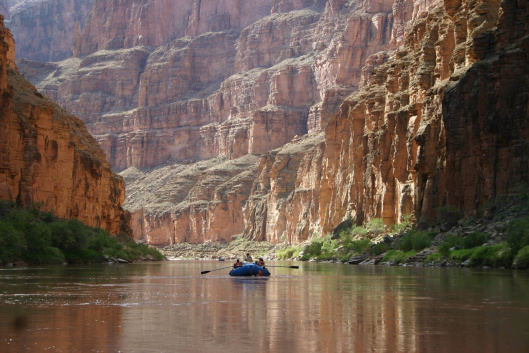
The spectacular and majestic Grand Canyon, eons in the making, needs our help. Some Republican members of Congress want President Donald Trump to overturn a ban on new uranium mining nearby, along with other conservation measures. We need to urge Congress to protect this national jewel.
Some six million people arrive each year to view the vast, multi-hued and intricate canyon, though most don’t venture far from the rim. For them, it’s an inspiring and breath-taking sight. But hardy trekkers who explore remote trails might see something else: signs warning them they are entering an area of the canyon tainted by radioactivity spewed years ago from uranium mines. National Geographic reports uranium leaching from old mines has rendered 15 springs and five wells inside the canyon unsafe to drink. We don’t need more of that.
Uranium pollution is no way to treat an immense and ancient panorama of stunningly varied rock that has been called one of the seven wonders of the natural world. Recently, I had an opportunity to backpack with intrepid family members from the rim to the bottom and camp along Bright Angel Creek, near where it flows into the Colorado River. The ever-changing vista along the rocky trails was magnificent. Unafraid mule deer browsed just a few feet from us. A rare condor flew overhead. Bold rock squirrels waited for a chance to gnaw and rummage through any backpacks absent-mindedly left on the ground.
….. We now have a president who last year ordered federal agencies to review anything that could interfere with domestic energy production. In response, the Forest Service in November recommended reopening land near the Grand Canyon for uranium mining. In March, groups representing the mining industry asked the U.S. Supreme Court to lift the ban on new uranium mining on public land bordering the Grand Canyon National Park.
Uranium mining is extremely risky for the environment. Mining releases radioactive dust into the air and contaminates the land and water with radioactive and toxic substances.
“Uranium mining has left a toxic trail across the West — including at the Grand
Canyon itself,” the environmental group Environment America wrote in its April report update, “Grand Canyon at Risk: Uranium Mining Threatens a National Treasure.”
The waste rock and dirt left behind can remain radioactive for hundreds of thousands of years and also contain toxic chemicals such as arsenic that can contaminate the surrounding environment and make the mines themselves permanently hazardous, the report says.








 nuclear-news