https://www.eurekalert.org/pub_releases/2019-01/hjap-hcp010419.php– 4 Jan 19, Whereas most of the ocean is responding to modern warming, the deep Pacific may be cooling, HARVARD JOHN A. PAULSON SCHOOL OF ENGINEERING AND APPLIED SCIENCES The ocean has a long memory. When the water in today’s deep Pacific Ocean last saw sunlight, Charlemagne was the Holy Roman Emperor, the Song Dynasty ruled China and Oxford University had just held its very first class. During that time, between the 9th and 12th centuries, the earth’s climate was generally warmer before the cold of the Little Ice Age settled in around the 16th century. Now, ocean surface temperatures are back on the rise but the question is, do the deepest parts of the ocean know that?
Researchers from the Woods Hole Oceanographic Institution and Harvard University have found that the deep Pacific Ocean lags a few centuries behind in terms of temperature and is still adjusting to the advent of the Little Ice Age. Whereas most of the ocean is responding to modern warming, the deep Pacific may be cooling.
The research is published in Science.
“Climate varies across all timescales,” said Peter Huybers, Professor of Earth and Planetary Sciences in the Department of Earth and Planetary Sciences and of Environmental Science and Engineering at the Harvard John A. Paulson School of Engineering and Applied Sciences and co-author of the paper. “Some regional warming and cooling patterns, like the Little Ice Age and the Medieval Warm Period, are well known. Our goal was to develop a model of how the interior properties of the ocean respond to changes in surface climate.”
What that model showed was surprising.
“If the surface ocean was generally cooling for the better part of the last millennium, those parts of the ocean most isolated from modern warming may still be cooling,” said Jake Gebbie, a physical oceanographer at Woods Hole Oceanographic Institution and lead author of the study.
The model is a simplification of the actual ocean. To test the prediction, Gebbie and Huybers compared the cooling trend found in the model to ocean temperature measurements taken by scientists aboard the HMS Challenger in the 1870s and modern observations from the World Ocean Circulation Experiment of the 1990s.
The HMS Challenger, a three-masted wooden sailing ship originally designed as a British warship, was used for the first modern scientific expedition to explore the world’s ocean and seafloor. During the expedition from 1872 to 1876, thermometers were lowered into the ocean depths and more than 5,000 temperature measurements were logged.
“We screened this historical data for outliers and considered a variety of corrections associated with pressure effects on the thermometer and stretching of the hemp rope used for lowering thermometers,” said Huybers.
The researchers then compared the HMS Challenger data to the modern observations and found warming in most parts of the global ocean, as would be expected due to the warming planet over the 20th Century, but cooling in the deep Pacific at a depth of around two kilometers depth.
“The close correspondence between the predictions and observed trends gave us confidence that this is a real phenomenon,” said Gebbie.
These findings imply that variations in surface climate that predate the onset of modern warming still influence how much the climate is heating up today. Previous estimates of how much heat the Earth had absorbed during the last century assumed an ocean that started out in equilibrium at the beginning of the Industrial Revolution. But Gebbie and Huybers estimate that the deep Pacific cooling trend leads to a downward revision of heat absorbed over the 20th century by about 30 percent.
“Part of the heat needed to bring the ocean into equilibrium with an atmosphere having more greenhouse gases was apparently already present in the deep Pacific,” said Huybers. “These findings increase the impetus for understanding the causes of the Medieval Warm Period and Little Ice Age as a way for better understanding modern warming trends.”
###
This research was funded by the James E. and Barbara V. Moltz Fellowship and National Science Foundation grants OCE-1357121 and OCE-1558939
January 6, 2019
Posted by Christina Macpherson |
2 WORLD, climate change, oceans |
Leave a comment
 Melting Arctic ice is now pouring 14,000 tons of water per second into the ocean, scientists find Melting Arctic ice is now pouring 14,000 tons of water per second into the ocean, scientists find
A new survey finds that the region has contributed almost an inch to rising seas since 1971.https://www.washingtonpost.com/energy-environment/2018/12/21/melting-arctic-ice-is-now-pouring-tons-water-per-second-into-ocean-scientists-find/?utm_term=.45ab481784ea By Chris MooneyDecember 21
A new scientific survey has found that the glaciers of the Arctic are the world’s biggest contributors to rising seas, shedding ice at an accelerating rate that now adds well over a millimeter to the level of the ocean every year.
That is considerably more ice melt than Antarctica is contributing, even though the Antarctic contains far more ice. Still, driven by glacier clusters in Alaska, Canada and Russia and the vast ice sheet of Greenland, the fast-warming Arctic is outstripping the entire ice continent to the south — for now.
However, the biggest problem is that both ice regions appear to be accelerating their losses simultaneously — suggesting that we could be in for an even faster rate of sea-level rise in future decades. Seas are rising by about three millimeters each year, according to NASA. That’s mainly driven by the Arctic contribution, the Antarctic and a third major factor — that ocean water naturally expands as it warms.
For Arctic ice loss, “the rate has tripled since 1986,” said Jason Box, first author of the new study and a scientist at the Geological Survey of Denmark and Greenland. “So it clearly shows an acceleration of the sea-level contribution.”
“Antarctica will probably take over at some point in the future, but during the past 47 years of this study, it’s not controversial that the Arctic is the largest contribution of land ice to sea-level rise,” he said.
Scientists in the United States, Chile, Canada, Norway and the Netherlands contributed to the work, published in Environmental Research Letters.
The Arctic is also losing floating sea ice at a rapid pace, but that loss does not contribute substantially to rising seas (though it has many other consequences). Sea ice losses closely match what is happening on land, which makes sense because both phenomena are being driven by the fast warming of the atmosphere in the Arctic, which has heated up at a rate much faster than seen in lower latitudes. Warming seas are also driving some of the ice loss.
Here’s the new study’s tally of where all the Arctic ice loss has come from since 1971: [diagram on original]
The total Arctic loss at present is 447 billion tons of ice per year — which Box calculated is about 14,000 tons of water per second. That’s for the period between 2005 and 2015. Between 1986 and 2005, the loss is calculated at around 5,000 tons per second — therefore, the rate has almost tripled.
Separate research has recently found that the Antarctic’s loss rate has also tripled in just a decade, reaching 219 billion tons per year from 2012 to 2017.
Assuming these numbers are correct and summing them together, the world’s polar regions are losing about 666 billion tons of ice to the ocean each year — amounting to a little bit less than two millimeters of sea-level rise annually.
Treating the Arctic as a whole can miss something, though, notes Christopher Larsen, a glacier expert at the University of Alaska at Fairbanks.
Namely, the Arctic acceleration documented in the study is really being driven by Greenland, which contains more than 20 feet of potential sea-level rise, dwarfing all other Arctic ice sources.
“With respect to the present rate of ice mass loss, and the increasing rates thereof, it is Greenland that has the most significant rate of increased mass loss in the present day,” Larsen said in an email.
“This is especially noteworthy as ultimately Greenland has the most ice to lose in the Northern Hemisphere,” he said. “As rapid as ice loss is now or may become anywhere in the north, the regional totals of ice mass within Alaska or the Arctic Canada are smaller than what Greenland holds.”
To give a sense of the scale of the Arctic losses, Box imagined what it would mean if they were distributed among Earth’s human population.
“If you take the 7.7 billion people on Earth and divide the present-day numbers, from 2005 to 2015, each person on Earth would have the equivalent of 160 liters per day, every day, every year,” Box said.
|
|
|
December 24, 2018
Posted by Christina Macpherson |
oceans |
Leave a comment
 Explosive Accidents: The Lost Nuclear Arsenal at the Bottom of the Sea https://www.thevintagenews.com/2018/09/03/nuclear-arsenal/?fbclid=IwAR1dPU13kVGGrYK–PFmFciWyMO28xaa1nU7OFMlC7UfuQwjMFh4
Sep 3, 2018 Ian Harvey In July of 2018, Andrew Thaler wrote for Southern Fried Science that there were at least two nuclear capsules, four unarmed weapons, and one armed nuclear weapon sitting on the ocean floor, that he was aware of.
His information was based on declassified U.S. Department of Defense narrative summaries of accidents involving U.S. nuclear weapons.
He noted that the documents he had access to only covered the period of time between 1950 and 1980. Any more recent data would still be classified. There is reason to believe that his estimated numbers for nuclear material in the oceans are far too low.
Business Insider in 2013 wrote that since 1950 there have been 32 nuclear weapon accidents, known as Broken Arrows, where an unexpected event involving nuclear weapons resulted in the firing, launching, theft, or loss of said weapon.
BI reported in this piece that there were six nuclear weapons that have been lost and never recovered. The time frames for the BI list continued into the 2000’s, but this is also a lowball number.
According to a 1989 article in the New York Times, however, there have been at least 50 nuclear warheads and nine reactors scattered on the ocean floors since 1956.
These were the result of various accidents on the part of U.S. and Soviet bombers, ships, and rockets, according to a study of naval accidents that was published by Greenpeace and the Institute for Policy Studies.
The study outlines 1,276 accidents, both nuclear and non-nuclear, on the part of the world’s navies, and has some, more limited, information on another 1,000 accidents. The study points out that the total number of incidents amounts to one major peacetime accident a week
Information for the study was gathered mostly through the Freedom of Information Act, which included American intelligence assessments of Soviet naval accidents.
Eighty days after it fell into the ocean following the January 1966 midair collision between a nuclear-armed B-52G bomber and a KC-135 refueling tanker over Palomares, Spain, this B28RI nuclear bomb was recovered from 2,850 feet (869 meters) of water and lifted aboard the USS Petrel (note the missing tail fins and badly dented “false nose”).
The authors also received information from the governments of other nations. The report said that the worst accident occurred in 1986, when a Soviet submarine sank 600 miles northeast of the Bermuda coast, depositing two nuclear reactors and 32 nuclear warheads on the bottom of the ocean.
That one accident left more nuclear material under the sea than the authors of the first two pieces posited, combined. The study also notes that it doesn’t reflect data on any of the “many hundreds” of Soviet accidents about which little is known, and suggested that the Soviet Navy has far more accidents than those of America.
The accidents are, for the most part, due to human factors, ranging from issues of faulty navigation to outright sabotage.
So far, the U.S. has admitted to knowing of one hydrogen bomb that is leaking radioactive material. That bomb was accidentally dropped into the sea south of Japan in 1965 by an aircraft carrier.
Read another story from us: The Missing Nuclear Weapons Lost Off The Coast Of Bermuda
There is some likelihood that other bombs may have also begun to leak radiation into the water, and are just unknown as yet. Even if it hasn’t happened yet, the chances of such leaks will increase over time as the weapons degrade, having the potential to cause untold harm to the oceans and our planet as a whole.
December 18, 2018
Posted by Christina Macpherson |
incidents, oceans, Reference |
1 Comment
Rudolph the radioactive reindeer https://beyondnuclearinternational.org/2018/12/16/rudolph-the-radioactive-reindeer/ December 16, 2018 by beyondnuclearinternational
Dosed by Chernobyl and atomic tests, reindeer and their herders are carrying a heavy nuclear burden, By Linda Pentz GunterFallout from Soviet atomic bomb tests over the Arctic Ocean, compounded by the 1986 Chernobyl nuclear power plant explosion, have left reindeer too radioactive to eat, even today. That may be good news for the reindeer, sort of. But it’s bad news for the indigenous Laplanders in Finland and Sami herders in Norway, who carry high levels of radiation in their own bodies as well as in the reindeer on which they depend for sustenance and sales.
Reindeer carry heavy radioactive doses, mainly of cesium-137, because they devour lichen, moss and fungi, which bioaccumulate radioactive deposits from fallout. Norway’s radioactive contamination is primarily from Chernobyl, made worse because it was snowing heavily at the time of the April 26 accident.
The Sami story is beautifully explained in this stunning photo essay by Amos Chapple and Wojtek Grojec for Radio Free Europe/Radio Liberty.
As the essay describes it, despite the length of time since the Chernobyl disaster, the fallout is a nasty gift that keeps on giving. “In 2014, there was a huge spike in radiation levels that scientists put down to a bumper season for mushrooms. Hundreds of Norwegian reindeer intended for slaughter had to be released back into the wild.” Levels apparently shot from 1,500 becquerels per kilogram to 8,200.
A video of Chapple and Grojec’s work, on Tech Insider, also explains the impact of cesium-137 fallout on reindeer and their herders. [0n originall]
Unfortunately, Norway’s “allowable” radiation standards are far higher than in other parts of Europe, at 3,000 becquerels per kilogram of food compared to the EU standard of 600 becquerels. When Chapple and Grojec were compiling their story, the herd they visited was testing at 2,100 becquerels, passing the Norwegian test for “safe”. The authors say that the higher levels were established by the Norwegian government in “response to radiation levels in reindeer that threatened the very existence of the Sami herders.”
This practice of simply moving the radiation goalposts to make dangerous levels safe still goes on today, of course, most notably in Japan. As was pointed out in an earlier story on our site, the Japanese government, eager to show the world that the Fukushima region could quickly be made safe for habitation, simply raised the “allowable” annual exposure rate from 1 millisievert to 20, an entirely unacceptable dose for most people, especially women and children.
In Finland, most of the persistent radiation levels are due to atomic testing during the Cold War. Measurements continue to be taken among the Lapland reindeer herders where cesium levels are ten times higher than in the rest of Finland. Although cesium levels in humans were a shocking 45,000 becquerels per kilo in the 1960s according to one report, they still hover at over 1,000 today.
The reduction in slaughter of reindeer comes with other side effects as well. As far back as 1997, it was already being observed that the increase in reindeer population, leading to “Over-grazing and trampling, is causing more damage to the fragile tundra than some of the world’s most seriously polluting factories,” wrote Geoffrey Lean in The Independent.
Now, as Russia begins using floating nuclear reactors to plunder the Arctic Ocean for oil, the region has been placed under threat of a radioactive catastrophe again. From both an economic and health perspective, neither the reindeer nor their indigenous herders can afford a second assault.
December 17, 2018
Posted by Christina Macpherson |
environment, Finland, Reference |
1 Comment
Burnham-on-Sea 13th Dec 2018 . Concern that Hinkley Point C will have ‘devastating’ impact on sea fish
numbers in Burnham. Proposals to scrap plans for an acoustic fish deterrent
system in the sea next to Hinkley Point C will have a ‘devastating’ impact
on fish stocks in the sea around Burnham-On-Sea and the Bristol Channel, it
has been predicted this week. Sea anglers in Burnham claim EDF’s plans
not to install a fish deterrent system around the cooling water intakes in
the channel will lead to “significant” numbers of fish being killed.
https://www.burnham-on-sea.com/news/concern-over-hinkley-point-c/
December 15, 2018
Posted by Christina Macpherson |
environment, UK |
Leave a comment
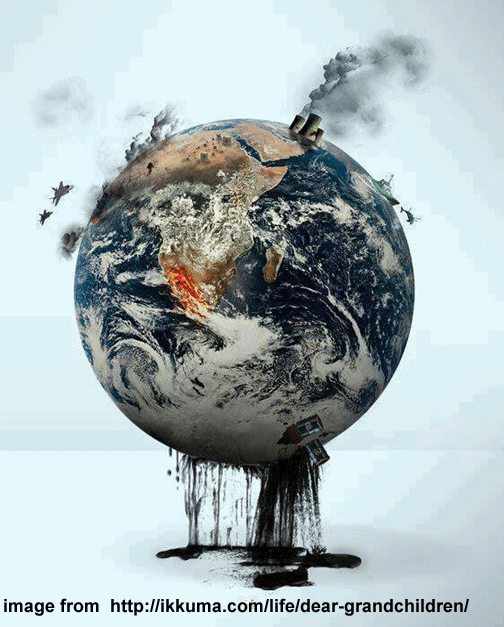
Right to end life on Earth: Can corporations that spread climate change denialism be held liable?
If a corporation’s propaganda destroys the world, doesn’t that conflict with our right to live? Salon , MATTHEW ROZSA, DECEMBER 10, 2018
To facetiously paraphrase a line that I often hear from global warming deniers: Don’t be offended, I’m just asking questions.
It’s conventional wisdom that the right to free speech does not permit you to shout “fire!” in a crowded theater – but does that mean you have the right to claim there is no fire when a theater is ablaze?
This is the question posed by the existential crisis of man-made global warming, and it is one that doesn’t lend itself to an easy answer. Certainly it can be acknowledged that man-made global warming has forced us to re-examine other verities that once underpinned the modern liberal political order. Laissez-faire economic theory, which holds that state regulation of the economy is an unequivocal social ill, doesn’t stand up when you consider that insufficient  environmental regulations got us into this mess and stronger ones will be necessary to mitigate the damage. A similar observation could be made about the consumerist ethos that drives free market economic models: A status quo of constant expansion may be economically healthy within the paradigm of capitalist markets, but it is devastatingly unsustainable when it comes to the fitness of our planet………
Michael E. Mann, a professor of atmospheric science at Penn State University, shared his own views on whether individuals who mislead the public about climate change should face penalties for doing so.
“In my book ‘The Hockey Stick and the Climate War,’ I state that those who knowingly misled the public and policymakers about the reality and threat of climate change must be held responsible for their actions, and that includes legal repercussions,” Mann told Salon. “Note that there is a distinction between those at the top (e.g., fossil fuel executives and lobbyists and the politicians in their pocket) who are guilty of misleading the public, and those at the bottom (the typical climate denying trolls we encounter on the internet) who in many cases are actually victims of the disinformation campaign.”………https://www.salon.com/2018/12/09/right-to-end-life-on-earth-can-corporations-that-spread-climate-change-denialism-be-held-liable/
December 11, 2018
Posted by Christina Macpherson |
2 WORLD, environment |
Leave a comment
Thanks to climate change, Earth’s freshwater supplies will never be the same again, Science News for Students, BETH GEIGER, DEC 6, 2018 This is the fourth in a 10-part series about the ongoing global impacts of climate change. These stories will look at the current effects of a changing planet, what the emerging science suggests is behind those changes and what we all can do to adapt to them.
It’s January 2018 in Cape Town, South Africa. After three years of record low rainfall, reservoirs that supply this city’s water are dangerously low. The city is running out of water, and fast………..
Water world Our cool blue planet is covered in water. Just 2.5 percent of that water, however, is fresh. Of that, only about one third is liquid. The rest is locked up as ice.That isn’t much freshwater. Yet we depend on it for everything. In the United States, each person uses an average of 340 liters (90 gallons) per day at home. And that doesn’t include the water needed to grow our food or manufacture everything from clothes to cars to cell phones. It takes 3,400 liters (900 gallons) just to make one pair of jeans.
As climate changes, though, so does how much water is available. Water, climate and weather are connected in a never-ending loop called the water cycle. And like any natural system, change one part of it — whether it’s temperature, soil moisture or even how many trees are in a region — and everything else changes, too. Continue reading →
December 11, 2018
Posted by Christina Macpherson |
2 WORLD, climate change, water |
Leave a comment
Cancer as Weapon: Poppy Bush’s Radioactive War on Iraq Counter Punch, by JEFFREY ST. CLAIR , DECEMBER 7, 
 2018, At the close of the first Gulf War, Saddam Hussein was denounced as a ferocious villain for ordering his retreating troops to destroy Kuwaiti oil fields, clotting the air with poisonous clouds of black smoke and saturating the ground with swamps of crude. It was justly called an environmental war crime.
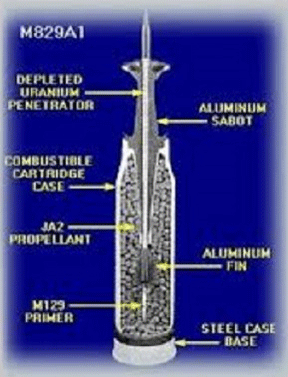
But months of bombing of Iraq by US and British planes and cruise missiles has left behind an even more deadly and insidious legacy: tons of shell casings, bullets and bomb fragments laced with depleted uranium. In all, the US hit Iraqi targets with more than 970 radioactive bombs and missiles.
It took less than a decade for the health consequences from this radioactive bombing campaign to begin to coming into focus. And they are dire, indeed. Iraqi physicians call it “the white death”-leukemia. Since 1990, the incident rate of leukemia in Iraq has grown by more than 600 percent. The situation is compounded by Iraq’s forced isolations and the sadistic sanctions regime, recently described by UN secretary general Kofi Annan as “a humanitarian crisis”, that makes detection and treatment of the cancers all the more difficult.
“We have proof of traces of DU in samples taken for analysis and that is really bad for those who assert that cancer cases have grown for other reasons,” said Dr. Umid Mubarak, Iraq’s health minister.
Mubarak contends that the US’s fear of facing the health and environmental consequences of its DU bombing campaign is partly behind its failure to follow through on its commitments under a deal allowing Iraq to sell some of its vast oil reserves in return for food and medical supplies.
“The desert dust carries death,” said Dr. Jawad Al-Ali, an oncologist and member England’s Royal Society of Physicians. “Our studies indicate that more than forty percent of the population around Basra will get cancer. We are living through another Hiroshima.”
Most of the leukemia and cancer victims aren’t soldiers. They are civilians. And many of them are children. The US-dominated Iraqi Sanctions Committee in New York has denied Iraq’s repeated requests for cancer treatment equipment and drugs, even painkillers such as morphine. As a result, the overflowing hospitals in towns such as Basra are left to treat the cancer-stricken with aspirin.
This is part of a larger horror inflicted on Iraq that sees as many as 180 children dying every day, according to mortality figures compiled by UNICEF, from a catalogue of diseases from the 19th century: cholera, dysentery, tuberculosis, e. coli, mumps, measles, influenza.
Iraqis and Kuwaitis aren’t the only ones showing signs of uranium contamination and sickness. Gulf War veterans, plagued by a variety of illnesses, have been found to have traces of uranium in their blood, feces, urine and semen.
Depleted uranium is a rather benign sounding name for uranium-238, the trace elements left behind when the fissionable material is extracted from uranium-235 for use in nuclear reactors and weapons. For decades, this waste was a radioactive nuisance, piling up at plutonium processing plants across the country. By the late 1980s there was nearly a billion tons of the material.
Then weapons designers at the Pentagon came up with a use for the tailings: they could be molded into bullets and bombs. The material was free and there was plenty at hand. Also uranium is a heavy metal, denser than lead. This makes it perfect for use in armor-penetrating weapons, designed to destroy tanks, armored-personnel carriers and bunkers.
When the tank-busting bombs explode, the depleted uranium oxidizes into microscopic fragments that float through the air like carcinogenic dust, carried on the desert winds for decades. The lethal dust is inhaled, sticks to the fibers of the lungs, and eventually begins to wreck havoc on the body: tumors, hemorrhages, ravaged immune systems, leukemias.
In 1943, the doomsday men associated with the Manhattan Project speculated that uranium and other radioactive materials could be spread across wide swaths of land to contain opposing armies. Gen. Leslie Grove, head of the project, asserted that uranium weapons could be expected to cause “permanent lung damage.” In the late, 1950s Al Gore’s father, the senator from Tennessee, proposed dousing the demilitarized zone in Korea with uranium as a cheap failsafe against an attack from the North Koreans.
After the Gulf War, Pentagon war planners were so delighted with the performance of their radioactive weapons that ordered a new arsenal and under Bill Clinton’s orders fired them at Serb positions in Bosnia, Kosovo and Serbia. More than a 100 of the DU bombs have been used in the Balkans over the last six years.
Already medical teams in the region have detected cancer clusters near the bomb sites. The leukemia rate in Sarajevo, pummeled by American bombs in 1996, has tripled in the last five years. But it’s not just the Serbs who are ill and dying. NATO and UN peacekeepers in the region are also coming down with cancer. As of January 23, eight Italian soldiers who served in the region have died of leukemia.
The Pentagon has shuffled through a variety of rationales and excuses. First, the Defense Department shrugged off concerns about Depleted Uranium as wild conspiracy theories by peace activists, environmentalists and Iraqi propagandists. When the US’s NATO allies demanded that the US disclose the chemical and metallic properties of its munitions, the Pentagon refused. It has also refused to order testing of US soldiers stationed in the Gulf and the Balkans.
If the US has kept silent, the Brits haven’t. A 1991 study by the UK Atomic Energy Authority predicted that if less than 10 percent of the particles released by depleted uranium weapons used in Iraq and Kuwait were inhaled it could result in as many as “300,000 probable deaths.”
The British estimate assumed that the only radioactive ingredient in the bombs dropped on Iraq was depleted uranium. It wasn’t. A new study of the materials inside these weapons describes them as a “nuclear cocktail,” containing a mix of radioactive elements, including plutonium and the highly radioactive isotope uranium-236. These elements are 100,000 times more dangerous than depleted uranium.
Typically, the Pentagon has tried to dump the blame on the Department of Energy’s sloppy handling of its weapons production plants. This is how Pentagon spokesman Craig Quigley described the situation in chop-logic worthy of the pen of Joseph Heller.: “The source of the contamination as best we can understand it now was the plants themselves that produced the Depleted uranium during the 20 some year time frame when the DU was produced.”
Indeed, the problems at DoE nuclear sites and the contamination of its workers and contractors have been well-known since the 1980s. A 1991 Energy Department memo reports: “during the process of making fuel for nuclear reactors and elements for nuclear weapons, the Paducah gaseous diffusion plant… created depleted uranium potentially containing neptunium and plutonium”
But such excuses in the absence of any action to address the situation are growing very thin indeed. Doug Rokke, the health physicist for the US Army who oversaw the partial clean up of depleted uranium bomb fragments in Kuwait, is now sick. His body registers 5,000 times the level of radiation considered “safe”. He knows where to place the blame. “There can be no reasonable doubt about this,” Rokke told Australian journalist John Pilger. “As a result of heavy metal and radiological poison of DU, people in southern Iraq are experiencing respiratory problems, kidney problems, cancers. Members of my own team have died or are dying from cancer.”
Depleted uranium has a half-life of more than 4 billion years, approximately the age of the Earth. Thousand of acres of land in the Balkans, Kuwait and southern Iraq have been contaminated forever. If George Bush Sr., Dick Cheney, Colin Powell and Bill Clinton are still casting about for a legacy, there’s a grim one that will stay around for an eternity.
This article is adapted from Been Brown So Long, It Looked Like Green to Me. https://www.counterpunch.org/2018/12/07/cancer-as-weapon-of-mass-destruction-poppy-bushs-radioactive-war-on-iraq/
December 10, 2018
Posted by Christina Macpherson |
environment, health, Iraq, USA, weapons and war |
Leave a comment
|
  While Fukushima suffered a blow, trade ties between Japan and Taiwan avoided any major impact. The Diplomat , By Thisanka Siripala, December 03, 2018 On Friday, Japan and Taiwan signed off on five bilateral trade pacts just days after Taiwan voted in a referendum to uphold an import ban on agricultural products from areas surrounding the Fukushima nuclear fallout. While Fukushima suffered a blow, trade ties between Japan and Taiwan avoided any major impact. The Diplomat , By Thisanka Siripala, December 03, 2018 On Friday, Japan and Taiwan signed off on five bilateral trade pacts just days after Taiwan voted in a referendum to uphold an import ban on agricultural products from areas surrounding the Fukushima nuclear fallout.
Last week, 7.8 million voters in Taiwan approved renewing a legally binding food ban that was originally imposed after the nuclear disaster in 2011. The ongoing agricultural ban covers five Japanese prefectures including Fukushima and nearby Gunma, Ibaraki, Tochigi, and Chiba over an extended two year period. Although the setback was expected to put a strain on bilateral relations, outright animosity has been diverted for now………..
Taiwan isn’t the only government to regulate Fukushima imports behind the backdrop of radiation concerns. China, South Korea, Singapore, and Macau are among the neighbors imposing partial seafood and farm produce restrictions to varying degrees. …….. https://thediplomat.com/2018/12/taiwan-votes-to-maintain-import-ban-on-fukushima-food-imports/
|
|
December 4, 2018
Posted by Christina Macpherson |
environment, politics international, Taiwan |
Leave a comment
|
 Radiation Free Lakeland 2nd Dec 2018 Is it OK to have Radiocaesium and Transuranics in a Childrens Play Area on the Beach? Radiation Free Lakeland 2nd Dec 2018 Is it OK to have Radiocaesium and Transuranics in a Childrens Play Area on the Beach? Last thursday Radiation Free Lakeland were invited to Cleator Moor Civic Hall for the West Cumbria Site Stakeholder meeting (Environment and Health). We have deliberately shunned these meetings thinking that they are PR exercises for the industry. The meetings are billed as a way of holding the industry and regulators to account but our experience on thursday confirmed our suspicions. We were invited to the meeting to make a presentation on our citizen science project 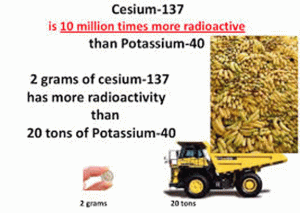 with nuclear science students in the US. We had been sending samples to the US from the whole of the Cumbrian coast for over a year. The US undergraduate student’s findings shocked us. A full third of the samples taken were contaminated with material that can only have come from decades of Sellafield’s reprocessing.
At the meeting we listened from 1pm to 4pm to the industry and the regulators congratulate themselves endlessly for “reducing emissions” (continuing piling on the crapola in word and deed) and then we got a chance to make the 15 minute presentation at 4pm. There was no press in the room. We had told them we would be there but apparently they never bother going, instead they prefer to wait for Sellafield’s press release. The chair of the meeting was clearly biased in favour of the industry and even went so far at the end of the meeting to say that “if
only you came and listened and understood more the gap between us (!) would be bridged”. I took that to mean that if we were only browbeaten enough we would learn to love Nukiller Big Brother and not hold them to account
with our pesky questions.
|
|
December 4, 2018
Posted by Christina Macpherson |
environment, media, UK |
Leave a comment
 Portrait of a planet on the verge of climate catastrophe As the UN sits down for its annual climate conference this week, many experts believe we have passed the point of no return, Guardian, by Robin McKie, 2 Dec 18 “…………Great Barrier Reef Coral reefs cover a mere 0.1% of the world’s ocean floor but they support about 25% of all marine species. They also provide nature with some of its most beautiful vistas. For good measure, coral reefs protect shorelines from storms, support the livelihoods of 500 million people and help generate almost £25bn of income. Permitting their destruction would put the planet in trouble – which is precisely what humanity is doing.
Rising sea temperatures are already causing irreparable bleaching of reefs, while rising sea levels threaten to engulf reefs at a faster rate than they can grow upwards. Few scientists believe coral reefs – which are made of simple invertebrates related to sea anemones – can survive for more than a few decades.
Yet those who have sounded clear warnings about our reefs have received little reward. Professor Terry Hughes, a coral expert at James Cook University in Queensland, Australia, recently studied the impact of El Niño warmings in 2016 and 2017 on Australia’s Great Barrier Reef, the world’s largest coral reef and its largest living entity – and wept when he saw the damage.
“The 2016 event killed 30% of corals, the one a year later killed another 20%. Very close to half the corals have died in the past three years,” he said recently.
For his pains, Hughes has faced demands from tourist firms for his funding to be halted because he was ruining their business. “The Australian government is still promoting new developments of coal mines and fracking for gas,” Hughes said, after being named joint recipient of the John Maddox prize, given to those who champion science in the face of hostility and legal threats. “If we want to save the Great Barrier Reef, these outdated ambitions need to be abandoned. Yet Australia’s greenhouse gas emissions are rising, not falling. It’s a national disgrace.”
This grim picture is summed up by the ethnographer Irus Braverman in her book Coral Whisperers: “The Barrier Reef has changed for ever. The largest living structure in the world has become the largest dying structure in the world.” https://www.theguardian.com/environment/2018/dec/02/world-verge-climate-catastophe
December 3, 2018
Posted by Christina Macpherson |
AUSTRALIA, climate change, oceans |
1 Comment
Guardian 28th Nov 2018 , Grab your Geiger counter: a trip to Chernobyl’s first rave. The nuclear
disaster site is being marketed as a tourist destination with novelty gas
masks, radioactive ice cream and – now – a multimedia art show with the
military. It is a two-hour drive from the centre of Kiev, following the
banks of the Dnieper river into the woods. It is minus six degrees outside.
Wild dogs scavenge at the side of the road. Our bus comes to a stop and
military men in uniform tell us to disembark and ready our passports.
We’re at the main check point of the Chernobyl exclusion zone. From here,
signs warn us, everything is contaminated.
https://www.theguardian.com/artanddesign/2018/nov/28/chernobyl-art-party-nuclear-pripyat-ukraine-artefact-valery-korshunov
December 1, 2018
Posted by Christina Macpherson |
environment |
Leave a comment
 For nuclear plants, that warning is particularly grave. Reactors require 720 gallons of water per megawatt-hour of electricity they produce……Solar plants, by contrast, use approximately 20 gallons per megawatt-hour, mostly for cleaning equipment
Trump Administration’s Climate Report Raises New Questions About Nuclear Energy’s Future
The thirstiest source of electricity is already struggling, and greater risk of droughts will only add to those woes. Huffington Post.By Alexander C. Kaufman, 28 Nov 18,
Call it the nuclear power industry’s thirst trap.
The United States’ aging fleet of nuclear reactors ― responsible for one-fifth of the country’s electricity and most of its low-carbon power ― has never been more necessary as policymakers scramble to shrink planet-warming emissions. Yet the plants are struggling to stay afloat, with six stations shut down in the last five years and an additional 16 reactors scheduled to close over the next decade. So far, new coal- and gas-burning facilities are replacing them.
The nuclear industry blames high maintenance costs, competition from cheaper alternatives and hostile regulators concerned about radiation disasters like the 2012 Fukushima meltdown in Japan. But the country’s most water-intensive source of electricity faces what could be an even bigger problem as climate change increases the risk of drought and taxes already crumbling water infrastructure.
That finding, highlighted in the landmark climate change report that the Trump administration released with apparent reluctance last Friday, illustrates the complex and at times paradoxical realities of anthropogenic, or human-caused, warming. It also stokes an already hot debate over the role nuclear energy should play in fighting global warming, a month after United Nations scientists warned that carbon dioxide emissions must be halved in the next 12 years to avoid cataclysmic climate change leading to at least $54 trillion in damage.
The report ― the second installment of the Fourth National Climate Assessment, a congressionally mandated update on the causes and effects of anthropogenic warming from 13 federal agencies ― devoted its entire third chapter to water contamination and depletion. Aging, deteriorating infrastructure means “water systems face considerable risk even without anticipated future climate changes,” the report states. But warming-linked droughts and drastic changes in seasonal precipitation “will add to the stress on water supplies and adversely impact water supply.”
Nearly every sector of the economy is susceptible to water system changes. And utilities are particularly at risk. In the fourth chapter, the report’s roughly 300 authors conclude, “Most U.S. power plants … rely on a steady supply of water for cooling, and operations are expected to be affected by changes in water availability and temperature increases.”
For nuclear plants, that warning is particularly grave. Reactors require 720 gallons of water per megawatt-hour of electricity they produce, according to data from the National Energy Technology Laboratory in West Virginia cited in 2012 by the magazine New Scientist. That compares with the roughly 500 gallons coal requires and 190 gallons natural gas needs to produce the same amount of electricity. Solar plants, by contrast, use approximately 20 gallons per megawatt-hour, mostly for cleaning equipment, according to the Solar Energy Industries Association, a trade group.
Nuclear plants are already vulnerable to drought. Federal regulations require plants to shut down if water in the river or lake that feeds its cooling drops below a certain level. By the end of the 2012 North American heat wave, nuclear generation fell to its lowest point in a decade, with plants operating at only 93 percent of capacity.
The availability of water is one problem, particularly for the majority of U.S. nuclear plants located far from the coasts and dependent on freshwater. Another is the temperature of the water that’s available.
Nearly half the nuclear plants in the U.S. use once-through cooling systems, meaning they draw water from a local source, cool their reactors, then discharge the warmed water into another part of the river, lake, aquifer or ocean. Environmental regulations bar plants from releasing used water back into nature above certain temperatures. In recent years, regulators in states like New York and California rejected plant operators’ requests to pull more water from local rivers, essentially mandating the installation of costly closed-loop systems that cool and reuse cooling water.
In 2012, Connecticut’s lone nuclear power plant shut down one of its two units because the seawater used to cool the plant was too warm. The heat wave that struck Europe this summer forced utilities to scale back electricity production at nuclear plants in Finland, Germany, Sweden and Switzerland. In France the utility EDF shut down four reactors in one day.
“Already they’re having trouble competing against natural gas and renewable energy,” said John Rogers, a senior energy analyst at the Union of Concerned Scientists. “Add onto that high water temperatures, high air temperatures and drought. It’s just another challenge.”
…….. the heart of the biggest question looming over the nuclear industry: Is it, given the radioactive waste it produces, clean energy?
……… For the Sierra Club, the environmental giant making a huge push to get cities and states to go all renewable, nuclear power is “a uniquely dangerous energy technology for humanity” and “no solution to climate change.”
“There’s no reason to keep throwing good money after bad on nuclear energy,” Lauren Lantry, a Sierra Club spokeswoman, said by email. “It’s clear that every dollar spent on nuclear is one less dollar spent on truly safe, affordable, and renewable energy sources like wind, solar, energy efficiency, battery storage, and smart grid technology.” https://www.huffingtonpost.com.au/entry/nuclear-energy-climate-change-report_us_5bfdb9cae4b0a46950dce58f
November 29, 2018
Posted by Christina Macpherson |
climate change, USA, water |
Leave a comment
There has been great concern about extensive and extremely toxic and radioactive waste at the SSFL for years.
According to Daniel Hirsch, who recently retired as director of the Program on Environmental and Nuclear Policy at the University of California, Santa Cruz, SSFL is “one of the most contaminated sites in the country
There are multiple human health impacts that have been known to stem from the site well before the Woolsey Fire began.
A study prepared by Professor Hal Morgenstern for the federal Agency for Toxic Substances and Disease Registry studied the community surrounding SSFL and found a greater than 60 percent increase in incidence of key cancers associated with proximity to the site.
“DTSC is a classically captured regulatory agency, captured by the polluters it is supposed to regulate,”
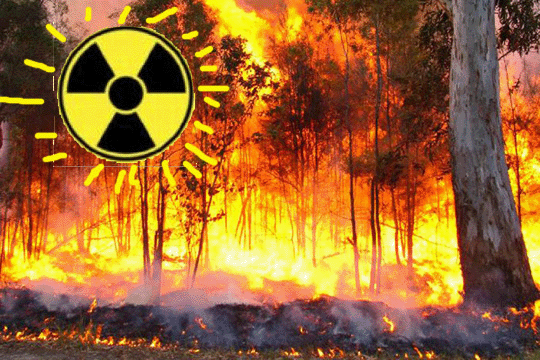
California Wildfire Likely Spread Nuclear Contamination From Toxic Site https://truthout.org/articles/california-wildfire-likely-spread-nuclear-contamination-from-toxic-site/, Dahr Jamail,, November 26, 2018The incredibly destructive Woolsey Fire in southern California has burned nearly 100,000 acres in Los Angeles and Ventura counties, killed three people, destroyed more than 400 structures, and at the time of this writing, was finally nearly completely contained.
The fire may also have released large amounts of radiation and toxins into the air after burning through a former rocket engine testing site where a partial nuclear meltdown took place nearly six decades ago.
“The Woolsey Fire has most likely released and spread both radiological and chemical contamination that was in the Santa Susana Field Laboratory’s soil and vegetation via smoke and ash,” Dr. Bob Dodge, president of Physicians for Social Responsibility-Los Angeles (PSR-LA), told Truthout.
The fire has been widely reported to have started “near” the Santa Susana Field Laboratory site (SSFL), but according to PSR-LA, it appears to have started at the site itself.
The contaminated site — a 2,849-acre former rocket engine test site and nuclear research facility — is located just 30 miles northwest of downtown Los Angeles.
A press release issued by PSR-LA on November 12 stated: Continue reading →
November 27, 2018
Posted by Christina Macpherson |
environment, incidents, USA |
Leave a comment

Delay in Dalgety Bay radiation remediation work ‘due to Brexit’, Courier UK by Aileen RobertsonNovember 19 2018 A further delay in the project to contain radiation at Dalgety Bay has been blamed on Brexit.
It was hoped remediation work to contain radioactive particles at the contaminated shore would be complete by the end of next summer.
But it has been revealed the work will not even be started in 2019 after the UK Government took longer than expected to give the plans final approval.
“I think every government department is focused on Brexit, and I think that’s potentially the problem,” said Labour councillor Bobby Clelland.
David Barratt, SNP councillor for Inverkeithing and Dalgety Bay, said: “It’s extremely disappointing that an entirely avoidable delay is now likely to occur and even more frustrating that this may be down to it sitting in someone’s inbox.
“I am writing to Lesley Laird as the MP for Dalgety Bay to express this frustration and to ask her to seek answers on why such a delay occurred in seeking ministerial approval.”
Radioactive particles were first discovered at the headland near Dalgety Bay Sailing Club in 1990.
The particles were found to contain radium-226 which was in paint used to make aircraft dials luminous. Studies of the coastline suggest incinerated radioactive waste was dumped prior to 1959, when the nearby airbase HMS Merlin was decommissioned.
After years of refusing to accept liability, the Ministry of Defence (MoD) was named as the polluter by the Scottish Environment Protection Agency more than two decades after the radiation was found.
The MoD has drawn up an action plan, including removing some of the contaminated debris and containing the rest by building a wall and new slipway, which is with UK ministers for approval.
Stephen Ritchie from the MoD’s Defence Infrastructure Organisation (DIO) told South and West Fife Area Committee the delay was “very frustrating for everybody”……….. https://www.thecourier.co.uk/fp/news/local/fife/766779/delay-in-dalgety-bay-radiation-remediation-work-due-to-brexit/
November 19, 2018
Posted by Christina Macpherson |
environment, politics, UK |
Leave a comment









 nuclear-news