World urgently needs a Paris-style agreement for biodiversity
‘We’ll get it done. Come hell, high water or Covid’: Can 2022 be a
super year for nature? Biodiversity talks in Kunming are likely to be
delayed again, but the world urgently needs a Paris-style agreement for
nature.
Guardian 30th Dec 2021
France’s Environmental Authority requires a list of all the problems encountered in building the Flamanville EPR nuclear reactor
An inventory of incidents on the EPR required according to the
Environmental Authority. In its latest opinion, the Environmental Authority
recommends a listing of all the problems encountered during the
construction of the EPR, as well as an update on the various solutions
provided.
France Bleu 23rd Dec 2021
Science & Avenir 23rd Dec 2021
https://www.sciencesetavenir.fr/nature-environnement/nucleaire-l-autorite-environnementale-reclame-plus-d-informations-sur-flamanville_160059
Le Figaro 23rd Dec 2021
Swedish environmental groups sound a warning on the government’s plans for a new radioactive waste dump.
| On 22 December, the Government decided to approve the extension of the repository for short-lived radioactive waste in Forsmark (SFR) with a new repository (SFR 2). SFR is the current repository for short-lived radioactive operational waste from the nuclear power plants and is located under the seabed outside the Forsmark nuclear power plant. SFR 2 is a new repository for short-lived radioactive waste from the decommissioning of the Swedish nuclear reactors, and the repository will be built next to the old one. The government decided to grant permissibility according to the Environmental Code and a license according to the Nuclear Activities Act. The decisions can be found in the news story on the MKG Swedish web page (link below on original)). The Swedish Society for Nature Conservation, The Swedish Friends of the Earth and the Swedish NGO Office for Nuclear Waste Review (MKG) have stated that the government should say no to the new repository. The organisations recently told the government in an opinion that it has not been shown that the new repository will be safe enough. The environment risks being damaged by the repository leaking radioactive particles into the Öregrundsgrepen outside Forsmark faster than expected, perhaps already within 50 to 100 years after closure. In addition, there is already a relatively unexpected and extensive breakdown of the technical repository barriers in the existing repository. The organisations believe that the government should have conditioned the decision on leaving the repository open under supervision for the 400 to 500 years required for the radioactive content to have decayed to less dangerous levels. MKG 22nd Dec 2021 https://www.mkg.se/en/the-government-approves-the-expansion-of-sfr-in-forsmark |
China opposes Japanese decision to release nuclear-contaminated water into ocean
BEIJING, Dec. 22 (Xinhua) — China is seriously concerned about and firmly opposes Japan’s unilateral decision to discharge the nuclear-contaminated water into the sea and its proceeding with the preparatory work, a Chinese Foreign Ministry spokesperson said Wednesday.
Zhao Lijian made the remarks when asked to comment on a media report that Tokyo Electric Power Company has submitted an application to Japan’s Nuclear Regulation Authority with a detailed plan of discharging nuclear-contaminated water from the Fukushima Daiichi nuclear power plant into the sea.
Since April this year, the international community has raised concerns to the Japanese side over the legitimacy of the discharge into the sea, the rationality of the discharge plan, the credibility of the data about the nuclear contaminated water and the reliability of the equipment to purify the nuclear-contaminated water, Zhao said.
The work of the IAEA technical working group on the handling of the nuclear-contaminated water from Fukushima is still undergoing, he added.
“In total disregard of the legitimate and reasonable concerns of the international community, the Japanese side only continues to proceed with the preparations for the discharge both policy-wise and technology-wise,” Zhao said.
“Obviously, it wants to impose its wrong decision on the entire international community, and it is all the littoral countries of the Pacific Ocean that will have to take the risk for such move. The Japanese side is extremely irresponsible in doing so.”……….. http://www.xinhuanet.com/english/asiapacific/20211015/C9A4AEDD72B00001F26810B030601260/c.html
France’s Association for the Control of Radioactivity in the West (ACRO) reveals plutonium pollution in La Hague.

14 Dec 21, Plutonium pollution in La Hague revealed by ACRO. As part of its Citizen’s Observatory of Radioactivity in the Environment, ACRO regularly monitors radioactive pollution around the nuclear installations in La Hague, which enabled it, in 2016, to highlight unusual pollution. in the Ru des Landes
area, with the notable presence of americium-241 and plutonium, which are particularly toxic.
Areva, now Orano, has pledged to take back the contaminated land. But, as of December 2021, no sanitation work has yet been carried out and cows continue to graze there.
ACRO 14th Dec 2021
France ready to join forces with fossil fuel promoters, in order to put nuclear at the heart of European environment policy.

To put nuclear power at the heart of European environmental policy, France
is ready to join forces with countries which promote fossil fuels.
European taxonomy is a register classifying the different energies with a more or
less green label. Obtaining it may in particular make it possible to
benefit from grants or funding.
For its part, France is pushing for nuclear
power to be recognized by the European Commission as sustainable energy. To
achieve its ends, it is not excluded that it ally with other countries
which, for their part, support natural gas – fossil energy – as shown by a
note revealed by the newspaper Context relayed by many NGOs.
France Inter 17th Dec 2021
Climate change has crashed Earth’s ”air – conditioners” – the North and South poles.

Though the continent stays frozen for much of the year, rising temperatures in the Pacific have changed how air circulates around the South Pole, which in turn affects ocean currents. Warm, deep ocean water is welling up towards coastlines, lapping at the ice sheet’s weak frozen underbelly, weakening it from below.
“This is triggering the beginnings of a massive collapse,” Scampos wrote in an email from Antarctica’s McMurdo Station, where he is preparing for a field trip to Thwaites Glacier’s failing ice shelf………………………………….

Climate change has crashed Earth’s ‘air-conditioners’, risking rest of planet, The Age , By Sarah Kaplan, 16 Dec 21, The ice shelf was cracking up. Surveys showed warm ocean water eroding its underbelly. Satellite imagery revealed long, parallel fissures in the frozen expanse, like scratches from some clawed monster. One fracture grew so big, so fast, scientists took to calling it “the dagger”.
“It was hugely surprising to see things changing that fast,” said Erin Pettit. The Oregon State University glaciologist had chosen this spot for her Antarctic field research precisely because of its stability. While other parts of the infamous Thwaites Glacier crumbled, this wedge of floating ice acted as a brace, slowing the melt. It was supposed to be boring, durable, safe.
Now climate change has turned the ice shelf into a threat – to Pettit’s field work and to the world.
Planet-warming pollution from burning fossil fuels and other human activities has already raised global temperatures more than 1.1 degrees Celsius. But the effects are particularly profound at the poles, where rising temperatures have seriously undermined regions once locked in ice.
In research presented this week at the world’s biggest earth science conference, Pettit showed that the Thwaites ice shelf could collapse within the next three to five years, unleashing a river of ice that could dramatically raise sea levels.
Up north, aerial surveys document how warmer conditions have allowed beavers to invade the Arctic tundra, flooding the landscape with their dams. Large commercial ships are increasingly infiltrating formerly frozen areas, disturbing wildlife and generating disastrous amounts of rubbish. In many Alaska Native communities, climate impacts compounded the hardships of the coronavirus pandemic, leading to food shortages among people who have lived off this land for thousands of years.
“The very character of these places is changing,” said Twila Moon, a glaciologist at the National Snow and Ice Data Centre and co-editor of the Arctic Report Card, an annual assessment of the state of the top of the world. “We are seeing conditions unlike those ever seen before.”
The rapid transformation of the Arctic and Antarctic creates ripple effects all over the planet. Sea levels will rise, weather patterns will shift and ecosystems will be altered. Unless humanity acts swiftly to curb emissions, scientists say, the same forces that have destabilised the poles will wreak havoc on the rest of the globe.
“The Arctic is a way to look into the future,” said Matthew Druckenmiller, a scientist at the National Snow and Ice Data Centre and another co-editor of the Arctic Report Card. “Small changes in temperature can have huge effects in a region that is dominated by ice.”
This year’s edition of the report card, which was presented at the American Geophysical Union annual meeting on Tuesday, describes a landscape that is transforming so fast scientists struggle to keep up. Temperatures in the Arctic are rising twice as fast as the global average. The October to December 2020 period was the warmest on record, scientists say.
Separately on Tuesday, the World Meteorological Organisation confirmed a new temperature record for the Arctic: 38 degrees in the Siberian town of Verkhoyansk on June 20, 2020.
These warm conditions are catastrophic for the sea ice that usually spans across the North Pole. This past northern summer saw the second-lowest extent of thick, old sea ice since tracking began in 1985. Large mammals like polar bears go hungry without this crucial platform from which to hunt. Marine life ranging from tiny plankton to giant whales are at risk.
“It’s an ecosystem collapse situation,” said Kaare Sikuaq Erickson, Inupiaq, whose business Ikaagun Engagement facilitates cooperation between scientists and Alaska Native communities.
The consequences of this loss will be felt far beyond the Arctic. Sea ice has traditionally acted as Earth’s “air conditioner”; it reflects as much as two-thirds of the light that hits it, sending huge amounts of solar radiation back into space.
By contrast, dark expanses of water absorb heat, and it is difficult for these areas to refreeze. Less sea ice means more open ocean, more heat absorption and more climate change.
“We have a narrow window of time to avoid very costly, deadly and irreversible climate impacts,” National Oceanic and Atmospheric Administration head Rick Spinrad said.
Record highs have also sounded the death knell for ice on land. Three historic melting episodes struck Greenland in July and August, causing the island’s massive ice sheet to lose about 34 trillion kilograms. On August 14, for the first time in recorded history, rain fell at the ice sheet summit…….
Though the Greenland ice sheet is more than a mile thick at its centre, rain can darken the surface, causing the ice to absorb more of the sun’s heat, Moon said. It changes the way snow behaves and slicks the top of the ice.
The consequences for people living in the Arctic can be dire. …………..
In Antarctica, University of Colorado-Boulder glaciologist Ted Scampos said “climate change is more about wind changes and ocean changes than warming – although that is happening in many parts of it as well.”
Though the continent stays frozen for much of the year, rising temperatures in the Pacific have changed how air circulates around the South Pole, which in turn affects ocean currents. Warm, deep ocean water is welling up towards coastlines, lapping at the ice sheet’s weak frozen underbelly, weakening it from below.
“This is triggering the beginnings of a massive collapse,” Scampos wrote in an email from Antarctica’s McMurdo Station, where he is preparing for a field trip to Thwaites Glacier’s failing ice shelf………………………………….
For many Arctic residents, climate change is a threat multiplier – worsening the dangers of whatever other crises come their way. Another essay in the report card documents the threats to Alaska Natives’ food security caused by the coronavirus pandemic. Quarantine restrictions prevented people from travelling to their traditional harvesting grounds. Economic upheaval and supply chain issues left many supermarkets with empty shelves.
But the essay, which was co-written by Inupiaq, Hadia, Ahtna and Supiaq researchers, along with experts from other Native communities, also highlights how Indigenous cultural practices helped communities stave off hunger. Existing food sharing networks redoubled their efforts. Harvesting traditions were adapted with public health in mind………………….
Though no place on Earth is changing as fast as the Arctic, rising temperatures have already brought similar chaos to more temperate climes as well. Unpredictable weather, unstable landscapes and collapsing ecosystems are becoming facts of life in communities around the globe.
None of this represents a “new normal,” Moon cautioned. It’s merely a pit stop on a path to an even stranger and more dangerous future.
Global greenhouse gas emissions are on track to keep rising. Governments and businesses have not taken the steps needed to avert catastrophic warming beyond 1.5 degrees above pre-industrial levels. There is every reason to believe that instability at the poles – and around the planet – will get worse.
But achieving the best case climate scenarios could cut the volume of ice lost from Greenland by 75 per cent, research suggests. International cooperation could prevent garbage from getting into the oceans and alleviate the effects of marine noise. Better surveillance and early warning systems can keep people safe when melting triggers landslides and floods.
“There’s such a big range and difference in what the future of the Arctic and the future anywhere on our globe can look like,” Moon said. “It all depends on human actions.”
The Washington Post https://www.theage.com.au/world/north-america/climate-change-has-crashed-earth-s-air-conditioners-risking-rest-of-planet-20211215-p59hny.html
An Antarctic glacier the size of Britain could ”shatter like a car windscreen” in the next 5 to 10 years
An Antarctic glacier the size of Britain could “shatter like a car windscreen” in the next five to 10 years, causing a significant rise in global sea levels, scientists have warned. The Thwaites glacier in the western Antarctic is the widest on earth at 80 miles across.
A huge part of it is now in danger of breaking off and releasing hundreds of billions of tonnes of ice into the ocean. Data from a comprehensive study by the International Thwaites Glacier Collaboration (ITGC) shows that this colossal glacier is particularly vulnerable to climate change, and the effects of its collapse would be devastating.
Thwaites – also known as the ‘Doomsday glacier’ – has already lost an estimated 900 billion metric
tons of ice since 2000. Its annual ice loss has doubled in the past 30 years, and it now loses approximately 45 billion metric tons more ice than it receives in snowfall per year, according to The International Thwaites Glacier Collaboration (ITGC).
If the glacier were to break up entirely and release all its water into the ocean, sea levels worldwide would rise by more than 2 feet (65 centimetres), said ITGC lead coordinator Dr Ted Scambos. “And it could lead to even more sea-level rise, up to 10 feet (3m), if it draws the surrounding glaciers with it,” Dr Scambos said in a statement.
Telegraph 14th Dec 2021
Biden administration must end the environmental injustices of the nuclear era
 | |||
Biden administration must end the environmental injustices of nuclear era https://chicago.suntimes.com/2021/12/14/22827937/renewable-energy-nuclear-biden-executive-order-chiefs-raiders-person-year-letters
If nuclear energy can’t be changed into something safe, it’s a bad idea to produce it in the first place Stephanie Bilenko, La Grange Park, Dec 14, 2021, President Joe Biden’s executive order, Tackling the Climate Crisis at Home and Abroad, created the White House Environmental Justice Advisory Council (WHEJAC) to advise the federal government’s efforts to address environmental injustice.
In a May report, WHEJAC recommended ruling out nuclear power under the council’s criteria for federal investments that maximize benefits and avoid harm. WHEJAC concluded that nuclear power is not beneficial to communities that have suffered from environmental injustice and are on the frontlines of radioactive exposure, contamination and environmental degradation across the entire nuclear fuel chain and radioactive waste streams.
Instead of propping up aging reactors and perpetuating injustices, the Biden administration must implement policies that end injustice. Congress and the Biden administration should commit to phasing out nuclear power, cleaning up radioactive sites, making reparations to impacted communities and transitioning to 100% renewable energy — now.
The more nuclear power we generate now, the more radioactive waste will be stockpiled for generations far into the future. An essential boundary of appropriate tech is the boundary between matter you can change with tools on hand, and matter you can’t change. If it can’t be changed to something safe, it’s a bad idea to produce it in the first place.
Basic morality teaches us that we ought to leave the world a better place for those who come after us. If we know better, we have to do better.
Radionuclides found from Hinkley nuclear mud Bristol Channel Citizens Radiation Survey .
Radionuclides found…! Bristol Channel Citizens Radiation Survey, Tim Deere-Jones, Stop Hinkley C. A new survey has concluded the spread of man-made radioactivity from reactor discharges into the Bristol Channel is far more extensive and widespread than previously reported.
The research has also detected a high concentration of radioactivity in Splott Bay, which could be linked to the controversial dumping of dredged waste off the Cardiff coast in 2018.The survey was undertaken over the summer by groups from both sides of the Bristol Channel after EDF Energy refused to carry
out pre-dumping surveys of the Cardiff Grounds and Portishead sea dump sites where they have disposed of waste from the construction of the Hinkley Point C nuclear power plant.
The survey found that shoreline concentrations of two radio nuclides (Caesium 137 and Americium 241)
typical of the effluents from the Hinkley reactors and indicators of the presence of Plutonium 239/240 and 241, do not decline significantly with distance from the Hinkley site as Government and Industry surveys had previously reportedOverall, the study found significant concentrations of Hinkley derived radioactivity in samples from all 11 sites, seven along the Somerset coast and four in south Wales and found unexpectedly high concentrations in sediments from Bristol Docks, the tidal River Avon, the
Portishead shoreline, Burnham-on-Sea and Woodspring Bay.
Public Enquiry 11th Dec 2021
Research finds ‘significant concentrations’ of radioactivity in
samples taken from across the Somerset and south Wales coast. Nation Cymru 9th Dec 2021
Turkey’s nuclear plans threaten Eastern Mediterranean ecosystems
Turkey’s nuclear plans threaten East Med ecosystems, ekathimerini.com, Elias G. Hadjikoumis, 10 Dec 21, Turkey has had plans to establish nuclear power plants since the 1970s, and these plans have become a key aspect of the country’s goal of economic development and growth. The Akkuyu Nuclear Power Plant (ANPP) is the first. Turkey and Russia ratified the agreement to construct the plant in May 2010. The agreement indicated that Akkuyu NGS Elektrik Uretim Corp, a subsidiary of Rosatom, would construct, own and operate the plant. The nuclear power plant is to comprise four reactors. While the major construction activities began in March 2018, the first reactor unit is expected to be operational in 2023 and the remaining units in 2026. Once complete, the plant is seen covering 10% of the country’s total electricity supply. Turkey also intends to build two nuclear power plants on the Black Sea coast to meet energy demands. Although the plants would give the country clean [?] energy and make it energy-independent, there are numerous negative environmental effects associated with the generation of nuclear energy, and these pose a threat to Turkey’s neighboring countries as well as Turkey itself.
Nuclear is considered a clean source of energy because no carbon dioxide is emitted during operation, however, all activities related to building and running a plant lead to the production of high amounts of CO2, including the current construction and plant development processes at Akkuyu. Additionally, the plant will use uranium as its main source of fuel, whose extraction processes release great amounts of CO2 into the atmosphere.
The power plant is located close to the Eastern Mediterranean, a region which comprises a vast set of coastal and marine ecosystems that deliver valuable benefits to all its coastal inhabitants. The region is set to experience negative environmental changes because of the huge amounts of water that will be required to cool the plant’s reactors. Pumping the seawater used to cool the four reactors back into the sea could lead to an 80% increase in water temperatures (2 to 5 degrees Celsius). The temperature rise would affect the area’s marine diversity. Environmentalists expect a decline in the number of fish because the high temperatures would probably kill most of them and reduce the egg-laying capacity of the rest. The high temperatures will also make the marine environment uninhabitable for a colony of Mediterranean monk seals and a very rare species of sea daffodil (Pancratium maritimum).
ANPP will affect countries around Turkey, especially Cyprus and Greece. Greece has already raised the alarm due to the lack of significant evaluation of the project and any protective measures for the environment and its neighbors. In fact, there were claims that the evaluation process for the plant was never concluded in Turkey. It is said that the government was influenced to hasten and conclude the evaluation process to favor its establishment in the specified site, which many consider unsafe because of the seismic activity in the area.
The European Parliament has called on the Turkish government to halt construction of the plant, citing the location of the construction site in a region prone to severe earthquakes. According to the European Parliament, the location of the site in a region prone to earthquakes poses a threat to Turkey and the entire Mediterranean region. The facility is situated 16 miles from the Ecemis fault line at the meeting point of the Eurasian and African tectonic plates. The fault was initially believed to be inactive when the nuclear plant’s site license was issued in 1976. However, scientific studies published in recent decades have shown that the fault is active. A nuclear engineering professor from an Istanbul university, one of the original nuclear engineers who signed the site license in 1976, indicates that the current construction is based on ignorant planning
and may pose a considerable threat to the Mediterranean region……………..
So far, no consultations have been held with neighboring countries. Commenting on the issue, a representative of the European Commission indicated that Turkey was not a party to international conventions, requiring countries to consult their neighbors over the environmental effects of major projects. The EU representative emphasized that Turkey is expected to align its legislation with EU requirements on such projects………
the greatest concern in the development of ANPP is radioactive waste in the East Medn region. Turkey has not yet signed the Joint Convention on the Safety of Spent Fuel Management and on the Safety of Radioactive Waste Management which came into effect in June 2001. Burying radioactive waste in the region would make it uninhabitable and in the event of an accident, the radioactive leak would be catastrophic to the environment. Local observers have already raised these issues. The observers argue that there has not been any clear explanation as to how Rosatom will dispose of the radioactive byproduct material generated by the nuclear plant. They fear that the site may even become a Russian nuclear dumpsite.
In conclusion, the nuclear project is a threat to Turkey and its neighbors. Its location in earthquake-prone areas and its anticipated negative environmental impact mean that the international community should put it on hold until a further assessment is carried out to determine its environmental viability. The project should be placed on hold because Turkey is not a signatory of international conventions and hence not obliged to consult with neighboring nations. The lack of consultations means that Turkey does not adequately account for the negative externalities arising from the plant on neighboring countries such as Greece and Cyprus.
Further assessment is needed to determine the effect of the plant on marine life and the potential negative effects owing to the vulnerability of Turkey and the Mediterranean region to earthquakes. The project was initiated and started even before a full commission and evaluation had been done and Turkey’s energy policies and prospects have a short overview, increasing the likelihood of an accident or lack of appropriate measures to contain any accidents in the region. The international community should take a strict position vis-a-vis the project, asking for close and consistent monitoring of all the nuclear development activities and future operations of the plant. https://www.ekathimerini.com/opinion/1173463/turkey-s-nuclear-plans-threaten-east-med-ecosystems/
France quietly benefiting from the neglect of international commitments to protect the seas from radioactive discharges.
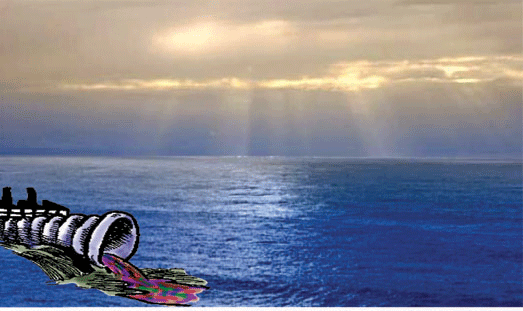
SafeEnergy E Journal No.92. December 21, Radioactive Discharges The OSPAR Convention for the Protection of the North-East Atlantic has discreetly postponed its commitment to reduce radioactive discharges at sea from 2020 to 2050. Following a meeting on October 1st, the participating ministers discreetly postponed until 2050 the commitment made in 1998 in Sintra to reduce radioactive discharges into the sea to levels close to zero by 2020.
Once again, international commitments to the environment are being disregarded. This does not bode well for the upcoming COP26 in Glasgow. France is the first beneficiary of this 30-year postponement because, with its reprocessing plant at La Hague, it has the highest radioactive discharges to the sea in Europe. And these discharges are not decreasing, as shown by the results of the citizen monitoring of radioactivity in the environment carried out by Association pour le Contrôle de la Radioactivité dans l’Oues (ACRO) for over 25 years. (1)
The “Cascais Declaration” signed at a Ministerial Meeting in October 2021 said:“We aim to achieve zero pollution by 2050 and commit to reduce single-use plastic items and maritime related plastic items on our beaches by 50% by 2025 and 75% by 2030. We will take action to eliminate anthropogenic eutrophication and continue to reduce hazardous and radioactive substances to near background levels for naturally occurring substances and close to zero for human made substances.” (2)
Remi Parmentier, who was the lead Greenpeace International campaigner when the Sintra Decalation was signed in 1998 tweeted:
“30 yrs backward presented as progress. The OSPAR Commission is using Orwellian language: “We *aim* to achieve zero pollution by 2050” [“aim”, not “commit”], wiping out the previous target date (agreed in 1998) which was…2020.”
Meanwhile, the NDA is now saying all Magnox reprocessing will be completed in 2022. The Magnox reprocessing plant was expected to close in 2020 before delays caused by Covid. (3
2. OSPAR Cascais Declaration October 2021 https://www.ospar.org/site/assets/files/46205/cascaisdeclaration2021.pdf
3. NDA Mission Progress Report 2021. 4th Nov 2021 https://assets.publishing.service.gov.uk/government/uploads/system/uploads/attachment_data/file/103121https://www.no2nuclearpower.org.uk/wp/wp-content/uploads/2021/11/SafeEnergy_No92.pdf
Europe to pay half for raising Russia’s dangerous sunken submarines, – while Russia builds new ones!

“The sunken submarines K-27 and K-159 are the potential source of contamination of the Arctic, the riskiest ones,”
As Moscow this spring took the Chair of the Arctic Council, the need to lift dangerous nuclear materials from the seabed was highlighted as a priority.
No other places in the world’s oceans have more radioactive and nuclear waste than the Kara Sea.
Europe to pay half … it is a dilemma that international partners are providing financial support to lift old Cold War submarines from the ocean, while Russia gives priority to building new nuclear-powered submarines threatening the security landscape in northern Europe.
EU willing to co-fund lifting of sunken nuclear subs from Arctic seabed https://thebarentsobserver.com/en/nuclear-safety/2021/11/europe-offers-pay-russia-raise-sunken-nuclear-subs The Northern Dimension Environmental Partnership (NDEP) has decided to start a technical review aimed to find a safe way to lift two Cold War submarines from the Barents- and Kara Seas. By Thomas Nilsen
“We are proceeding now,” says a smiling Jari Vilén, Finland’s Ambassador for Barents and Northern Dimension.
Projects aimed to improve nuclear safety are some of the few successful arenas for cooperation still going strong between the European Union and Russia.
“In roughly two years time we will have the understanding on what and how it can be done, what kind of technology has to be used,” Vilén elaborates with reference to the two old Soviet submarines K-159 and K-27, both rusting on the Arctic seabed with highly radioactive spent nuclear fuel elements in their reactors.
Continue readingThe US Faces Pressure To Do More To Address Its Nuclear Legacy In The Marshall Islands.

The US Faces Pressure To Do More To Address Its Nuclear Legacy In The Marshall Islands, Civil Beat By Anita Hofschneider 22 Nov 21, Marshallese are concerned about continued health effects from Cold War-era nuclear testing as well as a concrete dome in which the atomic waste was stored.
Two Congress members are asking the U.S. Department of Energy to provide more information about the effects of U.S. nuclear waste in the Marshall Islands.
The U.S. conducted 67 nuclear weapons tests in the Marshall Islands from 1946 to 1958, exposing Marshallese people to radiation that continues to have health and environmental implications. The U.S. then stored the atomic waste at Runit Dome, a concrete dome on Enewetak Atoll.
Rep. Katie Porter represents Orange County, California, and is chair of the Subcommittee on Oversight and Investigations in the House Committee on Natural Resources.
She has been seeking more details about the effects of nuclear testing in the Marshall Islands in the wake of a Los Angeles Times investigation that found the U.S. stored nuclear waste from Nevada in Runit Dome without informing the Pacific nation.
In a letter Friday, Porter and Rep. Raul Grijalva of Arizona asked for documents and correspondence among Department of Energy officials related to a letter that officials sent to the Marshall Islands about the state of nuclear waste in May.
The Department of Energy didn’t respond to a request for comment.
In October, Porter led a congressional hearing regarding concerns about Runit Dome, which is leaking radioactive waste. The Energy Department said in a report last year that the leaking is not significant.
“The U.S. has both a moral and national security imperative to address our nuclear legacy in the Marshall Islands,” Porter said at the hearing, adding that addressing the issue would be in line with the Biden administration’s commitment to racial justice and national security issues in the Pacific………
In their letter, Porter and Grijalva criticized the agency’s lack of response to repeated document requests, raised concerns about conflicting Energy Department testimony and the timing of the department’s May letter.
The U.S. is in the midst of renegotiating a treaty with the Marshall Islands that in part gives the U.S. military strategic denial rights over the country’s surrounding air and waters.
The Congress members described how the U.S. failed to evacuate Marshallese people quickly enough to protect them from the fallout during the 1946-1958 testing, and cited descriptions of how mothers later gave birth to babies with translucent skin and no bones.
A 2014 study analyzed how the radiation exposure in the Marshall Islands increased the risk of certain cancers, especially thyroid cancer.
Broader Concerns
Franscine Anmontha, communication director of the Marshall Islands National Nuclear Commission, said Saturday that the community is concerned about the ongoing health effects of radiation on people not only on the atolls enrolled in the U.S. medical program but on surrounding atolls.
“If you were to ask a group of young Marshallese people if they knew someone with cancer almost 90% of them would raise their hands,” she said. She said the commission wants to bring scientists to the Marshall Islands to analyze the dome so that they don’t have to rely solely on U.S. data……….
Friday’s letter is the second letter this month pressing the Biden administration for more information about the nuclear testing.
Several Congress members — including Hawaii Reps. Ed Case and Kai Kahele — wrote to the White House on Nov. 5 pushing for the appointment of a lead negotiator for treaty discussions who would have the ability to address concerns about nuclear waste.
The lead negotiator “should have the mandate to see that legacy issues related to U.S. nuclear testing in the region are appropriately resolved, including proper environmental protections, clean up, health benefits, and monetary compensation for victims and their descendants,” the lawmakers wrote…………. https://www.civilbeat.org/2021/11/the-us-faces-pressure-to-do-more-to-address-its-nuclear-legacy-in-the-marshall-islands/
“Blown to Hell: America’s Deadly Betrayal of the Marshall Islanders”

Biggest US nuclear bomb test destroyed an island—and this man’s life, https://nypost.com/2021/11/20/biggest-us-nuclear-bomb-test-destroyed-an-island-and-lives/ By Eric Spitznagel The US bomb tested near John Anjain’s (right) home in the Marshall Islands in 1954 was 1,000 times stronger than at Hiroshima, and left his wife and kids with debilitating and deadly health problems, as detailed in a new book. November 20, 2021
Just before dawn on March 1, 1954, John Anjain was enjoying coffee on the beach in the South Pacific when he heard a thunderous blast, and saw something in the sky that he said “looked like a second sun was rising in the west.”
Later that day, “something began falling upon our island,” said Anjain, who at the time was 32 and chief magistrate of the Rongelap atoll, part of the Marshall Islands. “It looked like ash from a fire. It fell on me, it fell on my wife, it fell on our infant son.”
It wasn’t a paranormal experience. Anjain and his five young sons, along with the 82 other inhabitants of Rongelap, were collateral damage from a “deadly radioactive fallout from a hydrogen bomb test… detonated by American scientists and military personnel,” writes Walter Pincus in his new book, “Blown to Hell: America’s Deadly Betrayal of the Marshall Islanders” (Diversion Books), out now.
In 1946, the US started testing atomic weapons began in Bikini Atoll, 125 miles west of Rongelap. Known as Operation Crossroads, the tests were moved to the islands from the US because officials feared “radioactive fallout could not be safely contained at
any site in the United States,” writes Pincus.
During those early tests, the Rongelapians were relocated to another island a safe distance away.
But the 1954 test was different. Not only were there no evacuations, but “Castle
Bravo,” as it was dubbed, was also the largest of the thermonuclear devices detonated during the military’s 67 tests, “a thousand times as large as the bomb that destroyed Hiroshima,” writes Pincus.
It took just hours for fallout to reach the shores of Rongelap, where it blanketed the island with radioactive material, covering houses and coconut palm trees. On some parts of the isle, the white radioactive ash was “an inch and a half deep on the ground,” writes Pincus.
The natives, who often went barefoot and shirtless, were covered in the toxic debris. It stuck to their hair and bodies and even between their toes.
“Some people put it in their mouths and tasted it,” Anjain recalled at a Washington DC hearing run by the Senate Energy and Natural Resources Committee to investigate the incident in 1977. “One man rubbed it into his eye to see if it would cure an old ailment. People walked in it, and children played with it.”
Rain followed, which dissolved the ash and carried it “down drains and into the barrels that provided water for each household,” writes Pincus.
It took three days before American officials finally evacuated the island, taking the natives to nearby Kwajalein for medical tests. Many Rongelapians were already suffering health effects, like vomiting, hair loss, and all-over body burns and blisters. Tests showed their white blood cell counts plummeting, and high levels of radioactive strontium in their systems. No one died, at least not immediately. That would come later.
After three years, the Rongelapians were allowed to return home, assured by officials that conditions were safe. But by 1957, the rate of miscarriages and stillbirths on the island doubled, and by 1963 the first residents began to develop thyroid tumors.
Though they continued to conduct annual medical tests, the US military admitted no culpability, other than awarding each islander $10,800 in 1964 as compensation for the inconvenience.
In fact, some — including the islanders — have speculated that the US government had used the Rongelapians as “convenient guinea pigs” to study the effects of high-level radiation.
For Anjain and his family, the effects were devastating. His wife and four of his children developed cancer. A sixth child, born after the fallout, developed poliomyelitis and had to use a crutch after one of his legs became paralyzed.
But the biggest tragedy befell his fifth child Lekoj, who was just one year old when Castle Bravo covered their island in nuclear dust. As a child, he was mostly healthy, other than the occasional mysterious bruise. Soon after his 18th birthday, Lekoj was flown to an American hospital, where doctors discovered he had acute myelogenous leukemia.
Anjain stayed at his son’s bedside for weeks as he underwent chemo, holding his dying son’s hand and watching him disappear.
He recounted Lekoj’s final days in a letter to the Friends of Micronesia newsletter in 1973. “Bleeding started in his ears, mouth and nose and he seemed to be losing his mind,” Anjain wrote of his son. “When I would ask him questions he gave me no
answer except ‘Bad Luck.’”
Lekoj passed away on November 15, 1972, at just 19. Newsweek called him “the first, and so far only leukemia victim of an H-bomb,” and said his death was proof that nuclear fallout “could be even more lethal to human life than the great fireball itself.”
After burying his son at a spot overlooking Rongelap Lagoon, Anjain continued to battle for financial restitution for his family and other Rongelapian survivors. In 2004, just months before his death (of undisclosed causes) at 81, he marched with 2,000 people in Japan to commemorate the 50th anniversary of the 1954 hydrogen bomb test that slowly killed his son.
In 2007, a Nuclear Claims Tribunal awarded Rongelap more than $1 billion in damages, but not a penny of it has yet been paid. And according to a 2019 Columbia University study, radiation levels on Rongelap are still higher than Chernobyl or Fukushima.
For Anjain, it was never really about the money. “I know that money cannot bring back my son,” he once said. “It cannot give me back 23 years of my life. It cannot take the poison from the coconut crabs. It cannot make us stop being afraid.”
1 This Month



26 September – International Day for the Total Elimination of Nuclear Weapons


PLEASE OPPOSE HR 8255 AND S.3639 – bills would accelerate satellite deployment, with no environmental review or safeguards – https://ncstd5li.quorum.us/campaign/169331/
To see nuclear-related stories in greater depth and intensity – go to https://nuclearinformation.wordpress.com
-
Archives
- September 2026 (233)
- August 2026 (330)
- July 2026 (355)
- June 2026 (287)
- May 2026 (306)
- April 2026 (356)
- March 2026 (251)
- February 2026 (267)
- January 2026 (308)
- December 2025 (358)
- November 2025 (359)
- October 2025 (375)
-
Categories
- 1
- 1 NUCLEAR ISSUES
- business and costs
- climate change
- culture and arts
- ENERGY
- environment
- health
- history
- indigenous issues
- Legal
- marketing of nuclear
- media
- opposition to nuclear
- PERSONAL STORIES
- politics
- politics international
- Religion and ethics
- safety
- secrets,lies and civil liberties
- spinbuster
- technology
- Uranium
- wastes
- weapons and war
- Women
- 2 WORLD
- ACTION
- AFRICA
- Atrocities
- AUSTRALIA
- Christina's notes
- Christina's themes
- culture and arts
- Events
- Fuk 2022
- Fuk 2023
- Fukushima 2017
- Fukushima 2018
- fukushima 2019
- Fukushima 2020
- Fukushima 2021
- general
- global warming
- Humour (God we need it)
- Nuclear
- RARE EARTHS
- Reference
- resources – print
- Resources -audiovicual
- Weekly Newsletter
- World
- World Nuclear
- YouTube
-
RSS
Entries RSS
Comments RSS
 nuclear-news