Japan approves nuclear-contaminated water discharge plan, may turn Japanese people into ‘sick men of Asia,’ seafood consumption and export nosedive
By Zhang Hui and Xing Xiaojing Jul 22, 2022 , Japan’s nuclear regulator on Friday approved the discharge plan of Fukushima nuclear-contaminated water, with Chinese observers voicing concerns that the release of the contaminated water into the ocean may start earlier than the previous schedule of next spring and warning that Japan will bear the brunt of damage, with people’s lives under serious threat and seafood consumption and export nosediving.
………………… Although the Foreign Ministry statement said this does not mean that TEPCO can immediately start the discharge of the contaminated water into the sea as there are remaining processes, such as the Japanese regulator’s inspections to check and confirm the installation status of the discharge facilities, Chinese observers believed that Japan may accelerate its scheduled plan, making the release start earlier than April 2023.
Chang Yen-chiang, director of the Yellow Sea and Bohai Sea Research Institute of Dalian Maritime University, who has been closely following the Japanese government’s decision on discharging Fukushima wastewater, told the Global Times on Friday that the administrative process for releasing the contaminated water was done in a really fast manner, as it only took Japan five days from announcing completion of construction for undersea tunnel outlet to approving the plan.
The TEPCO has basically completed the construction of an undersea tunnel outlet to dump the nuclear-contaminated water, the Kyodo News agency reported on Sunday.
Japan’s latest move apparently aroused lots of concern and opposition from neighboring countries.
Chinese Foreign Ministry spokesperson Wang Wenbin said at Friday’s media briefing that it is extremely irresponsible for Japan to attempt to create a fait accompli, regardless of various parties’ concerns and China firmly opposes it.
China once again urges Japan to earnestly fulfill its due international obligations, dispose of the nuclear-contaminated water in a scientific, open, transparent and safe manner, and stop pushing through the ocean discharge plan, Wang said.
……………. Meanwhile, Japan’s seafood exports will be greatly hindered, which would hurt the economy and local fishery groups, observers said.
Many countries, including the US and UK, banned imports of food products manufactured in and around Fukushima Prefecture following the 2011 nuclear disaster, and some countries and regions have not lifted the ban even now.
Fishery groups in Japan have repeatedly said they were firmly opposed to the plan due to concerns over a negative impact on the industry. ……………..
China and other stakeholders could through the UN request an advisory opinion from the International Court of Justice, to prove the release is illegal, Chang said.
Yu also advised countries to conduct maritime environment investigation, which could be evidence in seeking compensation from Japan in cases of biological resources damages and other damage.
https://www.globaltimes.cn/page/202207/1271183.shtml
All at Sea: Energy Security Bill reveals UK government preference to dump waste offshore

https://www.nuclearpolicy.info/news/all-at-sea-energy-security-bill-reveals-government-preference-to-dump-waste-offshore/ 20 July 22, The Government has published a factsheet in support of the new Energy Security Bill which has confirmed the long-held suspicion of Britain’s Nuclear Free Local Authorities that the nuclear industry intends to dump its deadly legacy of radioactive waste out at sea.
Tucked away in this page-turner is a reference that could be missed on page seven revealing that with refence to the government stated ambition to Prepare for our nuclear future and clean up the past’, that ‘The Bill will also facilitate the safe, and cost-effective clean-up of the UK’s nuclear sites, ensuring the UK is a responsible nuclear state by clarifying that a geological disposal facility located deep below the seabed will be licensed.’[1]
That the intention is to dump the waste at a location out at sea has helpfully been made plain in the latest infomercial published by the Theddlethorpe GDF Community Partnership
20th July 2022
All at Sea: Energy Security Bill reveals government preference to dump waste offshore
The Government has published a factsheet in support of the new Energy Security Bill which has confirmed the long-held suspicion of Britain’s Nuclear Free Local Authorities that the nuclear industry intends to dump its deadly legacy of radioactive waste out at sea.
Tucked away in this page-turner is a reference that could be missed on page seven revealing that with refence to the government stated ambition to Prepare for our nuclear future and clean up the past’, that ‘The Bill will also facilitate the safe, and cost-effective clean-up of the UK’s nuclear sites, ensuring the UK is a responsible nuclear state by clarifying that a geological disposal facility located deep below the seabed will be licensed.’[1]
That the intention is to dump the waste at a location out at sea has helpfully been made plain in the latest infomercial published by the Theddlethorpe GDF Community Partnership

This latest plan to jeopardise the marine environment is par for the course for successive British Governments which, without a care for the ecology of British waters, have previously chosen to recklessly dump deadly munitions and poison gas into our oceans.
In November 2020, the NFLA published a horrifying report commissioned from marine pollution expert, Tim Deere-Jones, which revealed that evidence was mounting that around two million tons of unused wartime munitions were dumped in, or around, the Beaufort’s Dyke in the Irish Sea in the interwar and post-war years, up until at least the mid-1970’s.[2]
Alongside conventional explosives, this deadly legacy included at least 14,000 tons of phosgene gas and a cocktail of other nasties such as ‘canisters of chemical warfare agents including sarin, tabun, mustard gas, cyanide, … and the biological warfare agent anthrax’.
The New Scientist has reported instances of munitions washing up on Scottish beaches and the British Geological Survey confirmed that explosions generated by degrading munitions are a relatively frequent occurrence and that at least one of those explosions was observed to have generated an explosive force equivalent to approximately 5.5 tonnes of TNT.
The report also revealed that radioactive waste has previously been dumped into the Irish Sea, in the Beaufort’s Dyke, in the Firth of Tay and off the island of Arran, including radium-coated aircraft dials, laboratory waste, luminous paint and waste encased in concrete within metal drums.
Responding to the latest revelation, Councillor David Blackburn, Chair of the NFLA Steering Committee, said:
“Clearly then the Energy Security Bill demonstrates that once again the British Government’s plan is to dump its deadly legacy of high-level radioactive waste offshore whatever the long-term detriment to the marine environment and regardless of local and international opposition, and the Theddlethorpe Community Partnership diagram makes this intention writ large.
“The NFLA has far from convinced that however well engineered a nuclear waste dump, or Geological Disposal Facility as the nuclear industry likes to call it, is that the structure of such a facility will not become compromised over the 100,000 years it is required to hold waste whilst it remains radioactive. We fear that in future centuries we shall see radioactive waste poisoning our oceans and beaches.
“This is an especial issue of concern in West Cumbria, where three of the possible four current sites for the dump are under consideration; for here for generations Sellafield has been leaking its toxics into the Irish Sea.
“The NFLA will continue to oppose a GDF, especially one at sea. Our policy is to see radioactive waste properly monitored and managed in a near surface facility, rather than dumped out of sight, out of mind and forgotten about!”
For more information, please contact NFLA Secretary Richard Outram by email on richard.outram@manchester.gov.uk or mobile 07583097793
The lingering horror of thorium radioactive poisoning in West Chicago

On the one hand, the story of West Chicago and thorium is one of triumph: a small town overcomes the odds and makes a big corporation clean up its radioactive waste. On the other hand, thorium still haunts some residents, especially those living with illness or deaths in the family that they suspect are related.
Are West Chicago’s Radiation Worries Over?, BELT Magazine, By Liuan Huska, 13 July 22,
Sandra Arzola was relaxing in her West Chicago home one weekend in 1995, when she heard a knock at the door. Recently married, she shared the gray duplex with her husband, mom and sister, and family members were constantly coming and going. But when Sandra answered the door that day, what she learned would change how she looked at her home and suburban community forever.
At the door was a woman representing Envirocon, an environmental cleanup company. There was thorium on the family’s property, the woman said, and if it was OK with them, workers were coming to remove it. It was the first time Sandra had heard of thorium “It took me by left field,” she said. “But [the representative] made it sound like everything was going to be fine.”
Unknowingly, the Arzolas had bought their way into what the Chicago Tribune in 1979 called “the radioactive capital of the Midwest.” Not long after they purchased the property, the U.S. Environmental Protection Agency designated it a Superfund site because of the hazardous waste in their yard.
The source of the danger was the old factory one block to the north of the Arzola home, which Jesse Arzola frequently went past while walking their dogs. From 1932 to 1973, the factory was the largest producer of rare earth and radioactive thorium compounds in the world. It started out producing lamps and later supplied thorium for the federal government’s atomic bomb development. But perhaps the factory’s most lasting legacy, at least in West Chicago, is the harmful radioactive waste that was dumped in ponds, piled at the factory and buried around homes and sidewalks across town.
Residents raised health concerns as early as the 1940s about the toxic material, but these were regularly dismissed by the factory, last owned by the Kerr-McGee Chemical Corporation. Comprehensive environmental protection rules weren’t put in place until the early 1970s, leaving the factory largely free to dispose of its nuclear waste for decades.
It has taken just as long for the company and government to clean up the radioactive waste. As of 2015, the radioactive sites under federal jurisdiction near the factory have been cleaned to EPA standards. There are no remaining health risks from the land, according to government officials.
But below the factory, the groundwater is still polluted with a range of toxins – particularly uranium – that exceed protection standards. The Illinois Emergency Management Agency, which has jurisdiction over the site, expects remediation to begin this fall. ……………………..
Prolonged or high levels of radiation exposure can damage genetic material in cells and cause cancer and other diseases later on, especially for children, who are more sensitive to radiation. Only two public health studies, published in the early 1990s, have been conducted in West Chicago. Both found elevated cancer rates in the 60185 zip code, which includes the neighborhood around the factory……………………………
The challenges facing West Chicago residents today began ninety years ago, when Charles R. Lindsay moved his lamp factory from Chicago to what was then an undeveloped little town with multiple rail connections. The factory, now officially known as the Rare Earths Facility, took monazite ore and used powerful acids to extract minerals to make gas lanterns, which burned thorium nitrate to emit an incandescent glow. During World War II, it also supplied thorium to the federal government to develop the atomic bombs that were later dropped on Nagasaki and Hiroshima, Japan.
During its four decades of operation, the Rare Earths Facility processed up to one hundred and forty-one thousand tons of monazite. The liquid waste from the extraction process was dumped into unlined ponds around the factory, seeping into the surrounding water table. Solid waste, a black, sand-like material known as thorium tailings, piled up on site. Old-timers share stories of sneaking into the factory grounds and playing on “Mount Thorium.” When the pile got too big, the waste was trucked down the road to a new pile in Reed Keppler Park.
Facing mounting piles of toxic waste, Lindsay came up with another solution: offer the waste to residents for landscaping. From the 1930s through the 1950s, radioactive thorium tailings were distributed across town, mixed with concrete to pour foundations, mixed with topsoil for gardens and spilled along roadways. The company continued to do this as the risks of radiation exposure became widely known starting in the late 1940s through its effects on Japanese atomic bomb survivors.
Soon after the factory moved to West Chicago, people started complaining. In 1941, nearby residents sued Lindsay Light for releasing airborne hydrofluoric acid that killed trees and shrubs nearby.
The federal government did not begin regulating nuclear materials until 1954. Starting in 1957 the company received repeated citations for safety violations, including failing to fence off radioactive storage areas, exposing workers to radiation levels above standards and improper waste disposal.
As the environmental movement gained steam through the 1960s, growing public pressure pushed Congress to create the Environmental Protection Agency and pass the Clean Air Act of 1970 and Clean Water Act of 1972. That resulted in sweeping new regulations – and obligations to the American public – for companies like Kerr-McGee, which had gotten used to operating with limited oversight…………………………….
The EPA denied the company’s request for an operating permit and the factory shuttered in 1973. It was cheaper to cease operations than follow the new rules. By 1980, Kerr-McGee had started the process of closing down the West Chicago facility for good. Pressure from residents and the city pushed the company to begin cleanup on 119 contaminated residential properties.
Still, Kerr-McGee had another plan that worried residents: to permanently store thirteen million cubic feet of radioactive waste at the factory site in a four-story, twenty-seven-acre, clay-covered cell. Concerned residents formed an organization, the Thorium Action Group, to fight the company’s proposal. This spawned more than a decade of legal battles between residents, the city of West Chicago, and state of Illinois — who wanted the thorium out of town — and the company and the federal Nuclear Regulatory Commission, who insisted the waste could safely be stored in this densely populated neighborhood of West Chicago…………………
Moving the thorium waste out of town would take over two decades to complete. In the meantime, there was still the problem of radioactive tailings embedded around the neighborhood…………………….
The Arzolas’ experience is far from rare. Realtors in West Chicago have operated with a “don’t ask, don’t tell” policy, said longtime realtor and former West Chicago resident Dan Czuba. Unlike for radon or lead, realtors never received directives from the state or any licensing board to disclose other harmful thorium byproducts. People have had to do their own homework and decide whether or not a home was a risk. “To this day,” Czuba said, “I still don’t know that there was an official statement of, ‘Thorium will hurt you.’”…………………………………..
Throughout the decades, various groups have tried to get the word out about thorium. The Thorium Action Group was active through the early 2000s. Once the EPA got involved and Kerr-McGee agreed to move the waste out, the group dissipated………
The lack of easily accessible information surrounding the contamination and cleanups has left some residents with the nagging worry that there may be other hidden pockets of radiation around town……….
One house to the west and across the railroad from the Arzolas, Erika Bartlett grew up playing along the tracks and under her yard’s sprawling old oak trees. When she was diagnosed with leukemia in 2012, at age thirty-four, a friend asked if there was anything she could have been exposed to.
“Wait a minute, I actually was,” Bartlett told her friend. She thought back to her high school years, when the oak trees, swingset and above-ground pool at her house were removed during the radiation remediation. Bartlett realized she had spent her childhood, starting from age four, in a neighborhood embedded with nuclear waste. She wondered how many others living near the factory had similar health problems. That started her on a yearslong personal investigation into the town’s thorium legacy.
Between 2012 and 2016, as Bartlett was undergoing cancer treatment, she knocked on doors in the neighborhoods around the factory, an area covering about one square mile. She found over 200 cases of cancers and other illnesses that could stem from radiation exposure, including birth defects, Hashimoto’s and aplastic anemia, the illness that killed the pioneering radioactivity researcher Marie Curie in 1934.
“When I first started, I didn’t think I’d find anything,” Bartlett said. “But block after block, it seemed like a bigger deal than I thought.”
The EPA estimated that, before the waste was removed, radiation levels in some residential neighborhoods in West Chicago increased lifetime cancer risks up to seventy times what is acceptable……
The only official health studies into the impacts on people living near the factory were conducted over three decades ago, by the Illinois Department of Public Health. Among residents in the 60185 zip code, studies in 1990 and 1991 found elevated rates of cancer, including melanomas and lung, colorectal and breast cancers. By grouping exposed and unexposed people together, however, researchers said more differences may have been masked……………………………………….
On the one hand, the story of West Chicago and thorium is one of triumph: a small town overcomes the odds and makes a big corporation clean up its radioactive waste. On the other hand, thorium still haunts some residents, especially those living with illness or deaths in the family that they suspect are related………………… https://beltmag.com/are-west-chicagos-radiation-worries-over/
Japan halts shipment of black rockfish caught off Fukushima over radiation
Reuters https://www.reuters.com/world/asia-pacific/japan-halts-shipment-black-rockfish-caught-off-fukushima-over-radiation-2022-02-08/
OKYO, Feb 8 (Reuters) – Japan’s health ministry said on Tuesday it had ordered the suspension of shipments of black rockfish caught off Fukushima prefecture after radiation exceeding an upper limit was detected in a catch late last month.
The development comes on the heels of an announcement by Taiwan that it would relax a ban on food imports from Japan put in place after the 2011 Fukushima nuclear disaster.
The suspension means the targetted fish would not be shipped, regardless of the destination, a ministry official said.
Millom and Haverigg being conned by nuclear industry over waste dump, claims former councillor.
A Millom resident, who recently resigned from her local council in disgust
at the shenanigans she witnessed, has claimed that the residents and
elected members of Millom and Haverigg and surrounding villages are
‘being conned’ with lies and false promises from Nuclear Waste Services
and some members of the local South Copeland GDF Community Partnership.
Only last month, Jan Bridget founded the Millom and District against the
Nuclear Dump campaign group as a voice for local people who are opposed to
the proposal to bring a nuclear waste dump to the South-West of Cumbria.
The waste dump or Geological Disposal Facility (as Nuclear Waste Services
prefers to call it) will be final resting place for the high-level
radioactive waste generated by Britain’s civil and military programmes
over the last seventy years.
One catalyst for local opposition has been
NWS’s plan to ‘sound blast’ the Irish Sea to determine if the geology
of the seabed could host the waste dump. Almost 50,000 individuals have
signed an online petition in opposition to the plan, whilst environmental
and conservation groups have registered their concerns that the health of
marine wildlife will be seriously compromised.
To date, the local and national authorities have been deaf to these objections. Over the last
month, the Millom and District group has become an effective local force
opposing plans for a dump. Nearly 400 local people have so far joined, and
members have been active with a protest by 19 local people outside an
NWS-organised community consultation event in Haverigg, and a door-to-door
delivery campaign completed with activists posting almost 5,000 leaflets
through letter boxes. As a member of Millom Town Council, Jan spoke up for
the objectors, but, from the hostile response she received from several
fellow Councillors involved with the Community Partnership, it soon became
clear that her lone voice was unwelcome in the council chamber, and the
atmosphere turned so toxic that Jan felt unable to stay.
NFLA 18th July 2022 https://www.nuclearpolicy.info/news/millom-and-haverigg-being-conned-by-nuclear-industry-over-waste-dump-claims-former-councillor/
Developer dismisses B-52 crash radiation fears at proposed site of Spanish resort
Two nuclear bombs exploded in 1966 after US aircraft involved in mid-air collision over Palomares in Almería
https://www.theguardian.com/world/2022/jul/14/developer-dismisses-b-52-crash-radiation-fears-at-proposed-site-of-spanish-resort Stephen Burgen in Barcelona, Thu 14 Jul 2022
A British company has defended its plans to develop a resort in south-east Spain after environmental groups claimed the area could be contaminated with radioactivity from nuclear bombs that fell after a plane crash in the 1960s.
On 17 January 1966 a US air force B-52 collided mid-air with a refuelling plane over Palomares in Almería, killing seven of the 11 crew.
Of the four 1.5 megatonne nuclear bombs the B-52 was carrying, three fell to Earth, of which two exploded as conventional bombs, spreading radioactive debris over a wide area, while the fourth landed in the sea. It was recovered 80 days later.
Shortly after the accident, the US shipped 1,700 tonnes of contaminated earth to South Carolina, after which it was largely forgotten.
British-based Bahía de Almanzora plans to build 1,600 homes, a hotel and a sports complex about a mile (1.5km) from the contaminated zone in Palomares, which has been fenced off for the past 56 years. The Almanzora proposal makes no mention of the 1966 incident or the contamination.
José Ignacio Domínguez, a lawyer who heads the local Ecologists in Action group, said: “The plutonium isn’t just in the fenced-off area because it’s carried on the wind and by animals such as birds and rabbits.” Domínguez said his group’s own tests have revealed dangerously high levels of radiation outside the closed zone.
Meritxell Bennasar from Greenpeace said: “A chain-link fence isn’t much of a barrier. Some of the contamination is only a few centimetres deep. There are places where the United States secretly buried contaminated soil and we’re only just finding out where they are.”
Fraser Prynne, development director for Bahía de Almanzora, said the contaminated land was “nowhere near the development” and that “this stuff about particles flying about is nonsense”.
“There’s no need to say it’s close to contaminated land,” he said. “There are probably 150 existing houses that are closer.”
The 1966 accident happened as Francoist Spain was opening up to tourism and shortly afterwards Manuel Fraga, the tourism minister, and Angier Biddle Duke, the US ambassador, staged a photo-op of them swimming in the sea at Palomares in an attempt to demonstrate that the waters were safe.
Fifty-six years later, 103 hectares (254,000 acres) remain fenced off and neither the Spanish nor US governments have complied with a mutual agreement signed in 2015 to clean up the zone.
“We’re as keen as anyone to see the area cleaned up,” Prynne said. “It’s American plutonium but there’s no nuclear cemetery in Spain and no one else wants it.”
Palomares was not mentioned during the recent visit to Madrid by the US president, Joe Biden, and when Julissa Reynoso Pantaleón, the US ambassador to Spain, was asked about the long-delayed clean-up in an interview this week in El País newspaper, she said only that “we are prepared to listen to any proposal from the Spanish government”.
Aside from the radiation issue, environmentalists say the proposed development will destroy what is virtually the last stretch of virgin coast in Almería.
“The only reason this part of the coast hasn’t been destroyed is because it’s radioactive,” said Domínguez.
The developers however say the mayor and the local population are in favour of the plan. “They’ve seen all the development along the coast and it’s been disappointing not to see it happening in their area,” Iain Anderson Moody said on behalf of the Almanzora
8 billion morons on an orbiting sewer – World population rises as quality of life crashes

https://www.digitaljournal.com/world/op-ed-8-billion-morons-on-an-orbiting-sewer-world-population-rises-as-quality-of-life-crashes/article#ixzz7YyLkFrGe ByPaul Wallis, July 12, 2022
The human race as usual is growing beyond its means. So are pollution, poverty, resources unreliability, environmental degradation, and arguably, insanity. Mismanagement is the norm, madness is the default policy for anything to do with human survival.
This idiotic, system-less approach to global management guarantees failure. 8 billion people will be living in this obscenity of a world by the end of this year. Assuming there’s not a nuclear war or some other fun option.
The current state of play is:
- Global poverty is euphemized by statistics. Poverty doesn’t have a dollar number. What you can’t afford is the definition. 22% of the world’s population lives in “multidimensional poverty”, a wonderful expression. That includes 644 million children, according to World Vision, see the link.
- Global pollution news is consistently bad and getting worse. All the talk has achieved precisely nothing. Air pollution is truly horrendous. That’s largely due to skank governments deregulating everything and corporate trash enabling endless breaches of laws with the full support of politicians. Filtering any sort of emission is cheap and easy; but it’s not done. Nor are effluents managed at all well, if at all.
- Education news by any global measure is truly repulsive. The failures are constant. The West is leading the charge to fatally-dumbed-down with decades of bad calls degrading education to a meaningless abstract. Obscenely overpriced colleges, “education poverty”, and backward-moving US education policies making teachers’ lives impossible in particular aren’t helping.
- The World Economic Forum asks the interesting if unnecessary question of whether 8 billion people can get equal opportunity. Short answer, the idea of equal opportunity is a luxury to a very large percentage of the world’s population. They’ve never had it, and an overstrained economy can’t give it to them.
- Cost of living has exactly one consistent characteristic throughout history – Most people can’t afford it. The rising population is a ticket to disaster in this regard. The theory of supply and demand is the problem. Create a demand which can’t possibly be supplied, make sure people can’t afford what they need, and this is what happens. Dumb as dumb can be.
- Health is truly insane, thanks to Big Pharma and a lot of parasitic things in health systems. Costs are simply inaccessible. That’s not news; it’s now an institutionalized reality in the US and getting worse. Add politicized pandemics, anti-vax lunatics, and waiting times of years, and everything’s just ducky. Even the idea of universal health care is now a “leftist” thing.
- Housing – The four-letter word of the 21st century so far. Nothing is being done right, if anything is done at all, and it usually isn’t.
- The environment – No good news at all on this front. At this rate, the environment which gave humanity a chance to exist won’t exist itself. Well done, morons. The sheer buildup of unregulated toxins is getting worse by the second, but hey, you like being sick and poisoned and poor, right? Bacteria are smarter than that. The difference is that they can prove it
The science of failure
To totally screw future generations, all you need are:
- Truly mediocre economic management.
- Totally unsystematic knee-jerk social management.
- Obsolete political “ideologies” which achieve nothing at all.
- Non-policies that do nothing for the future.
- Total economic instability, like the last 2 decades.
- Crashing societies and never fixing them.
- Total refusal to even recognize the needs of future generations.
- Inability to comprehend future tech and extremely high potential values.
These alone will guarantee the global population hits a truly hideous wall. You can’t survive without what you need to survive. This odd coincidence apparently hasn’t reached the exalted excremental intellects of whatever’s claiming to manage this dunghill of a world.
…But wait! There’s more!
Nuclear war would turn oceans upside down, crash food web
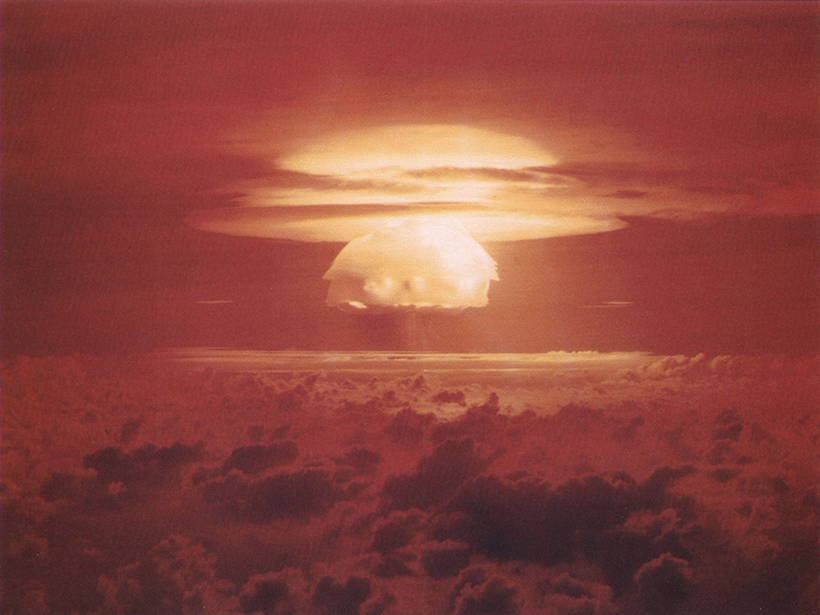
https://news.wisc.edu/nuclear-war-would-turn-oceans-upside-down-crash-food-web/ July 8, 2022 By Chris Barncard , Russia’s invasion of Ukraine has given the specter of nuclear war renewed weight as a global threat, and a new study of the environmental impact of a nuclear conflict describes dire consequences for the world’s oceans.
“If there were a nuclear war, these huge explosions and the firestorms they cause could throw so much soot — teragrams, or millions of tons — into the atmosphere, it would block out enough sunlight to cool the atmosphere significantly,” says Elizabeth Maroon, a professor of atmospheric and oceanic sciences at the University of Wisconsin–Madison.
In just one month after a nuclear exchange between Russia and the United States or India and Pakistan, average global temperatures would drop by 13 degrees Fahrenheit — a larger temperature change than in the last ice age — according to climate modeling by Maroon and collaborators from around the world. The research team, led by Louisiana State University professor of oceanography and coast sciences Cheryl Harrison, published their findings July 7 in the journal AGU Advances.
Even setting aside radioactive fallout, the consequences on land would be dire, including widespread crop failures. But in just a year, the planet’s interconnected oceans would enter a state unfamiliar to scientists like Maroon who study the way oceans have changed on much longer time scales. And, unlike effects on the atmosphere and on land, oceans would not fully recover within the 30-year time period covered by the researchers’ simulations of nuclear conflicts.
“Changes in the ocean take longer than in the atmosphere or on land, but our modeling shows that even in the first year after a nuclear war the ocean circulation would have started changing drastically,” says Maroon, an expert on the interplay between the Atlantic Ocean’s complex circulation patterns and Earth’s climate.
The Atlantic’s major circulation turn-around in the northern latitudes — in which warm surface water streaming north to Greenland, Iceland and Norway cools and sinks into middle depths to be drawn south again — comes unhinged.
“Within the first year or two, water in the North Atlantic sinks all the way to the bottom of the ocean, which we think has not happened even in the ice ages,” says Maroon. “In today’s ocean, only near Antarctica does water sink all the way to the seafloor.”
That unprecedented mixing and ocean circulation speed-up — which would last for about two decades — would move nutrients in the ocean vital for supporting the smallest and most numerous marine organisms, like plankton, into entirely unfamiliar conditions around the world.
It would also result in cooling so strong it would extend sea ice and render impassable major seaports that are now open year-round, and would likely cause significant damage to much of the ocean food web.
“It’s no secret that nuclear winter would be terrible,” Maroon says. “What this study shows are the lasting extent of effects we hadn’t really addressed before on ocean circulation and ecosystems and the very base of the food web.”
To read more about the study and its findings, visit: https://www.lsu.edu/mediacenter/news/2022/07/07docs_harrison_aguadvances.php
Could nuclear plant ruin Suffolk haven for avocets, bitterns and harriers?

Guardian, Robin McKie Science editor 3 July 22, The Bittern Hide at the RSPB’s Minsmere reserve was doing steady business last Wednesday. More than a dozen birdwatchers were crammed into the elevated shelter which overlooks a broad band of heath, freshwater pools and reed beds stretching to the Suffolk coast. Marsh harriers swirled overhead and an occasional bittern swept across the landscape. In front of another nearby hide, avocets waded leisurely across a lagoon. Minsmere is an ornithologist’s paradise.
But a threat hangs over its wildlife glories. In a few days, the government is set to announce its decision on whether to allow the Sizewell C nuclear power plant to be built by EDF on land that overlooks the 1,000-hectare (2,500-acre) reserve.
Threat to the wetlands
Approval will trigger the go-ahead for one of Europe’s biggest construction projects, and the impact on the reserve will be intense. New roads and a temporary port may be built, and dozens of huge cranes erected across land that borders Minsmere. For at least a decade, construction of the giant plant’s twin nuclear reactors will proceed – day and night.,,,,,,,,,,
Minsmere, which is celebrating its 75th anniversary this year, is rated as one of the UK’s finest wildlife reserves, though its origins are unusual. At the beginning of the second world war, it was decided the area’s low-lying farmland should be flooded as a protection against German invasion. After the war ended, it was discovered that avocets, which had been extinct in the UK for more than 100 years, had started nesting there.
“At the time, there was all sorts of pressure being put on landowners to drain land and boost food production in the UK in the years after the war,” added Rowlands.
“However, in the end it was decided to keep the area as a natural mix of shingle beaches, coastal lagoons, grazing marshes and woodland. The RSPB took this over in 1947. Essentially, the land was rewilded, long before the term became an ecological buzzword.”
Many rare species, such as the marsh harrier and the bittern, found precious refuge at Minsmere. However, it was the return of the avocet that had the greatest impact. After a century’s absence from Britain, the black-and-white wader, with its distinctive up-curved beak, established a small colony at Minsmere. From there it spread slowly across the nation. Today, there are about 1,500 breeding pairs in the UK and the bird is now depicted in the RSPB’s emblem, a symbol of hope in the cause of saving threatened bird species.
Nor are avocets, bitterns and marsh harriers the only Minsmere residents. Otters, water voles, kingfishers, nightjars, woodlarks, Dartford warblers, adders, natterjack toads and silver-studded blue butterflies have also made homes on the reserve. “It is the range of habitats that makes Minsmere special,” said Rowlands. “There are reed beds, wet grassland, ditches, coastal shingle, woodland, heather heathland and acid grassland. This is a precious space.”
The prospect of a vast construction project proceeding on adjacent land, therefore, causes concerns. In Somerset, where EDF is building the Hinkley Point C nuclear plant, about 1,600 workers are on site every day; 3m tonnes of concrete and 230,000 tonnes of steel will eventually be used to make the new power plant while the site is dominated by giant 40-metre (130ft) cranes. The construction of its twin at Sizewell C will be identical in scale.
Sizewell C will also require vast amounts of water for its workers, and to make the concrete needed for its construction. It is not clear where this water will come from in an area where supplies are already stretched.
After its completion, even greater amounts will be needed to cool its reactors. “There is also the issue of the warm water leaving the reactor,” said Rowlands. “That could have a significant impact on the marine environment on the coast at Minsmere, affecting the populations of fish and shellfish there and the birds that feed on them.”……………….. https://www.theguardian.com/uk-news/2022/jul/02/could-sizewell-c-nuclear-plant-ruin-minsmere-rspb-suffolk
Marine Management Organisation Put “On Notice” Should they Rubber Stamp Possibly “Unlawful” Seismic Blasting Plan in Irish Sea — RADIATION FREE LAKELAND

The Marine Management Organisation are, any day, due to give their decision on Nuclear Waste Services seismic blasting plan for the Irish Sea. A report condemning Nuclear Waste Services plan for seismic blasting has been funded entirely by contributions from the public and written by renowned marine expert Tim Deere-Jones. The threat to the supposedly […]
Marine Management Organisation Put “On Notice” Should they Rubber Stamp Possibly “Unlawful” Seismic Blasting Plan in Irish Sea — RADIATION FREE LAKELAND
‘Lacking in scientific rigour’: Damning verdict of marine expert on UK’s Nuclear Waste Services seismic testing plan
Radiation Free Lakeland (RFL) and the Nuclear Free Local Authorities
(NFLA) have announced the publication of a report by a renowned marine
expert which is highly critical of Nuclear Waste Services’ (NWS) proposal
to carry out a seismic survey in the Irish Sea to further a plan for an
offshore nuclear waste dump.
The report, ‘The West of Copeland Acoustic
Airgun Survey Proposal: A critical analysis Review Briefing’, was
commissioned by Radiation Free Lakeland and supported wholly through
financial contributions made by members of the public concerned about the
harm that could be caused to marine life by seismic testing.
The report was written by Tim Deere-Jones, a highly-regarded marine radioactivity and
pollution researcher and consultant who has been working independently in
this field since 1983. The NWS, an operating division of the Nuclear
Decommissioning Authority, is responsible for finding a site for a
so-called Geological Disposal Facility, either below ground or beneath the
seabed.
This nuclear waste dump will be filled with the toxic radioactive
waste that is the legacy of Britain’s seven decades of the civil nuclear
power production; much of it will remain radioactive for many tens of
thousands of years.
Three search areas in Cumbria, falling within the local
authority areas of Allerdale and Copeland and offshore up to 22kms, are
under consideration. Seismic testing will enable NWS to determine if the
geology beneath the bed of the Irish Sea is suitable to host a repository
for the nuclear waste.
This involves firing blasts of sound from air guns
below the waves every 10 seconds for four weeks or longer. This sound
penetrates under the ocean floor to help scientists discover more about the
suitability of the geology to store nuclear waste. Seismic testing can
seriously impair the health of marine life, which in the Irish Sea includes
whales, dolphins, porpoises, and seals, but some scientific reports also
suggest that even tiny shellfish and plankton can be adversely impacted,
hazarding the whole marine ecosystem.
NWS have claimed an exemption from
the requirement to seek a Marine Licence from the MMO citing their survey
as furthering ‘scientific research’ and in so doing have prevented
public analysis of their proposals or commentary from academics and marine
welfare organisations.
NFLA 27th June 2022
To Bella Lack – being called a ”snowflake” is a badge of honour
Most teenagers would take offence at being labelled a snowflake, the
disparaging moniker given to young people perceived to be too easily
offended by un-PC terms or environmental damage. For Bella Lack, who at
nineteen-years-old is already one of the UK’s leading environmental
activists, the label is a badge of honour.
“Is it fragile to care about
the future of the planet and our species? I don’t think so,” she says.
“I think it’s quite a powerful term to be honest, because lots of
snowflakes create a snowstorm.” In the UK, the youth climate movement is
largely credited with pushing the UK government to set a target for net
zero emissions by 2050, and for introducing swathes of new environmental
legislation to curb the use of disposable plastic.
Bella has quickly
emerged as one of the leading lights of Britain’s youth activist circles.
She is an ambassador for the Born Free Foundation, spent her teenage years
campaigning on everything from palm oil to circus animals, and spent 2020
filming wildlife documentary Animal alongside Jane Goodall. Her Twitter
account boasts 138,000 followers.
iNews 27th June 2022
The UK is searching the sea for a nuclear dump site with huge risks to marine life

”Protections clearly mean nothing when the nuclear waste industry wants to pave the way to a deep nuclear dump.”
By Charlie Jaay • euro news green, 22/06/2022
A new report delivers a damning verdict on the proposed seismic blasting in the Irish Sea.
The UK government’s Nuclear Waste Services (NWS) is set to carry out seismic surveys off the Cumbrian Coast between July and August this year.
They are looking for a place to dispose of the waste produced by Britain’s nuclear reactors.
The report, commissioned by Radiation Free Lakeland, calls for these plans to be postponed, claiming the impact assessment by NWS is “deeply inadequate” and “lacking in appropriate scientific and academic rigour”.
What is seismic blasting?
Seismic blasting is a process that allows scientists to find out more about the geography of the sea bed. Loud, repetitive blasts of sound are produced from an underwater airgun – like a powerful horn – and their echoes are measured to map the underwater rocks
The airgun will fire every 10 to 15 seconds, throughout the survey period of around one month.
The surveys, commissioned by NWS, will be looking into the possibility of locating a Geological Disposal Facility (GDF). Deep under the seabed, this facility will be used to dispose of the UK’s toxic legacy of high level nuclear waste – the highly radioactive byproducts of nuclear reactors.
Shearwater GeoServices, the company which last year saw the high court put an end to its work on South Africa’s ecologically sensitive Wild Coast, is carrying out the investigations.
According to a freedom of information request, a licence of exemption to carry out these surveys was given to NWS for ‘scientific research’. But Radiation Free Lakeland says the survey is not for ‘scientific research’ but a plan to dispose of nuclear waste.
“We commissioned an independent report because we need to counter the PR spin from the nuclear waste industry who are calling the seismic testing ‘non-invasive scientific research,’” says Marianne Birkby, Founder of the campaign group.
She argues that, rather than seismic blasting for scientific purposes, the plans facilitate a commercial venture for a “deep nuclear dump for heat generating nuclear waste.”
A limited company that wants to enable ever more nuclear waste from new nuclear builds, Radioactive Waste Management, is behind it, Birkby claims.
“Despite the marine protections this part of the Irish Sea has, it is an outrage that independent environmental impact assessments have not been carried out. Protections clearly mean nothing when the nuclear waste industry wants to pave the way to a deep nuclear dump.”
In response to the claims, NWS says “there is no requirement to undertake a public consultation for these surveys.”……
Seismic surveys can devastate marine life
Low frequency sounds generated by a single seismic airgun can extend over large distances, particularly in deeper waters.
They have been recorded at locations up to 4,000 kilometres from the source, and can blanket areas of up to 300,000 square kilometres with noise. Studies have shown that, because seismic surveys can disturb, injure or kill a wide variety of marine life, they can impact entire ecosystems.
Zooplankton are the base of the marine food chain and are extremely important to our ocean’s health. They are also very vulnerable to these loud noises, according to scientists.
Researchers have found that seismic surveys significantly increase the death rates of zooplankton in the 1.2 kilometre range they tested, killing all larval krill in the range.
Radiation Free Lakeland’s report says the surveys will take place when zooplankton populations are expected to be high. These creatures provide a food source for a wide variety of organisms including baleen whales, basking sharks and fish which, in turn, feed many other species.
Many other marine animals rely on sound for survival too. Seismic testing can interfere with basic functions such as communication, navigation, feeding and mating.
“Noise exposure can be a problem for a wide variety of Cetaceans-dolphins, porpoises and whales,” according to the Zoological Society of London’s Cetacean Strandings Investigation Programme.
“Noise related impacts have also been causally linked to many cetacean stranding and mass stranding events globally.”
The NWS investigation will focus on a survey area five to 20 kilometres off the Cumbrian coast in the north west of England in an area of approximately 250 square kilometres. The proposed GDF may extend over an area of 25 kilometres square, deep beneath the seabed.
This region is one of a number of designated Marine Conservation Zones in the Irish Sea. It has protected habitats and is home to a number of European protected species, such as sea turtles, minke whales, common and bottlenose dolphins, and harbour porpoises…………………
Marine habitats are already under huge pressure from pollution, irresponsible development and bottom trawling – as well as the consequences of climate change, she explains. Joan Edwards. Director of Policy at the Wildlife Trusts
We are concerned about the implications of seismic testing in the Irish Sea, which evidence shows can be devastating for marine life.”
The report claims many of the hugely important marine species found in the area have not been studied for their sensitivity to seismic surveys.
A ‘marked lack of transparency’ from Nuclear Waste Services
Marine radioactivity researcher and consultant Tim Deere-Jones is the author of Radiation Free Lakeland’s report. He says that NWS’s licence application for the seismic survey is characterised by “a marked lack of transparency.”
We are concerned about the implications of seismic testing in the Irish Sea, which evidence shows can be devastating for marine life.”
The report claims many of the hugely important marine species found in the area have not been studied for their sensitivity to seismic surveys.
A ‘marked lack of transparency’ from Nuclear Waste Services
Marine radioactivity researcher and consultant Tim Deere-Jones is the author of Radiation Free Lakeland’s report. He says that NWS’s licence application for the seismic survey is characterised by “a marked lack of transparency.”
The UK government, similar to many others, favours deep geological disposal to deal with the most radioactive waste – whether deep below ground or deep beneath the seabed.
However, there are still many concerns about this £53 billion (€62 billion) facility in the Irish Sea, which has not been tried or tested and provides no guarantees of safety. https://reliefweb.int/report/world/let-us-move-towards-world-without-nuclear-weapons
Extreme torture — Beyond Nuclear International

24/7 blasting for nuke waste dump will devastate marine life, Beyond Nuclear 19th June 2022
Extreme torture — Beyond Nuclear International magine being subjected to ear-shattering blasts every ten seconds, twentyfour hours a day for four straight weeks? By any metric, that would qualify
as the most appalling form of torture. But that is exactly what is about to
be inflicted on whales, dolphins, seals and other marine creatures in the
Irish Sea if a new wave of opposition cannot stop it. The Irish Sea is
already the most radioactive sea in the world, in large part a result of
decades of radioactive discharges from the Sellafield reprocessing facility
on the Cumbrian shoreline. Now, Nuclear Waste Services (NWS) has contracted
a company called Shearwater Geosciences to blast its undersea seismic
airguns off the Cumbria coast this summer, calling it “scientific
research”. https://beyondnuclearinternational.org/2022/06/19/extreme-torture/
Antarctic “doomsday glacier” melting at faster rate than in past 5,500 years

Two Antarctic glaciers are now losing ice at a faster rate than any time
over the past 5,500 years, with “potentially disastrous” implications for
sea level rise, new research has found. The Thwaites Glacier, known as the
“Doomsday glacier”, due to the grave risk its melting poses to the world,
is around the size of Great Britain, and its neighbour, the Pine Island
Glacier is only slightly smaller. The two glaciers form part of the Western
Antarctic Ice Sheet, which is being impacted by warming temperatures due to
the climate crisis, and are already contributing to global sea level rise.
Independent 16th June 2022
https://www.independent.co.uk/climate-change/news/antarctica-doomsday-glacier-ice-melt-b2102698.html
1 This Month



Shut down the radiation-damaged Heysham nuclear reactors now
To see nuclear-related stories in greater depth and intensity – go to https://nuclearinformation.wordpress.com

Say No to NASA’s Reckless Nuclear Reactor on the Moon
Say No to NASA’s Reckless Nuclear Reactor on the Moon
-
Archives
- October 2026 (256)
- September 2026 (339)
- August 2026 (330)
- July 2026 (355)
- June 2026 (287)
- May 2026 (306)
- April 2026 (356)
- March 2026 (251)
- February 2026 (267)
- January 2026 (308)
- December 2025 (358)
- November 2025 (359)
-
Categories
- 1
- 1 NUCLEAR ISSUES
- business and costs
- climate change
- culture and arts
- ENERGY
- environment
- health
- history
- indigenous issues
- Legal
- marketing of nuclear
- media
- opposition to nuclear
- PERSONAL STORIES
- politics
- politics international
- Religion and ethics
- safety
- secrets,lies and civil liberties
- spinbuster
- technology
- Uranium
- wastes
- weapons and war
- Women
- 2 WORLD
- ACTION
- AFRICA
- Atrocities
- AUSTRALIA
- Christina's notes
- Christina's themes
- culture and arts
- Events
- Fuk 2022
- Fuk 2023
- Fukushima 2017
- Fukushima 2018
- fukushima 2019
- Fukushima 2020
- Fukushima 2021
- general
- global warming
- Humour (God we need it)
- Nuclear
- RARE EARTHS
- Reference
- resources – print
- Resources -audiovicual
- Weekly Newsletter
- World
- World Nuclear
- YouTube
-
RSS
Entries RSS
Comments RSS

