Depleted uranium endangering rare seal
to protect marine mammals and other marine life from……….highly toxic materials like depleted uranium that have been deposited by the military.
Saving the world’s rarest seal from uranium, guardian Uk, 17 June 2010, Dr Anastasia Miliou was interviewed by Georgina Kenyon“....Greek conservationists from the Greek NGO, Archipelagos, work to protect endangered common dolphins and monk seals and also the region’s marine ecosystems from the effects of overfishing, shipping, and the military. Dr Anastasia Miliou, manager and head scientist from Archipelagos Institute of Marine and Environmental Research of the Aegean Sea, based on the Greek island of Samos in the eastern Aegean, explains about seals, uranium deposits and sonar Continue reading
Rio Tinto’s Australian uranium mine radioactively pollutes national park
The Green Gauge: Rio Tinto takes a hit , Reuters, 7 June 2010, “……..Global miner Rio Tinto enters the spotlight this week as one of its uranium mines in Australia leaks toxins into a river leading to the wetlands of the Kakadu National Park,…..Rio Tinto PLC has recently faced controversies concerning the impacts of two of its subsidiaries on their surrounding communities. Reports have emerged that a uranium mine operated by Energy Resources of Australia, which is owned by Rio Tinto, has been leaking high levels of uranium, sulphate and radium into a river flowing into the world-heritage wetlands of the Kakadu National Park in Northern Australia….”
The Green Gauge: Rio Tinto takes a hit | Analysis & Opinion |
India’s uranium radioactivity hotspot
Uranium, metals make Punjab toxic hotspot, The Times of India. Balwant Garg, TNN, Jun 15, 2010, BATHINDA: After discovery of high levels of uranium in hair samples of a large number of mentally retarded children in Punjab’s Malwa region last year, another study suggests Punjab has become a hotspot of environmental toxicity of multiple types……….. The adverse health effects on plants, animals and humans are visible and some of the studies have proved this. “It’s clear that Punjab is in a deep ecological crisis with its ramifications on socio-economic and cultural aspects of its population,” said Dr Reyes Tirado, a scientist from the University of Exeter in the United Kingdom, who conducted the study in 50 villages in Muktsar, Bathinda and Ludhiana districts last year under a Greenpeace Research Laboratories investigation.
Uranium, metals make Punjab toxic hotspot – India – The Times of India
Insects much more resistant to ionising radiation
PODCAST Cockroaches V. Radiation: Who Wins? | A Moment of Science – Indiana Public Media 15 June 2010, Cockroaches V. Radiation: Who Wins? | A Moment of Science – Indiana Public Media You may have heard that cockroaches can survive nuclear war. Have you wondered if there is any truth to this?Well, they couldn’t survive the heat of a nuclear blast at ground zero, but their resistance to radiation may surprise you. In fact, most insects are much more resistant to ionizing radiation than mammals. Continue reading


Vermont nuclear plant likely to be source of radiation in fish
it was impossible to establish a baseline for strontium-90 in Connecticut River fish, because the state had not tested for it before this year.
Bad news: Radioactive fish found near Vt. nuclear plant; Worse news: Fish said to be ordinary, Washington Examiner, By: DAVE GRAM, Associated Press05/30/10 MONTPELIER, VT. — When a fish taken from the Connecticut River recently tested positive for radioactive strontium-90, suspicion focused on the nearby Vermont Yankee nuclear plant as the likely source. Continue reading
AREVA’s uranium enrichment plant a danger to Idaho’s groundwater
Areva uranium enrichment plant in Idaho would threaten aquifer, Beyond Nuclear, 28 May 2010, The $2 billion in federal loan guarantees just awarded to Areva by the U.S. Department of Energy for a new uranium enrichment plant in Idaho, will produce depleted uranium (half-life of 4.5 billion years) and will threaten the Snake River Aquifer, say leaders of the Snake River Alliance.

Areva plans to build a new uranium enrichment plant “on the upstream end of the Snake River Aquifer a few miles east of the Idaho National Laboratory,” stated the Alliance in a press release. “INL’s nuclear activities have already contaminated the aquifer and have left substantial radioactive waste behind. Addressing these environmental challenges has already cost billions of taxpayer dollars and will continue for decades”. Continue reading
Nuclear solution to oil spill could be worse than the problem
BP Oil Spill: The Nuclear Option, THE HUFFINGTON POST, Susan Deily-Swearingen, 26 May 2010, “……One solution that is getting increased attention on the web and in the European press is the terrifying sounding nuclear option which, essentially, would detonate a nuclear bomb underground near the oil well shaft……………What are the lasting effects of such an explosion? Is there a potential for them to be even worse than the pollution from the dispersants already used to “solve” or abate the problem? Continue reading
Radioactive carbon in human teeth – thanks to nuclear bomb testing
The Radioactive Clock In Your Teeth – Forbes.com Jonathan Fahey, 05.21.10, How bomb testing in the 1950s is helping scientists determine a person’s age.“……….They had discovered that a bygone era of world political history had made it possible to date unidentified human remains more precisely than other forensic methods. Aboveground testing of nuclear bombs in the 1950s and early 1960s created elevated levels of radioactive carbon that soon became incorporated into all living things. Continue reading
Uranium mining’s radioactive pollution of World Heritage National Park
Mine fears grow as pollutants flow to Kakadu, Sydney Morning Herald, LINDSAY MURDOCHMay 24, 2010
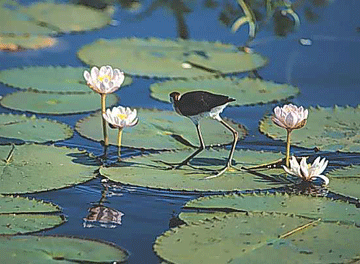
MILLIONS of litres of radioactive water from the Ranger uranium mine have flowed into internationally acclaimed and World Heritage-listed wetlands in Kakadu National Park. Continue reading
State legal proceedings looming for uranium company, over water contamination
Mountain State Nixes Plan For Cleanup Of Colo. Uranium Mine, cbs4denver.com, DENVER (AP) May 20, 2010 ― State regulators have rejected a plan by Cotter Corp. to clean up contamination from a closed uranium mine that has flowed into a creek that feeds a Denver-area reservoir.The Colorado Division of Reclamation Mining and Safety said Thursday it doesn’t believe the plan would prevent uranium from contaminating Ralston Reservoir, which supplies some of the Denver area’s drinking water. Continue reading
Tribal women’s campaign for uranium-mining free water
Grand Canyon uranium threatens tribal water, High Country News, Caitlin Sislin | May 18, 2010 Last week, a delegation of leaders from Arizona’s Havasupai Tribe traveled to Washington D.C., to advocate for the protection of the Grand Canyon region from a potential onslaught of uranium extraction activities. These four women – tribal council members and traditional elders – voiced their concern for the safety of the land, the purity of the water and the health of the community, and called for the passage of the Grand Canyon Watershed Protection Act (H.R. 644). Introduced in 2009 by Rep. Raul Grijalva (D-AZ) this law would ban mineral exploration and the establishment of new mining claims pursuant to the 1872 Mining Law, on about one million acres of public lands surrounding Grand Canyon National Park. Continue reading
Indian Point Nuclear Reactor may be first to lose licence
If the DEC does not provide the facility with a water permit, it would mark the first time in the history of the Nuclear Regulatory Commission that a nuclear power plant was unable to renew its federal license

New York officials claim power plant is killing endangered fish, Eat, Drink and Be, By Julian Martin. May 19, 2010 New York’s largest power provider may be shut down amidst concerns endangered fish species are threatened by the plant. Continue reading
Uranium contamination blocks plans for Towpath Trail
(USA) Towpath Trail planners consider options in crossing through radioactive site in downtown Cleveland, cleveland.com By Michael Scott, May 19, 2010, The Towpath Trail is at the crossroads.Planners of the ambitious and nearly complete hiking and bicycle trail are facing three uncomfortable choices as they try again to stitch together the final few miles through a downtown Cleveland industrial area along the Cuyahoga River.Their preferred route is still blocked by the lurking presence of a parcel on the northeast corner of Harvard Avenue and Jennings Road where uranium was once refined during World War II.
The U.S. Army Corps of Engineers have said that the former Harshaw Chemical site won’t be fully cleaned up until about 2016 at the earliest,……Workers at Harshaw had refined uranium for the production of atomic bombs during World War II, leaving behind traces of uranium and other compounds in the buildings and soil on site. Towpath Trail planners consider options in crossing through radioactive site in downtown Cleveland | cleveland.com
It could be the water problem that finishes off the nuclear industry

“The best alternatives from a water perspective are wind and photovoltaics, that require effectively no water.”
Water Adds New Constraints to Power, NYTimes.com By ERICA GIES May 17, 2010 “……In the United States, thermoelectric power generation — mainly coal, nuclear and natural gas — accounted for 41 percent of U.S. freshwater withdrawals in 2005, U.S. Geological Society data show………..
But there is a growing awareness in California and throughout the United States that the use of water for energy generation may be reaching its limits.
California has extensive experience with water shortages, resulting in its adoption of a policy, included in the energy commission’s 2003 Integrated Energy Policy Report, that discourages freshwater use for power plant cooling…….“If you want to build a big central power plant, whether it’s oil, gas or nuclear, you can’t take the water for granted.” Continue reading
Uranium mining prevented in Indian National Park
Uranium mining blocked,The Telegraph – Calcutta (Kolkata), New Delhi, May 14: A national panel of wildlife experts today rejected a proposal from the department of atomic energy for uranium exploration on the Rongcheng plateau in Meghalaya’s South Garo Hills.The standing committee of the National Board of Wildlife decided to reject the proposal for exploratory drilling in view of the sentiments of the local people and representations from civil society groups, the environment ministry said.
The Rongcheng plateau falls in the Balpakram National Park, home to elephants, black bear, leopards, deer and the red panda, one of the rarest animals in the world.Several green groups and NGOs have campaigned against a proposal for exploratory drilling, arguing that it would harm the bio-diversity in the park. The Telegraph – Calcutta (Kolkata) | Nation | Uranium mining blocked
1 This Month
26 September – International Day for the Total Elimination of Nuclear Weapons





PLEASE OPPOSE HR 8255 AND S.3639 – bills would accelerate satellite deployment, with no environmental review or safeguards – https://ncstd5li.quorum.us/campaign/169331/
To see nuclear-related stories in greater depth and intensity – go to https://nuclearinformation.wordpress.com
-
Archives
- September 2026 (292)
- August 2026 (330)
- July 2026 (355)
- June 2026 (287)
- May 2026 (306)
- April 2026 (356)
- March 2026 (251)
- February 2026 (267)
- January 2026 (308)
- December 2025 (358)
- November 2025 (359)
- October 2025 (375)
-
Categories
- 1
- 1 NUCLEAR ISSUES
- business and costs
- climate change
- culture and arts
- ENERGY
- environment
- health
- history
- indigenous issues
- Legal
- marketing of nuclear
- media
- opposition to nuclear
- PERSONAL STORIES
- politics
- politics international
- Religion and ethics
- safety
- secrets,lies and civil liberties
- spinbuster
- technology
- Uranium
- wastes
- weapons and war
- Women
- 2 WORLD
- ACTION
- AFRICA
- Atrocities
- AUSTRALIA
- Christina's notes
- Christina's themes
- culture and arts
- Events
- Fuk 2022
- Fuk 2023
- Fukushima 2017
- Fukushima 2018
- fukushima 2019
- Fukushima 2020
- Fukushima 2021
- general
- global warming
- Humour (God we need it)
- Nuclear
- RARE EARTHS
- Reference
- resources – print
- Resources -audiovicual
- Weekly Newsletter
- World
- World Nuclear
- YouTube
-
RSS
Entries RSS
Comments RSS

