Uranium mine closed in 1966, still emitting ionising radiation
Firm begins cleanup at Stanislaus National Forest uranium mine site, The Modesto Bee, Aug. 27, 2011, By John Holland KENNEDY MEADOWS — A crew has started cleanup at a uranium mine that operated in the Stanislaus National Forest from 1956 to 1966.The site, about three miles west of Kennedy Meadows, has emitted radiation that exceeded health standards, the U.S. Environmental Protection Agency said.
The cleanup is funded by the Comprehensive Environmental Response, Compensation and Liability Act, better known as the Superfund… http://www.modbee.com/2011/08/27/1833616/firm-begins-cleanup-at-uranium.html
Long process of radiation cleanup in Japan
Japan aims to halve radiation in affected areas in 2 yrs
— Japan aims to bring radiation levels below 20 millisieverts annually
* Thorough cleanup of areas frequented by children also a priority
* Group launched which will form core of new nuclear watchdog
By Shinichi Saoshiro TOKYO, Aug 26 (Reuters) – Japan aims to halve radiation over two years in places contaminated by the Fukushima nuclear crisis, removing soil, plants and trees as well as cleaning roofs of buildings in an area spanning thousands of square kilometres.
The cleanup could cost tens of billions of dollars, and thousands of evacuees may not be able to return home for years, if ever. Continue reading
No end in sight to the cleanup and the costs of Fukushima radiation
 “Fukushima is mountainous and such large-scale and highly concentrated contamination has not taken place on earth before in an area like this. How things will go is unpredictable.”
Japan faces costly, unprecedented radiation cleanup, By Yoko Kubota, TOKYO | Thu Aug 25, 2011 (Reuters) – Nearly six months after the world’s worst nuclear crisis in 25 years at the Fukushima nuclear plant, Japan faces the task of cleaning up a sprawling area of radioactivity that could cost tens of billions of dollars, and thousands may not be able to return home for years, if ever. Continue reading
China finding excessive radiation levels in seafoods east of Fukushima
 Excessive Radiation Found in Sea Organisms Near Japan’s Nuke Plant 2011-08-24 Xinhua Web Editor: Guo Biological samples taken from waters in the Western Pacific region east of Fukushima, Japan show excessive radiation levels, said a statement from China’s State Oceanic Administration on Wednesday.
The samples were also found to contain argentum-110m and cesium-134, which are normally difficult to detect in biological samples from China’s coastal waters, the statement said. Continue reading
Japan increasing radiation monitoring, as more “hot spots” appear
Japan Triples Airborne Radiation Checks as ‘Hot Spots’ Spread, Bloomberg, By Tsuyoshi Inajima and Yuji Okada – Aug 23, 2011 Japan will more than triple the number of regions it checks for airborne radiation as more contaminated “hot spots” are discovered far from Tokyo Electric Power Co.’s crippled Fukushima nuclear power station.
The government said it will increase radiation monitoring by helicopter to 22 prefectures from the six closest to the plant, which began spewing radiation after an earthquake and tsunami struck the station in March. The plan comes after radioactive waste more than double the regulatory limit was found 200 kilometers (125 miles) from the plant this week.
Authorities have refused to give a cumulative figure for radiation released from the Fukushima Dai-ichi nuclear plant after estimating in June that fallout in the six days following the quake was equal to 15 percent of total radiation released in the Chernobyl nuclear disaster in 1986. The authorities have been too slow to widen airborne radiation testing, said Tetsuo Ito, the head of Kinki University’s Atomic Energy Research Institute in Osaka…..http://www.bloomberg.com/news/2011-08-24/japan-triples-air-radiation-checks-for-hot-spots-.html
Radiation evacuees from Fukushima not to return home, ever?
The government is expected to tell many of these residents that they will not be permitted to return to their homes for an indefinite period.
 Large Zone Near Japanese Reactors to Be Off Limits, NYTimes.com, By MARTIN FACKLER August 21, 2011 TOKYO — Broad areas around the stricken Fukushima Daiichi nuclear plant could soon be declared uninhabitable, perhaps for decades, after a government survey found radioactive contamination that far exceeded safe levels, several major media outlets said Monday.
The formal announcement, expected from the government in coming days, would be the first official recognition that the March accident could force the long-term depopulation of communities near the plant, an eventuality that scientists and some officials have been warning about for months. Continue reading
Japan’s intractable problem of virtually permanently irradiated areas
Fukushima zone likely off-limits for ‘decades’, ABC Radio 774 ,Mark Willacy, August 22, 2011 The Japanese government says highly radioactive areas around the crippled Fukushima nuclear plant will remain no-go zones for decades after the damaged complex is stabilised.
Authorities say they plan to bring the stricken nuclear plant to a state of cold shutdown early next year. But with some areas near the complex continuing to show high levels of radioactive contamination, the government says it is unavoidable that some places will remain no-go zones.
Japanese newspaper The Daily Yomiuri reports government sources have said it could be “several decades” before the area is considered safe to enter. For the first time, the government has released figures revealing that many communities within 20 kilometres of the complex have contamination levels up to 500 times higher than safety limits.
The radiation readings were taken in 50 locations within a 20-kilometre radius of the Fukushima nuclear plant.Based on that data, the government has released estimates of the annual dose of radiation residents would be exposed to.
It found that in one town, Okuma, people would receive a dose of 508 milisieverts per year – more than 500 times the acceptable limit.At more than half the locations it was more than 20 times the limit.Tokyo Institute of Technology’s associate professor of radiobiology, Yoshihisa Matsumoto, says efforts to decontaminate the area will likely prove difficult…http://www.abc.net.au/news/2011-08-22/fukushima-radiation-500-times-safe-limit/2849394/?site=melbourne
Nuclear Regulatory Commission does not protect public from radioactive groundwater leaks
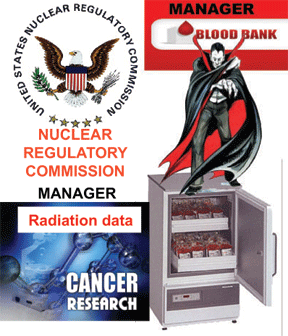 The NRC’s decision on groundwater protection comes four months after an Asbury Park Press investigation documented hundreds of leaks and spills of radioactive water called tritium over the decades at plants, including Oyster Creek in Lacey. The NRC has never issued a fine against any plant.
NRC fails to change groundwater protection rules for nuclear plants, Activist says NRC needs to enforce its rules on radioactive water leaks and spills, Aug. 17, 2011 APP.com, Todd B. Bates:After years of criticisms that they were lax in dealing with radioactive leaks, spills and groundwater contamination at nuclear power plants, federal regulators have decided to let the industry keep policing itself.
The five-member U.S. Nuclear Regulatory Commission agreed to maintain the status quo and not add a tougher level of oversight Continue reading
The spread of Fukushima nuclear radiation in our interconnected world
amazed that particles could be spread across the world from such a small footprint like a reactor, which he compared in size to a swimming pool.
“It shows you how connected the world is,” he said. “What happens in one place can show up someplace else.”
Radioactive Tritium in Connecticut River, from Vermont Yankee nuclear plant
Tritium has leaked from dozens of nuclear plants around the country, but it has been particularly problematic for Vermont Yankee as it seeks to renew its license….
Within weeks, the state Senate voted 26-4 to block the state Public Service Board from issuing a permit for the plant to operate after its initial 40-year license expires in March 2012. Vermont is the only state with a law requiring its Legislature to give the OK before regulators can issue a new nuclear plant permit.
Tritium from Vt. nuke plant in Connecticut River, Boston.com, By Dave Gram, Associated Press / August 17, 2011, MONTPELIER, Vt.—Radioactive tritium that leaked from the Vermont Yankee nuclear plant into surrounding soil and groundwater has now reached the nearby Connecticut River, the state Health Department said Wednesday as it released new river water test results….. Continue reading
Confusion: radioactivity in town of Iitate and other “hot spots” in Japan
Murky Science Clouded Japan Nuclear Response,WSJ By YUKA HAYASHI, 15 Aug 11, “………Confusion over what to do about radioactive contamination is playing out in various forms all over Japan. Officials are struggling to figure out where it is safe to live, what is safe to eat and how farmers decontaminate their fields. At present, 116,000 people remain unable to return to their homes due to the radiation threat. Even as the government continues to ask more people to evacuate, it is mulling allowing others to return to towns where contamination is relatively light…..
Volunteers risk health in radiation cleanup outside Fukushima area
 “The area itself is relatively highly contaminated,” Kodama says. “Many small children playing around the ground might touch some mud or in some case, eat some sand, which would result in internal radiation..”
 Volunteers Take on Dangerous Job of Scrubbing Nuke Contamination, ABC News International. By AKIKO FUJITA (@akikofujita), Aug. 12, 2011 Tatsuhiko Kodama’s voice shakes as he addresses volunteers at Ishigami Daini Kindergarten in the city of Minamisoma, 15 miles from the troubled Fukushima Daiichi Nuclear Plant.
The director of the University of Tokyo’s Radioisotope Center is training people how to decontaminate a school filled with radiation spewed from the nuclear reactors. He has explained the process a dozen times before, yet tears well up every time Kodama sees mothers donning masks, fathers taking notes with dosimeters in hand. Continue reading
Nuclear reactors’ impact on America’s fresh water supplies
 Nuclear Information and Resource Service, Michael Mariotte, 12 Aug 11, America’s aging power plants are not only the nation’s largest air polluters, they also withdraw more water than any other source, causing staggering aquatic impacts. And nuclear reactors are the largest water users of them all.
Power plants’ toll on fisheries rivals, and in some cases exceeds, that of the fishing industry. Fortunately, none of this damage is necessary because modern closed-cycle cooling systems recirculate cooling water, reducing withdrawals and fish kills by about 95 percent. Since 1972, Section 316(b) of the federal Clean Water Act has required power plants to use the Best Technology Available (BTA) to minimize the adverse environmental impacts of cooling water intake structures.
In 2001, EPA issued national regulations identifying closed-cycle cooling as BTA for new power plants. But many older reactors, typically although not exclusively those built more than 30 years ago, still rely on antiquated and damaging once-through cooling systems, which withdraw water directly from its source but do not recycle it. Instead the water is thrown back into its source at far higher temperatures than it was when taken in.
For more information on the environmental devastation caused by once-through cooling at nuclear reactors, see Licensed to Kill, a report published by NIRS and other groups in 2001 and available here.
The rule EPA proposed on April 20, 2011 would be a step backward in our collective efforts to safeguard America’s waters. Basically, EPA has chosen the path of least resistance by caving into industry pressure and punting this issue to state agencies–agencies that too often lack the resources and the ability to stand up to industry on this issue. And if the Nuclear Energy Institute gets its way, things will get even worse. What is needed is a clear rule focused on modernizing power plants by stopping the use of once-through cooling.
Urge EPA to stand up for our waters and wildlife. You can submit a comment here urging EPA to adopt a strong standard for modernizing power plant cooling systems in its final rule.
Safecast monitors Japan’s radiation levels, and sees it as a global issue
Despite the alarm inside Japan and abroad, specific information about radiation levels and its range are still mostly unavailable. This lack of information is what Safecast is trying to overcome…..
Global debate The Japanese government does not consider non-government readings to be authentic, and has urged the public to only rely on government data on radiation.
Bonner said: “Getting into this has showed us there is a lack of data everywhere.
“We’re going to start getting devices to people around the US and Europe. We’re going to set up fixed sensors and we’re making a device that we’ll sell to the public.
“We’re hoping to continue to get lots of data from lots of sources.”
Bonner’s ambitions appear timely against the backdrop of a revitalised global debate on the dangers of nuclear energy, especially in Japan.
“………..In the months since the catastrophe, the Japanese government, its nuclear watchdogs and Tokyo Electric Power Company (TEPCO), have provided differing, confusing, and at times contradictory, information on critical health issues.
Fed up with indefinite data, a group of 50 volunteers decided to take matters, and Geiger counters, into their own hands.
In April, an independent network of like-minded individuals in the Japan and United States banded together to formSafecast and began an ongoing crusade to record and publish accurate radiation levels around Japan. Continue reading
India’s National Green Tribunal wants study of nuclear radiation’s effects
The occurrence of adioactive substances from the sites of Thermal Power Plants in India have been been reported widely. A recent study by National Geophysical Laboratory found high quantity of nuclear radiation in Chandraapur Thermal power plant in Maharashtra. …..
The tribunal has also asked the ministry to study the impact of radiaton on local population who live in close vicinit of the thermal plant. “We have been informed that there is large population residing within 2 to 3 KM from the project site,” the bench said….http://www.hindustantimes.com/Green-tribunal-asks-govt-to-study-nuclear-radiation/Article1-730553.aspx
1 This Month
26 September – International Day for the Total Elimination of Nuclear Weapons





PLEASE OPPOSE HR 8255 AND S.3639 – bills would accelerate satellite deployment, with no environmental review or safeguards – https://ncstd5li.quorum.us/campaign/169331/
To see nuclear-related stories in greater depth and intensity – go to https://nuclearinformation.wordpress.com
-
Archives
- September 2026 (291)
- August 2026 (330)
- July 2026 (355)
- June 2026 (287)
- May 2026 (306)
- April 2026 (356)
- March 2026 (251)
- February 2026 (267)
- January 2026 (308)
- December 2025 (358)
- November 2025 (359)
- October 2025 (375)
-
Categories
- 1
- 1 NUCLEAR ISSUES
- business and costs
- climate change
- culture and arts
- ENERGY
- environment
- health
- history
- indigenous issues
- Legal
- marketing of nuclear
- media
- opposition to nuclear
- PERSONAL STORIES
- politics
- politics international
- Religion and ethics
- safety
- secrets,lies and civil liberties
- spinbuster
- technology
- Uranium
- wastes
- weapons and war
- Women
- 2 WORLD
- ACTION
- AFRICA
- Atrocities
- AUSTRALIA
- Christina's notes
- Christina's themes
- culture and arts
- Events
- Fuk 2022
- Fuk 2023
- Fukushima 2017
- Fukushima 2018
- fukushima 2019
- Fukushima 2020
- Fukushima 2021
- general
- global warming
- Humour (God we need it)
- Nuclear
- RARE EARTHS
- Reference
- resources – print
- Resources -audiovicual
- Weekly Newsletter
- World
- World Nuclear
- YouTube
-
RSS
Entries RSS
Comments RSS

