South Korea’s radiation hotspot – from Japan, or from China?
 The Institute of Nuclear Safety has previously reported that cesium-137 has been detected over the past 10 years in South Korea’s air and soil when so-called yellow dust blows in from China .
 Radiation Hot Spot Detected in South Korean Pavement,Voice of America , November 3rd, 2011 South Korea’s Institute of Nuclear Safety says it has discovered a patch of pavement in Seoul is emitting radiation at levels 10 times higher than normal. Continue reading
Twice as much radiation released from Fukushima as previously estimated
the institute warned that a significant degree of pollution would remain in waters off the coast of Fukushima Prefecture as caesium-137 has a half-life of around 30 years….
 New Norwegian report says Fukushima radiation releases twice initial estimates, Two new European reports on the Fukushima Daiichi disaster released over the last week take large steps in proving that radioactive caesium-137 released after the nuclear power plant was slammed by 9.0 magnitude earthquake and tsunami last March was twice as much as initially thought. Bellona Charles Digges, 31/10-2011 Continue reading
Wikileaks reveal Saudi Arabia’s fears about Iran’s nuclear plant
 Plumbing WikiLeaks: Saudi Arabia Fears
 Iranian Nuclear Meltdown and Potential Terrorism to Desalination, Circle of Blue, By Brett Walton, 28 OCTOBER 2011 Classified cables show that Saudi and U.S. officials believe water supplies along the Persian Gulf are at high-risk for terrorist attacks and possible contamination from nearby nuclear plants. This is the first of a new series that will analyze the water-related U.S. embassy cables published by WikiLeaks.
“The location is so dangerous,” said Prince Turki Al-Kabeer, the undersecretary for multilateral affairs from the Saudi Ministry of Foreign Affairs. “Not just to us, but to the world economy!”
Ostensibly, Prince Turki was meeting with the Netherlands ambassador, the Russian ambassador, and a political/military counselor from the American embassy to discuss an initiative against nuclear terrorism. But — according to a classified American embassy cable from 2009 that has since been published by WikiLeaks — the conversation turned to Iran’s nuclear program and the Russian-built reactor at Bushehr, a site less than 300 kilometers (186 miles) from Saudi shores on Iran’s Persian Gulf coast.
Prince Turki went on to say that Russia should “use its influence” to persuade Iran to relocate the reactor to the Caspian Sea, where there would be sufficient water for cooling, and, the cable’s author makes clear, isolation from Saudi territory, if a nuclear accident were to occur.
At risk, according to both Saudi and U.S. officials, are the desalination plants supplying much of Saudi Arabia’s drinking water, and the Persian Gulf waterway that conveys a large portion of the world’s oil exports — 6.6 million barrels per day… http://www.circleofblue.org/waternews/2011/world/plumbing-wikileaks-saudi-arabia-fears-iranian-nuclear-meltdown-and-potential-terrorism-to-desalination/
Las Vegas’ water supply must be protected from uranium mining
Keep uranium out of our water supply, Launce Rake, Las Vegas Sun, Oct. 28, 2011 Uranium mining on the Colorado River, near the Grand Canyon National Park, is a bad idea that needs to be rejected by Nevada’s representatives in Congress. Uranium mining contaminates rivers — even mines that closed years or decades ago leach toxic and radioactive material into our water. The mining industry wants to start mining about 90 miles northeast of Las Vegas on the Arizona Strip, within range of Lake Mead and our water supply.
The U.S. Department of Interior told the uranium mining industry this week that our water is too important to risk with its mines. Our entire congressional delegation should support the decision and keep the mines away from our drinking water. http://www.lasvegassun.com/news/2011/oct/28/keep-uranium-out-our-water-supply/
Fukushima’s radiation pollution of the Pacific ocean
 Fukushima’s nuclear pollution of Pacific the world’s greatest: nuclear monitor, The Vancouver Sun, Agence France-Presse October 27, 2011 The IRSN cites deep-water fish, fish at the top of the marine food chain and molluscs and other filtrating organisms as “the species that are the most sensitive” to caesium pollution.
PARIS – France’s nuclear monitor said on Thursday that the amount of caesium 137 that leaked into the Pacific from the Fukushima disaster was the greatest single nuclear contamination of the sea ever seen….. Continue reading
New data study shows radiation from Fukushima much higher than claimed
 Fallout Forensics: Fukushima’s radiation toll much higher than claimed, Smart Planet, By Janet Fang | October 25, 2011, Far more radiation was released after the Fukushima Daiichi nuclear power plant accident than the Japanese government has claimed, new global data conclude.
This new study on the post-earthquake disaster in March combines radioactivity data from around the world to estimate the scale and fate of emissions from the plant. Nature News reports.
This is the most comprehensive effort yet to understand the amount of radiation released from the power plant (pictured), according to study researcher Andreas Stohl from the Norwegian Institute for Air Research. Continue reading
Japan’s radioactive used cars
Radioactive second-hand cars dog Japan, BY:THE AUSTRALIAN, RICHARD LLOYD PARRY , October 26, 2011 RUSTING hulks disguised with new paint, and mileage clocks reset – the wiles of the second-hand car dealer are well known.
However, motorists in Japan are facing an unfamiliar peril. They are being offered used cars with low mileage, well-maintained engines and sound bodywork. The only flaw is that they are dangerously radioactive. Continue reading
Empowering Japanese people with knowledge about nuclear radiation
Journalists must empower those who have to stay near Fukushima plant (Part 4), Mainichi Daily News, 25 Oct 11 Eight days after the nuclear disaster at the Fukushima No. 1 nuclear plant began to unfold, samples of spinach and raw milk were found to be contaminated with radioactive iodine in amounts exceeding the provisional permissible amount set by the Food Sanitation Act.
Government officials have tried to underplay the dangers with messages such as, “It’s all right as long as you’re not eating 4,200 servings of spinach,” and “Even drinking 1 liter of milk every day will not cause any problems.”
However, the problem boils down to how much radiation we’re exposed to at the dinner table. Continue reading
Japan’s radiation pollution wider and more serious than previously estimated
the contamination in the area is so severe that authorities need to remove not only the topsoil but also road surfaces, roofs and concrete walls….
“Radiation levels drop soon after decontamination work, but whenever it rains, contaminated soil flows into the area from surrounding mountain forests and the levels climb once again,” she said.
Experts and locals said woodlands that cover 71 per cent of Fukushima prefecture have been highly contaminated.

Concern grows over wider radiation contamination, Oman Daily Observer 22 October 2011 By Takehiko Kambayashi – Scientists, environmentalists and citizens’ groups have called for Japanese authorities to evacuate more areas in the wake of March’s nuclear accident after finding wider radiation contamination than officially reported. Continue reading
Japan might have to widen the radiation evacuation area
Seven months on, Japan yet to finalize nuclear evacuation plan, (Reuters), (Reporting by Yoko Kubota) 22 Oct 11, – Japanese nuclear experts are considering widening the evacuation zone in the event of a nuclear disaster, more than seven months after the world’s worst such disaster since Chernobyl…..
A committee under Japan’s Nuclear Safety Commission has been reviewing the country’s nuclear disaster prevention guidelines, trying to learn lessons from the worst nuclear disaster since 1986.
It is considering creating a 30-km (18-mile) radius around nuclear power plants where residents should be ready to take shelter or prepare to evacuate, a draft document compiled by the NSC secretariat and released by the NSC on Thursday showed.
This compares with a current zone of a radius up to 10 km. It is also considering recommending that local authorities in a 50-km radius from plants be prepared to provide iodine tablets that help prevent thyroid cancers from radiation exposure.
The committee is planning to revise the draft document and finalize recommendations on evacuation zones next month. It plans to come up with a mid-term review this year, while it may take years to fully revise the guidelines, an official at the NSC secretariat said.
About 80,000 residents were forced to evacuate from a 20-km radius from the Fukushima Daiichi plant after the radiation crisis and some 30,000 more left the 20-30-km radius zone, though some are starting to come back……
The United States and some other countries had advised its citizens to stay out of a 80-km radius of the Fukushima plant. http://www.reuters.com/article/2011/10/21/us-japan-nuclear-idUSTRE79K24420111021
Radiation from Fukushma found in USA rain and food
Japan’s Nuclear Accident Spreading to Some Parts of the United States Universal Detection Technology Comments on Traces of Japanese Radiation Found in US Rain and Food MarketWatch Oct. 17, 2011, LOS ANGELES, CA, Oct 17, 2011 (MARKETWIRE via COMTEX) –-Universal Detection Technology (www.udetection.com ) UNDT -33.33% , a developer of early-warning monitoring technologies that protect against biological, chemical, and radiological threats, commented today on a recent study funded by the US Departments of Energy and Homeland Security that linked elevated radiation in US rain water and food to the nuclear accident in Japan. Continue reading
More radioactive particles found on Scottish beach
The foreshore at Dalgety Bay was closed after tests carried out over the weekend of October 8 and 9 found high levels of radiation.
Since then, workers from the Scottish Environment Protection Agency (Sepa) have been searching the area for more particles. Over the weekend, they found a total of 60 particles.
The amount of radioactive material found has been higher than the agency were expecting and it is all being taken to a laboratory to be examined….
Sepa is due to meet with the Scottish Government and MoD to discuss the long term plan for Dalgety Bay later this month.
Radioactivity to move up food chain from plankton near Fukushima
Radioactive plankton found near Fukushima plant, ABC News, By North Asia correspondent Mark Willacy, October 15, 2011 Researchers say high concentrations of radioactive caesium have been detected in plankton in the Pacific Ocean off the shattered Fukushima nuclear plant.
The Fukushima nuclear plant was badly damaged in the March earthquake and tsunami that struck Japan, and has been leaking radiation ever since.
It is feared more radiation could now enter the food chain.
Researchers from Tokyo University collected plankton from the sea south of the Fukushima nuclear plant, discovering nearly 700 becquerels per kilogram of caesium in plankton close to the shore.
Research leader professor Takashi Ishimaru told Japan’s NHK network sea currents had carried contaminated water south from the nuclear plant, heavily contaminating the plankton. A wide range of fish and other marine species feed on the plankton, leading to fears it could have a serious impact on the food chain. http://www.abc.net.au/news/2011-10-15/radioactive-plankton-found-near-fukushima/3573076?section=world
In long run, Grand Canyon’s watershed must be saved from uranium mining contamination
the task of elected officials is not to just manage our county’s and city’s assets, but to thoroughly understand the complexities of our evolving human development. This involves managing our environmental resources to the best long-range benefit, and not for short-sighted, misperceived monetary gain.
 Consequences outweigh benefits Kingman Daily Miner, Jack Ehrhardt, 14 Oct 11 Over the past months, stories have reported on how our local elected officials support the lifting of the moratorium on uranium mining in the Northern Arizona area, on the other side of the Grand Canyon. This area that is a watershed to the Grand Canyon is a sensitive area of environmental protection for its capacity to bring vast amounts of water to the storage downstream in Lake Mead and provide clean water to communities in the west. Continue reading
Widening problems in Japan’s nuclear radiation disaster
 AUDIO Japanese govt afraid to tell the truth http://enenews.com/professor-believe-going-nightmare-im-afraid-dealt-fatal-blow-japan-japan-lost-future-video
Mr. Hayashida, who discovered the high level at the baseball field, says that he is not waiting any longer for government assurances. He moved his family to Okayama, about 370 miles to the southwest.
“Perhaps we could have stayed in Tokyo with no problems,” he said. “But I choose a future with no radiation fears.”
Radioactive Hot Spots in Tokyo Point to Wider Problems NYT, By HIROKO TABUCHI : October 14, 2011TOKYO — Takeo Hayashida signed on with a citizens’ group to test for radiation near his son’s baseball field in Tokyo after government officials told him they had no plans to check for fallout from the devastated Fukushima Daiichi nuclear plant. Like Japan’s central government, local officials said there was nothing to fear in the capital, 160 miles from the disaster zone.
Then came the test result: the level of radioactive cesium in a patch of dirt just meters from where his 11-year-old son, Koshiro, played baseball was equal to those in some contaminated areas around Chernobyl.
The patch of ground was one of more than 20 spots in and around the nation’s capital that the citizen’s group, and the respected nuclear research center they worked with, found were contaminated with potentially harmful levels of radioactive cesium.
It has been clear since the early days of the nuclear accident, the world’s second worst after Chernobyl, that that the vagaries of wind and rain had scattered worrisome amounts of radioactive materials in unexpected patterns far outside the evacuation zone 12 miles around the stricken plant. But reports that substantial amounts of cesium had accumulated as far away as densely populated Tokyo have raised new concerns about how far the contamination had spread, possibly settling in areas where the government has not even considered looking. Continue reading
1 This Month

Protect Sazan Island from the Trump family! https://secure.avaaz.org/campaign/en/protect_sazan_island_from_the_trump_family_loc/?bqFCVab&v=174511&cl=22707147157&_checksum=5e9dde668860e8231c33699735e16a1fbf22ab2cb01da50c999fe8732b9775ef&utm_source=email&utm_medium=blast_email&utm_campaign=174511
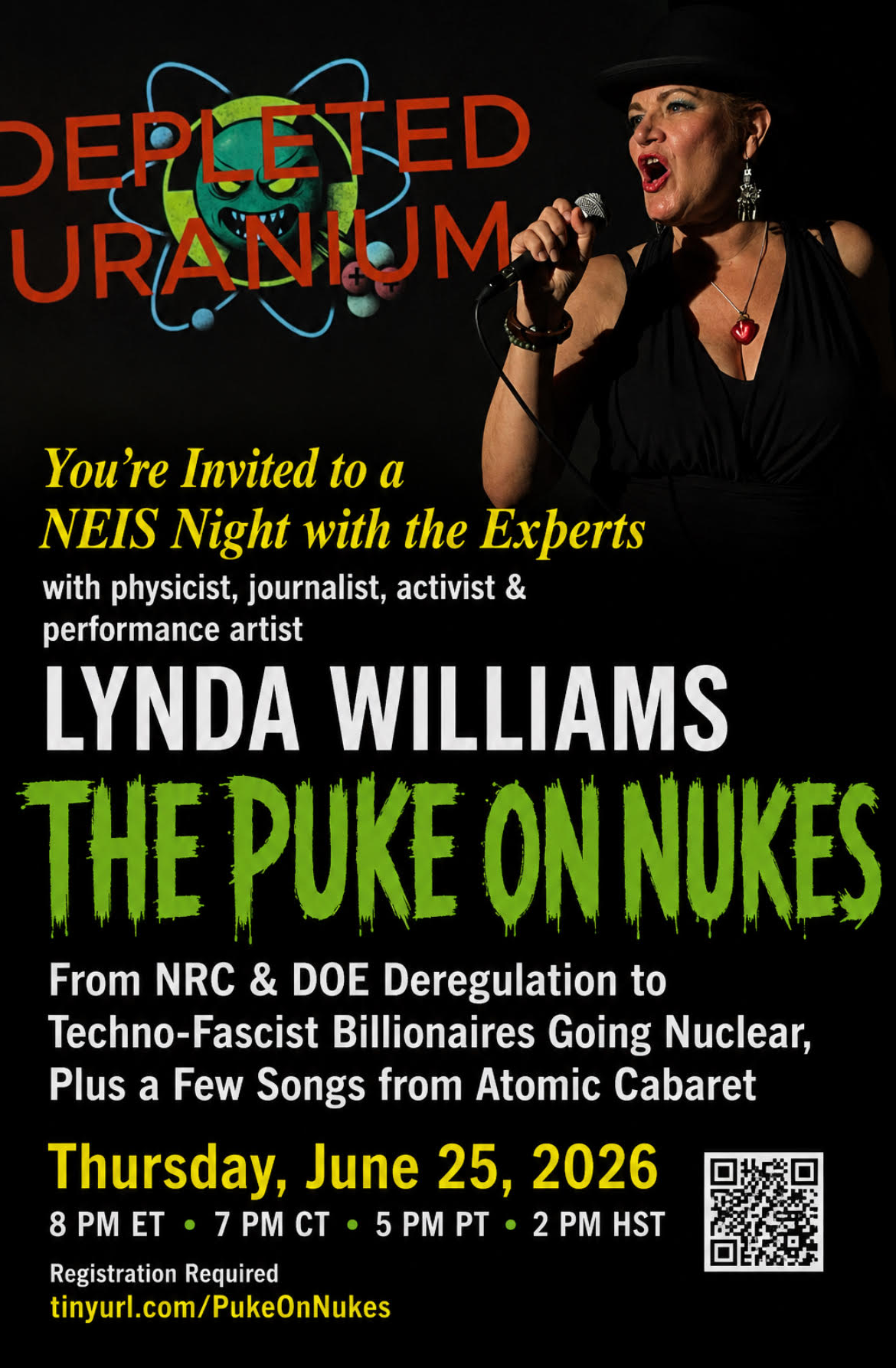
25 June- THE PUKE ON NUKES
Thursday, June 25, 2026
7pm Central Time (8pm ET, 6pm MT, 5pm PT) UTC – 5
From NRC & DOE Deregulation to Techno-Fascist Billionaires Going Nuclear, Plus a Few Songs from Atomic Cabaret REGISTER
26 June – Radiation Trainwreck at the NRC / Join the Protect Better Campaign – https://us02web.zoom.us/meeting/register/4ZlZ5_qLSHGiLSCg8FF6Bg#/registration


Cuba Is Not a Failed State – It Is a Besieged State
PETITION: “Global Appeal to Endorse Palestinian Right of Return of Refugees”
To see nuclear-related stories in greater depth and intensity – go to https://nuclearinformation.wordpress.com
-
Archives
- June 2026 (162)
- May 2026 (306)
- April 2026 (356)
- March 2026 (251)
- February 2026 (268)
- January 2026 (308)
- December 2025 (358)
- November 2025 (359)
- October 2025 (376)
- September 2025 (257)
- August 2025 (319)
- July 2025 (230)
-
Categories
- 1
- 1 NUCLEAR ISSUES
- business and costs
- climate change
- culture and arts
- ENERGY
- environment
- health
- history
- indigenous issues
- Legal
- marketing of nuclear
- media
- opposition to nuclear
- PERSONAL STORIES
- politics
- politics international
- Religion and ethics
- safety
- secrets,lies and civil liberties
- spinbuster
- technology
- Uranium
- wastes
- weapons and war
- Women
- 2 WORLD
- ACTION
- AFRICA
- Atrocities
- AUSTRALIA
- Christina's notes
- Christina's themes
- culture and arts
- Events
- Fuk 2022
- Fuk 2023
- Fukushima 2017
- Fukushima 2018
- fukushima 2019
- Fukushima 2020
- Fukushima 2021
- general
- global warming
- Humour (God we need it)
- Nuclear
- RARE EARTHS
- Reference
- resources – print
- Resources -audiovicual
- Weekly Newsletter
- World
- World Nuclear
- YouTube
-
RSS
Entries RSS
Comments RSS
 nuclear-news