A decision with vision – ban on uranium minng near Grand Canyon
the 20-year ban is supported by an unprecedented coalition of tribal leaders; hunting, fishing, ranching and conservation groups; municipal water suppliers; wildlife advocates; and nearly 300,000 individuals who commented favorably on the proposed moratorium. Chambers of commerce, community leaders and elected officials are also among those mainstream voices speaking out against a handful of politicians now defending industrialists’ demand to exploit our treasured landscape.
At risk are the Grand Canyon’s watersheds. These interconnected surface and groundwater systems extend many miles beyond the park’s boundary.
 Uranium-mining ban was a grand decision, The Arizona Republic, by Roger Clark – Jan. 22, 2012 Arizonans and all Americans won a major victory on Jan. 9 when Interior Secretary Ken Salazar signed a “record of decision” for a 20-year ban on new uranium claims on 1.1 million acres of public land surrounding Grand Canyon National Park.
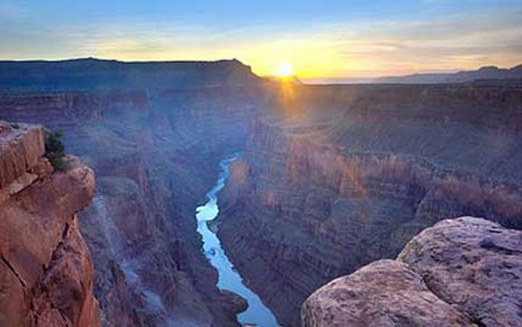
The decision reduces the risk of permanent harm to wildlife, water, our economy and sites sacred to Havasupai and all native people in ourregion. It also best serves our nation’s interests. Continue reading
Nuclear power and water rights in Utah
“the Nuclear Regulatory Commission is notorious for cozying up to the nuclear industry and basically never says no,”
“approval of the application doesn’t actually guarantee there will be enough water to operate the plant.”
 Water Rights Approved for Nuclear Plant 01.22.2012 by Whittney Evans, (KCPW News) Utah State Engineer Kent Jones has approved water rights from the Green River for Blue Castle Holdings’ proposed nuclear power plant in Emery County, much to the dismay of environmental groups.
Matt Pacenza, Policy Director of the anti-nuclear group HEAL Utah, says the decision was the only opportunity for a Utah official to reject the plan. He says the company now faces two hurdles, the easier of which will be getting permission from the U.S. Nuclear Regulatory Commission.
“Although the process will take several years and will cost them quite a bit of money, the NRC is notorious for cozying up to the nuclear industry and basically never says no,” he says. “So one imagines that they will fairly easily convince Washington bureaucrats that it’s okay to put a nuclear reactor in Utah.”
Pacenza says the bigger hurdle is finding investors and customers for the power. Rob Mrowka with the Center for Biological Diversity says taking almost 54,000 acre-feet of water a year from the Green River would impact rare fish, among other problems. “…to the point of perhaps driving those already listed for protection to the point of extinction and necessitating the addition of the other three to the endangered species act list of protected species,” says Mrowka.
A call to the state engineer’s office was not returned. In a news release, he said concerns raised about the water rights application were considered, adding that an application must be approved by law if the water is available, it won’t interfere with existing water rights, and it would not be detrimental to the public welfare. And approval of the application doesn’t actually guarantee there will be enough wate rto operate the plant.
http://kcpw.org/blog/local-news/2012-01-22/water-rights-approved-for-nuclear-plant/
World’s groundwater being depleted
since the year 1900 up to the year 2008, something in the order of 4,500 cubic kilometres of depletion; most of that occurring in the last 50 years. That’s how much less water is in the ground today than 108 years ago.
 Audio http://www.abc.net.au/pm/content/2012/s3413882.htm Is the world facing a groundwater crisis? ABC Rural radio Dubravka Voloder reported this story on January 23, 2012 MARK COLVIN: Water is not just a sensitive subject in Australia. In a crowded world of seven billion people, water is an increasing source of friction and the lack of it could have damaging results.
International water researchers say that water shortages could affect world food production in the next few decades unless something’s done about it. The scientists are meeting in Sydney to discuss whether there’ll be a groundwater crisis.
Dubravka Voloder reports. Continue reading
Oyster Creek nuclear plant will close, despite pro nuclear court ruling about Vermont
jurisdictional issues over safety and water quality mean the Vermont Yankee ruling has little impact on the agreement to close Oyster Creek.
Every day Oyster Creek strains 1.4 billion gallons of bay water through its cooling system, he said. The bay only has 60 billion gallons of water. The strain Oyster Creek puts on the bay is equivalent to 2.4 percent of the bay’s water each day and 800 percent each year.
“It’s just a gargantuan death machine as far as fish eggs and plant larva,”
 Oyster Creek Stands By Closure Plan Despite Federal Court Ruling ‘No similarities’ between Vermont ruling and Lacey nuclear plant’s planned shutdown, DEP says Lacey Patch, By Elaine Piniat, 23 Jan 12, Oyster Creek will stick to the plan to close in 2019 after a federal judge ruled that the Vermont Yankee nuclear plant could remain open beyond its scheduled shutdown date, plant spokesperson Suzanne D’Ambrosio said.
“We made a commitment to our regulators and to the public,” she said. “Our commitment and our plan is to retire Oyster Creek in 2019. That’s the plan.”
A U.S. district judge in Brattelboro, Vt., ruled Thursday that the Vermont Yankee nuclear plant could remain open beyond its scheduled shutdown date this year, the Washington Post reported. The state had originally ruled against Vermont Yankee’s federal operating license, which gives the plant 20 more years to operate.
Advocates opposed to Oyster Creek have showed concerns that this federal decision could impact the Forked River-based nuclear plant’s closure date. Continue reading
Continuing radiation fallout danger from Fukushima nuclear disaster
 Radiation used to be a word that evoked serious concern in a lot of people. However, the nuclear industry and its supporters have done a masterful job in allaying public fears about it. They do this in significant part by relying on outdated and highly questionable data collected on Japanese atom bomb survivors, while at the same time ignoring and dismissing inconvenient but much more relevant evidence that shows the actual harmful effects of radiation exposure from nuclear accidents.
neglecting to monitor the fallout will not make it go away. In fact, another enormous problem with radioactive contamination is that it bioaccumulates in the environment, which means it concentrates as it moves up the food chain. (Think of mercury in fish.) Because many radionuclides are so long-lived, this can be a problem for a very long time.
 Fukushima Update: Why We Should (Still) Be Worried Business Insider, Russ Baker, WhoWhatWhy | Jan. 20, 2012, After the catastrophic trifecta of the triple meltdowns at the Fukushima Daiichi nuclear complex in Japan last March—what the Japanese are referring to as their 3/11—you would think the Japanese government would be doing everything in its power to contain the disaster. You would be wrong—dead wrong.
Instead of collecting, isolating, and guarding the millions of tons of radioactive rubble that resulted from the chain reaction of the 9.0 earthquake, the subsequent 45- to 50-foot wall of water that swamped the plant and disabled the cooling systems for the reactors, and the ensuing meltdowns, Japanese Environment Minister Goshi Hosono says that the entire country must share Fukushima’s plight by accepting debris from the disaster……
The enormous volume of waste is much more than the disaster areas can handle. So, in an apparent attempt to return this region to some semblance of normal life, the plan is to spread out the waste to as many communities across the country as will take it. Continue reading
AREVA’s environmental plan for uranium mining rejected by Nunavut
 “Barry McCallum [Areva’s manager of Nunavut affairs] from Areva has been boasting about how many thousands of pages long their draft environmental impact statement is. It appears that size isn’t everything,” said Jack Hicks, a member of Nunavummiut Makitagunarningit, in an email.
Nunavummiut Makitagunarningit has lobbied against the Kiggavik project for years and is opposed to uranium mining in Nunavut….
 NIRB gives Areva failing grade on Kiggavik’s draft EIS Environmental review on uranium scheme stalled NUNATSIAQ NEWS, Nunavut January 20, 2012 The Kiggavik uranium project, about 80 km from Baker Lake, would cost
$2.1 billion to build … The Nunavut Impact Review Board has rejected Areva Canada’s
draft environmental statement and said an environmental review cannot begin until the company fixes its work.
An environmental review of Nunavut’s first uranium mine is stalled for the time being, following a decision by the Nunavut Impact Review Board to reject an 11-volume draft environmental impact statement from Areva Canada on its proposed Kiggavik uranium extraction project near Baker Lake. Continue reading
Radioactive cesium in the ocean fish food chain
 Some cesium was found in 16 of these 22 species in November, the last
full month for which data was available.
Cesium was especially prevalent in certain of the species:
– 73 per cent of mackerel tested
– 91 per cent of the halibut
– 92 per cent of the sardines
– 93 per cent of the tuna and eel
– 94 per cent of the cod and anchovies
– 100 per cent of the carp, sea-weed, shark and monkfish
After Fukushima, fish tales, By Alex Roslin, The Montreal Gazette January 14, 2012 “…………evidence has emerged that the impacts of the disaster on the Pacific Ocean are worse than expected.
Since a tsunami and earthquake destroyed the Fukushima Daiichi Nuclear Power Plant last March, radioactive cesium has consistently been found in 60 to 80 per cent of Japanese fishing catches each month tested by Japan’s Fisheries Agency. Continue reading
Inadequate monitoring of Fukushima radiation in ocean
Buesseler has already reported some results from the 15-day cruise last May and June….. ”It implies the groundwater is contaminated or the facility is still leaking radiation.”
”There is no safe level of radiation. They should be making every effort to monitor food.”.
After Fukushima, fish tales, By Alex Roslin, The Montreal Gazette January 14, 2012“.………..evidence has emerged that the impacts of the disaster on the Pacific Ocean are worse than expected.
“People want to know what’s happening with the cesium and how much is in the fish, but we don’t know. It’s frustrating,” said oceanographer Buesseler.
“It’s disconcerting how big of an event Fukushima was and how little data are out there. No one has taken responsibility for studying this in a single agency (in the U.S.), even though we also have reactors on the coast and other events could happen,” he said. Continue reading
Fukushima radiation around the world
Fukushima Radiation Spreads Worldwide, Global Research 17 Jan, by Washington’s Blog California, Finland, Canada, Australia Hit By Radiation The University of California at Berkeley detected cesium levels in San Francisco area milk above over EPA limits … and even higher than they were 6 months ago.
Finnish public television says that cesium from Fukushima has been detected in lichens, fungi and elk and reindeer meat in Finland.
The Australian Radiation Protection and Nuclear Safety Agency confirmed a radiation cloud over the East Coast of Australia.
The West Coast of Canada is getting hit by debris from Japan … and at least some of it is likely radioactive…..
Bed Bath and Beyond has recalled radioactive tissue holders after they set off police radiation monitors aboard a delivery truck This may just be an example of the incredibly lax handling of radioactive materials.
And thyroid cancers are – mysteriously – on the rise in the U.S.
But don’t worry: The owner of the Fukushima plant has the plant in cold shutdown, so everything is “under control” … Although temperatures have apparently jumped inside Fukushima’s number 2 reactor, and the Japanese have no idea where the nuclear fuel has gone, so they are drilling a hole into the contain
Fukushima radiation cleanup might cause environmental damage
Ten months after the nuclear disaster, trust in the authorities is nearly non-existent. Without it, Japan’s government risks the biggest cleanup fiasco of all: a decontamination effort that carries huge financial and environmental costs but still fails to convince Fukushima residents that their homes, farms, and forests are safe once again.
Fukushima nuclear cleanup could create its own environmental disaster
Decontaminating the Fukushima region to remove radioactive particles will not be possible without removing large amounts of soil, leaves and plants Winifred Bird for Yale Environment 360, part of the Guardian Environment Network guardian.co.uk, 9 January 2012 Following the nuclear disaster at Chernobyl 25 years ago, the Soviet government chose long-term evacuation over extensive decontamination; as a result, the plants and animals near Chernobyl inhabit an environment that is both largely devoid of humans and severely contaminated by radioactive fallout.
The meltdown last March of three nuclear reactors at the Fukushima Daiichi nuclear power plant in Japan also contaminated large areas of farmland and forests, albeit not as severely or extensively as at Chernobyl. But lacking land for resettlement and facing public outrage over the accident, the Japanese government has chosen a very different path, embarking on a decontamination effort of unprecedented scale.
Beginning this month, at least 1,000 sq km of land — much of it forest and farms — will be cleaned up as workers power-spray buildings, scrape soil off fields, and remove fallen leaves and undergrowth from woods near houses. The goal is to make all of Fukushima livable again. But as scientists, engineers, and ordinary residents begin this massive task, they face the possibility that their efforts will create new environmental problems in direct proportion to their success in remediating the radioactive contamination. Continue reading
Japanese towns Okuma, Futaba to disappear because of nuclear radiation
many spots in the two towns where annual levels of exposure to radiation would be 100 millisieverts or higher. This is at least five times higher than the level deemed safe for human habitation.
 2 towns at risk of disappearing / Okuma, Futaba face uncertain future due to nearby crippled N-plant Yasushi Kaneko / Daily Yomiuri 9 Jan 12, How will the government help the estimated 25,000 people who lived in areas where residency likely will be prohibited for an extended period due to the crisis at the Fukushima No. 1 nuclear power plant?
In particular, Okuma and Futaba towns in Fukushima Prefecture will face extreme hardship because most of their residential areas fall in those areas. The crippled nuclear plant is located in the two towns. Continue reading
As radioactivity lingers, most of Japan’s evacuees not returning home
 “We can’t go home even if we want to, out of consideration for our children,”
More than half of nuclear radiation zone evacuees in Japan have yet to return home, The Australian Eye, By Nigel Shelbourne, December 31, 2011 FUKUSHIMA, Japan _ Fifty-four percent of evacuees from areas between 20 and 30 kilometers (12.5 and 18.6 miles) of the Fukushima No. 1 nuclear power plant in Japan have yet to return home, three months after the government lifted its emergency evacuation preparation zones. Continue reading
Uranium’s radiation danger: Port Hope and Huntington
“Contrary to statements provided by federal government agencies, no level of radiation is safe and it is cumulative — each dose adds to the risk of cancer. Children are 10 to 20 times more radiosensitive than adults, and fetuses are extremely sensitive,”
Port Hope Uranium Plant Contamination Circumstances Contain Similarities to Huntington’s Buried Uranium Plant, December 29, 2011 BY TONY RUTHERFORD HUNTINGTON NEWS Port Hope has a water treatment plant supplying its drinking water. Incredibly, adjacent to this water treatment plant, is a huge factory which emits uranium gas and dust into the air and Lake Ontario. Continue reading
UK’s legacy of radiation from World War 2
Former RAF base at Little Rissington named by MoD as contaminated Cotswold Journal, 29th December 2011 THE former Red Arrows site at Little Rissington has been revealed by the MoD as one of 15 places in the UK to be contaminated by radioactivity from the Second World War.
A dozen such sites, which have not been made public by the ministry before, were revealed after a parliamentary question was asked of MP Andrew Robathan earlier this month…… Building work has already started on a raft of other amenities including a primary school, health centre and shops, and leisure facilities are planned for the site.
Lionel Teague, chairman of the Little Rissington Parish Council, said the council was unaware of the contamination…… The contamination comes from radium used to coat the dials of aircraft and other equipment to illuminate them in the dark. The radium comes from scrap
that was burned and dumped in the 1940s and 50s….. http://www.cotswoldjournal.co.uk/news/9441673.Ex_RAF_base_radiation_alert/
China continues research on Fukushima radiation in Pacific Ocean
China conducts second radiation monitor in Pacific Ocean By Yu Jianbin (People’s Daily Overseas Edition), December 29, 2011 Edited and translated by People’s Daily Online A marine monitoring team dispatched by China’s State Oceanic Administration accomplished the mission of monitoring radiation in the western Pacific Ocean for the second time, and returned to Xiamen on Dec. 27 aboard the Xiangyanghong 09 scientific exploration ship.
The monitoring team sailed about 6,100 nautical miles in 30 days, and monitored radiation in the air over and water in the western Pacific Ocean as well as radiation-sensitive sea creatures, chemistry and dynamic environments.
This is the second time that China has monitored radiation in international waters in the western Pacific Ocean.
The aim of the mission is to gain a deeper understanding of the impact of Japan’s Fukushima Daiichi nuclear disaster on the western Pacific Ocean and China’s marine environment, and to help build a western Pacific marine environmental monitoring and early warning system.
http://english.peopledaily.com.cn/202936/7691886.html
1 This Month
26 September – International Day for the Total Elimination of Nuclear Weapons





PLEASE OPPOSE HR 8255 AND S.3639 – bills would accelerate satellite deployment, with no environmental review or safeguards – https://ncstd5li.quorum.us/campaign/169331/
To see nuclear-related stories in greater depth and intensity – go to https://nuclearinformation.wordpress.com
-
Archives
- September 2026 (291)
- August 2026 (330)
- July 2026 (355)
- June 2026 (287)
- May 2026 (306)
- April 2026 (356)
- March 2026 (251)
- February 2026 (267)
- January 2026 (308)
- December 2025 (358)
- November 2025 (359)
- October 2025 (375)
-
Categories
- 1
- 1 NUCLEAR ISSUES
- business and costs
- climate change
- culture and arts
- ENERGY
- environment
- health
- history
- indigenous issues
- Legal
- marketing of nuclear
- media
- opposition to nuclear
- PERSONAL STORIES
- politics
- politics international
- Religion and ethics
- safety
- secrets,lies and civil liberties
- spinbuster
- technology
- Uranium
- wastes
- weapons and war
- Women
- 2 WORLD
- ACTION
- AFRICA
- Atrocities
- AUSTRALIA
- Christina's notes
- Christina's themes
- culture and arts
- Events
- Fuk 2022
- Fuk 2023
- Fukushima 2017
- Fukushima 2018
- fukushima 2019
- Fukushima 2020
- Fukushima 2021
- general
- global warming
- Humour (God we need it)
- Nuclear
- RARE EARTHS
- Reference
- resources – print
- Resources -audiovicual
- Weekly Newsletter
- World
- World Nuclear
- YouTube
-
RSS
Entries RSS
Comments RSS

