Radiation induced mutations in insects
 Mousseau et al confirms Cornelia Hesse-Honegge, Paul Langley’s Nuclear History Blog, 10 Feb 12, http://www.wissenskunst.ch/en/biographie.htm have a look at the illustrations. quote: Biography Cornelia Hesse-Honegger, scientific illustrator and science artist, was born in 1944 in Zurich, Switzerland. For 25 years she worked as a scientific illustrator for the scientific department of the Natural History Museum at the University of Zurich. Since 1969 she has collected and painted leaf bugs, Heteroptera. Her watercolors are exhibited internationally at museums and galleries. Her work is an interface between art and science; it plays witness to a beautiful but endangered nature.
Since the catastrophe of Chernobyl in 1986, she has collected, studied and painted morphologically disturbed insects, which she finds in the fallout areas of Chernobyl as well as near nuclear installations. http://nuclearhistory.wordpress.com/2012/02/09/mousseau-et-al-confirms-cornelia-hesse-honegger/
13.5 tons of water hourly in effort to cool Fukushima nuclear reactor No. 2
 Boric acid to prevent recriticality, Japan Times,8 Feb 12, Reactor No. 2 heats up, gets more water Kyodo Workers at the Fukushima No. 1 nuclear plant increased the amount of water injected into reactor 2 on Tuesday to the highest level since the plant achieved cold shutdown in December as concerns grew over rising temperatures at the bottom of the pressure vessel….
Tepco said it increased the amount of injected water, some of which contained boric acid, at 4:24 a.m. Tuesday. Reactor 2 is now being cooled with 13.5 tons of water per hour, up from 10.5 tons. The boric acid is being used to prevent a sustained nuclear chain reaction, or recriticality.
Nuclear disaster minister Goshi Hosono told reporters that Tepco is
making every effort to lower the temperature…. http://www.japantimes.co.jp/text/nn20120207x1.html
Uranium company’s bribes to law-makers can backfire
 Lawmaker: Trip to France dissuaded him on uranium mining, Pilot Online.com. 7 Feb 12, “……..The bulk of the largesse directed at Cosgrove was the $12,449 spent by Virginia Uranium, the company lobbying to establish a uranium mine in Pittsylvania County. The
company sent Cosgrove and several other lawmakers to visit a mine site in France.The purpose of the trip, Cosgrove said, was to reassure the Virginia legislators that uranium could be mined safely with no chance of contaminating Lake Gaston, a major source of Hampton Roads’ drinking water that lies downstream from the proposed mine site.
But the trip persuaded him of the exact opposite, Cosgrove said. “They never showed us beyond any doubt that there couldn’t be some catastrophic effect on our drinking water,” he said. As a result, “I came back thinking that uranium mining is probably not in the best
interest of Hampton Roads.”… http://hamptonroads.com/2012/02/lawmaker-trip-france-dissuaded-him-uranium-mining
Polynesia’s radioactive pollution from France’s nuclear bomb tests
 France’s upper chamber approved a motion that provides for Mururoa and Fangataufa, currently under the control of the defence ministry, to be restored to the Polynesian public domain, though the bill stands little chance of becoming law. “We realise that they are the two largest nuclear dumps in an ocean environment. But in Oceania you cannot separate human beings from their ecosystem,” says the author of the bill, Senator Richard Tuheiva. “Restitution [of the atolls] is a way of soothing the psychological wounds [caused by the nuclear era].”
 about 5kg of plutonium is trapped in the sediment at the bottom of the Mururoa and Fangataufa lagoons, ……. There is no question of them returning to “normal” use.
 France urged to clean up deadly waste from its nuclear tests in Polynesia, Guardian UK, 7 Feb 2012, 193 nuclear tests carried out on the Mururoa and Fangataufa atolls between 1966 and 1996 have left a dangerous legacy. Continue reading
In amongst spent nuclear fuel rods – a weirdness, perhaps a mutant spider’s web

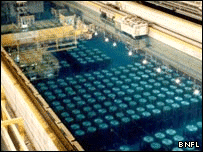 Could Spider-Man become a reality? Bizarre white cobweb found on nuclear waste that could have come from a ‘mutant’ spider Daily Mail, By TED THORNHILL 6th February 2012 Scientists are investigating a bizarre white cobweb found on nuclear waste – amid fears it could have been made by a ‘mutant’ spider. Continue reading
Spain wants USA to clean up plutonium pollution B-52 bomber accident
two of the bombs that hit the ground detonated, spreading seven pounds of plutonium over a 200 hectares (490 acres).
US and Spain discuss cleanup of nuclear radiation, PhysOrg.com, February 5, 2012 The United States is offering technical assistance to Spain to clean up land contaminated by radiation from undetonated nuclear bombs that accidentally fell on the area in 1966, Continue reading
Birds and radiation fallout
not sure of the reliability of this one
Bird life badly hit by nuclear fallout in Japan The Irish Times – February 3, 2012, DAVID McNEILL in Tokyo RESEARCHERS WORKING in the irradiated zone around the disabled Fukushima nuclear plant say bird populations there have begun to dwindle, in what may be a chilling harbinger of the impact of radioactive fallout on local life. Continue reading
USA govt does not want monitoring of radiation near Savannah River Nuclear Site
 U.S. Department of Energy won’t help Georgia monitor radiation near Savannah River Nuclear Site The Augusta Chronicle By Rob Pavey Feb. 2, 2012 The U.S. Department of Energy will not honor its 2010 offer to help Georgia’s Environmental Protection Division restore a program to monitor radiation levels in Georgia counties near Savannah River Site…..
The intent of the monitoring, which includes analysis of water, soil, vegetation and air, is to determine off-site effects from SRS – and to provide independent data to compare with
extensive sampling already conducted by DOE on both sides of the Savannah River.
Anti-nuclear activists who lobbied for the restoration of the Georgia program said the Department of Energy’s about-face is disturbing. “The DOE’s obstruction to environmental monitoring in Georgia is a gross example of environmental injustice,” said Bobbie Paul, the
director of Georgia Women’s Action for New Directions. “Radiation does
not acknowledge state boundaries.” In 2010, then DOE Assistant Secretary Ines Triay pledged that monitoring would be restored to Georgia with a five-year contract independent of any restrictions from SRS.
“The money was never sent and in July 2011, DOE reported they would only fund $300,000 annually, less than half of what the program received annually when the its funding was cut in 2003,” Paul said. “Now, the offer is off the table.”
Giusti said SRS has a half century of experience at monitoring programs, which will remain intact to protect health and the environment. http://chronicle.augusta.com/news/government/2012-02-02/us-department-energy-wont-help-monitor-georgia-radiation-near-savannah?v=1328205850
Radioactive drinking water risk for 11 million people
 New York nuclear plant threatens drinking water for 11M people, (philstar.com) February 01, 2012 NEW YORK –– The drinking water for more than 11.3 million people could be at risk of radioactive contamination from a leak or accident at the Indian Point Nuclear Plant, located in Buchanan, New York, said a new study released on Tuesday.
According to the report by Environment New York, the state environmental advocacy organization, the drinking water intakes for 11.3 million people in New York, New Jersey, and Connecticut are within 50 miles of Indian Point — the distance the U.S. Nuclear Regulatory Commission uses to measure risk to food and water supplies.
The report also showed that the Indian Point Nuclear Plant threatens drinking water supplies for more than twice as many people compared to any other nuclear facility in the United States.
Environment New York is urging the state to deny the plant relicensing and to move toward a future with no nuclear power and use clean, renewable energy such as wind and solar power. The Indian Point Nuclear Plant, which is 80-minute ride from New York City, has a long history of leaks and accidental releases of radioactive material. One of its nuclear reactors was recently shut down to repair a pump, which was leaking radioactive coolant. http://www.philstar.com/Article.aspx?articleId=773362&publicationSubCategoryId=200
Radioactivity poses risk in Japan’s tsunami debris
 citizens say they are worried about radioactivity or even say that we should refuse to import this debris. “They worry about their children, they are afraid that radiation levels are too high.”
Radiation experts agree that children are at greatest risk from cancers and genetic defects because they are still growing, are more prone to thyroid cancers, and because they will have more time to develop health defects…..
Radiation fears slow tsunami clear-up, News 24, 1 Feb 12, Tokyo – Giant piles of debris from Japan’s earthquake and tsunami scar the country’s once picturesque northeast coast – and the clear-up is hamstrung by fears the rubbish may be contaminated by radiation. Continue reading
Area on endangered list, due to possibility of uranium mining
Uranium puts Southside on endangered list GoDanRiver.com January 27, 2012 Southside landed on the Southern Environmental Law Center’s fourth annual Top 10 Endangered Places in the Southeast list because of proposed uranium mining and pressure to lift Virginia’s uranium moratorium.
Many of the areas on SELC’s top 10 list are endangered by pressure to undercut environmental protections and to lower the hurdles for potentially destructive projects, …..
Nuclear fuel could be corroded by seawater
How sea water could corrode nuclear fuel, UC Davis, January 26, 2012, Japan used seawater to cool nuclear fuel at the stricken Fukushima-Daiichi nuclear plant after the tsunami in March 2011 — and that was probably the best action to take at the time, says ProfessorAlexandra Navrotsky of the University of California, Davis.
But Navrotsky and others have since discovered a new way in which seawater can corrode nuclear fuel, forming uranium compounds that could potentially travel long distances, either in solution or as very small particles. The research team published its work Jan. 23 in the
journal Proceedings of the National Academy of Sciences.
“This is a phenomenon that has not been considered before,” said Alexandra Navrotsky, distinguished professor of ceramic, earth and environmental materials chemistry. “We don’t know how much this will increase the rate of corrosion, but it is something that will have to
be considered in future.”….
In the new paper, the researchers show that in the presence of alkali metal ions such as sodium — for example, in seawater — these clusters are stable enough to persist in solution or as small particles even when the oxidizing agent is removed.
In other words, these clusters could form on the surface of a fuel rod exposed to seawater and then be transported away, surviving in the environment for months or years before reverting to more common forms of uranium, without peroxide, and settling to the bottom of the
ocean. There is no data yet on how fast these uranium peroxide clusters will break down in the environment, Navrotsky said… http://www.news.ucdavis.edu/search/news_detail.lasso?id=10131
Radioactive threats to the Great Lakes
Nuclear worries abound in Great Lakes region. Do solutions?, Medill News, BY RORY KEANE, JAN 26, 2012 “..…The report, titled “Too Close to Home,” cites numerous articles that followed the unfolding disaster at Japan’s Fukushima-Daiichi nuclear power plant and concerns in the U.S., including a series of Associated Press stories dating from summer of 2010.
According to the report, over 10 million Americans in Great Lakes states, excluding Indiana and Minnesota, receive drinking water originating within 12 miles of a nuclear power plant. The AP stories cited focused on radioactive isotopes that could leak into drinking water. Continue reading
Uranium mining and radioactive water pollution
The truly frightening part is the sentence that reads, ” Covering tailings material with water during operations …” Where do they imagine all that water will end up? It’s water containing not only radioactive material, but a host of other toxins as well? And how do they know for certain that an earthquake could not crack that containment cell open like an egg or that a hurricane would not dump enough water on Coles Hill to cause those cells to become so saturated that they leak their contents into the groundwater surrounding them?
 Uranium risks far outweigh benefits AltaVista Journal, Jesse Andrews, 25 Jan 12, Virginia Uranium Inc.’s most recent propaganda release, “We’re committed to protecting water quality.” Why does VUI feel the need to continue to explain itself if in fact uranium mining would be as safe and innocuous as they claim? If uranium mining had ever been safe anywhere, which it has not, they wouldn’t feel such a desperate need to explain just how safe their mine would be.
What they have presented is a pretty drawing of a disaster waiting to happen. A containment cell constructed just like your local landfill, only instead of household garbage, it contains radioactive waste. A nice concept, but one whose reliability over the course of 1,000 years is indeed doubtful. Continue reading
Over 2 million Californians risk radioactive water pollution in proximity to nuclear reactors
Nuclear Power Plants Threaten Drinking Water for 2.3 Million Californians
San Diego is the 6th Largest Region in the Country to Have Drinking Water Sources Located Within 50 Miles of a Nuclear Plant YubaNet.com Jan 24, 2012 By: CALPIRG San Diego, CA January 24, 2012 – The drinking water for 2.3 million people in California could be at risk of radioactive contamination from a leak or accident at a local nuclear power plant, says a new study released today by the California Public Interest Research Group Education Fund and Environment California Research and Policy Center.
“The danger of nuclear power is too close to home. Here in California, the drinking water for 2.3 million people is too close to an active nuclear power plant,” said Emily Rusch, CALPIRG Education Fund State Director. “An accident or a leak could spew cancer-causing radioactive waste into our drinking water.” Continue reading
1 This Month
26 September – International Day for the Total Elimination of Nuclear Weapons





PLEASE OPPOSE HR 8255 AND S.3639 – bills would accelerate satellite deployment, with no environmental review or safeguards – https://ncstd5li.quorum.us/campaign/169331/
To see nuclear-related stories in greater depth and intensity – go to https://nuclearinformation.wordpress.com
-
Archives
- September 2026 (291)
- August 2026 (330)
- July 2026 (355)
- June 2026 (287)
- May 2026 (306)
- April 2026 (356)
- March 2026 (251)
- February 2026 (267)
- January 2026 (308)
- December 2025 (358)
- November 2025 (359)
- October 2025 (375)
-
Categories
- 1
- 1 NUCLEAR ISSUES
- business and costs
- climate change
- culture and arts
- ENERGY
- environment
- health
- history
- indigenous issues
- Legal
- marketing of nuclear
- media
- opposition to nuclear
- PERSONAL STORIES
- politics
- politics international
- Religion and ethics
- safety
- secrets,lies and civil liberties
- spinbuster
- technology
- Uranium
- wastes
- weapons and war
- Women
- 2 WORLD
- ACTION
- AFRICA
- Atrocities
- AUSTRALIA
- Christina's notes
- Christina's themes
- culture and arts
- Events
- Fuk 2022
- Fuk 2023
- Fukushima 2017
- Fukushima 2018
- fukushima 2019
- Fukushima 2020
- Fukushima 2021
- general
- global warming
- Humour (God we need it)
- Nuclear
- RARE EARTHS
- Reference
- resources – print
- Resources -audiovicual
- Weekly Newsletter
- World
- World Nuclear
- YouTube
-
RSS
Entries RSS
Comments RSS

