Dumping of Fukushima radioactive water into Pacific Ocean
 Report: Tepco now dumping contaminated water from Fukushima plant into ocean — 200 tons of radioactive groundwater “pumped out” http://enenews.com/report-tepco-begins-dumping-contaminated-water-into-ocean-200-tons-of-radioactive-groundwater-pumped-out
Kyodo News: Tokyo Electric Power Co. plans to discharge some groundwater that has flowed into the premises of the crippled Fukushima Daiichi nuclear power plant […] As a trial, TEPCO has pumped out about 200 tons of groundwater using the wells. Its density of radioactive substances was “the same as rivers in surrounding areas,” according to company officials. […] The utility hopes to hold a meeting with local fishermen Monday to seek approval of the groundwater release […]
SimplyInfo: TEPCO B Begins Dumping Contaminated Water Into The Sea […] TEPCO has begun dumping groundwater pumped out of a set of wells inland from the reactors into the Pacific. TEPCO dumped 200 tons of groundwater yesterday as a test. […]
From Yesterday: Asahi: Tepco to dump groundwater from Fukushima nuclear plant into Pacific Ocean — Trying to “avoid a total collapse” of system for handling radioactive water (PHOTO)
Tomatoes, deformed by Fukushima radiation, on sale in Japan
 Fukushima: Japan sells radiation-mutated tomatoes http://www.agoracosmopolitan.com/news/headline_news/2013/05/04/5858.html# 04 MAY 2013 BY RAYMOND Lori Mochizuki, who edits Fukushima-Diary.com, reports that capitalists in Japan are now selling clearly discernible radiation contaminated and genetically mutated tomatoes. Mr. Mochizuki reports that such mutated plants are being increasingly found all over Japan, as the capitalist try to draw our attention elsewhere.
“I didn’t buy them.” They look like the mutated tomato on this article. The labels of origin read “Kumamoto”, in Kyushu.
Capitalists in Japan have apparently become so bold that they now seek to make money from tomatoes not fit to be eaten by human or animal alike, as their achon confederates in America and elsewhere seek to cover-up their negligent response to the on-going and worsening Fukushima crisis.
Radioactive waste dumping into the world’s oceans
 Ocean disposal of radioactive waste http://en.wikipedia.org/wiki/Ocean_disposal_of_radioactive_waste#1946-93 April 2013 (Excellent maps)
From 1946 through 1993, thirteen countries (fourteen, if the USSR and Russia are considered separately) used ocean disposal or ocean dumping as a method to dispose of nuclear/radioactive waste. The waste materials included both liquids and solids housed in various containers, as well as reactor vessels, with and without spent or damaged nuclear fuel.[1] Since 1993, ocean disposal has been banned by international treaties. (London Convention (1972), Basel Convention, MARPOL 73/78)
However, according to the United Nations, some companies have been dumping radioactive waste and other hazardous materials into the coastal waters of Somalia, taking advantage of the fact that the country had no functioning government from the early 1990s onwards. This caused health problems for locals in the coastal region and posed a significant danger to Somalia’s fishing industry and local marine life.[2]
“Ocean floor disposal” (or sub-seabed disposal)—a more deliberate method of delivering radioactive waste to the ocean floor and depositing it into the seabed—was studied by the UK and Sweden, but never implemented.[3]…….
United Nations call to save the world’s oceans
 Ban calls for concerted global action to save world’s oceans from pollution, acidification http://www.un.org/apps/news/story.asp?NewsID=44621&Cr=climate+change&Cr1=#.UYW18aJwpLt 11 April 2013 – Secretary-General Ban Ki-moon today called on world leaders to take stronger action to protect the planet’s seas, warning that pollution, unsustainable exploitation, climate change and acidification threaten the very foundations of all life and the global economy.
“We need practical, timely action at the national, regional and global levels to improve the health of the oceans, and to recover and sustain ocean resources,” he told ‘The High Seas, Our Future! Conference’ in a message read out in Paris by United Nations Educational, Scientific and Cultural Organization (UNESCO) Director-General Irina Bokova.
“It is time to take stronger, more pragmatic and more concerted effort to protect our oceans,” he said, stressing that oceans are heating up and their acidification is adversely affecting on marine life, while rising sea levels threaten to re-draw the global map at the expense of hundreds of millions of people, often the most vulnerable.
He highlighted the critical role oceans play “for the health of our planet, for all life, and for the global economy.”
Mr. Ban said he vividly remembered his meeting last year in New York with the crew of the UN-backed Tara Expedition, which travelled 70,000 miles across the Atlantic, Pacific, Antarctic and Indian oceans investigating the effects of global warming on biodiversity and marine life, particularly focusing on marine plankton.
“The Tara team and other civil society organizations are critical to raising global awareness of the importance of oceans and the challenges they face,” he concluded. “If we work together – the United Nations system, governments and businesses, civil society actors and individuals – we can find sustainable ways to support life and protect our planet and our precious oceans.”
In last few days, high spike of radiation in air in Japan and West USA
 Fukushima pushes Japan over 26 times normal radiation http://www.agoracosmopolitan.com/news/headline_news/2013/05/02/5835.html 02 MAY 2013 BY : BY SADIA ARSHAD
- As of the sampling done four days ago, the radiation fallout level has spiked up to twenty six times its average level since the past year in Japan. The reading indicates 100.4 MBq/Km2. The average reading was at 3.85 MBq/Km2 until 26th April. The reason behind this sudden climb is not known as of yet.
The leak is suspected from the radioactive waste water from the water storage ponds at Fukushima I Nuclear Power Plant. The amount of radioactive material in the water sample taken from Pond No. 1 on 27th April has led to this discovery.
As per air samples taken by the United States Environmental Protection Agency at eighteen different collection points in the Pacific States, the average level of radioactivity in the air has also spiked to more than seven times the normal levels.
Radioactive groundwater in Santa Susanna could take centuries to clean up
Santa Susana groundwater cleanup could take centuries, official says, VC Star, By Mike Harris, April 18, 2013 The groundwater cleanup at the Santa Susana Field Laboratory, the site of a 1959 partial nuclear meltdown, could take centuries, a state official said Wednesday night.
The soil decontamination will take far less time, a few or more years, but might not be finished by a 2017 deadline, Mark Malinowski of the state Department of Toxic Substances Control told about 100 people during a cleanup update at the Grand Vista Hotel in Simi Valley.
“It’s a very aggressive schedule to get to 2017, and many things have to happen correctly in order to get there,” said Malinowski, the department’s cleanup team manager.
The groundwater cleanup will take “a lot longer … decades, possibly centuries to complete,” Malinowski said. “Groundwater is an extremely difficult thing to clean up. This contamination we’re dealing with did not happen overnight.”……
Boeing owns most of the 2,850-acre site, formerly the Rocketdyne nuclear and rocket engine test facility, in the hills between Simi Valley and the San Fernando Valley. The rest of the site is owned by the federal government and administered by NASA.
During a question-and- answer period, cleanup activists sharply questioned Malinowski’s statement that no significant contamination has been found beyond the site’s boundaries.
“I had to remind him that in 2008, they removed three football fields of contaminated soil off the adjacent Sage Ranch Park property,” William Bowling said. “And then last year, the EPA found radioactivity in a well on the campus owned by the American Jewish University, which also adjoins the site.
“They’re not giving the public the clear picture, which is that there is off-site contamination,” Bowling said. http://www.vcstar.com/news/2013/apr/18/santa-susana-soil-cleanup-may-not-make-2017-deadli/#ixzz2SI1pAhgC
Shortage of water a big threat to nuclear reactors
 Cooling systems for nuclear plants and power plants that burned coal, gas and oil accounted for 41 per cent of fresh water withdrawals and 49 per cent of all water withdrawals.
During the 2003 heat wave in France, which was responsible for more than 10,000 deaths, nuclear plants had to reduce their output, worsening the crisis. The rising temperature of river water meant they could not achieve sufficient cooling and still observe discharge limits
Nuclear and coal-fired power plants with OTC systems are especially vulnerable to droughts and heat waves because they rely on by far the largest volume of water withdrawals.
US energy supplies imperiled by water shortages, The Age May 1, 2013 – John Kemp Water and energy are inextricably linked.Power plants are the largest users of water in the United States, while substantial amounts of energy are needed to supply fresh water to homes, farms and factories and treat waste water prior to safe disposal.
Rising water consumption for hydraulic fracturing and production of biofuels, coupled with severe droughts in Texas in 2011 and across more than 60 per cent of the continental United States in 2012, have propelled that link up the policymakers’ agenda.
The threat to hydroelectric generation is obvious. But in 2007-2009, drought put the water supplies of 24 of the nation’s 104 reactors at nuclear plants at risk. In 2011, more than 3,000 megawatts of thermal generating capacity in Texas also was considered at risk of having to shut down if the drought persisted as reservoir levels plunged.
Texans were asked to conserve water to keep the lights on. The state was only spared blackouts because of high output from wind farms.
On April 25, the Energy and Natural Resources Committee of the US Senate held a hearing to explore the effect of drought on the energy sector and water management, reflecting lawmakers’ fears about the instability created by the tightening links between water and energy supplies. Continue reading
Apparently uncontrolled continual leakage of Fukushima radiation into the ocean
 Fukushima’s Catastrophic Aftermath: The Dangers of Worldwide Nuclear Radiation, Global Research, By Stephen Lendman 28 April 13,“……..In early April, around 120 tons of contaminated water leaked from Fukushima’s No. 1′s underground storage tank. It contained an estimated 710 billion becquerels of radioactivity.
Water around the affected tank is highly radioactive. It’s about 800 meters from the Pacific. Government and Tokyo Electric (Tepco) claimed it won’t likely reach it. Numerous previous reports suggest otherwise.
Tepco general manager Masayuki Ono said “(w)e cannot deny the fact that our faith in the underwater tanks is being lost.”
In November 2012, Nature.com headlined “Ocean still suffering from Fukushima fallout,” saying:
“Radioactivity is persisting in the ocean waters close to Japan’s ruined nuclear power plant at Fukushima Daiichi.”
New data show high contamination levels. “The Fukushima disaster caused by far the largest discharge of radioactivity into the ocean ever seen.”
Radiation levels aren’t dropping. “The implications are serious for the fishing industry.”………http://www.globalresearch.ca/fukushimas-catastrophic-aftermath-the-dangers-of-worldwide-nuclear-radiation/5333138
17,000 tons of radioactive rice still stored in Fukushima prefecture
“It would bedifficult to find an option other than disposal.”
Fukushima’s ‘contaminated’ rice still in storage two years, Asahi
Shimbun, April 25, 2013 By TETSUYA KASAI/ Staff Writer
FUKUSHIMA–-Officials are still struggling to dispose of some 17,000
tons of contaminated rice produced in Fukushima Prefecture after the
nuclear disaster there two years ago. Most of the rice, called
“kakurimai” (rice separated for disposal), was produced in 2011.
The central government wants to incinerate the rice, but disposal
facility operators have been reluctant to do so for fear that harmful
rumors could start circulating if they handle contaminated material. Continue reading
Muslumovo, a town radioactively poisoned for 60 years
Soviet radiation biology took a different trajectory from science in the United States. American researchers at that time were working with the highly politicized medical studies of Japanese bomb survivors. They narrowed the list of radiation-related illnesses to leukemia, a few cancers, and thyroid disease. Soviet doctors in formulating chronic radiation syndrome had grasped the effects of radiation on the body more holistically. They determined that radiation illness is not a specific, stand-alone disorder, but that its indications relate to other illnesses. They determined that radioactive isotopes weaken immune systems and damage organ tissue and arteries, causing illnesses of the circulation and digestive tracts and making people susceptible to conventional diseases long before they succumb to radiation-related cancers.
 Strange illnesses in one of the most contaminated towns in the world challenge what we think we know about the dangers of radioactivity. Slate, By Kate Brown, April 18, 2013, ”…… the sad fact is that there are irradiated zones that are fully inhabited, and have been since the first years of the nuclear arms race. Despite a media culture enthralled with nuclear accidents, the cameras generally turn off after the first clouds of radioactive vapors dissipate.
“………..For Soviet leaders, the river dwellers were a unique opportunity in the history of health physics—what scientists call “a natural experiment” that promised to answer an important civil defense question about how to survive a nuclear attack. In 1962, the Cheliabinsk branch of the Soviet Institute of Bio-Physics, called FIB-4, started conducting regular medical exams of the Muslumovo population. FIB-4 doctors invited village children playing on the streets to a clinic room to take blood samples. In Cheliabinsk, they set up a repository of irradiated body parts: hearts, lungs, livers, bones. They started a collection of genetically malformed babies who died soon after birth, each infant preserved in a two-quart glass jar. A Dutch photographer, Robert Knoth, visited the repository and saw hundreds of babies in jars. He photographed one infant with skin like patched, rough burlap. Another boy had eyes on top of his head like a frog. During the examinations, doctors did not inform the villagers of their exposures or of diagnoses of radiation-related illness.
In 1986, soon after the Chernobyl disaster, Glufarida Galimova, working as chief doctor at a pediatric clinic in Muslumovo, her native town, was puzzled by the saturation of illness in her community. The illnesses were rare, strange, complex, and often genetic: hydrocephalic children, children with cerebral palsy, missing kidneys, extra fingers, anemia, fatigue, and weak immune systems. Many kids were orphaned or had invalid parents. Continue reading
Move to have uranium companies clean up their mess in Colorado
A Fight in Colorado Over Uranium Mines NYT, By DAN FROSCH April 16, 2013 SLICK ROCK, Colo.”……..Despite bursts of activity from 2003 through 2008, most uranium mines scattered across Colorado have largely been out of production for decades, a testament to fluctuating mineral prices. Now the future of these mines is at the crux of a dispute that could set a precedent for how they are handled.
Environmental groups in Colorado contend that many of the state’s 33 uranium mines should be forced to clean up, given that uranium mining, which flourished here during the cold war, has gone dormant. In legal filings, they have alleged that companies like Cotter are skirting potential costs associated with cleanup, which is required by the state after an operation shuts down. Continue reading
For the Pacific Ocean? – 400 tons daily of Fukushima radioactive water
Bloomberg: Radioactive water from Fukushima reactors to be dumped in Pacific? “It’s obvious they can’t keep storing it forever”http://enenews.com/bloomberg-tepco-to-dump-radioactive-water-from-fukushima-reactors-into-pacific-its-obvious-they-cant-keep-storing-it-forever
Title:Title: Tepco Faces Decision to Dump Radioactive Water in Pacific Ocean
Source: Bloomberg
Author: Tsuyoshi Inajima
Date: Apr 11, 2013
[Tepco]’s discovery of leaks in water storage pits at the wrecked Fukushima atomic station raises the risk the utility will be forced to dump radioactive water in the Pacific Ocean.
Leaks were found in three of seven pits in the past week, reducing the options for moving contaminated water from basements of reactor buildings. […]
Not Ruled Out
Officials at the utility known as Tepco, including President Naomi Hirose, have said the company will not “easily” release radiated water into the ocean, indicating it’s not ruling out the possibility if it runs out of storage.
“It’s obvious Tepco cannot keep storing water forever as it increases by 400 tons a day,” said Hideyuki Ban, co-director of the antinuclear group Citizens’ Nuclear Information Center. That’s why the company won’t rule out discharge into the sea, Ban said in a telephone interview. […]
See also: Tepco: It’s ‘really impossible’ for us to keep storing liquid from Fukushima reactors — We need to think about discharging it into ocean (VIDEO)
Fukushima radiation levels rise in rivers, in food 225 miles away
Deadly levels of radiation found in food 225 miles from Fukushima: Media blackout on nuclear fallout continues
http://thewatchers.adorraeli.com/2013/04/08/deadly-levels-of-radiation-found-in-food-225-miles-from-fukushima-media-blackout-on-nuclear-fallout-continues/ – Source: NaturalNews By Ethan A. HuffAPRIL 8, 2013 NEW DATA  RELEASED BY JAPAN’S MINISTRY OF HEALTH, LABOR AND WELFARE (MHLW) SHOWS ONCE AGAIN THAT THE FUKUSHIMA DAIICHI NUCLEAR DISASTER IS FAR FROM OVER. DESPITE A COMPLETE MEDIA BLACKOUT ON THE CURRENT SITUATION, LEVELS OF CESIUM-137 (CS-137) AND CESIUM-134 (CS-134) FOUND IN PRODUCE AND RICE CRACKERS LOCATED ROUGHLY 225 MILES (~ 362 KM) AWAY FROM FUKUSHIMA ARE HIGH ENOUGH TO CAUSE RESIDENTS TO EXCEED THE ANNUAL RADIATION EXPOSURE LIMIT IN JUST A FEW MONTHS, OR EVEN WEEKS. Continue reading
TEPCO on a tightrope in attempt to move tons of radioactive water
Japan nuclear safety plans too lax for crowded, quake-prone nation, say nuclear experts The Star, By: Mari Yamaguchi The Associated Press,Apr 08 2013 TOKYO
“…….TEPCO is moving tons of highly radioactive water from the temporary tanks to two similar ones nearby to minimize the leak. They are among seven underground tanks of different sizes which employ the same design.
TEPCO admitted Sunday it had dismissed earlier signs of water loss as within a margin of error and waited until a spike in radiation levels around the tanks was detected. Critics suspect cash-strapped TEPCO built poorly designed underground pits instead of safer and more manageable steel tanks to save money. TEPCO has also been criticized for delaying replacement of makeshift equipment, raising questions about whether the plant is really under control.
The underground tanks, several times the size of an Olympic swimming pool and similar to an industrial waste dump, are dug directly into the ground and protected by double-layer polyethylene linings inside an outermost clay-based lining, with a felt padding between each layer. Officials suspect there were ruptures in the linings due to the weight of the water.
Contaminated water at the plant, which suffered multiple meltdowns after the 2011 disaster, has escaped into the sea several times during the crisis. Experts suspect a continuous leak into the ocean through an underground water system, citing high levels of contamination in fish caught in waters just off the plant.
The contaminated water in the tanks is part of more than 270,000 tons of water used to cool melted fuel at the plant’s reactors damaged in the disaster. So much water has been used that TEPCO is struggling to find storage space. The water is also kept in hundreds of steel tanks.
NRA commissioner Toyoshi Fuketa told reporters Monday that the water leak poses a more immediate threat to the plant’s water management than to the environment. He questioned TEPCO’s risk evaluation in the tanks’ design process, but acknowledged that regulators have to allow TEPCO to use the remaining underground tanks for now.
“Although we need more long-term plans, we have to tackle the most immediate problem first. TEPCO’s decommissioning process is a tightrope situation to begin with,” he said. http://www.thestar.com/news/world/2013/04/08/japan_nuclear_safety_plans_too_lax_for_crowded_quakeprone_nation_say_nuclear_experts.html
Asbestos killed a town. Uranium towns next?
WA GOVERNMENT TO MOVE LAST RESIDENTS FROM ASBESTOS TOWN ABC Radio National 3 April 2013 By:Catherine Van Extel The West Australian Government is looking to move a group of residents who continue to live in the deadly asbestos mining town of Wittenoom, in the Pilbara region of Western Australia. But while there are moves to finally clean up the toxic site, many continue to face the legacy of their time spent growing up in or visiting the notorious town.
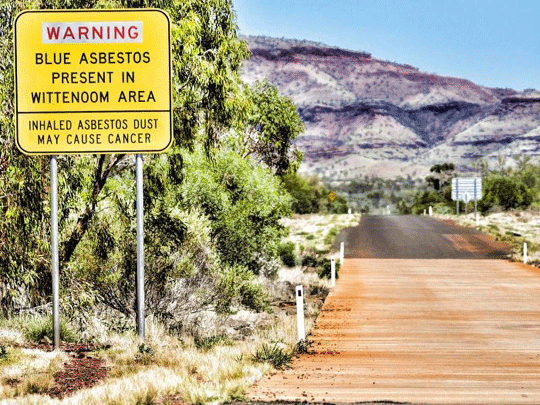
The 1990 Midnight Oil song ‘Blue Sky Mine’ was inspired by Wittenoom and its deadly mining industry. It’s estimated that more than 20,000 people lived at Wittenoom before the mine closed in 1966.
Asbestos-related diseases have killed more than 2000 former workers and family members of Wittenoom, a death toll that continues to rise.
In 2007, the state government withdrew Wittenoom’s town status—disconnecting services like water and electricity—but a small group of residents stayed. Now the government wants them out in order to remediate the contaminated site. Continue reading
1 This Month
26 September – International Day for the Total Elimination of Nuclear Weapons





PLEASE OPPOSE HR 8255 AND S.3639 – bills would accelerate satellite deployment, with no environmental review or safeguards – https://ncstd5li.quorum.us/campaign/169331/
To see nuclear-related stories in greater depth and intensity – go to https://nuclearinformation.wordpress.com
-
Archives
- September 2026 (281)
- August 2026 (330)
- July 2026 (355)
- June 2026 (287)
- May 2026 (306)
- April 2026 (356)
- March 2026 (251)
- February 2026 (267)
- January 2026 (308)
- December 2025 (358)
- November 2025 (359)
- October 2025 (375)
-
Categories
- 1
- 1 NUCLEAR ISSUES
- business and costs
- climate change
- culture and arts
- ENERGY
- environment
- health
- history
- indigenous issues
- Legal
- marketing of nuclear
- media
- opposition to nuclear
- PERSONAL STORIES
- politics
- politics international
- Religion and ethics
- safety
- secrets,lies and civil liberties
- spinbuster
- technology
- Uranium
- wastes
- weapons and war
- Women
- 2 WORLD
- ACTION
- AFRICA
- Atrocities
- AUSTRALIA
- Christina's notes
- Christina's themes
- culture and arts
- Events
- Fuk 2022
- Fuk 2023
- Fukushima 2017
- Fukushima 2018
- fukushima 2019
- Fukushima 2020
- Fukushima 2021
- general
- global warming
- Humour (God we need it)
- Nuclear
- RARE EARTHS
- Reference
- resources – print
- Resources -audiovicual
- Weekly Newsletter
- World
- World Nuclear
- YouTube
-
RSS
Entries RSS
Comments RSS

