Uranium mining continues to radioactively poison land and water in USA
Uranium Mine Pits Continue to Leak Radiation Today
Radiation and heavy metals from uranium mines continue to pollute the land, air and water today and very little action is being taken to stop it.
America’s “Secret Fukushima”: Uranium Mining is Poisoning the Bread Basket of the World By Margaret Flowers and Kevin Zeese Global Research, June 07, 2013 Truthout Early in the morning of July 16, 1979, a 20-foot section of the earthen dam blocking the waste pool for the Church Rock Uranium Mill caved in and released 95 million gallons of highly acidic fluid containing 1,100 tons of radioactive material. The fluid and waste flowed into the nearby Puerco River, traveling 80 miles downstream, leaving toxic puddles and backing up local sewers along the way.

Although this release of radiation, thought to be the largest in US history, occurred less than four months after the Three Mile Island partial nuclear meltdown that sent radioactive gases and iodine into the air, the Church Rock spill received little media attention. In contrast, the Three Mile Island accident made the headlines. And when the residents of Church Rock asked their governor to declare their community a disaster area so they could get recovery assistance, he refused. Continue reading
Radioactive seawater travels towards USA from Fukushima
Are North Americans Already Succumbing to Radiation From Japan? http://www.complex.com/city-guide/2013/06/are-north-americans-already-succumbing-to-radiation-from-japan
BY JULIAN KIMBLE | JUN 5, 2013 We don’t mean to alarm anyone, but there’s reportedly been an increase in radiation levels in food and water thanks to the Japanese earthquake and tsunami that struck in 2011. In addition, children being born with thyroid issues has also been tied to radiation while both the U.S. and Canada are allowing more of specific toxic substances in food being imported from Japan.

The image above shows radiation on the move from the Fukushima nuclear plant following the horrible events of 2011. That was captured in March 2012, meaning it’s probably covered even more ground over the past year and change.
According to World Truth TV, milk samples taken from across the U.S. show that radiation levels are 2000 percent above the EPA maximums. Milk is also used to represent the entire food supply. Furthermore, the Food and Drug Administration and Environmental Deception Protection Agency have responded by raising the “acceptable levels” of radioactive materials that are found in foods.
So apparently water, dairy products, produce, seafood, and meat are all at risk. Great, just great. Remember that when you go grocery shopping this weekend. [via Jeromie Williams]
Tepco now admits that groundwater flowing into Fukushima reactors is radioactive
 Fukushima plant operator reverses claim groundwater not contaminated (Reuters) Reporting by Risa Maeda; Writing by Aaron Sheldrick. 4 June 13- Tokyo Electric Power Co said on Tuesday it had detected radioactive caesium in groundwater flowing into its wrecked Fukushima Daiichi plant, reversing an earlier finding that any contamination was negligible.
The announcement is yet another example of Tokyo Electric initially downplaying a problem, only to revise its findings because of faulty procedures. It casts further doubt over its control over the cleanup of the worst nuclear disaster since Chernobyl in 1986.
“Once again, they’ve missed something they should be aware of,” said Atsushi Kasai, a former researcher of radiation protection at the Japan Atomic Energy Research Institute…… The discovery that groundwater is also being contaminated before it enters the damaged reactor buildings compounds the problems for the company known as Tepco. It has been trying to convince local authorities and fishermen that the groundwater has negligible levels of contamination and is safe enough to be dumped into the ocean.
About 400 tonnes of groundwater flow daily into the reactor buildings only to be mixed with highly contaminated water that comes from cooling the melted fuel.That water has to be stored in tanks and pits. Leaks in the latter in recent weeks have prompted it to scramble to build more tanks.
Tepco on May 30 told fishermen that radioactive caesium in the groundwater was at a level that could not be detected.But the results were false as they were skewed by using procedures that failed to take into account the background radiation at the damaged plant, Tepco told Reuters on Tuesday. The findings were earlier reported by local media.
“We’ll have to correct the way we analyse sample data,” said Mayumi Yoshida, a Tepco spokeswoman.The revised results still show the radiation level to be below what Tepco views as the upper limit for releasing groundwater — one becquerel of caesium 137 per litre. A becquerel is a measure of radioactivity.
Follow up analysis showed the groundwater had 0.22 becquerel of caesium-134 per litre and 0.39 becquerel of cesium-137 per litre rather than an undetectable amount, Yoshida said……http://uk.reuters.com/article/2013/06/04/uk-nuclear-japan-tokyo-electric-idUKBRE95309020130604
Uranium mining pollution evident in Thalupula mandal in Anantapur district, India
“Uranium mining posing danger to people, habitat” http://www.thehindu.com/news/national/andhra-pradesh/uranium-mining-posing-danger-to-people-habitat/article4782354.ece 5 June 13, Kadapa Memorandum submitted to in-charge Collector
Uranium mining at Thummalapalle in Pulivendula and Kadiri in Anantapur district is leading to radiation and causing water pollution, thus endangering the health of people, Rayalaseema Rashtra Samithi president K. Venkatasubba Reddy alleged on Tuesday.
People were perturbed at reports that uranium purification plant would be set up at P. Kothapalli in Nambulapoolakunta mandal in Anantapur district, he said in a press release here. The effects of radiation were evident in Somavandlapalle, Velagalabailu and other villages in Thalupula mandal in Anantapur district and RIMS doctors were collecting blood samples of the people and enquiring about their health as the radiation was said to have been causing cancer, he said.
Uranium Corporation of India Limited and Bhabha Atomic Research Centre officials have inspected lands in P. Kothapalle panchayat in accordance with the plans to set up the uranium purification plant. The UCIL plant at Thummalapalle has an installed capacity to produce 3,000 tonnes of uranium. A 140 km. tunnel was being dug for excavating uranium and it caused steep depletion of groundwater, he said. Drinking water was being contaminated and water was not available for irrigation, he alleged.
Meanwhile, United Forum Against Uranium Project, leaders L. Nagasubba Reddy, P. Siva Reddy, K. Jayasri, R. Shamir Basha, M. Bhaskar and K. Srinivasulu Reddy submitted a memorandum to in-charge District Collector K. Nirmala complaining against the UCIL Executive Director. The UCIL laid tailing pipeline through two acres of land belonging to L. Damodar Reddy in Mabbuchinthalapalle in Vemula mandal, they alleged.
The pipeline leakage on April 22 led to the death of goats due to internal chemical injuries and skin burns when they entered the sludge pond. The UCIL officials tried to hush up the matter by getting the sick livestock treated by veterinary doctors and issuing compensation cheques to farmers for the death of the livestock, they said.
USA’s Hanford nuclear radioactive wasteland
In all, since that very first leak in the 1950s, at least 69 tanks are known to have excreted more than 1 million gallons of waste – and possibly far more – into the soil.
Nuclear dump an environmental wasteland 3 New NZ, By Shannon Dininny, 3 June 13, A stainless steel tank the size of a basketball court lies buried in the sandy soil of southeastern Washington state, an aging remnant of US efforts to win World War II. The tank holds enough radioactive waste to fill an Olympic-sized swimming pool. And it is leaking.
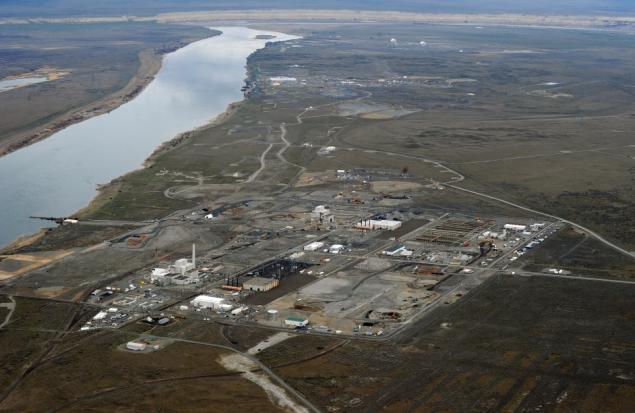
For 42 years, tank AY-102 has stored some of the deadliest material at one of the most environmentally contaminated places in the country: the Hanford Nuclear Reservation. Continue reading
As Fukushima radioactive water grows, situation hopeless for fishermen
Fukushima fishermen forced to test fish for radiation REUTERS, 31 May 13“….The fishermen of Hisanohama, forced out of work by the disaster, have had no choice but to take the only job available – checking contamination levels in fish just offshore from the destroyed nuclear reactor buildings. ”We used to be so proud of our fish. They were famous across Japan and we made a decent living out of them,” said 80-year-old Yaoita, who survived the tsunami by taking on the waves and sailing the six-person True Prosperity out to sea.”Now the only thing for us is sampling.”…..
The fishermen and Tepco are in dispute over the utility’s plans to dump 100 tons of groundwater a day from the devastated plant into the sea. The complicated clean-up plan for Fukushima could take 30 years or more. Tepco’s challenge is what to do with the contaminated water that has been pooling at the plant at a rate of 400 tons a day – enough to fill an Olympic-size swimming pool in a week.
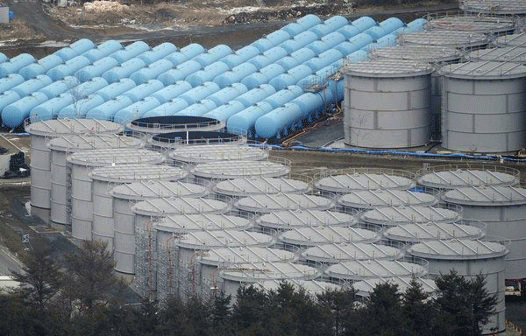
So far it has been racing to build tanks to store the contaminated water on the grounds of the plant, in which all the water is kept at the moment.It has also asked fishermen to support a plan to build a “by-pass” that would dump groundwater into the sea before it becomes contaminated by flowing under the reactor’s wreckage.
“We are staunchly against it,” said Tatsuo Niitsuma, 71, who fishes with Yaoita.
MORE CONTAMINATION, LESS HOPE Representatives from fishing cooperatives met Tepco officials on Thursday to discuss the proposal, with Trade Minister Toshimitsu Motegi to instruct Tepco on what to do, although no final plans were announced. In addition to the “by-pass” Motegi, who also holds the energy portfolio, told Tepco to create “protective walls” in the ground by freezing the soil around the reactors to create an underground barrier to stop groundwater from flowing in and mixing with contaminated water inside the reactor building.
The fishermen, however, worry the “by-pass” plan risks more contamination and delays, possibly ending any hope for the only job they know.
Tepco officials have said it may take as long as four years to fix the problem, but have said they do not need outside help.
The uncertainty and stress have become problems. Many former fishermen live in temporary homes next to people they barely know after losing not only their jobs, but also family members…….. http://www.reuters.com/article/2013/05/31/us-fukushima-fishermen-idUSBRE94U0D620130531
Beaverlodge area – an example of uranium mining’s filthy legacy
Uranium mining legacy expensive, The Star Phoenix, By Ann Coxworth, May 30, 2013 “…….The Canadian Nuclear Safety Commission recently reviewed plans for continuing management of some of the contaminated sites in northern Saskatchewan – relics of uranium mining activities that took place during the 1960s and 1970s.
The cost of remediating surface waters to levels compatible with Saskatchewan surface water quality objectives is so overwhelming thatwe know it will never happen.
Because the companies that caused the pollution are no longer in existence, these costs now fall to the federal and provincialtaxpayers. The goal of industry and regulators now is simply to prevent the contamination from getting any worse.
One such contaminated region is the Beaverlodge area. Continue reading
Fukushima’s radioactive contamination spreads in marine life
 Japan Radiation Widely Contaminates Pacific Marine Life http://www.earthweek.com/2013/ew130524/ew130524b.html 24 May 13, Traces of radioactive cesium from Japan’s crippled Fukushima No. 1 nuclear power plant have been found in water and plankton collected
from all 10 points monitored across a vast stretch of the western Pacific.
The isotopes cesium-134 and cesium-137 were found in the tiny plantlike creatures from the coast of Japan’s Hokkaido Island to Guam.
The samples were taken early last year, less than a year after the tsunami that overwhelmed the plant, but the findings were just
announced at a meeting of the Japan Geoscience Union.
Cesium-134 has a half-life of two years while it takes 30 years for cesium-137 to decay by half. Scientists say the isotopes were being dispersed across the Pacific in plankton, and were accumulating up the food chain as the tiny creatures were eaten by larger marine life.
Further studies are being conducted to see how much cesium was building up in fish and possibly marine mammals.
Radiation was flushed into the Pacific after three meltdowns occurred at the Fukushima nuclear plant. More than two years after the March 2011 disaster, plant operators are struggling to contain the 400 tons of radioactive water poured over the melted cores of reactors 1, 2 and 3 to prevent the fuel from melting and burning again.
1957 Mayak nuclear disaster – the forgotten event near Ozyorsk
Ozyorsk was and remains a closed town because of its proximity to the Mayak plant,
To consider how insanely radioactive Lake Karachay is, think about this: Chernobyl disaster: 5-12 exabecquerels blown over thousands of square miles Lake Karachay: 4 exabecquerels in this tiny lake, less than a quarter of a mile in diameter. Even approaching the lake will get you a lethal dose within an hour. And they ARE starting to cover it up with concrete and gravel as the water evaporates. As the water recedes, they lay down dirt, gravel and concrete over the area so it can’t fill back in and the sediment doesn’t get disturbed by the wind.
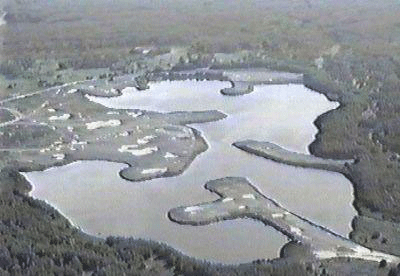
The 10 Worst Civilian Nuclear Accidents in History http://www.neatorama.com/2013/05/21/The-10-Worst-Civilian-Nuclear-Accidents-in-History/ Miss Cellania , May 21, 2013 Quick -how many nuclear accidents can you name? Chernobyl, Three Mile Island, Fukushima …any more? There have been quite a few nuclear accidents of varying danger that you probably never heard of, including some fatal incidents. For example, in 1957, nuclear waste exploded at a reactor near the Soviet town of Ozyorsk.
One of the storage tanks contained around 70 to 80 tons of radioactive liquid waste, and its cooling mechanism stopped working and wasn’t fixed. The tank’s contents, made up mostly of ammonium nitrate and acetates, began to dry out as the liquid heated up and evaporated. Moreover, the temperature increase caused an explosion whose force was equivalent to 70 to 100 tons of TNT, and this sent huge amounts of radioactivity – roughly 20 MCi (800 PBq) – into the environment. The fallout cloud from the explosion contaminated an area of up to 7,722 square miles (20,000 square kilometers).
Over a period of nearly two years, about 10,000 people were evacuated from the surrounding area. In terms of fatalities, the exact cost of the incident is not known, but immediately around the site of the explosion there were 66 diagnosed cases of chronic radiation syndrome.
Read more about the Ozyorsk incident and nine others in a list at Tech Graffiti. Link -via the Presurfer
Perpetual water needed to nuclear reactors – will end up in Pacific Ocean
Japan Times: Discharges of Fukushima nuclear material into Pacific “have effectively contaminated the sea” — Melted reactor cores will burn again if water not perpetually poured in — “Tepco proposing some of it be dumped into ocean” http://enenews.com/japan-times-discharges-of-nuclear-material-into-the-pacific-from-fukushima-have-effectively-contaminated-the-sea-melted-reactor-cores-will-burn-again-if-water-not-perpetually-poured-in-t
Title: Fukushima No. 1 can’t keep its head above tainted water
Source: The Japan Times
Author: Reiji Yoshida
Date: May 21, 2013
[…] Tepco must perpetually pour water over the melted cores of reactors 1, 2, and 3 via makeshift systems to prevent the fuel from melting and burning again. […]
Tepco is proposing some of the water be dumped into the sea after processing it to remove most, but not all, radioactive isotopes. […]
Previous discharges into the Pacific have effectively contaminated the sea. Failure to store it means it will probably flood the whole compound and end up in the ocean anyway. […]
Will the processed water pose health or environmental risks?
According to Tepco, the processed water could theoretically be safe […]
Tritium is the exception, however. Tepco says the tritium level in the contaminated water is between 1 million and 5 million becquerels per liter. The legal limit is 60,000. […]
See also: Gundersen: “Liquid releases” of nuclear material into ocean will continue for years and years at Fukushima Daiichi — Already 10 times Chernobyl (VIDEO)
Fishermen testing fish for radiation, in South Fukushima waters
Fishermen net fish in Fukushima waters to measure radiation levels
http://ajw.asahi.com/article/0311disaster/recovery/AJ201305210005 May 21, 2013 By HIROSHI KAWAI/ Staff Writer
A fishing vessel from Fukushima Prefecture caught fish in waters south
of the crippled Fukushima No. 1 nuclear power plant on May 20 to test
them for levels of radiation contamination, as local fishing
cooperatives hope to soon resume fishing in the area.
The No. 12 Akira Maru belonging to the Iwaki fishermen’s cooperative
trawled plenty of flatfish and other species.
Due to ocean currents, the concentration of radioactive materials has
been found to be higher in waters to the south of the plant, than to
the north.
Of the Akira Maru’s catch, nine species of fish were kept as samples
to measure radiation levels in them. The fishermen tested about 10
kilograms of each type and threw the rest back into the sea.
“It feels hollow to have to throw fish back into the sea, considering
that they could fetch high prices,” Captain Akiyoshi Abe said.
Before the nuclear accident triggered by the Great East Japan
Earthquake and tsunami in March 2011, waters off the prefecture were
known as a good fishing area where more than 100 species could be
caught.
Many local fisheries cooperatives have had to suspend operations since
the nuclear accident.
Japanese authorities ignore radiation levels in Tokyo river eels
 Local governments ignore cesium detection in Tokyo river eels, Asahi Shimbun May 17, 2013 By YUSUKE FUKUI/ Staff Writer Tokyo and Chiba local governments took no action for nearly two months after being informed that radioactive cesium had been detected in eels caught in a boundary river between the two prefectures.
Officials of both governments said no independent study was conducted because the eels were not caught by professional fishermen intending to sell the catch.
The detection of the cesium was also not publicized. On March 9, a 47-year-old self-employed woman caught an eel from the Edogawa river in Tokyo’s Katsushika Ward. Concerned about reports that cesium had accumulated downstream in the river, she sent the eel to Hideo Yamazaki, a professor of environmental analysis at Kinki University in Osaka Prefecture. Using a germanium semiconductor detector, Yamazaki found that the eel had 147.5 becquerels of radioactive cesium per kilogram, higher than the central government standard of 100 becquerels.
Yamazaki reported his finding to the Fisheries Agency in late March because he felt there was a need for an official investigation to back up his finding as well as further studies to look into the effects on other fish.
Although the Fisheries Agency informed both the Tokyo metropolitan and Chiba prefectural governments about the finding, neither had conducted an official study as of May 16.
An official with the Tokyo metropolitan government’s fisheries division said, “Basically, only fish that enter the distribution network is subject to studies. The eel fishing season also does not start until summer.”….. Yamazaki conducted further studies on four eels caught by the same woman in April and May in the Edogawa river. The eels had cesium levels between 97.4 becquerels and 129.6 becquerels per kilogram, with three of the eels having cesium levels exceeding the central government standard….. http://ajw.asahi.com/article/behind_news/social_affairs/AJ201305170079
Dumping tons of Fukushima radioactive water into ocean is not illegal?
‘Absurd’: Intentionally dumping Fukushima nuclear material into ocean from land “is not considered dumping” — Allowed under international law? http://enenews.com/absurd-intentionally-dumping-fukushima-nuclear-material-ocean-land-considered-dumping-allowed-international-law
Source: Oceanus
Author: David Pacchioli
Date: May 6, 2013 The Fukushima disaster is without precedent and will have unprecedented impacts on future policies governing the ocean, both Japanese and international.
[…] the Fukushima accident has revealed some key shortcomings in international law, said Kentaro Nishimoto, who teaches law of the sea at Tohoku University. To illustrate, he used an incident that has brought sharp criticism from Japan’s neighbors: the intentional release of radioactive water into the sea.
[…] Nishimoto said, the relevant international laws proved to be nonbinding. In particular, he noted, the London Convention on marine pollution, although it expressly prohibits ocean dumping of radioactive material, limits these restrictions to vessels at sea. Release of materials from land is not considered dumping.
“When I tell this to people outside the field of international law, the reaction I get is, ‘This is absurd,’ ” Nishimoto acknowledged. […]
See also: Bloomberg: Increasing risk that Fukushima radioactive waste being dumped into Pacific Ocean
Radioactive trash in St Louis – related to underground landfill fire?
Rolling Stone: “Mass release of floating radioactive particles in metro St. Louis” possible from inferno at landfill? Fire “smells like dead bodies” — 8,700 tons of nuclear waste nearby. http://enenews.com/rolling-stone-mass-release-of-floating-radioactive-particles-in-metro-st-louis-possible-from-underground-inferno-at-landfill-8700-tons-of-nuclear-waste-nearby-fire-smells-like-dead-bodies
Title: St. Louis Landfill Fire
Source: Rolling Stone
Author: Steven Hsieh
Date: May 10, 2013
An underground landfill fire near tons of nuclear waste raises serious health and safety concerns – so why isn’t the government doing more to help?
[…] It’s invisible to area residents, buried deep beneath the ground in a North St. Louis County landfill. […] “It smells like dead bodies,” observes another local.
[…] “Am I going to end up with cancer 20 years down the road?” […]
The Bridgeton landfill fire is burning close to at least 8,700 tons of nuclear weapons wastes. […]
About 1,200 feet south of the radioactive EPA site, the fire at Bridgeton Landfill spreads out like hot barbeque coals. No one knows for sure what happens when an underground inferno meets a pool of atomic waste, but residents aren’t eager to find out. […]
At a March 15th press conference, Peter Anderson – an economist who has studied landfills for over 20 years – raised the worst-case scenario of a “dirty bomb,” meaning a non-detonated, mass release of floating radioactive particles in metro St. Louis. “Now, to be clear, a dirty bomb is not nuclear fission, it’s not an atomic bomb, it’s not a weapon of mass destruction,” Anderson assured meeting attendants in Bridgeton’s Machinists Union Hall. “But the dispersal of that radioactive material in air that could reach – depending upon weather conditions – as far as 10 miles from the site could make it impossible to have economic activity continue.” […]
Robert Criss, a geochemist at Washington University in St. Louis who has studied the issue closely, says the EPA is grossly underplaying a host of risks surrounding West Lake – flooding, earthquakes, liquefaction, groundwater leaching – that could pave the way for a public health crisis. That’s not to mention the recent development of an underground fire nearby. Says Criss, “There is no geological site I can think of that is more absurd to place such waste.” […]
The nuclear devastation in northeastern Kazakhstan
Kazakhstan’s Painful Nuclear Past Looms Large Over Its Energy Future, The Atlantic 13 May 13, The central Asian country is positioning itself as a global nuclear leader, but it’s haunted by the lasting impacts of Soviet testing decades ago……….. Kazakhstan is moving forward with plans to build a civilian nuclear power facility for domestic energy needs, possibly on the Aktau site of a now defunct Soviet-era plant…..

1 This Month
26 September – International Day for the Total Elimination of Nuclear Weapons





PLEASE OPPOSE HR 8255 AND S.3639 – bills would accelerate satellite deployment, with no environmental review or safeguards – https://ncstd5li.quorum.us/campaign/169331/
To see nuclear-related stories in greater depth and intensity – go to https://nuclearinformation.wordpress.com
-
Archives
- September 2026 (281)
- August 2026 (330)
- July 2026 (355)
- June 2026 (287)
- May 2026 (306)
- April 2026 (356)
- March 2026 (251)
- February 2026 (267)
- January 2026 (308)
- December 2025 (358)
- November 2025 (359)
- October 2025 (375)
-
Categories
- 1
- 1 NUCLEAR ISSUES
- business and costs
- climate change
- culture and arts
- ENERGY
- environment
- health
- history
- indigenous issues
- Legal
- marketing of nuclear
- media
- opposition to nuclear
- PERSONAL STORIES
- politics
- politics international
- Religion and ethics
- safety
- secrets,lies and civil liberties
- spinbuster
- technology
- Uranium
- wastes
- weapons and war
- Women
- 2 WORLD
- ACTION
- AFRICA
- Atrocities
- AUSTRALIA
- Christina's notes
- Christina's themes
- culture and arts
- Events
- Fuk 2022
- Fuk 2023
- Fukushima 2017
- Fukushima 2018
- fukushima 2019
- Fukushima 2020
- Fukushima 2021
- general
- global warming
- Humour (God we need it)
- Nuclear
- RARE EARTHS
- Reference
- resources – print
- Resources -audiovicual
- Weekly Newsletter
- World
- World Nuclear
- YouTube
-
RSS
Entries RSS
Comments RSS

