AUDIO Groundwater flows from Fukushima reactors to the ocean
 Tecpo shows groundwater flowing from Fukushima reactors into ocean April 2nd, 2013 http://enenews.com/tecpo-shows-groundwater-flowing-from-fukushima-reactors-into-ocean-photo
Title: Progress Status of the Groundwater Bypass Construction
Source: Tokyo Electric Power Company
Date: March 27, 2013
[…] Gradual Reduction of Groundwater
The groundwater level will be gradually reduced with the groundwater bypass put in operation. Careful water level control will be implemented to prevent the accumulated water in the buildings from leaking to the outside while monitoring the groundwater level reduction and its water quality. The sub-drains installed around the buildings will be fully utilized for the monitoring. An observation hole will be newly installed between the Reactor Building and the pump well. […]
See also: Graphic shows ‘direct discharge’ going from Fukushima Daiichi reactors into Pacific — Underground flow of contaminated water also indicated (VIDEO)
Fukushima radiation into ocean: is it killing sea lions?
Unfortunately, the nuclear accident is nowhere near contained. Japanese experts say that Fukushima is currently releasing up to 93 billion becquerels of radioactive cesium into the ocean each day, the reactors have lost containment, and groundwater is flooding into the stricken reactors(delaying clean-up).
And things may get worse for California, instead of better .
Is Fukushima Radiation Causing the Epidemic of Dead and Starving Sea Lions In California? http://www.zerohedge.com/contributed/2013-03-31/fukushima-radiation-causing-epidemic-dead-and-starving-sea-lions-california by George Washington on 03/31/2013 Associated Press reports:
At island rookeries off the Southern California coast, 45 percent of the pups born in June have died, said Sharon Melin, a wildlife biologist for the National Marine Fisheries Service based in Seattle. Normally, less than one-third of the pups would die.It’s gotten so bad in the past two weeks that the National Oceanic and Atmospheric Administration declared an “unusual mortality event.” That will allow more scientists to join the search for the cause, Melin said. Continue reading
Australia’s Great Barrier Reef could be lost for uranium’s petty financial gain
The price tag of the uranium deposits in Queensland, if all extracted and sold is about $10 billion. A pretty big chunk of cash, but worth only a paltry two years of tourism dollars that the Great Barrier Reef brings in.
To anyone who has looked in wonderment at the fish on a reef, this is not an “Australian issue”, this is an issue that speaks to how we want to leave the world to future generations. Our kids will remember visiting a reef teeming with tropical fish, turtles and fluorescent coral, but what will they remember if it isn’t there to be seen? They sure as heck won’t remember the quick buck made by uranium mining companies a few decades previous
Radioactive scuba diving a potential new Aussie destination sport http://www.vancouverobserver.com/city/outdoors/radioactive-scuba-diving-potential-new-aussie-destination-sport Kevin Grandia Mar 19th, 2013 Okay, I am exaggerating, but only slightly, but new anti-regulation laws have recently been passed in Australia that could mean uranium will be shipped out directly over this oceanic masterpiece of nature. Continue reading
Fukushima radiation is transforming Japan’s forest ecosystems
 Japan Scientists: Truly unusual deformities in Fukushima — Forests may be evolving into different ecosystems — “There’s been a sudden, large change” http://enenews.com/japan-scientists-truly-unusual-deformities-in-fukushima-theres-been-a-sudden-large-change-forests-may-be-evolving-into-different-ecosystems
February 27th, 2013
Excerpts from ‘Radiant Wildlands‘ by Winifred Bird and Jane Braxton in the Spring 2013 issue of Earth Island Journal
[…] When Joji Otaki began looking closely at the [pale grass blue butterflies] the size of a silver dollar, however, he was struck by abnormal patterns in the dark dots on their wings. Then he noticed dents in their eyes and strangely shaped wings and legs.
Otaki, a professor at the University of the Ryukyus in Okinawa, was in the Abukuma Mountains west of the disaster site collecting butterflies to study their response to the accident [2 months after 3/11].
[…] the aberrations they found took them by surprise. Abnormalities in the first generation were within normal boundaries. But when Otaki bred these butterflies in his laboratory, mutations in the offspring increased to 18 percent. That suggested inherited genetic damage. Field samples collected in September 2011, representing the fourth or fifth generation of butterflies since the disaster, had even higher abnormality rates. The changes may not all have been caused by radiation; Otaki had previously found evidence that temperature can affect wing markings. But the deformities his team found in antennae, legs, and other body parts are truly unusual, says Hokkaido University entomologist Shin-ichi Akimoto, who is studying the impact of Fukushima fallout on aphids. The abnormalities are troubling not only because insects are commonly assumed to be more resistant to radiation than humans, but also because they suggest the Fukushima nuclear disaster may be changing individual species, even entire forests.
“There is no question that ecosystems as a whole are suffering,” Otaki says. “There has been a sudden, large change.”
[…] As plants and animals continue to live in these irradiated environments, forests themselves may be evolving into different ecosystems. […]See also: Biologist on Mutated Butterflies: Study is overwhelming in its implications for humans — Japan Researcher: Insects were believed to be very resistant to radiation — Irregularly developed eyes, malformed antennae, much smaller wings (PHOTO)
Ocean fish to be studied for Fukushima radiation
 L.A. Times: NOAA to start testing wildlife for Fukushima contamination http://enenews.com/l-a-times-noaa-to-start-testing-wildlife-for-fukushima-radiation
February 26th, 2013
Title: Radioactive tuna from Fukushima? Scientists eat it up
Source: Los Angeles Times
Author: Eryn Brown
Date: February 25, 2013
Title: Radioactive tuna from Fukushima? Scientists eat it up
[…] In coming months, the three researchers and colleagues at the National Oceanic and Atmospheric Administration and other institutions plan to analyze hundreds more bluefin tuna, as well as albacore tuna; mahi mahi; ocean sunfish; opa; mako, blue and salmon sharks; loggerhead turtles; and sooty shearwaters, a type of migratory seabird.
They’ll examine samples collected in New Zealand, Hawaii and Alaska as well as in California. They might look through archived specimens for salmon and whales to test. Other research groups may track the contamination to study marine animals too, [Dan Madigan of Stanford University] said.
If scientists find Fukushima radiation in swordfish, for example, it will be the first evidence that the species migrates across the entire Pacific. […]
“Amazing”
They concluded that their tracking method worked, and that Fukushima provided “an unprecedented opportunity” for scientists to use radioactive tracers to follow animal movement. “This was just nature being amazing,” [Nicholas Fisher of Stony Brook University] said.
He imagines pulling together a map of the Pacific crisscrossed by the paths of radiation-toting animals — “an amazing image of transport … all from a little dot” in Japan, Madigan said.
See also: HuffPost: “Radioactive Fish Found In California” — Is it a good thing?
STOP THE GREAT LAKES NUCLEAR DUMP FACT SHEET

1. Ontario Power Generation (OPG), a multi-billion dollar corporation wholly owned by the Province of Ontario, plans to build a nuclear waste dump at the Bruce Nuclear Power Plant site, Municipality of Kincardine, Ontario “located approximately 1 km inland from the shore of Lake Huron at the surface and more than 400 metres below the deepest near-site point of Lake Huron.” http://tinyurl.com/arc34y2 , page 55 OPG owns all Ontario’s nuclear plants and all radioactive nuclear waste created.
2. Low and intermediate level radioactive nuclear waste will be buried in the nuclear waste dump. Intermediate level nuclear wastes are highly radioactive and many remain toxic for over 100,000 years. Some are as dangerous as nuclear spent fuel. No scientist or geologist can provide a 100,000 year guarantee that this nuclear waste dump will not leak. Continue reading
Washington’s Governor alarmed at major radioactive leak from Hanford
 Editorial: Radioactive leak at Hanford may suggest “serious tank failure of such magnitude that even semisolid materials are now able to find a way out” http://enenews.com/editorial-radioactive-leak-hanford-suggest-serious-tank-failure-magnitude-semisolid-materials-able-find
Title: Editorial: A perfect radioactive storm
Source: Daily Astorian
Date: February 19, 2013
“Perfect radioactive storm” are not words any resident along the Columbia River ever wanted to hear coming from the lips of a top elected official about the Hanford Nuclear Reservation.
Yet this is how Washington Gov. Jay Inslee last week characterized news about a major leak of highly toxic sludge from a single-wall storage tank, at the very time the nation nears across-the-board funding cuts that could hobble any response.
[…] All the liquids that could be pumped from it were removed in 1995. That a serious new breach has developed suggests the possibility additional water is seeping into the tank, or there has been a serious tank failure of such magnitude that even semisolid materials are now able to find a way out. […]
It is time for Pacific Northwest leaders and citizens to express our concern about this matter in the strongest possible terms. […]
See also: Governor alarmed about leak at most contaminated nuclear site in U.S. — “You couldn’t find a more perfect radioactive storm” (VIDEO)
Ocean near Fukushima still getting radiation leakage, blue fin tuna with radiation

“…The answer was yes. (See below for the PDF of the study.) That means, ultimately, that there is still a high level of radiation in the waters near the Fukushima plant most likely because, as marine chemist, Ken Buessler, asserts, the plant is still leaking radiation into the ocean nearly two years later….”
Bluefin Tuna From The Fukushima Nuclear Meltdown Still Have Traces Of Radiation, Forbes, Monte Burke, 20 Feb 13,
Last May I wrote a piece about Bluefin tuna caught off the coast of southern California that carried radiation from the Fukushima,Japan, nuclear plant that was damaged in the March 2011. The fish were caught in August 2011 as they migrated east 6,000 miles from their spawning grounds in Japan in search of prey….
Last week one of the authors of the study from last year, Daniel J. Madigan from Stanford University’s Hopkins Marine Station—along with five other scientists— published a new follow-up study. The main question that this new study wanted to answer: Would the migratory Bluefin tuna show up again a year later off the coast of California carrying radiation from Fukushima? Bluefin Tuna Study http://www.forbes.com/sites/monteburke/2013/02/20/bluefin-tuna-from-the-fukushima-nuclear-meltdown-still-have-traces-of-radiation/
Rocky Flats development raises dangers of ionising radiation
Judith Mohling: Rocky Flats development risks exposure to nuclear radiation http://www.dailycamera.com/letters/ci_22620349/judith-mohling-rocky-flats-development-risks-exposure-nuclear 02/20/2013 Dr. Daniel A. Kinderlehrer illuminated many reasons for the current myriad of mental and physical illnesses in the United States (Guest commentary, Feb. 10). However, his excellent guest commentary and description of the “toxic chemical soup” we are all living in left out at least one major toxin: nuclear radiation. Continue reading
Fukushima evacuation zone – all 47 cows tested had radioactive silver
Study: Radioactive silver found inside all 47 cows tested from Fukushima evacuation zone http://enenews.com/study-radioactive-silver-found-inside-every-cow-tested-fukushima-evacuation-zone
Title: Distribution of Artificial Radionuclides in Abandoned Cattle in the Evacuation Zone of the Fukushima Daiichi Nuclear Power Plant
Source: PLoS One. 2013; 8(1): e54312
Published Online: January 23, 2013
[…] Between August 29 and November 15, 2011, we collected 79 cattle in total, 27 of which were from Minami-soma city located north and 52 from Kawauchi village located southwest of the FNPP. […]
In the liver (100%: 47/47 animals) and PB [whole peripheral blood] (9.8%: 5/51 animals), 110mAg (half-life: 249.8 d) was detected (Table 1). […]
Although Silver and Tellurium […] were efficiently captured by the mother’s organs and were not delivered to the fetus. […]
We detected 110mAg in the liver of all of the cattle except for fetuses examined (Table 1 and Figure 3A). […]
See also: CNN: Scientists surprised by high levels of radioactive silver in fish off Japan coast
Plutonium in ocean near Fukushima
 Study: Fukushima plutonium in Pacific Ocean from ‘liquid direct releases’? http://enenews.com/study-plutonium-could-be-pacific-ocean-liquid-direct-releases-fukushima
Title: Should we measure plutonium concentrations in marine sediments near Fukushima?
Source: Journal of Radioanalytical and Nuclear Chemistry
Author: R. Periáñez, Kyung-Suk Suh, Byung-Il Min
Date: February 2013
Excerpt
Much less information is available in the case of plutonium isotopes. Trace amounts of Pu isotopes originating from the accident have been identified in soil samples. While it is known that atmospheric releases of Pu were several orders of magnitude lower than that from Chernobyl accident, no information on Pu isotopes in the liquid direct releases to the sea is available. Pu isotopes have been measured in marine sediments outside a 30 km radius circle around Fukushima. Results do not show any contamination due to the accident. Instead Pu isotopes here detected are attributed to global fallout.
However, the situation inside the 30 km zone remains unknown. It could be possible that Pu isotopes entered this coastal area from the direct release of contaminated water in early April 2011. The objective for this work consists of showing, by means of numerical modelling, that, if Pu contamination originating from the accident would be present in sediments of the close area to Fukushima, contamination would not reach areas far from the plant. Contamination would be restricted to the close area because of the low mobility of Pu. Thus, it would not be detected if samples are not collected there. Consequently, further studies on the determination of Pu isotopes in seawater and sediments within the 30 km zone would be required.
Note the objective: “The objective for this work consists of showing […] that, […] Pu contamination […] would not reach areas far from the plant.”
Precious groundwater now threatened by fracking for uranium, too
When it comes to fracking for yellowcake, even more pressing than shaky economics is the obvious potential for environmental contamination. The process is not only extremely water intensive, as is typical of fracking, but it’s also happening at a shallow depth. Unlike the Eagle Ford’s oil and gas reserves, which are miles underground, the in situ uranium mining is taking place at the same level as local groundwater supplies.

Fracking for Yellowcake: The Next Frontier? http://www.huffingtonpost.com/jeffrey-rubin/fracking-for-yellowcake-t_b_2612418.html Jeffrey Rubin 02/04/2013 It works for oil and natural gas, so why not frack for uranium too? After all, America relies on foreign uranium just like it depends on foreign oil.
In the U.S. these days, it seems like you can sell almost anything if you spin it as part of the pursuit of energy independence. Enter Uranium Energy Corp. A junior mining company with Canadian roots, UEC is developing the newest uranium mine in the U.S. And it’s counting on fracking to do it.
Texans, in general, are no strangers to fracking. UEC is operating in the heart of fracking country, south Texas’s Eagle Ford basin, one of the most prolific shale plays in the country. Instead of oil and gas, though, UEC (recently profiled by Forbes Magazine) is fracking for yellowcake.
The technology is basically the same. It involves injecting a mixture of highly pressurized water and sand into an underground formation in order to break open fissures in the rock that allow the energy riches within to be extracted. In this case, it’s a slurry of uranium ore that’s then dried and processed into powdery yellowcake, an intermediate product that eventually becomes fuel for nuclear reactors.
Of course, the very idea of fracking for yellowcake begs the question–just because you can do something, should you? The world isn’t exactly running short of uranium. Prices tell you that much. Uranium prices have plunged from more than $90 a ton before the last recession to just more than $40 a ton following the Fukushima disaster. Friendly countries like Canada and Australia are able to ramp up supply, as can less friendly countries like Kazakhstan. Yellowcake is also exported by Niger (part of the reason, according to some, that nuclear-powered France is taking such an interest in neighbouring Mali right now.)
What’s more, the emergence of cheap natural gas from shale plays is making nuclear energy less attractive to U.S. power utilities. Many are considering shuttering some high cost nuclear stations and switching to cheaper natural gas, just as they’ve been doing with a number of coal plants in recent years.
When it comes to fracking for yellowcake, even more pressing than shaky economics is the obvious potential for environmental contamination. The process is not only extremely water intensive, as is typical of fracking, but it’s also happening at a shallow depth. Unlike the Eagle Ford’s oil and gas reserves, which are miles underground, the in situ uranium mining is taking place at the same level as local groundwater supplies.
According to the International Energy Agency, the amount of fresh water used for global energy production will double over the next twenty-five years. Whether it’s Alberta’s oil sands that run on water from the Athabasca River or the countless gallons used to frack underground stores of oil, gas and now even uranium, it’s easy to see why.
Hydraulic Fracking is a source of radiation pollution, too
“We’ve known for a long time that there is radiation coming back in the wastewater”
Among the radioactive material often found in drilling wastes is radium 226, which can cause cancer, anemia and cataracts, according to the federal Agency for Toxic Substances and Disease Registry
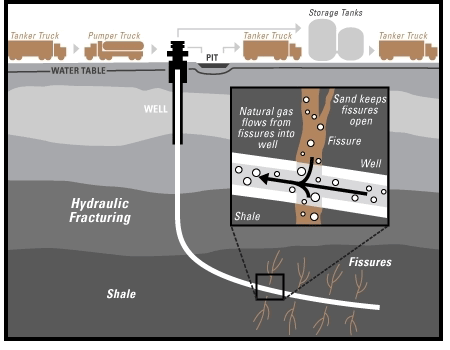
DEP backtracks on radiation issue Times online,January 25, 2013 By Rachel Morgan HARRISBURG — For months, the state Department of Environmental Protection denied that radiation in wastewater from natural gas drilling was an issue. On Thursday night, the state announced plans to study the effects of radiation in natural gas drilling wastewater.
After continued questioning by Shale Reporter regarding radioactivity in wastewater, Gov. Tom Corbett’s announcement of a 12-month DEP study of radioactive wastewater was a surprise. The DEP had consistently denied radiation was even an issue……. In the governor’s unexpected announcement Thursday evening, DEP officials said they will begin sampling and analyzing fracking flowback for radioactivity, testing everything from fracking wastewater, drill cuttings, treatment solids and sediments at well pads and wastewater treatment and disposal facilities.
They also plan to analyze radioactivity in pipes, well casings, storage tanks, treatment systems and trucks. http://www.timesonline.com/news/local_news/dep-backtracks-on-radiation-issue/article_9e5853a5-325b-5f9a-83ed-24aea5811db0.html
An Increase in Radiation Monitoring for Fracking, NYT, Jan 25 13 By JON HURDLE Pennsylvania will step up its monitoring of naturally occurring radiation levels in water, rock cuttings and drilling wastes associated with oil and gas development in a yearlong study that will be peer-reviewed, the state’s environmental agency reports.
The study will also assess radiation levels in the pipes, well casings, storage tanks, treatment systems and trucks used by the natural gas industry, which has drilled thousands of wells in the gas-rich Marcellus Shale over the last five years….
Hydraulic fracturing, which involves injecting chemicals and water under enormous pressure into underground shale formations to extract gas or oil, got under way in Pennsylvania in 2008.
In New York, state officials are currently weighing whether to allow the drilling process to begin. The state’s health commissioner is conducting a review of whether the state’s Department of Environmental Conservation has adequately addressed potential impacts on public health. Continue reading
Contamination of seafoods, following nuclear and oil spill disasters
Frankenfish Surface in Japan and the Gulf of Mexico Years following some of the world’s worst environmental disasters, marine life remains contaminated, Energy Digital 25 Jan 13, Two years after the catastrophic Fukushima nuclear plant meltdown in Japan, fish with 2,500 times the legal limit for radiation in seafood are turning up near the plant.
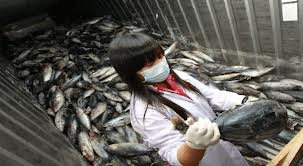 Since the incident, fishing around Fukushima has been banned, along with beef, milk, mushrooms and vegetables produced in surrounding areas. The sale of certain kinds of seafood and produce have resumed, while scientists continue to monitor the spread and impact of radiation from the disaster.
Marine chemist Ken Buesseler, leading the research from the US-based Woods Hole Institution, has warned that Fukushima fish “may be inedible for a decade,” according to the Guardian. They found “elevated levels” of radiation in the marine environment, and cited that 40 percent of the fish caught near the nuclear plant were contaminated with radioactive caesium above government safety limits.
Related Story: Radioactive Japanese Tuna Found off California Coast
Meanwhile, in the US, the debate continues over the safety of seafood from the Gulf of Mexico nearly three years after BP’s offshore rig exploded, dumping some 4.9 million barrels of oil into the ocean. Not to mention the two million gallons of dispersants used to clean up the spill that were up to 52-times more toxic than the oil itself. Read More in Energy Digital’s December/January Issue http://www.energydigital.com/oil_gas/frankenfish-surface-in-japan-and-the-gulf-of-mexico
USA’s EPA gave miners more than 1,500 permits to pollute deep aquifers
In a parched world, Mexico City is sending a message: Deep, unknown potential sources of drinking water matter, and the U.S. pollutes them at its peril.
Message from Mexico: The US is Polluting Water it May Someday Need to Drink, World News Curator , January 25, 2013 By OryanWNC. By Abrahm Lustgarten from ProPublica Mexico City plans to draw drinking water from a mile-deep aquifer, according to a report in the Los Angeles Times. The Mexican effort challenges a key tenet of U.S. clean water policy: that water far underground can be intentionally polluted because it will never be used.
U.S. environmental regulators have long assumed that reservoirs located thousands of feet underground will be too expensive to tap. So even as population increases, temperatures rise, and traditional water supplies dry up, American scientists and policy-makers often exempt these deep aquifers from clean water protections and allow energy and mining companies to inject pollutants directly into them.
As ProPublica has reported in an ongoing investigation about America’s management of its underground water, the U.S. Environmental Protection Agency has issued more than 1,500 permits for companies to pollute such aquifers in some of the driest regions. Frequently, the reason was that the water lies too deep to be worth protecting. Continue reading
1 This Month
26 September – International Day for the Total Elimination of Nuclear Weapons





PLEASE OPPOSE HR 8255 AND S.3639 – bills would accelerate satellite deployment, with no environmental review or safeguards – https://ncstd5li.quorum.us/campaign/169331/
To see nuclear-related stories in greater depth and intensity – go to https://nuclearinformation.wordpress.com
-
Archives
- September 2026 (281)
- August 2026 (330)
- July 2026 (355)
- June 2026 (287)
- May 2026 (306)
- April 2026 (356)
- March 2026 (251)
- February 2026 (267)
- January 2026 (308)
- December 2025 (358)
- November 2025 (359)
- October 2025 (375)
-
Categories
- 1
- 1 NUCLEAR ISSUES
- business and costs
- climate change
- culture and arts
- ENERGY
- environment
- health
- history
- indigenous issues
- Legal
- marketing of nuclear
- media
- opposition to nuclear
- PERSONAL STORIES
- politics
- politics international
- Religion and ethics
- safety
- secrets,lies and civil liberties
- spinbuster
- technology
- Uranium
- wastes
- weapons and war
- Women
- 2 WORLD
- ACTION
- AFRICA
- Atrocities
- AUSTRALIA
- Christina's notes
- Christina's themes
- culture and arts
- Events
- Fuk 2022
- Fuk 2023
- Fukushima 2017
- Fukushima 2018
- fukushima 2019
- Fukushima 2020
- Fukushima 2021
- general
- global warming
- Humour (God we need it)
- Nuclear
- RARE EARTHS
- Reference
- resources – print
- Resources -audiovicual
- Weekly Newsletter
- World
- World Nuclear
- YouTube
-
RSS
Entries RSS
Comments RSS

