Russian scientists find high levels of cesium 137 in Pacific ocean near Fukushima
[The Voice of Russia] Cs137 in Pacific ocean 500~800km from Fukushima, “10 times higher than norm” http://fukushima-diary.com/2012/09/the-voice-of-russia-cesium137-detected-in-pacific-ocean-500800km-from-fukushima-10-times-higher-than-normal/#.UFOPru59MAQ.facebook by Mochizuki on September 14th, 2012
<Quote> [The voice of Russia]
Russian scientists find radiation off Fukushima coast
Russian scientists have detected radiation in the north-west of the
Pacific Ocean at a distance between 500-800 km to the east from
Japan’s troubled Fukushima-1 nuclear power plant.
The expedition of the Russian geographical society has detected that
the concentration of cesium-137 in that area exceeds the norm 10
times.
This is the first time when concentration of cesium 137 was found in
the local sea waters while the air is clean.
The level of radiation near the Russian coast is normal.
Cesium found in deep subsea mud along West coast of Japan
 Asahi: “Significant quantity” of cesium detected along West Coast of Japan — Concentrations rise as it gets deeper http://enenews.com/asahi-significant-quantity-of-cesium-detected-along-west-coast-of-japan-concentrations-rise-as-it-gets-deeper
September 11th, 2012 By ENENews
Title: Radioactive fallout detected far from Fukushima
Source: Asahi Shimbun
Author: NOBUTARO KAJI
Date: September 11, 2012
A significant quantity of radioactive cesium, likely from the crippled Fukushima No. 1 nuclear power plant, has turned up in subsea mud about 200 kilometers away, near the mouth of the Shinanogawa River on Japan’s northwestern coast.
Scientists said samples taken in 2011 at Nagaoka, Niigata Prefecture, contained concentrations of up to 460 becquerels per kilogram of dry mud
[…]
The highest concentration was 2-3 cm below the mud surface at a water depth of 30 m. That reading of 460 becquerels per kg compares to samples of over 400 becquerels around the mouth of the Arakawa river in Tokyo Bay in August 2011.
Both readings are dozens of times higher than contamination detected after past atmospheric nuclear tests.
At a depth of 20 m the maximum concentration was 318 becquerels per kg, while at 15 m it was 255 becquerels.
[…]
Huge tuna fish caught – must be tested for radiation
Radiation tests for monster bluefin tuna Weekly Times, September 7, 2012 SCIENTISTS are to test a monster bluefin tuna caught off New Zealand to see if it carries radioactivity from Japan’s Fukushima nuclear plant.
The 275kg tuna was caught by Victorian fisherman Paul Worsteling50km off the coast of Greymouth.
Mr Worsteling said he waited more than 30 hours to hook the fish, then another two hours to haul it on board.
This came after a year planning the trip to hook the fish.He said he was “blown away” when he saw the tuna, which took five men to haul aboard the boat.
The fish will now be tested for radiation to determine if it has been affected by the Fukushima reactor meltdown in Japan.
The waters around Japan are a spawning ground for bluefin tuna. Mr Wosterling, from the Mornington Peninsula, said the fish would be worth more than $700,000 in Japan, but as an amateur fisherman he couldn’t sell it….
http://www.weeklytimesnow.com.au/article/2012/09/07/535075_latest-news.html
IN its quest for Arctic oil, Russia admits its undersea nuclear dump
17,000 containers of radioactive waste, 19 ships containing radioactive waste, 14 nuclear reactors, including five that still contain spent nuclear fuel; 735 other pieces of radiactively contaminated heavy machinery, and the K-27 nuclear submarine with its two reactors loaded with nuclear fuel.
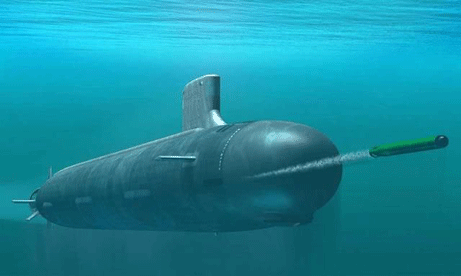 one of the most critical pieces of information missing from the report released to the Norwegian Radiation Protection Authority was the presence of the K-27 nuclear submarine, which was scuttled in 50 kilometers of water with its two reactors filled with spent nuclear fuel in in Stepovogo Bay in the Kara Sea in 1981.
Information that the reactors abord the K-27 could reachieve criticality and explode was released at the Bellona-Rosatom seminar in February.

 Russia Dumped 17 Nuclear Reactors and Tons of Waste in the Arctic by Charles Digges / Bellona.org, Earth First! Newswire, 30 Aug 12, Enormous quantities of decommissioned Russian nuclear reactors and radioactive waste were dumped into the Kara Sea in the Arctic Ocean north of Siberia over a course of decades, according to documents given to Norwegian officials by Russian authorities and published in Norwegian media.
Bellona had received in 2011 a draft of a similar report prepared for Russia’s Gossoviet, the State Council, for presentation at a meeting presided over by then-president Dmitry Medvedev on Russian environmental security.
The Russian state nuclear corporation Rosatom confirmed the figures in February of this year during a seminar it jointly held with Bellona in Moscow. Bellona is alarmed by the extent of the dumped Soviet waste, which is far greater than was previously known – not only to Bellona, but also to the Russian authorities themselves. Continue reading
Excessive levels of radioactive cesium in Pacific cod
Fukushima hot cod stopped from entering U.S. Examiner, FUKUSHIMA AUGUST 30, 2012 BY: DEBORAH DUPRE The central government of Japan has ordered Aomori Prefecture to suspend shipping Pacific cod caught near the port of Hachinohe due to excessive levels of cesium detected, according to The Japan Times Wednesday.
The central government ordered Aomori Prefecture to halt shipping Pacific cod caught near the port of Hachinohe after excessive levels of radioactive cesium were, initiating the first such ban for the prefecture because of the Fukushima nuclear disaster…
..Nuclear expert Arnie Gundersen told SolarIMG that high-level people he knows in the
State Department said Hillary Clinton signed a pact with her counterpart in Japan agreeing for the United States to continue buying food from Japan, despite that food not being properly tested for radioactive materials…….
Earlier this month, fish off the crippled Fukushima No. 1 nuclear power plant were found to have 258 times the legal limit of radioactive cesium, according to Tokyo Electric Power Co.
“So we are not sampling the food coming into the United States,” he said, repeating, “The US government has come up with a decision at the highest levels of the State Department, as well as other departments who made a decision to downplay Fukushima.”
Aomori prefecture is surrounded by the sea on three sides. It literally means blue forest and was used as a landmark for fishermen. http://www.examiner.com/article/fukushima-hot-cod-stopped-from-entering-u-s?CID=examiner_alerts_article
JAPANESE FISH FOUND WITH RADIATION 250 TIMES LEGAL LIMIT
, fish Update.com, 25 Aug 12 NEW tests have detected high levels of radioactive cesium on fish caught close to the Japanese Fukushima nuclear power plant badly damaged in a massive earthquake more than 18 months ago.
Some reports suggests that the rock trout caught contained more than 250 times the legal limit.The Japanese government has already banned the sale of most species fish from that area and this is likely to continue in the light of the new tests. A few months ago radiation from the plant was found in fish close to the US West Coast…
http://www.fishupdate.com/news/fullstory.php/aid/18105/FISHupdate_Briefing.html
Shocking increase in amounts of radioactive caesium-137 into Fukushima fish
 Fukushima Fish Soaked In Record Levels Of Radiation MARIO AGUILAR, AUGUST 22, 2012 http://www.gizmodo.com.au/2012/08/fukushima-fish-soaked-in-record-levels-of-radiation/ During last year’s nuclear disaster, the deadly radiation inside Fukushima 1, became one with the surrounding environment, contaminating everything. Things aren’t getting any better. Record quantities of the deadly radioactive isotope caesium-137 have just been discovered in the fisheries around Fukushima.
We’ve known about the untold and nearly inconceivable quantities of caesium-137 released into the surrounding ecosystem for over a year. But these numbers reported by the AFP are still shocking:
The fishes, captured 20 kilometres (12.5 miles) off the plant on August 1, registered 25,800 becquerels of caesium per kilo, Tokyo Electric Power Co. (TEPCO) said — 258 times the level the government deems safe for consumption. The previous record in fish and shellfish off Fukushima was 18,700 becquerels per kilo detected in cherry salmons, according to the government’s Fisheries Agency.
Authorities had hoped things were getting better, and as the AFP reports , they allowed fishermen to get back to work for a trial run as long as they were more than 50km from the disaster site and stuck to shellfish. So far, the experimental catches have proven (relatively) clean. Still, while everyone in the region is understandably eager to get back to normal, let’s hope the wishful thinking doesn’t get out of hand. [AFP ]
Extracting uranium from oceans: very worrying questions arise
Extracting Uranium from oceans offers a mixed bag of possibilities Examiner, AUGUST 22, 2012 BY: DAVID HERRON Oak Ridge National Labs (ORNL) yesterday announced a new technique for efficiently harvesting uranium from the ocean. This raises the possibility that Uranium supplies will be much deeper and longer lasting than previously thought.
For the environmentally minded it raises a quandary…. there are radiation risks galore…. there is the huge spectre of more nuclear accidents and radiation exposure…..
It would appear this material could be used to target other materials. For example there are concerns over supplies of lithium, or of rare earth metals, or various other minerals, some of which are present in ocean water. Could this material be tailored to target extraction of
those materials from the ocean, providing a source of raw materials that is independent of digging rocks out of the ground? If so it could reduce the amount of hard rock mining operations around the world.
Maybe the material could be used in environmental mitigation, in that there are sites poisoned by releases of toxic metals into the ocean.
But what if corporations so efficiently mine the oceans certain metals that it actually affects the chemical balance of the ocean? The existing chemical balance in the ocean is vital to the food chain, and changing that balance would clearly have some effect on the living things in the ocean. Do “we” even have a clue about the potential impact?…
Fish found to have record radiation levels, near coast of Fukushima
 Record radiation found in fish off Japan http://www.news.com.au/breaking-news/world/record-radiation-found-in-fish-off-japan/story-e6frfkui-1226456080459#ixzz24P8h1Smb August 22, 2012 RECORD levels of radioactive caesium were detected in fish caught within 20 kilometres of Japan’s damaged Fukushima Daiichi Nuclear Power Station.
The operator Tokyo Electric Power Co said it had found 25,800 becquerels per kilogram of radioactive caesium in greenling, 258 times higher than the government safety standard.
Fishing in waters off the plant has been voluntarily restricted since
the nuclear disaster at the plant, which went into meltdown after the
March 2011 earthquake and tsunami.
Less than a month after the start of the disaster, Tokyo Electric
dumped more than 11,000 tonnes of wastewater containing radioactive
substances into the Pacific.
The previous record of radioactive contamination in fish was 18,700
becquerels per kilogram detected in cherry salmon caught in March,
according to the Fisheries Agency.Wakao Hanaoka, a Greenpeace Japan
official, said the government now needs to carry out a full
investigation of radioactive contamination in a wide range of sea
areas off Fukushima, which has not been done yet.
The organisation’s surveys show higher levels of radioactive
contamination were found in fish and seaweed sampled in areas further
from the Fukushima plant.
Factors that affect the spread of contamination include ocean currents
and seabed configuration, Hanaoka added.
VIDEO: Norway cops radioactive water waste from UK’s Sellafield nuclear site

 Norway’s Nuclear Problem http://www.sbs.com.au/shows/thalassa/ Radioactive material from the Sellafield nuclear plant in the UK has been detected in Norwegian waters.In the early 1990s in Norway, scientists discovered the presence of radioactive material in the seawater, seaweed and lobster. But Norway has no nuclear facilities, and no nuclear weapons, so it had to be coming from another country.
Russia was a prime suspect, but it is in fact in southern Scotland on the edge of the Irish Sea that the problem originated. Over fifty years ago the British government built the Sellafield plant to produce electricity and plutonium for the making of atomic bombs. Now it has reconverted into a nuclear waste processing plant, but security is still not guaranteed and fires, leakage and accidental toxic discharge have occurred over the years.
Some speak of negligence. Environmental activists around the world are on the case, demanding the closure of the site once and for all. In 1997, a huge rock concert was organised by U2 to raise the alarm.
Gov’t Releases Last Year’s Tests: “Contamination detected even in the Sea of Japan” — “Airborne material” blamed — Includes Niigata, Shizuoka, and Iwate http://enenews.com/govt-releases-last-years-tests-contamination-detected-sea-japan-airborne-material-blamed-includes-niigata-shizuoka-iwate
August 5th, 2012
By ENENews Title: Radioactive cesium found off of Niigata, Shizuoka, Iwate coasts: gov’t study
Source: Mainichi
Date: August 4, 2012
Radioactive cesium likely from the Fukushima nuclear disaster was detected last year in a survey of ocean waters and fish off Niigata, Shizuoka, and Iwate prefectures, the government announced on Aug. 3. “Even if taken internally, the radiation levels detected are not a risk to human health,” the Ministry of Education, Culture, Sports, Science and Technology stated. The ministry added it believes the small amount of contamination detected even in the Sea of Japan off Niigata was probably originally airborne material that made it to coastal waters through rain and river courses.
[…]
Test results:
- In May last year that there were 9.1 millibecquerels of radioactive cesium per liter of seawater off Omaezaki, Shizuoka Prefecture
- In December, the survey found two becquerels per kilogram in a type of flounder in [Shizuoka]
- In May last year, the survey found dried sea floor dirt from the southeast of Sado Island […] was contaminated with 31 becquerels of cesium per kilogram
- In the ocean off Yamada, Iwate Prefecture […] 0.7 becquerels per liter of seawater were detected in May 2011
Human effect on the atmosphere leads to skin cancer in fish
A whopping 15% of the fish surveyed had melanoma. … While 15% sounds high, Sweet and his colleagues believe it’s only a minimum estimate. “Once the cancer spreads further you would expect the fish to become quite sick, becoming less active and possibly feeding less, hence less likely to be caught. This suggests the actual percentage affected by the cancer is likely to be higher than observed in this study.”….
Fish with Melanoma – Our Enduring Environmental Legacy Scientific American. By Christie Wilcox | August 1, 2012 | We’ve all heard the horror stories. Melanoma is one of the most dangerous kinds of skin cancer, killing around 50,000 people worldwide every year. If caught early enough, it can be cured, but once it invades past the skin, it’s deadly. On the advice of doctors, we try to protect ourselves, donning floppy hats and coat upon coat of SPF 50 sunblock. We pick over our bodies in the mirror regularly, looking for dark, irregularly-shaped spots. . The recent rise in the incidence of skin cancer, though, is our own fault.
It is the result of our environmental hubris, a combination of a chemically-depleted ozone layer and our pathological obsession with a tanned physical appearance. Now, we’re becoming increasingly aware that our choices don’t just impact our own species. The rest of life has to deal with our poor decisions, and studies are just now determining the wide-ranging consequences of our actions.
Unable to slather on sunscreen, the creatures on our planet are much more limited in their ability to deal with the sun’s radiation Continue reading
High cesium levels in migratory fish in Pacific: Is Fukushima still leaking radiation?
 the persistently high cesium numbers may be a sign that the Fukushima plant is still leaking radiation into the ocean.
Lead scientist surprised by Japan data: Fukushima plant still leaking radiation into ocean? By ENENews Title: Post-Fukushima, Japan’s irradiated fish worry B.C. experts Source: Vancouver Free Press Author: Alex Roslin Date: July 19, 2012
The numbers show that far from dissipating with time, as government officials and scientists in Canada and elsewhere claimed they would, levels of radiation from Fukushima have stayed stubbornly high in fish. Continue reading
TEPCO covering seafloor with enormous amounts of concrete. Why?
Tepco completes covering seafloor with layers of cement mix — More coating used at Reactors 5 & 6 than for Reactors 1, 2, 3 & 4 combined (PHOTOS & VIDEOS) July 19th, 2012 By ENENews http://enenews.com/tepco-completes-covering-seafloor-with-layers-of-cement-mix-more-coating-used-outside-reactors-5-6-than-for-reactors-1-2-3-4-combined-photos-videos
And all those funny looking black containers which were placed/dropped into the water..just COVER those things up with LAYERS of CONCRETE. Next generation can worry about it. Sadly, Mr. TEPCOman, one has to ask WHAT next generation will be healthy enough to work the problem?
One question to ask..what happened at Reactors 5 and 6 to require as much concrete or MORE than Reactors 1-4? Were more containers dumped into the ocean? More meltdown corium heading for the ocean..or is the ground so unstable..I hope its not the last. Subsidence(loss of ground HEIGHT) could be raising its ugly head. That is bad– almost as bad as Reactor 1-4 “payloads.”
Also note the non-concern of “radiation” going out into the OCEAN. What do they think the ocean is? An endless pit? Its not.
Fukushima radiation will be higher on USA West coast, than off Japan
Study: N. America’s West Coast to be most contaminated by Fukushima cesium of all regions in Pacific in 10 years — “An order-of-magnitude higher” than waters off Japan (MAPS) July 15th, 2012 Title: Model simulations on the long-term dispersal of 137Cs released into the Pacific Ocean off Fukushima, IOPscience, Erik Behrens, Franziska U Schwarzkopf, Joke F Lübbecke and Claus W Böning Continue reading
1 This Month

of the week – Shut Down Drone Warfare!


Tell the Ukrainian Government to Drop Prosecution of Peace Activist Yurii Sheliazhenko

Petition to revoke the licensing of the Near Surface Nuclear Disposal Facility (NSDF) at Chalk River. https://www.ourcommons.ca/petitions/en/Petition/Details?Petition=e-7247
To see nuclear-related stories in greater depth and intensity – go to https://nuclearinformation.wordpress.com
-
Archives
- March 2026 (237)
- February 2026 (268)
- January 2026 (308)
- December 2025 (358)
- November 2025 (359)
- October 2025 (376)
- September 2025 (257)
- August 2025 (319)
- July 2025 (230)
- June 2025 (348)
- May 2025 (261)
- April 2025 (305)
-
Categories
- 1
- 1 NUCLEAR ISSUES
- business and costs
- climate change
- culture and arts
- ENERGY
- environment
- health
- history
- indigenous issues
- Legal
- marketing of nuclear
- media
- opposition to nuclear
- PERSONAL STORIES
- politics
- politics international
- Religion and ethics
- safety
- secrets,lies and civil liberties
- spinbuster
- technology
- Uranium
- wastes
- weapons and war
- Women
- 2 WORLD
- ACTION
- AFRICA
- Atrocities
- AUSTRALIA
- Christina's notes
- Christina's themes
- culture and arts
- Events
- Fuk 2022
- Fuk 2023
- Fukushima 2017
- Fukushima 2018
- fukushima 2019
- Fukushima 2020
- Fukushima 2021
- general
- global warming
- Humour (God we need it)
- Nuclear
- RARE EARTHS
- Reference
- resources – print
- Resources -audiovicual
- Weekly Newsletter
- World
- World Nuclear
- YouTube
-
RSS
Entries RSS
Comments RSS
 nuclear-news