Japan’s radioactive leaks to Pacific Ocean make it imperative to get international help
Nuclear error Japan should bring in international help to study and mitigate the Fukushima crisis. Nature, 03 September 2013 The radioactive water leaking from the site of the wrecked Fukushima Daiichi nuclear power plant in Japan is a stern reminder that we have not seen the end of the world’s largest nuclear crisis since the Chernobyl meltdown in Ukraine in 1986……..
The most important impacts of the leaks will be those on the sea off Fukushima and the larger Pacific Ocean, which must be closely monitored. After assessments by US and Japanese scientists in 2011 and 2012, two major questions remain unanswered. How much radioactivity is still entering the sea? And, given the high levels of radioactivity that have been measured in some species long after the accident, when will fish and seafood from the region be safe to consume? The leaks make it more urgent to find answers to these questions.
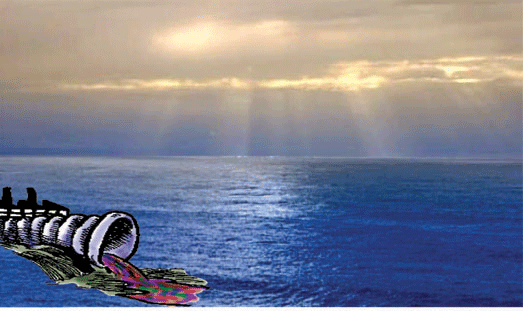
To make reliable assessments of any environmental effects, scientists need to be able to collect data on contamination of marine food webs with all long-lived radionuclides, and particularly with caesium-137, strontium-90 and plutonium-239. They also need to know the sources of contamination, and to study the transport of radionuclides in groundwater, sediments and ocean currents. Current Japanese Prime Minister Shinzo Abe and his government have promised to boost science; they should encourage and support researchers from around the world in collecting and sharing information. Chernobyl was a missed opportunity for post-accident research — in that sense at least, Fukushima could do much better. http://www.nature.com/news/nuclear-error-1.13667
Pacific Ocean – a handy drain for Fukushma’s radioactive trash
Use sea as nuclear sink, says Tokyo http://www.theaustralian.com.au/news/world/use-sea-as-nuclear-sink-says-tokyo/story-fnb1brze-1226709319491 BY:RICK WALLACE, TOKYO CORRESPONDENT September 03, 2013 THE head of Japan’s nuclear watchdog has flagged dumping contaminated water from the Fukushima Daiichi nuclear power plant into the Pacific Ocean amid mounting woes over storage and seepage of radioactive water.
But Nuclear Regulation Authority chairman Shunichi Tanaka said any water released would be treated to an extent that the level of contaminants was well below international limits.
“If (the situation) becomes more severe, and some water falls below regulatory limits, it might have to be discharged into the ocean,” he said yesterday in a speech to the Foreign Correspondents’ Club of Japan in Tokyo.
“I know this (previously) created a great stir in some circles. However, I will absolutely not support the dumping of water where the level of contamination is above the limits.”
Mr Tanaka said properly functioning nuclear plants dumped contaminated water into the ocean as part of normal operations, provided it met the limits.
But any discharge of water – irrespective of the level of decontamination carried out – is likely to spark outrage from environmentalists, fishing operators and neighbouring countries. Continue reading
USA tuan contamnated by Fukushima radiation

 Fukushima Radiation Affecting U.S. Tuna http://www.energyrefuge.com/blog/fukushima-radiation-affecting-u-s-tuna/?utm_source=feedburner&utm_medium=feed&utm_campaign=Feed%3A+EnergyrefugecomBlog+%28EnergyRefuge.com+Blog%29
by ANTONIO PASOLINI on AUGUST 28, 2013
Recent reports have exposed what some people had predicted at the time of theFukushima nuclear disaster: that radiation would spread. And it has, through fish that migrates between North America and Japan.
Reuters recently reported that “low levels of radioactive cesium from Japan’s Fukushima Daiichi nuclear accident turned up in fish caught off California in 2011”. The statement was based on a recent report compiled by Stanford University’s Hopkins Marine Station.
Bluefin spawn off the Japanese coast and many migrate across the Pacific. The researchers analyzed tissue samples collected in August 2011, five months after the nuclear spill. All samples contained reactor byproducts cesium-134 and cesium-137 at levels that produced radiation about three percent higher than natural sources.
According to this report, anada and the U.S. are feeling the effects of the radiation in food and water, with babies born with thyroid issues. Government has increased acceptable levels of certain toxic substances in the food imported from Japan.
Most of the radiation leaked in April 2011. Radioactive cesium does not quickly sink to the sea bottom but remains dispersed in the water column, from the surface to the ocean floor. Fish can swim right through it and will ingest it through seawater or by eating contaminated organisms. Bluefin tuna typically have low levels of natural radiation such as potassium 40.
Strontium 90, another radioactive element discharging from Fukushima nuclear mess
Since June 2011 there have been further large discharges of strontium from Fukushima that have not been measured with precision.
Along with caesium-137, Sr-90 is one of the most important artificial radioactive isotopes released into the environment, with a half-life of 30 years. Strontium’s chemical behaviour is similar to that of calcium, and it can accumulate in organisms, especially in bone.
Fukushima accident raised levels of radioactive strontium off the east coast of Japan by up to a hundred times : http://phys.org/news/2013-06-fukushima-accident-radioactive-strontium-east.html#jCp Researchers from the Institute for Environmental Science and Technology (ICTA) and the Department of Physics of the Universitat Autònoma de Barcelona (UAB) have studied the spread of radioactive strontium in the coastal waters of eastern Japan during the three months following the Fukushima nuclear accident, which happened in March, 2011. The samples analysed show the impact of the direct release of radioactive materials into the Pacific Ocean, and indicate that the amount of strontium-90 discharged into the sea during those three months was between 90 and 900 Tbq (terabecquerels), raising levels by up to two orders of magnitude. The highest concentrations were found to the north of the Kuroshio current, which acts as a barrier preventing radioactive material from being carried to lower latitudes. Continue reading
Radioactive plume will arrive at uneven times and concentrations on USA West Coast
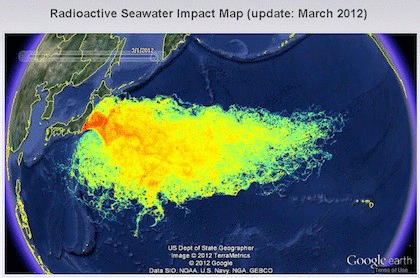 Fukushima radioactive plume to reach US in three years Phys Org 28 Aug 13“….While atmospheric radiation was detected on the US west coast within days of the incident, the radioactive particles in the ocean plume take considerably longer to travel the same distance.
In the paper, researchers from the Centre of Excellence for Climate System Science and others used a range of ocean simulations to track the path of the radiation from the Fukushima incident.
The models identified where it would likely travel through the world’s oceans for the next 10 years…… Observers on the west coast of the United States will be able to see a measurable increase in radioactive material three years after the event,” said one of the paper’s authors, Dr Erik van Sebille…… Eddies and giant whirlpools – some tens of kilometres wide – and other currents in the open ocean continue this dilution process and direct the radioactive particles to different areas along the US west coast.
“Although some uncertainties remain around the total amount released and the likely concentrations that would be observed, we have shown unambiguously that the contact with the north-west American coasts will not be identical everywhere,” said Dr Vincent Rossi.
“Shelf waters north of 45°N will experience higher concentrations during a shorter period, when compared to the Californian coast. This late but prolonged exposure is due to the three-dimensional pathways of the plume. The plume will be forced down deeper into the ocean toward the subtropics before rising up again along the southern Californian shelf.”
Interestingly, the great majority of the radioactive material will stay in the North Pacific, with very little crossing south of the Equator in the first decade. Eventually over a number of decades, a measurable but otherwise harmless signature of the radiation will spread into other ocean basins, particularly the Indian and South Pacific oceans……. For those interested in tracking the path of the radiation, we have developed a website to help them.
“Using this website, members of the public can click on an area in the ocean and track the movement of the radiation or any other form of pollution on the ocean surface over the next 10 years.”
Read more at: http://phys.org/news/2013-08-fukushima-radioactive-plume-years.html#jCp
USA West Coast Tuna, Salmon and Herring contaminated by radiation?
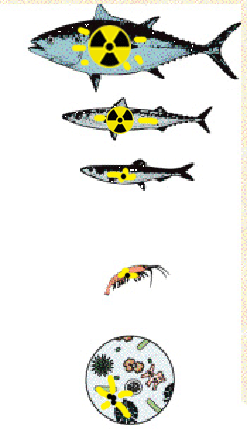 The bottom line – as nuclear experts said 4 days after the Japanese earthquake and tsunami – is that we all need to demand that fish be tested for radiation.
Is Fukushima Radiation Contaminating Tuna, Salmon and Herring On the West Coast of North America?
By Washington’s Blog Global Research, August 26, 2013 Demand that Fish Be Tested for Radiation
We’ve extensively documented that radioactivity from Fukushima is spreading to North America.
More than a year ago, 15 out of 15 bluefin tuna tested in California waters were contaminated with radioactive cesium from Fukushima.
Bluefin tuna are a wide-ranging fish, which can swim back and forth between Japan and North America in a year. But what about other types of fish?
Sockeye salmon also have a range spanning all of the way from Japan to Alaska, Canada, Washington and Oregon: Associated Press reports that both scientists and native elders in British Columbia say that sockeye numbers have plummeted:…….
Another example – pacific herring – is even more dramatic. Pacific herring is wide-ranging fish, spanning all the way from Japan to Southern California:
Every single pacific herring examined by a biologist in Canada was found to be hemorrhaging blood. As Ene News reports:
See also: Alexandra Morton via Vancouver 24 hrs, Vancouver 24 hrs, Alexandra Morton)
The Globe and Mail, Aug 13, 2013 (Emphasis Added):
Independent fisheries scientist Alexandra Morton is raising concerns about a disease she says is spreading through Pacific herring causing fish to hemorrhage. […] “Two days ago I did a beach seine on Malcolm Island [near Port McNeill on northern Vancouver Island] and I got approximately 100 of these little herring and they were not only bleeding from their fins, but their bellies, their chins, their eyeballs. […] “It was 100 per cent … I couldn’t find any that weren’t bleeding to some degree. And they were schooling with young sockeye [salmon]”
Sun News, Aug 12, 2013: Continue reading
Massive underground reservoir of radioactive water moves closer to Fukushima coast
 The turbine buildings at the Fukushima Dai-ichi plant are about 150 meters (500 feet) from the ocean. According to a Japan Atomic Energy Agency document, the contaminated underground water is spreading toward the sea at a rate of about 4 meters (13 feet) a month.
At that rate, “the water from that area is just about to reach the coast,” if it hasn’t already,
radioactive cesium levels in most fish caught off the Fukushima coast hadn’t declined in the year following the March 2011 disaster, suggesting that the contaminated water from the reactor-turbine areas is already leaking into the sea.
But TEPCO hasn’t provided the details he and other scientists need to further assess the situation.
Radioactive Groundwater at Fukushima Nears Pacific abc news, TOKYO August 23, 2013 (AP) By MARI YAMAGUCHI Associated Press Deep beneath Fukushima’s crippled nuclear power station, a massive underground reservoir of contaminated water that began spilling from the plant’s reactors after the 2011 earthquake and tsunami has been creeping slowly toward the Pacific.
Now, 2 1/2 years later, experts fear it is about to reach the ocean and greatly worsen what is fast becoming a new crisis at Fukushima: the inability to contain vast quantities of radioactive water.
The looming crisis is potentially far greater than the discovery earlier this week of a leak from a tank that stores contaminated water used to cool the reactor cores. That 300-ton (80,000-gallon) leak is the fifth and most serious from a tank since the March 2011 disaster, when three of the plant’s reactors melted down after a huge earthquake and tsunami knocked out the plant’s power and cooling functions.
But experts believe the underground seepage from the reactor and turbine building area is much bigger and possibly more radioactive, confronting the plant’s operator, Tokyo Electric Power Co., with an invisible, chronic problem and few viable solutions. Continue reading
Radiation concentrates as it goes up the ocean’s food chain
Canadian University Scientist: Test seafood for Fukushima contamination — Continuous inputs for 2 years and counting will lead to ample opportunity for re-concentrating up food chain — Simply not enough being done on this side of Pacific http://enenews.com/canadian-university-scientist-continuous-input-of-fukushima-contamination-for-two-years-and-counting-will-lead-to-ample-opportunity-for-re-concentrating-up-food-chain-simply-not-enough-tests-being
Title: Nuclear meltdown’s effect on B.C. fish unclear
Source: Times Colonist
Author: Judith Lavoie
Date: August 21, 2013
[…] Nikolaus Gantner, an ecotoxicologist affiliated with Trent University in Peterborough, Ont., said the challenge is to discover how much radiation is accumulating in migratory or long-lived fish, such as halibut, salmon and tuna.
“There are simply not enough measurements being done in water and biota on this side of the Pacific Ocean,” he said.
“Continuous input to water for two years — and counting — will lead to ample opportunity for re-concentrating … up the food chain.”
[…] Gantner would like testing extended to seafood eaten frequently by First Nations, such as oysters and crab.
Gantner doubts whether studies will find dangerous levels of radiation in fish, and said he has no hesitation in eating fish from the Pacific. […]
“Pockets” of radioactive seawater will impact USA’s West Coast
West Coast of North America to Be Hit Hard by Fukushima Radiation (Excellent maps and animation) http://www.globalresearch.ca/west-coast-of-north-america-to-be-hit-hard-by-fukushima-radiation/5346470 By Washington’s Blog Global Research, August 21, 2013
Radiation Levels Will Concentrate in Pockets In Baja California and Other West Coast Locations
An ocean current called the North Pacific Gyre is bringing Japanese radiation to the West Coast of North America: While many people assume that the ocean will dilute the Fukushima radiation, a previously-secret 1955 U.S. government report concluded that the ocean may not adequately dilute radiation from nuclear accidents, and there could be “pockets” and “streams” of highly-concentrated radiation. Continue reading
Chris Busby explains impact of radioactive water on Fukushima coast
| Nevertheless, the sea-to-land effect is real. And anyone living within 1km of the coast to at least 200km north or south of Fukushima should get out. They should evacuate inland. It is not eating the fish and shellfish that gets you – it’s breathing.
|
Radiation contaminated food – over 6 million pounds found in South Korea
TV: Public concern over Japan fish imports “looks to be justified” — Contaminated seafood recently on sale in Korea adding to fears — Over 6 million pounds found since 3/11 — Strong backlash against gov’t http://enenews.com/tv-publics-concerns-over-japan-fish-imports-look-to-be-justified-contaminated-seafood-recently-on-sale-in-korea-over-6-million-pounds-found-since-311
Arirang News,, Aug 19, 2013: Consumer concerns about the safety of Japanese fish imports into Korea since the Fukushima nuclear disaster look to be justified as authorities here say over 3-thousand tonnes of fish from Japan have been found to contain levels of radioactive cesium since 2011. Korea’s Ministry of Food and Drug Safety on Sunday said there were 131 different cases in which fish containing traces of cesium were detected since March 2011. […] Cases peaked in 2012, but the amount has dropped sharply this year.
The Korea Herald, Aug 18, 2013: Government slammed over monitoring of Japanese seafood […] Seafood contaminated by radiation leaks from the Fukushima nuclear plant has been found in the local market recently, adding to public fears […] However, the food ministry was found not to have carried out additional inspections nor tightened return procedures […] While most products had below 10 becquerels of radiocesium (134Cs and 137Cs) per kilogram, some products showed up to 98 becquerels ― just two becquerels less than the level considered unsafe. […] The government’s stance has sparked strong public backlash. [Tepco] has recently confirmed long-held suspicions that the sea had been contaminated […]
US West Coast seafoods should be tested for radiation
Calls for US seafood testing after revelations of Fukushima radiation leaks http://japandailypress.com/calls-for-us-seafood-testing-after-revelations-of-fukushima-radiation-leaks-1633993/ AUGUST 16, 2013 by IDA TORRES NUCLEAR EXPERTS IN THE UNITED STATES ARE CALLING FOR TESTING OF SEAFOOD CAUGHT IN THE WEST COAST WATERS AS NEWS CAME OUT THAT THE FUKUSHIMA DAIICHI PLANT HAS BEEN LEAKING CONTAMINATED WATER INTO THE PACIFIC OCEAN FOR SOME TIME NOW. THE PLANT OPERATOR TOKYO ELECTRIC POWER ADMITTED LAST WEEK THAT EVERYDAY, 300 TONS OF WATER CONTAINING RADIOACTIVE MATERIALS HAVE BEEN SEEPING INTO THE OCEAN.
Dr. Arjun Makhijani, president of the Institute for Energy and Environmental Research, said that because the Pacific Oceanis such a large body of water, the contaminated water would have already been diluted by the time it reached the West Coast. But he acknowledges that no one knows up until now how contaminated the ocean has become and so a sampling of the US West Coast waters would be helpful, as well as a random sampling of seafood caught from that area.
The immediate concern though is for the people in Fukushima, particularly the fishermen, residents and cleanup crews, who are possibly directly affected by the leaks. There is fear that the spike in levels of strontium 90 which bio-concentrates in the bones of fish and algae. He said the accumulation effect of the radioactive strontium 90 could be extremely dangerous for a pregnant woman who has eaten or drank contaminated materials because the baby will be born with a weak immune system. Joseph Mangano, executive director of the nonprofit Radiation and Public Health Project, said that “a cocktail of more than 100 radioactive chemicals” from Fukushima can bring certain dangers when ingested through food or just breathing contaminated air. Health risks include birth defects and thyroid cancer.
Up to 40 trillion becquerels of tritium in the sea, from Fukushima
 Japan learns extent of nuclear leakage, news.com.au AAP August 04, 2013 THE operator of Japan’s crippled Fukushima nuclear plant has given its first public estimate of the size of the leakage of radioactive tritium into the Pacific Ocean since the disaster.
Between 20 trillion to 40 trillion becquerels of the substance is estimated to have leaked into the sea since May 2011, said Tokyo Electric Power Co (TEPCO). It was the first such figure TEPCO has released since a massive tsunami led to the accident in March 2011, a spokesman said Sunday…..
http://www.news.com.au/breaking-news/world/japan-learns-extent-of-nuclear-leakage/story-e6frfkui-1226691042588#ixzz2b7p2HHZg
Tim Deere-Jones analyses UK government’s monitoring of marine radiation

On the basis of this review it’s my conclusion that the current programme for monitoring doses of marine derived radioactivity in food lacks the appropriate scientific rigour. It is not fit for current purpose because, owing to the weaknesses described above, it cannot provide sufficiently detailed data to justify the FSA claim that there is a “low risk from radioactivity in food” and that “no food safety risks have been identified”.
 UK government failing to protect population from potentially radioactive food
  http://www.theecologist.org/News/news_analysis/1915331/uk_government_failing_to_protect_population_from_potentially_radioactive_food.html by Tim Deere-Jones 25 July 13, Tim Deere-Jones dissects the UK Government’s system for monitoring doses of marine derived radioactivity in food and concludes that the current programme is deeply flawed.
2013 has seen a major surge in the potential for expansion of UK nuclear power. In February, the Environment Agency (EA) found no objection to the discharge and disposal of radioactive wastes from a proposed nuclear power station with two CPWRs (contained pressurised water reactors) at Hinkley Point on the Somerset coast. It stated that the discharge of gaseous and liquid wastes to the marine environment and atmosphere of the Bristol Channel could proceed.
One month later the UK Government granted permission for the construction of the Hinkley CPWR, paving the way for a three-fold increase in the amount of some radio nuclides discharged to sea and also for the rolling out of planning permissions for another eight stations holding two or three reactors each.
In the same period, the Food Standards Agency (FSA), responsible for monitoring radioactivity in food, stated that, since “an annual monitoring programme has been in place for more than 25 years and no food safety risks have been identified during this period”, it now proposed to “optimise” the monitoring of radioactivity in food by reducing the scope and volume of its annual environmental monitoring and analysis programmes.
The FSA risk estimate for marine radioactivity is based on the outcome of assessment modelling of dietary dose, received from a range of foodstuffs thought to be representative of dietary exposure pathways. Here follows my review of the data inputs quality, upon which such modelling relies for its accuracy and relevance. Continue reading
American Medical Association (AMA) warns on seafood radiation danger
The AMA Responds to Radiation in Seafood, FFAN Urges FDA to Act Now July 24, 2013 by Kim Roberson
Food Safety Group Applauds Recent American Medical Association (AMA)Recommendation to Test U.S. Seafood for Radiation
FFAN urges responsible, transparent testing guidelines and national database for seafood radiation. Wants results to be made public.
Fukushima Fallout Awareness Network (FFAN) today applauded the recent American Medical Association (AMA) resolution that calls on the U.S. government to test all U.S.seafood for radiation and fully report the results to the public. The AMA joins FFAN in demanding the public’s ‘Right to Know’ regarding radiation levels in food. The California Medical Association (CMA) initiated the resolution. Continue reading
1 This Month

of the week – Shut Down Drone Warfare!


Tell the Ukrainian Government to Drop Prosecution of Peace Activist Yurii Sheliazhenko

Petition to revoke the licensing of the Near Surface Nuclear Disposal Facility (NSDF) at Chalk River. https://www.ourcommons.ca/petitions/en/Petition/Details?Petition=e-7247
To see nuclear-related stories in greater depth and intensity – go to https://nuclearinformation.wordpress.com
-
Archives
- March 2026 (237)
- February 2026 (268)
- January 2026 (308)
- December 2025 (358)
- November 2025 (359)
- October 2025 (376)
- September 2025 (257)
- August 2025 (319)
- July 2025 (230)
- June 2025 (348)
- May 2025 (261)
- April 2025 (305)
-
Categories
- 1
- 1 NUCLEAR ISSUES
- business and costs
- climate change
- culture and arts
- ENERGY
- environment
- health
- history
- indigenous issues
- Legal
- marketing of nuclear
- media
- opposition to nuclear
- PERSONAL STORIES
- politics
- politics international
- Religion and ethics
- safety
- secrets,lies and civil liberties
- spinbuster
- technology
- Uranium
- wastes
- weapons and war
- Women
- 2 WORLD
- ACTION
- AFRICA
- Atrocities
- AUSTRALIA
- Christina's notes
- Christina's themes
- culture and arts
- Events
- Fuk 2022
- Fuk 2023
- Fukushima 2017
- Fukushima 2018
- fukushima 2019
- Fukushima 2020
- Fukushima 2021
- general
- global warming
- Humour (God we need it)
- Nuclear
- RARE EARTHS
- Reference
- resources – print
- Resources -audiovicual
- Weekly Newsletter
- World
- World Nuclear
- YouTube
-
RSS
Entries RSS
Comments RSS
 nuclear-news