Antarctic ice sheets could be at greater risk of melting than previously thought
|
|
|

As the Runit nuclear waste dome crumbles, Marshall Islanders want honesty and justice
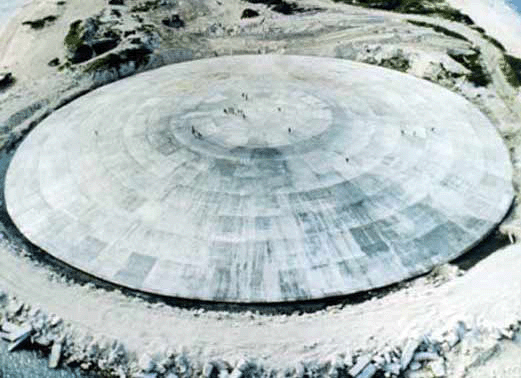
‘People want justice’: Marshalls’ fury over nuclear information US withheld– https://www.rnz.co.nz/international/programmes/datelinepacific/audio/2018723289/people-want-justice-marshalls-fury-over-nuclear-information-us-withheld From Dateline Pacific, 21 November 2019
|
The caretaker president of the Marshall Islands says it’s unconscionable that the United States kept secret key information about its nuclear tests for decades. New details reveal the US withheld information about the nuclear waste it left behind when the Marshall Islands gained independence, and the extent of the tests it carried out. Now, a dome that contains hundreds of tonnes of nuclear waste is at risk of crumbling into the ocean. But with Washington increasingly jittery about China, the small Pacific country’s finding it might now have some leverage to get something done. TRANSCRIPTEnewetak was once a paradise – a long atoll in the clear blue waters of the north Pacific, white sand and thick green palms. Today, it’s rutted with scars, after the US detonated dozens of nuclear bombs on, in and above it in the 1940s and ’50s. Whole islands were vaporised, deep craters carved into the coral. Jack Ading is a senator from Enewetak. His family was forced to move for the tests, and then allowed to return in the 1980s. “It appears that when we moved back to Enewetak in the 1980s after we were assured by the US government that it was safe. We were actually subjecting ourselves to a risk that we were never warned about.” Government documents reveal that beyond the nuclear blasts, the US also tested biological weapons, including an aerosol bacteria. Jamie Tahana reports. TRANSCRIPTEnewetak was once a paradise – a long atoll in the clear blue waters of the north Pacific, white sand and thick green palms. Today, it’s rutted with scars, after the US detonated dozens of nuclear bombs on, in and above it in the 1940s and ’50s. Whole islands were vaporised, deep craters carved into the coral. Jack Ading is a senator from Enewetak. His family was forced to move for the tests, and then allowed to return in the 1980s. “It appears that when we moved back to Enewetak in the 1980s after we were assured by the US government that it was safe. We were actually subjecting ourselves to a risk that we were never warned about.” Government documents reveal that beyond the nuclear blasts, the US also tested biological weapons, including an aerosol bacteria. But this was kept secret when the people from Enewetak were allowed to return, and other documents show that people were subjected to tests and experiments about the lingering effects of radiation. Last week, the Los Angeles Times also uncovered that the US didn’t tell the Marshallese it had shipped 130 tonnes of soil from its atomic testing grounds in Nevada in 1958 and dumped it at Enewetak. The caretaker president of the Marshall Islands, Hilda Heine, says the new details are disturbing. “To say the least you would have thought that all that information would have been shared with the Enewetak people before they went back to Enewetak. It is unbelievable that such information was held back, and as a result people have gone back and lived there for many years.” The nuclear waste from the era is stored in a pile at the end of the island of Runit, covered in a concrete dome. But a recent study by the Marshall Islands Nuclear Commission found the dome is now at risk of collapsing, and as rising seas erode beneath it, much of that waste is seeping into the lagoon. The commission’s chair, Rhea Moss-Christian, says information about the dome and the testing era was withheld throughout the independence process, while a compact of free association was negotiated in the 1980s. “We signed the compact in 1986 on the understanding that we had all the information we needed to have. It’s pretty hard for us to see this information, to have the level of detail that we now have, and to think that any of those previous agreements could stand.” The Marshall Islands has sought US help to clean up contamination and to shore up the dome, but American officials have declined, saying it’s on Marshallese land and, therefore, is the Marshall Islands’ responsibility. Ms Moss-Christian says that’s ridiculous. “How can it be that this radioactive waste and structure that we didn’t ask for. How can it be that this is ours and ours to deal with?” A Nuclear Claims Tribunal formed by the two countries in 1988 concluded that the US should pay $US2.2 billion in claims and settlements. But documents from both the Nuclear Commission and a 2010 US House inquiry show only $4 million has been paid. Last month, the Marshall Islands parliament – the Nitijela – endorsed a Nuclear Commission strategy which calls for, among other things, full compensation, better healthcare, and environmental protections. The US maintains it is upholding its responsibilities. It says it’s paid nearly a billion dollars, which has gone towards resettlement, rehabilitation and healthcare costs for affected communities, and that it’s funding tests of the water and atmosphere around the Runit dome. But Giff Johnson, the editor of the Marshall Islands journal and an author of books about the nuclear legacy, says that’s not enough. “People want justice for Marshall Islanders. The US government has to step up and address issues that it has addressed for American victims but is ignoring out here.” For the Marshall Islands, a smattering of atolls in the North Pacific – population 53,000 – it might be an opportune time to twist a superpower’s arm. Washington is increasingly nervous about a growing Chinese presence, and the compact of free association – which guarantees relations and funding from the US – expires in three years. Having initially maintained there won’t be a replacement compact, Washington is now keen to open talks for a new one, and has sent a string of high-ranking officials for visits. The caretaker president, Hilda Heine – who a few months ago was invited to the White House to meet President Donald Trump – says that could bode well. “The geopolitical situation in the Pacific is really helpful to the cause of the Marshall Islands. The US is now paying more attention to the Marshall Islands, so our issues around climate change, around our nuclear legacy, I think those will come to the forefront of our discussions going forward with the United States.” Whatever comes from those discussions, the people of Enewetak want more than they’re getting now. |
|
The hazards of nuclear submarines
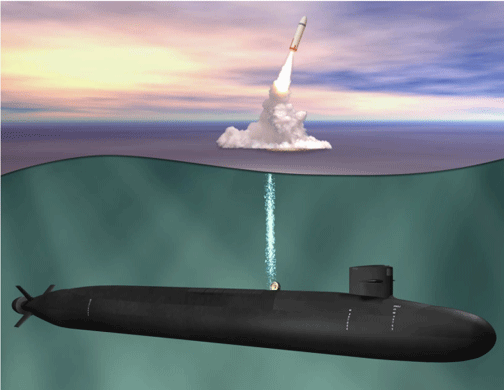
In 2019, a new set of nuclear dangers emerged for Southasia. The growing danger was underscored during the military crisis between India and Pakistan in February 2019, when India put one or more of its nuclear submarines on “operational deployment mode.” During the crisis, the Pakistani Navy claimed to intercept an Indian submarine. No one has confirmed if this interception involved an Indian submarine carrying nuclear weapons. With India and Pakistan on an accelerated programme of acquiring and developing nuclear submarines, Southasia needs to pay urgent attention to the risks of nuclear accidents at sea.
The expansion of nuclear operations to the sea also raises issues about who has the ability to authorise the use of these weapons, especially in a crisis. This is of particular concern in the case of India because it has already deployed such weapons. According to a November 2018 announcement by Prime Minister Narendra Modi, the Arihant nuclear-powered submarine successfully completed its maiden “patrol”.
A further source of concern is the August 2019 announcement by India’s defence minister to the effect that the country’s ‘No First Use’ (NFU) policy – which pledges not to attack with nuclear weapon unless attacked first – “would depend on the circumstances.” His comments, made during a period of increased tension between India and Pakistan following the amendment to Article 370 of India’s Constitution conferring special status to Jammu & Kashmir, underscore these risks.
India’s nuclear submarines……… Strategic competition with China in the Indian Ocean may be another factor. Serving and retired members of India’s Navy publicly express concerns about the deployment of Chinese submarines, warships and tankers in the Indian Ocean.
India’s growing arsenal also makes it a more valuable ally for the United States in its efforts to deal with the growth in China’s political and military power. For some time now, the US and India have been conducting joint naval exercises.
Pakistan’s naval force
Pakistan, for its part, announced the setting up of a Naval Strategic Force Command in 2012. Pakistan’s Navy has started preparing to put nuclear-armed cruise missiles on conventional submarines. The cruise missile is expected to be the 450-kilometer range Babur, which had a successful underwater test launch in 2018. There are reports that Pakistan is seeking to develop or acquire a nuclear-powered submarine…..
Submarine accidents
Almost all the countries operating nuclear-powered or nuclear-armed submarines have experienced accidents, often with significant loss of life and the spread of radioactivity in the environment. There have been over 40 accidents involving nuclear-powered submarines, claiming a total of over 650 lives. Of these accidents, more than half involved Soviet/Russian submarines resulting in over 400 deaths. The United States comes next, with at least a dozen submarine accidents leading to well over 200 deaths.
Two accidents have involved India’s nuclear submarines. …….
It would be unreasonable to expect that no more accidents involving nuclear submarines would ever take place. Nuclear submarines involve many technologies that are susceptible to a range of accidents affecting the submarine, nuclear reactor, missiles and nuclear weapons. All of these are operating under challenging conditions: deep under water, with limited supplies of air and water, possibly under attack. None of these factors is likely to change…….. Should a naval nuclear-reactor accident occur, especially at or near a naval base, coastal city or town the consequences could extend far beyond the vessel and its crew……
Pathways to war
The introduction of nuclear armed submarines, whether diesel or nuclear-fuelled, increases the likelihood of conventional conflicts escalating to a nuclear one. Any use of nuclear weapons would have devastating consequences, especially if the use of nuclear weapons by one country sets off a nuclear response from the other side.
In a military crisis, nuclear armed submarines increase the potential for nuclear war because they open up new risk pathways. The Australian strategist Desmond Ball pointed out in 1985 that “the sea is the only area where nuclear weapon platforms [of adversary states] … actually come into physical contact” and this contact can lead to accidents from several kinds of what seem to be typical naval operations.
There have already been incidents of Indian and Pakistani naval platforms coming into physical contact, for example in 2011, when the Pakistani vessel PNS Babur brushed past India’s INS Godavari. Contact between Navy forces from India and Pakistan might also result from deliberate attempts to attack submarines. Both countries are known to be acquiring anti-submarine warfare capabilities.The consequences of such events could be worse if submarines come into contact with each other during periods of heightened tensions or crises.
During a crisis, there may be inadvertent attacks on submarines carrying nuclear weapons, because these are intermingled with submarines carrying only conventional weapons. One notable instance occurred during the Cuban Missile Crisis, when US ships used practice depth charges against Soviet nuclear-armed submarines. This almost led to the use of nuclear weapons by the Soviet submarine.
Challenges to controlling nuclear weapons
A significant new challenge resulting from the deployment of nuclear weapons at sea is managing command and control. To the extent that such things are publicly known, India and Pakistan were believed to keep their nuclear weapons on land separate from the delivery vehicles, be they missiles or aircraft. This separation makes it harder for the weapons to be used without proper authorisation. With submarines armed with nuclear weapons at sea, this separation may not be possible and so the risk of unauthorised use is greater.
At the same time, one purpose of the nuclear-armed submarine is to be a final fail-safe means of nuclear attack even if a country’s political leadership is killed and its cities destroyed. To serve this role, the nuclear weapons on the submarine cannot rely on timely launch orders from political authorities. A further problem for submarines is that they are supposed to remain hidden from the enemy. Constant communication from the submarine to the military or civilian leadership may make it easier to detect. All of this means that during the time of a crisis, the personnel in a nuclear submarine might be the ones making decisions on whether or not to use nuclear weapons.
Southasians need to consider how they feel about trusting their lives in some future crisis to the restraint of Indian or Pakistani submariners far from home and fearful that their vessel is under attack, trying to decide about launching their nuclear missiles in a ‘use them or lose them’ scenario. The consequences would be devastating.
~Zia Mian is co-director of Princeton University’s Program on Science and Global Security, where he also directs the Project on Peace and Security in South Asia.
~M V Ramana is the Simons Chair in Disarmament, Global and Human Security at the Liu Institute for Global Issues in the School of Public Policy and Global Affairs at the University of British Columbia in Vancouver, Canada.
~Abdul H Nayyar is a physicist and a founder and former President of the Pakistan Peace Coalition, a national network of peace and justice groups. https://himalmag.com/nuclear-dangers-of-the-naval-kind-2019/?fbclid=IwAR0G8NZSV5ANg7Ag7KcuJU_80iv3pNJiqb6E_T12sylV9BaJWIvcZ3Vb_j0
 |
ReplyForward
|
US govt to fund study of Marshall Islands nuclear dome water
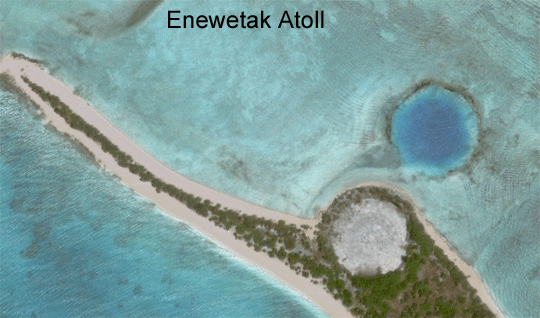
However, Marshall Islands officials say the lagoon water is already more contaminated than the dome itself, which has been leaking.
The money announced last week will fund a radiochemical analysis of the water surrounding the crater, and an engineering survey of the structure.
Surface melting causes Antarctic glaciers to slip faster towards the ocean
Direct link between surface melting and short bursts of glacier acceleration in Antarctica
- Date:
- September 20, 2019
- Source:
- University of Sheffield
- Summary:
- Study shows for the first time a direct link between surface melting and short bursts of glacier acceleration in Antarctica. During these events, Antarctic Peninsula glaciers move up to 100% faster than average. Scientists call for these findings to be accounted for in sea level rise predictions…….
https://www.sciencedaily.com/releases/2019/09/190920111355.htm
Russia’s nuclear torpedoes at the bottom of the sea
A Dead Russian Submarine Armed with Nuclear Torpedoes was Never Recovered, National Interest, Robert Farley, September 15, 2019
Key point: She rests at a depth of 15,000 feet —too deep to make recovery practical.
The Novembers (627):

Japan says TEPCO will dump more than 1 million tons of radioactive water from Fukushima nuclear plant into Pacific Ocean
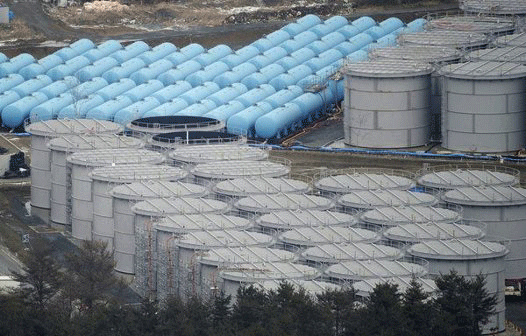
10 Sept 2019 | Japan’s environment minister announced Tuesday that the country will have to dump radioactive water from the Fukushima power plant into the ocean because it is running out of space, Reuters reported. According to Reuters, Tokyo Electric, or Tepco, has collected more than 1 million tonnes of contaminated water from the cooling pipes used to keep fuel cores from melting since the plant was crippled by an earthquake and tsunami in 2011. “The only option will be to drain it into the sea and dilute it,” the minister, Yoshiaki Harada, told a news briefing in Tokyo…The government is awaiting a report from an expert panel before making a final decision on how to dispose of the radioactive water. (The Hill, Reuters)
UN warns on need for global action – treaty – as the world’s oceans are in dire trouble
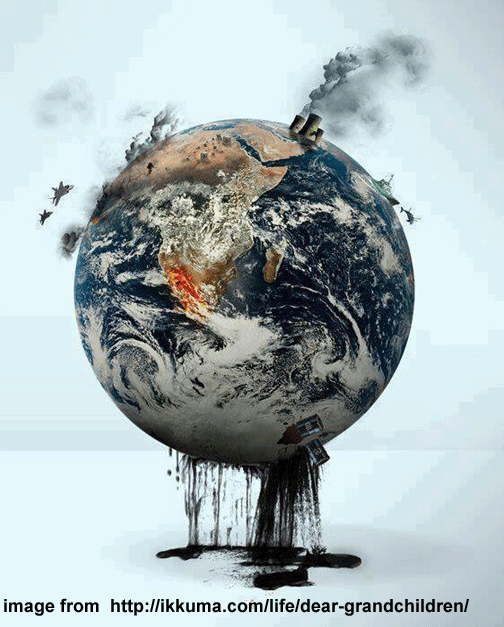 INTERVIEW-Ocean treaty needed to tackle ‘deep trouble’, says UN envoy, http://news.trust.org/item/20190831063635-oygwk/, by Adela Suliman | @adela_suliman | Thomson Reuters Foundation, Saturday, 31 August 2019 The oceans are increasingly threatened by global warming, acidification and pollution, and the impacts will affect us all, warned the U.N. oceans envoy. By Adela Suliman
STOCKHOLM, Aug 31 (Thomson Reuters Foundation) – The world’s seas are increasingly threatened by global warming, acidification and pollution, making it crucial to agree on a global treaty to protect them, the U.N. oceans envoy said.
Peter Thomson warned in an interview with the Thomson Reuters Foundation that the oceans were “in deep trouble”.
“It is worse than we think and there are no easy solutions,” he said at World Water Week in Stockholm this week, as the latest round of talks on a treaty wound up in New York.
The first global ocean treaty is due to be agreed in the first half of 2020. But on Friday environmental group Greenpeace said the negotiations were “disappointing” so far, blaming a lack of political will to secure a “progressive outcome”.
Thomson said a “comprehensive global regime” was needed to accelerate action to protect waters beyond national jurisdictions.
“It is critical in these challenging times for planetary environmental conditions that we develop a binding treaty for the conservation and sustainable use of marine biodiversity in the ocean,” he said.
A flagship scientific report warned this year that two-thirds of the ocean area was already affected by growing human impacts, primarily from stressors linked to global warming.
Climate change and the oceans were “intimately linked”, Thomson said, adding humanity was on a “totally irresponsible course” by not tackling global warming urgently enough. In 2015 nearly 200 nations signed up to the Paris Agreement that aims to keep the rise in average global temperatures to “well below” 2 degrees Celsius (3.6F) above pre-industrial times, and ideally to 1.5C.
“(Climate change) is going to have huge human impact and there will have to be a change of occupations, a change of domiciles,” Thomson warned.
Fishing communities and coastal dwellers would be worse off and needed support to adapt in a warmer world, he added.
A set of global development goals to be met by 2030 include conserving and using oceans, seas and marine resources wisely.
Much of the planet’s rainwater, drinking water, food and weather systems are provided or regulated by the sea.
“Every second breath you take comes from oxygen from the ocean,” said Thomson, a Fijian diplomat.
But seawater warming and acidification could change the chemical composition of the oceans, with profound effects for humans, he warned.
TURNING THE TIDE?
Pollution, including plastic, industrial waste, sewage and fertiliser, poses a serious threat to marine life, Thomson said.
“There are over 500 ‘dead zones’ all over the world where actually no life exists because of what’s coming down those rivers by way of pollution,” he said.
Meanwhile, irresponsible fishing practices have depleted fish stocks and are “part of the human tragedy of ending biodiversity”, he added.
Billions of people depend on oceans for their food and livelihoods, but the U.N. Food and Agriculture Organization has said nearly 90% of fish stocks are over-fished or fully exploited as global demand rises.
Thomson said, however, that pollution and over-fishing were “very fixable” with better environmental management.
Individual action had begun to make inroads – from public beach clean-ups to how people shop and vote.
Climate change, on the other hand, was a more “pernicious” threat to the Earth’s water, he said.
The U.N. climate science panel is due to publish a special report in late September on how climate change is affecting the world’s oceans and frozen water. Thomson said it would be a “guiding light” for future international protection efforts by providing scientific insight on how global warming is affecting life in the sea.
“The report will no doubt provide further support for dramatic scaling up of political ambition (to act),” he said.
“It’s no time to be sitting around philosophising … The changes have to be made now
Climate change is destabilising the Earth’s marine environment
|
Oceans turning from friend to foe, warns landmark UN climate report, Phys Org, by Marlowe Hood, Patrick Galey 30 Aug 19, The same oceans that nourished human evolution are poised to unleash misery on a global scale unless the carbon pollution destabilising Earth’s marine environment is brought to heel, warns a draft UN report obtained by AFP. Destructive changes already set in motion could see a steady decline in fish stocks, a hundred-fold or more increase in the damages caused by superstorms, and hundreds of millions of people displaced by rising seas, according to the Intergovernmental Panel on Climate Change (IPCC) “special report” on oceans and Earth’s frozen zones, known as the cryosphere. As the 21st century unfolds, melting glaciers will first give too much and then too little to billions who depend on them for fresh water, it finds. Without deep cuts to manmade emissions, at least 30 percent of the northern hemisphere’s surface permafrost could melt by century’s end, unleashing billions of tonnes of carbon and accelerating global warming even more. The 900-page scientific assessment is the fourth such tome from the UN in less than a year, with others focused on a 1.5-Celsius (2.6-Farenheit) cap on global warming, the state of biodiversity, and how to manage forests and the global food system. All four conclude that humanity must overhaul the way it produces and consumes almost everything to avoid the worst ravages of climate change and environmental degradation. Governments meet in Monaco next month to vet the new report’s official summary. While the underlying science—drawn from thousands of peer-reviewed studies—cannot be modified, diplomats with scientists at their elbow will tussle over how to frame the findings, and what to leave in or out. The final advice to policymakers will be released on September 25, too late to be considered by world leaders gathering two days earlier for a summit convened by UN Secretary-General Antonio Guterres to extract stronger national commitments in confronting the climate crisis. Guterres may be disappointed by what the world’s major greenhouse gas emitters put on the table, according to experts tracking climate politics in China, the United States, the European Union and India……….. 1,000-fold flood damage increase By 2050, many low-lying megacities and small island nations will experience “extreme sea level events” every year, even under the most optimistic emissions reduction scenarios, the report concludes. By 2100, “annual flood damages are expected to increase by two to three orders of magnitude,” or 100 to 1,000 fold, the draft summary for policymakers says. Even if the world manages to cap global warming at two degrees Celsius, the global ocean waterline will rise enough to displace more than a quarter of a billion people. The report indicated this could happen as soon as 2100, though some experts think it is more likely to happen on a longer timescale……… Marine heatwaves Oceans not only absorb a quarter of the CO2 we emit, they have also soaked up more than 90 percent of the additional heat generated by greenhouse gas emissions since 1970. Without this marine sponge, in other words, global warming would already have made Earth’s surface intolerably hot for our species. But these obliging gestures come at a cost: acidification is disrupting the ocean’s basic food chain, and marine heatwaves—which have become twice as frequent since the 1980s—are creating vast oxygen-depleted dead zones. In the Tasman Sea, for example, a 2015-16 heatwave lasted for 251 days, causing disease outbreaks and a die-off of farmed shellfish.https://phys.org/news/2019-08-oceans-friend-foe-landmark-climate.html |
|
Sea level rise only half the story – climate change is altering ocean waves
If the climate warms by more than 2℃ beyond pre-industrial levels, southern Australia is likely to see longer, more southerly waves that could alter the stability of the coastline.
Scientists look at the way waves have shaped our coasts – forming beaches, spits, lagoons and sea caves – to work out how the coast looked in the past. This is our guide to understanding past sea levels.
But often this research assumes that while sea levels might change, wave conditions have stayed the same. This same assumption is used when considering how climate change will influence future coastlines – future sea-level rise is considered, but the effect of future change on waves, which shape the coastline, is overlooked.
Changing waves
Waves are generated by surface winds. Our changing climate will drive changes in wind patterns around the globe (and in turn alter rain patterns, for example by changing El Niño and La Niña patterns). Similarly, these changes in winds will alter global ocean wave conditions.
Further to these “weather-driven” changes in waves, sea level rise can change how waves travel from deep to shallow water, as can other changes in coastal depths, such as affected reef systems.
Recent research analysed 33 years of wind and wave records from satellite measurements, and found average wind speeds have risen by 1.5 metres per second, and wave heights are up by 30cm – an 8% and 5% increase, respectively, over this relatively short historical record.
These changes were most pronounced in the Southern Ocean, which is important as waves generated in the Southern Ocean travel into all ocean basins as long swells, as far north as the latitude of San Francisco.
Sea level rise is only half the story.…. https://theconversation.com/climate-change-may-change-the-way-ocean-waves-impact-50-of-the-worlds-coastlines-121239
Anxiety over Russian nuclear power plant afloat in Arctic
|
Russian nuclear power plant afloat in Arctic causes anxiety across Bering Strait
|
|
The radioactively polluted oceans


Radionuclide-Inundated Oceans https://www.opednews.com/articles/Radionuclide-Inundated-Oce-by-ed-tanner-Ocean-Acidification_Ocean-Currents_Ocean-Energy_Ocean-Pollution-190712-791.html– OpEdNews Op Eds 7/12/2019 By ed tanner Only God knows how much radioactive waste has run off, from the continental United States and Asia, into the oceans. Only the gods know how many barrels of nuclear waste from countries like France, the USA, and Russia have been carted out on freighters into the Atlantic and Pacific Oceans and dumped. The French blew up a Greenpeace ship by New Zealand for dogging one of France’s nuclear-waste dumping freighters.
The Russians continue to have the least-contained, most-dangerous reactor designs in the world running on undependable mox [a type of nuclear fuel] made in Mayak. Two Russian reactors may have already gone off since Chernobyl. You will not hear about that. There were elevated radiation readings in Europe, since Fukushima, that came from Russia and stunk of high-level reactor releases.
Busby used a gamma spectrometer off the coast of the Baltic Sea by Russia and found that cesium 134 and 137 levels were twice as high, post Chernobyl, as they should be, in 2017.
America is a radioactive crudhole with places like Hanford, Three-Mile Island, and multiple open-air nuclear tests for decades. Ninety-seven of the leakiest, oldest, most cracked and brittle nuclear reactors in the world. Tens of thousands of tons of the worst high-level nuclear waste are spread across the USA.
Now think about Russia and Japan and the Arctic ocean and Pacific ocean for a minute.
Many places in Russia are so radioactive that one cannot stand for 30 minutes without dropping dead. Russia has the distinction of being one of the most radioactive countries on earth! Up there with Japan and many places in America.
The CIA will tell you about Russia’s shrinking demographics, but they will not tell the truth about it.
Half the men and women in Russia have fertility problems from massive radionuclide contamination. The CIA says it is from an aging Russian population and bad Russian economy. I knew a Russian doctor that was in a port where a Russian sub blew in the late ’80s. She has had dysmenorrhea and has been bleeding since then.
The Russians run nuclear-powered ice breakers in the Arctic. America is a radioactive shithole and so is Russia. The Russians have dumped two hundred thousand tons of high-level nuclear waste in the Arctic ocean. That includes the old nuclear reactors it has pushed into the Arctic and Baltic oceans and the old nuclear submarines there. Altogether there are probably a half a million tons of the highest-level radionuclides dumped in the Arctic ocean, from Russia, the USA, France and England. Some of that high-level waste is constantly changing. Some has longer lasting, heat-generating radionuclides like pyrophoric plutonium
Uraniums
Strontiums THESE ARE STRONG
Cesium 134-137 BETA-GAMMA
Radioactive-cobalt EMITTERS
Germanium-72, 73, 74, 76
Arsenic-75
Strontiums 88-90
Iodine 129
Yttrium-89
Zirconium-90 to 96

Niobium-95
Technetium-99
Ruthenium-101 to 106
Things like strontium 90, plutonium and
CESIUM 134-137 are migrating to the Pacific ocean from the Arctic ocean, so there is the Fukushima nuclear excrement in the Pacific and everything else.
The Russians brag about a floating reactor in the Arctic. That crappy old reactor will dump nuclear waste into the ocean and forever be prone to exploding there. The Russians have dumped old nuclear submarines and old reactors in the Arctic ocean. Americans and the UK and France have dumped subs into the oceans too.

THIS SUNKEN NUCLEAR SUB IS LEAKING RADIATION INTO THE OCEAN
 THIS SUNKEN NUCLEAR SUB IS LEAKING RADIATION INTO THE OCEAN, https://futurism.com/the-byte/sunken-nuclear-sub-leaking-radiation _KRISTIN HOUSER__10 Jul19 THIS SUNKEN NUCLEAR SUB IS LEAKING RADIATION INTO THE OCEAN, https://futurism.com/the-byte/sunken-nuclear-sub-leaking-radiation _KRISTIN HOUSER__10 Jul19
Sunken Measures A team of Russian and Norwegian scientists just made a grim, timely discovery. Just one week after a nuclear-powered Russian submarine caught fire, killing 14 sailors, researchers sent a remote submarine to collect samples around the sunken wreckage of another nuclear sub, which caught fire in 1989 leading to the deaths of 42 crew members. The preliminary results of their investigation indicate that radiation levels in the water near the sunken Soviet sub’s ventilation duct are up to 800,000 times higherthan expected in sea water — suggesting we may be dealing with the repercussions of the recent disasterfor decades to come. This isn’t the first time researchers have detected higher than normal radiation levels around the wreckage of K-278 Komsomolets, which sunk about 260 miles off the Norwegian coast and is now about a mile beneath the ocean’s surface. “We took water samples from inside this particular duct because the Russians had documented leaks here both in the 1990s and more recently in 2007,” expedition leader Hilde Elise Heldal said in a press release. “So we weren’t surprised to find high levels here.” While the current levels are higher than normal, according to Heldal, they aren’t high enough to threaten Norwegian fish or seafood — so for now, the team plans to thoroughly study its collected samples and continue to monitor to wreckage for signs that the radiation is getting worse. |
|
Trip to check radiation after 1989 sinking of Russian sub
The Radiation and Nuclear Safety Authority say Norwegian research vessel G.O. Sars will set off Saturday from Tromsoe, northern Norway, to the Arctic Barents Sea where the Komsomolets submarine sank in 1989. Forty-two of the 69 crewmen died in a fire, and the submarine’s nuclear reactor and two nuclear warheads are still on board.
The agency said a Norwegian-built remote-controlled submersible would be used and the work “would be demanding” as the submarine “lies deep” at about 1,700 meters (5,610 feet)…… https://www.apnews.com/dd6e18dafde14bf799de6d9b5f13fccd
1 This Month
To see nuclear-related stories in greater depth and intensity – go to https://nuclearinformation.wordpress.com/
12 February – Webinar The Big Push: New Nuclear Projects in Canada
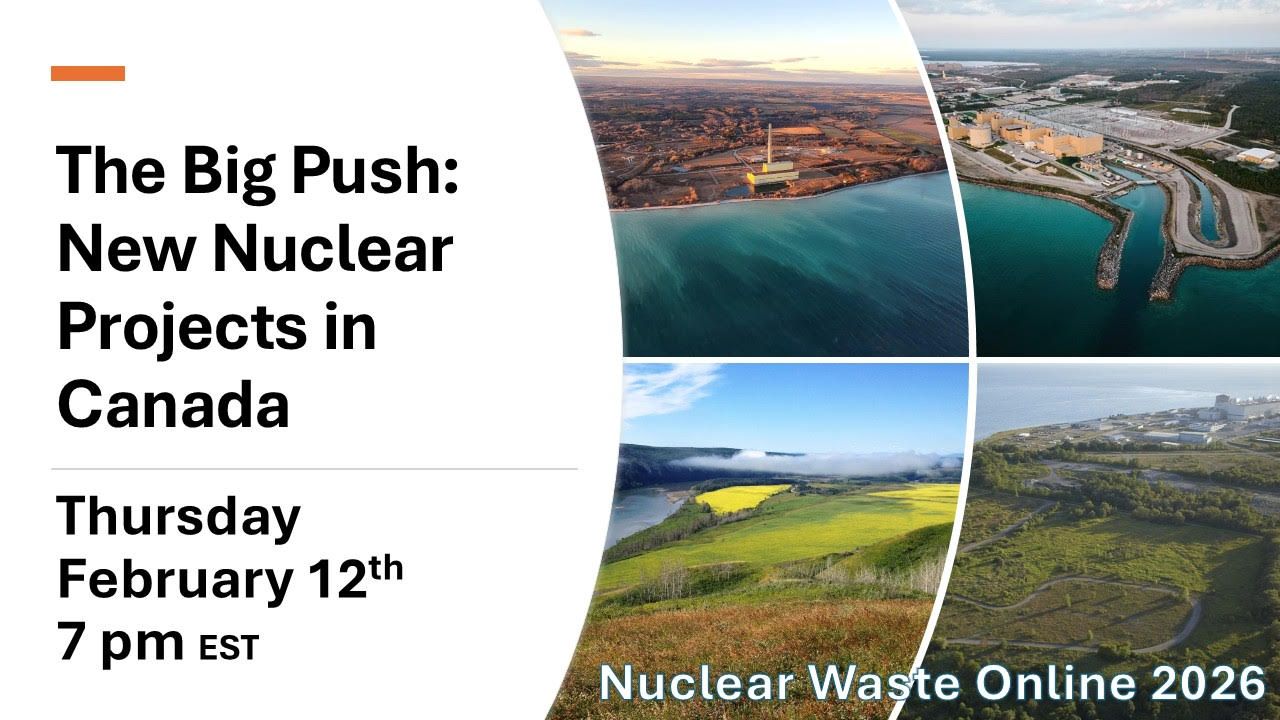
Thursday, February 12, 7 pm Eastern | 2nd of 4 sessions in the 2026 Nuclear Waste Online webinar series
Join a webinar on the push for new nuclear generation in Canada. Go to Northwatch.org to register or use the registration link https://us02web.zoom.us/webinar/register/WN_ZfWOf1GITqSRIZX8CB-A9w
-
Archives
- February 2026 (115)
- January 2026 (308)
- December 2025 (358)
- November 2025 (359)
- October 2025 (376)
- September 2025 (258)
- August 2025 (319)
- July 2025 (230)
- June 2025 (348)
- May 2025 (261)
- April 2025 (305)
- March 2025 (319)
-
Categories
- 1
- 1 NUCLEAR ISSUES
- business and costs
- climate change
- culture and arts
- ENERGY
- environment
- health
- history
- indigenous issues
- Legal
- marketing of nuclear
- media
- opposition to nuclear
- PERSONAL STORIES
- politics
- politics international
- Religion and ethics
- safety
- secrets,lies and civil liberties
- spinbuster
- technology
- Uranium
- wastes
- weapons and war
- Women
- 2 WORLD
- ACTION
- AFRICA
- Atrocities
- AUSTRALIA
- Christina's notes
- Christina's themes
- culture and arts
- Events
- Fuk 2022
- Fuk 2023
- Fukushima 2017
- Fukushima 2018
- fukushima 2019
- Fukushima 2020
- Fukushima 2021
- general
- global warming
- Humour (God we need it)
- Nuclear
- RARE EARTHS
- Reference
- resources – print
- Resources -audiovicual
- Weekly Newsletter
- World
- World Nuclear
- YouTube
-
RSS
Entries RSS
Comments RSS
 nuclear-news