Cost of renewable energy has halved since 2008
Analysis: 50% Reduction In Cost Of Renewable Energy Since 2008 Clean Technica, 11 Sept 13 (Very good graphs). Renewable energy becoming more cost-competitive with fossil fuels isn’t news – as technology improves and more clean power generation comes online, electricity without emissions gets cheaper. But one new analysis reveals just how shockingly cheap it’s gotten.
The levelized cost of electricity (LCOE) from wind and solar sources in America has fallen by more than 50% over the past four years, according to Lazard’s Levelized Cost of Energy Analysis 7.0, recently released by global financial advisor and asset manager firm Lazard Freres & Co.
Lazard’s analysis compared the LCOE for various renewable energy technologies to fossil fuels on a cost per megawatt hour (MWh) basis, including factors like US federal tax subsidies, fuel costs, geography, and capital costs.
Utility-Scale Solar, Wind Lead LCOE Charge Continue reading
Wind power to dismantle nuclear weapons
The Largest Federal Wind Farm Will Power The Dismantling Of Nuclear Weapons, Stan Alcorn, Co exist 10 Sept 13 “…..The largest federal wind power plant is now being built to power a facility that does most of the nuclear weapons dismantling in the United States.
At the Pantex in the wind-rich Texas panhandle, electricity will soon come from five massive turbines, to help “green the nuclear security enterprise.”….. The case for the project is largely economic. The 47 million kilowatt hours of energy the five massive turbines will deliver should provide of 65% of the plant’s energy needs. That will save $2.8 million annually over the course of the 18-year contract, according to Siemens–money that will be used to pay back the original investment…. it’s a smart investment in the long run. And Marks says it’s only the beginning. “We hope to expand the wind farm even beyond these five turbines,” she says. “There’s plenty of property there, and plenty of wind.” http://www.fastcoexist.com/3016748/the-largest-federal-wind-farm-will-power-the-dismantling-of-nuclear-weapons
Cheaper solar cells with nanotechnology
 Cheaper Solar Cells With Abundant Earth Materials http://www.energymatters.com.au/index.php?main_page=news_article&article_id=3921 4 Sept 13 University of Alberta scientists have used nanotechnology to design a solar cell incorporating abundant-earth elements, which they say could lead to cheaper and more prolific solar power in off-grid areas.
The team’s work revolves around finding ways to lower the cost of print and spray-on solar technology using nanoparticle-based photovoltaic cells. Jillian Buriak, senior research officer of the UA’s National Institute for Nanotechnology and fellow researchers used two commonly occurring elements, zinc and phosphorous, to form zinc phosphide, a highly conductive and photosensitive nanoparticle. The team then invented a method for dissolving the nanocrystals into a red-coloured ink capable of absorbing light and transforming it to energy.
Buriak believes this photovoltaic ink is an important step towards mass production of solar power through roll-to-roll printing and spray-on techniques.
“Nanoparticle-based ‘inks’ could be used to literally paint or print solar cells or precise compositions,” she said.
“Half the world already lives off the grid, and with demand for electrical power expected to double by the year 2050, it is important that renewable energy sources like solar power are made more affordable by lowering the costs of manufacturing.”
According to the University, the advantage of using such abundant-earth elements in the solar research is that both materials are more plentiful than scarce materials such as cadmium and are free from manufacturing restrictions imposed on lead-based nanoparticles.
Team member Hosnay Mobarok of UA’s Faculty of Science discovered the method of turning the zinc phosphide nanoparticles into a photovoltaic liquid. Erik Luber, from the Faculty of Engineering then worked on making the film responsive to sunlight.
The team have built a prototype solar panel and are currently working on spray-coating larger solar cells to test their efficiencies.
The work, funded in part by the Natural Sciences and Engineering Research Council of Canada, has been published in the journal ACS Nano.
Gulf Cooperation Council showcases solar energy development
UAE And Saudi Arabia Evolving Into Solar Powerhouses http://www.energymatters.com.au/index.php?main_page=news_article&article_id=3920 3 Sept 13 The United Arab Emirates and Saudi Arabia are leading the way among Gulf Cooperation Council (GCC) states in the deployment of solar power.
Combined, GCC countries have approximately 84 GW of solar farm projects in the pipeline due for completion by 2017; representing investment value of US$155 billion.
“Over the years, solar power has been acknowledged as the most promising source of renewable energy and GCC governments have demonstrated their keenness to shift from traditional energy sources to these low-cost and abundant alternatives,” said Derek Burston, Director of the UK-based Bowmedia, the organisers of Gulf Sol 2013.
“Direct radiation in many Middle Eastern countries exceeds 6 kWh per square metre per day, making for excellent solar potential. In addition, recent decreases in the costs of solar technologies coupled with rising electricity demand in these growing nations, if coupled with the right policies, could make the region a hub for solar expansion”.
Saudi Arabia aims to double its installed electricity capacity; a goal that will be achieved in part by the construction of 54 GW of renewable energy power stations by 2032, 41 GW of which will be solar.
The largest operating solar panel based power generation facility in the GCC region currently is Enviromena’s 10 MW PV plant in Masdar City, Abu Dhabi, UAE. Abu Dhabi has set a goal of generating 7% of its electricity from renewable sources by 2020.
The Gulf Sol 2013 summit will run from September 3 to 5 and aside from showcasing the latest in solar technology, the event will include sessions discussing the feasibility of solar power projects in remote areas, opportunities in the GCC for international companies and regulatory and policy frameworks for implementation of solar projects.
The Gulf Cooperation Council consists of six Middle Eastern countries – Saudi Arabia, Kuwait, the United Arab Emirates, Qatar, Bahrain, and Oman. The alliance was formed in part to strengthen relations among its member countries.
Look at this – World’s largest solar thermal energy plant
Take A Tour Of This Insane Solar Thermal Energy Plant (Excellent photos) GIZMODO ALISSA WALKER 30 AUG 13 Sometime in the next few months, the Ivanpah Solar Electric Generating System will flip the switch on the largest solar plant of its kind in the world: a 377-megawatt, 3500-acre solar thermal energy system. It’s located in California’s Mojave Desert, near the Nevada border, and it’s ridiculously big. ‘

‘I would suggest going to check it out in person during your next Vegas binge weekend, but from the 15 freeway it’s little more than a silvery blur — a rippling, mirage-like, silvery blur that feels like it might sear your retinas if you look at it too long. So it’s a good thing they’ve just posted this incredible virtual tour……. HTTP://WWW.GIZMODO.COM.AU/2013/08/TAKE-A-TOUR-OF-THIS-INSANE-SOLAR-THERMAL-ENERGY-PLANT-IN-THE-CALIFORNIA-DESERT/
127 countries now supporting renewable energy schemes
Renewable energy support schemes now present in 127 countries, report finds PV Magazine, 28. AUGUST 2013 | MARKETS & TRENDS, GLOBAL PV MARKETS, APPLICATIONS & INSTALLATIONS | BY: IAN CLOVER The Worldwatch Institute — an independent research organization based in Washington D.C. — reports that 127 countries worldwide have now enacted support schemes for renewable energy…….. Despite the economic downturn leaving a number of countries mired in recession and hamstrung by shrinking budgets, investment in renewable energy development and expansion has generally followed an upward trend, particularly in the solar photovoltaics industry, which has seen module costs fall by as much as 80% since 2008, and 20% since 2012.
At the beginning of this year, 66 countries offered tax incentives on renewable energy development, the report finds. And as the technology has proliferated, so has regional diversity.
In the middle of the decade, 58% of countries that enacted renewable energy support schemes were located in Europe and Central Asia. Today, that figure is slightly more than a third of the global total, with East Asia and the Pacific (21%), and Latin America and the Caribbean (LAC) following closely. http://www.pv-magazine.com/news/details/beitrag/renewable-energy-support-schemes-now-present-in-127-countries–report-finds_100012528/#ixzz2dOMWGZNk
China to replace coal by wind and solar energy, by 2030
China has already demonstrated what’s in store by reducing the cost of solar PV modules so much that they are now commonplace on roofs across the mortgage belt suburbs of Australia. Between one-in-10 and even as much as one-in-three households now have solar PV systems installed in the outer metropolitan suburbs of Sydney, Brisbane, Perth, Adelaide and Melbourne as well as several regional cities. Such an outcome wasn’t even dreamt about by the most wildly optimistic greenie just four years ago.
What Japan did for home entertainment equipment, China will do for clean energy
 Wind & solar outpace coal in China by 2030 – Bloomberg Tristan Edis 28 Aug 13, Bloomberg New Energy Finance (BNEF) has released analysis which finds renewables will make up more than half of new power capacity growth in China to 2030, across a variety of plausible scenarios. By 2030 total installed capacity of renewable energy power plants will equal that of coal.
This study sought to examine how technological and economic changes might realistically alter the make-up and growth of China’s power sector. They found that coal’s dominance will be challenged by:
– faster technological improvement and cost reductions achieved by renewable energy technologies;
– increased social concern and, consequently, government regulation over environmental pollution;
– the prospects of shale gas, and;
– a potential price on carbon emissions. Continue reading
America could get to 75% renewable energy quite quickly

Billions of solar panels and millions of wind turbines
The good news is we are already getting these.
With An ‘All-Out’ Federal Renewable Energy Strategy, How Long Before We Could Be 100% Renewably Powered?, Forbes, Mark Rogowsky, Internet Entrepeneur, 22 Aug 13, Probably 20-30 years to get to 70-80%, but 80 years to get the last 20-30%.
Let’s clarify that the assumption here is that the United States actually decides to do this per the hypothetical. That means that for whatever reason, the politics has shifted massively from where it currently stands. There are a lot of roadblocks to 100% renewable energy, but relatively few toward mostly renewable energy — assuming you’ve solved the politics problem. Here’s what you need:
An integrated long-distance grid
You’ll be carrying a lot of wind from the Midwest, possibly from offshore in the East, and tons of solar from the Southwest long distances. So you’re going to want much better long-distance power lines, maybe even with superconducting trunks. This will let you use Arizona’s 5 pm sun to power Florida’s air conditioners at 8 pm. Is this trivial? No. Is it technologically impossible? Absolutely not.
Millions of electric cars
We use a lot of non-renewable fuel for transportation. We’re going to need electric vehicles to fix that. Continue reading
Solar energy shiningin Japan, amidst its nuclear nightmare
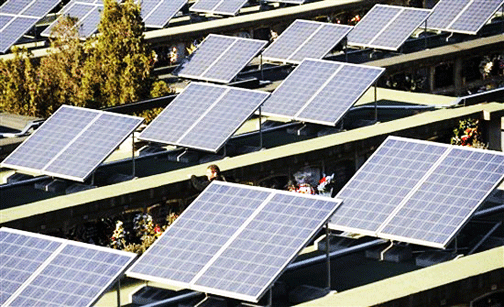
 Japan Adds 2+ Gigawatts Of Solar PV by Energy Matters, 22 Aug 13, Japan’s love affair with solar blossoms while a massive radioactive contamination threat still looms large.
Renewable energy facilities that commenced operations during Japan’s 2012 fiscal year (1 April 2012 to March 31 2013) totaled 2.08 gigawatts capacity, equivalent to two nuclear reactors, said the nation’s Economy, Trade and Industry Ministry.
Of the 2.08 gigawatts, 1.98 gigawatts was contributed by residential, commercial and utility scale solar PV.
The Ministry describes Japan’s shift towards a renewable future as “smooth”, with an additional 1.28 gigawatts of renewables added to the nation’s energy infrastructure in April and May this year.
All told, the amount of renewable capacity approved between July 2012 and March this year was 21.09 gigawatts, meaning far more is yet to be built.
While solar is enjoying smooth sailing, the country’s nuclear industry is experiencing anything but; with crisis after crisis occurring at the crippled Fukushima nuclear power station…… http://www.energymatters.com.au/index.php?main_page=news_article&article_id=3905
Breakthrough in solar energy storage battery
 No Mem-Brainer Flow Battery Delivers Big http://www.energymatters.com.au/index.php?main_page=news_article&article_id=3904 23 Aug 13, A palm-sized experimental flow battery developed by Massachusetts Institute of Technology researchers has the potential to solve intermittency challenges in utility-scale renewable energy systems.
The MIT team has engineered a prototype flow battery storage system without the expensive membrane usually required. Continue reading
Contrary to mainstream media propaganda, renewable energy is growing fast
 national media sentiment towards the renewable energy industry is overwhelmingly negative and neglects the voice of the industry. I should imagine similar findings are likely in Australia.
Fundamentally, a green future is inevitable and the next industrial revolution will be low carbon. Why? Because clean technology is fast becoming recognised as lower cost financially, socially and environmentally than carbon dense alternatives. The sooner it’s recognised as the low cost political road too the better.
Has Europe pulled the plug on renewables? http://www.businessspectator.com.au/article/2013/8/21/renewable-energy/has-europe-pulled-plug-renewables#ixzz2cjFBwgch
First, Peiser is incorrect to say that green growth is dwindling. In fact, quite the opposite is true. Continue reading
Wind turbines getting quieter, cleaner, and cheaper
Quieter Wind Turbines = More Power http://www.energymatters.com.au/index.php?main_page=news_article&article_id=3898 20 Aug 13 GE has been conducting research into new low-noise wind turbine blade design. It’s not about addressing infrasound – which has already been shown not to be an issue in areas surrounding wind farms – it’s all about producing more power.
“There’s no question, aerodynamic noise is a key constraint in wind turbine blade design today”, says Mark Jonkhof, Wind Technology Platform Leader at GE Global Research.
“By using high-performance computing (HPC) to advance current engineering models that are used to predict blade noise, we can build quieter rotors with greater blade tip velocity that produce more power. This not only means lower energy costs for consumers, but also a significant reduction in greenhouse gas emissions.”
Aerodynamic noise refers to the “swooshing” sound created as the leading edge of a turbine blade moves through the air. GE predicts that a mere one decibel drop in this sound would lead to an annual two percent increase in power per turbine. With an estimated 240 gigawatts of wind power to come online globally over the next five years, GE says this would be the equivalent of 5 gigawatts of added wind energy capacity.
The company currently uses wind tunnel technology to test the noise levels of its wind turbines, as well as on-site acoustic tests at wind farms; but new computer modelling has advanced these techniques.
The GE team partnered with Sandia National Laboratories in New Mexico, spending three months running high-fidelity Large Eddy Simulations (LES) on a single wind blade section with the lab’s Red Mesa supercomputer. The LES system and resulting analysis provided fresh insight about airflow over wind turbines and will play a key role in building the next generation of quiet turbine blades.
“Having access to Sandia’s supercomputer was invaluable in our ability to conduct these experiments and make discoveries that will bolster wind power’s potential. Access and availability to HPC resources offers a critical advantage to companies trying to compete in a global environment.”
Every 4 minutes A Solar System Is Installed in the US
A Solar System Is Installed in the US Every 4 Minutes http://www.greentechmedia.com/articles/read/america-installs-a-solar-system-every-four-minutes The industry will soon install one solar system every minute and a half. STEPHEN LACEY: AUGUST 19, 2013
A lot happens in America every four minutes. During that short time period, 30 babies areborn, 4,080 McDonald’s Big Macs are consumed, and 48,000 tons of CO2 are emitted.
And as it turns out, the U.S. is now installing one solar photovoltaic (PV) system every four minutes as well. If market growth continues at its current pace, the American solar industry could be installing a system every minute and twenty seconds by 2016. That’s a dramatic difference from 2006, when installers were only putting up one system every 80 minutes. Shayle Kann, vice president of GTM Research, documents the accelerating speed of solar deployment in the chart below:

It may not quite match Big Mac sales yet, but solar is on an extraordinarily fast growth trajectory. According to figures from GTM Research, two-thirds of all distributed solar in the U.S. has been installed over the last 2 1/2 years. And by 2016, cumulative installations of distributed PV will double.
That means the U.S. will hit 1 million cumulative residential solar installations by then — making the market in 2016 ten times larger than it was in 2010. For more information on American solar trends, check out the U.S. Solar Market Insight Report from GTM Research and SEIA.
Japan buying lots of solar panels
 REC Supplies 15,000+ Panels To Japanese Solar Farms, by Energy Matters. 20 Aug 13, REC is continuing to make its presence felt in Japan, with 2 new solar farms using REC Peak Energy Series solar panels.
The 2.5 MW Toyobo Mie (Kusu) C-Energy plant; located in Yokkaichi, Mie Prefecture, started operation last month and is expected to generate 2.5 million kWh of electricity annually.
The second REC-based installation is a ground-mounted 1.3 MW array situated at the Research Institute in Ohtsu City, Shiga Prefecture. Construction of that facility began last month and will be completed in December.
Japan is becoming a lucrative market for REC, with 29 percent of REC’s solar panel shipments heading to the nation in the second quarter of 2013….. http://www.energymatters.com.au/index.php?main_page=news_article&article_id=3897
Reliable and cheap renewable energy storage
Rechargeable flow batteries could be cheaper solution to renewable energy storage http://www.treehugger.com/clean-technology/rechargeable-flow-batteries-could-be-cheaper-solution-renewable-energy-storage.html Megan Treacy August 19, 2013 Researchers at MIT have developed a battery that could bring us reliable and cheap large scale energy storage. Based on flow battery technology, the researchers took out the costly membrane and created a battery that has a power density that is an order of magnitude higher than lithium-ion batteries and three times greater than other membrane-less systems.
MIT reports, “The device stores and releases energy in a device that relies on a phenomenon called laminar flow: Two liquids are pumped through a channel, undergoing electrochemical reactions between two electrodes to store or release energy. Under the right conditions, the solutions stream through in parallel, with very little mixing. The flow naturally separates the liquids, without requiring a costly membrane.”
The reactants used are liquid bromine and hydrogen fuel, which is cheap, but also has had issues with breaking down the membrane in other flow batteries. By taking out the membrane they were able to speed up energy storage and extend the life of the battery.
“Here, we have a system where performance is just as good as previous systems, and now we don’t have to worry about issues of the membrane,” says Martin Bazant, a professor of chemical engineering. “This is something that can be a quantum leap in energy-storage technology.”
As we bring more renewable technologies like wind and solar into the grid, affordable and reliable energy storage is increasingly important. While solar and wind energy output varies based on weather conditions, large scale energy storage systems can smooth out the power delivery from those technologies by storing any excess energy when it’s produced and using it when the output is lower or demand is higher.
“Energy storage is the key enabling technology for renewables,” says Cullen Buie, an assistant professor of mechanical engineering. “Until you can make [energy storage] reliable and affordable, it doesn’t matter how cheap and efficient you can make wind and solar, because our grid can’t handle the intermittency of those renewable technologies.”
MIT says, “Braff built a prototype of a flow battery with a small channel between two electrodes. Through the channel, the group pumped liquid bromine over a graphite cathode and hydrobromic acid under a porous anode. At the same time, the researchers flowed hydrogen gas across the anode. The resulting reactions between hydrogen and bromine produced energy in the form of free electrons that can be discharged or released.
The researchers were also able to reverse the chemical reaction within the channel to capture electrons and store energy — a first for any membraneless design.”
Now that the team’s experiments have lined up with their computer models, they’re focused on scaling up the technology and seeing how it performs. They predict that the technology will be able to produce energy costing as little as $100/kWh, which would make it the cheapest large scale energy storage system built yet.
1 This Month
26 September – International Day for the Total Elimination of Nuclear Weapons





PLEASE OPPOSE HR 8255 AND S.3639 – bills would accelerate satellite deployment, with no environmental review or safeguards – https://ncstd5li.quorum.us/campaign/169331/
To see nuclear-related stories in greater depth and intensity – go to https://nuclearinformation.wordpress.com
-
Archives
- September 2026 (305)
- August 2026 (330)
- July 2026 (355)
- June 2026 (287)
- May 2026 (306)
- April 2026 (356)
- March 2026 (251)
- February 2026 (267)
- January 2026 (308)
- December 2025 (358)
- November 2025 (359)
- October 2025 (375)
-
Categories
- 1
- 1 NUCLEAR ISSUES
- business and costs
- climate change
- culture and arts
- ENERGY
- environment
- health
- history
- indigenous issues
- Legal
- marketing of nuclear
- media
- opposition to nuclear
- PERSONAL STORIES
- politics
- politics international
- Religion and ethics
- safety
- secrets,lies and civil liberties
- spinbuster
- technology
- Uranium
- wastes
- weapons and war
- Women
- 2 WORLD
- ACTION
- AFRICA
- Atrocities
- AUSTRALIA
- Christina's notes
- Christina's themes
- culture and arts
- Events
- Fuk 2022
- Fuk 2023
- Fukushima 2017
- Fukushima 2018
- fukushima 2019
- Fukushima 2020
- Fukushima 2021
- general
- global warming
- Humour (God we need it)
- Nuclear
- RARE EARTHS
- Reference
- resources – print
- Resources -audiovicual
- Weekly Newsletter
- World
- World Nuclear
- YouTube
-
RSS
Entries RSS
Comments RSS

