World’s largest solar thermal plant now in action
World’s biggest solar thermal power plant fired up in California Grist By John Upton 25 Sept 13 Business Wire Ivanpah The 3,500-acre Ivanpah Solar Electric Generating System is a startling sight in the Mojave Desert. Three sprawling units each contain a circular array of mirrors reflecting rays from the sun toward a 459-foot central tower. Water in the tower is heated by the rays to produce steam, which spins turbines and — voila — electricity is produced.
It all seems a bit magical, but as of Tuesday, the world’s largest solar thermal power plant began feeding energy into a power grid for the first time.

How much energy? Once fully operational, the project is expected to produce 377 megawatts of power that will be sold to two Californian utilities, helping the state’s electricity sector meet ambitious, state-mandated renewable energy goals. During some days it could provide enough power for more than 200,000 homes.
Partners in the project include NRG Energy, BrightSource Energy, Google, Bechtel and, of course, you and me. The federal government leased public land to the effort and backed it up with one of those loan guarantees that you heard so much about in 2011 and 2012…….http://grist.org/news/worlds-biggest-solar-thermal-power-plant-fired-up-in-california/?utm_campaign=daily&utm_medium=email&utm_source=newsletter&sub_email=chris%40protectourwinters.org
Germany shows political success of its renewable energy transition
it is a clear signal that citizens are favouring a publicly owned, decentralised energy system with a leading role of renewables.”
The German result is likely to present good news. HSBC believes the IPCC report – despite its criticism in some quarters, and particularly by the fossil fuel lobby – could mark “a new phase in climate action”.
Germany votes for energy transition, and to buy back the grid http://reneweconomy.com.au/2013/germany-votes-for-energy-transition-and-to-buy-back-the-grid-50110 By Giles Parkinson on 25 September 2013
As the dust settles on the election results, and Chancellor Angela Merkel begins the process of selecting a new coalition partner, most observers are suggesting that the poll results are positive for Germany’s Energiewende, the ambitious energy transition program that aims to have Europe’s strongest industrial economy powered 50 per cent by renewables by 2030, and 80 per cent by 2050. (Below renewable energy in just one province of Germany 2012)
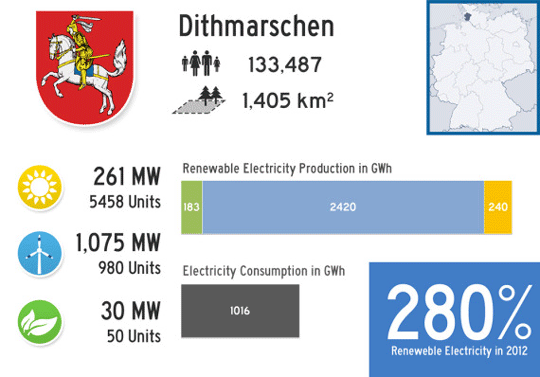
 The politicians are wrong – 100% renewable energy is possible Guardian UK Dr Nafeez Ahmed 25 Sept 13, If Miliband wants to beat the Big Six and deliver energy price freeze promise, he must fix his party’s broken policies first “…….In May this year, a report by the Committee found that investing in renewable energy, as opposed to a new ‘dash for gas’, would be the cheapest option for keeping the lights on while cutting greenhouse gas emissions. Investing in renewable energy was the best option even if shale gas prices were relatively low. The report identified “a clear benefit in committing to invest in low-carbon generation over the next two decades”, rather than “an alternative strategy of investing in gas-fired generation through the 2020s and delaying investment in low-carbon technologies.”
In other words, we don’t need shale gas to keep the lights on. Renewables can not just keep the lights on, they can keep them cheap, and perhaps therefore back-up a proposed price freeze. But it seems, politicians and ministers are not interested in listening to the independent scientific advice that they themselves are commissioning with taxpayer’s money. Continue reading
Renewable energy: costs are in $millions, but savings are in $billions
 Cost of renewable energy’s variability is dwarfed by the savings http://arstechnica.com/science/2013/09/cost-of-the-variability-of-renewable-energy-is-dwarfed-by-the-savings/
Wear and tear on equipment costs millions, but fuel savings are worth billions.
by John Timmer – Sept 24 2013, The variability of renewable energy sources like solar and wind have raised concerns about how well the US electrical grid could tolerate high levels of them. Some of the early estimates suggested that the grid couldn’t handle having more than 20 percent of its electricity coming from intermittent sources without needing a major overhaul. But thanks to improved practices and a bit of experience, several states are already pushing that 20 percent limit well in advance of having a smart grid in place.
Adjusting for intermittent power sources primarily comes from cycling traditional fossil fuel plants on and off to match supply with demand. And that cycling has a cost in terms of wear and tear to equipment and fuel burned without producing electricity. So the National Renewable Energy Laboratory (NREL) produced a series of studies to look at these costs and how they compared to the savings in fuel that doesn’t get burned. The answer: the cost is a tiny fraction of the ultimate savings. Continue reading
Association of Southeast Asian Nations (Asean) urged to focus on benefits of renewable energy
Greenpeace Report Calls for Renewed Vigor in Asean’s Renewable Energy Drive Jakarta Globe, By Ethan Harfenist September 24, 2013. Greenpeace Southeast Asia laid out an argument on Tuesday for a concerted push for renewable energy in the Association of Southeast Asian Nations (Asean), focusing on both the economic and environmental benefits of a greener power policy.
“The deteriorating climate should be Asean’s top concern, given that the region is experiencing frequent and more intense extreme weather events due to climate change caused by carbon emissions,” said Amalie H. Obusan, regional climate and energy campaigner for Greenpeace Southeast Asia.
Launched at the 31st Asean Ministers of Energy meeting in Bali, “Energy [R]evolution: A Sustainable Asean Energy Outlook” emphasizes the socio-economic advantages of pursuing renewables in a roadmap detailing how the regional group could safeguard its energy security.
“The Asean region, with its rapid pace of economic and population growth should play an important role in this global solution as the E[R] report clearly shows that a low carbon development path is possible,” Obusan said.
The report said sustainable energy sources — such as wind, photovoltaics and geothermal energy — could comprise 70 percent of the region’s total electricity generation by 2050. This is due in part to a “democratization of energy production,” according to Greenpeace — access to solar panels could bring electricity to remote or deprived Southeast Asian communities currently unconnected to electricity grids.
Costs and benefits
The exploitation of green-energy sources across Asean could, the report said, result in $2.8 trillion worth of investment, $2.7 trillion in fuel-cost savings and 1.1 million jobs by 2030…….http://www.thejakartaglobe.com/news/greenpeace-report-calls-for-renewed-vigor-in-aseans-renewable-energy-drive/
Renewable energy is thriving, despite natural gas investment
Natural Gas Is Not Destroying Renewable Energy http://blogs.wsj.com/experts/2013/09/23/natural-gas-is-not-destroying-renewable-energy/ What is the single biggest misconception people have about renewable energy in the U.S.? And why do you think they have this misconception? IVAN MARTEN: 23 Sept 13 Very simply, the biggest misconception about renewable energy in the U.S. today is that it is failing.
Many people believe that cheap natural gas is crowding out the prospects investment in renewable energy investment; that U.S. companies are largely destined for bankruptcy as Chinese players expand to dominate the market; and that the Department of Energy has lost an immense amount of money on its federal loan guarantee program. In reality, however, the outlook is much brighter. The market for renewable energy in the U.S. continues to grow rapidly alongside natural gas as a quickly increasing source for power generation. Solar-power installations in 2013 are expected to be up 33% over last year and reach their highest level ever. Consumption of wind-powered energy was 21% higher in the first six months of 2013 than during the same period of 2012.
While there has been a shakeout of weak U.S. renewable-energy companies, others are thriving. U.S. solar manufacturer SunPower gained market share versus Chinese competitors in 2012. Innovative services businesses, such as solar installers, also are enjoying dramatic growth: share prices of SolarCity, for example, have tripled since the company’s initial public offering in early 2013. Project developers such as NRG have built strong pipelines of activity. And new players are popping up frequently. More than $500 million in venture capital was invested in clean-technology companies, including those in renewable energy, during the summer of 2013. Nearly all are based in the U.S.
What about those federal loans? Despite a few high-profile failures –including the infamous Solyndra debacle– the DoE currently is on track to recover 98% of the loans it made since 2009 to help renewable-energy startups commercialize their technologies.
In summary, the U.S. remains a healthy, competitive, and growing renewable-energy market. This growth will continue, driven by the need to meet existing mandates and falling costs that will make the energy more competitive with fossil fuels in the future. The creative destruction brought by market forces will continue, and some existing companies will fail. But new, innovative business models will continue to emerge.
Renewable energy is here to stay as part of the U.S.’s total energy mix.
Republican heresy? Religious conservatives promoting renewable energy
As conservatives, we believe that increasing our use of renewable energy will improve public health and help protect the lives of the most vulnerable among us. Study after study demonstrates the negative health effects on people who live near coal plants. They are, by and large, people who are too poor to move. The quality of our air and water impacts not just your health and mine and people across Michigan. They also affect the health and life of the unborn.
As conservatives, we believe that using more renewable energy will reduce the amount of fuel we import from other nations
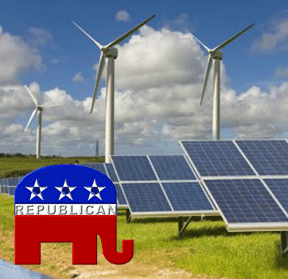
 Conservatives should lead on renewable energy as way to protect God’s creations http://www.mlive.com/politics/index.ssf/2013/09/keith_den_hollander_ renewable.html By Keith den Hollander State Committee Member at Michigan Republican Party Chairman, MI Chapter at Christian Coalition, 22 Sept 13 In the next few days, Michigan Governor Rick Snyder unveiled the first of four reports on renewable energy that could potentially reshape Michigan’s energy economy.
Conservatives have a real opportunity to lead in the area of renewable energy and we should applaud Governor Snyder for his leadership in the energy sector……. Opinions like those expressed by the Mackinac Center’s Ken Braun (9/14/2013), who downplays the importance of renewable energy to Michigan, do not fully reflect the conservative viewpoint on energy.
Humankind has a moral obligation to be good stewards of the Earth and the resources that God has put on this planet for our responsible use. We are free to use coal, natural gas and oil – and also the wind, sun, manure and any other resource that can be economically and responsibly used or harnessed to create energy.
An “all of the above” approach to energy generation is beneficial to our state, economy, and long-term sustainability. This approach can help reduce the amount of energy derived from fossil fuels, and increase the amount generated from renewable sources. Continue reading
Dispelling some myths about renewable energy
Six Myths About Renewable Energy WSJ, By KEITH JOHNSON 22 Sept “……….MYTH NO. 1: Renewables Are an Insignificant Source of Power ……. Conventional hydroelectric power, such as the Hoover Dam, is also renewable energy. Taken together, hydroelectric and other sources—biomass, geothermal, solar and wind—combined to account for 12% of U.S. electricity production last year, and close to 14% so far this year………It’s also important to remember the scale of the country’s renewable efforts. The U.S. has the second-biggest electricity system in the world, accounting for about 20% of the entire world’s generation capacity. Wind power’s 5% of that pie is a big slice. The 60-odd gigawatts of wind power installed in the U.S. amounts to more electricity-generation capacity than in the entire country of Australia or Saudi Arabia, and as much as all of Mexico…….
Forget about problems down the road. Another criticsm of renewables in the here and now: They’re expensive ways to generate electricity…...
- here are two big issues to bear in mind. First, costs are falling fast—thanks largely to technological advances such as larger wind turbines and cheaper components for solar-power arrays—so in some places, solar and wind power can cost even less.
The latest price data for wind-energy power-purchase agreements, released by the Department of Energy last month, showed that nationwide, the price of wind-generated electricity fell to just over 4 cents per kilowatt-hour nationwide, not counting the 2.2-cent federal tax subsidy. In some regions, well-sited wind farms produce electricity for closer to 2 cents.
Likewise, Lawrence Berkeley National Laboratory just released its latest report on the costs of installing solar power. Costs for small-scale solar residential arrays fell by about 13% in the past year, driven largely by cheaper solar components due to a global supply glut. Utility-scale prices also fell…..
There’s also the question of hidden costs. Coal-fired electricity, for instance, has nasty side effects, including air pollution, health impacts and carbon-dioxide emissions that contribute to global warming (all of which factored into the Obama administration’s proposal Friday for new limits on coal emissions)—and those don’t show up in coal’s price tag. If coal and other fossil fuels had to tally the total costs their use imposed on society, coal wouldn’t be the cheapest source of electricity, and clean-burning renewables wouldn’t look nearly so pricey.
Add all the hidden costs together, and the total cost of different power sources looks quite different, according to that recently published study……..
MYTH NO. 3: Variability Dooms Renewable Energy
The sun doesn’t always shine, and the wind doesn’t always blow,……..Consider the situation with wind power. Curtailments have fallen steadily in recent years as system operators have gotten better at using forecasting and integrating wind power. Investment in new transmission lines has also picked up pace, enabling wind farms in isolated locations to offer power more readily to a wider area.
That is the key to overcoming the natural variability of renewables such as wind and solar power. Individual wind farms may be very volatile. But scores of wind farms over thousands of square miles show less volatility—the wind is always blowing somewhere. As grid operators have added more wind in more locations to their systems, as well as the lines to carry that wind, integrating wind power into the electricity system has become easier.
Take Texas. Four years ago, facing severe transmission constraints, the state was dumping 17% of all the wind power it produced. In 2012, after adding more wind farms and almost 2,600 miles of transmission lines, curtailments were below 4%, and wind power provided 10% of the electricity in the nation’s biggest power market.
New report on America’s renewable energy policy
2013 America Renewable Energy Policy Handbook Report http://www.environmental-expert.com/news/2013-america-renewable-energy-policy-handbook-report-393874
|
Sep. 19, 2013 North and South America Renewable Energy Policy Handbook 2013 report presents an in-depth analysis of the renewable energy policies across the major countries in North and South America namely the US, Canada, Brazil, Argentina and Mexico. The report provides the current and future renewable energy targets and plans along with the present policy framework, giving a fair idea of overall growth potential of their renewable energy industry.
The report also provides major technology specific policies and incentives provided in each of these countries. The report also provides insights to major policy initiatives for the market development of renewable energy sources such as wind, solar, geothermal, biopower and biofuels. The report ( http://www.reportsnreports.com/reports/268267-north-and-south-america-renewable-energy-policy-handbook-2013.html ) is built using data and information sourced from industry associations, government websites and statutory bodies. The information is also sourced through other secondary research sources such as industry and trade magazines. Scope
Table of Contents for the report North and South America Renewable Energy Policy Handbook 2013 include: Continue reading |
USA’s renewable energy progress races ahead in Western States
US West Leads The Renewable Energy Way http://www.energymatters.com.au/index.php?main_page=news_article&article_id=3949 19 Sept 13, According to the American Council on Renewable Energy, western US states are leading the charge on good clean energy policy and investment and other regions in the nation need to follow their lead.
In the first instalment of its annual “Renewable Energy In The 50 States” report, ACORE reviewed the renewable energy policies, programs and investment environment in the 13 states that make up the Western Region, and judged the potential for future growth of the renewables sector.
Three more reports, focusing on the Midwest, Northeast, and the Southeast, are due for release in coming months.
The ACORE report found while all states had benefited from enhanced federal government support for wind, solar, and other renewable technologies over the last ten years, “In no part of the U.S. is this truer than in the West,” said Michael Brower, ACORE’s Interim President and CEO.
“With strong renewable portfolio standards (RPS), the political will to protect and/or expand them, and the nearly half of 2012’s new build asset finance for renewable energy, the West is far and away in the national renewable energy vanguard. America needs all the states in our three other regions to quickly follow their lead.” Continue reading
Solar power in Japan surpasses the 10 gigawatt mark.

 Solar energy reaches new milestone in Japan http://www.hydrogenfuelnews.com/solar-energy-reaches-new-milestone-japan/8513955/ 17 September 2013.
Japan hits 10GW of installed solar energy capacity
As Japan continues to look for alternatives to fossil-fuels and nuclear power, the country has reached a major milestone concerning solar energy. A recent study conducted by NPD Solarbuzz, a research organization focused on solar energy, found that Japanese photovoltaic installations surpassed the 10 gigawatt mark. This makes Japan only the fifth country in the world to reach this milestone. The other four are Italy, China, Germany, and the U.S. Continue reading
Scotland’s Sustainable Renewable Technologies (SRT) comes up with the SOLAR PYRAMID
The Solar Powered Pyramid http://www.energymatters.com.au/index.php?main_page=news_article&article_id=3947 18 Sept 13 The sight of solar panels on a rooftop mightn’t generally capture as much attention as it once did, but this installation certainly does.
Designed and installed by Scotland’s Sustainable Renewable Technologies (SRT), the 48.25 kW installation provides 85% of the power used by the pyramid-shaped headquarters of Survey Solutions at Bilston Glen, Loanhead, Edinburgh.
According to SRT, other solar companies approached to execute the installation shied away from the project; stating that it could not be done.
Design of the scaffolding system that would allow the panels to be positioned in place was quite a challenge, but even more so was the clients’ requirement that each face of the pyramid to be covered in solar panels must be a perfect triangle. There could be none of the stepping that would otherwise be seen with square solar cells of the cut-down panels along edges.

To achieve the “perfect triangle” effect wasn’t so much a case of high-tech wizardry, but more design ingenuity – the panels along the edge are dummies and do not generate power. The 193 panel array will provide a benefit to the building’s owners of around AUD$17,000 annually and avoid the creation of around 36 tonnes of carbon dioxide emissions each year.
The system was installed in July 2012 and has been nominated for this year’s Solar Power Portal Awards, which recognises good practice, professionalism, quality, safety and innovation in the UK’s solar industry.
The SRT installation is unsurprisingly in the “Most Innovative System Design,” category. Also not surprising is the comment from Tom King, SRT’s managing director, who said the installation was the most challenging project he has planned so far.
We imagine the project has resulted in all sorts of weird and wonderful design requests for Mr. King and his team.
Brazil cools on nuclear power plans; favors wind
Brazil will probably scale down its plans for new nuclear plants due to safety concerns following the 2011 radiation leak in Japan and pick up some of the slack with a “revolution” in wind power, the head of the government’s energy planning agency said.
http://planetark.org/enviro-news/item/69772

Japan’s big electricity companies put obstacles in the way of renewable energy
Since there are no regulations defining grid access, the restrictions can be imposed at will by the major utilities.
In a survey by the Japan Renewable Energy Foundation, in Tokyo, as many as 60 solar power providers said they had given up selling power because of the grid access problems.
a major stumbling block for renewable energy,
Renewable energy push blunted as ad-hoc rules stymie private upstarts, Japan Times, KYODO SEP 15, 2013 Ever since Japan kicked off a system to encourage the use of renewable energy for electricity in July 2012, businesses, civic organizations and even local government bodies have been trying to break into the tightly held power market.
Under the so-called feed-in tariff system, utilities are required purchase any generated electricity derived from five types of renewable energy for a fixed price and a set time.
But the momentum seems to be slowing. Several potential power suppliers are dropping their bids after coming face to face with restrictions that make it difficult for them to link to the power grids run by the utilities, which are essentially monopolies. Continue reading
Power companies join in California’s Community Renewable Energy project
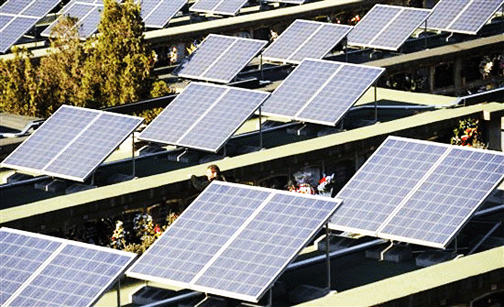 The group estimates that more than 20,000 residential ratepayers throughout California, each purchasing an average 5 KW share, will be able to participate in the program, as well as local schools, businesses, the military and the government.
California approves shared renewable energy program http://www.pv-magazine.com/news/details/beitrag/california-approves-shared-renewable-energy-program_100012727/#axzz2etkybguT 13. SEPTEMBER 2013 BY: IAN CLOVER
Approval of the largest program for shared renewable power in the U.S. passes in California, enabling schools, rental tenants and owners of homes in the shade to invest in solar energy projects. California’s Legislature has given the green light for the state’s “Green Tariff Shared Renewables Program”, which is the largest of its kind in the U.S. and will allow rental tenants, schools, cities and many other interested parties to invest in California’s renewable energy projects.
The program allows businesses and individuals to purchase shares in the renewable developments of three investor-owned utilities– Pacific Gas and Electric Co. (PG&E), San Diego Gas & Electric Co. (SDG&E), and Southern California Edison Co. (SCE) – in return for a greener electricity supply and, in the future at least, lower bills. Continue reading
1 This Month
26 September – International Day for the Total Elimination of Nuclear Weapons





PLEASE OPPOSE HR 8255 AND S.3639 – bills would accelerate satellite deployment, with no environmental review or safeguards – https://ncstd5li.quorum.us/campaign/169331/
To see nuclear-related stories in greater depth and intensity – go to https://nuclearinformation.wordpress.com
-
Archives
- September 2026 (305)
- August 2026 (330)
- July 2026 (355)
- June 2026 (287)
- May 2026 (306)
- April 2026 (356)
- March 2026 (251)
- February 2026 (267)
- January 2026 (308)
- December 2025 (358)
- November 2025 (359)
- October 2025 (375)
-
Categories
- 1
- 1 NUCLEAR ISSUES
- business and costs
- climate change
- culture and arts
- ENERGY
- environment
- health
- history
- indigenous issues
- Legal
- marketing of nuclear
- media
- opposition to nuclear
- PERSONAL STORIES
- politics
- politics international
- Religion and ethics
- safety
- secrets,lies and civil liberties
- spinbuster
- technology
- Uranium
- wastes
- weapons and war
- Women
- 2 WORLD
- ACTION
- AFRICA
- Atrocities
- AUSTRALIA
- Christina's notes
- Christina's themes
- culture and arts
- Events
- Fuk 2022
- Fuk 2023
- Fukushima 2017
- Fukushima 2018
- fukushima 2019
- Fukushima 2020
- Fukushima 2021
- general
- global warming
- Humour (God we need it)
- Nuclear
- RARE EARTHS
- Reference
- resources – print
- Resources -audiovicual
- Weekly Newsletter
- World
- World Nuclear
- YouTube
-
RSS
Entries RSS
Comments RSS

