Japan buying lots of solar panels

 REC Supplies 15,000+ Panels To Japanese Solar Farms, by Energy Matters. 20 Aug 13, REC is continuing to make its presence felt in Japan, with 2 new solar farms using REC Peak Energy Series solar panels.
The 2.5 MW Toyobo Mie (Kusu) C-Energy plant; located in Yokkaichi, Mie Prefecture, started operation last month and is expected to generate 2.5 million kWh of electricity annually.
The second REC-based installation is a ground-mounted 1.3 MW array situated at the Research Institute in Ohtsu City, Shiga Prefecture. Construction of that facility began last month and will be completed in December.
Japan is becoming a lucrative market for REC, with 29 percent of REC’s solar panel shipments heading to the nation in the second quarter of 2013….. http://www.energymatters.com.au/index.php?main_page=news_article&article_id=3897
Reliable and cheap renewable energy storage
Rechargeable flow batteries could be cheaper solution to renewable energy storage http://www.treehugger.com/clean-technology/rechargeable-flow-batteries-could-be-cheaper-solution-renewable-energy-storage.html Megan Treacy August 19, 2013 Researchers at MIT have developed a battery that could bring us reliable and cheap large scale energy storage. Based on flow battery technology, the researchers took out the costly membrane and created a battery that has a power density that is an order of magnitude higher than lithium-ion batteries and three times greater than other membrane-less systems.
MIT reports, “The device stores and releases energy in a device that relies on a phenomenon called laminar flow: Two liquids are pumped through a channel, undergoing electrochemical reactions between two electrodes to store or release energy. Under the right conditions, the solutions stream through in parallel, with very little mixing. The flow naturally separates the liquids, without requiring a costly membrane.”
The reactants used are liquid bromine and hydrogen fuel, which is cheap, but also has had issues with breaking down the membrane in other flow batteries. By taking out the membrane they were able to speed up energy storage and extend the life of the battery.
“Here, we have a system where performance is just as good as previous systems, and now we don’t have to worry about issues of the membrane,” says Martin Bazant, a professor of chemical engineering. “This is something that can be a quantum leap in energy-storage technology.”
As we bring more renewable technologies like wind and solar into the grid, affordable and reliable energy storage is increasingly important. While solar and wind energy output varies based on weather conditions, large scale energy storage systems can smooth out the power delivery from those technologies by storing any excess energy when it’s produced and using it when the output is lower or demand is higher.
“Energy storage is the key enabling technology for renewables,” says Cullen Buie, an assistant professor of mechanical engineering. “Until you can make [energy storage] reliable and affordable, it doesn’t matter how cheap and efficient you can make wind and solar, because our grid can’t handle the intermittency of those renewable technologies.”
MIT says, “Braff built a prototype of a flow battery with a small channel between two electrodes. Through the channel, the group pumped liquid bromine over a graphite cathode and hydrobromic acid under a porous anode. At the same time, the researchers flowed hydrogen gas across the anode. The resulting reactions between hydrogen and bromine produced energy in the form of free electrons that can be discharged or released.
The researchers were also able to reverse the chemical reaction within the channel to capture electrons and store energy — a first for any membraneless design.”
Now that the team’s experiments have lined up with their computer models, they’re focused on scaling up the technology and seeing how it performs. They predict that the technology will be able to produce energy costing as little as $100/kWh, which would make it the cheapest large scale energy storage system built yet.
Renewable energy creates many more jobs than there are in fossil fuel energy
Debunking the Renewables “Disinformation Campaign”, Mother Earth News, Despite vast evidence supporting the advancement of renewable energy, various media outlets insist on denying its progress, blurring the lines between inefficient reporting and deliberate lying. By Rocky Mountain Institute August 19, 2013 “……..a recent study commissioned by Germany’s Federal Environment Ministry found that the renewable energy sector provided around 382,000 jobs in 2011, up four percent in a year, and more than doubled in seven years. More jobs have been created than lost in Germany’s energy sector—plus any jobs gained as heavy industry moves to Germany for its competitive electricity.

Yet a myth persists that countries lose more jobs then they gain when they transition to renewables. This upside-down fantasy rests largely on a 2009 study from King Juan Carlos University in Spain, by an economist reportedly tied to ExxonMobil, the Heartland Institute, and the Koch brothers. His study asserted that, on average, every renewable energy job in Spain destroys 2.2 jobs in the broader Spanish economy. This story was picked up by news media around the world and is still promoted by U.S. anti-renewables groups. But its methodology and assumptions were promptly demolished by the National Renewable Energy Laboratory and the Spanish government, among others. A 2012 report for the International Labour Organization (ILO) even cites Spain, which built a renewable export industry, as a counterexample: “The green economy presents a good opportunity to increase competitiveness, promote the creation of quality employment and reduce the economy’s environmental impact,” says Joaquín Nieto, who heads the ILO Office in Madrid, especially “when Spain needs to kick-start its economy.” Sure enough, despite new electricity taxes and a halt to subsidies for new renewable projects, Spain’s latest solar projects continue to be built to compete without subsidy.
The disinformation campaign about job creation is not limited to Europe. A Cato Institute article claimed that if people believe a commitment to renewables will fuel job growth “we’re in a lot of trouble.” Yet in 2012 alone, more than 110,000 new U.S. clean-energy direct jobs were created, and in 2010, the U.S. had more jobs in the “clean economy” than in the fossil-fuel industries. The Bureau of Labor Statistics reports that direct employment in May 2012 totaled 181,580 for oil and gas extraction, 87,520 for coal mining, and 93,200 for iron and steel production. BLS doesn’t similarly classify solar or wind jobs, but reputable analysts have determined from bottom-up industry surveys that in September 2012, for example, the U.S. had 119,016 direct solar jobs (89 percent full-time, the rest at least half-time), up 27 percent in two years—more than in steel-making or coal-mining. Had you heard that before? Why not? …….. http://www.motherearthnews.com/renewable-energy/debunking-the-renewables-disinformation-campaign-zm0z1308zsal.aspx#axzz2cYi1w7VS
Europe to develop cross-border electrical grids, as renewable eneergy grows
Demand for renewable energy will drive Europe transmission market 08/08/2013 By Editors of Electric Light & Power/ POWERGRID International
Key European countries, including Germany, France, U.K., Norway, Italy, Ireland and France, will spend substantial sums on grid expansion and upgrade programs in order increase security of electricity supply, deploy smart gridtechnology and accommodate new sources of power generation — particularly renewable energy……..
“Europe is expected to invest heavily in the establishment of transmission infrastructure as it strives to create cross-border grid interconnections and harness the energy generated from renewable sources around the continent,” http://www.elp.com/articles/2013/8/demand-for-renewable-energy-will-drive-europe-transmission-market0.html
President Obama finally allows return of solar panels to the White House
Finally: Obama Green Lights Solar Panels on White House
Details are not yet final, but President Obama has finally allowed retrofitting the White House roof to allow for solar panels. No, this is not a plot from HBO’s hit series Veep: it is finally happening. The final total of panels will range between 20 and 50 solar panels according to Think Progress and the Washington Post—perhaps enough to power a few flat screen TVs or power the equivalent of 15 seconds of flight on Air Force One.
It is a step that is surely attracting all kinds of buzz in and outside of Washington, DC, one either seen as a token effort, a sign of leadership on sustainability, or as a yawner. The installation falls on the heels of a 2010 promise Obama had made to install a rooftop solar system. http://www.enn.com/green_building/article/46324
Germany- a World Leader in Solar, Wind and Health
Germany is leading the charge to economic self sufficiency through a massive nationwide network of wind and solar, recycling, high efficiency cars, self-grown food, cultivating wild plants (weeds), respecting nature and sensible living. Raw Food speaker Markus Rothkranz takes you on an inspirational tour of one of the world’s cleanest, most mature advanced countries, on a 200 mph train!
Clean wind power to help boost dirty nuclear weapons in USA
Nuclear Wind The government’s largest wind farm is to be used to generate electricity for atomic bombs. TIME By Mark Thompson @MarkThompson_DCAug. 14, 2013 The Obama Administration is building the nation’s biggest wind farm to generate electricity to help…assemble the nation’s nuclear arsenal.
It’s boasting of the great environmental stewardship the project represents – breezes for bombs? — and has contracted with Siemens USA, the American subsidiary of a German company, for the wind turbines at the heart of the operation.
The government broke ground Tuesday for the Pantex Renewable Energy Project. When finished next summer, it will include five 2.3 megawatt wind turbines on 1,500 acres of government-owned property east of the Pantex plant in the Texas panhandle…….
The wind farm “will be funded by the energy savings guaranteed by Siemens,” Pantex says – an estimated $50 million over 18 years.
Read more: http://swampland.time.com/2013/08/14/nuclear-wind/#ixzz2c5WBzzzc
Solar powered drone flies for 9 hours
Weighing just under 6 kilograms, the drone features ultra thin and light gallium arsenide solar cells manufactured by Alta Devices.
“Our integration of this cutting-edge technology dramatically increases Puma’s current flight endurance using a clean, renewable power source,” said Roy Minson, AeroVironment senior vice president and general manager, Unmanned Aircraft Systems (UAS).
The new battery extends Puma AE’s non-solar endurance to more than three hours.
The solar Puma AE is a hand-launched vehicle designed for intelligence, surveillance and reconnaissance (ISR) operations. While its military and law enforcement applications are obvious, it also can be used to assist in environmental monitoring, fire-fighting and search and rescue efforts…… http://www.energymatters.com.au/index.php?main_page=news_article&article_id=3888
IKEA investing in wind and solar energy
Ikea assembles renewable energy portfolio SMH 13 Aug 13 Ikea Group, the world’s biggest home-furnishings retailer, plans to buy a wind farm in Ireland from Mainstream Renewable Power Ltd. as part of plans to invest 1.5 billion pounds ($2.5 billion) in wind and solar by 2015.
Mainstream is building the 7.65-megawatt project in Leitrim in northwest Ireland, Dublin-based Mainstream said today in an e-mailed statement. It’s expected to start operating early next year, at which point Ikea will buy the plant, Mainstream said.
“Our investments in renewable energy not only help to reduce carbon dioxide emissions from our operations in Ireland, but also, together with our energy-efficiency efforts, help to control our electricity costs so we can pass any benefits to our customers,” Joanna Yarrow, head of sustainability at Ikea U.K., said in the statement.
Ikea plans to invest 1.5 billion pounds in wind and solar energy to help become energy independent by 2020. It now owns 137 wind turbines, according to the statement. …http://www.smh.com.au/business/carbon-economy/ikea-assembles-renewable-energy-portfolio-20130813-2rt1c.html#ixzz2btrEuNZc
Massachusetts town saves money while leading on renewable energy
 A Town Saves Money with Renewable Energy Engineering.com, Tom Lombardo posted on August 11, 2013 Scituate is the first town in Massachusetts to power all of its government services using only renewable energy. All municipal services – including water, sewer, municipal buildings, and streetlights – will soon be powered by the sun and the wind. The town expects to save over $400,000 per year in electricity costs and the best part is that they didn’t have to buy the solar panels or wind turbine.
Too good to be true? Here’s the deal. Private investors purchased and installed the equipment on municipal land, so those companies paid for and own the equipment. In exchange, the town agreed to purchase its electrical power from the owners at a rate that’s about 40% lower than what they’d be paying the utility. These agreements are becoming more common in the residential market, as consumers want to lower their electricity costs but can’t afford a large initial investment. This is the first time I’ve heard of a municipality doing it.
 First, Use Less Energy

The first step in saving money on energy is not to generate your own, but to use less. Once you make yourself more efficient, then you consider ways to generate power. Several years ago the town of Scituate formed a committee to investigate clean energy. They sent out requests for proposals (RFPs) on energy efficiency and renewable energy production. After an electric load analysis, they found ways to use less electricity by replacing lighting fixtures, transformers, and other electrical equipment with more efficient models. A heating/cooling energy audit determined that they could also save energy through improvements in insulation, replacing oil-burning furnaces with gas-burning furnaces, etc. They invested almost $6M to upgrade this equipment based on the promise of energy savings over the next eighteen years.
 Next, Generate Energy

After improving their efficiency, they hired a consulting firm to do a wind site analysis. In addition to taking wind measurements at various locations over a 12-month period, they also considered logistical factors such as proximity to transmission lines. In spring of 2012, a 1.5 megawatt wind turbine was installed. Over its first year, the turbine generated 3.2 million kWh. At an electric rate of $0.143/kWh – the utility rate in that area – that’s almost half a million dollars worth of energy that the town received; they paid less than $300k for that energy. ……..
Use the Grid for “Virtual Storage”
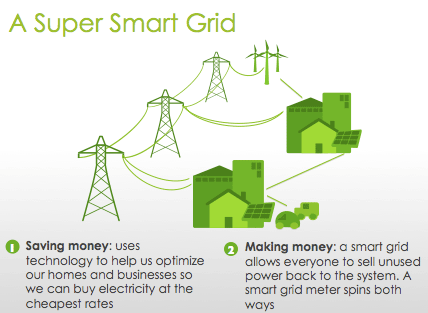
Through a net-metering agreement with the utility, any excess energy that the town generates is sold to the grid at retail rates. When demand exceeds generating capacity, they buy power from the grid. In effect, the grid is acting as a free storage medium for excess energy…….
Reduce Government Spending and Boost Business
Disregarding the optional purchases to improve energy efficiency, the town of Scituate reduced its electric rate by 40% with virtually no investment on its part. In addition, the projects created jobs, gave a boost to a burgeoning industry, and produced science/technology/engineering/math (STEM) lessons for schools. Will other municipalities follow suit? I hope so. http://www.engineering.com/ElectronicsDesign/ElectronicsDesignArticles/ArticleID/6125/A-Town-Saves-Money-with-Renewable-Energy.aspx
Household solar power now so cheap – subsidies are not needed

solar PV systems are now so cheap they still make sense in countries with high power prices – even those without much sun that are cutting subsidies, such as Germany.
Renewables: A rising power. Ft.com By Pilita Clark, Environment Correspondent, 8 Aug 13
Plunging prices are finally making solar power competitive with conventional sources of energy “..….Until now, the idea that unsubsidised solar power could make enough financial sense to be competitive with conventional electricity has been largely confined to the realms of environmental campaigners and renewable energy advocates.
However, as solar panels become more efficient and vastly cheaper, and household power bills keep rising, analysts at some of the world’s largest financial institutions say such a prospect is indeed possible – and likely to cause profound disruption in the energy industry.
“We’re at a point now where demand starts to be driven by cold, hard economics rather than by subsidies and that is a game changer,” says Jason Channell of Citigroup. Continue reading
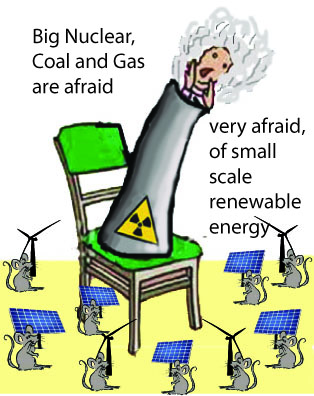
Big energy utilities move to stomp out home solar power
 Renewables: A rising power. Ft.com By Pilita Clark, Environment Correspondent, 8 Aug 13……… “People think solar PV is only possible with subsidies and that is totally wrong,” says Karl Kuhlmann, the chief executive. “We’re happy that the industry is moving into an unsubsidised phase. It makes it simpler, better and totally independent from politicians.”
This is not quite true. The impact of cheap Chinese solar panels on western solar-panel makers has stirred political tensions, with trade rows over the threat of punitive tariffs erupting in the US and Europe…….
The more immediate threat to the nascent unsubsidised solar industry may be closer to home. In the US last month, Arizona’s largest utility, APS, asked regulators to look at imposing fees on people installing new rooftop solar systems to help pay for the cost of a grid they still use “essentially for free”.
“As the number of customers installing solar goes up, it drives rates even higher for non-solar customers, making the problem more difficult to solve,” it said in a statement. Utilities in other US states want similar action, infuriating solar companies.
Another outcry has broken out in Spain, the EU’s third-largest solar market after Germany and Italy, where the government last month also produced a proposal to impose new charges on rooftop solar owners.
“It’s really crazy,” says Mr Jornet. “They want me to pay for the electricity I take from my own solar panels. It’s amazing.”…….
Regulators still have to decide if the utilities will get their way. What does seem certain, however, is that the surge in solar power is changing energy markets in ways we have only begun to understand……http://www.ft.com/intl/cms/s/0/a41d86b4-ff9c-11e2-a244-00144feab7de.html#axzz2bb20LPZl
A solar diesel energy hybrid – an economic boon for developing countries
 Renewables: A rising power. Ft.com By Pilita Clark, Environment Correspondent, 8 Aug 13 Developing nations: Cheap solar could ‘leapfrog’ subsidies The plummeting cost of solar power systems is driving more than a surge in suburban rooftop panels in Bavaria and Barcelona.
It also promises to provide regular electricity to the 1.2bn people who have no access to it today. Low-cost solar panels could help them leapfrog traditional power grids in the same way parts of the developing world sidestepped fixed-line telecommunications networks and went straight to mobile phones.
An 80 per cent fall in the cost of solar panels since 2008 has opened up new business opportunities for companies such as Germany’s Donauer, which has just developed the D: Hybrid, a system that allows thousands of solar panels to be attached to the diesel generators that are a fixture in industrialising countries with rickety electricity systems. Continue reading
Energy storage available in wind turbines
Wind Turbines Store Energy For Less Breezy Days HUFF POST, 7 Aug 13 “……a new wind turbine that generates more electricity at lower wind speeds, stores some excess energy for sale to the grid later (allowing owners to take advantage of higher prices), and also does a better job of analyzing and predicting the supply of wind energy too. In short, many clean energy advocates are pretty excited about GE’s 1.6-100 and 1.7-100 wind turbines and power management system.
Specifically, here are some of the features that clean tech geeks are getting excited about:
- Improved blade designs resulting in a 47 percent increase in “swept area” (the square feet of the rotor) compared to previous models – meaning a 20-24 percent increase in power.
- More energy harvested at lower wind speeds, resulting in a class-leading capacity factor of 54 percent. (Detail alert: the capacity factor is the actual power output over time, compared as a percentage to the theoretical power output of the turbine if it was producing at its maximum output at all times.)
- A battery storage system that allows wind turbine operators to save excess electricity — either because they are producing more electricity than the grid needs at a given moment, or because they’ll get a better price for it later.
- A sophisticated package of analytics equipment and software, which helps owners predict both when power will be needed and when the wind will be blowing, allowing communication between turbines in what’s been described as “an industrial Internet”.
Individually, each of the developments represented in the Brilliant turbines are a big deal. Collectively, says Andrew Burger of CleanTechnica, they have the potential to be game changing. In an enthusiastic, three-part series on the Brilliant turbines (see alsopart two, and part three), Burger explains why all this really matters to the rest of us – namely that the cost of wind energy has come down by 60 percent in recent years, making it competitive with new coal and natural gas plants. And that’s before you even start calculating all the hidden, but very real economic costs caused by our reliance on fossil fuels…. http://www.huffingtonpost.com/2013/08/07/wind-turbines-store-energ_n_3715788.html
Solar powered lap-top is not costly
SOL – The Affordable Solar Powered Laptop http://www.energymatters.com.au/index.php?main_page=news_article&article_id=3879 8 Aug 13 SOL can be run entirely on the power of the sun and could make a big difference to education and communications in developing countries.
Developed by Canadian R&D corporation WeWi Telecommunications, Inc.; SOL is a laptop initially aimed at the 1 in 4 people in the world who have little to no access to reliable power.
Able to run 8-10 hours on a full charge, the laptop features an Intel Atom D2500 1.86 GHz Duo Core processor, 2-4 gigabytes of RAM and a 320 gigabyte hard drive; plus a 13.3 inch display, WiFi, 3G/4G modem and a camera. Multiple external ports extend SOL’s capabilities.
Cutting the cost of software to run the laptop has been achieved through the use of the free Ubuntu operating system.
While information on the capacity of the detachable folding solar panels doesn’t appear to be on the SOL web site; according to the FAQ, the battery can be fully recharged in a little over 2 hours.
Far from being a fragile device that wouldn’t survive long in target markets, WeWi claims it was developed with “durable, reinforced materials, complex military industrial design and architecture that are meant to keep the laptop in good shape.”
The standard unit is expected to sell for around USD $350 and a submersible version, approximately USD $400. It will be initially rolled out in Ghana before other markets. While geared towards developing nations; SOL will ultimately be available globally and the company intends developing “adventurer” versions of the laptop with enhanced capabilities.
WeWi Telecommunications, Inc originally launched as a B2B Internet Service Provider and then evolved into a global solutions provider with an advanced research division specializing in security, telecom and innovative energy products.
Read more on the Sol web site.
1 This Month
29 Jan. Thursday 7-8 p.m. Webinar – World’s Largest Nuclear Station in Port Hope, ON?
To see nuclear-related stories in greater depth and intensity – go to https://nuclearinformation.wordpress.com/



31st January – Challenging the War Machine – a DECLASSIFIED UK SUMMIT

Website of the Week
Now until to February 10, 2026 Radioactive waste storage in France: the debate is finally open! How to participate?
-
Archives
- January 2026 (288)
- December 2025 (358)
- November 2025 (359)
- October 2025 (376)
- September 2025 (258)
- August 2025 (319)
- July 2025 (230)
- June 2025 (348)
- May 2025 (261)
- April 2025 (305)
- March 2025 (319)
- February 2025 (234)
-
Categories
- 1
- 1 NUCLEAR ISSUES
- business and costs
- climate change
- culture and arts
- ENERGY
- environment
- health
- history
- indigenous issues
- Legal
- marketing of nuclear
- media
- opposition to nuclear
- PERSONAL STORIES
- politics
- politics international
- Religion and ethics
- safety
- secrets,lies and civil liberties
- spinbuster
- technology
- Uranium
- wastes
- weapons and war
- Women
- 2 WORLD
- ACTION
- AFRICA
- Atrocities
- AUSTRALIA
- Christina's notes
- Christina's themes
- culture and arts
- Events
- Fuk 2022
- Fuk 2023
- Fukushima 2017
- Fukushima 2018
- fukushima 2019
- Fukushima 2020
- Fukushima 2021
- general
- global warming
- Humour (God we need it)
- Nuclear
- RARE EARTHS
- Reference
- resources – print
- Resources -audiovicual
- Weekly Newsletter
- World
- World Nuclear
- YouTube
-
RSS
Entries RSS
Comments RSS
 nuclear-news