Agua Caliente, Florida – the first of many big solar power arrays
World’s Largest Solar Array Set to Crank Out 290 Megawatts of Sunshine Power Megaplants like Agua Caliente in Arizona herald a new efficiency in solar-sourced electricity Megaplants like Agua Caliente in Arizona herald a new efficiency in solar-sourced electricity Scientific American May 9, 2014 |By Roni Jacobson
Global climate change is here, and it’s only going to get worse, according to a White House report released on Tuesday. To combat rising sea levels and blistering summers, the Obama administration has been pushing for clean, renewable energy sources that cut down on carbon emissions. Now one of its projects is poised to pan out: Agua Caliente, the largest photovoltaic solar power facility in the world, was completed last week in Arizona.
The plant comprises more than five million solar panels that span the equivalent of two Central Parks in the desert between Yuma and Phoenix. It generates 290 megawatts of power—enough electricity to fuel 230,000 homes in neighboring California at peak capacity. The Agua Caliente Solar Project represents a significant advance in the technology compared with just four years ago, when the largest solar facility in the U.S. generated only 20 megawatts. “Solar has completely arrived as a competitive energy resource,” says Peter Davidson, executive director of the Loan Programs Office at the U.S. Department of Energy (DoE).
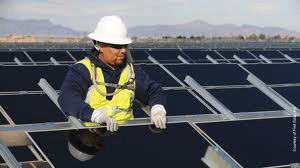
The project, which cost a total of $1.8 billion to construct, received a million-dollar loan from the Loan Programs Office. Under its “SunShot” initiative (so-named in the spirit of president John F. Kennedy’s “moon shot” program), the DoE provides guaranteed loans to unproved ventures in solar power in the hopes of promoting innovation and making the technology more cost-effective.* Although Agua Caliente (owned by U.S. energy giant NRG Energy and partner MidAmerican Solar) is now the largest photovoltaic solar facility in the world, it probably will not hold that distinction for long. …….
But as solar power becomes cheaper, Davidson predicts that utilities will pass those savings on to consumers. And as the technological advancements emerging from megaplants like Agua Caliente become more widely available, individual solar power adopters may eventually see savings as well. http://www.scientificamerican.com/article/world-s-largest-solar-array-set-to-crank-out-290-megawatts-of-sunshine-power/
Wind power and energy storage bringing 100% renewable power to Denmark

 Carbon Dioxide and Denmark’s Plan for 100 Percent Renewable Energy by 2050 http://guardianlv.com/2014/05/carbon-dioxide-and-denmarks-plan-for-100-percent-renewable-energy-by-2050/ by Sara Watson on May 3, 2014. Studies have shown that levels of carbon dioxide currently in the atmosphere are at an all time high. The time for change regarding energy choices is now. One nation has already taken up the charge to change the way we create and use energy. Denmark is leading the world in making changes regarding energy sources. The nation has a plan to be 100 percent dependant on renewable sources by 2050. This will create new jobs, decrease dependency on international resources and increase their exports to other nations. Continue reading
Africa’s powerful future with renewable energy
 Renewable energy will power Africa’s ambitious future Adnan Amin May 3, 2014 It’s time to prove wrong the widely held stereotype about renewable energy only being for rich countries.
With smart planning and prudent investment, all African countries can reduce their dependence on fossil fuels and leapfrog into a sustainable future. And, as Africa makes the transition to renewable energy in the coming years, new projects will provide much-needed jobs and power economic growth………Irena’s initiative encourages the deployment of hydro, geothermal, biomass, wind and solar options from Cairo to Cape Town to increase capacity, stabilise the grid, and reduce fossil fuel dependency. It is a regional approach, promoting international cooperation across countries of the eastern and southern African power pools to develop vast energy resources, optimise the energy mix and attract more investment. The plan identifies development zones to cluster renewable plants in areas with high potential, resource planning, new financing models and knowledge and capacity building.
This week, as we convene for the Abu Dhabi Ascent, we are welcoming many African ministers who have engaged with us on this project.
The Africa Clean Energy Corridor is one of the many concrete steps needed that offer a cost-effective, economically viable solution to the climate challenge that lies ahead of us.
With the right combination of policy, investment and rapid deployment, we can make substantial progress in decarbonising the world’s energy mix while generating growth and employment. http://www.thenational.ae/thenationalconversation/comment/renewable-energy-will-power-africas-ambitious-future#ixzz30tYRkXQl
Island goes 100% renewable energy – a world first
This Island Is The First In The World To Be Powered Fully By Wind And Water BY ARI PHILLIPS MAY 1, 2014 THE SMALLEST AND SOUTHERNMOST OF SPAIN’S CANARY ISLANDS IS ABOUT TO MAKE AN OUTSIZED MARK ON THE PATH TOWARD A MORE RENEWABLE ENERGY-POWERED FUTURE. HTTP://THINKPROGRESS.ORG/CLIMATE/2014/05/01/3433002/SPANISH-ISLAND-RENEWABLE-ENERGY/
With the opening of a new wind farm next month, El Hierro, population just over 10,000, will become the first island in the world to be fully energy self-sufficient through combined wind and water power. The five wind turbines will provide 11.5 megawatts of power, enough to meet the demand of the population and the desalination plants on this small crop of land off the coast of Africa in the Atlantic Ocean.
When the wind isn’t blowing, hydropower will fill the void. When the wind is blowing, power will be used to pump water into a reservoir in a volcanic crater about 2,300 feet above sea level. Then when power is needed, that water will be released down to a lower reservoir and used to generate electricity on the way. This process is known as pump-storage hydroelectricity, and is used in many other countries across the globe — including the world’s largest outside of Washington, D.C.
“This system guarantees us a supply of electricity,” said the director of the Gorona del Viento wind power plant, Juan Manuel Quintero.
With the $75 million project set to come online, El Hierro will no longer have to rely on costly and dirty diesel generators for electricity — although it will maintain an oil power station just in case. According to Phys.org, the island’s transition to renewable energy will cut carbon dioxide emissions by 20,600 tons per year and save the island from using 40,000 barrels of oil a year.
Other islands are taking advantage of renewable resources to become wind- and solar-powered, but El Hierro is believed to be the first to do so exclusively with wind and hydro power and without having any connection to an outside electricity grid.
Renewable energy: GE’s $1 billion investment
According to the division’s CEO, David Nason, renewable power is its fastest growing market and also a good way of spurring sales of GE wind turbines and solar inverter equipment.
“We see renewable energy providing very significant returns going forward,” Nason told Bloomberg.
As part of this the company is actively involved in a range of solar projects with solar panel manufacturer and project developer First Solar. According to Kevin Walsh, the company’s head of power and renewable energy, “There is a very active dialog with First Solar”.
100,000 renewable energy jobs now in Britain
Renewable energy sector now supports over 100,000 UK jobs by ClickGreen staff. Published Wed 30 Apr 2014 The renewable energy industry has attracted nearly £30 billion of private sector investment since 2010, according to a new joint report published by the REA, Innovas and PwC.
The huge investment has enabled the industry to sustain over 100,000 jobs in 2013, generate turnover last year of £14 billion and deliver 4.2% of UK energy.
The report, REview – Renewable Energy View: 2014, builds on the REA’s 2012 report Renewable Energy: Made in Britain, the first industry-wide analysis of employment in the UK renewable energy industry.

The 116-page paper is the most complete assessment to date of the UK renewable energy market and will be formally launched this evening by Energy Minister Greg Barker in the House of Commons.
REA Chief Executive Dr Nina Skorupska said the report should provide the Government with a reminder of learning from past mistakes and provide market stability.
She added: “This report highlights the close relationship between clear, stable policies and sustained growth and jobs in the renewable energy industry. The Government’s renewable electricity policies have incentivised nearly £28 billion of private investment since 2010, achieving annual growth rates of over 20%. The world’s first Renewable Heat Incentive is also beginning to spur positive growth in green heating. This is a tremendous success story.
“This positive message also comes with a warning. Drastic Feed-in Tariff cuts in 2011/12 led to widespread job losses in the solar industry, and the continued policy uncertainty for renewable transport has seen employment and investment opportunities in UK refineries go begging.
“Clear, stable policies create the investment, jobs and growth in renewables that the UK needs. We urge the Government to learn the lessons from past experiences, such as solar FITs and biofuels uncertainty, and engage closely with industry to resolve outstanding uncertainties, such as State Aid rules and the details of CfDs.”
Analysis by the REA reveals that:
* Renewable electricity generation has grown steadily, increasing on average by 20.3% year-on-year between 2009 and 2013………
Continue reading
SunEdison going ahead with large solar energy plants
 SunEdison Lighting Up California (And Elsewhere) http://www.energymatters.com.au/index.php?main_page=news_article&article_id=4287 SunEdison has announced it has secured construction financing for the 60 MW Regulus solar power plant located in Kern County, California.
Regulus will consist of around 250,000 solar panels and once operational; SunEdison will provide management and monitoring, field dispatch and reporting services via its Renewable Operation Center (ROC).
“Regulus is our largest North America project to date and is evidence of the momentum we are building in the California utility scale solar market,” said Bob Powell, SunEdison president of North America.
Announcements concerning SunEdison’s involvement in big ticket solar plants in California have become rather commonplace these days – just in the last couple of 6 weeks; the 24 MW Cascade solar farm and the 20MW Adobe Solar Facilityhave been brought online.
Last Thursday, the company also announced it had secured financing from Deutsche Bank Securities Inc. for two solar power plants to be built in Ontario, Canada. Combined, the solar farms will supply enough clean energy to power 1,300 average households.
As well as large-scale flashy solar farms, SunEdison also has interests in helping out those less fortunate with clean energy too.
Last Friday, the company dedicated a solar power system to the Mariposa Center for Girls in the Dominican Republic. The facility assists at-risk schoolgirls in support of the UN’s goals to increase energy access for all. SunEdison donated $10,000 in cash plus an in-kind donation of equipment – a 9.9 kW solar panel system.
“Electricity facilitates education, the delivery of healthcare services, and economic growth,” said Steve O’Rourke, senior vice president and chief strategy officer for SunEdison.
“We are proud to support the UN’s Sustainable Energy for All initiative in this and future endeavors to ensure all people have access to clean, affordable energy.”
Investment analysts point to the opportunities in solar power
 Solar Power on the Rise The Motley Fool, By Stephen O’Brien April 28, 2014 “…..The obvious solution is to substitute these fossil fuels with solar power. While the technology to harness the sun’s energy is perpetually being upgraded and refined, solar power is gradually becoming the most attractive choice for many consumers to power their homes, and not only for environmental reasons, but often for the lower costs solar energy is affording.
The corporate sector has also begun to see solar’s advantages. IKEA has committed to becoming a zero-energy company 2020, and has allotted $2 billion for a number of renewable energy endeavors. It has already installed more than 550,000 solar panels. The company is additionally involved in wind energy, and has established a wind farm about a hundred miles south of Chicago and other wind projects in eight countries. In 2013, renewable energy sources accounted for close to 40% of IKEA’s energy usage.
Aside from such moves by a few of the larger corporations, demand for solar power has been increasing significantly in the U.S. residential market. SunPower (NASDAQ: SPWR ) , a U.S. firm headquartered in San Jose, California, has been leasing its solar-panel systems to over 20,000 U.S. customers.
Demand for solar power around the world is also increasing rapidly. SunPower has offices in Europe, Australia, Africa and Asia to meet the growing cries for sun-generated energy. SunPower recently announced that it has begun selling megawatts of cell packages in inner Mongolia, and plans further moves to serve companies and consumers in China.It will have to contend, however, with the Chinese companies that currently serve the Chinese market, the leaders being Trina Solar (NYSE: TSL ) and JinkoSolar (NYSE: JKS ) .
Solar companies are in their early stages of development, and it is unclear who will become the dominant player a few years from now. Currently, there seems to be plenty of growth ahead for a number of solar companies. SunPower is said to have an advantage in that its solar panels are smaller in size and convert energy efficiently, making them well suited for rooftop installations.
Brean Capital recently initiated coverage on the company’s shares and rated them as a buy. SunPower’s stock currently has a forward price to earnings ratio of under 20, and its five-year growth rate in earnings per share looks to be over 30%, making the stock highly attractive to a longer-term investor who don’t mind price volatility. This company is clearly worth considering when investing in the solar sector, and in clean energy generally.
As the world shifts to solar power due to its increasingly cheaper cost or to ward off environmental catastrophe in the years ahead, a great investment opportunity has presented itself. While there certainly are strong competitors to SunPower, there is also a vast market for solar energy, and SunPower is poised to flourish……http://www.fool.com/investing/general/2014/04/28/solar-power-on-the-rise.aspx
‘photoswitches,’ – a coming breakthrough in solar energy?
Scientists Discover How to Generate Solar Power in the Dark Meet ‘photoswitches,’ a breakthrough set of materials that act as their own batteries, absorbing energy and releasing it on demand. THE ATLANTIC, TODD WOODYAPR 15 2014, The next big thing in solar energy could be microscopic.
Scientists at MIT and Harvard University have devised a way to store solar energy in molecules that can then be tapped to heat homes, water or used for cooking.
The best part: The molecules can store the heat forever and be endlessly re-used while emitting absolutely no greenhouse gases. Scientists remain a way’s off in building this perpetual heat machine but they have succeeded in the laboratory at demonstrating the viability of the phenomenon called photoswitching……….
“One design we have for such an application is purely gravity driven – the material flows from one tank to another. The flow rate is restricted so that it’s exposed to the sun long enough that it gets fully charged. Then, when it’s time to cook dinner, after the sun is down, the flow direction is reversed, again driven by gravity, and the opposite side of the setup is used as the cooking surface.”
“As the material flows back to the first tank, it passes by an immobilized catalyst which triggers the energy-releasing process, heating the cooking surface up,” he adds.
Other versions of such device could be used to heat buildings.
Kucharski said the MIT and Harvard team is now investigating other photoswitching molecules and substrates, “with the aim of designing a system that absorbs more of the sun’s energy and also can be more practically scaled up.” http://www.theatlantic.com/technology/archive/2014/04/scientists-discover-how-to-generate-solar-power-in-the-dark/360679/
Vast majority of French people prefer renewable energy, would not invest in nuclear power
 France moving away from Nuclear power http://www.enn.com/energy/article/47327 27 April 14 France may be the world’s most nuclear energy dependent country, but times are changing as the country looks to increase the amount of wind—sourced electricity in its power mix.
When French President François Hollande took the reins of power in 2012 he pledged to reduce the country’s nuclear dependency from 75% to 50% by 2025. Today, France has a goal of reaching 19 GW of wind energy by 2020, up from its current level of 8.2 GW, according to the European Wind Energy Association’s (EWEA) latest statistics. This will significantly raise the percentage of wind powered electricity in the country from the 3% wind covers today. And, according to a very recent survey, the French people are firmly behind the transition.
Some 64% of French people see wind energy as a solution, among others, in the context of the energy transition, says a CSA survey published in March 2014. Moreover, 80% of the 1010 respondents consider it necessary to invest in wind without waiting for the traditional power plants to reach the end of their lifecycle.
65% of those surveyed said that they would invest in renewable energy (wind and solar/photovoltaic) today if they had to personally invest in one energy source, while 15% chose nuclear, 7% chose gas and 1% chose coal. Meanwhile, 69% of French people would choose wind energy if they had to choose one energy type to be constructed in their region. 75% chose solar, 21% chose nuclear, 16% chose gas and 4% chose gas.
The results show that the French are aware that an energy transition must take place, they are confident enough in renewables to invest if they could, and they know that the time to act is now.
Decentralised wind and solar power – democratising the energy system
Communicating The Renewable Energy Revolution, Clean Technica, Zachary Shahan 27 April 14, The clean tech movement is about a shift toward a more peaceful world, a world in which there is more respect for others and in which our ways of living leave a smaller environmental footprint. Clean energy is not just about cleaning our air, preserving our water supplies and helping to protect our climate; it is also about democratizing the energy sector……
Solar Power and Wind Power
Solar power has been a dream for ages. In 1931, Thomas Edison wrote, “I’d put my money on the sun and solar energy. What a source of power! I hope we don’t have to wait until oil and coal run out before we tackle that.”
The energy potential from sunshine for one single year is far greater than the energy potential of all known coal, oil, uranium and natural gas reserves combined. The circles in the chart shown here represent annual potential for renewable sources.
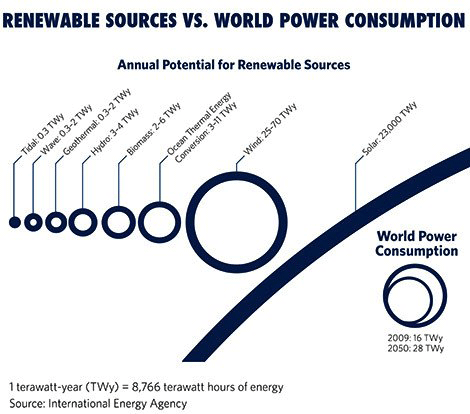
The potential is amazing. The solar energy hitting the state of Texas each month is greater than the total amount of energy the Texas oil and gas industry has ever produced.
Importantly, while sunshine is free, the solar panels needed to collect the energy in that sunshine and convert it into electricity are not. However, solar panels today are over 100 times cheaper (per watt) than they were in 1977. Since 2011, the cost of solar panels has dropped by approximately 60 percent, and growth has also been a big part of the stimulus for the cost drops. It is a virtuous circle. The growth curve for the solar panel market over the past few years is steep and resembles that of a plant shooting out of the earth toward the sun!
Solar power is now cheaper than retail electricity for millions of households. In the developed world, it can save countless homeowners tens of thousands of dollars. Meanwhile, all across the developing world, solar power is actually cheaper than power generated from fossil fuels. Just as many people in the developing world leapfrogged from no phones to cell phones, these populations will leapfrog from no electricity to electricity from solar panels.
The cost of wind power came down much earlier than the cost of solar power. In many regions of the world, wind power is currently the cheapest form of renewables-based electricity available–and also cheaper than electricity generated from coal, natural gas, nuclear power and oil, even if related health and environmental costs, which are staggering in themselves, are not taken into account. And costs continue to fall. The cost of wind turbines has fallen by approximately 29 percent since 2008.
In 2012, more wind power capacity was installed in the US than for any other power source. Wind is also routinely at the top of the global charts for annual power capacity additions.
Democratizing the Energy System
One of the major implications of solar power growth, electric vehicle growth and wind power growth to some extent (wind turbines are great additions to farms and small communities) is that they are essentially democratizing our energy system. They decentralize ownership and provide more societal power and more money to common citizens and small businesses. They create more energy independence and security for families, cities and nations, which I believe will ultimately contribute to greater peace in the world.
Also, there has got to be some positive psychological effect from people realizing that they are no longer burning the bones of dinosaurs (amongst other fossils!) for their energy needs, but are instead using renewable sources of energy such as sunlight and wind. http://cleantechnica.com/2014/04/27/communicating-renewable-energy-revolution/
New Zealand helps Pacific island nations go solar
 NZ Lends A Solar Helping Hand In Pacific Nations http://www.energymatters.com.au/index.php?main_page=news_article&article_id=4277 New Zealand is supporting the construction of the Pacific’s largest solar panel array in Samoa and also providing a helping hand for other Pacific Nations to pursue clean energy.
According to New Zealand’s Foreign Minister, Murray McCully, the country is working in partnership with the Government of Samoa, the European Union and the Asia Development Bank to increase renewable energy in Samoa.
Part of the project includes the construction of 2.2 MW installation at the Apia Sports Complex, a smaller array on the rooftop of one of the gymnasiums at the Complex; plus another solar power system in Salelologa, Savaii.
“Renewable energy is a strong focus of New Zealand’s support to developing countries. The investments in Samoa reflect commitments made at the Pacific Energy Summit in Auckland last year,” Mr McCully said.
Elsewhere in the Pacific, New Zealand has been assisting in Tuvalu where 95 percent of electricity is currently gained from diesel generation.
New Zealand has funded the construction of four small scale solar-hybrid systems on the Islands of Niutao, Nanumanga, Nanumea and Vaitupu; which will provide 90 per cent of the islands’ electricity needs and improve continuity of service.
Last week, New Zealand also entered into a partnership with the European Union (EU), and Tuvalu to continue this work
“This in an excellent example of New Zealand’s cooperation with the EU on renewable energy and the sort of practical projects we can deliver in partnership with Pacific countries,” Mr McCully says.
On Kiribati’s Kiritimati Island, which also has a heavy reliance on imported diesel fuel for electricity generation, New Zealand and the EU have entered into an agreement to allow for greater technical cooperation relating to renewable energy project development on the island.
Many Pacific nations are low-lying and particularly threatened by sea level rises spurred on by global warming; so the shift from fossil fuels is as much about survival and setting an example for the rest of the world to follow as it is about saving money.
Renewable energy financing deal for home-owners
 Google, SunPower announce joint renewable energy financing deal Renewable Energy Focus 24 April 2014 Pair teams up to finance $250 million in residential solar lease projects
According to the agreement, Google will commit up to $100 million, with SunPower committing approximately $150 million. Thousands of homeowners are expected to finance solar power systems through SunPower solar leases as a result of this program, joining approximately 20,000 Americans already leasing from SunPower……
…..This agreement represents Google’s 16th renewable energy investment and its third residential rooftop solar investment. Overall, Google has invested more than $1 billion in renewable energy projects on three continents and across a range of technologies. Together, these projects can generate more than 2GW — enough electricity each year to power approximately 500,000 U.S. homes. http://www.renewableenergyfocus.com/view/38121/google-sunpower-announce-joint-renewable-energy-financing-deal/
Scotland shows the way to community cash from renewable energy

 Scotland helps communities earn cash from onshore wind turbines by ClickGreen staff. Published Fri 25 Apr 2014 Scotland’s Energy Minister Fergus Ewing has announced a fresh set of principles designed to maximise community benefit from onshore renewable energy developments.
These principles will help the Scottish Government deliver the 500 megawatts of community and locally owned renewables target by 2020.
The finalised Good Practice Principles for Community Benefit from Onshore Renewable Developments have now been published, following a period of consultation.
The key principle is the promotion of a national community benefits package rate equivalent to at least £5,000 per Megawatt per year, index linked to inflation for the operational lifetime of the development. So for example, a 20 Megawatt windfarm of eight turbines will generate at least £100,000 a year for the local community.
Another key component of the guidance encourages renewable energy developers to submit information on potential community benefits as early in the development process as possible. This is considered a vital step in allowing time for the community to consider properly and to develop ideas for implementation of the community benefit package.
In addition, as part of the principles Mr Ewing has announced that Government will work in partnership with Scottish Renewables to set up a short-term industry working group to develop guidance to encourage community investment in commercial renewables schemes. This is with a view to maximising the opportunity for communities to invest directly in local commercial schemes. To date communities involved in benefit schemes have reaped over £5.6 million for local projects and developments…….http://www.clickgreen.org.uk/news/national-news/124523-scotland-helps-communities-cash-in-with-onshore-wind-turbines.html
$10 billion renewable energy investment by GE Energy Financial Services
GE bankrolls $10bn renewables http://renews.biz/65461/ge-bankrolls-10bn-renewables/ United States-based GE Energy Financial Services has exceeded $10bn in renewable energy investment commitments worldwide, including $8bn in wind power projects.
The financing agency expects it will continue to invest more than $1bn annually in wind, solar and other renewable energy projects, its fastest-growing energy sector and one that often facilitates sales of GE’s energy technology.
“Our rapid growth in renewable energy investments benefits not only GE’s customers and shareholders but society at large,” said GE Energy Financial Service CEO David Nason.
“These benefits will increase as we execute on a robust pipeline of prospective new investments that provide excellent risk-adjusted returns, serve as a catalyst for the growth of GE’s industrial energy business, and provide customer value.”
GE’s renewable energy projects represent 17GW of generating capacity. Of the more than $10bn in cumulative equity and debt investment commitments, $8bn are in more than 12GW of wind farms and $1.7 billion are in 1GW of solar power installations, with the balance in other renewables.
The projects span 16 countries and 28 states, helping 18 states meet their renewable portfolio standards. The developments create an estimated 10,000 direct US jobs, according to National Renewable Energy Laboratory and GE modeling.
GE capital is working in southern California to complete the 550MW Desert Sunlight solar power project, which uses GE power inverters and is already producing more than 375MW.
It’s also building wind farms in Ireland, Nebraska, Illinois and Texas. The wind farms under construction or completed use more than 4,400 GE turbines.
1 This Month
29 Jan. Thursday 7-8 p.m. Webinar – World’s Largest Nuclear Station in Port Hope, ON?
To see nuclear-related stories in greater depth and intensity – go to https://nuclearinformation.wordpress.com/



31st January – Challenging the War Machine – a DECLASSIFIED UK SUMMIT

Website of the Week
Now until to February 10, 2026 Radioactive waste storage in France: the debate is finally open! How to participate?
-
Archives
- January 2026 (288)
- December 2025 (358)
- November 2025 (359)
- October 2025 (376)
- September 2025 (258)
- August 2025 (319)
- July 2025 (230)
- June 2025 (348)
- May 2025 (261)
- April 2025 (305)
- March 2025 (319)
- February 2025 (234)
-
Categories
- 1
- 1 NUCLEAR ISSUES
- business and costs
- climate change
- culture and arts
- ENERGY
- environment
- health
- history
- indigenous issues
- Legal
- marketing of nuclear
- media
- opposition to nuclear
- PERSONAL STORIES
- politics
- politics international
- Religion and ethics
- safety
- secrets,lies and civil liberties
- spinbuster
- technology
- Uranium
- wastes
- weapons and war
- Women
- 2 WORLD
- ACTION
- AFRICA
- Atrocities
- AUSTRALIA
- Christina's notes
- Christina's themes
- culture and arts
- Events
- Fuk 2022
- Fuk 2023
- Fukushima 2017
- Fukushima 2018
- fukushima 2019
- Fukushima 2020
- Fukushima 2021
- general
- global warming
- Humour (God we need it)
- Nuclear
- RARE EARTHS
- Reference
- resources – print
- Resources -audiovicual
- Weekly Newsletter
- World
- World Nuclear
- YouTube
-
RSS
Entries RSS
Comments RSS
 nuclear-news
