World’s Largest Floating Solar Power Project planned for India
India Plans World’s Largest Floating Solar Power Project (50 MW) After canal-top solar power projects, India is planning to install the world’s largest floating solar power project.Clean Technica, 4 July 14
India’s leading hydro power generator National Hydro Power Corporation (NHPC) is planning to set up a 50 MW solar photovoltaic project over the water bodies in the southern state of Kerala. Renewable Energy College will provide assistance to the company for implementing the project…….http://cleantechnica.com/2014/07/02/india-plans-worlds-largest-floating-solar-power-project-50-mw/
Renewable energy records in Texas and California
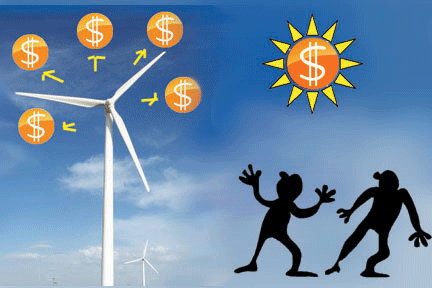 Renewable energy records set in California and Texas http://www.pv-magazine.com/news/details/beitrag/renewable-energy-records-set-in-california-and-texas_100015571/?utm_content=buffer11a9a&utm_medium=social&utm_source=twitter.com&utm_campaign=buffer#ixzz369kysSef 30. JUNE 2014 BY: IAN CLOVER Solar power in California sets new one-day record of 4.76 GW in June as Texas joins the ranks of the renewables big league, powered largely by wind. Figures from the California Independent System Operator (Cal ISO) revealed this week show that the Golden State broke its own one-day record for solar PV generation on June 1 when 4767 MW of utility scale solar energy was fed into the grid.
The record smashed California’s previous one-day best of 4100 MW in March, which also stood as the highest one-day figure for the whole of the U.S.
California’s solar footprint is growing bigger with each passing day, week and month, with May recording three times as much solar generation as recorded during the same month in 2013. In total, solar PV powered 6% of Cal ISO’s total electric load in May, rising to 14% during peak hours, according to data gathered by the U.S. Energy Information Administration (EIA). In 2013, California added 2145 MW of utility scale solar.
In Texas, wind power accounted for 30% of the state’s electric load on March 26, generating 10.2 GW of electricity according to the Electric Reliability Council of Texas (ERCOT). Regulators in Texas expect that record to be outstripped again shortly as the state’s wind capacity rises above 12 GW.
Last year was a record 12 months for renewable energy generation in the U.S. The solar sector grew by 41% in 2013, with California responsible for more than half of new PV capacity. For the remainder of 2014, the U.S. Energy Information Administration (EIA) expects California to add an additional 1728 MW of utility scale solar before the year is out.
Germany an energy policy winner, Japan a loser
 In short, German policy gave renewables fair access to the grid, promoted competition, weakened monopolies, and helped citizens and communities own half of renewable capacity. In 2013, Germany’s nuclear generation reached a 30-year low while renewable generation, 56% greater, set a new record, reaching an average of 27% of domestic use in the first quarter of 2014 and a brief peak of 74% on 11 May.

How Opposite Energy Policies Turned The Fukushima Disaster Into A Loss For Japan And A Win For
Germany Forbes, Amory B Lovins 28 June 14 Japan thinks of itself as famously poor in energy, but this national identity rests on a semantic confusion. Japan is indeed poor in fossil fuels—but among all major industrial countries, it’s the richest in renewableenergy like sun, wind, and geothermal. For example, Japan has nine times Germany’s renewable energy resources. Yet Japan makes about nine times less of its electricity from renewables (excluding hydropower) than Germany does.
That’s not because Japan has inferior engineers or weaker industries, but only because Japan’s government allows its powerful allies—regional utility monopolies—to protect their profits by blocking competitors. Since there’s no mandatory wholesale power market, only about 1% of power is traded, and utilities own almost all the wires and power plants and hence can decide whom they will allow to compete against their own assets, the vibrant independent power sector has only a 2.3% market share; under real competition it would take most of the rest. These conditions have caused an extraordinary divergence between Japan’s and Germany’s electricity outcomes. Continue reading
To revitalise its economy, Japan needs to turn to renewable energy
To revitalize its economy and politics, Japan needs an efficiency-and-renewables leapfrog that enables the new energy economy, not protects the old one. Japanese frogs jump too, says Bashō’s famous haiku “The old pond / frog jumps in / plop.” But we’re still waiting for the plop
How Opposite Energy Policies Turned The Fukushima Disaster Into A Loss For Japan And A Win For Germany Forbes, Amory B Lovins 28 June 14 “……..More than the sacred sun on Japan’s flag, its leaders appear to worship old policies that retard wide use of the energy sources now taking over the global market. Since 2008, half the world’s added electric generating capacity has been renewable. Non-hydroelectric renewables, chiefly wind and solar, got a quarter-trillion dollars of private investment and added over 80 billion watts in each of the past three years. Three of the world’s top four economies—China, Japan, and Germany, as well as India—now produce more electricity from non-hydro renewables than from nuclear power. Japan is on that list only because its nuclear production is roughly zero; it remains the rich nations’ renewable laggard. Perhaps the unexpected May 2014 court decision that prohibited restart of the Oi reactors as unsafe, and for the first time prioritized public safety over utility profits, may signal an emergent change beyond the cosmetic reforms offered by the executive and legislative branches—2016 “deregulation” in name only.
In 2012 and 2013, China made more electricity from wind than from the world’s most aggressive nuclear power program. In 2013, China added more solar power than its first developer, the United States, has installed in its whole history. But Japan is heading in the opposite direction: of the 8 GW of renewables brought into operation in the first 20 months after it introduced renewable FITs in July 2012, 97.5% was solar and only 1% windpower. Windpower (especially onshore where it’s cheapest) is stymied, first by uniquely slow and onerous approval processes and then by outright rejection by utility monopsonists who get to bar competitors from their regional grids. Japan’s windpower association projects the same market share in 2050 that Spain achieved three years ago.
It’s not hard to figure out why. Solar power displaces daytime peak that’s costly to generate, but the way the solar feed-in tariff works, it’s profitable for utilities. In contrast, they lose money on cheap windpower that also runs at night, displacing coal and nuclear. Japan’s latest rules reiterate utilities’ right to refuse renewable power that would displace such legacy “baseload” plants. Japanese business leaders may be upset to learn that their electricity, among the world’s costliest, is even costlier because their utilities run their own costlier thermal plants while rejecting windpower with nearly zero operating cost.
The electricity reforms passed in late 2013 by the lower house of the Diet (23 years after Germany’s reforms began) still let Japan’s utilities reject cheaper renewable power for any reason or no reason. Many claim renewables could harm grid stability. So why do Germany, with 25% renewable electricity in 2013, and Denmark, with at least 47%, have Europe’s most reliable electricity, about ten times more reliable than America’s? These countries, like three others in Europe (none very rich in hydropower) that used roughly half-renewable electricity in 2013—Spain 45%, Scotland 46%, Portugal 58%—simply require fair grid access and competition. Of all major industrial nations, only Japan doesn’t.
Germany also uses energy more efficiently. In each of the past three years, German electricity consumption fell while GDP grew. During 1991–2013, i.e.since reunification, German real GDP grew 33% using 4% less primary energy and 2% less electricity, and emitting 21% less carbon. Even more ambitious savings are available and planned.
In contrast, Japan’s world-leading energy efficiency gains in the 1970s later stagnated. Japanese industry has continued to improve, and remains among the most efficient of 11 major industrial nations, but Japan ranks tenth in industrial cogeneration and commercial building efficiency, eighth in truck efficiency, and next-to-last (tied with the U.S.) in car efficiency. Yet Japan’s sky-high energy prices make energy efficiency very profitable, most of all in buildings. Semiconductor company Rohm’s office opposite Kyōto Station, for example, cut its energy use 46% and repaid its cost in two years. With a few exceptions, like the Tōkyō Metropolitan Government’s efficiency efforts, few Japanese buildings have received the kind of kaizen (continuous improvement) that has long distinguished Japanese industry.
To revitalize its economy and politics, Japan needs an efficiency-and-renewables leapfrog that enables the new energy economy, not protects the old one. Japanese frogs jump too, says Bashō’s famous haiku “The old pond / frog jumps in / plop.” But we’re still waiting for the plop.http://www.forbes.com/sites/amorylovins/2014/06/28/how-opposite-energy-policies-turned-the-fukushima-disaster-into-a-loss-for-japan-and-a-win-for-germany/
In just 8 years, German State goes from 30% to 100% renewable energy
German State to Reach 100% Renewable Power This Year http://inhabitat.com/german-state-to-reach-
100-renewable-power-this-year/ by Josh Marks, 06/25/14 Germany recently smashed three solar energy records in just two weeks and set a new overall renewables record last month with 74 percent clean energy use during the middle of the day. Now the Federal Republic’s northernmost — and windiest — state of Schleswig-Holstein is set to generate all of its electricity from green energy this year. The state, which borders Denmark and the North and Baltic Seas, has a goal to generate 300 percent of its electricity needs from renewables.
Related: Germany Smashes Three Solar Energy Records in Just Two Weeks!
Schleswig-Holstein is home to more than 200 businesses in the wind energy sector with around 7,000 employees. As of 2010, wind power in Germany provided more than 96,000 jobs and that figure is expected to increase as the nation commits to phasing out nuclear energy and replacing it with renewables.
While Schleswig-Holstein aims to become the first of Germany’s 16 states to pass the 300 percent renewables mark, a Bavarian village has already blown past that milestone. In 2011, Wildpoldsried produced a whopping 321 percent of its electricity from clean energy, generating four million Euro (US $5.7 million) in revenue by selling it back to the national grid. Via CleanTechnica
Amazing portable solar power unit
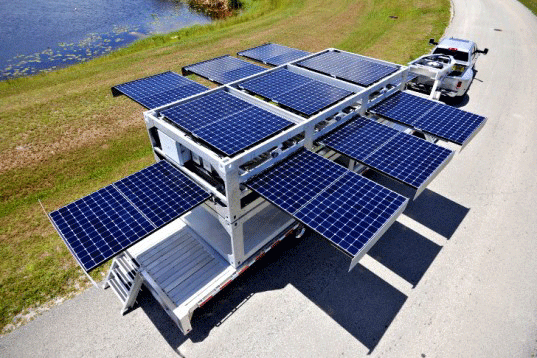
Amazing Pop-Up Solar Power Station Delivers Energy Anywhere it’s Needed, Inhabitat, by Beverley Mitchell, 06/24/14 Ecosphere Technologies’ latest product combines several of our very favorite things in one easy-to-transport package: shipping containers, off-the-grid solar power, and clean drinking water generation. With their new Ecos PowerCube, the company can deliver a shipping-container-sized, self-sustaining solar power station by air, sea, rail or road to anywhere in the world it is needed.
Renewabl eenergy investments by Warren Buffett set to increase to around $30 billion
 Warren Buffett could double renewable energy investment to $30bn http://blueandgreentomorrow.com/2014/06/11/warren-buffett-could-double-renewable-energy-investment-to-30bn/ Wednesday, June 11th, 2014 By Richard Heasman
Warren Buffett has said his Berkshire Hathaway holding company could invest a further $15 billion (£8.9 billion) in solar and wind projects in the US.
At a Las Vegas conference this week, the world’s third wealthiest man was reminded by his deputy Greg Abel of the company’s current $15 billion investment in the sectors.
Buffett swiftly declared that the same figure should be committed again, describing the overall potential of sustainable energy as an expanding market.
Bloomberg said Buffett responded to Abel’s prompt with, “There’s another $15 billion ready to go, as far as I’m concerned.” Buffett has remained one of the world’s leading investors in renewable energies,bankrolling major solar and wind power developments with multi-billion dollar investments.
Buffett’s Nebraska-based firm Berkshire Hathaway is now the fifth-largest in the world by market value. It has huge investments in regulated, capital-intensive businesses such as infrastructure and energy.
Buffett has described the renewables market as high in potential, with the predictability of reinvestment and large growth.
In 2011, he bought a massive California-based solar farm project from First Solar. Other investments include the acquisition of an Iowa energy holding company in 2011.
His unit now operates power grids in the UK, natural gas pipelines that run across the entirety of the US and wind farms in Iowa, Wyoming, California and Arizona.
Buffett’s pledge to boost renewables investment comes after Barack Obama declared tighter emission targets for coal power companies – with an overall aim of cutting emissions by 30% by 2030. The Environmental Protection Agency (EPA) declared this would bring net climate and health benefits of up to $82 billion (£48 billion).
The inevitable renewable energy revolution will transform society
 No wonder Wall Street is cheering. Hailing the ‘Age of Renewables’, Citi thinks solar will soon be the cheapest electricity in many markets, even without government incentives.
Electricity’s inevitable renewables revolution, Eco Business, 5 June 14 Due to different factors and advancing technologies, the ‘Age of Renewables’ has come and it will transform not only industries but also society.
Renewable electricity development is going to accelerate over the next few years because of trends in water, population and technology. A successful turnout in the 2015 climate talks in Paris can also be a game-changer in the demand for renewable electricity.
This position was made clear by the Intergovernmental Panel on Climate Change (IPCC) in April and more starkly in May by the International Energy Agency (IEA), which called for an “active transformation” through “radical action”.
To tackle climate change, most of the 4.2 terawatts of coal, gas and oil power plants – about 80 per cent of world’s electricity generating capacity – must be replaced with generators using clean energy well before 2050.
Revolutionary forces However, if climate talks should fail, as many expect given the current sorry state of affairs, there are several intensifying and complementary factors that could drive the rapid growth of renewable electricity in the years to come.
With renewable energy storage, conventional utilities face a difficult future
Electricity’s inevitable renewables revolution, Eco Business, 5 June 14 “…..Disruption in store Storage multiplies the value of renewable electricity thereby increasing demand, which in turn will create a positive feedback for more storage. Disruption of incumbent business models and energy markets is likely to increase as innovation drives down storage costs. Widespread storage, such as batteries, will transform renewable electricity in two ways. One, allow consumers to use renewable electricity power when they need it most, not just when the sun shines or the wind blows. Two, provide consumers and entrepreneurs with the capability to make and trade electricity without conventional utilities. Storage highlights the profound physical differences between renewable energy and conventional energy. To simplify, conventional energy, be it ore, oil or gas, is a concentrated finite stock flowing at a rate set by how much we spend on digging and drilling. Renewable energy, like solar radiation and wind, streams freely and diffuses at variable rates ultimately set by the sun. Those characteristics mean swapping out gas-turbine generators for solar modules or wind turbines watt-for-watt would result in lower electricity output. Thus, to replace 4.2 terawatts of carbon power plants, and meet rising electricity demand, will take several times as much capacity in terms of generators using solar, wind, and other renewable energy sources. However, capital costs, which as noted are falling, for renewables are offset by zero fuel costs over the operating lifetime and zero emissions which avoid social costs of harm to health, climate and ecosystems. Such costs are harming households and firms alike, triggering shifts in perceptions which favour the characteristics of renewable electricity and distributed generation. Already, the increasing competitiveness and preference for renewable energy has hit conventional utilities, contributing to losses of €500 billion in Europe in recent years. David Crane, chief executive of America’s top power producer NRG, warns conventional utilities face irrelevance. Their future looks difficult. They must switch to renewable energy and simultaneously compete against the expanding army of millions of people turning their homes and firms into power producers. Civic groups and cooperatives are acting locally to bankroll renewable power or take over grids in communities across Europe and the US.http://www.eco-business.com/opinion/electricitys-inevitable-renewable-revolution/
Warren Buffett backs revolutionary development in renewable energy
Buffett’s $28 billion winning bet on clean energy, SMH, June 5, 2014 Warren Buffett’s $US26 billion (A$28 billion) bet on western US power plants, transmission lines and wind farms is poised to pay off.
The energy unit of Buffett’s Berkshire Hathaway, with the help of California’s grid operator, is moving to unite the holdings under a single market capable of dispatching power across seven states every five minutes. The system, designed to handle sudden swings in supply and demand, would revolutionise the markets from Oregon to Nevada, where 38 transmission operators manually balance their territories on an hourly basis.
The move would be a game-changer for the renewables that Berkshire Hathaway Energy has accumulated over the past decade, including two of the world’s largest solar farms, and for other clean-power producers, according to those who trade in the region’s markets. Berkshire’s plants stand to run for longer periods of time, and its NV Energy and PacifiCorp utilities will save as much as $US63.9 million annually by 2017, Energy and Environmental Economics reports show.
“It would be huge if all 38 balancing authorities joined,” Sean Breiner, a market design analyst for energy trader Viasyn, said by telephone June 2. “Instead of having these balkanised regions, you’d have resources from Idaho to Wyoming all flowing into one kind of large spot market.”
Green power……
California has a goal of securing 33 per cent of power from clean energy by 2020. By next year, the California Independent System Operator Corp. expects renewables to meet almost a quarter of demand. In the Northwest, renewables are nearly 7 per cent of total supply, excluding hydropower.
The market, scheduled to start Oct. 1 pending approval from the Federal Energy Regulatory Commission, would use hourly bids from generators to match the cheapest resources with supply, demand and transmission changes every five minutes. It would initially include the territories of the California ISO and PacifiCorp — spanning 42,200 miles of transmission lines in six states from California to Wyoming, extend to NV Energy’s Nevada network a year later and could accommodate all operators in the region…….
Berkshire Hathaway Energy’s spending in the western states included $US10.7 billion to acquire PacifiCorp and NV Energy, $US8.7 billion in renewable investments, a $US6 billion Northwest transmission project and at least $US568 million on the Lake Side natural gas-fired power plant being completed this year in Utah, according to company filings.
Power generators and transmission operators in other parts of the US already participate in real-time markets run by grid operators from the Northeast to Texas. California runs a five-minute market within its own territory. Should all the authorities in the western US join the new system, it would become the nation’s largest geographically.
Analyses prepared by San Francisco-based Energy and Environmental Economics show the real-time market would save the California ISO area as much as $US74.3 million, PacifiCorp $US54.4 million and NV $US9.5 million in the year 2017……….. http://www.smh.com.au/environment/climate-change/buffetts-28-billion-winning-bet-on-clean-energy-20140605-zry0t.html#ixzz33v2NcWMC
One Man’s AMAZING Plan To Replace Non-Renewable Energy
A Small Victory For Japanese Nuclear Residents & One Man’s AMAZING Plan To Replace Non-Renewable Energy Collective Evolution, June 4, 2014 by Jeff Roberts  http://www.collective-evolution.com/2014/06/04/a-small-victory-for-japanese-nuclear-residents-one-mans-amazing-plan-to-replace-non-renewable-energy/ “…….. VIDEO: One man’s AMAZING plan to replace non-renewable energy The big oil, gas, coal and nuclear companies claim that we need those energy sources in order to power America. Good news: it’s a myth. Mark Diesendorf – Associate Professor and Deputy Director, Institute of Environmental Studies, UNSW at the University of New South Wales – notes: The deniers and scoffers repeatedly utter the simplistic myth that renewable energy is intermittent and therefore cannot generate base-load (that is, 24-hour) power. Detailed computer simulations, backed up with actual experience with wind power overseas, show that the scoffers are wrong. Several countries, including Australia with its huge renewable energy resources, could make the necessary transition to an electricity generation system comprising 100 per cent renewable energy over a few decades. Diesendorf gave an update earlier this month: Continue reading
India on the road to a renewable energy revolution?
India’s energy future: Australian coal or renewable revolution? The Conversation, Craig Froome Global Change Institute – Clean Energy Program Manager at University of Queensland “…….…Renewable revolution?
India’s renewable energy ambitions are driven both by the need to reduce carbon emissions and by falling renewableenergy prices (relative to increasing coal prices).
Currently India has four renewable energy schemes. They are:
- Renewable Mix Target (Electricity)
- Renewable Capacity Target
- Renewable Portfolio Standard (PAT Scheme)
- Jawaharlal Nehru National Solar Mission
The Renewable Mix Target sets a target of 15% of India’s total electricity generation by 2020. This target ignores large-scale hydroelectricity, but with renewable energy generation currently at 12% India is in a good starting position.
The Renewable Capacity Target is a target for installed capacity. Set in 2012, it aims for 41.3 gigawatts of installed renewable capacity by 2017, increasing to 72.4 gigawatts by 2022. As of March 31 India has 29.5 gigawatts installed capacity. The capacity target also sets ambitions for individual technologies 4 to 20 gigawatts of solar capacity, and 20.2 gigawatts to 27.3 gigawatts of wind energy by 2017 and 2022. Solar and wind currently stand at 2.2 and 20.2 gigawatts respectively.
The portfolio standard is a cap-and-trade scheme, due to end in 2015. Current estimates suggest the scheme has had the desired effect, and rules for continuing the scheme are being considered.
Finally, the solar mission is a solar-specific program to increase grid-based generation to 20 gigawatts by 2020, funded by a national feed-in tariff. More than 80 solar manufacturers are now establishing in India in anticipation for the roll out……..http://theconversation.com/indias-energy-future-australian-coal-or-renewable-revolution-26569
Nuclear publicists like Rod Adams wasting time trying to discredit Energiewende
 Renewable Energy Growth Greater Than Nuclear Decline in Germany Clean Technica, JamesWimberley 3 June 14,
Foreigners lecturing Germans that they should keep their nuclear reactors running are wasting their time. The well-heeled nuclear lobby in Germany has completely failed to sell its product to a firmly anti-nuclear public, and has given up, so why should a few foreign bloggers make a difference?
FWIW, I agree with the argument – ten years of avoided coal power is not to be sniffed at. But the Energiewende is a package: phase out nukes and gas first, then coal. and replace them with renewables.
The real purpose of publicists like Adams is to convince Americans that the Energiewende is a hoax so that they will support their own domestic nuke-building. This objective is less hopeless, but not by much. Wall Street and the Administration have lost interest. Republicans in Congress will defend existing nuclear subsidies, but don’t have any appetite for upping them to the Hinkleyish scale needed for a significant revival of the American nuclear industry. Move on, there’s nothing to see here.http://cleantechnica.com/2014/06/03/renewable-energy-growth-germany-nuclear-decline/
Renewable energy employing 6.5 million people world wide
 IRENA: 6.5 M People Employed in Renewable Energy Worldwide http://dailyfusion.net/2014/05/6-5-m-employed-in-renewable-energy-28962/ May 30, 2014 In 2013, approximately 6.5 million people were already employed in the renewable energy industry worldwide, a new study by the International Renewable Energy Agency (IRENA) reveals.

SEE ALSO: IRENA: Global Renewable Energy Share Can Double by 2030
“With 6.5 million people directly or indirectly employed in renewable energy, the sector is proving that it is no longer a niche, it has become a significant employer worldwide,” said IRENA Director-General Adnan Z. Amin. “The insights into shifts along segments of the value-chain revealed in the report are crucial to developing policy that strengthens job growth in this important sector of the economy.”
Renewable energy employment was shaped by regional shifts, industry realignments, growing competition and advances in technologies and manufacturing processes in 2013. The largest employers by country are China, Brazil, the United States, India, Germany, Spain and Bangladesh, while the largest employers by sector are solar photovoltaic, biofuels, wind, modern biomass and biogas.
Among other updates, the 6.5 million figure published in the annual review reflects growth in Chinese numbers, which can be attributed to a significant increase in annual installation and manufacturing activity and differences in the way employment figures are estimated. IRENA estimates a five-fold increase of solar PV installations in China from 2011 to 2013. Surging demand for solar PV in China and Japan has increased employment in the installation sector and eased some PV module over-supply concerns,” said Rabia Ferroukhi, heading the Knowledge, Policy and Finance division at IRENA and lead author of the report. “Consequently some Chinese manufacturers are now adding capacity.”
In the wind industry, China and Canada provided positive impulses while the outlook for the United States remains somewhat mixed because of political uncertainty. The offshore wind industry is still concentrated in Europe, particularly the United Kingdom and Germany.
The biofuels value chain provides the second largest number of renewable energy jobs after solar PV. The United States remains the largest biofuels producer, while Brazil remains the largest employer.
Nuclear and coal get twice the subsidies that wind and solar power get
Wind Subsidies & Solar Subsidies ~50% Nuclear & CCS Subsidies (Charts) Clean Technica 30 May 14, After a week which saw the use of renewable energy support schemes in Australia described as “plain crazy”, it seems like a good time to take another look at the study published last month by Agora Energiewend that shows European subsidies for solar and wind essentially come at half the price of those for nuclear or CCS.
The analysis – based on a comparison of European subsidies for low-carbon energy systems – found that new wind and solar PV could generate energy for an overall cost of up to 50 per cent less than new nuclear or coal or gas with (as yet unavailable) carbon capture and storage technology.
“Today’s feed-in tariffs for wind and PV in Germany are up to 50 per cent lower than those offered for new nuclear in the UK according to the Hinkley Point C agreement,” the report says, noting that for CCS, with the technology still in demonstration phase, estimates suggest it would cost about as much as new nuclear power or more.
“Even today and under conservative assumptions, a generation mix consisting of PV, onshore wind and gas is approximately 20 percent less expensive than a mix consisting of new nuclear power (based on the Hinkley Point C agreement) and gas,” the report says.
Overall, it says, “onshore wind at sites with a good resource potential and utility-scale PV represent the low-carbon technologies with the lowest cost,” while power from nuclear, as well as gas and coal plants with CCS represent the low-carbon technologies with the highest cost.
But we’ll let the charts do the talking…http://cleantechnica.com/2014/05/30/wind-subsidies-solar-subsidies/
1 This Month
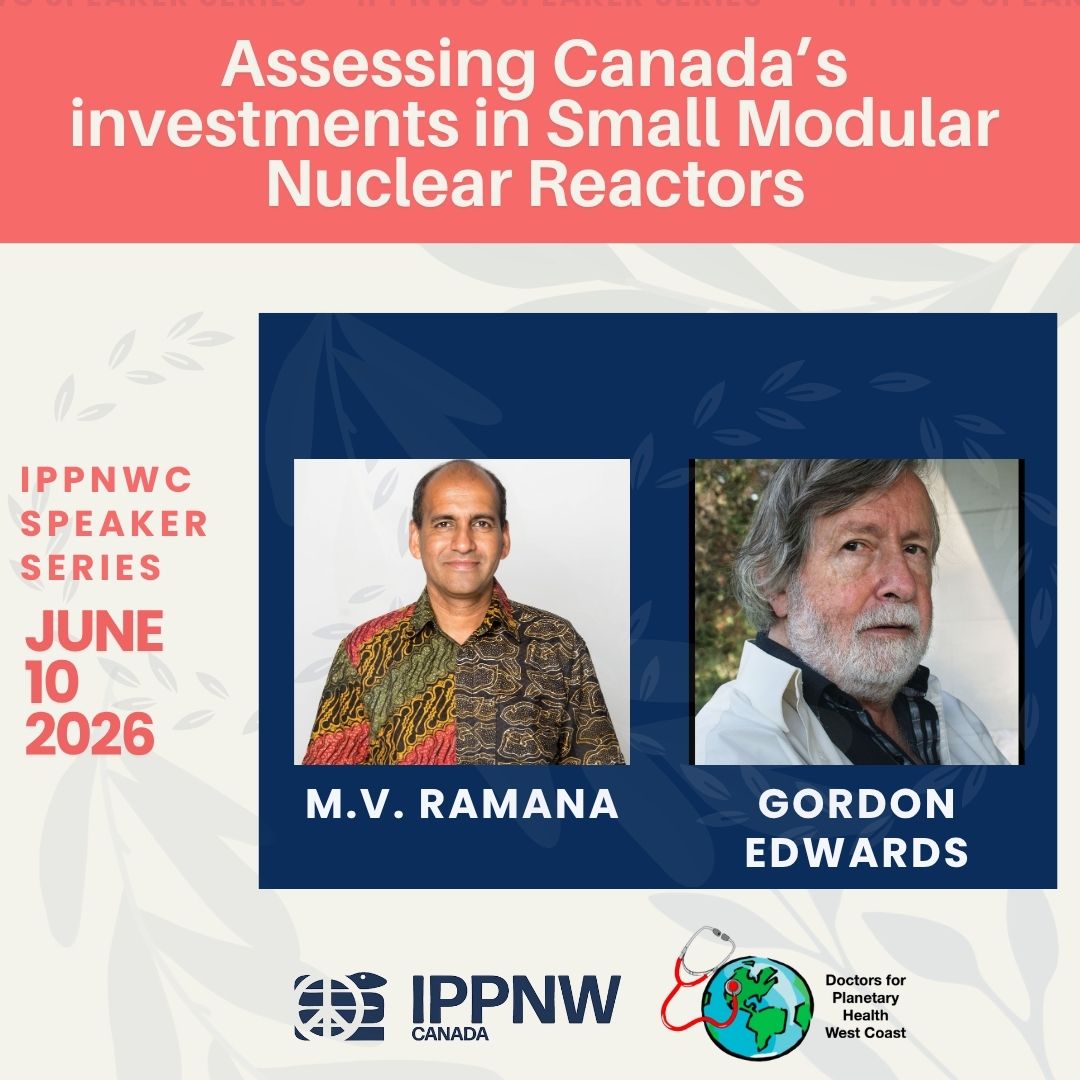
10 June – Assessing Canada’s Investments in Small Modular Nuclear Reactors – https://zoom.us/meeting/register/IiqHA5feRhaEBycOLNTJlA#/registration


Cuba Is Not a Failed State – It Is a Besieged State
PETITION: “Global Appeal to Endorse Palestinian Right of Return of Refugees”
To see nuclear-related stories in greater depth and intensity – go to https://nuclearinformation.wordpress.com
-
Archives
- June 2026 (79)
- May 2026 (306)
- April 2026 (356)
- March 2026 (251)
- February 2026 (268)
- January 2026 (308)
- December 2025 (358)
- November 2025 (359)
- October 2025 (376)
- September 2025 (257)
- August 2025 (319)
- July 2025 (230)
-
Categories
- 1
- 1 NUCLEAR ISSUES
- business and costs
- climate change
- culture and arts
- ENERGY
- environment
- health
- history
- indigenous issues
- Legal
- marketing of nuclear
- media
- opposition to nuclear
- PERSONAL STORIES
- politics
- politics international
- Religion and ethics
- safety
- secrets,lies and civil liberties
- spinbuster
- technology
- Uranium
- wastes
- weapons and war
- Women
- 2 WORLD
- ACTION
- AFRICA
- Atrocities
- AUSTRALIA
- Christina's notes
- Christina's themes
- culture and arts
- Events
- Fuk 2022
- Fuk 2023
- Fukushima 2017
- Fukushima 2018
- fukushima 2019
- Fukushima 2020
- Fukushima 2021
- general
- global warming
- Humour (God we need it)
- Nuclear
- RARE EARTHS
- Reference
- resources – print
- Resources -audiovicual
- Weekly Newsletter
- World
- World Nuclear
- YouTube
-
RSS
Entries RSS
Comments RSS
 nuclear-news