Wind energy takes over, as 4 nuclear power plants shut down
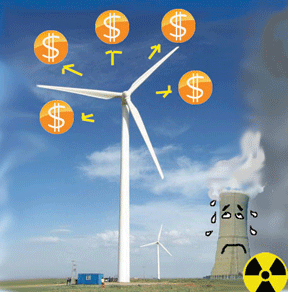 4 Nuclear Power Plants Shut Down; Wind Power Steps In Clean Technica August 16th, 2014 by Jake Richardson Wind power in the UK is helping to fill the void left by the shuttering of four nuclear reactors. One reactor was found with a defect on its boiler spine, so EDF Energy decided to shut it down, along with three others. It is expected they will be offline for about two months. (EDF is a French utility responsible for managing many nuclear reactors. It stands for Electricity de France.) The reactor with the potential boiler spine issue is at Heysham-1 plant in Lancashire. Another was shut down at Heysham as well. The remaining two that were taken offline are at Hartlepool. The UK energy supply should not suffer from the nuclear shut downs.
“Demand is low at this time of year, and a lot of wind power is being generated right now,” explained National Grid. In fact, the UK just set a new summer record for wind powergeneration, “According to figures from trade association RenewableUK, wind reached its maximum output at 10pm on Sunday night, delivering an average of 5.0GW of power over the hour and meeting 17 per cent of national demand.”…….
One of the small ironies about wind power filling in somewhat for nuclear reactors is that wind is criticized for being intermittent.
This is a very minor point, but there seems to be some slight discrepancies in the reporting about the reactor shut downs. The UK-based Financial Times reported that all four were shut down. The UK-based Guardian say they were to be shut down. The New York Timesreported that one was shut down in June, and that it had recently been decided by EDF to shut down three more. http://cleantechnica.com/2014/08/16/4-nuclear-power-plants-shut-wind-power-steps/
Storage for renewable energy is not a big problem, as pro-nukes claim it is
Is Storage Necessary for Renewable Energy? (includes videos) Engineering .com Tom Lombardo August 17, 2014 Physicist and energy expert Amory Lovins, chief scientist at The Rocky Mountain Institute, recently released a video in which he claims that renewable energy can meet all of our energy needs without the need for a fossil fuel or nuclear baseload generation. There’s nothing unusual about that – many people have made that claim – but he also suggests that this can be done without a lot of grid-level storage. Instead, Lovins describes a “choreography” between supply and demand, using predictive computer models models to anticipate production and consumption, and intelligent routing to deliver power where it’s needed. This “energy dance,” combined with advances in energy efficiency, will allow us to meet all of our energy needs without sacrificing reliability.
Report highlights rapid increase in solar energy systems
 Solar System Installations Increasing Fast Clean Technica August 4th, 2014 by Worldwatch Institute Originally published on Worldwatch Institute.
New analysis by the Worldwatch Institute examines global trends in the solar power sector
Washington, D.C.—The year 2013 saw record-breaking growth for solar electricity generation as the photovoltaic (PV) and concentrated solar thermal power (CSP) markets continued to grow. With over 39 gigawatts installed worldwide, the PV solar market represented one-third of all newly-added renewable energy capacity, write Worldwatch’s Max Lander and Climate and Energy Intern Xiangyu Wu in the Worldwatch Institute’s latest Vital Signs Online trend (www.worldwatch.org).
Solar PV installations nearly matched those of hydropower and, for the first time, outpaced wind additions. Even though photovoltaic systems continue to dwarf CSP capacity, the CSP market also had another year of impressive growth. By the end of 2013, a total of 19 countries had CSP plants installed or under construction.
Consumption of power from PV and CSP plants increased by 30 percent globally in 2013 to reach 124.8 terawatt-hours. Europe accounted for the majority of global solar power consumption (67 percent), followed by Asia (23.9 percent) and North America (8.1 percent). Worldwide, solar consumption equalled 0.5 percent of electricity generation from all sources……….
Country Highlights from the Report:
- China installed 12.9 gigawatts of PV, the most ever installed in one year by any country. The country’s momentous expansion was fueled largely by its feed-in tariff (FIT) program, which supports large, grid-connected utility-scale projects as well as distributed generation projects. However, grid connections are struggling to keep up with the rapid pace of China’s PV deployment.
- Europe installed close to 11 GW of PV. This represented the second annual decline in installations after peaking at 22.3 GW in 2011. In Germany, a reduction of FIT rates and an increase in regulations for utility-scale projects contributed to the fall in installations.
- North America added 5.2 GW of PV. The United States installed the third most PV worldwide, with 4.8 GW.
- In Central and South America, solar development has been sluggish. Despite power consumption more than doubling in 2013, the region still accounts for a small fraction of the world’s solar power.
- The Middle East and Africa had little PV activity, with the exception of Israel and South Africa, which added 420 MW and 75 MW, respectively. http://cleantechnica.com/2014/08/04/solar-system-installations-increase-significantly/
Renewable enegy already viable – and the myth of storage necessity
We Don’t Need a Huge Breakthrough to Make Renewable Energy Viable—It Already Is The idea that renewable energy can’t handle the load is a myth, says Amory Lovins http://www.smithsonianmag.com/smart-news/we-dont-need-huge-breakthrough-make-renewable-energy-viable-it-already-180952254/?no-ist By Colin Schultz August 5, 2014 From the windy plains to the sunny southwest, energy companies around the U.S. are investing heavily in renewable energy production. More than half of the energy production equipment being planned for installation in the next few years is renewable. Yet despite the environmental and economic sense of renewable energy, the public conception still lingers that wind and solar and other renewable tech will never be able to quite handle the job. After all, do we expect factories and homes to go dark when the sun sets or the wind falters?
The storage necessity myth: how to choreograph high-renewables electricity systems
In the video above, physicist and environmentalist Amory Lovins explains how renewable energy should be able to keep the electricity flowing just fine. We won’t need any big technological breakthroughs in batteries or storage technology, he says, or any other huge breakthroughs. All we’ll really need is good management and a diverse array of renewable energy production equipment.
Amory Lovins is the co-founder of the Rocky Mountain Institute, a think tank working on energy and resource use issues. This video was based on a presentation Lovins gave at the 2014 TED conference.
Wind power – te renewable solution for energy needs in dry Jordan
Jordan turns to wind power in search of renewable energy, Al Monitor, 5 Aug 14 Jordan is carrying out a project to use wind power in Tafila province in the south of the country. The project’s energy production is around 117 megawatts per hour, generating 400 gigawatt hours yearly. The Jordan Wind Project Company (JWPC) will provide the necessary supply for the Jordan Electric Power Company (JEPCO) to carry out the project’s commercial execution in mid-2015, with an estimated cost of around $285 million. JWPC is a joint project between InfraMed (50%), Masdar in Abu Dhabi, UAE (31%) and EP Global Energy (19%). The cost of generating electricity from wind power is estimated at around $120 for every megawatt hour, which is significantly lower than conventional sources of electric power………
The Tafila wind farm project is the first of its kind in Jordan and the region in which a private company uses wind power to generate energy. The project includes installing 38 turbines (3 MW per turbine). The strategy adopted by the energy sector of Jordan aims at having renewable energy rise to 10% of the total energy and reach 8%-10% of the consumed electricity in Jordan by 2020. The Tafila wind farm is expected to generate electricity with a cost 25% lower than thermal energy, which would lower CO2 emissions by 40,000 tons per year.

The Ministry of Energy and Mineral Resources is working on launching a second wind-power project. Last week, the ministry signed a contract with the Spanish company Elecnor for a project designed to generate wind-power energy in Maan [south of the capital, Amman.] The available information shows that this project is going to be funded by the Gulf grant program, Kuwait Fund for Economic Development. On this project as well, the Arab funds create a transparency for contracting and covering expenses……http://www.al-monitor.com/pulse/business/2014/08/jordan-wind-power-project-energy-consumption.html#
Germany reaches record in share of renewable energy
 Renewable energy share reaches record high in Germany, PV Magazine 31. JULY 2014 New installations coupled with favorable climatic conditions helped boost the share of renewables to a record 28.5% in the first half of 2014. The share of renewable energy in gross domestic energy consumption is expected to rise to a record high of 28.5% in the first half of 2014, according to a preliminary survey by the German Association of Energy and Water Industries (BDEW).
The construction of new renewable installations coupled with favorable climatic conditions helped boost the share of renewables to record levels by mid-year. In the first half of 2013, the renewables share of gross domestic energy consumption was at 24.6%.
Producing 18.3 billion kilowatt hours, photovoltaic power generation increased by 27.3%, while wind grew by 21.4% to 31 billion kilowatt hours. Biomass energy generation increased 5.2% to 22 billion kilowatt hours in the period……..
Energy generation by conventional plants on decline
The production by conventional power plants is declining significantly, BDEW reported……..
Gas and electricity consumption saw a general decline in the period: Natural gas consumption amounted to 445.7 billion kilowatt hours, down some 20% from 555.5 billion. The BDEW attributed the drop to significantly warmer weather in 2014, which lowered overall heating demand, especially compared to the very cold first half of 2013. A decline in production in Germany’s chemical industry likewise contributed to lower gas use. Adjusted for temperature, natural gas consumption still fell nearly 7%.
Electricity consumption in the period dropped 5% to 268 billion kilowatt hours, down from 282 billion a year ago, due mainly to the mild weather.
UK has record year for renewable energy
 Record year for UK renewables http://renews.biz/71533/uk-renewables-output-hits-18-1twh/ Renewables claimed a record 14.9% of the UK generation mix in 2013, figures from DECC reveal.Some 53% of this came from onshore (32%) and offshore wind (21%), accounting for 7.9% of the nation’s electricity. Offshore wind generation surged by 52% and onshore by 40%. Overall renewables output was up 30% on 2012.
Meanwhile, figures for the first quarter of 2014 showed a renewables share of 19.4%, up 43% to 18.1TWh on the 12.7TWh in the first quarter of 2013.
Onshore wind rocketed 62% in the quarter, from 4.1TWh to 6.6TWh, as a result of “much increased capacity and high wind speeds”. Offshore wind was up 53% from 2.9TWh to 4.4TWh.
Energy Secretary Ed Davey said: “The government’s investment in renewable energy is paying off. Renewable electricity has more than doubled in just four years.
“Having a strong UK renewable sector helps to reduce our foreign imports of energy, improving our energy security as well as helping us tackle climate change and creating hi-tech green jobs. A green energy future that once seemed impossible for Britain is fast becoming a reality.”
RenewableUK welcomed the figures, which it said should “make those in government who have failed to support wind energy sit up and take notice”.
R-UK director of policy Gordon Edge said: “More than half of Britain’s clean electricity now comes from onshore and offshore wind. We’re now on course to hit 10% of electricity from wind alone this year.
“That’s why it’s particularly puzzling to see some politicians fail to back the cheapest and most successful renewable technology, onshore wind, at a time when a majority of voters from all the main parties are telling them to support it.”
Installed renewables capacity in the UK increased by 27% (4.2GW) to 19.7GW in 2013, due mainly to a 27% increase in onshore wind capacity and a 23% increase in offshore wind capacity. For the first time, more than 5% of the total energy supply, covering electricity, heat and fuel for transport, came from renewables, up from 4.2% in 2012 to 5.2% in 2013. The UK needs to meet a legally binding target of 15% of all energy from renewables by 2020.
Meanwhile, figures for the first three months of 2014 showed high rainfall in Scotland led to hydro output increasing by 78% to a record quarterly level of 2.2TWh.
Renewable electricity capacity was 20.8GW at the end of the period, a 15% increase on the corresponding window in 2013 and a 5.4% increase on the previous quarter.
Some 145MW of capacity joined the feed-in tariff scheme, increasing the total to 2386MW or 11% of all installed renewable capacity. Solar PV contributed 107MW, wind 13MW and anaerobic digestion 7MW.
Overall UK electricity generation for the quarter was 93.3TWh, a dip of 8.2% on a year ago due to the warmest first three months seven years.
Denmark’s wind power soon to be half the cost of fossil fuel energy
In Two Years, Denmark’s Wind Power Will Be Half the Cost of Fossil Fuels http://motherboard.vice.com/en_au/read/in-two-years-wind-power-will-be-half-the-cost-of-fossil-fuels-in-denmark BRIAN MERCHANT SENIOR EDITOR July 30, 2014 Wind power is officially the cheapest source of energy in Denmark, according to the nation’s government—and by 2016, it claims the electricity whipped up by its newest turbines will be half the price of fossil fuels like coal and natural gas.
Denmark’s Energy Association (everything about Scandinavia is friendlier, even its DEA) announced the news last week, and it’s an achievement worth highlighting. Wind and solar are achieving grid parity with fossil fuels—that is, it’s just as cheap—in many places around the world. Even without the tax breaks, declining manufacturing costs and growing scale have rendered wind power just as cheap as natural gas in many states right here in the gas-rich US. And at least one analyst determined that this is the “beginning of the grid parity era” for solar, worldwide.
But Denmark is blowing past grid parity and towards a scenario in which clean energy is actually much, much cheaper: When its two massive offshore wind farms come online, they’ll be the nation’s most inexpensive energy source by a wide margin, analysts say.
“Electricity from two new onshore wind power facilities set to begin operating in 2016 will cost around 5 euro cents per kilowatt-hour,” Yale 360 explains. “Wind power would remain the cheapest energy option even if interest rates on wind power projects were to increase by 10 percent, the report found.”
That’s good news for a nation that’s hoping to get 50 percent of its power from wind turbines by 2050. Right now, the nation already boasts an impressive clean energy mix of 43 percent. “Wind power today is cheaper than other forms of energy, not least because of a big commitment and professionalism in the field,” Rasmus Peterson, Denmark’s energy minister, said at a press conference. “This is true for researchers, companies and politicians. We need a long-term and stable energy policy to ensure that renewable energy, both today and in the future, is the obvious choice.”
Importantly, the DEA’s analysis “was not based on a full cost-benefit assessment of different technologies that included an assessment of environmental benefits, taxes or subsidies.” That is, the agency did not factor in the health and environmental costs of burning fossil fuels—which are considerable—and instead looked directly at the market forces in the country.
Natural gas and coal are much more expensive in Denmark than it is in the US, which helps make wind such an economic bargain, and the nation has explicitly pursued wind power for decades. But improving technology, falling costs, and the strong, consistently blowing offshore winds that will turn the new turbines are making the case airtight.
Yesterday brought the good news that Germany was meeting a full 28.5 percent of its energy needs with clean sources. Now Denmark is proving that running your nation on clean energy can be cheaper than we possibly could have imagined, even ten years ago.
For mitigation of climate change, wind power leaves nuclear and carbon capture way behind
Wind Energy Beats Nuclear & Carbon Capture For Global Warming Mitigation Clean Technica July 29th, 2014 by Mike Barnard There’s an enduring myth related to wind energy and nuclear energy that needs to be put to bed. That myth is that only nuclear can be scaled to sufficient capacity to reduce the impacts of global warming, and that wind energy is much less scalable so it should be ignored.
Most recently, this appeared as a broad generalization without any supporting evidence in a pro-carbon capture series by a CCS researcher on the Siemens-sponsored Energy Collective, which features this particular myth regularly, being a bit of an echo chamber for it. Of course the nuclear industry’s PR professionals love this line as well.
And there’s another myth related to carbon capture and sequestration being more significant than renewables that has to be assessed as well.
China is the true test bed for maximum scalability of nuclear vs wind. It has a tremendous gap between demand and generation. It can mostly ignore lack of social license for nuclear. It is building both wind and nuclear as rapidly as possible. It has been on a crash course for both for about the same period of time. It has bypassed most of the regulatory red tape for nuclear which sensibly exists elsewhere given concerns about economic fallout of Fukushima-scale disasters, nuclear proliferation and terrorism. And in four years it has built significantly less nuclear generation capacity than it built of wind generation capacity in 2013 alone…….
Where does this leave the claims about nuclear and CCS?
Nuclear isn’t more scalable than wind or other renewables, in fact it’s going in reverse while renewables are being expanded rapidly. And CCS won’t dodge more climate change than renewables because wind and solar are being built in production rapidly and CCS isn’t and won’t be in comparable scales because the economics don’t support it. Both are busted myths.
Wind energy isn’t the only answer. It is likely to reach a maximum of 30% to 40% of supply in a century worldwide. That’s impressive and amazing, but far from the only tool necessary to deal with climate change. Solar will be in the same range. Storage will likely be necessary somewhere from 15% to 20% and grid interconnections will improve substantially. Biomass and geothermal will add their bits, as will tidal possibly. And demand for electricity will go up a lot as countries become richer and transportation and other forms of energy usage become electrified. It’s a complex space, and CCS has an important if smaller and only bridging role to play in it. Nuclear is useful as well, although diminishing as a percentage of total worldwide generation.
But the heavy lifting will be done by displacing fossil fuel generation with renewables, not trying to mitigate the extraordinary problems with burning fossil fuels or building nuclear generation. That’s what the empirical data tells us………. http://cleantechnica.com/2014/07/29/wind-energy-beats-nuclear-carbon-capture-global-warming-mitigation/
China is developing wind energy much more than nuclear energy
Wind Energy Beats Nuclear & Carbon Capture For Global Warming Mitigation Clean Technica July 29th, 2014 by Mike Barnard “……….
What is the reality of nuclear vs wind built out?
 China turned on just over 16 GW of nameplate capacity of wind generation in 2013 according to the Global Wind Energy Council.
- Over the four years of 2010 to 2014 China managed to put 4.7 GW of nuclear into operation. This is not their stated plan for nuclear which is much higher, but the actual generation capacity put into production.
- Modern wind turbines have a median 40.35% capacity factor and exceed 50% in the best wind resources according to the US National Renewable Energy Laboratory (NREL) who track the actuals on this sort of thing.
- Taking similarly sourced numbers for nuclear capacity factor from the Nuclear Energy Institute, we see 90.9% capacity factors for nuclear reactors. These are apples-to-apples statistics from the same country.

Running the math, that’s about 6.5 GW of real capacity of wind energy in one year vs 4.3 GW of real capacity for nuclear over four years. That’s roughly six times more real wind energy capacity than nuclear per year. 2014 might be better than average as perhaps 2 GW have been made operational this year. We’ll see what reality brings as wind energy is being expanded rapidly as well.
Comparing 2013 only we see over six times as much real capacity from wind energy as from nuclear. There’s no reason to believe that this will change significantly as years slide by, as China is well below projections for new nuclear generation in operation, much like most jurisdictions’ experiences with the realities of getting nuclear to work.
No other geography is capable of building as much nuclear per capita as China is. India’s track record as the next biggest source of nuclear growth is poor as well, as they’ve only managed to build 4.2 GW in several decades.
Globally nuclear capacity has diminished and is expected to continue to diminish over the next few years as France shuts off 33% of its fleet in favour of mostly wind energy, Germany shuts off its fleet, Ontario intends to move from 55% to 42% supply from nuclear according to its draft long term energy plan and aging reactors globally reach end-of-life with no economic refurbishment possible. In empirical terms it doesn’t matter what anybody claims is possible: wind energy is growing rapidly while nuclear is going backwards. That’s reality.
Meanwhile, most geographies are perfectly capable of building wind farms and are, with utility-scale wind generation in 100 countries so far. For the past five years wind energy has averaged 40 GW of new operational nameplate capacity according to GWEC or 16 GW of median capacity and that is expected to grow………. http://cleantechnica.com/2014/07/29/wind-energy-beats-nuclear-carbon-capture-global-warming-mitigation/
Small is Beautiful – solar power for remote Indonesian island
Stand-Alone Solar Power “Container” Supports Educational Development on Remote Indonesian Island
>Panasonic, Jul 22, 2014 Indonesia consists of approximately 13,000 islands, many of which lack access to electricity due to the difficulty building large power plants and running power lines in the distinctive geography. Panasonic chose Karimunjawa Island, an island located not far from Java Island, near Jepara District, as the recipient of our installation of the Power Supply Container, an easy to set up and transport electrical supply system, in aims to make life better for the people living there.
In total, 250 people attended the ceremony, including Governor KH. Ahmad Marzuki of Jepara District, Minister Yoshiko Kijima of the Embassy of Japan in Indonesia, Representative Director Iskandar Budisaroso Kuntoadji of IBEKA, and the Executive Director Tri Mumpuni as guests of honor; and teachers and students. The guests of honor delivered congratulatory speeches; Mrs. Kijima told that she felt really happy about regional contributions through support by a Japanese company.
People in Karimunjawa Island can only use electricity at night from 6pm-6am, utilizing diesel generators. As no power is available during daytime, their crucial activities are interfered including commercial activities and certain education curriculum. In particular the opportunity to utilize electronic devices, such as fans, computers, or even lighting during the day ultimately hamper the economical development of the island. To solve this social issue, Koperasi Pundih Artah, which receives Grant Assistance for Grassroots Human Security, IBEKA and Panasonic have launched a project for improving the educational environment, by utilizing the Power Supply Container, under the cooperation of Jepara District and the Embassy of Japan in Indonesia.
During school hours, the Power Supply Container gives support to improve the educational environment; children can use lighting fixtures, ceiling fans and audiovisual educational materials through personal computers and TVs. When there are no classes, the electricity is sold to nearby areas through a management association of the Power Supply Container to contribute to activation of the regional community and improve the regional electricity infrastructure.
Panasonic made efforts to provide the Power Supply Container and to offer IBEKA with technical assistance in this project. Meanwhile, IBEKA is giving support for establishing management associations in Karimunjawa for independent operation of power supplies as well as provides training and supports for their operation, management and maintenance to achieve a sustainable power supply in Karimunjawa……..http://news.panasonic.net/stories/2014/0722_28041.html
Renewable energy wanted – call by 12 top USA corporations
12 Mainstream American Corporations Want More Renewable Energy Clean Technica, uly 17th, 2014 by Jake Richardson Just a couple of weeks ago, we reported that a number of mainstream American companies are saving about $1.1 billion a year by using renewable energy. Now, 12 prominent and very large corporations have combined their voices to say they want more renewables. Renewable energy might seem like a marginal part of American society, even something for ‘hippies,’ but if you believe that take a look at some of the companies that want more of it.
- General Motors
- Walmart
- Johnson & Johnson
- Proctor and Gamble
- Sprint
- Intel
- Hewlett-Packard
- Bloomberg
- Mars
- Novelis
- REI
- Facebook…….
- No one would say any of these companies are ‘radical,’ so it seems that renewable energy, like solar and wind are definitely mainstream now. In other words, it’s not for ‘kooks,’ ‘granolas,’ ‘socialists,’ ‘treehuggers,’ or ‘vegans’.The twelve companies listed above are brands recognizable to almost any American. They are thoroughly mainstream and some are even part of American history. Take Johnson and Johnson, for example. This huge corporation was founded in 1886. Similarly, General Motors was founded in 1908. These two companies are part of American culture and have been around for over one hundred years……..http://cleantechnica.com/2014/07/17/12-mainstream-american-corporations-want-renewable-energy/
Largest hybrid renewable energy project unveiled in Jamaica
“World’s largest” hybrid renewable energy project unveiled in Jamaica (incl video) Gizmag, By Stu Robarts July 18, 2014 Generating renewable electricity at home or in commercial buildings is becoming increasingly viable. WindStream Technologies has installed what it says is the world’s largest wind-solar hybrid array on an office roof in Kingston, Jamaica. The array is expected to generate over 106,000 kWh annually.
The array is expected to generate 25kW of wind power and 55kW of solar power. Windstream says it will return its investment within four years and will produce savings of around US$2 million over the course of its estimated 25-year lifespan.
Renewabl eenergy providing 6.5 million jobs
 Career in renewable energy? 6.5m jobs for grabs, Emirates 24/7 July 12, 2014 There may now be as many as 6.5 million direct and indirect jobs in renewable energy, according to updated data from the International Renewable Energy Agency (Irena).
Earlier assessments had put the global estimate at 2.3 million jobs in 2008 (United Nations Environment Programme) and at 5 million jobs in 2012 (International Labour Organisation).
Although these estimates suggest a strong expansion in employment in renewable energy, the figures also represent successive efforts to broaden data collection across countries and sectors, reads the Worldwatch Institute’s latest Vital Signs Online trend.

The overall upward trend in renewable energy jobs has been accompanied by considerable turmoil in some industries.
Nowhere are the upheavals more noticeable than in the solar photovoltaic (PV) sector, where intensified competition, massive overcapacities, and tumbling prices have caused a high degree of turbulence in the last two to three years, but they have also triggered a boom in installations.
Global PV employment is thought to have expanded from 1.4 million jobs in 2012 to as many as 2.3 million in 2013……….
All in all, available information suggests that renewable energy has grown to become a significant source of jobs. Rising labour productivity notwithstanding, the job numbers are likely to grow in coming decades as the world’s energy system shifts toward low-carbon sources.
Solar PV has bypassed biofuels (ethanol and biodiesel) as the top renewable energy job generator……….http://www.emirates247.com/news/career-in-renewable-energy-6-5m-jobs-for-grabs-2014-07-12-1.556215
$US1 billion loan for Japanese solar projects, from Deutsche bank and Goldman Sachs
 Deutsche Bank lends $US1 billion in Japan’s solar gold rush, SMH, July 9, 2014 Chisaki Watanabe and Finbarr Flynn Deutsche Bank plans to lend about $US1 billion ($1.06 billion) for Japanese solar projects, joining Goldman Sachs in funding cleaner energy as the government struggles to restart nuclear power plants after the Fukushima disaster.
The bank is ready to provide financing for three to six projects in the next 12 to 18 months, said Hans Van Der Sande, director of Deutsche Bank’s structured products group at its Tokyo branch. The Frankfurt-based lender agreed last month to provide a 11.1 billion yen ($116 million) loan for a solar power project on a former golf course north of Tokyo to be operated by a unit of Spain’s Gestamp Renewables Corp.
Japan may add the most solar power capacity in the world this year, according to Bloomberg New Energy Finance, as a two- year-old incentive program attracted investors including Goldman Sachs…http://www.smh.com.au/business/carbon-economy/deutsche-bank-lends-us1-billion-in-japans-solar-gold-rush-20140709-zt0uh.html#ixzz378jMBQUy
1 This Month
26 September – International Day for the Total Elimination of Nuclear Weapons





PLEASE OPPOSE HR 8255 AND S.3639 – bills would accelerate satellite deployment, with no environmental review or safeguards – https://ncstd5li.quorum.us/campaign/169331/
To see nuclear-related stories in greater depth and intensity – go to https://nuclearinformation.wordpress.com
-
Archives
- September 2026 (291)
- August 2026 (330)
- July 2026 (355)
- June 2026 (287)
- May 2026 (306)
- April 2026 (356)
- March 2026 (251)
- February 2026 (267)
- January 2026 (308)
- December 2025 (358)
- November 2025 (359)
- October 2025 (375)
-
Categories
- 1
- 1 NUCLEAR ISSUES
- business and costs
- climate change
- culture and arts
- ENERGY
- environment
- health
- history
- indigenous issues
- Legal
- marketing of nuclear
- media
- opposition to nuclear
- PERSONAL STORIES
- politics
- politics international
- Religion and ethics
- safety
- secrets,lies and civil liberties
- spinbuster
- technology
- Uranium
- wastes
- weapons and war
- Women
- 2 WORLD
- ACTION
- AFRICA
- Atrocities
- AUSTRALIA
- Christina's notes
- Christina's themes
- culture and arts
- Events
- Fuk 2022
- Fuk 2023
- Fukushima 2017
- Fukushima 2018
- fukushima 2019
- Fukushima 2020
- Fukushima 2021
- general
- global warming
- Humour (God we need it)
- Nuclear
- RARE EARTHS
- Reference
- resources – print
- Resources -audiovicual
- Weekly Newsletter
- World
- World Nuclear
- YouTube
-
RSS
Entries RSS
Comments RSS

