Why renewable energy is beating nuclear – an unexpected alliance
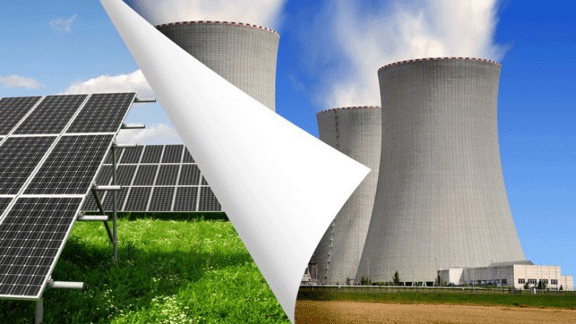
In effect, we are now seeing an egalitarian-individualist alliance against the conservative hierarchists.
even hierarchists cannot ignore economic reality entirely. The South Carolina project has beenabandoned and the Georgia project only survives through a very large federal loan bailout.
Contrast this with casino complexes in Nevada like MGM Resorts not only installing their own solar photovoltaic arrays but paying many millions of dollars to opt out from the local monopoly electricity supplier. They have campaigned successfully to win a state referendum supporting electricity liberalisation.
The unholy alliance that explains why renewables are trouncing nuclear http://reneweconomy.com.au/the-unholy-alliance-that-explains-why-renewables-are-trouncing-nuclear-96079/ By Dave Toke on 20 March 2018 The Conversation
If recent trends continue for another two years, the global share of electricity from renewables excluding hydropower will overtake nuclear for the first time.
Even 20 years ago, this nuclear decline would have greatly surprised many people – particularly now that reducing carbon emissions is at the top of the political agenda.
On one level this is a story about changes in relative costs. The costs of solar and wind have plunged while nuclear has become almost astoundingly expensive.
Culture wars
The seminal text in this field, Risk and Culture (1982), by the British anthropologist Mary Douglas and American political scientist Aaron Wildavsky, argues the behaviour of individuals and institutions can be explained by four different biases:
- Individualists: people biased towards outcomes that result from competitive arrangements;
- Hierarchists: those who prefer ordered decisions being made by leaders and followed by others;
- Egalitarians: people who favour equality and grassroots decision-making and pursue a common cause;
- Fatalists: those who see decision-making as capricious and feel unable to influence outcomes.
The first three categories help explain different actors in the electricity industry. For governments and centralised monopolies often owned by the state, read hierarchists. For green campaigning organisations, read egalitarians, while free-market-minded private companies fit the individualist bias.
The priorities of these groups have not greatly changed in recent years. Hierarchists tend to favour nuclear power, since big power stations make for more straightforward grid planning, and nuclear power complements nuclear weapons capabilities considered important for national security.
Egalitarians like Greenpeace and Friends of the Earth usually oppose new nuclear power plant and favour renewables. Traditionally they have worried about radioactive environmental damage and nuclear proliferation. Individualists, meanwhile, favour whichever technologies reduce costs.
These cultural realities lie behind the problems experienced by nuclear power. To compound green opposition, many of nuclear power’s strongest supporters are conservative hierarchists who are either sceptical about the need to reduce carbon emissions or treat it as a low priority.
Hence they are often unable or unwilling to mobilise climate change arguments to support nuclear, which has made it harder to persuade egalitarians to get on board.
This has had several consequences.
Green groups won subsidies for renewable technologies by persuading more liberal hierarchists that they had to address climate change – witness the big push by Greenpeace and Friends of the Earth for the feed-in tariffs that drove solar uptake in the late 2000s, for example. In turn, both wind and solar have been optimised and their costs have come down.
Nuclear largely missed out on these carbon-reducing subsidies. Worse, greens groups persuaded governments as far back as the 1970s that safety standards around nuclear power stations needed to improve. This more than anything drove up costs.
As for the individualists, they used to be generally unconvinced by renewable energy and sceptical of environmental opposition to nuclear. But as relative costs have changed, they have increasingly switched positions.
The hierarchists are still able to use monopoly electricity organisations to support nuclear power, but individualists are increasingly pressuring them to make these markets more competitive so that they can invest in renewables more easily.
In effect, we are now seeing an egalitarian-individualist alliance against the conservative hierarchists.
Both sides of the pond
Donald Trump’s administration in the US, for example, has sought subsidies to keep existing coal and nuclear power stations running.
This is both out of concern for national security and to support traditional centralised industrial corporations – classic hierarchist thinking.
Yet this has played out badly with individualist corporations pushing renewables. Trump’s plans have even been rejected by some of his own appointments on the Federal Energy Regulatory Commission.
In similarly hierarchist fashion, electricity supply monopolies in Georgia and South Carolina started building new nuclear power stations after regulatory agencies allowed them to collect mandatory payments from electricity consumers to cover costs at the same time.
Yet even hierarchists cannot ignore economic reality entirely. The South Carolina project has beenabandoned and the Georgia project only survives through a very large federal loan bailout.
Contrast this with casino complexes in Nevada like MGM Resorts not only installing their own solar photovoltaic arrays but paying many millions of dollars to opt out from the local monopoly electricity supplier. They have campaigned successfully to win a state referendum supporting electricity liberalisation.
The UK, meanwhile, is an example of how different biases can compete. Policy has traditionally been formed in hierarchical style, with big companies producing policy proposals which go out to wider consultation.
It’s a cultural bias that favours nuclear power, but this conflicts with a key priority dating back to Thatcher that technological winners are chosen by the market.
This has led policymakers in Whitehall to favour both renewables and nuclear, but the private electricity companies have mostly refused to invest in nuclear, seeing it as too risky and expensive.
The only companies prepared to plug the gap have been more hierarchists – EDF, which is majority-owned by France, and Chinese state nuclear corporations.
Even then, getting Hinkley C in south-west England underway – the first new nuclear plant since the 1990s – required an extensive commitment by the UK treasury to underwrite bank loans.
There is also an embarrassingly high price to be paid for the electricity over a very long 35-year period. Such has been the bad publicity that it’s hard to imagine a politician agreeing to more plant on such terms.
Where does this reality leave hierarchists? Increasingly having to explain prohibitive nuclear costs to their electorates – at least in democracies. The alternative, as renewable energy becomes the new orthodoxy, is to embrace it.
In Australia, for example, a big utility company called AGL is trying to seduce homeowners to agree to link their solar panels to the company’s systems to centralise power dispatch in a so-called a “virtual power plant”.
When the facts change, to misquote John Maynard Keynes, you can always change your mind.
France to commit 700 million euros to International Solar Alliance
13 Mar 18
France will commit 700 million euros to the International Solar Alliance (ISA), President Emmanuel Macron said on Sunday at the founding conference of the organization, reiterating the European country’s commitment to the alliance and clean energy.
https://www.reuters.com/article/us-india-solar-alliance/france-to-commit-700-million-euros-to-international-solar-alliance-idUSKCN1GN0JU
Fukushima and the move towards renewable energy
“The nuclear disaster was not a natural disaster, it was a very man-made disaster,” Watanabe says. “So we felt that there was now a need for clean energy and greater energy independence.”
“It was at that symposium that I started to really think about the need for an energy shift away from nuclear power and about how rich the prefecture of Fukushima is in renewable resources,” Sato says.
“Nuclear power companies are not prepared for the cost of decommissioning and could in some cases go bankrupt. Banks and pension funds have lent them a lot of money because they have been regarded as stable, so bankruptcies could become a national financial problem. This would be difficult for the government to handle and might directly hurt pensioners,” he says. “But now the government is just hiding the problem and postponing managing it.”
Fukushima looks to renewable energy sources in the aftermath of nuclear disaster, Japan Times, BY KAJSA SKARSGÅRD ,
Yauemon Sato | CHRISTINA SJOGREN11 Mar 18,
Steam rises from outdoor pools overlooking a waterfall at a 90-year-old hotel in Fukushima Prefecture’s Tsuchiyu Onsen.
“What has saved us since the disaster are the loyal regular guests and the new visitors who have come to study our town’s renewable energy plant. Without them, I’m sure we would have had to close,” says Izumi Watanabe, who has been director of Sansuiso Tsuchiyu Spa for 37 years.
“People come from other onsen areas all over Japan to learn how they can become energy independent and how the binary plant we have doesn’t affect our hot springs,” she says, challenging the preconception that onsen communities, fearing a negative impact on their tourism business, typically hold back the development of geothermal energy in Japan.
Watanabe was at a meeting in the city of Fukushima when the Great East Japan Earthquake struck seven years ago. She returned to Tsuchiyu Onsen to find her hotel intact, but two other hotels in the area damaged and the entire community without power.
or three snowy days, Watanabe sheltered 70 of her own and other hotels’ guests without electricity, telephones or working internet. Gathered together, they ate whatever stored food they could find. Over the next six months, her spa served as accommodation for police and rescue workers, grieving families and people displaced by the tsunami and nuclear crisis.
In total, this town of about 340 residents took in around 1,000 evacuees after the 2011 disasters. Five of the 16 hotels in Tsuchiyu Onsen have since gone out of business: two as a result of earthquake damage, the others on the back of a decline in visitor numbers from approximately 230,000 a year to about 70,000 as rumors of elevated radiation levels swirled. Members of the local community gathered together in October 2011 to discuss their future at what was dubbed the “Tsuchiyu Onsen reconstruction conference.” The locals decided they couldn’t simply go back to doing what they had done before — something new was needed to revive the town and create a safer future.
“The nuclear disaster was not a natural disaster, it was a very man-made disaster,” Watanabe says. “So we felt that there was now a need for clean energy and greater energy independence.”
A renewable energy plant and shrimp farm……….
A local, national concern
An hour’s drive inland, past Mount Adatara and Mount Bandai in the city of Aizu-Wakamatsu, people also started organizing after the nuclear disaster. In July 2011, around 200 people met in the sake brewery owned by Yauemon Sato, a ninth-generation brewer, to discuss the disaster and the future.
“It was at that symposium that I started to really think about the need for an energy shift away from nuclear power and about how rich the prefecture of Fukushima is in renewable resources,” Sato says.
Sato had no background in electricity production, but he did have experience in trying to get small breweries into markets dominated by larger manufacturers. He took one of the leading roles in the growing community power movement.
With the help of the Institute for Sustainable Energy Policies, which had also worked to promote locally owned renewable electricity production before the disaster, Aizu Electric Power Co. was established to manage the planned solar parks.
Today, the company has 70 solar power sites and Sato has become a vocal critic of the large nuclear- and fossil-fuel companies that control the grid through regional monopolies, thereby hindering the new renewable energy companies from getting into the market.
The monopolies argue that they are protecting the stability of the grid, so at present newcomers in some regions can only connect a maximum voltage of 50 kilowatts onto the network.
“This is a severe problem,” Sato says. “In 2020, the government is going to separate the power transmission business from the power production business, but these big electric companies are creating sister companies to run the grid, so it will still be in the control of the same big companies and continue to be difficult for other producers to use.”
The Aizu region is where shogun Tokugawa Yoshinobu’s rebels fought one of the last big battles against government troops in 1868. The people’s rights movement flourished here after the civil war. It matters here that it is the people of Fukushima who have paid the ultimate price for the nuclear power that was sold mainly to Tokyo.
Aizu Electrical Power Co., its logo a fist held up in the air over the letters AiPower, is challenging the electricity establishment of Japan, and is part of a bigger movement.
The first World Community Power Conference was held in the city of Fukushima in November 2016 on the same day as the Paris climate accord came into force. One of the organizers was the Japan Community Power Association, in which Sato is a board member. He is also the vice president of Genjiren, an anti-nuclear power association that, with the help of the former prime ministers Junichiro Koizumi and Morihiro Hosokawa, pitched a bill to the opposition parties in January calling for an immediate halt to nuclear power, together with a more ambitious national goal for renewables.
“Finally I feel that we have a political movement for an energy shift,” Sato says. “We want to make this a national citizens’ movement.”
Unsustainable politics defied
The grass-roots movement pushing for renewables is not alone. Both at home and abroad, the Japanese government has been criticized for failing to embrace broader renewable energy policies in the wake of the 2011 disasters while remaining open to the construction of additional coal plants and nuclear reactor restarts.
……… Tomas Kaberger, executive board chairman of the Renewable Energy Institute in Tokyo. believes the government is willing to restart more reactors because it fears the financial consequences of failing to do so. The reactors are valuable for the balance sheets of the power companies, but in reality they represent a significant decommissioning liability.“Nuclear power companies are not prepared for the cost of decommissioning and could in some cases go bankrupt. Banks and pension funds have lent them a lot of money because they have been regarded as stable, so bankruptcies could become a national financial problem. This would be difficult for the government to handle and might directly hurt pensioners,” he says. “But now the government is just hiding the problem and postponing managing it.”…….https://www.japantimes.co.jp/life/2018/03/10/environment/fukushima-looks-renewable-energy-sources-aftermath-nuclear-disaster/#.WqWVhx1ubGg
The UK Energy Research Centre (Ukerc) wants a change in funding renewable energy projects, to make the system fairer
 Guardian 2nd March 2018, The richest households should pay £410 a year more towards supporting
energy subsidies for wind farms, solar rooftops and home insulation
schemes, government-funded researchers have urged.
The UK Energy Research Centre (Ukerc) said that shifting environmental and social levies off
electricity bills and instead loading them on to general taxation would
reduce the cost of energy for more than two thirds of households. The
researchers argued the current approach to funding low-carbon power and
energy efficiency was regressive.
The poorest households spend 10% of their income on heating and keeping the lights on, compared to 3% for the
richest.
The report by Ukerc found that shifting the costs to taxation
would save the poorest 10% of households £102 a year, “a significant
difference for them”. Meanwhile the 10% of the country with the highest
income would pay an extra £410 a year, “a relatively small difference”
for such earners.
The two high income brackets below the richest group
would see rises of between £26 and £102 a year, while the remaining 70%
would see no change or a decrease.
John Barrett, professor of energy and climate policy, who worked on the analysis, said the status quo was hurting
the switch to greener energy. Subsidies for low-carbon power cost
billpayers £5.2bn in 2016-17 but are projected by the Treasury to rise to
£8.6bn in 2024-25 as new wind farms and other projects come online.
Campaigners have said for years that funding green energy subsidies through
energy bills is regressive because the poor are disproportionately
affected, but there has been little political appetite for a change.
https://www.theguardian.com/environment/2018/mar/02/richest-uk-households-should-pay-more-to-fund-clean-energy
Global energy business is being transformed by cheap renewables
IEEFA 21st Feb 2018, We’ve just posted a research brief explaining through a telling combination of charts (and some written analysis) how the fast-growing
uptake of wind and solar around the world continues to shape
electricity-generation trends.
The phenomenon is unfolding across diverse
groups of markets that include ones in Latin America, the Middle East, and
the U.S. We note in the brief— “Cheap Renewables Are Transforming
Global Electricity Business”—how installations of wind and solar
totalled almost 155 gigawatts (GW) last year, actually outpacing coal-fired
power plant development.
We also note how lowest bids for solar dropped a
remarkable 50 percent from records set in 2014 and 2015, as solar power
continued its long-established expansion.
http://ieefa.org/ieefa-update-cheap-renewables-transforming-global-electricity-business/
Increasingly, cities are headed for 100% renewable energy
 Guardian 27th Feb 2018 The number of cities reporting they are predominantly powered by clean energy has more than doubled since 2015, as momentum builds for cities around the world to switch from fossil fuels to renewable sources.
Data published on Tuesday by the not-for-profit environmental impact researcher CDP found that 101 of the more than 570 cities on its books sourced atleast 70% of their electricity from renewable sources in 2017, compared to
42 in 2015. Nicolette Bartlett, CDP’s director of climate change,
attributed the increase to both more cities reporting to CDP as well as a
global shift towards renewable energy. The data was a “comprehensive
picture of what cities are doing with regards to renewable energy,” she
told Guardian Cities. In Britain, 14 more cities and towns had signed up to
the UK100 local government network’s target of 100% clean energy by 2050,
bringing the total to 84.
Among the recent local authority recruits were Liverpool City Region, Barking and Dagenham, Bristol, Bury, Peterborough, Redcar and Cleveland.
But the CDP data showed 43 cities worldwide were already entirely powered by clean energy, with the vast majority (30) in Latin America, where more cities reported to CDP and hydropower is more widespread. The Icelandic capital Reyjkavik, sourcing all electricity from hydropower and geothermal, was among them. It is now working to make all
cars and public transit fossil-free by 2040.
https://www.theguardian.com/cities/2018/feb/27/cities-powered-clean-energy-renewable
Russia’s Rosatom turning to wind power, as its nuclear export industry falters

 Rosatom stakes out wind power to gird against blustery nuclear futures, Russia’s state nuclear corporation unveiled plans this week to build up to 600 megawatts of wind energy in the Krasnodar region in southern Russia in what appears to be part of the company’s tentative diversification within renewable energy. Bellona, by Charles Digges
“…….. the new wind farm and several battery production ventures the company is pursuing come as an evident bow to declining global demand for the nuclear power plant builds on which until recently the company had staked its future growth.
The new wind plant will be built by VetroOGK, a subsidiary of Rosatom, and will comprise a 150 megawatt park in the Shovgenovsky and Giaginsky districts of the southerly Republic of Adygea using equipment supplied by Dutch wind turbine maker Lagerwey, according to a Rosatom release. It expects to obtain construction permits for the project in March or April, while commissioning is scheduled for December 2018 or January 2019.
The VetroOGK had likewise inked a letter of intention to install another 200 megawatts of wind power in the Krasnodar Region at a wind park the company says it will open by the end of 2018. For the two parks Rosatom has invested $364 million, though its release also anticipates further funding for a 300 megawatt wind park in the Rostov Region, though the start date for that project remains unclear.
Though it would be a stretch to suggest that the wind projects could financially buoy the consolidated bulk of Russia’s monolithic nuclear monopoly, they nonetheless acknowledge sour facts about the company’s prospects for building its AES-2006, or VVER-1200, reactor package on the foreign market.
Speaking last summer at Novosibirsk’s Tekhnoprom-2017 technical trade conference, the company’s deputy director, Vyacheslav Pershukov said Rosatom’s international nuclear market was “exhausted” – the starkest acknowledgment yet from the company that its marquee product was selling poorly. …….
Speaking last summer at Novosibirsk’s Tekhnoprom-2017 technical trade conference, the company’s deputy director, Vyacheslav Pershukov said Rosatom’s international nuclear market was “exhausted” – the starkest acknowledgment yet from the company that its marquee product was selling poorly. ……http://bellona.org/news/nuclear-issues/2018-02-rosatom-stakes-out-wind-power-to-gird-against-blustery-nuclear-futures
France’s energy giant EDF now making a revolutionary change – from nuclear to renewables?
 EDF kick-starts ‘unprecedented acceleration’ in renewables as nuclear slides https://www.cleanenergynews.co.uk/news/solar/edf-kick-starts-unprecedented-acceleration-in-renewables-as-nuclear-slides, By Liam Stoker, 16 Feb 2018,
Jeremy Corbyn commits to green energy, wants the national grid in public hands
 Times 11th Feb 2018, Bringing Britain’s energy system back under public ownership is the best
way of tackling climate change, according to Jeremy Corbyn. In his most
pro-green speech to date, the Labour leader said his government would sweep
away the “centralised system” of energy delivery by private firms in favour
of “new sources of energy large and small”.
Speaking yesterday at a conference in London on alternative models of ownership, Corbyn said: “The
greenest energy is usually the most local but people have been queuing up
to connect renewable energy to the national grid. “With the national grid
in public hands we can put tackling climate change at the heart of our
energy system, committing to renewable generation from tidal to onshore
wind.”
https://www.thetimes.co.uk/edition/news/nationalising-energy-grid-will-help-fight-climate-change-says-corbyn-z93xvqm50
France heading for a renewable energy revolution, with offshore wind power
 France Set to Become a European Offshore Wind Powerhouse by 2022 Bloomberg By Jeremy Hodges and Jess Shankleman,
-
WindEurope sees French turbine orders passing U.K., Germany
-
Offshore wind investments to recover after contracting in 2017
Europe’s wind-power industry expects new French offshore turbine installations to overtake the U.K. and Germany by 2022, boosting President Emmanuel Macron’s pledge to increase renewable energy.
South Australia’s world-leading solar energy system
 Reuters 4th Feb 2018, South Australia’s state premier Jay Weatherill announced a plan on Sunday to create a network of 50,000 home solar systems backed by Tesla Powerwall batteries, ahead of a state election in March.
“We lead the world in renewable energy with the world’s largest battery, the world’s largest solar thermal plant and now the world’s largest virtual power plant,” he said in a televised interview from the state capital of Adelaide. “The size of it is the reason why it’s going to be a success.” The project would begin with a trial on 1,100 public housing homes, the government said on its website.
https://uk.reuters.com/article/uk-australia-power-tesla/south-australia-promises-worlds-largest-virtual-power-plant-idUKKBN1FO029?rpc=401&
Massachusetts gets a great power deal from Quebec. What is Ontario waiting for?
 -Angela Bischoff,, 31 Jan 18, On the heels of signing an agreement to supply Massachusetts with enough power to meet the needs of one million homes at the barn burner price of 3 to 5.3 cents per kilowatt-hour (kWh), Hydro Quebec says it is still ready to make similar deals with Ontario and New York.
Meanwhile, Ontario muddles forward with plans to rebuild aging nuclear reactors at tremendous expense and is about to hold hearings on the safety of keeping the 47-year-old Pickering Nuclear Station (surrounded by 2.2 million people) running for up to another 10 years. As a result, Ontario Power Generation has told the Ontario Energy Board that it will need to raise its price of nuclear power to 16.5 cents per kWh.
Hydro Quebec has already offered Ontario power at a great price (5 cents kWh) only to have this province respond with the bizarre claim that the offer wasn’t competitive enough — despite it being less than one third the cost of rebuilding and extending our aging nuclear fleet.
Now Quebec is making it clear it won’t wait forever for Ontario to come to its senses and will prioritize deals with those jurisdictions that are ready to reap the benefits of its low-cost, renewable power right now.
With five months until the next provincial election, could this be the moment when our opposition parties finally get serious about offering real solutions to dealing with rising electricity costs and begin to champion making a deal with Quebec? Are there any candidates for the PC leadership ready to offer real help to Ontario power users by promising to quickly ink a deal with Quebec? Will the NDP make a money-saving Quebec deal part of its “pocketbook” promises to help average Ontarians? The next few months should be very interesting.
Please contact Interim PC Leader Vic Fedeli [vic.fedeli@pc.ola.org], potential PC Leadership candidate Caroline Mulroney [caroline@carolinemulroney.ca] and NDP Leader Andrea Horwath [ahorwath-qp@ndp.on.ca] and ask them to champion a long-term deal with Hydro Quebec to lower our electricity bills.
Busting the nuclear lobby’s lies about renewable energy: its faster, and more scalable than nuclear
Renewable Energy Is Much Faster To Install & More Scalable Than Nuclear Power https://cleantechnica.com/2018/01/28/renewable-energy-much-faster-install-scalable-nuclear-power/ January 28th, 2018 by Jake Richardson
This article is part of our “CleanTechnica Answer Box” collection. For some reason, there are certain anti-cleantech talking points that get thrown around over and over again that are absolute bunk. We got tired of dealing with the same myths repeatedly and also saw that many other people could use some support responding to these untruths — in discussions on CleanTechnica and elsewhere. So, at the suggestion of a reader, we created this resource in the same vein as Skeptical Science’s responses to global warming & climate change myths.
Myth: We need to build more nuclear power if we want to cut electricity emissions quickly and turn off coal and natural gas power plants.
Short answer: Renewables can grow fast because they can be installed practically everywhere rapidly and simultaneously. Renewable capacity in the magnitude of 1 TW can in principle be added every year. Germany installed 3 GW of PV in one single month in December 2011. Germany has roughly 1% of the world’s population. So, if the entire world installs only 20% the amount of PV that Germany did 5 years ago, it would be at 720 GW per year. At a single utility-scale-PV plant, 120 MWp per month was installed. If only 10% of all cities worldwide installed utility-scale-solar at this scale at the same time, it would lead to approximately the same number just for utility-scale-solar (the world has 4,412 cities with a population of at least 150,000). In fact, if the world only installs one PV module per person per year, this already leads to 1,850 GW per year. Nuclear power plants, meanwhile, take several years to build — and are much more expensive.
One major advantage renewable energy has over nuclear power (and fossil fuels) is that it can typically be installed much faster. Nuclear power plants can require 5–15 years to complete and some have taken 20 or more. (Constructing a new coal power plant cantakes 4 years or more. Building a new gas-powered plant generally takes several years as well.)
Installing a solar power farm can be completed in a number of months, depending upon the size and complexity of the project. Obviously, the much larger ones will require more time, but even they often can be finished in a year or less.
The same is true of wind farms. A 10 MW wind farm can be built in about 2 months and a 50 MW in approximately 6 months.
The speed at which renewables can be built and made operational is impressive. In the year 2017 alone, China installed about 52 GW of solar power. When it comes to wind power, China may install about 403 GW over the next 10 years. As with a large number of any type of construction project, the limiting factor in speed is generally one of financing, will, and labor, and that is certainly no less true with highly distributed wind and solar power projects.
The cost of renewables will likely continue to decrease with greater adoption and acceptance, especially as fossil fuel usage declines. Greater demand and adoption can spur further innovation to make renewables even more efficient, which enhances their effectiveness and the speed at which you can get large amounts of power onto the grid. With renewables, it is possible to have a virtuous cycle which drives increasing affordability and performance, whereas with fossil fuels we have a vicious cycle of climate change emissions, air pollution that harms and kills humans, rising seas, more severe weather, massive coral die-offs, and the contamination of air, soil, water, and food. Nuclear power costs, meanwhile, have risen in recent decades and are priced out of any free market or semi-free market.
Another advantage is that installing solar and wind power is not nearly as dangerous as building a nuclear or coal power plant. In India, an accident at a construction site for a new coal plant killed 32 people and injured many others. A similar accident in China killed 74. Installing solar power and wind power farms almost never results in fatalities.
Renewable energy is more scalable and a better fit to address global warming than nuclear because it costs much less, takes less time to install, and doesn’t carry the burden of potentially causing catastrophic damage — which also comes with sophisticated safety guards that take much time to implement, monitor, and keep up to date.
Electricity produced from sunlight and wind are scalable because these sources are abundantly available and will never run out. In order to combat climate change, we all need clean, renewable energy that can be quickly built and put into operation, but that will also never run out of the primary fuel source.
Another reason why renewables are scalable is their portability and ability to fit the scale needed, no matter how small or how large. Renewable energy systems can be sized precisely to the needs, whether at the small scale where people might use diesel generators or at the gigawatt scale. Community solar projects only require a capital investment and some land near the place where the electricity will be used. Renewables can easily power one community, one home, or even one device (like a light). Consumers can get solar power systems for their RVs, vans, or boats as well.
Because solar power costs have declined dramatically, more and more homeowners are going solar, and they will save money over the long term. (Home energy storage is making this scenario feasible for even more homeowners year by year.) While individual projects are not notable amongst a large grid and generation fleet, the aggregation of small projects that can go up in a matter of weeks or months is considerable.
On a bit of a larger scale, many companies are choosing to install solar power for cost-saving as well as environmental reasons and have shown that sensible, fast renewable energy installations can save huge amounts of money. Again, these projects can go up in a matter of weeks or months — unlike nuclear — and the aggregate of them means a large and quick increase in the amount of clean power on the grid. There’s a reason or two why large corporations don’t install nuclear power plants instead.
Mainstream American companies like PepsiCo, General Motors, Apple, Facebook, Amazon, and Walmart have been using more renewable energy and saving billions of dollars in the process while cleaning up the air and atmosphere.
Renewable energy can be employed by just about anyone at any time if they have the means to do so. Sunlight and wind are free. Installations can be on a watt scale or a gigawatt scale. If we want clean power added to the grid quickly, nothing can come online faster than renewables. In certain places, depending on market penetration and infrastructure, transmission lines or energy storage may be an important complement, but that still doesn’t change that renewables are the quickest option for new and cheap clean power capacity.
Epic crisis in USA’s nuclear industry – Trump’s trying to stop solar power will not save nukes
Trump’s Assault on Solar Masks an Epic Crisis in the Nuclear Industry, The Progressive , by Harvey Wasserman, January 25, 2018 As Donald Trump launches his latest assault on renewable energy—imposing a 30 percent tariff on solar panels imported from China—a major crisis in the nuclear power industry is threatening to shut four high-profile reactors, with more shutdowns to come. These closures could pave the way for thousands of new jobs in wind and solar, offsetting at least some of the losses from Trump’s attack.
Like nearly everything else Trump does, the hike in duties makes no rational sense. Bill McKibben summed it up, tweeting: “Trump imposes 30% tariff on imported solar panels—one more effort to try and slow renewable energy, one more favor for the status quo.”………
the burgeoning U.S. market for cheap Chinese panels has birthed a very large industry. More than a quarter-million Americans now work in photovoltaics, with most of the jobs in building desert arrays or perching the panels on rooftops. Except for the very marginal pressure from Suniva and SolarWorld, solar advocates have focussed on the rapid spread of low-cost panels, even if they come from China.
Powered largely by Chinese product, the cost of a solar-generated watt of power has dropped from $6.00 in the late 1990s to around $0.72 in 2016. Further drops are considered inevitable. At that price, there is virtually no economic margin for any other new energy production construction except wind and natural gas. Even gas—with its uncertain long-term supply—is on the cusp of being priced out.
Thus, the industry’s reactionto Trump’s solar panel tariff has been fierce.
“We are not happy with this decision,” Abigail Ross Hopper, president of the American Solar Energy Association, told Reuters. “It’s just basic economics—if you raise the price of a product, it’s going to decrease demand for that product.” Trump’s move is predicted to drop upcoming solar installations by 10 to 15 percent and cost some 23,000 jobs.
Sustainable energy professor Scott Sklar, in an email to The Progressive, estimated that Trump’s 30 percent tariff will, after four years, “retard the solar market by 9 percent, cause the loss of thousands of U.S. jobs, and not save the two companies that brought the anti-competitive tariff request initially. The tariff was a political statement to China rather than specifically addressing the health of the U.S. solar industry and increasing U.S. solar jobs.”
Two major developments in the nuclear power industry further illustrate the absurdity of Trump’s decision.
In California, the Public Utilities Commission has gutted a major agreement that would have kept two mammoth reactors at Diablo Canyon operating for several more years. The landmark deal—cut between Pacific Gas & Electric, the host communities around San Luis Obispo, the reactors’ union workers and two environmental groups—called for PG&E to collect some $1.3 billion from ratepayers.
But the California commission cut PG&E’s take to about $300 million. To continue running the two fast-deteriorating old reactors would require massive capital repairs. The company also has admitted that all of Diablo’s power can be otherwise produced with zero- and low-carbon green technologies.
While Trump’s tariffs may slightly alter the math, they’re not expected to make photovoltaics, wind, geothermal, or increased efficiency more expensive than the power Diablo might generate in the coming seven years. Thus, Diablo opponents like Linda Sealey of the San Luis-based Mothers for Peace are extremely hopeful for early shutdowns.
“We think this makes it likely they’ll shut as early as 2020,” she told me January 18 on California Solartopia at KPFK radio in Los Angeles. “They just can’t compete.”
A parallel fate may soon overtake Ohio’s ancient Perry and Davis-Besse reactors on Lake Erie. Because the increasingly decrepit nuclear plants have been priced out of the market and face huge capital repairs, their owner FirstEnergy has been desperately begging the Ohio legislature for massive bailouts, which it has so far resisted. As a result FirstEnergy is poised to go bankrupt, and may soon be bought out by financiers expected to insist the two reactors finally shut. A decision is expected in April.
The shutdown of four more major reactors would be a huge blow to the downwardly spiraling atomic energy industry. California’s booming solar business employs more than 100,000 Americans, more than are currently digging coal nationwide. The void left by Diablo’s shutdown would generate thousands of Golden State jobs and billions in renewable revenue.
In northern Ohio, massive wind potential is also poised to create far more jobs than are currently in place at the two reactors, with energy to be generated far more cheaply. Overall, the closure of these four high-profile plants would thus accelerate the already rapid run away from nuclear power toward renewable sources, regardless of any attempt by the Trump Administration to alter the course.
Harvey “Sluggo” Wasserman’s “California Solartopia Show” is broadcast at KPFK-Pacifica 90.7FM in Los Angeles. His “Green Power & Wellness Show” is podcast at prn.fm. His History of the US and Solartopia! are at www.solartopia.org, which will publish his America at the Brink of Rebirthlater this year. http://progressive.org/dispatches/trumps-assault-on-solar-masks-an-epic-crisis-in-nuclear-180125/
Chernobyl – from nuclear wreck to solar power farm
Chernobyl nuclear power plant transformed into a massive solar plant, http://www.news.com.au/technology/environment/chernobyl-nuclear-power-plant-transformed-into-a-massive-solar-plant/news-story/2d8d365ca1a6a7bde0c75c2372e888ed [excellent graphs and photos]
IT was the site of the world’s worst ecological disaster, but Chernobyl has risen from the ashes of its nuclear meltdown and is undergoing a massive makeover. News Corp Australia Network JANUARY 15, 2018 AT ground zero of Ukraine’s Chernobyl tragedy, workers in orange vests are busy erecting hundreds of dark-coloured panels as the country gets ready to launch its first solar plant to revive the abandoned territory.
The new one-megawatt power plant is located just a hundred metres from the new “sarcophagus”, a giant metal dome sealing the remains of the 1986 Chernobyl accident, the worst nuclear disaster in the world.
“This solar power plant can cover the needs of a medium-sized village”, or about 2,000 flats, Yevgen Varyagin, the head of the Ukrainian-German company Solar Chernobyl which carried out the project, told AFP.
Eventually, the region is to produce 100 times the initial solar power, the company says.
The amount of sunshine “here is the same as in the south of Germany,” says Varyagin.
Ukraine, which has stopped buying natural gas from Russia in the last two years, is seeking to exploit the potential of the Chernobyl uninhabited exclusion zone that surrounds the damaged nuclear power plant and cannot be farmed.
CHERNOBYL EXCLUSION ZONE ‘SUITABLE FOR SCIENCE’
Reactor Number Four of the Chernobyl plant exploded April 26, 1986 and the fallout contaminated up to three quarters of Europe, according to some estimates, especially hitting Russia, Ukraine and Belarus.
Following the disaster, Soviet authorities evacuated hundreds of thousands of people and this vast territory, over 2,000 square kilometres wide, has remained abandoned.
The plant continued to operate the remaining reactors, the last of which was shut down in 2000, ending industrial activity in the area.
People cannot return to live in the zone for “more than 24,000 years”, according to the Ukrainian authorities, who nevertheless argue that a prudent industrial use can be possible again.
“This territory obviously cannot be used for agriculture, but it is quite suitable for innovative and scientific projects,” Ostap Semerak, Ukrainian Minister of the Environment and one of the promoters of placing solar projects in Chernobyl, told AFP in 2016.
The installation of a huge dome above the ruins of the damaged reactor just over a year ago made the realisation of the solar project possible.
Funded by the international community, it covered the old concrete structure which had become cracked and unstable, to ensure greater isolation of the highly radioactive magma in the reactor.
As a result, radiation near the plant plummeted to just one-tenth of previous levels, according to official figures
Even so, precautions are still necessary: the solar panels are fixed onto a base of concrete blocks rather than placed on the ground.
The soil remains contaminated, explains Varyagin, whose group is a joint venture between the Ukrainian firm Rodina Energy Group and Germany’s Enerparc AG.
“We can not drill or dig here because of the strict safety rules,” he says.
Last year the consortium completed a 4.2-megawatt solar power plant in the irradiated zone in neighbouring Belarus, not far from Chernobyl.
Ukrainian authorities offered investors nearly 2,500 hectares (25 square kilometres) for potential construction of solar power plants in Chernobyl.
Kiev has received about 60 proposals from foreign companies — including American, Chinese, Danish and French — who are considering participating in future solar developments in the area, according to Olena Kovalchuk, spokeswoman of the State Administration for the zone of Chernobyl.
Investors are attracted by the price that Ukraine has set for solar electricity, which “exceeds on average by 50 per cent of that in Europe”, Oleksandr Kharchenko, executive director of the Energy Industry Research Center, told AFP
He adds that cheap land and the proximity of the power grids makes Chernobyl particularly attractive, though there is still no rush of western investors to the region.
Safety concerns and Ukraine’s notorious bureaucracy and corruption has put some off.
“It is very important to have guarantees that working in the Chernobyl zone will be safe for those who will be doing it,” says Anton Usov, adviser to the European Bank for Reconstruction and Development (EBRD).
The bank does not currently foresee any investment to Ukraine in this field.
1 This Month



26 September – International Day for the Total Elimination of Nuclear Weapons


PLEASE OPPOSE HR 8255 AND S.3639 – bills would accelerate satellite deployment, with no environmental review or safeguards – https://ncstd5li.quorum.us/campaign/169331/
To see nuclear-related stories in greater depth and intensity – go to https://nuclearinformation.wordpress.com
-
Archives
- September 2026 (219)
- August 2026 (330)
- July 2026 (355)
- June 2026 (287)
- May 2026 (306)
- April 2026 (356)
- March 2026 (251)
- February 2026 (267)
- January 2026 (308)
- December 2025 (358)
- November 2025 (359)
- October 2025 (375)
-
Categories
- 1
- 1 NUCLEAR ISSUES
- business and costs
- climate change
- culture and arts
- ENERGY
- environment
- health
- history
- indigenous issues
- Legal
- marketing of nuclear
- media
- opposition to nuclear
- PERSONAL STORIES
- politics
- politics international
- Religion and ethics
- safety
- secrets,lies and civil liberties
- spinbuster
- technology
- Uranium
- wastes
- weapons and war
- Women
- 2 WORLD
- ACTION
- AFRICA
- Atrocities
- AUSTRALIA
- Christina's notes
- Christina's themes
- culture and arts
- Events
- Fuk 2022
- Fuk 2023
- Fukushima 2017
- Fukushima 2018
- fukushima 2019
- Fukushima 2020
- Fukushima 2021
- general
- global warming
- Humour (God we need it)
- Nuclear
- RARE EARTHS
- Reference
- resources – print
- Resources -audiovicual
- Weekly Newsletter
- World
- World Nuclear
- YouTube
-
RSS
Entries RSS
Comments RSS
 nuclear-news