
nuclear-news

The News That Matters about the Nuclear Industry Fukushima Chernobyl Mayak Three Mile Island Atomic Testing Radiation Isotope

  • Home
  • 1 This Month
  • ACTION !
  • Disclaimer
  • Links
  • PAGES on NUCLEAR ISSUES

UK Labour Party’s plan for a Green Industrial Revolution

Solar Power Portal 16th May 2019 The Labour Party has announced plans to install solar one 1.75 million homes as part of a huge energy sector shake-up. The plans would see solar
installed on 1 million social homes in a bid to tackle fuel poverty, while
a series of interest free loans, grants and regulatory changes will help
enable an additional 750,000 domestic installs. Full details of the plans
are to be announced by Labour Party leader Jeremy Corbyn later today. The
party said the policies stood to create nearly 17,000 jobs, while raising
as much as £66 million for local authorities through the export of surplus
generation. Corbyn said that the party’s self-styled Green Industrial
Revolution would benefit homeowners and revive parts of the country through
the creation of new industries.

https://www.solarpowerportal.co.uk/news/labour_party_unveils_new_solar_commitment_in_push_to_install_pv_on_1.75_mil

May 18, 2019 Posted by Christina Macpherson | renewable, UK | Leave a comment

UK’s Conservative govt increases tax on domestic solar, despite its goal to fight climate change

Independent 10th May 2019 James Dyke – Professor of Sustainability Southampton Univ. The UK can’t fight the climate emergency when the Tories are entirely opposed to
renewables like solar. The party’s decision to increase tax on domestic
solar power shows that its head is still firmly in the sand.
Why does the UK government appear to be intent on frustrating the deployment of solar
power? The real reason for this tax hike is that domestic solar has proved
too popular. The cost of solar panels have plummeted and people
increasingly see them as desirable improvements to their homes.
The accelerating update of domestic solar threatens to disrupt the UK’s still
largely centralised energy grid. It also butts up against seemingly
ideological opposition to renewable energy in the current Conservative
Party. The decision to increase tax on domestic solar power needs to be
considered alongside its support of fracking for gas, billions of pounds of
subsidies to continue to pump fossil fuels out of the North Sea, and
resistance to onshore wind turbines.

https://www.independent.co.uk/voices/solar-panels-energy-climate-breakdown-vat-conservatives-a8908366.html

May 13, 2019 Posted by Christina Macpherson | politics, renewable, UK | Leave a comment

UK’s Committee on Climate Change sinks nuclear power in the UK in favour of renewables.

Dave Toke’s Blog 10th May 2019 Committee on Climate Change sinks nuclear power in the UK in favour of renewables. Few people seem to have noticed how the Committee on Climate
Change, in their ‘Net Zero’ report (net zero carbon emissions for 2050 for
the UK), have effectively junked nuclear power in favour of renewable
energy.
Indeed a careful reading of the evidence produced by the CCC
completely upends the former received wisdom that renewable energy could
not, on its own, achieve the UK’s long term carbon emission reduction
targets.
The late David McKay’s argument (see ‘Sustainable Energy without
hot air’) that large quantities of nuclear power were necessary have been
quietly sidelined by the CCC. Rather, the evidence presented by the CCC
says that not only can renewables do the whole job (on the supply side,
having taken account of demand reduction measures), but renewables can do
things much more cheaply than either nuclear power or carbon capture and
storage.
The CCC argues that investment in renewable energy will save
consumers money, whilst investment in nuclear power and carbon capture and
storage will cost a lot of money (eg see Table 2.3 page 43).

http://realfeed-intariffs.blogspot.com/2019/05/committee-on-climate-change-sinks.html

May 13, 2019 Posted by Christina Macpherson | renewable, UK | Leave a comment

Netherlands’ creative solar power initiative – archipelago of islands made up of sun-tracking solar panels

Guardian 21st April 2019 Dutch engineers are building what will be the world’s largest archipelago of islands made up of sun-tracking solar panels. Growing resistance to the
construction of wind turbines or fields of solar panels on land has led the
renewable energy industry to look for alternative options. Large islands of
solar panels are under construction or already in place in reservoirs and
lakes across the Netherlands, China, the UK and Japan. In a development
that is to become the largest of its type in the world, construction will
begin this year on 15 solar islands on the Andijk reservoir in north
Holland. The islands, containing 73,500 panels, will have the
sunflower-like ability to move to face the light.

https://www.theguardian.com/world/2019/apr/21/dutch-engineers-build-worlds-biggest-sun-seeking-solar-farm

April 23, 2019 Posted by Christina Macpherson | EUROPE, renewable | Leave a comment

Pumped storage hydro could fill nuclear nuclear energy gap 

Pumped storage hydro could fill nuclear nuclear energy gap    https://www.thenational.scot/news/17588663.pumped-storage-hydro-could-fill-nuclear-nuclear-energy-gap/, By Greg Russell  @MediaNetScot, 22 Apr 19 A SCOTTISH company has called for the UK Government to put pumped storage hydro (PSH) at the heart of its strategy to meet the challenge of providing a secure, low-carbon electricity supply in the coming decades.

Intelligent Land Investments (ILI) has submitted evidence to a House of Commons committee which is looking at the future investment outlook for the country’s energy infrastructure.

Members of the Business, Energy and Industrial Strategy (BEIS) Committee are investigating the fitness of purpose of PSH after the collapse of plans for two new nuclear power stations.

The committee’s inquiry is looking into the challenges of raising finance for clean technologies – such as renewables and storage – and at governments’ approach to attracting investment in energy.

Mark Wilson, ILI Group CEO, said: “We have submitted our written evidence to the inquiry, stating our belief that the gap left by nuclear can be filled by greater deployment of renewables in combination with new pumped storage hydro plants.

“There are currently over 4GW of PSH in the pipeline.

“Several organisations have indicated that they feel doubling the Government’s target of 30% generation from offshore wind (to 45%) is required to meet our obligations.”

Wilson added: “Underpinning this with pump storage would provide the necessary flexibility, it would be cheaper overall with none of the issues that come with nuclear.


“However, this will only be possible if governments and policy makers create the necessary market and commercial environment to support major infrastructure investments such as PSH.”

“We believe this can be done while meeting the Government’s own test criteria for energy investments that was laid out in the context of Hinkley Point C.”

PSH allows the National Grid to store energy that cannot be absorbed naturally by consumers during times of peak wind or solar generation.

It does so by using this energy to pump water from a lower reservoir to an upper reservoir, where the water can be held until times of higher demand where it is released back to the lower reservoir.


“However, this will only be possible if governments and policy makers create the necessary market and commercial environment to support major infrastructure investments such as PSH.”

“We believe this can be done while meeting the Government’s own test criteria for energy investments that was laid out in the context of Hinkley Point C.”

PSH allows the National Grid to store energy that cannot be absorbed naturally by consumers during times of peak wind or solar generation.

It does so by using this energy to pump water from a lower reservoir to an upper reservoir, where the water can be held until times of higher demand where it is released back to the lower reservoir.

April 23, 2019 Posted by Christina Macpherson | renewable, UK | Leave a comment

UK’s National Grid prepares for 100 per cent renewable energy by 2025.

Renew Economy 8th April 2019 National Grid, the operator of the UK electricity system and the equivalent
to the Australian Energy Market Operator, says it is preparing to change
its systems so it can operate the electricity grid with 100 per cent
renewable energy by 2025.
Australia is often thought as a leader in the
transition to renewables, but the progress in other countries is usually
overlooked.
In the UK, the Tory government’s official policy is to phase
out coal completely by 2025 and the grid operator says it needs to develop
a system in which it doesn’t need coal or gas back-up. The document
identifies the areas where traditional generation has delivered services
such as inertia, frequency control and voltage, which will now have to come
from wind and solar, plus various storage technologies and other “demand
side” options. This will require a re-design of the markets to better
represent the new technologies and the passing of the old ones. It has now
set a work plan that sets various deadlines in coming years, and tenders
for providers of new technologies.

https://reneweconomy.com.au/uks-national-grid-operator-gets-ready-for-100-renewables-by-2025/

April 9, 2019 Posted by Christina Macpherson | renewable, UK | Leave a comment

To increase energy self-sufficiency after the 2011 nuclear disaster, renewables are Japan’s only option.

Rethinking Japan’s Energy Security 8 Years After Fukushima

To increase energy self-sufficiency after the 2011 nuclear disaster, renewables are Japan’s only option.

The Diplomat, By Xie Zhihai
March 21, 2019 “………How should Japan tackle the challenges of energy security, then? It will take another round of strategic efforts for Japan to develop new alternative energy sources. To bring back its energy self-sufficiency rate to the 2010 level or even higher, renewable energy is the only possible solution as Japan has a very low primary energy reserve. Also it is not practical to reopen most nuclear power plants while the decommissioning of Fukushima Daiichi doesn’t appear to be going smoothly and many Fukushima people still haven’t been able to return to a normal life

In July 2018, the government of Japan formulated the Strategic Energy Plan in order to show the public the basic direction of Japan’s energy policy. The Plan set the goal to raise Japan’s energy self-sufficiency rate from around 8 percent in 2016 to 24 percent in 2030. This looks unrealistic, but it’s not impossible if Japan can concentrate on the development and spread of renewable energy.

However, the Strategic Energy Plan stays ambiguous about Japan’s future energy policy, despite its aim to shed light on that very subject. One big problem with the Plan is that the priority of the energy policy is not clear. The government aims to use renewable energy as the major power source by 2030, according to the Plan — but at the same time, the plan also attempts to restore nuclear energy and raise its share to 20 percent-30 percent.

Former Prime Minister Koizumi Junichiro is well known for advocating the “zero nuclear energy” campaign after the 3.11 triple disaster. He continues to argue that Japan must be able to live without nuclear energy. In a recent talk show, he questioned the current Japanese government’s energy policy and said it was a lie to claim that nuclear energy is safe, low-cost, and clean.

Some commentators criticize Japan for being poor at decisively changing track when necessary. When the time came for Japan to give up nuclear energy once and for all, the government was not ready to make a tough political decision. In the wake of the Fukushima nuclear accident, countries such as Germany declared they would abandon nuclear energy. However, it is ironic that Japan, the direct victim of the nuclear disaster, still doesn’t dare to say goodbye to nuclear energy completely.

The Fukushima nuclear accident caused a crisis for Japan’s energy security. But it is this very crisis that could provide an opportunity for Japan to redirect its energy policy and accelerate the development of renewable energy. Despite the government’s hesitation, many Japanese already believe that nuclear energy is outdated and renewable energy is the correct direction for Japan. As recent TV programs have reported, some ordinary people are starting to invest in solar energy and sell electricity to power companies.

Japan must build confidence that renewable energy has the potential to secure its energy supply. For example, it is said that during the golden week in May 2018, 93 percent of the electricity supply in the Kyushu area was from renewable energy. If Japan could get through the past eight years nearly without nuclear energy, then it must be able to do better in the future with the spread of renewable energy.

Finally, to solve the energy problem, Japan also needs revolutionary innovation. For example, Toyota has just launched the new generation of its Mirai (Future) hydrogen fuel cell vehicle. The new Mirai not only has zero emissions, but also can produce and store electricity to provide energy in an emergency. The Toyota automobile is not only an energy consumer, but also an energy supplier. Mirai points to the future for Japan’s energy policy. Similar innovation should take place in other industries.

Xie Zhihai is an associate professor at Kyoai Gakuen University in Japan.  https://thediplomat.com/2019/03/rethinking-japans-energy-security-8-years-after-fukushima/

March 25, 2019 Posted by Christina Macpherson | Japan, renewable | Leave a comment

Atlanta Adopts Plan To Get Off Fossil Fuels And Nuclear By 2035

https://www.wabe.org/atlanta-adopts-plan-to-get-off-fossil-fuels-and-nuclear-by-2035/

MOLLY SAMUEL • MAR 4, 2019 Atlanta will move to 100 percent “clean energy” by 2035, according to a resolution passed Monday by Atlanta City Council.

The goal is to have Atlanta use renewable energy, like wind and solar, and move away from power sources like coal, natural gas and nuclear.

In the plan approved by City Council, both the city of Atlanta and all residences and businesses in it would achieve that goal by 2035. That’s a change from the original proposal that set a deadline of 2025 for city operations, and 2035 for everything and everyone else.

The City Council had already voted unanimously to transition to what it calls clean energy, but Monday’s vote officially adopts the plan laying out how to do, and modifies those earlier dates. The resolution emphasizes finding ways to save energy and to make sure the switch is affordable.

March 7, 2019 Posted by Christina Macpherson | politics, renewable, USA | Leave a comment

Energy companies  should be planning for an industrial revolution driven by renewables


FT 4th March 2019 Nick Butler: A radical outlook needs strategy to match. Energy companies  should be planning for an industrial revolution driven by renewables. By
2035, renewables (solar and wind) will account for more than 50 per of
global power generation; electric vehicles will be the low-cost option for
car, van and small-truck drivers; oil demand will be declining; and gas
demand will have peaked.
Total energy demand will be plateauing despite a
growing global economy and a still-rising population. This is not, as you
might imagine, the latest summary of aspirations from a campaign group such
as Greenpeace or Friends of the Earth. Nor is it an ambitious claim by one
of the renewables trade associations.
In fact, all the statements above are
drawn from a serious, considered projection produced by McKinsey, the
global management consultancy. The key is the falling cost of renewables,
which are set “to become cheaper than existing coal and gas in most regions
by 2030”, McKinsey says. That will encourage electrification across the
global economy, driving efficiency by replacing less productive forms of
supply.
Over the next 20-30 years the energy business is set for an
industrial revolution. The 20th-century energy economy, centred on coal and
oil, is giving way to something very different. And this transition has
ceased to be a matter for the distant future or something that can be
pushed off by industry leaders to the next generation of executives. The
complacency that smothers hard thinking in most of the major energy
companies is outdated. In an industry that thinks on a 20-year horizon,
2035 is within the immediate planning horizon.
The revolution is happening
now. Establishing a corporate strategy for producing value in very
different market conditions should be a priority for all in the sector. We
are entering the season when energy companies produce their annual reports
and hold their AGMs. Shareholders, large and small, would be well advised
to ask the managers and non-executives who work for them to set out in
detail their plans for the transition. I would be delighted to publish a
collection of the answers.

https://www.ft.com/content/f3a201d6-3a7b-11e9-b72b-2c7f526ca5d0

March 5, 2019 Posted by Christina Macpherson | 2 WORLD, renewable | Leave a comment

Wind and solar power in China – fast outstripping nuclear power

Wind & Solar In China Generating 2× Nuclear Today, Will Be 4× By 2030,  Clean Technica, February 21st, 2019 by Michael Barnard, Close to five years ago I published an assessment of nuclear scaling vs wind and solar scaling using China as the proving ground in the CleanTechnica article “Wind Energy Beats Nuclear & Carbon Capture For Global Warming Mitigation.” Today, the China example is more clear proof that wind and solar are the better choice for global warming mitigation than nuclear generation.China’s example is meaningful because it disproves several arguments of those in favor of increased nuclear generation. It’s not suffering under regulatory burden. It’s mostly been using the same nuclear technologies over and over again, not innovating with every new plant. It doesn’t have the same issues with social license due to the nature of the governmental system. The government has a lot of money. The inhibitors to widespread deployment are much lower.

Yet China has significantly slowed its nuclear generation rollout while accelerating its wind and solar rollout. Even strong industry insiders accept this, ones such as former World Nuclear Association executive Steve Kidd, writing in Nuclear Engineering International in 2017.

Kidd estimates that China’s nuclear capacity will be around 100 gigawatts (GW) by 2030, well below previous expectations. Forecasts of 200 GW by 2030 were “not unusual only a few years ago,” he writes, but now seem “very wide of the mark.” And even the 100 GW estimate is stretching credulity ‒ nuclear capacity will be around 50 GW in 2020 and a doubling of that capacity by 2030 won’t happen if the current slow-down sets in.

Why is China slowing its nuclear rollout so drastically? Because nuclear is turning out to be more expensive than expected, new nuclear designs are proving to be uneconomical, and new wind and solar are dirt cheap and much easier to build.

Recently I published an assessment of the potential for wind and solar to massively exceed US CO2 reductions from nuclear in the CleanTechnica article US Could Achieve 3× As Much CO2 Savings With Renewables Instead Of Nuclear For Less Money. As usual, many of the comments from nuclear advocates related to the relative success of China, its speed of deployment compared to other jurisdictions and similar things.

In the discussion threads, I attempted to find apples-to-apples comparisons of China’s nuclear, solar, and wind generation compared, but none seemed to exist. As a result, I developed a model spanning 2010 to 2030, core years for all three programs. The charts are generated from the model

As I noted in 2014, the wind generation program had started much later than the nuclear program yet had been able to build much more capacity much more quickly, roughly six times more real wind energy capacity than nuclear per year over the years of 2010 through 2014. At the time, I used best of breed capacity factors for both wind and nuclear. One of the arguments against this at the time and on an ongoing basis is that China is curtailing wind and solar generation and achieving lower capacity factors. However, China is also experiencing less than best of breed capacity factors with its nuclear fleet, averaging 80% instead of 90%. This would have put the real world generation in the range of 3–4 times better for wind than for nuclear.

It doesn’t really matter as even with the diminished capacity factors for wind and solar currently experienced, they generated more than double the electricity generated by nuclear in 2018. Wind and solar each generated more electricity last year than nuclear did. By 2030, the ratio is very likely to be 4:1 in favor of wind and solar. And as Lazard has shown, wind and solar are much, much cheaper than nuclear, so China will be getting a lot more electricity at a lower cost point.

The chart above uses the capacity factors being experienced for wind, solar and nuclear to date in China and projects that all three will improve over the coming decade as operational efficiencies and grid connections improve………….

The quote from Kidd above suggests China might achieve only 100 GW of nuclear capacity by 2030. That’s an overestimation according to the actual data. Nuclear reactors in construction today only bring Chinese nuclear capacity to 55 GW by 2023. Reactors scheduled to start construction in the next three years only bring that number to 66 GW. Reactors planned but not scheduled at all are only likely to see 88 GW by 2030. There is no planned capacity that achieves even 100 GW, never mind the heady days when 200 GW was thought to be possible.

And to be clear, even if 200 GW of nuclear had been realized, it still would have been less actual generation than wind and solar.

As I indicated in the recent article on US ability to decrease carbon load, nuclear is much lower carbon per MWh than either coal or gas generation, as well as being free of chemical and particulate pollution. However, wind is still quite a bit lower than nuclear in CO2e per MWh and solar is around the same. Given the speed of deployment per GW of capacity and the much lower price per MWh of wind and solar, nuclear as part of the mix doesn’t make a lot of sense in most places…………https://cleantechnica.com/2019/02/21/wind-solar-in-china-generating-2x-nuclear-today-will-be-4x-by-2030/

February 23, 2019 Posted by Christina Macpherson | China, renewable | 1 Comment

Offshore wind could replace UK’s failed plans for new nuclear power

Orsted’s Hornsea Project Spawns Talk of Offshore Wind Replacing Nuclear, Greentech Media,  JASON DEIGN FEBRUARY 22, 2019 Danish developer Ørsted said its Hornsea One plant, which started delivering power to the grid this month, could help make up for a lack of planned nuclear generation in the U.K., as plans for new reactors have fallen by the wayside.When complete, Hornsea One will cover more than 157 square miles, making it bigger than the city of Denver, and have a peak capacity of 1.2 gigawatts, thanks to 174 turbines of at least 7 megawatts each.

It will be the biggest offshore wind plant on the planet, dwarfing the current leader, Walney Extension, which Ørsted opened last September with a capacity of 659 megawatts. Ørsted has plans for an even bigger project, the 1.8-gigawatt Hornsea Two plant, in U.K. waters………

Not just a U.K. debate

Given that the U.K. is relying on a largely untested reactor design for upcoming nuclear capacity, it is perhaps legitimate to ask if the reliability of new reactors will be significantly greater than those of gigawatt-scale offshore wind farms built at the same time.

Tom Dixon, wholesale team leader at U.K. consultancy Cornwall Insight, said: “New offshore wind farms being developed are now much more reliable than older offshore sites or their onshore counterparts.”

As a result, he said, “it is credible to say that the shortfall in new nuclear could be made up by offshore wind, with improving operational performance and relatively low costs for the technology, but additional flexibility would be required at times when output is low.”

It is not just the U.K. where offshore wind could potentially take over new nuclear’s mantle.

This month, in the wake of a partnership between Ørsted and Tokyo Electric Power Company, the analyst firm Wood Mackenzie Power & Renewables questioned whether offshore wind could also be a cure for rising energy demand as new nuclear languishes in Japan.

“Rising costs and a lack of public confidence in Tepco’s ability as a nuclear operator have led the company to reconsider its future strategy,” said WoodMac senior analyst Robert Liew. “Tepco’s involvement in offshore wind is a crucial development.” https://www.greentechmedia.com/articles/read/hornsea-spawns-talk-of-offshore-wind-replacing-nuclear#gs.v9EFOjv7

February 23, 2019 Posted by Christina Macpherson | renewable, UK | Leave a comment

Offshore wind power can replace UK’s failing nuclear industry

Can offshore energy replace a failing nuclear industry?   The Manufacturer, 12 Feb 2019 by Maddy White

The world’s largest offshore windfarm off the Yorkshire coast is to supply its first power to the UK electricity grid this week. Could it fill the gap left by a failing nuclear industry? When fully operational next year, Hornsea One will be the largest windfarm in the world. Its 174 Siemens 7MW turbines will generate enough electricity (1.2GW) to reportedly power more than one million homes.

The electricity generated by the turbines 120km off of the Yorkshire coast will pass through one of three offshore substations, before being carried by three high voltage subsea cables (245kV).

Danish developer Ørsted’s project propels the offshore wind power sector to a new scale; Hornsea One will cover 407 sqkm – almost eight-times the size of Norwich

Rapid growth for renewables

A clean and sustainable energy supply, and reducing the impacts of climate change has become priority for countries across the globe as part of the Paris Agreement. Climate change was also found, in the World Economic Forum’s global risks report, to be the biggest concern for business in 2019.

The UK committed to reducing its greenhouse gas emissions by at least 80% by 2050, relative to 1990 levels, but the question remains just how can this be achieved?

Offshore windfarms could help fulfill this. Additionally it could aid the low carbon power gap created as a result of Hitachi and Toshiba recently scrapping nuclear plant projects in Wales and Cumbria. Hitachi followed Toshiba’s move and halted work on the Welsh site earlier this year due to rising costs………

A failing nuclear industry

Last year renewable energy supplied a record 33% of the UK’s electricity, opposed to 19% from nuclear. As technology advances, renewable energy has become cheaper and the logical energy source.

Hinkley C, the nuclear power plant in Somerset is years behind schedule, and billions over budget. Alongside Hinkley, there were five other plants with nuclear proposals: Moorside (Cumbria), Wylfa (Wales), Oldbury (West Midlands), Bradwell (Essex) and Sizewell (Suffolk).

Three have been scrapped and two are yet to be approved. Of the eight sites currently generating power, the Nuclear Industry Association (NIA) report that only one is due to be in use by 2030…….

The renewable sector is rapidly growing, its technology advancing and its costs decreasing, while nuclear remains an expensive and complex option that is becoming less appealing.

Can renewable energy be created on the same scale as nuclear? As nuclear power plants shut down and reach their operational expiry date, their contributions to the UK’s energy mix becomes increasingly irrelevant.

With projects like Hornsea One, Two and Three in the pipeline, it seems renewable energy has gained notable momentum and if executed well, could mean its perhaps only a matter of time until nuclear is phased out entirely. https://www.themanufacturer.com/articles/can-offshore-energy-replace-a-failing-nuclear-industry/?fbclid=IwAR0OyYm24TSFr2y2JD_ibaOuNnziFiN_mR23G_eH0n2k1smw9HxsRe36pHc

February 18, 2019 Posted by Christina Macpherson | renewable, UK | Leave a comment

Chicago to go 100% renewable energy by 2035

The Windy – or maybe that should be nuclear – City will go 100% renewable https://www.pv-magazine.com/2019/02/15/the-windy-or-maybe-that-should-be-nuclear-city-will-go-100-renewable/

Chicago may be the largest city in the U.S. to commit to 100% renewable energy and has set a 2035 target date. The famous city’s long association with nuclear power says a lot about the future of clean energy Statesside.

FEBRUARY 15, 2019 CHRISTIAN ROSELUND From pv magazine USA.

Chase Tower is one of the tallest skyscrapers to dominate Chicago’s skyline. But it is not the building’s height, at 869 feet, which makes it prominent but rather what’s in it: the headquarters of Exelon, the largest owner and operator of nuclear power plants in the United States.

However, despite there being 11 nuclear reactors in operation in the state of Illinois, Chicago is moving to a different power source: renewable energy. Yesterday, Chicago Mayor Rahm Emanuel unveiled the Resilient Chicago plan, which with action number 38 commits to “transition to 100% clean, renewable energy in buildings community-wide by 2035”. The deadline for all city government buildings to be powered solely by renewables, first established in 2017, has been brought forward to 2025.

The policy has been introduced as part of environmental group the Sierra Club’s “Ready for 100” campaign, and Chicago is the largest city to join the effort to date. (Editor’s note: While Los Angeles Mayor Eric Garcetti has announced his city is on a path to 100% renewable energy, it is not clear if the formal goal is 100% renewable or 100% zero-carbon, and LA is not included in the Sierra Club’s Ready for 100 list.)

The language of the Resilient Chicago text says “clean, renewable energy”, and the Sierra Club does not include nuclear as part of its Ready to 100 campaign. The new policy is a particularly interesting move for Emanuel, once considered one of the more pro-nuclear politicians in the Democratic Party, and a man who brokered the deal that created Exelon.

Were Chicago to include nuclear in a 2035 target, it would require either buying power from existing plants instead of investing in new generation, or starting new nuclear plants within six years. Given the high cost of nuclear compared to wind and solar, few decision makers are contemplating that option.

The City of Chicago and stakeholders will have until December next year to come up with a plan to meet the city’s new mandate.

Community solar, electric buses

And there are a number of other clean energy commitments among the 50 action points in the wide-ranging Resilient Chicago report. Chicago plans to complete the electrification of its bus fleet by 2040, and the city is also making a push for community solar.

Action 37 states the city will “promote greater access to community solar”, by supporting the Illinois Power Agency’s community incentive programs and by incentivizing community solar through voluntary programs, with the Chicago Renewable Energy Challenge highlighted.

Since the passage of the Future Energy Jobs Act in the Illinois General Assembly, Chicago has seen a boom in community solar, with 1.8 GW of projects applying for block grants in just the last two weeks, more than ten times the amount the state had planned for in its block grant program.

February 16, 2019 Posted by Christina Macpherson | renewable, USA | Leave a comment

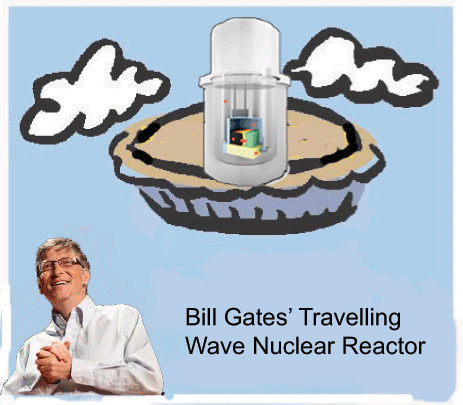
Energy efficiency, renewables, battery storage race ahead, as Bill Gates seeks tax-payer funds for chimera of “small modular nuclear reactors”

Consumers, businesses and utilities all win with this new distributed clean utility because renewables plus efficiency and batteries is available as a very resilient, near-zero carbon solution to providing power when and where it’s needed at the lowest cost. As these technologies continue to scale, they continue to experience steep cost declines, making the idea of a nuclear alternative vanishingly unrealistic.

Tens of billions of dollars have been spent developing different nuclear power plant designs, and even with enormous government subsidies and guarantees, corporations and utilities do not want to invest in nuclear power. Gates is a large investor in a nuclear firm, Terrapower, which hopes to build a prototype by 2030. If this target is achieved and a prototype is demonstrated by 2030, it could move toward commercial deployment in the 2030s. But we cannot afford to wait 15 or 20 years to scale very-low-carbon energy — and, fortunately, we don’t need to.

Renewable energy has more than doubled in the last decade to provide 20 percent of U.S. electricity, as much as nuclear.

Bill Gates’ quixotic quest to revive nuclear power https://www.greenbiz.com/article/bill-gates-quixotic-quest-revive-nuclear-power,Greg Kats, February 7, 2019  Bill Gates has been lobbying Congress to secure federal financial support for nuclear power and for a nuclear company in which he is a large investor. This plea for federal largesse from a decabillionaire illustrates why further nuclear subsidies make no sense.

Nuclear power is already a heavily subsidized 60-year-old industry with over half a trillion dollars invested in several hundred large operating nuclear plants, including 99 in the United States. The cost of nuclear power has soared while the cost for other low-carbon power options — including wind, solar, batteries and energy efficiency — have plunged. This is why no U.S. utilities want to build nuclear plants unless they can get large additional subsidies.

Gates’ rationale for nuclear power can be summarized as follows: Given the reality and gravity of climate change, nuclear provides the only large-scale, very-low-carbon electricity source that cost-effectively can provide power at scale when needed. Other very-low-carbon options, such as wind and solar power, batteries and energy efficiency, cannot reliably provide power when needed — especially on hot summer afternoons when air conditioning loads are large.

This same argument was made by nuclear advocates 30 years ago and is even less true today. Continue reading →

February 16, 2019 Posted by Christina Macpherson | renewable, spinbuster | Leave a comment

Scottish Energy Minister pressed to back closure of Hunterston B nuclear power plant in favour of renewable energy.

Dave Toke’s Blog 9th Feb 2019  Why Hunterston B Nuclear Powe Station should not be Restarted. Presentation made to Paul Wheelhouse,Minister for Energy Connectivity and the Islands by Dr Ian Fairlie and Dr David Toke.

In our view, Hunterston B nuclear power station needs to be
closed for safety reasons, but this should not be lamented because there is
presently a surplus of electricity generation in Scotland, and more is in
the pipeline.

Indeed there is so much renewable energy capacity being built
that Scottish electricity exports to England and Wales will continue to
increase, there will be no significant job losses in Scotland, and Scottish
energy security will be improved as Hunterston B’s operation results in
many Scottish wind farms being turned off at certain times and periods.
https://realfeed-intariffs.blogspot.com/2019/02/scottish-minister-pressed-to-back.html

Ian Fairlie 9th Feb 2019

https://www.ianfairlie.org/news/why-hunterston-b-nuclear-power-station-should-not-be-restarted/

February 11, 2019 Posted by Christina Macpherson | renewable, UK | Leave a comment

« Previous Entries     Next Entries »

1 This Month

of the week– Nuclear Reactor Information Task Force

14 May – online event From Bombs to Data Centres: the Face of Nuclear Colonialism

​To see nuclear-related stories in greater depth and intensity – go to https://nuclearinformation.wordpress.com

  • Categories

    • 1
      • Arclight's Vision
    • 1 NUCLEAR ISSUES
      • business and costs
        • employment
        • marketing
      • climate change
      • culture and arts
      • ENERGY
        • renewable
          • decentralised
          • energy storage
      • environment
        • oceans
        • water
      • health
        • children
        • psychology – mental health
        • radiation
        • social effects
        • women
      • history
      • indigenous issues
      • Legal
        • deaths by radiation
        • legal
      • marketing of nuclear
      • media
        • investigative journalism
        • Wikileaks
      • opposition to nuclear
      • PERSONAL STORIES
      • politics
        • psychology and culture
          • Trump – personality
        • public opinion
        • USA election 2024
        • USA elections 2016
      • politics international
      • Religion and ethics
      • safety
        • incidents
      • secrets,lies and civil liberties
        • civil liberties
      • spinbuster
        • Education
      • technology
        • reprocessing
        • Small Modular Nuclear Reactors
        • space travel
      • Uranium
      • wastes
        • – plutonium
        • decommission reactor
      • weapons and war
        • Atrocities
        • depleted uranium
      • Women
    • 2 WORLD
      • ANTARCTICA
      • ARCTIC
      • ASIA
        • Burma
        • China
        • India
        • Indonesia
        • Japan
          • – Fukushima 2011
          • Fukushima 2012
          • Fukushima 2013
          • Fukushima 2014
          • Fukushima 2015
          • Fukushima 2016
          • Fukushima continuing
        • Malaysia
        • Mongolia
        • North Korea
        • Pakistan
        • South Korea
        • Taiwan
        • Turkey
        • Vietnam
      • EUROPE
        • Belarus
        • Bulgaria
        • Denmark
        • Finland
        • France
        • Germany
        • Greece
        • Ireland
        • Italy
        • Kazakhstan
        • Kyrgyzstan
        • Russia
        • Spain
        • Sweden
        • Switzerland
        • UK
        • Ukraine
      • MIDDLE EAST
        • Afghanistan
        • Egypt
        • Gaza
        • Iran
        • Iraq
        • Israel
        • Jordan
        • Libya
        • Saudi Arabia
        • Syria
        • Turkey
        • United Arab Emirates
      • NORTH AMERICA
        • Canada
        • USA
          • election USA 2020
      • OCEANIA
        • New Zealand
        • Philippines
      • SOUTH AMERICA
        • Brazil
    • ACTION
    • AFRICA
      • Kenya
      • Malawi
      • Mali
      • Namibia
      • Niger
      • Nigeria
      • Somalia
      • South Africa
    • Atrocities
    • AUSTRALIA
    • Christina's notes
    • Christina's themes
    • culture and arts
    • Events
    • Fuk 2022
    • Fuk 2023
    • Fukushima 2017
    • Fukushima 2018
    • fukushima 2019
    • Fukushima 2020
    • Fukushima 2021
    • general
    • global warming
    • Humour (God we need it)
    • Nuclear
    • RARE EARTHS
      • thorium
    • Reference
      • Reference archives
    • resources – print
    • Resources -audiovicual
    • Weekly Newsletter
    • World
    • World Nuclear
    • YouTube
  • Pages

    • 1 This Month
    • ACTION !
    • Disclaimer
    • Links
    • PAGES on NUCLEAR ISSUES
      • audio-visual news
      • Anti Nuclear, Clean Energy Movement
        • Anti Nuclear movement – a success story
          • – 2013 – the struggle for a nuclear-free, liveable world
          • – 2013: the battle to expose nuclear lies about ionising radiation
            • Speakers at Fukushima Symposium March 2013
            • Symposium 2013 Ian Fairlie
      • Civil Liberties
        • – Civil liberties – China and USA
      • Climate change
      • Climate Change
      • Economics
        • – Employment
        • – Marketing nuclear power
        • – Marketing Nuclear Power Internationally
        • nuclear ‘renaissance’?
        • Nuclear energy – the sick man of the corporate world
      • Energy
        • – Solar energy
      • Environment
        • – Nuclear Power and the Tragedy of the Commons
        • – Water
      • Health
        • Birth Defects in the Chernobyl Radiation Affected Region.
      • History
        • Nuclear History – the forgotten disasters
      • Indigenous issues
      • Ionising radiation
        • – Ionising radiation – medical
        • Fukushima FACT SHEET
      • Media
        • Nuclear Power and Media 2012
      • Nuclear Power and the Consumer Society – theme for December 2012
      • Peace and nuclear disarmament
        • Peace on a Nuclear Free Earth
      • Politics
        • – Politics USA
      • Public opinion
      • Religion and ethics
        • -Ethics of nuclear power
      • Resources – print
      • Safety
      • Secrets and lies
        • – NUCLEAR LIES – theme for January 2012
        • – Nuclear Secrets and Lies
      • Spinbuster
        • 2013 nuclear spin – all about FEAR -theme for June
        • Spinbuster 1
      • Technology
        • TECHNOLOGY Challenges
      • Wastes
        • NUCLEAR WASTES – theme for October 2012
        • – Plutonium
      • Weapons and war
      • Women
  • Archives

    • May 2026 (102)
    • April 2026 (356)
    • March 2026 (251)
    • February 2026 (268)
    • January 2026 (308)
    • December 2025 (358)
    • November 2025 (359)
    • October 2025 (376)
    • September 2025 (257)
    • August 2025 (319)
    • July 2025 (230)
    • June 2025 (348)
  • Categories

    • 1
      • Arclight's Vision
    • 1 NUCLEAR ISSUES
      • business and costs
        • employment
        • marketing
      • climate change
      • culture and arts
      • ENERGY
        • renewable
          • decentralised
          • energy storage
      • environment
        • oceans
        • water
      • health
        • children
        • psychology – mental health
        • radiation
        • social effects
        • women
      • history
      • indigenous issues
      • Legal
        • deaths by radiation
        • legal
      • marketing of nuclear
      • media
        • investigative journalism
        • Wikileaks
      • opposition to nuclear
      • PERSONAL STORIES
      • politics
        • psychology and culture
          • Trump – personality
        • public opinion
        • USA election 2024
        • USA elections 2016
      • politics international
      • Religion and ethics
      • safety
        • incidents
      • secrets,lies and civil liberties
        • civil liberties
      • spinbuster
        • Education
      • technology
        • reprocessing
        • Small Modular Nuclear Reactors
        • space travel
      • Uranium
      • wastes
        • – plutonium
        • decommission reactor
      • weapons and war
        • Atrocities
        • depleted uranium
      • Women
    • 2 WORLD
      • ANTARCTICA
      • ARCTIC
      • ASIA
        • Burma
        • China
        • India
        • Indonesia
        • Japan
          • – Fukushima 2011
          • Fukushima 2012
          • Fukushima 2013
          • Fukushima 2014
          • Fukushima 2015
          • Fukushima 2016
          • Fukushima continuing
        • Malaysia
        • Mongolia
        • North Korea
        • Pakistan
        • South Korea
        • Taiwan
        • Turkey
        • Vietnam
      • EUROPE
        • Belarus
        • Bulgaria
        • Denmark
        • Finland
        • France
        • Germany
        • Greece
        • Ireland
        • Italy
        • Kazakhstan
        • Kyrgyzstan
        • Russia
        • Spain
        • Sweden
        • Switzerland
        • UK
        • Ukraine
      • MIDDLE EAST
        • Afghanistan
        • Egypt
        • Gaza
        • Iran
        • Iraq
        • Israel
        • Jordan
        • Libya
        • Saudi Arabia
        • Syria
        • Turkey
        • United Arab Emirates
      • NORTH AMERICA
        • Canada
        • USA
          • election USA 2020
      • OCEANIA
        • New Zealand
        • Philippines
      • SOUTH AMERICA
        • Brazil
    • ACTION
    • AFRICA
      • Kenya
      • Malawi
      • Mali
      • Namibia
      • Niger
      • Nigeria
      • Somalia
      • South Africa
    • Atrocities
    • AUSTRALIA
    • Christina's notes
    • Christina's themes
    • culture and arts
    • Events
    • Fuk 2022
    • Fuk 2023
    • Fukushima 2017
    • Fukushima 2018
    • fukushima 2019
    • Fukushima 2020
    • Fukushima 2021
    • general
    • global warming
    • Humour (God we need it)
    • Nuclear
    • RARE EARTHS
      • thorium
    • Reference
      • Reference archives
    • resources – print
    • Resources -audiovicual
    • Weekly Newsletter
    • World
    • World Nuclear
    • YouTube
  • RSS

    Entries RSS
    Comments RSS

Site info

nuclear-news
Create a free website or blog at WordPress.com.
Privacy & Cookies: This site uses cookies. By continuing to use this website, you agree to their use.
To find out more, including how to control cookies, see here: Cookie Policy
  • Subscribe Subscribed
    • nuclear-news
    • Join 2,102 other subscribers
    • Already have a WordPress.com account? Log in now.
    • nuclear-news
    • Subscribe Subscribed
    • Sign up
    • Log in
    • Report this content
    • View site in Reader
    • Manage subscriptions
    • Collapse this bar

Loading Comments...


