Offshore wind is General Electric’s great opportunity, not dodgy Small Nuclear Reactors
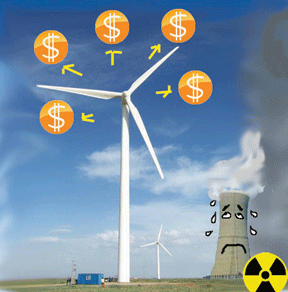 GE Power Plays: Wind Might Blow Coal, Gas And Nuclear Away, Seeking Alpha, Apr. 29, 2020 Keith Williams
GE offshore wind: massive offshore turbine Haliade-X 12MW looks like a winner.
GE-Hitachi Nuclear Energy may be a receding opportunity.
GE might sell its steam power business and rationalise its fossil fuel interests.
The power and renewables businesses are important in considering investment in GE.
………. Nuclear Small Modular Reactors : GE-Hitachi BWRX-300
There is a lot of talk in the nuclear industry and also in political circles from groups who are opposed to solar PV and wind developments, yet who acknowledge the need for low emissions technologies. The World Nuclear Association (WNA) has an excellent summary of many proposed developments in the area of Small Modular Nuclear Reactors (SMRs). The list of projects is long but many (most) seem to be struggling. A key point from the WNA report is the following : “Licensing is potentially a challenge for SMRs, as design certification, construction and operation licence costs are not necessarily less than for large reactors.” This is a huge red flag for any SMR project.
A second objection is cost of nuclear power versus solar PV/wind plus storage. There is a lot of information about these relative costs, including well into the future. I am not aware of any studies that suggest that any nuclear technology will be able to compete with renewables and storage on price. A recent study (December 2019) by the Australian Energy Market Operator (AEMO) and CSIRO concluded that SMR nuclear reactors will generate power costing ~8x that of rooftop or solar PV and wind, with solar and wind costs of power generation being similar.
……. With Small Modular Reactors the poster child of nuclear power supporters, it is clear that there is a lot riding on this potential saviour for the nuclear industry after Fukushima and recent delays and cost blowouts in the European (especially UK, French and Finnish) nuclear industries.
With current focus on emissions reductions and the climate emergency, this is an excellent time for low emissions technologies. However, the need is now and renewables (solar PV and wind) plus storage (pumped hydro and batteries) are making a lot of progress in addressing the needs. My question is whether the cost structure and long lead times mean that nuclear technology is too expensive and late to play a part.
A recent summary of the current state of the nuclear industry as a whole is depressing reading for someone who is enthusiastic about the nuclear industry’s prospects. A lot has to happen in the next decade and SMR technology isn’t ready yet. Is GE investing a lot in a technology that can’t compete with the dramatic advances in solar PV, wind and battery storage?……
GE’s adventures in nuclear developments seem like the kind of speculative play GE could happily fund when it was one of the world’s biggest and most powerful engineering companies. It doesn’t have that status anymore and my take is that it needs to cut its cloth and focus on projects that will have more immediate commercial outcomes. Of course, that is asking for a big rethink about how GE sees itself, but does it really have a choice if it wants to survive?
Offshore wind business
While there is some apprehension in the wind industry, especially in the US and China, as changes in regulations come into force next year, and 2020 has been messed up by COVID-19, there is a long-term future for wind power; offshore wind prospects look huge………
GE Renewable Energy is a major wind turbine supplier, with more than 42,000 of its turbines (mostly onshore) installed. Its role in the wind industry is extensive, from manufacture, digital optimization, operations and maintenance. Its onshore turbines range in size from 1MW to 5MW. GE installed ~50% of onshore turbines in the US last year, a 40% increase compared with the number of onshore turbines it installed in the US in 2018.
The offshore market is still emerging, with turbines substantially bigger than those used onshore. ….. The area that looks to me as if it could become a big winner is in offshore wind turbine developments, ….
A lot of investors have GE in their portfolios and a lot more are probably reflecting on whether GE might once again become a secure safe-haven investment. My biggest issue with GE is that it seems to me it is yet to understand that it is no longer the huge and dominant business that can afford to make big bets that burn a lot of cash. The current SMR nuclear programs in GE seem to be in this category. They have a very low chance of success but require major resources. I’d prefer not to have these distractions in a company I invest in….. https://seekingalpha.com/article/4340805-ge-power-plays-wind-might-blow-coal-gas-and-nuclear-away
Solar and Wind Cheapest Sources of Power in Most of the World
 Solar and Wind Cheapest Sources of Power in Most of the World https://www.bloomberg.com/news/articles/2020-04-28/solar-and-wind-cheapest-sources-of-power-in-most-of-the-world By Brian Eckhouse, April 28, 2020,
- Batteries also gaining against traditional energy sources
- Most competitive new power is wind in U.S., solar in China
Solar and onshore wind power are now the cheapest new sources of electricity in at least two-thirds of the world’s population, further threatening the two fossil-fuel stalwarts — coal and natural gas.
The levelized cost of electricity for onshore wind projects has fallen 9% to $44 a megawatt-hour since the second half of last year. Solar declined 4% to $50 a megawatt-hour, according to a report Tuesday by BloombergNEF.
The prices are even lower in countries including the U.S., China and Brazil. Equipment costs have come down, technologies have improved and governments across the world have boosted clean-power targets as they seek to combat climate change. That could squeeze out coal and natural gas when utilities develop new power plants.
“Best-in-class solar and wind projects will be pushing below $20 per megawatt-hour this side of 2030,” Tifenn Brandily, an analyst at BNEF, said in a statement. “There are plenty of innovations in the pipeline that will drive down costs further.”
Yet it remains unclear whether the coronavirus’ impact on coal and gas prices will erode the competitiveness of wind and solar. “If sustained, this could help shield fossil fuel generation for a while from the cost onslaught from renewables,” Seb Henbest, chief economist at BNEF, said in the statement.
A decade ago, solar was more than $300 a megawatt-hour and onshore wind exceeded $100 per megawatt-hour. Today, onshore wind is $37 in the U.S. and $30 in Brazil, while solar is $38 in China, the cheapest sources of new electricity in those countries.
Battery storage is also getting more competitive. The levelized cost of electricity for batteries has fallen to $150 a megawatt-hour, about half of what it was two years ago. That’s made it the cheapest new peaking-power technology in places that import gas, including Europe, China and Japan.
BNEF’s levelized cost for electricity measures the entire cost of producing power, accounting for development, construction and equipment, financing, feedstock, operation and maintenance.
European Solar Generation Breaks Records, As Coronavirus Shutdowns Reduce Air Pollution
|
As Coronavirus Shutdowns Reduce Air Pollution, European Solar Generation Breaks Records, 360 Yale, 23 Apr 20, Three of Europe’s biggest economies — Germany, Spain, and the United Kingdom — have recently achieved new records in solar generation, due in part to a drop in air pollution from coronavirus-related shutdowns, which has cleared skies and boosted production of photovoltaic cells, Greentech Media reported.
Germany generated a record-high 32.2 gigawatts (GW) of solar power earlier this week, accounting for 40 percent of the country’s electricity needs, according to Bloomberg News. And UK solar production peaked at 9.68 GW this week, up from a previous record of 9.55 GW set in May 2019, according to Sheffield Solar, a project of the University of Sheffield. In total, the UK has gone without coal power on its grid for nearly two weeks….. Spain’s record-high solar production is the result of last year’s boost in installations, which expanded new capacity by 4.7 gigawatts. On March 26, Spain generated 6.3 GW of solar power, accounting for about a quarter of the country’s electricity needs. https://e360.yale.edu/digest/as-coronavirus-shutdowns-reduce-air-pollution-european-solar-generation-breaks-records |
|
|
EDF nuclear power company looks to a profitable future in small-scale, distributed RENEWABLE energy
 Can EDF Make Big Money in Small-Scale Renewables?, Greentech Media
The world’s leading nuclear power generator is betting big on a future of small-scale, distributed energy.
Électricité de France operates 58 nuclear reactors in its home country and owns stakes in several U.S. nuclear plants that it’s now moving to sell. But EDF’s biggest stamp on the American power market has come in large-scale renewables: Its San Diego-based EDF Renewables North America subsidiary has developed and now operates gigawatts of wind and solar farms across the country.
Now, EDF Renewables is trying to replicate that success on a much smaller scale. How it fares in the distributed space will be of great interest to other 20th-century energy giants feeling their way toward a transformed, low-carbon future.
Over the past few years, and largely through acquisitions, EDF Renewables has amassed one of the most comprehensive U.S. distributed energy businesses, covering solar, energy storage, microgrids and electric vehicle chargers.
The coronavirus crisis may open the door to more dealmaking, said Raphael Declercq, who runs the Distributed Solutions unit at EDF Renewables North America. “There will be some casualties in our sector: Assets seemed overpriced up to a month ago; that may change and we may be able to grow through acquisitions,” Declercq told GTM.
Several European energy giants have been on a recent shopping spree for distributed energy companies in the startup-rich U.S. — notably Shell, EDF and Enel. Without their own U.S.-based utilities to worry about taking business from, they can roll up fleets of behind-the-meter energy assets and deliver power to customers in new ways, while learning lessons that can be applied in other markets.
“It’s a grab game right now, getting as much of that value chain as possible,” said Elta Kolo, content lead for grid edge research at Wood Mackenzie. “In a way, you’re almost seeing a new type of utility emerging in the market,” she said.
It’s a hazardous moment for the energy industry, oil companies and utilities alike. State-controlled EDF last week pulled its financial guidance for 2020 and 2021, saying it expects a sharp drop in its French nuclear output this year as the coronavirus outbreak depresses power demand…….
The rising importance of corporate renewables…….
Investment in green energy could drive Covid-19 recovery – International Renewable Energy Agency report
|
The agency’s director general, Francesco La Camera, said the global crisis ignited by the coronavirus outbreak exposed “the deep vulnerabilities of the current system” and urged governments to invest in renewable energy to kickstart economic growth and help meet climate targets. The agency’s landmark report found that accelerating investment in renewable energy would help tackle the climate crisis and would in effect pay for itself. Investing in renewable energy would deliver global GDP gains of $98tn above a business-as-usual scenario by 2050 by returning between $3 and $8 on every dollar invested. It would also quadruple the number of jobs in the sector to 42m over the next 30 years, and measurably improve global health and welfare scores, according to the report. “Governments are facing a difficult task of bringing the health emergency under control while introducing major stimulus and recovery measures,” La Camera said. “By accelerating renewables and making the energy transition an integral part of the wider recovery, governments can achieve multiple economic and social objectives in the pursuit of a resilient future that leaves nobody behind.” The report also found that renewable energy could curb the rise in global temperatures by helping to reduce the energy industry’s carbon dioxide emissions by 70% by 2050 by replacing fossil fuels. Renewables could play a greater role in cutting carbon emissions from heavy industry and transport to reach virtually zero emissions by 2050, particularly by investing in green hydrogen…… The call for a green economic recovery from the coronavirus crisis comes after a warning from Dr Fatih Birol, head of the International Energy Agency, that government policies must be put in place to avoid an investment hiatus in the energy transition. “We should not allow today’s crisis to compromise the clean energy transition,” he said. “We have an important window of opportunity.”….. https://www.theguardian.com/environment/2020/apr/20/green-energy-could-drive-covid-19-recovery-international-renewable-energy-agency |
|

Wind or solar technologies will provide UK with 100% energy, in a predominantly electric future
 Chartist 18th April 2020, Dave Toke: As offshore wind technology fully blooms as its own distinctmass industrial technology producing power at low prices, and as the prospect of floating wind turbines comes closer, the potential for the technology threatens to eclipse everything else – at least in countries with a large waterline, such as the UK.
another story. The story here is that on its own, the offshore wind available could generate over five times the anticipated total energy requirements for the UK in a ‘net zero carbon’ scenario – that is, based upon the Committee on Climate Change estimate that a mainly electric economy supplied from low carbon sources would require 645TWh of power generation in 2050. Wind power could do this as the cheapest electricity source available – apart from solar power of course, with which the competition will probably be intense in the future.
https://www.chartist.org.uk/offshore-wind-the-force-is-with-you/
Sweden’s wind power on the way to putting nuclear out of business
 Giant Wind Park Starting Up Is Another Blow to Nuclear Industry
A surge in renewable energy output in the Nordic region has sent power prices below the level where some nuclear plants are profitable. Bloomberg Green, By Lars Paulsson April 8, 2020, Sweden’s biggest wind farm began producing power this month, and the region’s nuclear reactors are feeling the heat.Vasa Vind AB’s Askalen started commercial output on April 1, increasing supplies in a market already bloated by a massive surplus of water for power generation. A day later, two units at Vattenfall AB’s Forsmark nuclear plant north of Stockholm curbed output by about 50%. Two reactors at the utility’s Ringhals plant are halted because of low power prices.
While there’s no direct link between those events, it’s the latest sign of how renewable energy is crowding out traditional power sources across Europe. The 288-megawatt facility in northern Sweden will boost the nation’s wind output further, after a 50% jump in the first quarter from a year earlier because of a very breezy winter.
“This could mean more frequent periods with rock bottom power prices, forcing conventional generators off the grid, especially when windy conditions coincide with high hydro output,” said Oliver Metcalfe, lead analyst for onshore wind research at BloombergNEF in London.
BNEF forecasts that global onshore wind capacity will gain 9% to more than 66 gigawatts this year, a forecast scaled back from the 24% expansion first anticipated.
That will help push out more traditional coal, gas and nuclear plants from the energy system. The German and U.K. coal power industries, among others, have already been decimated by a surge in green power.
Sweden will install more than 4.2 gigawatts of new onshore wind this year and next, according to BNEF. The Nordic region’s biggest economy will rely heavily on wind to replace old nuclear reactors in the future. The Askalen park has installed 80 Vestas A/S’s V136 turbines, which are as high as 112 meters……. https://www.bloomberg.com/news/articles/2020-04-08/giant-wind-park-starting-up-is-another-blow-to-nuclear-industry
Renewables surpass coal and nuclear says USA’s Federal Energy Regulatory Commission (FERC)
US: Renewables to rise above coal and nuclear says FERC https://www.smart-energy.com/renewable-energy/us-renewables-to-rise-above-coal-and-nuclear-says-ferc/ Renewables are estimated to add nearly 50,000 MW, being more than a quarter of the total capacity according to a review by the SUN DAY Campaign of data, issued last week by the Federal Energy Regulatory Commission (FERC). 13 Mar 20,
According to the report, the mix of renewable energy sources (i.e., biomass, geothermal, hydropower, solar, wind) provided 57.26% of new U.S. electrical generating capacity added in 2019 – swamping that provided by coal, natural gas, oil, and nuclear power combined.
FERC’s latest monthly “Energy Infrastructure Update” report (with data through to December 31, 2019) reveals renewable sources (i.e. biomass, geothermal, hydropower, solar, wind) accounted for 11,857 megawatts (MW) of new generating capacity by the end of the year. That is a third more (33.97%) more than that of natural gas (8,557 MW), nuclear (155 MW), oil (77 MW), and coal (62 MW) combined.
Renewables have now also surpassed 22% (i.e., 22.06%) of the US’ total available installed generating capacity – further expanding their lead over coal capacity (20.89%). Among renewables, wind can boast the largest installed electrical generating capacity – 8.51% of the U.S. total, followed by hydropower (8.41%), solar (3.49%) [2], biomass (1.33%), and geothermal (0.32%). Thus, wind and solar combined now account for 12.0% of the nation’s electrical generating capacity.
Moreover, the FERC foresees renewables dramatically expanding their lead over fossil fuels and nuclear power in terms of new capacity additions during the coming three years (i.e., by December 31, 2022). Net generating capacity additions (i.e., “proposed additions under construction” minus “proposed retirements”) for renewable sources total 48,254 MW: wind – 26,403 MW, solar – 19,973 MW, hydropower – 1,460 MW, biomass – 240 MW, and geothermal – 178 MW.
By comparison, net additions for natural gas total 21,090 MW while the installed capacities for coal, nuclear, and oil are projected to drop by 18,857 MW, 3,391 MW, and 3,085 MW respectively. In fact, FERC reports no new coal capacity in the pipeline over the next three years.
Thus, while net new renewable energy capacity is projected to be nearly 50,000 MW greater within three years, that of fossil fuels and nuclear power combined will decline by over 4,200 MW. Between now and the end of 2022, new wind capacity alone will be greater than that of natural gas while that of wind and solar combined will more than double new gas capacity.
Moreover, if FERC’s data prove correct, then by the end of 2022, renewable sources will account for more than a quarter (25.16%) of the nation’s total available installed generating capacity while coal will drop to 18.63% and that of nuclear and oil will decrease to 8.29% and 2.95% respectively. Natural gas will increase its share — but only slightly – from 44.67% today to 44.78%.
As the Executive Director of the SUN DAY Campaign, I believed that the rapid growth of renewables and corresponding drop in electrical production by coal and oil in 2019 provides a glimmer of hope for slowing down the pace of climate change. In addition, renewables’ continued expansion in the near future – as forecast by FERC – suggests that with supportive governmental policies, these technologies could provide an even greater share of total U.S. electrical generation.
Statistics presented in this article can be found here. Read the full FERC report.
Renewable energy push for Fukushima
|
Nine years since nuclear disaster, Fukushima looks to hydrogen as recovery efforts chug along, https://www.straitstimes.com/asia/east-asia/nine-years-since-nuclear-disaster-fukushima-looks-to-hydrogen-as-recovery-efforts11 Mar, 20 TOKYO – Fukushima is staking its future on renewable energy, taking the lead in a country that is not just squarely wedded to coal-fired power, but also reluctant to give up nuclear energy.This despite the anniversary on Wednesday (March 11) of the devastating triple tragedy nine years ago.
One of the world’s biggest renewable-based hydrogen power facilities was opened in Fukushima last Saturday, in the town of Namie that is home to just 1,100 people, or 5 per cent of the pre-disaster population. Many municipalities in the hardest-hit coastal areas of north-east Japan remain ghost towns, despite exclusion orders being gradually lifted, as former residents do not return. The full decommissioning of the crippled Fukushima Daiichi nuclear power plant is expected to continue until 2040 at best, while local fishermen despair over the increasing likelihood that water from the plant will be released into the Pacific Ocean. Japanese experts say all radioactive particles, except harmless tritium, would have been removed in the treatment process. Still, there are concerns that the move will further hurt a region already suffering from “toxic rumours” that have reduced demand for its produce despite stringent testing standards. Much of Japan observed a minute of silence at 2.46pm on Wednesday as emotions remain raw, especially among those directly affected by the catastrophe. It was the fateful time, down to the minute, when a magnitude 9.0 earthquake triggered 14m-high monster waves that caused nuclear meltdowns in three reactors at the Fukushima Daiichi plant. It was one of the world’s worst nuclear tragedies. Latest National Police Agency figures show a death toll of 15,899 people, with 2,529 missing. Another 3,739 people died owing to disaster-related causes, the Reconstruction Agency said. As many as 470,000 people fled their homes at the peak of the nuclear disaster, but more than 47,000 still have not returned. While many official memorial ceremonies were either scaled down or cancelled because of the coronavirus outbreak, Prime Minister Shinzo Abe vowed that the government will continue providing “seamless support to rebuild the lives of victims”. This involves not just physical infrastructure – including homes and retail businesses – to improve the living environment, but also support for new industries like that of renewables. The initial plan was to abolish the Reconstruction Agency in March 2021. But after 32 trillion yen (S$424.5 billion) was spent on rebuilding, the government decided to keep the organisation for another 10 years. Meanwhile, the Japanese government and Fukushima Daiichi operator Tokyo Electric Power Company (Tepco) continue to face civil lawsuits from Fukushima evacuees, although the sole criminal case arising from the disaster ended in a “not guilty” verdict last year. There are about 30 such civil lawsuits throughout the country. In the latest decision in favour of the plaintiffs, the Sapporo District Court on Tuesday ordered the government and Tepco to pay 52.9 million yen in damages to 89 people who evacuated to Hokkaido. Another judgment, by the Sendai High Court, is expected on Thursday. Still, Mr Abe has branded the upcoming Olympic Games as the “Reconstruction Olympics” to show the world how the region has recovered. The Olympic torch relay, which will pass through all 47 of Japan’s prefectures, is set to flag off on March 26 from the J-Village soccer training facility. It is just 20km from the nuclear plant and viewed as one of Fukushima’s key symbols of reconstruction. But environment group Greenpeace Japan had flagged in a report on Monday that typhoons like Hagibis, which battered the region last year, had created new radiation hot spots in areas that were previously cleared by the authorities. “It is vital to constantly monitor radiation levels and carry out decontamination work,” said Greenpeace representative Kazue Suzuki. Its survey found 40 hot spots with radiation levels more than four times the government’s decontamination standard of 0.23 microsievert per hour, including one with 71 microsieverts per hour near the J-Village complex. Long-term Fukushima residents, including Mr Nobuyoshi Ito, who lives in Iitate Village, have yielded similar results in grassroots surveys. “Perhaps, for runners passing through, the exposure is not very high, but the situation is still not ideal for those who have returned and are exposed to the radiation 24 hours a day, 365 days a year,” the 76-year-old said. “No matter how much money has been put into this, it is evident that full reconstruction or recovery back to how lives were before the disaster is not possible,” Mr Ito added. “That is the reality of a nuclear disaster.” |
|
Bavaria’s renewable capacity growing as nuclear plant shutdown boosts power imports
|
Bavaria’s renewable capacity growing as nuclear plant shutdown boosts power imports, 21 Feb 2020, Benjamin Wehrmann, Clean Energy Wire
Power generation with solar panels and bioenergy plants has reached a new record level in Bavaria, the German state’s economy ministry has said. Final data for 2018 showed that solar power production grew by 4.5 percent that year to reach nearly 12 terawatt hours (TWh), while production with bioenergy reached 9.2 TWh, 0.2 percent more than in 2017. “The energy transition is right on our doorstep,” said Bavaria’s economy minister Hubert Aiwanger, adding that the looming solar power support cap had to be removed and new land designated for solar panel installation to ensure that renewables could continue to grow in the state. However, the shutdown of nuclear power plant Gundremmingen B and a particularly dry year in 2018, which substantially reduced hydropower production, meant that Bavaria had to import large volumes of electricity for the first time ever in that year. Gross power production dropped from nearly 85 TWh to just under 74 TWh between 2017 and 2018, meaning that the economic powerhouse state had to import 10 TWh to cover its demand, a situation “that has never existed before,” the ministry says. Aiwanger said the “power generation gap” would grow further once Bavaria’s two remaining nuclear plants go offline at the end of 2021 and 2022, respectively. “The figures show that we all need to pull together to ensure a sustainable energy supply,” Aiwanger said…….. https://www.cleanenergywire.org/news/bavarias-renewable-capacity-growing-nuclear-plant-shutdown-boosts-power-imports |
|
Correcting Anti-Renewable Energy Propaganda
Correcting Anti-Renewable Energy Propaganda, Clean Technica B1 By Georg Nitsche, 12 Feb 20, In 1989, pro-nuclear lobbyists claimed that wind power couldn’t even provide 1% of Germany’s electricity. A few years later, pro-nuclear lobbyists ran ads in German newspapers, claiming that renewables wouldn’t be able to meet 4% of German electricity demand.
After the renewable energy revolution took off, in 2015, the pro-nuclear power “Breakthrough Institute” published an article claiming solar would be limited to 10–20% and wind to 25–35% of a power system’s electricity.
In 2017, German (pro-nuclear power) economist Hans-Werner Sinn tweeted that more than 50% wind and solar would hardly be possible. And in 2018, Carnegie Science reported a study claiming that “wind and solar could meet most but not all U.S. electricity needs.” According to one of the authors, their research indicates that “huge amounts of storage” or natural gas would need to supplement solar and wind power.
From a pro-renewable perspective, this is encouraging. The claims about the limits of renewable energy have moved from “not even 1% of electricity” to “most but not all of the electricity.” And yet, the anti-renewables message has always been the same: renewables will lead to a dead end.
In order to underscore their point, anti-renewable energy propagandists now publish incorrect cost figures that claim a fully renewable electric grid would be unaffordable or way more expensive than other options, such as, you guessed it, nuclear power. Continue reading
Australia May Add Record Amount of Renewable Power in 2020,
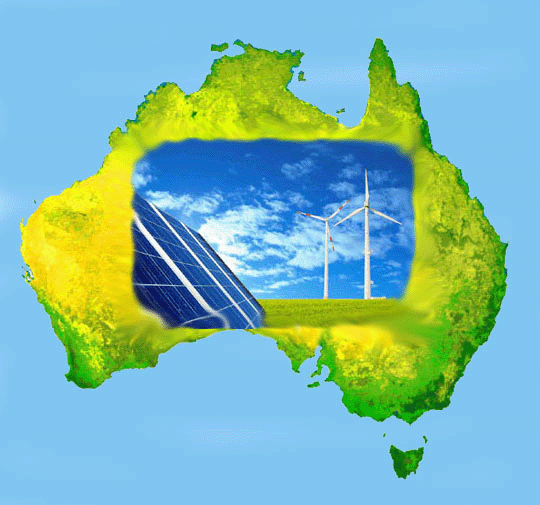 Australia May Add Record Amount of Renewable Power in 2020, Bloomberg, By James Thornhill, January 21, 2020
-
Corporate demand for clean electricity driving growth: Rystad
- Policy uncertainty seen undermining longer term expansion
Australia is set to add a record amount of renewable power in 2020, driven by growing corporate demand for clean electricity and to fill generation gaps created by the retirement of aging coal-fired plants.
New markets are expected to unlock growth as pilot hydrogen projects start and oil, gas and mining projects invest in off-grid renewables generation, according to Rystad Energy. The positive outlook would be a rebound for Australia’s clean energy developers after a sharp drop in investment in 2019.
“We expect the industry to bounce back in the second half of 2020,” Rystad said in a media release, citing projects with corporate power purchase agreements and the winners of government auction schemes that are scheduled to start construction this year.
Nearly 2 gigawatts of large-scale solar projects and 1.6 gigawatts of wind power are due to complete commissioning in the year ahead, up nearly 40% on 2019 levels. Wind and solar developers are also lining up to replace the Liddell coal plant in New South Wales, which is due to close by April 2023.
Still, developers may face headwinds over the longer term. The industry has already met the government’s 2020 target for renewable generation and there is no new target to replace it. Meanwhile, the profitability of projects located a long way from major demand centers has been hit by marginal loss factors — the amount of power lost along transmission lines.
Losing Momentum
Australia renewables investment fell 38% last year “While the outlook for the commissioning of new projects still looks solid in 2020, there is a risk that activity tails off in the years ahead as the impact of falling investment starts to feed through,” said BloombergNEF analyst Leonard Quong. AT TOP https://www.bloomberg.com/news/articles/2020-01-21/australia-may-add-record-amount-of-renewable-power-in-2020

In Turkey, renewable energy rising, as nuclear partnership with Japan is scrapped
|
Turkey, Japan scrap partnership in Sinop nuclear plant in Turkey’s north, Hurriyet Daily News, 20 Jan 2020, Turkey is reassessing its major partner for the country’s second nuclear plant in the Black Sea province of Sinop, Energy Minister Fatih Dönmez said on Jan. 19.In an interview with state-run Anadolu Agency, Dönmez said that the time schedule and pricing of the nuclear power plant in Sinop fell short of the ministry’s expectations after the results of feasibility studies, carried out by Japanese Mitsubishi Heavy Industries, Ltd., came out.
“We agreed with the Japanese side to not continue our cooperation regarding this matter,” Dönmez said…….. An intergovernmental agreement was signed between Turkey and Russia in May 2010 for Akkuyu NPP, the first nuclear plant of Turkey that will have four VVER-1200 power reactors with a total installed capacity of 4,800 megawatts. …… Share of local and renewable energy increases to 62 pct Dönmez also said Turkey saw an increase in the share of local and renewable resources for the country’s electricity production. Electricity production from local and renewables sources in 2019 amounted to 62 percent compared to 49 percent in 2018, a 13 percent increase, he further elaborated……… http://www.hurriyetdailynews.com/turkey-japan-scrap-partnership-in-sinop-nuclear-plant-in-turkeys-north-151212 |
|
New report: China soon to join countries where renewables are cheaper than coal
Oil Price 19th Jan 2020, In September of last year Oilprice reported an incredible milestone for renewable energy when solar and wind power became cheaper than coal in most of the world. Now, a new report released this week by Wood Mackenzie Power and Renewables has heralded another milestone: China will soon be added to that list of countries in which coal is no longer more economical than renewable energy.
Fukushima Japan Vows to Achieve 100% Renewable Energy Use in 20 Years
|
Impelled by Reactor Meltdown, Fukushima Japan Vows to Achieve 100% Renewable Energy Use in 20 Years, https://www.goodnewsnetwork.org/fukushima-moves-towards-100-percent-renewable-energy-production/ By Andy Corbley -Jan 11, 2020
Nine years ago, an earthquake and tsunami off the coast of Japan caused one of the most significant nuclear disasters in human history in the area around the Fukushima Daiichi nuclear power plant, where the resulting reactor meltdown led to the evacuation of 150,000 individuals.Now, the local government has vowed to restructure the grid of the north western prefecture to use entirely renewable energy sources by 2040. Fukushima is the third largest administrative district in the country, and uniquely includes a variety of energy resources like prime spots for solar and wind farms, and also opportunities for geothermal power as well. Working to achieve these ambitious goals, Fukushima Prefecture signed a memorandum of understanding in the field of renewables with the Ministry of Environment for the German state of North-Rhine Westphalia, the largest energy-producing state in Germany—and Europe as well—in August of 2017. North-Rhine Westphalia has doubled their renewable energy infrastructure over the last 15 years—growing it to deliver 9% of total energy production. Since 2012, however, Fukushima has tripled its renewable energy production, with solar, wind, water, thermal, and biofuel resources totaling 1,500 megawatts of electricity, delivering a contribution of nearly 18% of Japan’s total yearly energy consumption. Additionally, 300 billion yen ($2.75 billion) for the project has already been fronted by sponsors such as the state-owned Japan Development Bank and Mizuho Bank. The funding will be used to construct 11 solar farms and 10 wind farms over the next 4 years. The new projects also include biomass plants, geothermal stations, even fleets of sea-going windmills. The proposed new grid, spanning 80 kilometers, would reach the Tokyo metropolitan area and contribute 600 megawatts of electricity, replacing much of the power which, up until recently, the city had received from the pair of Fukushima atomic energy plants. Beyond moving away from its robust infrastructure and dependence on atomic energy, Japan is also the third largest importer of coal and natural gas, and a massive change in energy independence would help Japan reach its ambitious goals set forth in the recent UN climate change panel in Madrid last month. The country’s Prime Minister, Shinzo Abe, irrespective of the Fukushima Prefecture’s own energy objectives, is targeting 24% total energy from renewables nationally by 2030. |
|
|
1 This Month

of the week – Shut Down Drone Warfare!


Tell the Ukrainian Government to Drop Prosecution of Peace Activist Yurii Sheliazhenko

Petition to revoke the licensing of the Near Surface Nuclear Disposal Facility (NSDF) at Chalk River. https://www.ourcommons.ca/petitions/en/Petition/Details?Petition=e-7247
To see nuclear-related stories in greater depth and intensity – go to https://nuclearinformation.wordpress.com
-
Archives
- April 2026 (19)
- March 2026 (251)
- February 2026 (268)
- January 2026 (308)
- December 2025 (358)
- November 2025 (359)
- October 2025 (376)
- September 2025 (257)
- August 2025 (319)
- July 2025 (230)
- June 2025 (348)
- May 2025 (261)
-
Categories
- 1
- 1 NUCLEAR ISSUES
- business and costs
- climate change
- culture and arts
- ENERGY
- environment
- health
- history
- indigenous issues
- Legal
- marketing of nuclear
- media
- opposition to nuclear
- PERSONAL STORIES
- politics
- politics international
- Religion and ethics
- safety
- secrets,lies and civil liberties
- spinbuster
- technology
- Uranium
- wastes
- weapons and war
- Women
- 2 WORLD
- ACTION
- AFRICA
- Atrocities
- AUSTRALIA
- Christina's notes
- Christina's themes
- culture and arts
- Events
- Fuk 2022
- Fuk 2023
- Fukushima 2017
- Fukushima 2018
- fukushima 2019
- Fukushima 2020
- Fukushima 2021
- general
- global warming
- Humour (God we need it)
- Nuclear
- RARE EARTHS
- Reference
- resources – print
- Resources -audiovicual
- Weekly Newsletter
- World
- World Nuclear
- YouTube
-
RSS
Entries RSS
Comments RSS
 nuclear-news