Renewable energy heading to replace nuclear power in Switzerland
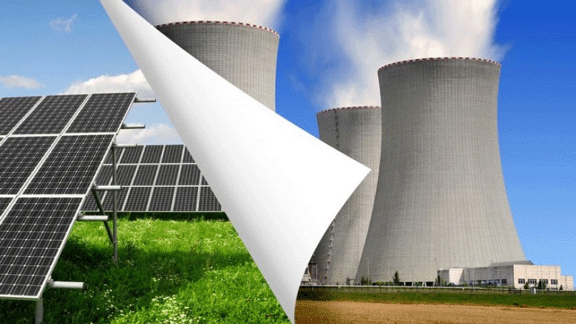
 Study pushes Swiss post-nuclear power potential, Swiss Info Ch. 8 Sep 16 Wind farms and solar installations already produce almost 50% of the energy that Switzerland gets from nuclear power plants, a new study finds.
Renewable energy sources could replace all of the power that Switzerland gets from nuclear plants sooner than people think, according to the study released on Thursday by Energy Future Switzerland.
That’s because of the fast pace of investment in renewable energy, the Swiss association says.
“At this pace of investment all the Swiss nuclear power plants can be replaced by renewable energy within about six years,” said the nonprofit’s director, Aeneas Wanner, in a statement. The association partners with utilities and others to promote energy efficiency and develop renewable energy sources…….
On November 27, Switzerland will hold a nationwide vote on its nuclear power plants. The Swiss popular initiative calls for amending the Constitution to prohibit getting electricity or heat from nuclear power. It also would set times for when the five plants must be shut down…….http://www.swissinfo.ch/eng/renewable-energy_study-pushes-swiss-post-nuclear-power-potential/42430574
Indian companies see Hybrid Solar and Wind Systems as the renewable energy future
Hybrid Solar and Wind Systems Attract Turbine Makers in India http://www.bloomberg.com/news/articles/2016-09-05/hybrid-solar-and-wind-systems-attract-turbine-makers-in-india Anindya Upadhyay September 6, 2016
-
Gamesa planning 50-megawatt wind-solar hybrid project
-
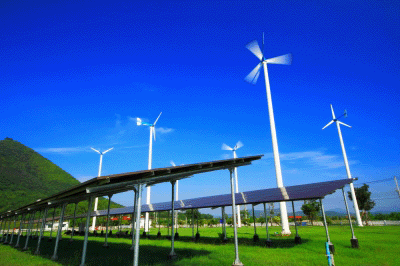
Combined power generation can boost a project’s reliabilityWind turbine makers in India are looking at building more renewable energy projects that would combine solar and wind in a bid to provide a reliable and cost-effective power supply.Gamesa Corp. Tecnologica SA, the largest wind-turbine maker in India by market share, is preparing to announce its first wind-solar project within the next two months. Suzlon Energy Ltd., India’s largest domestic manufacturer of wind turbines, says it expects to focus on hybrids starting next year.“We feel that hybrid projects will make 50 to 60 percent of our sales over the next three years,” Ramesh Kymal, the chief executive officer of Gamesa’s India operations, said in an interview in New Delhi. “In a couple of months an announcement of a hybrid project from Gamesa can be expected.”The major advantage of a solar-wind hybrid is a boost to the reliability of the system as power generation from the two different sources supplement each other. Combining the two technologies and sharing a grid connection can also increase capacity, developers say. Hybrids hold an additional appeal in India where land acquisition remains a challenge.
India aims to install 10 gigawatts of hybrid capacity by 2022, according to a draft policyreleased earlier this year by the Ministry of New and Renewable Energy.
- Interest in hybrids is spreading. In 2014, Toshiba Corp. and Mitsui & Co. announced the completion of a solar and wind project in Japan’s Aichi prefecture. That project, developed in cooperation with six other companies including Toray Industries Inc., consists of 50 megawatts of solar capacity and 6 megawatts of wind. Canberra-based Windlab Systems Pty Ltd. and Japan’s Eurus Energy Holdings Cop. are building a large-scale hybrid solar-wind plant in the state of Queensland.“A common grid infrastructure for wind and solar installations will bring stability in the grid and will help avoid curtailment and seasonality of energy production,” Tulsi Tanti, founder and chairman of Pune, India-based Suzlon Energy, said in an interview, adding that wind and solar are complementary.
Suzlon will focus more intensely on wind and solar hybrid projects beginning next year, with a target to win market share of more than 40 percent in the next five years, Tanti said. In the case of Gamesa, the Zamudio, Spain-based turbine manufacturer has already identified some projects owned by existing customers that could benefit by adding solar, Kymal said.
- Other developers have also shown interest. Inox Wind Ltd.’s wind sites in the Indian states of Rajasthan, Gujarat and Madhya Pradesh are all ideal for hybrid projects, said Devansh Jain, a director at Inox, adding that he’s waiting for the ministry’s policy to be finalized before moving forward.“Wind-solar hybrid projects will boost growth but will not be a fundamental game changer,” Jain said in a phone interview, saying the government’s auctions of wind projects will likely be the biggest driver of growth in the sector.
India Goals
The interest in hybrid projects comes as India pushes aggressively to develop its clean energy capacity. Under a effort led by Prime Minister Narendra Modi, India is aiming by 2022 to install 100 gigawatts of solar capacity and 60 gigawatts of wind power.
India installed a record 3.5 gigawatts of wind in the fiscal year ended March 31, according to the Indian Wind Turbine Manufacturers Association.
“Hybrid projects offer advantages in sharing of resources for construction and maintenance of a project, as well as power transmission,” according to Shantanu Jaiswal, a Bloomberg New Energy Finance analyst in New Delhi.
Taxpayers left with costs of mines cleanup as coal companies go bankrupt
 As coal companies sink into bankruptcy, who will pay to clean up their old mines? Peabody is the latest to make big promises to a bankruptcy judge. VOX David Roberts on September 2, 2016, In the context of US capitalism, corporate bankruptcy has become less an admission of failure or a final chapter than a kind of R&R, a chance to shed some flab and come back stronger. As anyone who has followed Donald Trump’s career knows, a big company declaring Chapter 11 bankruptcy is like Lindsay Lohan checking into rehab. They’ll be back.
So it is with Peabody Energy, the world’s largest private coal company, which entered bankruptcy back in April. It is currently undergoing its bankruptcy spa treatment — shedding workers and retirees, their health and pension benefits — and preparing to get back to work (or so it hopes).
Put more simply: Who’s going to pay to clean up all those old mines?
Coal companies promise to pay for mine cleanup, really and for true
The Surface Mining Control and Reclamation Act of 1977 says that coal companies have to clean up old mines and reverse their environmental damage, costs which can run to the hundreds of millions. Before they receive a permit for a new mine, coal companies have to prove that they can afford to clean it up. They do so by posting a bond.
These days, however, coal companies rarely have to meet this requirement. Instead, they are allowed to “self-bond,” which amounts to promising the states they operate in that they can pay for mine cleanups.
This cozy arrangement between coal companies and state regulators is longstanding, but it has come under increased scrutiny lately, as coal companies have tried to use bankruptcy to squirm out of those obligations. Wyoming just struck a deal with (bankrupt) Arch Coal to “accept up to $75 million in place of the company’s $486 million in bonding obligations.” That means if Arch Coal liquidates, Wyoming is first in line to collect at least $75 million in assets.
And it’s not an isolated case; there’s a lot of dough at stake. In addition to the $9 billion in mine cleanup costs already outstanding under the Abandoned Mine Land Program(covering mines abandoned before 1977), “officials estimate that roughly $3.6 billion in self-bond liabilities could fall to taxpayers.”
That would amount to a $3.6 billion subsidy to big coal, the latest (maybe the last?) in a century-long tradition of subsidies.
Worries about self-bonding led WildEarth Guardians and other environmental groups tofile a petition to the Office of Surface Mining Reclamation and Enforcement (OSMRE) in March, asking the agency to ensure that “companies with a history of financial insolvency are not allowed to self-bond coal mining operations.”……..http://www.vox.com/2016/9/2/12757074/coal-bankruptcy-mine-cleanup
Catholic churches and other religions taking action against climate change, switching to green energy
 Churches put their faith in green energy, Ft.com , Pilita Clark, Environment Correspondent, 1 Sept 16 Wind and solar farms have always had faithful adherents in the environmental movement but now more than 3,500 churches have turned their back on fossil fuels to embrace renewable energy.
Churches from a range of denominations have either made such a switch or registered their interest in doing so, but Roman Catholics have proved especially keen, according to figures from religious charities released on Thursday.
Nearly 2,000 Roman Catholic parishes have forsaken conventional energy in favour of green electricity in 16 dioceses, the charities said. Some made the decision after Pope Francis issued an encyclical last year urging the world to cut its dependence on fossil fuels.
“Pope Francis challenges us all to ‘care for our common home’, and by adopting renewable energy we will directly help people threatened, and already most severely affected, by climate change,” said John Arnold, Bishop of Salford, one of the 16 dioceses to have switched.
“There are many ways in which we may respond to the threat and the reality of climate change and adopting renewable energy for our church buildings must be a priority.”
In some cases, churches had banded together to use their collective buying power to secure green energy tariffs from companies that bought or produced at least 80 per cent of their electricity from renewable sources, said Tim Gee, campaigns leader at Christian Aid……
The overriding reason for acting, he added, was to send a message to governments and investors that there needed to be a shift away from fossil fuels if the world were to avoid dangerous levels of climate change.
“There really is a wave of enthusiasm for it,” Mr Gee said. “It’s relatively recent and it’s really sped up in the last year.” Some synagogues and mosques had also made the shift, he said.
Some of the companies benefiting from the churches’ shift are smaller green energy groups such as Ecotricity and Good Energy rather than the larger “big six” suppliers.
At least 100 Quaker meeting houses have switched to renewables by dealing directly with seven-year-old Good Energy……
More than 900 Salvation Army buildings have switched to renewable energy suppliers, according to the charities’ data.
Nearly 700 churches from several denominations have individually signed up for green power tariffs through the Big Church Switch website, which offers a simple way for churches to shift to green tariffs……. http://www.ft.com/cms/s/0/3909aeee-6f96-11e6-a0c9-1365ce54b926.html#axzz4J40ssnM7
Our Future Will Be Powered by the Sun, Water and Wind – the reasons why
 Here’s Why Our Future Will Be Powered by the Sun, Water and Wind https://www.thestreet.com/story/13691371/1/here-s-why-our-future-will-be-powered-by-the-sun-water-and-wind.html
The time may have finally come to make money investing in renewable energy. Kim Iskyan, Sep 1, 2016
- Coal and oil are slowly being replaced by sunlight, water and wind as civilization’s main energy sources, and there will be a lot of money to be made from this shift.
- Renewable energy comes from nature. The most common forms are solar (from sunlight), hydro (from water) and wind power.
- Renewable energy can generally be replenished faster than it is used.
- Last year, global renewable energy investment hit nearly $350 billion, a record and an increase of 11% from 2014. China was the biggest contributor, accounting for 36% of the total or $125 billion.
- Between this year and 2020, renewables will be the biggest source of energy growth, according to the International Energy Agency.
But this year has so far seen a slowdown in investment in renewables.
Another possible reason for the slowdown in investment is that it is getting cheaper to make solar panels. There is also a shift away from smaller solar energy projects to larger ones, which are cheaper on a per-unit basis.
A lot of this growth is expected to come from developing nations.
Big corporations are the biggest buyers of renewable energy
Corporate America Is Buying More Clean Energy Than Power Utilities Are https://www.fastcoexist.com/3063266/corporate-america-is-buying-more-clean-energy-than-power-utilities Want to get solar and wind power off the ground? It might be smarter to turn to Apple or Google rather than the power company. These days, the biggest buyers of renewable energy aren’t utilities. They’re corporations like Google, Walmart, and Owens Corning. Over the last year and a half, there’s been a surge of power purchases first by tech companies and more recently by more mainstream businesses, such as General Motors and Steelcase.
And, in some cases, companies are not only buying up power from a solar field or wind farm operator. They’re actually investing and running the plant themselves, or selling on power they don’t need. Ikea has invested in wind turbines in Texas and Illinois. And Apple has applied to sell on excess electricity as part of its $848 million California solar project (the new company would be called Apple Energy LLC).
Analysts say corporate players are increasingly driving decision-making in the large-scale energy market. “We’ve now reached the point where these companies that have shown leadership on renewables are doing that at a greater scale than utilities,” says Ian Kelly, manager of Rocky Mountain Institute’s Business Renewables Center. “It puts pressure on utilities to either offer renewable energy or see these companies go out and secure it directly themselves and leave utilities out of the picture.”
Wind and solar the cheapest way to power South Africa
Wind, solar can supply bulk of South Africa’s power at least cost, CSIR model shows, Creamer Engineering News 22nd August 2016 BY: TERENCE CREAMER , There has been much discussion in recent months about the work done by the Council for Scientific and Industrial Research Energy Centre into the role that renewable energy could play in South Africa’s future electricity mix. In an extensive interview with Engineering News Online, Dr Tobias Bischof-Niemz outlines the key findings of the research and unpacks the possible implications. The article follows:
The dramatic fall in the cost of supplying power from wind and solar photovoltaic (PV) plants has moved the global electricity supply industry beyond a critical “tipping point”, which leading energy scientist Dr Tobias Bischof-Niemz says is irreversibly altering the operating model, with significant implications for sun-drenched and wind-rich South Africa.
Instead of renewable energy playing only a modest and supportive role in the future supply mix, research conducted by the Council for Scientific and Industrial Research (CSIR) Energy Centre shows that, having the bulk of the country’s generation arising from wind and solar is not only technically feasibly, but also the lowest-cost option.
“The notion of baseload is changing,” Bischof-Niemz tells Engineering News Online. Over a relatively short period, renewables have become cost competitive with alternative new-build options in South Africa, dramatically altering the investment case.
Until the large-scale global adoption of wind and solar PV, a phenomenon that has only really taken hold over the last ten years, generation technologies were not dispatched by nature. The objective was, thus, to use the assets as often as possible in order to reduce unit costs. Under such conditions, it made sense to first build baseload, such as coal and nuclear plants, and use these as much as possible, before deploying the more expensive mid-merit plants and the peakers, which acted as the ultimate safety net.
With the large-scale adoption of renewables (in 2015 a record 120 GW of wind and solar PV were added globally, more than any other technologies combined), the model is being turned on its head, particularly as costs have fallen, making them competitive when compared with alternative new-build options in many countries, including South Africa.
CSIR Energy Centre research goes so far as to suggest that it now makes sense, for cost reasons, to favour renewables generation over traditional baseload sources, and to supply any “residual” demand using “flexible” technologies able to respond to the demand profile created when the sun sets and/or the wind stops blowing.
This has been stress tested using a simulated time-synchronous model, integrating wind and solar data from the Wind Atlas South Africa and the Solar Radiation Data respectively. The outcome is reflective of South Africa’s impressive wind and solar resource base, with a capacity factor of 35% found to be achievable anywhere in the country – far superior to the 25% actually achieved in Spain and the 20% in Germany.
“On almost 70% of suitable land area in South Africa a 35% capacity factor or higher can be achieved,” Bischof-Niemz says, noting that a key finding is that South Africa’s wind resource is far better than first assumed.
“The wind resource in South Africa is actually on par with solar, with more than 80% of the country’s land mass having enough wind potential to achieve a 30% capacity factor or more. In addition, on a portfolio level, 15-minute gradients are very low, which makes the integration of wind power into the electricity system easier compared to countries with smaller interconnected areas. On average, wind power in South Africa is available around the clock, but with higher output in the evenings and at night.”
TECHNICAL & FINANCIAL FEASIBILITY
The unit’s research has gone further, though, testing the technical feasibility of supplying a theoretical baseload of 8 GW resulting in a yearly electricity demand of 70 TWh using a mix of solar PV (6 GW) and wind (16 GW), backed up by 8 GW of flexible power, which could be natural gas, biogas, coal, pumped hydro, hydro, concentrated solar power, or demand-side interventions. In such a mix, 83% of the total electricity demand is supplied by solar PV and wind, and the flexible power generators make up the 17% residual demand. The carbon dioxide emissions of this mix per kilowatt hour are only 10% of what a coal-fired power station would emit.
The economic feasibility, meanwhile, has been tested using the 69c/kWh achieved for wind in the fourth bid window of the Renewable Energy Independent Power Producer Procurement Programme (REIPPPP) and the 87c/kWh achieved for solar. The flexible solutions to fill the gaps are assumed, “pessimistically”, to carry a cost of 200c/kWh.
Bischof-Niemz notes that 200c/kWh for flexible generation is a “worst-case” assumption, as is the assumption that any excess energy produced when solar PV and wind supply more than the assumed load is simply discarded and, thus, has no economic value.
The outcome shows that it is technically feasible for such a 30 GW mix to supply the 8 GW baseload in as reliable a manner as conventional baseload generators, while the economic analysis suggests that such a mix will deliver electricity at a blended cost of 100c/kWh. “Does it make sense to supply 8 GW baseload with an installed capacity of 30 GW? Yes, because it’s about energy, not capacity,” Bischof-Niemz avers………http://m.engineeringnews.co.za/article/wind-solar-can-supply-bulk-of-south-africas-power-at-least-cost-csir-model-shows-2016-08-22#.V8UXNQMApLs.twitter
Desalinising water for drinking, by use of a Solar-powered Pipe

Solar-powered Pipe desalinizes 1.5 billion gallons of drinking water for
California, http://inhabitat.com/solar-powered-pipe-desalinizes-1-5-billion-gallons-of-clean-drinking-water-for-california/ Inhabitat, by Tafline Laylin, 29 aug 16 The infrastructure California needs to generate energy for electricity and clean water, which will be significant, need not blight the landscape. Designs like The Pipe demonstrate how the provision of public services like these can be knitted into every day life in a healthy, aesthetically-pleasing way. A finalist of the 2016 Land Art Generator Initiative design competition for Santa Monica Pier, the solar-powered plant deploys electromagnetic desalination to provide clean drinking water for the city and filters the resulting brine through on-board thermal baths before it is reintroduced to the Pacific Ocean.
According to Khalili Engineers, their design, a long gleaming thing visible from Santa Monica Pier, is capable of generating 10,000 MWh each year, which will in turn produce 4.5 billion liters (or 1.5 billion gallons) of drinking water. Given the current drought throughout California, and the dearth of water in general, a variety of urban micro generators such as this can complement utility-scale energy generation.
“What results are two products: pure drinkable water that is directed into the city’s primary water piping grid, and clear water with twelve percent salinity. The drinking water is piped to shore, while the salt water supplies the thermal baths before it is redirected back to the ocean through a smart release system, mitigating most of the usual problems associated with returning brine water to the sea.”
The winners of LAGI 2016 will be announced on October 6, 2016 at Greenbuild 2016. + LAGI 2016: Santa Monica + Khalili Engineers
In 2016 every month has been a record breaker for Renewable Energy Generation

 Renewable Energy Generation Breaks Records Every Month in 2016 http://www.ecowatch.com/renewable-energy-breaks-records-1987755555.html DeSmogBlog By Mike Gaworecki, 29 Aug 16
Electricity generation from wind, solar and other renewable energy technologies have set monthly records every month so far in 2016, based on data through June released by the U.S. Energy Information Administration (EIA) Wednesday.
“Both hydroelectric and nonhydroelectric renewables have contributed to this trend, but in different ways. After a lengthy West Coast drought, hydro generation has increased and is now closer to historical levels. Nonhydro renewable generation continues to increase year-over-year and has exceeded hydro generation in each month since February 2016,” the EIA said.
According to EIA’s data, net U.S. electricity generation from non-hydroelectric, utility-scale renewables—biomass, geothermal, solar and wind—through June 2016 was 17 percent higher than in the first half of 2015. Electricity generation from conventional hydropower also rose, by nearly 12 percent. Combined, production from all utility-scale renewable sources was up 14.5 percent compared to the same period in 2015.
Not only has electricity generated by renewables exceeded previous levels in every month so far in 2016—in other words, more renewable energy was produced in January 2016 than any other January on record, more renewable energy was produced in February 2016 than any other February and so on—but renewable utility-scale electricity generation hit an all-time high of 16.55 percent of total domestic generation.
Those weren’t the only records broken, either. Utility-scale wind rose 23.5 percent in the first half of 2016, setting a new six-month record of 5.96 percent of total generation.
Meanwhile, generation from utility-scale solar thermal and photovoltaics grew by 30.3 percent and accounted for 0.87 percent of total utility-scale electrical output. The EIA also estimates that distributed solar photovoltaics or rooftop solar systems, expanded by 34.3 percent. Combined, utility-scale and distributed solar comprised 1.26 percent of total generation. A year ago, solar was responsible for just 0.94 percent of electricity generation.
Together, wind and solar grew by nearly 25 percent over the first half of 2015 and now provide almost as much electricity as conventional hydropower. Biomass and geothermal were the only renewable sources tracked by the EIA that have experienced declines so far in 2016.
Of course, renewables aren’t the only record-breakers out there. July 2016 was the 15th record-breaking month in a row in terms of global temperatures, data from the U.S. National Oceanic and Atmospheric Association showed. And Gavin Schmidt, director of NASA’s Goddard Institute for Space Studies, reported that July 2016 was also “absolutely the hottest month since the instrumental records began.”
Electricity generated from coal plummeted by more than 20 percent and nuclear power stagnated, growing just one percent, per the EIA data. Generation fueled by natural gas, on the other hand, was up by 7.7 percent.
Still, Ken Bossong, executive director of the SUN DAY Campaign, noted that renewable energy has continued to defy projections.
“Renewable energy’s share of net electrical generation for the balance of 2016 may dip a little because electrical output from wind and hydropower sources tends to be highest during the first six months of each year,” Bossong said. “Nonetheless, the data thus far is swamping EIA’s earlier forecast of just 9.5 percent growth by renewables in 2016.”
Tech giants investing in clean renewable energy
How Google and other tech giants are betting big on clean energy, https://www.weforum.org/agenda/2016/08/google-is-betting-big-on-clean-energy?utm_content=buffer34c08&utm_medium=social&utm_source=twitter.com&utm_campaign=buffer Joe Myers, Google has bought the future output from two huge wind farms in Norway and Sweden.
Part of the company’s drive to power itself entirely using renewable sources, the electricity will be used to run its European data centres. The farms are yet to be built though.
The Norwegian project, consisting of 50 turbines near Stavanger, will be ready late next year. The 22 turbines near Mariestad in Sweden, are set to be completed in early 2018.
Google going green The announcement is the latest in a series of power purchase agreements completed by the Silicon Valley giant. With seven agreements in place in Europe, and 18 deals across the globe, Google is set to have 2.5 gigawatts of energy at its disposal.
This is “the equivalent of taking over 1 million cars off the road,” said Marc Oman, EU Energy Lead, Google Global Infrastructure, in a blog post.
It’s a tech thing Data centres need a lot of power – around 2% of US consumption according to Berkeley Lab research – so Google is not alone in trying to use cleaner energy. According to Fortune, Apple, Facebook, Microsoft and Amazon have all been shifting to greener sources, by buying wind and solar power.
In fact, Apple is generating so much energy that it wants to start selling some directly to consumers, reported USA Today in June.
USA’s potential for immense electricity source, in offshore solar power
 The Unlimited Power of Ocean Winds, NYT By THE EDITORIAL BOARD, AUG. 27, 2016 The first offshore wind farm in American waters, near Block Island, R.I., was completed this month. With just five turbines, the farm won’t make much of a dent in the nation’s reliance on fossil fuels, but it shows the promise this renewable energy source could have. When the turbines start spinning in November, they will power the island, which currently relies on diesel generators, and will also send electricity to the rest of Rhode Island.
Making more efficient use of space with “solar trees”
 Indian Scientists Design Solar Tree to Save Space for Solar Power Generation VOA, 26 Aug 16 NEW DELHI— Indian scientists have designed a “solar tree” that they hope will help overcome one of the key challenges the country faces in the generation of solar power.
With photovoltaic panels placed at different levels on branches made of steel, “solar trees” could dramatically reduce the amount of land needed to develop solar parks.
“It takes about four-square meters of space to produce energy which otherwise would have required 400 square meters of space. So almost 100 times the space is saved, which as you know is very valuable,” said Daljit Singh Bedi, chief scientist at the Council of Scientific and Industrial Research (CSIR) in New Delhi, whose laboratory in Kolkata developed the tree.
A scarce resource in India, acquisition of land to develop roads, factories and other infrastructure is a sensitive issue that has led to frequent and sometimes violent protests from displaced people.
Scientists estimate the energy generated by a solar tree would be sufficient to light up five homes. They say the space-saving tree would not only make it easier to increase solar power generation to light up homes and streets in cities, but also in rural areas where farmers are unwilling to give up large tracts of land for solar panel installations.
The solar tree will also harness more energy compared to rooftop panels. “This design, it facilitates placement of solar panels in a way that they are exposed more towards sun and that way they are able to harness 10 to 15 per cent more energy, which is more or less equivalent to one hour more than the conventional format,” said Bedi……http://www.voanews.com/a/indian-scientists-design-solar-tree-to-save-space-for-solar-power-generation/3481641.html
Desk sized turbine could be more efficient than batteries for storing energy
https://www.technologyreview.com/s/601218/desk-size-turbine-could-power-a-town/ GE sees its new turbine as a strong rival to batteries for storing power from the grid. by David Talbot, April 11, 2016 GE Global Research is testing a desk-size turbine that could power a small town of about 10,000 homes. The unit is driven by “supercritical carbon dioxide,” which is in a state that at very high pressure and up to 700 °C exists as neither a liquid nor a gas. After the carbon dioxide passes through the turbine, it’s cooled and then repressurized before returning for another pass.
The unit’s compact size and ability to turn on and off rapidly could make it useful in grid storage. It’s about one-tenth the size of a steam turbine of comparable output, and has the potential to be 50 percent efficient at turning heat into electricity. Steam-based systems are typically in the mid-40 percent range; the improvement is achieved because of the better heat-transfer properties and reduced need for compression in a system that uses supercritical carbon dioxide compared to one that uses steam. The GE prototype is 10 megawatts, but the company hopes to scale it to 33 megawatts.
In addition to being more efficient, the technology could be more nimble—in a grid-storage scenario, heat from solar energy, nuclear power, or combustion could first be stored as molten salt and the heat later used to drive the process.
While such a heat reservoir could also be used to boil water to power a steam turbine, a steam system could take 30 minutes to get cranked up, while a carbon dioxide turbine might take only a minute or two—making it well-suited for on-the-spot power generation needed during peak demand periods.
GE’s system might also be better than huge arrays of batteries. Adding more hours of operation just means having a larger or hotter reservoir of the molten salt, rather than adding additional arrays of giant batteries. “The key thing will come down to economics,” says Doug Hofer, the GE engineer in charge of the project. While there’s work ahead, he says, “at this point we think our economic story is favorable compared to batteries.”
New report shows that Britain’s Hinkley Point C nuclear station is not essential
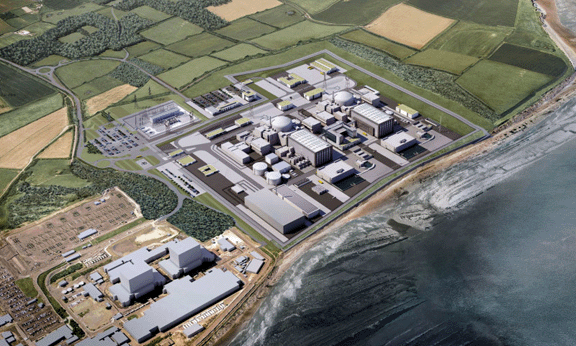 Hinkley Point C nuclear plant not essential – think tank, BBC News 26 Aug 16, The Hinkley Point C nuclear power plant is “not essential” for the UK to meet its energy and climate change targets, according to a think tank.
The Energy and Climate Intelligence Unit (ECIU) also said opting for “established” approaches instead would save bill payers £1bn a year in total.
EDF Energy, which has agreed to back Hinkley, said the ECIU report did not offer “credible alternatives”.
The government is due to make a final decision on Hinkley in the autumn………
One of the report’s authors, former Npower chief executive, Paul Massara – who now runs North Star Solar – said: “You are looking at a deal which is two and half times the current price, it goes on for 35 years and effectively this report today shows we can transition to a low carbon, affordable secure option without Hinkley and that’s what we should be doing.”
Mr Massara said a more “flexible” cost saving approach was needed that “includes things like demand-side management, which means people can turn down their electricity demand and manage their demand, with smart meters and batteries which are going to come in the next five to six years”…….
In its report, the not-for-profit ECIU made the assumption that “the total annual cost of Hinkley will probably be about £2.5bn”.
It then calculated the cost of a basket of alternative measures to meet the country’s energy and climate change targets, and concluded that bill payers, both domestic and business, would end up paying a total of £1bn less per year for their energy if they were adopted than if Hinkley C were built.
‘Not essential’
The think tank’s alternative proposals include building more wind farms and gas-fired power stations than are currently planned and laying more cables connecting the UK grid with other countries.
“Our conclusion is that [Hinkley Point’s] not essential,” said ECIU director, Richard Black.
“Using tried and tested technologies, with nothing unproven or futuristic, Britain can meet all its targets and do so at lower cost,” he added……..http://www.bbc.com/news/business-37191222
Hinkley nuclear station unnecessary – wind and solar can do the job faster and cheaper
 Why Use Nuclear When We Have Wind and Solar Power? http://trendintech.com/2016/08/26/why-use-nuclear-when-we-have-wind-and-solar-power/ By T.Henry August 26, 2016 The Hinkley Point nuclear project has been a topic of discussion recently with the time getting closer for a decision to be made about the future of the project. While once upon a time, nuclear power was thought to be the best form of renewable energy, with the recent developments in solar and wind energy, this isn’t the case any longer. Cheap lithium-air batteries can also be used that are long life and can store five times the energy as the lithium-ion ones that are used today.
One of the main arguments against Hinkley going ahead is not its £18.5 billion price tag, but its constant power generation is no longer what we are looking for. With the cost of renewables like wind and solar reducing daily and the ability to store extra energy produced, doesn’t it make more sense to invest in these forms instead of nuclear? If the UK was to accelerate renewables, we could achieve 100 percent renewable power well before 2050 advises Jeremy Leggett, founder of Solarcentury.
There are already 1000 cities and 60 giant corporations across the globe that are committed to a 100 percent renewable supply. Portugal showed how it could be done in May when it ran for four days on an only wind, solar, and hydropower. Britain also made the headlines that same month as it produced more electricity via solar energy than coal-fired stations. In Brussels, wind energy alone reached an installed capacity of over 430 gigawatts, which is more than the 382 gigawatts of nuclear.
Senior research fellow at the Energy Institute at University College London, Paul Dorfman, states, “Hinkley will not come online in time to help with the critical UK electricity gap or with our carbon emission commitments. In fact, due to inevitable delays and cost overruns, Hinkley will block scarce resources going to necessary UK renewables, grid upgrades, and energy efficiency. Don’t believe the hype: it’s not ‘nuclear and renewables’ – because of the sheer cost of nuclear, it’s ‘nuclear or renewables.’”
Even the people at The Economist have lost faith in Hinkley and headlined a recent article, “Hinkley Pointless”, pointing out that it makes much more sense to use the time and resources set aside for it to improve electricity storage. But, on the other end of the scale, Tom Greatex, chief executive of the Nuclear Industry Association and former MP feels that we need to use all available technologies to meet our energy needs and that includes both renewables and nuclear. Hinkley Point is projected to supply around 7 percent of the UK’s electricity needs with a look to more than double this by the mid-2020’s.
1 This Month
Chernobyl: The Lost Tapes – A good documentary on Chernobyl on SBS available On Demand for the next 3 weeks– https://www.sbs.com.au/ondemand/tv-program/chernobyl-the-lost-tapes/2352741955560

of the week–London Campaign for Nuclear Disarmament

Tell the Ukrainian Government to Drop Prosecution of Peace Activist Yurii Sheliazhenko
To see nuclear-related stories in greater depth and intensity – go to https://nuclearinformation.wordpress.com
-
Archives
- April 2026 (127)
- March 2026 (251)
- February 2026 (268)
- January 2026 (308)
- December 2025 (358)
- November 2025 (359)
- October 2025 (376)
- September 2025 (257)
- August 2025 (319)
- July 2025 (230)
- June 2025 (348)
- May 2025 (261)
-
Categories
- 1
- 1 NUCLEAR ISSUES
- business and costs
- climate change
- culture and arts
- ENERGY
- environment
- health
- history
- indigenous issues
- Legal
- marketing of nuclear
- media
- opposition to nuclear
- PERSONAL STORIES
- politics
- politics international
- Religion and ethics
- safety
- secrets,lies and civil liberties
- spinbuster
- technology
- Uranium
- wastes
- weapons and war
- Women
- 2 WORLD
- ACTION
- AFRICA
- Atrocities
- AUSTRALIA
- Christina's notes
- Christina's themes
- culture and arts
- Events
- Fuk 2022
- Fuk 2023
- Fukushima 2017
- Fukushima 2018
- fukushima 2019
- Fukushima 2020
- Fukushima 2021
- general
- global warming
- Humour (God we need it)
- Nuclear
- RARE EARTHS
- Reference
- resources – print
- Resources -audiovicual
- Weekly Newsletter
- World
- World Nuclear
- YouTube
-
RSS
Entries RSS
Comments RSS
 nuclear-news