World’s first large-scale tidal energy farm launched in Scotland

 All eyes on Scotland as world’s first large-scale tidal energy farm is launched on the Cromarty Firth, Thye National, SEPTEMBER 13TH, 2016 IT towers 49ft tall, weighs almost 200 tonnes and could mark the moment the tide turns for marine renewables, is is claimed.
The world’s first large-scale tidal energy farm was launched on Scotland’s coast yesterday.
The initial turbine for the MeyGen tidal stream project was unveiled at Nigg Energy Park on the Cromarty Firth, a former production centre for the oil and gas sector.
The massive structure, which will be installed in the Pentland Firth between Caithness and Orkney, has blades measuring 52 feet in diameter and developer Atlantis Resources eventually plans to add 268 others to create enough capacity to power 175,000 homes.
Maf Smith, deputy chief executive of industry body Renewables UK, hailed the development, saying: “New technology like this will be powering our nation for decades to come.”
Meanwhile, First Minister Nicola Sturgeon urged Westminster to honour a commitment to provide assurances for marine energy in its renewables support scheme or risk “irreparable damage” to the sector.
However, Tim Cornelius, chief executive of Edinburgh-based Atlantis Resources, said the launch was a “significant moment” for the green energy sector the world over…….http://www.thenational.scot/news/all-eyes-on-scotland-as-worlds-first-large-scale-tidal-energy-farm-is-launched-on-the-cromarty-firth.22312
Major USA utility sees Renewables and Efficiency as a Better Deal Than Nuclear
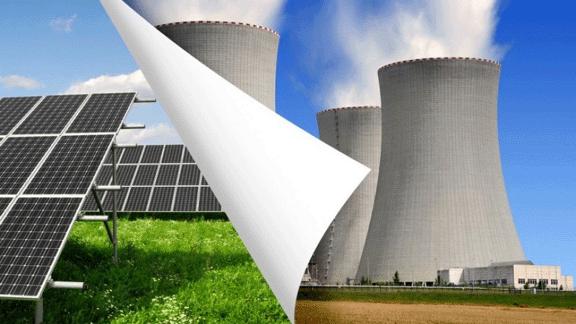 How a Major Utility Came to See Renewables and Efficiency as a Better Deal Than Nuclear Greeen Tech Media by Tam Hunt September 14, 2016 Pacific Gas & Electric, California’s biggest utility, made a historic proposal to shut down California’s last nuclear power plant, called Diablo Canyon. PG&E is arguing that replacing Diablo’s output with a mix of energy efficiency and renewables will not only cost less than relicensing Diablo, but will also lead to a more reliable and flexible grid. ……..
Energy efficiency and renewables come with none of the downsides of nuclear power. There is no radioactive waste that must be stored for literally thousands of years, there is no terrorist target, there is no ticking time bomb waiting for an earthquake to trigger it. There is a much larger footprint for renewables like solar and wind, but many countries around the world are demonstrating now that these resources can reach high penetration levels without spoiling views, impacting wildlife overly much, or taking up too much land.
Another benefit of shutting down Diablo that PG&E highlights in the joint application is the ability to better absorb increasing amounts of renewable energy. Diablo is a very large non-flexible “baseload” resource. It can’t be turned up or down to accommodate variable renewable resources — it’s either on or off. And as we push toward the current goal of 50 percent renewables by 2030, which is now mandated by law (SB 350), we need more flexible resources to accommodate an ever-increasing share of renewables.
Moreover, having such large, inflexible resources on the grid requires its own share of backup power, because if Diablo experiences a scheduled or unscheduled outage, such an outage will generally require replacement resources to make up for this loss. Renewables like wind and solar get a lot of negative attention for being variable and needing some grid backup, but this problem is actually far worse with very large inflexible generation assets like Diablo. By shutting down Diablo at the end of its current license, system-reserve requirements will actually be reduced.
How to avoid further nuclear boondoggles
The recent shutdown of San Onofre Nuclear Generating Station (SONGS) in Southern California turned into an extremely contentious battle over a number of issues, but primarily over who should bear the cost of this extremely expensive power plant.
PG&E’s joint application may entail some similar issues, as it requests a full reimbursement of all costs for the plant to date, without specifying exactly what those costs will be. As described above, the net cost of replacing Diablo with preferred resources will be about one-third less than the equivalent cost of relicensing Diablo.
That said, PG&E will need to present more information about the full costs of the shutdown, including the costs of decommissioning. With respect to SONGS, the total shutdown and decommissioning costs became a major issue. To avoid a similar fate, PG&E should be as transparent as possible as early as possible……http://www.greentechmedia.com/articles/read/how-a-major-utility-came-to-see-renewables-as-a-better-deal-than-nuclear
Geothermal power in use in Japan
After Fukushima, Japan turns to geothermal power for energy, By Michiyo Ishida, Japan Bureau Chief, Channel NewsAsia 11 Sep 2016 “…….. Japan’s largest geothermal plant – the Hatchobaru Geothermal Power Station – is located in Oita, southern Japan. Its total output is 110,000 kilowatts, and it powers about 37,000 households.
“Normally, you would utilise the steam straight from the source. But if there is energy left in the hot water, steam is drawn from there and it is used to generate energy. By doing that, we can increase power output by 20 per cent,” said the power station’s Vice-Director, Seiki Kawazoe.
The Kyushu Electric Power Company said this is an original technology known as the double flash system, which helps to raise energy efficiency.
The Hatchobaru plant generates the largest geothermal energy output in Japan, and it is able to do so as it is located in Oita, home to about 4,400 hot springs.
Geothermal energy can provide a stable supply of electric power. Kyushu Electric Power Company said it is still not ready to replace nuclear power altogether. The main constraints are the cost and the time to build the full infrastructure…….http://www.channelnewsasia.com/news/asiapacific/after-fukushima-japan-turns-to-geothermal-power-for-energy/3116858.html
Norway’s green energy from hydropower
 Beauty and power: how Norway is making green energy look good, Stuart Dredge, Guardian, 8 Sept 16
On the edge of a forest in northern Norway, an unusually handsome hydroelectric plant is generating a buzz Ovre Forsland is a big departure from the hulking power stations that traditionally served our energy needs. It looks more like an elegant, custom‑built home from TV show Grand Designs.
Located in the Helgeland district in northern Norway, it’s a small hydroelectric power station capable of supplying 1,600 homes with power.
Designed by Norwegian architecture firm Stein Hamre Arkitektkontor, it sits on a riverbed at the edge of a forest, with an exterior that aims to reflect the irregular shapes of the spruce trees forming its backdrop.
“It’s a small plant. The biggest stations in this region were built in the late 50s and 60s to serve industry, but in the last 15 years it has been much smaller projects,” says Torkil Nersund, production manager at the plant’s owner, energy company HelgelandsKraft.
“It’s the perfect place; the environment is fantastic. This region is known for its spectacular nature, so we thought the building should try to live up to the surroundings.”
The station benefits from a 157-metre drop in the Forsland river, and uses two Francis water turbines to turn the flow of water into electricity for the surrounding community. It produces about 30 gigawatt-hours (GWh) of power, with the flexibility of its storage system ensuring it can meet surges in demand.
“Øvre Forsland does not only serve hydropower to people in the region. Its purpose is also to bring attention to hydropower, the history around it and the benefits,” says Nersund.
“You can say that hydropower will play a main role in renewable society in the future, so we want more attention on the hydropower business.”………https://www.theguardian.com/environment/2016/sep/08/norwegian-power-station-ovre-helgeland-hydroelectric-renewable-energy
Renewable alternatives to Hinkley nuclear power now looking practical and economic

 Alternatives to Hinkley , NuClear News No 88 September 16 “……With on-shore wind and solar projects now going ahead at much lower CfD strike prices than that promised for Hinkley, if and when it started up in the mid to late 2020s, the alternative scenarios are beginning to look very attractive, even when the extra cost of grid balancing to deal with the variability of wind and solar is included. And crucially, offshore wind projects are now set to get a lower strike price from 2026 (£85/MWh) than Hinkley would get if it ever starts up- £92.50/MWh. With only 38% of the UK public now supporting nuclear power, and 81% backing renewables, it seems like a rethink is called for, says Professor Dave Elliott. (19)
Dong Energy, the world’s leading developer of offshore wind, says it is ready to offer the UK more offshore wind power should Theresa May scrap Hinkley. Dong’s chief executive officer Henrik Poulsen told Bloomberg “offshore wind could be an economically-viable alternative to nuclear. In contrast to the massive price of building the UK’s next generation of nuclear power stations and the very high strike price for the project, costs in the offshore wind sector are coming down quickly.” (20)
Jeremy Leggett, the founder of solar panel maker Solarcentury, is delighted that others are picking up on arguments he has been making for years. “Finally the message is getting through that Hinkley, and indeed nuclear, make no sense today simply because wind and solar are cheaper. If we accelerate renewables in the UK, we can get to 100% renewable power well before 2050,” he says. “The message is getting through on the feasibility of this too. One thousand cities around the world are committed to 100% renewable supply, some as soon as 2030. More than 60 giant corporations are committed to 100% [low carbon] supply, some as soon as 2020.” The Economist believes improved electricity storage is a key answer to the frequently repeated criticism of wind and solar that it is intermittent, and points out that battery technology is fast improving. The magazine also champions interconnectors, which can link energy-hungry Britain with northern Europe, where there is a wind-energy surplus, or with a country such as Iceland – a centre of geothermal power due to its volcanoes. The Economist concludes: “All of these options would be cheaper than Hinkley, which would take 10 years to get going and represent a huge, continuing cost to bill payers, if it ever worked at all. Such a strategy would also buy time to see what new technologies emerge.” (21)
The government expects solar and wind power to be cheaper than new nuclear power by the time Hinkley Point C is completed, its own projections show. An unpublished report by the energy department shows that it expects onshore wind power and large-scale solar to cost around £50-75 per megawatt hour of power generated in 2025. New nuclear is anticipated to be around £85-125/MWh, in line with the guaranteed price of £92.50/MWh that the government has offered Hinkley’s developer, EDF. On previous forecasts, made in 2010 and 2013, the two renewable technologies were expected to be more expensive than nuclear or around the same cost. This is the first time the government has shown it expects them to be a cheaper option. The figures were revealed in a National Audit Office (NAO) report on nuclear in July. “The [energy] department’s forecasts for the levelised cost of electricity of wind and solar in 2025 have decreased since 2010. The cost forecast for gas has not changed, while for nuclear it has increased,” the NAO said. …..”http://www.no2nuclearpower.org.uk/nuclearnews/NuClearNewsNo88.pdf
Major city bucks the South Korean pro nuclear trend, with Seoul’s success in renewable energy
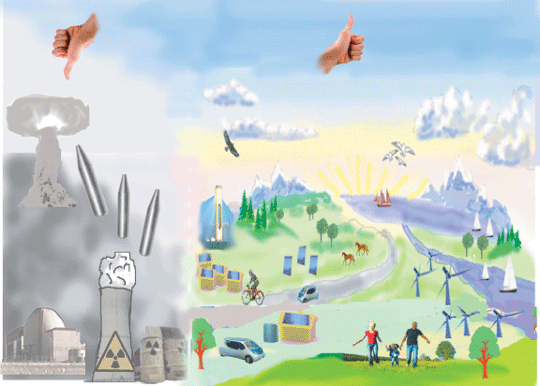
 How Japan’s Nuclear Disaster Still Haunts South Korea’s Biggest City, Seoul is trying to go green — but not the shade associated with plutonium. Huffington Post, Alexander C. Kaufman 10/09/2016 NEW YORK ― In 2010, South Korea seemed to be all-in on nuclear power. The country had won a landmark bid a year earlier to build nuclear reactors across the Middle East, including a $20.4 billion deal to build four power plants in the United Arab Emirates. A top-ranking minister called for a “renaissance of nuclear energy.” Some 66 percent of South Koreans said they supported building new nuclear plants, more than any other country in a 2010 report from the Organization for Economic Cooperation and Development’s Nuclear Energy Agency.
That presented a problem for Park Won-soon, the eco-minded human rights lawyer elected mayor of Seoul eight months after the disaster……..
Nearly a year after the Fukushima disaster, Park unveiled the city’s flagship energy policy, dubbed the “One Less Nuclear Power Plant” initiative. It aimed to reduce overall energy consumption and became the cornerstone of Seoul’s plan to overhaul its power production, in part by encouraging more people to install solar panels on rooftops. Park set a goal of cutting energy use by one nuclear power plant’s output, the equivalent of 2 million tons of burning oil.
It worked. Seoul reached its target in June 2014 ― six months ahead of schedule, according to a government report. Now, as part of the second phase of the plan, Seoul is working to cut greenhouse gas emissions by 10 million tons.
But the plan also highlighted a fissure between the national government and the local leaders of Korea’s capital, a megacity where over half the country’s population lives. The national government has plans to build 11 more plants by 2024.
Seoul also continues to issue feed-in tariffs ― payments to customers who produce their own energy and sell it back to the grid ― to households in hopes of spurring more rooftop solar production, a policy the central government scrapped in 2011.
“We cannot eliminate at once the whole nuclear power [industry],” Park said. “But as an experiment of Seoul, we can, step by step, eliminate [the need for] nuclear power.”
That experiment has yielded some significant progress. A core component of Seoul’s second-phase clean energy plan is electrical “self-reliance.” As part of the plan, the city has invested heavily in solar energy, granting five-year subsidies to small solar plants producing less than 100 kilowatt-hours of energy, according to areport by the consulting giant KPMG.
Just as South Korea has exported its nuclear reactor technology, the country is now becoming a major source of solar energy hardware. Sales of solar panels and other equipment reached $2.01 billion in the first half of this year, a 46.7 percent jump from the same period last year, Seoul-based Yonhap News Agency reported on Friday.
For the past two years, Seoul has hosted a three-day fair for investors to showcase upcoming clean energy projects. This year’s fair took place last week. http://www.huffingtonpost.com.au/entry/seoul-nuclear-energy_us_57d03babe4b03d2d4597b38e
Five remarkable facts on China’s solar and wind energy
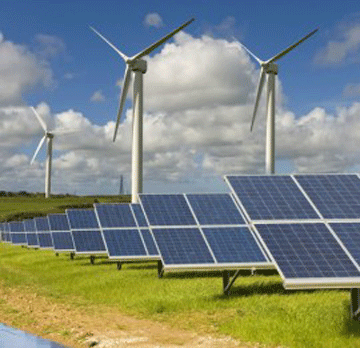
 China Five little known facts about the country’s solar and wind boom http://energydesk.greenpeace.org/2016/09/08/china-six-little-known-facts-countrys-solar-wind-boom/ [good graphs] September 8, 2016 by Lauri Myllyvirta @laurimyllyvirta China is installing one wind turbine an hour – according to a new analysis of the latest data on the country’s startling state-backed renewables boom.
The analysis comes as China – alongside the US – moved to ratify the Paris climate treaty.
China’s coal use fell for the second year in a row in 2015, with 2016 on track to be the third – though it remains the largest source of energy; causing an estimated 370,000 premature deaths from air pollution in 2013.
But it’s China’s use of renewable energy that is really changing.
1. Power generation from wind and solar increased more than China’s total electricity demand in 2015.
So yes, energy demand in the world’s largest economy is growing but this new data means that all new demand was covered from these sources.
In detail that means:
Electricity consumption in China rose 0.5% from 2014 to 2015, from 5522 TWh (terawatt-hours) to 5550 TWh.
At the same time, electricity generated from wind and solar sources increased by 21% and 64%, respectively, covering off the rise almost twice over.
2. China’s increase in power generation from wind and solar in 2015 (48 TWh) alone was twice as large as Ireland’s entire electricity demand the previous year (24 TWh).
3. Half of all wind power capacity and almost one third of all solar PV capacity installed globally in 2015 was in China.
4. The surface area of solar panels installed in China in 2015 is equal to over 10,000 football pitches. That’s more than one football pitch per hour, every hour of the year.
5. China’s targets a similar pace of wind and solar growth in its 2020 renewable energy targets.This will mean adding approximately the entire electricity demand of UK from wind and solar in just five years. See the full dataset here.
Britain’s pro nuclear National Policy Statement on Energy is outdated and must be reviewed
In deciding when to review part of a national policy statement the Secretary of State must consider whether there has been a significant change in circumstances. If there has been a significant change in circumstances on which the policy regarding the need for new nuclear power stations was based; and if those changes were not anticipated at the time then the policy should be reviewed.
TASC concludes that the case for a review of EN-1 is unanswerable
 National Policy Statement on Energy NuClear News No 88 Sept 16 The government has a legal duty under section 6 of the 2008 Planning Act to review the National Policy Statement (NPS) on Energy, according to lawyers Leigh Day, because of dramatically changed circumstances over the last five years since the national policy statements enshrining the nuclear element were first published.
A report by Together Against Sizewell C (TASC) underlines the government’s duty to undertake a review and demonstrates why new nuclear has to be written out of the government’s energy policy.
The sections of the Overarching NPS on Energy (EN-1) which the TASC report says show the policy needs to be reviewed are section 3.5.1 to 3.5.11. Continue reading
2016 a year of rapid progress for renewable energy storage
Year over year, energy storage deployments were up just 1%. What the market lacked in annual growth, however, it made up for in geographic and market-segment diversification.
The report says the largest front-of-the-meter project was not deployed in either PJM territory or California, the perennially leading markets, but rather in MISO’s territory in Indiana. In fact, PJM territory and California together accounted for only 35% of the megawatt capacity and 47% of megawatt-hour capacity deployed in the quarter – their lowest contribution in more than three years. The report says that by the end of the year, though, California will reclaim its position as the nation’s top storage market, as several megawatts of storage are slated to be installed in record time to help ease Aliso Canyon-related capacity issues in Southern California.
“This quarter marked several storage firsts, such as the first grid-scale project in MISO and a large solar-plus-storage at a municipal utility in Ohio,” said Ravi Manghani, GTM Research’s director of energy storage. “Additionally, the industry received a big boost from the White House, with recently announced public and private commitments that will result in 1.3 GW of new storage deployments and, more importantly, spur a billion dollars in storage investments.”
Behind-the-meter deployments, which consist of residential and commercial energy storage systems, grew 66% year over year. The report attributes this success to improving economics and adoption in new state markets.
The industry continues to surpass milestones, fueled by increased value and market opportunities, as well as plummeting system costs,” said Matt Roberts, executive director of the Energy Storage Association. “After record-breaking deployments in 2015, the energy storage industry is on pace to grow another 30 percent this year – increasing grid flexibility, efficiency and resiliency along the way.”
According to the report, the U.S. is on track to deploy 287 MW of energy storage this year.
China’s new power demand being met in full by wind and solar
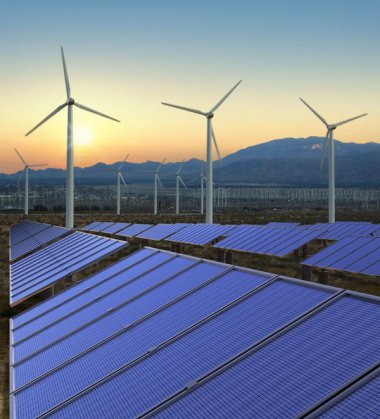 Data: All China’s new power demand met by wind and solar last year http://energydesk.greenpeace.org/2016/09/08/data-chinas-new-power-demand-met-wind-solar-last-year/ [good graphs] September 8, 2016 by Joe Sandler Clarke @JSandlerClarke China dramatically increased the portion of its electricity generated from wind and solar in 2015, with the growth in the two forms of power alone exceeding the rise in the country’s total electricity demand.
Wind and solar comfortably met this new demand, producing 186.3 TWh and 38.3 TWh of electricity in 2015, compared to 153.4 TWh and 23.3 TWh the year before. That’s a dramatic increase: 21% and 64%, respectively.
To give those numbers more context, China’s increase in power generation from wind and solar in 2015 (48 TWh) alone was twice Ireland’s entire electricity demand the previous year (24 TWh).
Half UK energy needs In fact, Chinese wind alone could have met more than half the UK’s entire energy needs in 2015 (304 TWh).
The expansion of renewable energy generation was made possible by China vastly increasing its wind and solar capacity in 2015, up 28% and 54% respectively on 12 months previously. In total, the country made up nearly half of the world’s new solar and wind capacity last year.
Coal use falls The increased use of renewable energy, together with a marked economic shift away from heavy industry sectors, has meant that coal use in the country has dropped for a third year in a row, though it is still the biggest source of global CO2 emissions.
Last week, China announced that it was ratifying the Paris climate agreement, alongside the United States, in a move widely hailed as historic.
With the American presidential election now just two months away, it remains to be seen whether the States will be able to catch up in the race to lead the post-fossil fuels global economy. See the full dataset here.
Renewable energy heading to replace nuclear power in Switzerland
 Study pushes Swiss post-nuclear power potential, Swiss Info Ch. 8 Sep 16 Wind farms and solar installations already produce almost 50% of the energy that Switzerland gets from nuclear power plants, a new study finds.
Renewable energy sources could replace all of the power that Switzerland gets from nuclear plants sooner than people think, according to the study released on Thursday by Energy Future Switzerland.
That’s because of the fast pace of investment in renewable energy, the Swiss association says.
“At this pace of investment all the Swiss nuclear power plants can be replaced by renewable energy within about six years,” said the nonprofit’s director, Aeneas Wanner, in a statement. The association partners with utilities and others to promote energy efficiency and develop renewable energy sources…….
On November 27, Switzerland will hold a nationwide vote on its nuclear power plants. The Swiss popular initiative calls for amending the Constitution to prohibit getting electricity or heat from nuclear power. It also would set times for when the five plants must be shut down…….http://www.swissinfo.ch/eng/renewable-energy_study-pushes-swiss-post-nuclear-power-potential/42430574
Indian companies see Hybrid Solar and Wind Systems as the renewable energy future
Hybrid Solar and Wind Systems Attract Turbine Makers in India http://www.bloomberg.com/news/articles/2016-09-05/hybrid-solar-and-wind-systems-attract-turbine-makers-in-india Anindya Upadhyay September 6, 2016
-
Gamesa planning 50-megawatt wind-solar hybrid project
-
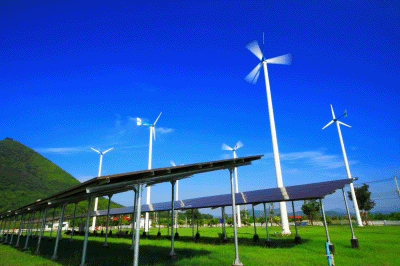
Combined power generation can boost a project’s reliabilityWind turbine makers in India are looking at building more renewable energy projects that would combine solar and wind in a bid to provide a reliable and cost-effective power supply.Gamesa Corp. Tecnologica SA, the largest wind-turbine maker in India by market share, is preparing to announce its first wind-solar project within the next two months. Suzlon Energy Ltd., India’s largest domestic manufacturer of wind turbines, says it expects to focus on hybrids starting next year.“We feel that hybrid projects will make 50 to 60 percent of our sales over the next three years,” Ramesh Kymal, the chief executive officer of Gamesa’s India operations, said in an interview in New Delhi. “In a couple of months an announcement of a hybrid project from Gamesa can be expected.”The major advantage of a solar-wind hybrid is a boost to the reliability of the system as power generation from the two different sources supplement each other. Combining the two technologies and sharing a grid connection can also increase capacity, developers say. Hybrids hold an additional appeal in India where land acquisition remains a challenge.
India aims to install 10 gigawatts of hybrid capacity by 2022, according to a draft policyreleased earlier this year by the Ministry of New and Renewable Energy.
- Interest in hybrids is spreading. In 2014, Toshiba Corp. and Mitsui & Co. announced the completion of a solar and wind project in Japan’s Aichi prefecture. That project, developed in cooperation with six other companies including Toray Industries Inc., consists of 50 megawatts of solar capacity and 6 megawatts of wind. Canberra-based Windlab Systems Pty Ltd. and Japan’s Eurus Energy Holdings Cop. are building a large-scale hybrid solar-wind plant in the state of Queensland.“A common grid infrastructure for wind and solar installations will bring stability in the grid and will help avoid curtailment and seasonality of energy production,” Tulsi Tanti, founder and chairman of Pune, India-based Suzlon Energy, said in an interview, adding that wind and solar are complementary.
Suzlon will focus more intensely on wind and solar hybrid projects beginning next year, with a target to win market share of more than 40 percent in the next five years, Tanti said. In the case of Gamesa, the Zamudio, Spain-based turbine manufacturer has already identified some projects owned by existing customers that could benefit by adding solar, Kymal said.
- Other developers have also shown interest. Inox Wind Ltd.’s wind sites in the Indian states of Rajasthan, Gujarat and Madhya Pradesh are all ideal for hybrid projects, said Devansh Jain, a director at Inox, adding that he’s waiting for the ministry’s policy to be finalized before moving forward.“Wind-solar hybrid projects will boost growth but will not be a fundamental game changer,” Jain said in a phone interview, saying the government’s auctions of wind projects will likely be the biggest driver of growth in the sector.
India Goals
The interest in hybrid projects comes as India pushes aggressively to develop its clean energy capacity. Under a effort led by Prime Minister Narendra Modi, India is aiming by 2022 to install 100 gigawatts of solar capacity and 60 gigawatts of wind power.
India installed a record 3.5 gigawatts of wind in the fiscal year ended March 31, according to the Indian Wind Turbine Manufacturers Association.
“Hybrid projects offer advantages in sharing of resources for construction and maintenance of a project, as well as power transmission,” according to Shantanu Jaiswal, a Bloomberg New Energy Finance analyst in New Delhi.
Taxpayers left with costs of mines cleanup as coal companies go bankrupt
 As coal companies sink into bankruptcy, who will pay to clean up their old mines? Peabody is the latest to make big promises to a bankruptcy judge. VOX David Roberts on September 2, 2016, In the context of US capitalism, corporate bankruptcy has become less an admission of failure or a final chapter than a kind of R&R, a chance to shed some flab and come back stronger. As anyone who has followed Donald Trump’s career knows, a big company declaring Chapter 11 bankruptcy is like Lindsay Lohan checking into rehab. They’ll be back.
So it is with Peabody Energy, the world’s largest private coal company, which entered bankruptcy back in April. It is currently undergoing its bankruptcy spa treatment — shedding workers and retirees, their health and pension benefits — and preparing to get back to work (or so it hopes).
Put more simply: Who’s going to pay to clean up all those old mines?
Coal companies promise to pay for mine cleanup, really and for true
The Surface Mining Control and Reclamation Act of 1977 says that coal companies have to clean up old mines and reverse their environmental damage, costs which can run to the hundreds of millions. Before they receive a permit for a new mine, coal companies have to prove that they can afford to clean it up. They do so by posting a bond.
These days, however, coal companies rarely have to meet this requirement. Instead, they are allowed to “self-bond,” which amounts to promising the states they operate in that they can pay for mine cleanups.
This cozy arrangement between coal companies and state regulators is longstanding, but it has come under increased scrutiny lately, as coal companies have tried to use bankruptcy to squirm out of those obligations. Wyoming just struck a deal with (bankrupt) Arch Coal to “accept up to $75 million in place of the company’s $486 million in bonding obligations.” That means if Arch Coal liquidates, Wyoming is first in line to collect at least $75 million in assets.
And it’s not an isolated case; there’s a lot of dough at stake. In addition to the $9 billion in mine cleanup costs already outstanding under the Abandoned Mine Land Program(covering mines abandoned before 1977), “officials estimate that roughly $3.6 billion in self-bond liabilities could fall to taxpayers.”
That would amount to a $3.6 billion subsidy to big coal, the latest (maybe the last?) in a century-long tradition of subsidies.
Worries about self-bonding led WildEarth Guardians and other environmental groups tofile a petition to the Office of Surface Mining Reclamation and Enforcement (OSMRE) in March, asking the agency to ensure that “companies with a history of financial insolvency are not allowed to self-bond coal mining operations.”……..http://www.vox.com/2016/9/2/12757074/coal-bankruptcy-mine-cleanup
Catholic churches and other religions taking action against climate change, switching to green energy
 Churches put their faith in green energy, Ft.com , Pilita Clark, Environment Correspondent, 1 Sept 16 Wind and solar farms have always had faithful adherents in the environmental movement but now more than 3,500 churches have turned their back on fossil fuels to embrace renewable energy.
Churches from a range of denominations have either made such a switch or registered their interest in doing so, but Roman Catholics have proved especially keen, according to figures from religious charities released on Thursday.
Nearly 2,000 Roman Catholic parishes have forsaken conventional energy in favour of green electricity in 16 dioceses, the charities said. Some made the decision after Pope Francis issued an encyclical last year urging the world to cut its dependence on fossil fuels.
“Pope Francis challenges us all to ‘care for our common home’, and by adopting renewable energy we will directly help people threatened, and already most severely affected, by climate change,” said John Arnold, Bishop of Salford, one of the 16 dioceses to have switched.
“There are many ways in which we may respond to the threat and the reality of climate change and adopting renewable energy for our church buildings must be a priority.”
In some cases, churches had banded together to use their collective buying power to secure green energy tariffs from companies that bought or produced at least 80 per cent of their electricity from renewable sources, said Tim Gee, campaigns leader at Christian Aid……
The overriding reason for acting, he added, was to send a message to governments and investors that there needed to be a shift away from fossil fuels if the world were to avoid dangerous levels of climate change.
“There really is a wave of enthusiasm for it,” Mr Gee said. “It’s relatively recent and it’s really sped up in the last year.” Some synagogues and mosques had also made the shift, he said.
Some of the companies benefiting from the churches’ shift are smaller green energy groups such as Ecotricity and Good Energy rather than the larger “big six” suppliers.
At least 100 Quaker meeting houses have switched to renewables by dealing directly with seven-year-old Good Energy……
More than 900 Salvation Army buildings have switched to renewable energy suppliers, according to the charities’ data.
Nearly 700 churches from several denominations have individually signed up for green power tariffs through the Big Church Switch website, which offers a simple way for churches to shift to green tariffs……. http://www.ft.com/cms/s/0/3909aeee-6f96-11e6-a0c9-1365ce54b926.html#axzz4J40ssnM7
Our Future Will Be Powered by the Sun, Water and Wind – the reasons why
 Here’s Why Our Future Will Be Powered by the Sun, Water and Wind https://www.thestreet.com/story/13691371/1/here-s-why-our-future-will-be-powered-by-the-sun-water-and-wind.html
The time may have finally come to make money investing in renewable energy. Kim Iskyan, Sep 1, 2016
- Coal and oil are slowly being replaced by sunlight, water and wind as civilization’s main energy sources, and there will be a lot of money to be made from this shift.
- Renewable energy comes from nature. The most common forms are solar (from sunlight), hydro (from water) and wind power.
- Renewable energy can generally be replenished faster than it is used.
- Last year, global renewable energy investment hit nearly $350 billion, a record and an increase of 11% from 2014. China was the biggest contributor, accounting for 36% of the total or $125 billion.
- Between this year and 2020, renewables will be the biggest source of energy growth, according to the International Energy Agency.
But this year has so far seen a slowdown in investment in renewables.
Another possible reason for the slowdown in investment is that it is getting cheaper to make solar panels. There is also a shift away from smaller solar energy projects to larger ones, which are cheaper on a per-unit basis.
A lot of this growth is expected to come from developing nations.
1 This Month



26 September – International Day for the Total Elimination of Nuclear Weapons


PLEASE OPPOSE HR 8255 AND S.3639 – bills would accelerate satellite deployment, with no environmental review or safeguards – https://ncstd5li.quorum.us/campaign/169331/
To see nuclear-related stories in greater depth and intensity – go to https://nuclearinformation.wordpress.com
-
Archives
- September 2026 (257)
- August 2026 (330)
- July 2026 (355)
- June 2026 (287)
- May 2026 (306)
- April 2026 (356)
- March 2026 (251)
- February 2026 (267)
- January 2026 (308)
- December 2025 (358)
- November 2025 (359)
- October 2025 (375)
-
Categories
- 1
- 1 NUCLEAR ISSUES
- business and costs
- climate change
- culture and arts
- ENERGY
- environment
- health
- history
- indigenous issues
- Legal
- marketing of nuclear
- media
- opposition to nuclear
- PERSONAL STORIES
- politics
- politics international
- Religion and ethics
- safety
- secrets,lies and civil liberties
- spinbuster
- technology
- Uranium
- wastes
- weapons and war
- Women
- 2 WORLD
- ACTION
- AFRICA
- Atrocities
- AUSTRALIA
- Christina's notes
- Christina's themes
- culture and arts
- Events
- Fuk 2022
- Fuk 2023
- Fukushima 2017
- Fukushima 2018
- fukushima 2019
- Fukushima 2020
- Fukushima 2021
- general
- global warming
- Humour (God we need it)
- Nuclear
- RARE EARTHS
- Reference
- resources – print
- Resources -audiovicual
- Weekly Newsletter
- World
- World Nuclear
- YouTube
-
RSS
Entries RSS
Comments RSS

