Big savings for Illinois in energy efficiency programs

Illinois needs to invest in energy efficiency programs, State Journal Register, Jason Vogelbaugh, Nov 16, 2016 . Concluding a yearlong debate, lawmakers appear ready to consider legislation addressing Illinois energy policy as they return to Springfield this month. To create jobs, save energy and improve air quality, members of the General Assembly must act now to create a stronger energy future for Illinois.
But after a decade of inaction, other states have moved ahead of Illinois, seizing private investment and creating jobs that should have come here instead. Last year alone, Illinois lost more than 500 jobs in wind and solar combined, while dozens of other states registered significant gains in these sectors. At the same time, Exelon says that nuclear plants in two communities, the Quad Cities and Clinton, are at risk of closure barring quick action by the Legislature.
To maximize economic and environmental goals, this legislation should not simply address questions about the type of energy we use, it should also address the amount of energy we use by reducing demand through energy efficiency.
Energy efficiency has a proven track record in Illinois, saving money and putting people to work. Since Illinois energy efficiency standards were passed in 2007, customers have saved more than $1 billion on their electric bills. Today 86,000 people statewide work in this field, weatherizing or insulating buildings, designing efficiency measures and upgrading appliances…….
Proponents of the Illinois Clean Jobs Bill (HB 2607/SB 1485) have called for boosting energy efficiency standards statewide and fixing limits that artificially cap investments that utilities can make to save customers money. A bill from ComEd and its parent company Exelon (SB 1585) would expand these programs to save customers in ComEd’s Northern Illinois service area up to $4 billion over the next decade and create thousands of new jobs.
A bill that melds these ideas to expand energy efficiency would be a boon to Illinois customers.
Now that that these parties have put forward a strong energy efficiency initiative, we strongly encourage Ameren Illinois to join them. Central and Southern Illinois customers should not left behind while those in Northern Illinois reap the benefits of lower costs and thousands of new jobs created by expanding energy efficiency.
Programs ensuring that energy efficiency programs are targeted at low-income communities are also under consideration, helping unlock savings for customers who need them most, while accelerating employment opportunities in these areas of Illinois.
Every day wasted by not acting on clean energy is a day Illinois loses out on good-paying jobs. Energy efficiency programs represent the best path to ensure that these jobs — along with big savings — are available to people in every corner of the state. http://www.sj-r.com/opinion/20161116/guest-column-illinois-needs-to-invest-in-energy-efficiency-programs
Just like any other house – but it’s got a SOLAR ROOF
No One Saw Tesla’s Solar Roof Coming Elon Musk just showed us the grand unification of Tesla: Fast cars, big batteries, and a stunning solar rooftop. Bloomberg, Tom Randall October 31, 2016 “…….. This is the future of solar, Musk proclaimed. “You’ll want to call your neighbors over and say ‘check out the sweet roof.’ It’s not a phrase you hear often.”
The roof tiles are actually made of textured glass. From most viewing angles, they look just like ordinary shingles, but they allow light to pass through from above onto a standard flat solar cell. The plan is for Panasonic to produce the solar cells and for Tesla to put together the glass tiles and everything that goes along with them. That’s all predicated on shareholders approving the $2.2 billion acquisition of SolarCity, the biggest U.S. rooftop installer, on Nov. 17.

Tesla says the tempered glass is “tough as steel,” and can weather a lifetime of abuse from the elements. It can also be fitted with heating elements to melt snow in colder climates. “It’s never going to wear out,” Musk said, “It’s made of quartz. It has a quasi-infinite lifetime.”
In a Q&A with reporters after the presentation, Musk said the tiles are comparable to competing high-efficiency solar panels. The current prototypes that Tesla engineers are working with reduce the efficiency of the underlying solar cell by just 2 percent. With further refinement, Musk said he hopes the microscopic louvers responsible for making the tiles appear opaque can be used to actually boost the efficiency of standard photovoltaic cells.
Putting the pieces together
The vision presented at Universal Studios in Los Angeles is the grand unification of Musk’s clean-energy ambitions. The audience was able to step into a future powered entirely by Tesla: a house topped with sculpted Tuscan solar tiles, where night-time electricity is stored in two sleek wall-hung Powerwall batteries, and where a Model 3 prototype electric car sits parked out front within reach of the home’s car charger.
Attracting less attention on Wisteria Lane was Tesla’s Powerwall 2, a major upgrade of its home battery for electricity storage. …Version 2 is a much different product. It packs more than twice the capacity—14 kilowatt hours versus 6.4 kilowatt hours—for a cheaper price after installation. 1 It includes a built-in Tesla-brand inverter and comes with a ten year, infinite-cycle warranty. ……https://www.bloomberg.com/news/articles/2016-10-31/no-one-saw-tesla-s-solar-roof-coming?cmpid=google
Strong case for solar power in Taiwan
20GW by 2025: Behind Taiwan’s big solar numbers, PV Tech Nov 02, 2016 By Tom Kenning Nuclear reactors approaching end-of-life, a sound PV manufacturing industry and a robust legal system all make a strong case for solar PV to muscle into Taiwan’s energy mix. A new government set the tone for renewables integration by setting a target of 20GW solar by 2025 last year, but this is one of the most densely populated countries on earth, with two thirds of the island covered in steep mountainous forest and national parks; where the city ends the mountains begin. Moreover, a list of unique geographical and cultural challenges to PV development is topped off by the looming threat of some of the most gruelling typhoons in all Asia.
The capital city Taipei, to the north of the island, where population is most concentrated, also happens to have the poorest irradiation. Meanwhile, if solar deployment is concentrated in the more favourable conditions of the south, transmission infrastructure is limited. An island population of more than 23 million needs a solid agricultural industry, so the government has had to focus on releasing uncultivable land for solar, which is again in short supply. Even floating solar is being promoted in an attempt to alleviate these land constrictions. However, with many more hurdles for solar developers ahead, the proximity of Japan and the fallout over Fukushima means the appetite for nuclear has been quashed. New forms of energy are the priority.
As the Taiwan government prepares to finalise details of how its target will be met, PV Tech examines some of the huge numbers being proposed and what it will take to realise them. The government has shown clear support for its clean energy transition with Chen Chien-Jen, vice president of the Republic of China (Taiwan), speaking at the opening ceremony of the PV Tawain exhibition in Taipei this year. He cited the need for more energy independence while reiterating plans to phase out nuclear by 2025 through focusing on solar and off-shore wind.
He said: “Taiwan has great resources and is in a good positon to develop PV and green energy.”
According to the green energy policy released in 2015 by the Bureau of Energy, Ministry of Economic Affairs, the plan is to have 20% of Taiwan’s energy mix coming from renewables by 2025. With all the island’s constraints, it would make sense to concentrate on the highest efficiency solar modules to make the most of every hectare of land used. As it happens, Taiwanese cell manufacturers have tended to produce some of the highest efficiency cells across the globe. It has roughly 2GW annual capacity of the higher efficiency cells, which would translate into the 2GW per year necessary over ten years to reach the domestic 20GW target.
It is no wonder then that Taiwan’s new feed-in tariff (FiT) is bias towards higher efficiency solar modules by offering a higher reward.
It may also be the reason that several Taiwanese cell manufacturers including Neo Solar Power (NSP) and AU Optronics have started to focus on vertical integration, as discussed by Solar Intelligence’s Finlay Colville in his two-part blog on upstream trends from PV Taiwan. For example, Alex Wen, senior vice president, NSP, tells PV Tech that with cell prices dropping as much as 33% in a period of just three months, the firm is increasing its module manufacturing as well as investing in solar PV projects to raise cash. Proximity to the sea and floating solar opportunities are also driving innovation in modules, with NSP due to release a double-glass module that benefits from water reflection.
PV Tech has already detailed how the landscape for solar in Taiwan is changing, but having canvassed industry members at PV Taiwan, here we go into more detail:
The numbers……… http://www.pv-tech.org/features/20gw-by-2025-behind-taiwans-big-solar-numbers?utm_source=twitterfeed&utm_medium=twitter
India turning away from fossil fuels, to replace coal with Cheaper Solar Power by 2022
Renewable Energy: India to Replace Coal with Cheaper Solar Power by 2022 http://www.natureworldnews.com/articles/30601/20161024/renewable-thinking-india-replace-coal-cheaper-solar-power-2022.htm by Monica Antonio Oct 24, 2016 India is taking the lead in creating a country powered by renewable energy by replacing expensive imported coal with affordable solar power in just six years’ time. But how will they do it? According to a report from Eco Business, India is aiming to alleviate poverty by providing the entire population with cheap electricity while, at the same time, not contributing to global warming by turning its back on fossil fuels and fully embracing solar energy.
The report says the key drivers in the rising demand for energy in the future are population growth and the doubling of GDP.
Turning Its Back on Fossil Fuels As a solution to the ballooning of energy consumption, India’s government has recently updated its National Solar Mission Target. By the year 2022, the country aims to achieve 175 GW of renewable power, including 100 GW of solar power. This means that India’s capacity for renewable energy needs to be seven times bigger, from 3 GW to 20 GW per year.
However, a big feat as it may seem, this new focus on renewable energy will benefit 600 million people with electricity by 2040. Ajay Goel, president of solar and chief of new businesses at ReNew Power said,”Especially for the 400 million Indians who have no access to electricity, solar power would mean access to clean and affordable energy.”
Is a Solar-Powered India Possible?
According to Bloomberg New Energy Finance, if India manages to create photovoltaic ground-mounted systems, the country will have an energy source that’s more affordable than imported coal. By using the levelised cost of energy (LCOE), the outlet notes that in the future, solar energy will be more economic than using coal.
Apart from giving access to cheap electricity, solar energy will also provide livelihood and “generate more than 675,000 jobs in the Indian solar industry,” Goel notes.
South Africa’s Eskom imperils national energy security
Eskom imperils our energy security – It is long past time to Liberate the Grid, Daily Maverick 27 OCT 2016 It is a paradox of sorts but Eskom’s increasingly hostile attitude towards the country’s once successful renewable energy programme (REIPPPP) and indeed, the government’s own energy policy, should be welcomed. By DIRK DE VOS.
Recently, we have seen Eskom’s current head generation, Matshela Koko, saying that National Treasury itself should pick up the liability created by existing renewable energy projects even though the costs of these are passed through via the regulated tariff mechanism (so no cost is borne by Eskom).
Eskom’s defiance of national policy and legislation by its refusal to connect additional renewable energy projects is now the subject of an official complaint by the Wind Energy Association (SAWEA). At the same time, Eskom wants to be at the centre of a future nuclear energy procurement programme despite the lack of an Integrated Resource Plan (IRP) to support any such thing.
This should not be seen as a bad thing. Why? In the Finance Minister’s Medium Term Budget Policy Statement, we see Treasury support REIPPPP and other energy initiatives but these are little more than encouraging words. It is Eskom that, perhaps inadvertently, is framing exactly the kind of debate that South Africa should have finalised more than 18 years ago. In 1998, Cabinet adopted the White Paper on Energy. It contemplated a substantial restructuring of our electricity sector separating generation, transmission and distribution, the extensive use of markets to regulate price, promoting energy efficiency and environmental sustainability.
Almost none of the policies was carried out. One initiative that did emerge was an Independent System and Market Operator (ISMO) Bill which would have made a modest start on separating the management of the grid from Eskom’s generation and distribution activities. It went nowhere.
In the interim, a revolution driven by increasingly cheap renewable energy has got under way. In 2014, more additions to global electricity generating capacity were accounted for by renewables than any other form of energy and growth of this sector is charging on requiring constant upward revisions to the future growth of renewables.
In South Africa however, despite claims to the contrary, the promising renewables programme is grinding to a halt. Eskom’s willingness to connect ever cheaper renewable projects has moved from what can be described as passive-aggressive to one of open defiance. Soon, investors in renewables will have to abandon the country and relocate their efforts to countries that are moving with the times.
We seem to be caught in endless debates about the merits of renewables. While Eskom, a publicly owned company, refuses to disclose information about the costs of its generation, new renewables are proving to be cheaper than any other source of electricity generation. Eskom, for its part, has sought to dismiss renewables with a series of misrepresentations about renewable energy and does so even in its own financial statements. Eskom’s false claims on renewable energy are then trafficked to the general public in such bad faith that there is little purpose in the tedious efforts to refute them.
Let’s get to the more useful debate then: Mr Koko is reported to have said that the financial strain caused by the REIPPPP (renewables) was indefensible. In doing so, he makes a telling point, “I am an executive of Eskom. I will not preside over Eskom sinking,” and to underline what he means, he goes on to say, “You cannot be a cardinal and not believe in the pope.” So, there it is. Eskom and its viability stands in the way of sensible electricity sector decisions.
One of the more recent changes to the electricity sector is that planning future generation is now not done by Eskom itself but through an independent IRP process. The IRP is now the means by which South Africa plans its future electricity path. The outcome of the IRP permits the Minister of Energy to make a determination in terms of the Electricity Regulation Act on what type of capacity is to be built, when and by whom. Previous such ministerial determinations have resulted in the REIPPPP, the coal IPP and the gas IPP.
The IRP processes are fairly rigorous but it looks at the South African electricity supply sector as a holistic system. That is essential for planning processes but it does not take into account that for all practical purposes system is Eskom and Eskom has its own plans for itself. If, theoretically, Eskom’s interests were the same as those of the rest of the country, that would not be much of a concern. But they are not and Mr Koko and his management now have made it quite clear whose interests are to be pursued. They are not our interests…….
Eskom’s extraordinary ability to dissipate large amounts of physical capital on a more or less continuous basis is matched only by its ability to maintain and preserve political capital. This is not a new problem. The current Eskom management simply follows an established tradition extending back to well before our democratic dispensation. As DrGrové Steyn, of Meridian Economics, writing about Eskom a decade ago, points out: “It should not escape the attention that technological paradigms, construction choices and (lack) of demand-side strategies serve the pecuniary and reputational interests of engineers, managers and politicians… Unfortunately, the interests of these groups are often not adequately aligned with the social interest”. None of this should be surprising – all government sanctioned monopolies do the same thing.
Seen in this way, Eskom’s enthusiastic support for the completely ludicrous nuclear programme makes perfect sense. Very few sensible independent observers think it can proceed and Eskom has no chance of financing or, as we have seen, successfully project managing any such programme. It is more than likely that most senior managers within Eskom know this too – as their own 2008 study showed. But there is a lot of political capital to be won by getting behind it. Again, dissipating physical capital and building political capital…….http://www.dailymaverick.co.za/article/2016-10-27-eskom-imperils-our-energy-security-it-is-long-past-time-to-liberate-the-grid/#.WBZ2hdJ95pg
Wind and solar power set to take over as Fort Calhoun nuclear plant closes
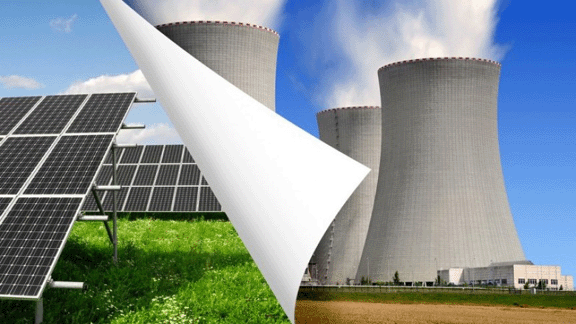 As Fort Calhoun nuclear plant closes, OPPD weighs its future in renewable energy http://www.omaha.com/money/as-fort-calhoun-nuclear-plant-closes-oppd-weighs-its-future/article_1475d290-c89c-5924-8be4-17cb76ba06a4.html By Cole Epley / World-Herald staff writer, 25 Oct 16 The winds of change are howling in the Nebraska energy industry.
Spain – the cradle of renewable energy
Costs falling fast, as wind energy booms in Europe
Europe’s offshore wind industry booming as costs fall The European Union’s push away from fossil fuels toward renewables, along with falling costs, has seen offshore wind thrive with turbines being installed from the Irish to the Baltic Seas, reports Environment 360, Guardian, Christian Schwägerl, 2q1 Oct 16 “……In Europe, offshore wind farms like the one at Burbo Bank are undergoing a boom. While still significantly outnumbered by windfarms on land, the importance of windfarms at sea has grown dramatically in the past several years. Until 2011, between 5 and 10% of newly installed wind energy capacity in Europe was offshore. Last year, almost every third new wind turbine went up offshore. That growth has helped boost the share of wind energy in the European Union’s electricity supply from 2% in the year 2000 to 12% today, according toWindEurope, a business advocacy group.
New investments for offshore projects totaled $15.5bn in the first half of 2016 alone, according to WindEurope, and newly installed offshore wind energy capacity will double to 3.7 gigawatts this year compared to 2015. More than 3,300 grid-connected turbines now exist in the North Sea, the Baltic Sea, and the Irish Sea, and 114 new wind turbines were linked to the grid in European waters in the first half of this year alone. This is in stark contrast to the US and Asia, where offshore wind use is only just getting started.
The offshore wind boom is part of a wider move from fossil fuels to renewable energy across the European Union. The overall share of renewable electricity sources in the EU – hydropower, wind, solar, biomass, and geothermal – has gone up from about 15% in 2004 to roughly 33% in 2014, according to data from Eurostat and Entso-E, the association of grid operators. Along with solar photovoltaic power, wind energy is driving this expansion. Newly installed wind energy capacity amounted to 13 gigawatts in 2015, twice as much as newly installed fossil fuel and nuclear capacity combined. WindEurope claims that all European wind turbines taken together can now generate enough electricity for87m households.
This is not only a result of government subsidies and incentives, but also of dramatically reduced production costs for wind energy. The price for a megawatt hour is now between €50 and €96 for onshore wind and €73 to €140 for offshore wind, compared to around €65 to €70 for gas and coal. Electricity generated from onshore windfarms is now the cheapest among newly installed power sources in the UK and many other countries. If environmental costs are considered, the picture looks even more favorable for wind power.
Germany now meets one-third of its electricity demand with renewable energy, Denmark 42%, and Scotland as much as 58%. On some sunny or very windy days, renewables can now fully supply the electricity demand in these countries.
The picture isn’t entirely rosy, though. The European wind industry says that grid and storage infrastructure hasn’t expanded fast enough to soak up surplus wind energy, and that the fossil fuel and nuclear industries are trying to sabotage what is called Energiewende, Germany’s transition from coal andnuclear power to renewable energy. The wind energy boom, with its recurrent surges of surplus energy, has led to a dramatic decline in electricity prices in spot market trading at the European Electricity Exchange, with the price per kilowatt hour falling by as much as 50% in the last five years. With preferential treatment from EU governments, wind energy is now outcompeting coal-fired power plants, posing major challenges for utilities heavily invested in fossil fuels.
Out in the Irish Sea, however, Dong Energy’s Sykes shows no mercy for the fossil fuel industry. “Wind power on land is becoming the cheapest form of newly installed electricity capacity,” he says. “And even out here at sea, we can’t say anymore that there are technical hurdles.”………
To long-term players in the field such as Henrik Stiesdal, a Danish wind power pioneer and former chief technology officer of Siemens Wind power, the situation is ironic: “While there were warnings in the past that wind energy would never be able to meet demands, politicians are now confronted with its abundance,” he said. Stiesdal sees storage technologies and better grid integration as opportunities, rather than problems – wind energy’s “golden bullets”.
“Once these problems are solved, wind will be able to cover the greatest part of the world’s electricity needs,” he says. The WindEurope business group says it could easily double the amount of wind electricity for EU consumption to almost 30% by the year 2030. The group argues that the recent ratification of the Paris agreement on climate change means the EU will have to pursue a more ambitious energy transition.
A visit to Dong Energy’s Burbo Bank project demonstrates the rapid progress the industry has made from its modest beginnings in the 1990s. It will take engineers and workers just a few months to assemble a facility that will provide electricity for a quarter-million households.
Like Stiesdal, Dong’s Sykes sees a bright future for offshore wind. He expects no impact from the UK’s Brexit and notes that the Burbo Bank extension is co-owned by an unlikely player in power production: the parent company of Lego, the toymaker. “Offshore is a reliable and increasingly cheap source of energy, with no lasting harm to the environment,” Sykes says. “It will soon be simply unbeatable.” https://www.theguardian.com/environment/2016/oct/20/europes-offshore-wind-industry-booming-as-costs-fall
American governments’ huge new clean energy purchase
 The U.S. government just made its biggest clean energy purchase ever , WP, On Friday in Maricopa County, Ariz., the U.S. government will hit a clean energy milestone: What officials are calling the largest procurement ever of renewable energy by the federal government, in this case from a desert solar array.
The new 150-megawatt, or million-watt, Mesquite 3 solar array is located in Arizona, but the electricity it generates will be sent to California’s electric grid and will power roughly one-third of the electricity needs of 14 naval installations in the state, including San Diego’s naval base and the Marines’ Twentynine Palms and Camp Pendleton………
The move is being celebrated not only by the Navy, but also the Energy Department, which contends that the dramatic growth of large-scale solar plants in the Southwest is a direct result of major investments made by its Loan Programs Office as part of the stimulus legislation passed in the wake of the financial collapse in 2008-2009……..
The over 10 gigawatts of installed utility scale solar photovoltaic capacity in the United States today is just one part of the tremendous solar boom the country has seen. None of this takes into account more medium-sized arrays or individual rooftop solar installations. The Energy Department has also given loans for a different type of large-scale solar array, called concentrated solar power, many of which also have been built.
According to the Solar Energy Industries Association, there are 31.6 total gigawatts of solar photovoltaic capacity installed in the United States, capable of providing enough electricity for 6.2 million homes……. https://www.washingtonpost.com/news/energy-environment/wp/2016/10/14/the-u-s-government-just-made-its-biggest-clean-energy-purchase-ever-it-was-for-the-navy/?utm_term=.f407e98b78ca
Solar power in Australian desert farm – producing tons of tomatoes
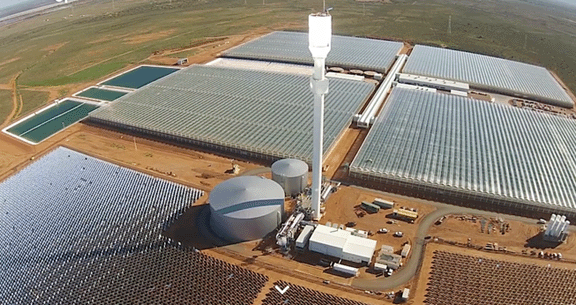
Desert farm grows 180,000 tomato plants using only sun and seawater http://www.mnn.com/your-home/organic-farming-gardening/stories/desert-farm-grows-180000-tomato-plants-using-only-sun-and-seawater
Farms that grow food in arid deserts, without groundwater or fossil fuels, could be the future of agriculture. BRYAN NELSON October 10, 2016, No soil, no pesticides, no fossil fuels, and no groundwater. And yet, a thriving farm in the heart of the arid Australian desert. How is this possible?
An international team of scientists has spent the last six years fine-tuning a system that pipes seawater in from the ocean and desalinates it using a state-of-the-art concentrated solar energy plant. The water is then used to irrigate 180,000 tomato plants grown in coconut husks instead of soil, kept in a network of greenhouses.
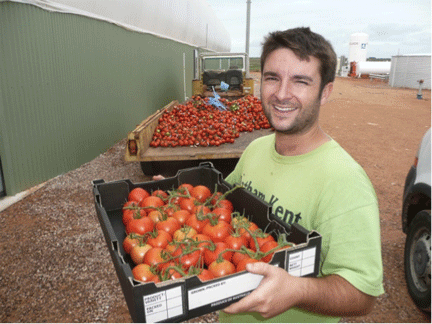 The result is Sundrop Farms, a commercial-scale facility located just off the Spencer Gulf in South Australia that began construction in 2014. Today it’s producing an estimated 17,000 tons of tomatoes per year to be sold in Australian supermarkets.
Given the increasing demand for fresh water around the world — a problem that’s particularly apparent in the sunburned landscape of South Australia — this might just represent future of large-scale farming, especially in coastal desert regions that have previously been non-arable.
The heart of the farm is the 23,000 mirrors that reflect sunlight towards a 115-meter high receiver tower. All of that concentrated sunlight produces an immense amount of power, up to 39 megawatts. That’s more than enough to cover the desalination needs of the farm and supply all the electricity needs of the greenhouses.
The seawater, too, has other purposes besides just irrigation. During scorching hot summers, seawater-soaked cardboard lines the greenhouses to help keep the plants at optimal temperature. Seawater also has the remarkable effect of sterilizing the air, meaning that chemical pesticides are unnecessary.
All in all, the facility cost around 200 million dollars to get up and running. That might sound excessive, but in the long run the facility should save money compared to the costs of conventional greenhouses that require fossil fuels for power. It’s a self-sustaining, cost-efficient design so long as the initial investment can be provided. Facilities similar to the Australian one are already being planned for Portugal and the U.S., as well as another in Australia. Desert areas like those seen in Oman, Qatar and the United Arab Emirates could be next in line.
“These closed production systems are very clever,” said Robert Park of the University of Sydney, Australia, to New Scientist. “I believe that systems using renewable energy sources will become better and better and increase in the future, contributing even more of some of our foods.”
With progressive policies, Scotland could be 50% fuelled by solar and wind, within 15 years
Half of Scotland’s energy could be produced by wind and sunlight in less than 15 years, report says http://www.independent.co.uk/environment/scotland-energy-renewables-half-by-2030-report-wind-solar-a7353831.html Analysis paints a picture of Scotland where fuel poverty is ‘eradicated’, air pollution is slashed and green electricity is a major export Ian Johnston Environment Correspondent, Monday 10 October 2016 Half of all the energy used in Scotland could be produced by renewable technology in less than 15 years, according to a new report.
It painted a picture of a country that exports vast amounts of electricity to the rest of the UK by producing 40 per cent more than it needs, where half of the buses and a third of cars are electric – improving air quality and public health – and where fuel poverty is “eradicated”.
However the report, called The Energy of Scotland, warned that while a low-carbon future was “achievable and desirable”, Scotland was currently on track to miss its climate targets, getting less than 30 per cent of energy from renewables by 2030. title=”10 October 2016 11:03 London”>Writing in the report, commissioned by the Scottish branches of WWF, Friends of the Earth and the RSPB, Lang Banks, WWF-Scotland’s director, said: “Scotland is in the enviable position of having fantastic renewable energy potential.
“Successfully unlocking this potential will not only secure our climate goals but provide the means to deliver economic opportunities across Scotland, bring social benefits and improve public health.”
However he said bringing about this future would require “significant changes to the way we heat our homes and organise our transport” and “new, bold policies”.The report, by consultants Ricardo Energy and Environment, found emissions from electricity power stations could drop to near zero with an “almost entirely renewable” supply, creating 14,000 new jobs.
“A 40 per cent drop in the use of petrol and diesel improves air quality in cities, resulting in better public health,” the report said.
“People are also fitter and healthier thanks to more walking and cycling in renewed cityscapes that are less dominated by cars.
“There is less congestion, with fewer and quieter vehicles on the road.”
Energy Efficiency – not sexy – but it works against climate change
Energy Efficiency Is Key To Taking On Climate Change—Here Are The Numbers That Matter https://www.fastcoexist.com/3064550/energy-efficiency-is-key-to-taking-on-climate-change-here-are-the-numbers-that-matter
Energy efficiency needs to account for one-third of all emissions reductions by 2040. BEN SCHILLER 10.13.16
Energy efficiency isn’t as sexy as inventing new, cleaner forms of power. But, if you care about climate change, you really ought to care about it. Efficiency will need to account for a third of emissions reductions by 2040 if we’re stay within relatively safe global warming limits, according to the International Energy Agency.

“Simply put, there are no realistic or affordable energy and climate change policy without a sizable and vigorous energy efficiency component,” the IEA says in a new report.
The good news is we are becoming smarter about energy use. Energy “intensity”—the amount of energy needed to generate a unit of global GDP—improved by 1.8% last year. That was higher than in 2014, even though energy prices have been falling, which normally encourages people to use more energy, not less.
Between 2000 and 2015, IEA countries—including the U.S. and most of Europe—improved their energy intensity by an average of 14%. That’s the equivalent of 450 million tonnes of oil, or enough to power Japan for a whole year. In all, efficiency saved $490 per person across the IEA area, or cumulative energy spending of $4 trillion.
The bad news is that even this rate isn’t enough to meet the 2040 target. The IEA calls on countries to implement more mandatory efficiency targets—likeour CAFE car efficiency standards—and to spread more efficient lighting, heating, and air conditioning technology. Best-in-class equipment could save 14% of global residential energy consumption, the report says.
See more here.
Britain slips down in sustainable energy ratings
UK loses top 10 spot in global energy ranking for the first time
World Energy Council warns of potential gap in energy supply due to government’s lack of clarity and myriad changes, Guardian, Adam Vaughan, 11 Oct 16, The UK has fallen out of the top 10 of a respected international league table of countries’ energy sectors for the first time.
The World Energy Council blamed the government’s lack of clarity and myriad changes which it said have left the country facing a potential gap in energy supply.
The UK has previously been one of the top performers in the council’s “Trillema Index”, which has ranked countries on energy security, costs and decarbonisation efforts for the last six years.
But the Brexit vote, cuts to renewable energy subsidies and planned changes on foreign ownership have created investment uncertainty and significant challenges for the UK, according to the latest edition of the index for the London-headquartered agency, whose members include energy companies across the world…….
Despite the recent decision to go ahead with new nuclear reactors at Hinkley in Somerset, the UK had a “distinct lack of policy direction”, the council’s chief said……..
The result of the EU referendum vote in July has also cast a cloud over thegovernment’s pledge last year to phase out coal power by 2025, as leaving the single market as part of a hard Brexit “could significantly increase the cost of its energy imports”. Imports via interconnectors to the continent accounted for around 6% of the UK’s electricity supply last year.
Planned changes to rules on foreign ownership of energy infrastructure, announced during May’s review of Hinkley Point C contract, added to the investment uncertainty, the report said.
The council also highlighted government cuts to onshore wind and solar subsidies since it took power, which Office for National Statistics figures showed last week had led solar power installations to crash. The changes could hinder investments in those sectors, the council said. ….. https://www.theguardian.com/environment/2016/oct/11/uk-loses-top-10-spot-in-global-energy-ranking-for-the-first-time?CMP=twt_a-environment_b-gdneco
Google keenly promoting wind energy in Africa
Why Google Cares about Wind Power in Africa Millions of people are coming online, and that requires (renewable) energy, Scientific American By Daniel Cusick, ClimateWire on October 12, 2016
The California internet giant has shown a growing interest in sub-Saharan Africa since it made its first cash outlay three years ago—a $12 million investment in the Jasper Solar Power Project in South Africa’s Northern Cape Province.
The 96-megawatt photovoltaic project, completed in 2014, was built by U.S.-based SolarReserve LLC and is capable of powering roughly 80,000 South African homes.
The Lake Turkana deal, whose financial terms were not disclosed, calls for Google to acquire 12.5 percent of the nearly $700 million project from Vestas Wind Systems A/S of Denmark after the wind farm is completed next year.
“We are investing in clean energy projects like Lake Turkana because they make business sense and can help accelerate the deployment of renewable energy,” a Google spokesperson said in an email to E&E News.
She added that the company sees “a large opportunity in fast-growing markets with rich renewable energy resources, where both the need and the potential are great.”
The ownership group includes lead developers Aldwych International Ltd. of Great Britain and KP&P Africa BV of the Netherlands, with additional financial support from international development funds in Norway, Finland and Denmark.
As with Jasper in South Africa, Google said its wind power investment “will help bring much needed capacity and stability to Kenya’s energy supply, reducing reliance on fossil fuels and emergency diesel generation while providing some of the most cost effective power in the country.”
In total, Google has committed more than $2.5 billion to 22 renewable energy projects around the world, mostly through power purchase agreements and direct ownership of wind and solar farms, officials said. Much of its purchased power goes to support massive Google data centers in the United States and Europe.
But the company sees a future in the developing world, where millions of new internet users are coming online annually……..https://www.scientificamerican.com/article/why-google-cares-about-wind-power-in-africa/
Solar microgrids are changing lives
 Changing lives with solar microgrids, Green Biz, Laurie Guevara-Stone Monday, October 10, 2016 Haiti is the poorest country in the western hemisphere. Only 25 percent of the 10.3 million people in the country have access to electricity. One nonprofit organization is testing a solution that could not only change the lives of the unelectrified in Haiti, but could be a model of how to bring electricity to the 1.2 billion people in the world still living in the dark.
EarthSpark International has built a 93-kilowatt solar-powered microgrid in the small town of Les Anglais (pop. 3,000 in the “downtown” area), which currently supplies clean reliable power to about 2,000 people.
Why a microgrid?
Haiti has more than 30 existing municipal microgrids, but most don’t work. Even when they do function, they run on diesel and operate just a few hours a day, a few days a week. So EarthSpark’s goal was to provide people with 24-hour clean, affordable electricity.
EarthSpark began working in Haiti providing people with small solar home systems and solar lanterns, products that are life-changing tools for people without access to grid electricity. But the organization soon realized that those aren’t the solutions to which everyone aspires. “To truly unlock economic opportunity, people need access to higher levels of electricity than what a solar home system can provide,” Allison Archambault, president of EarthSpark International, told RMI.
“With the right conditions, minigrids can provide energy services in a low-cost sweet spot between small levels of energy consumption that can be effectively served by small stand-alone solar systems and traditional grid extension,” said Eric Wanless, a principal in RMI’s international practice leading the Sustainable Energy for Economic Development initiative.
EarthSpark isn’t the only group focusing on microgrids. Husk Power has brought electricity to 200,000 people in the highly unelectrified state of Bihar in India, using rice husks to fuel microgrids; Powerhive, Devergy and PowerGen are bringing power to East Africa with solar microgrids; and Gham Power is building solar microgrids in rural Nepal.
A microgrid can give residences and businesses enough power to run motors, process agricultural products and power freezers. Plus, much of the electricity used by rural industry is seasonal, such as an agricultural mill, which is used during harvest season and on market days.
“Building an energy system just for that mill would mean an asset that is underutilized much of the time,” said Archambault. “But with a microgrid, you can use that capacity for other uses, and everyone buys down the cost for everyone else. We like to say our system is powerful enough to energize industry, and progressive enough to serve every single customer.”
Tackling technical challenges………
Overcoming logistical challenges
Working in developing countries such as Haiti brings a lot of logistical challenges as well. There is often not a clear process for implementing innovative projects…….
Confronting legal and regulatory challenges
One of the biggest challenges comes in the legal and regulatory framework in Haiti, or lack thereof. ………
Promoting economic development
Residents of Les Anglais not only have access to reliable power 24 hours a day, but are also saving money on their energy expenses. Before the microgrid, they were spending about $10 to $12 each month for kerosene and spending $3 to $4 each month to charge phones (at nearly $0.25 per charge). Now residential microgrid customers are saving 80 percent of their household energy budget, paying about $2 to $3 per month for much better quality power. And EarthSpark’s larger business customers are saving 50 percent over what they were spending on diesel.
EarthSpark’s goal is to build 80 microgrids in the next five years, bringing power to over 200,000 people, a small dent in the 7 million Haitians still living without access to electricity. But for those 200,000 people, it’s a game changer.
“We have small enterprises using electricity for the first time, people starting new businesses. The carpenter now has power tools. The hotel and the mill have been able to drastically reduce their power bills, by switching off their big diesel generators. And people come up to me and tell me their children no longer have the smoke of kerosene burn their eyes when they’re studying,” said Archambault. EarthSpark’s project in Haiti and RMI’s work in sub-Saharan Africa are delivering clean reliable electricity to people and unlocking huge opportunities for rural communities around the world. https://www.greenbiz.com/article/changing-lives-solar-microgrids
1 This Month



26 September – International Day for the Total Elimination of Nuclear Weapons


PLEASE OPPOSE HR 8255 AND S.3639 – bills would accelerate satellite deployment, with no environmental review or safeguards – https://ncstd5li.quorum.us/campaign/169331/
To see nuclear-related stories in greater depth and intensity – go to https://nuclearinformation.wordpress.com
-
Archives
- September 2026 (245)
- August 2026 (330)
- July 2026 (355)
- June 2026 (287)
- May 2026 (306)
- April 2026 (356)
- March 2026 (251)
- February 2026 (267)
- January 2026 (308)
- December 2025 (358)
- November 2025 (359)
- October 2025 (375)
-
Categories
- 1
- 1 NUCLEAR ISSUES
- business and costs
- climate change
- culture and arts
- ENERGY
- environment
- health
- history
- indigenous issues
- Legal
- marketing of nuclear
- media
- opposition to nuclear
- PERSONAL STORIES
- politics
- politics international
- Religion and ethics
- safety
- secrets,lies and civil liberties
- spinbuster
- technology
- Uranium
- wastes
- weapons and war
- Women
- 2 WORLD
- ACTION
- AFRICA
- Atrocities
- AUSTRALIA
- Christina's notes
- Christina's themes
- culture and arts
- Events
- Fuk 2022
- Fuk 2023
- Fukushima 2017
- Fukushima 2018
- fukushima 2019
- Fukushima 2020
- Fukushima 2021
- general
- global warming
- Humour (God we need it)
- Nuclear
- RARE EARTHS
- Reference
- resources – print
- Resources -audiovicual
- Weekly Newsletter
- World
- World Nuclear
- YouTube
-
RSS
Entries RSS
Comments RSS
 nuclear-news