Is the IEA underestimating renewables? Spreading nuclear weapons cost, DW, 26 Mar 18 Gero Rueter Scenarios from the International Energy Agency (IEA) have failed to predict the growth of renewables and overestimated the role of nuclear. Critics say that’s a political choice.
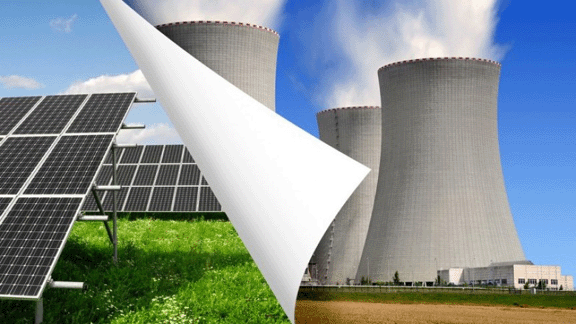
Last year, the world’s photovoltaic power capacity overtook nuclear for the first time – reaching 402 gigawatts, compared to 353 (GW). Wind power outstripped nuclear back in 2014, and by the end of 2017 amounted to 539 GW.
According to the World Wind Energy Association, 2017 saw the installation of 52.6 GW of new wind capacity. The latest estimates from Solar Power Europe put PV capacity installed in that year at 98.9 GW.
New nuclear power facilities going online were modest in comparison – amounting to just 2.7 GW, according to Mycle Schneider, lead author of the World Nuclear Industry Report.
Back in 2010, you might not have predicted such a shift in the global energy mix – at least, not if you were basing your predictions on the International Energy Agency’s annual Word Energy Outlook (WEO), which estimated annual deployment of less than 10 GW of photovoltaic capacity.
According to this scenario, globally installed solar capacity would hit around 85 GW last year – 315 GW less than the actual figure.
Critics say this is part of a pattern of the IEA consistently underestimating the growth of renewables while making unrealistic assumptions about the development of nuclear.
The 2010 WEO estimated that nuclear capacity would reach 470 GW by the end of 2017, over 110 GW more than the current global figure.
And that imbalance has, according to a 2015 study, has continued in subsequent annual WEOs from the IEA, which ignores facts such as “climate protection and divestment of finance from the conventional energy sector.”
Political bias?
Claudia Kemfert, head of the German Institute for Economic Research’s energy and environment department, told DW the IEA has underestimated drop in renewable power costs, as well as the cost of nuclear and fossil alternatives.
“Probably for political and economic reasons, neither the external costs of fossil fuels nor the cost increases of nuclear energy have been factored in,” Kemfert said. “The fossil fuel and nuclear industries have an interest in artificially exaggerating the cost of renewables in order to influence policy in their favor.”
Sven Teske of the Institute for Sustainable Futures at Sydney University, an advisor to the International Panel on Climate Change, told DW he’d been told unofficially that how much nuclear power was included in IEA scenarios was “basically dictated.”
Hans-Josef Fell, president of the Energy Watch Group, says the IEA acts “on behalf of the OECD governments that ultimately oversee it,” and reflects their ongoing commitment to the fossil fuels sector.
And that has serious consequences, Fell says. “It is likely these scenarios are a major culprit in the global community’s failure to put a sufficiently intensive focus on renewable energy over the last ten to 20 years,” he told DW. “It paints a picture of renewables as too expensive and unable to expand fast enough.”…………http://www.dw.com/en/is-the-iea-underestimating-renewables/a-43137071
World invested more in solar energy than coal, gas and nuclear combined in 2017, UN report revealsNew figures show ‘how much can be achieved when we commit to growth without harming the environment,’ says UN Independent UK, Josh Gabbatiss Science Correspondent @josh_gabbatiss
Global investment in renewable energy shot up last year, far outstripping investment in fossil fuels, according to a UN report.
As the price of clean energy technology plummets, it has become an increasingly attractive prospect for world governments.
China was by far the world’s largest investor in renewable energy in 2017, accounting for nearly half of the new infrastructure commissioned.
Utility Dive 29th March 2018. French national utility EDF says it plans to spend 8 billion euros ($9.8
billion) by 2035 in a move to become “the European leader” in energy
storage. EDF’s goal is to develop 10 GW of storage around the world by that
same timeframe. The company already operates 5 GW of storage facilities. In
particular, EDF is targeting the residential sector in France and Europe
with a variety of self-consumption services that use batteries, as well as
Africa where the utility company hopes to develop a portfolio of 1.2
million off-grid customers by 2035 through local partnerships. https://www.utilitydive.com/news/edf-to-invest-nearly-10b-in-energy-storage-by-2035/520212/
Dave Toke’s Blog 1st April 2018, The media is awash with stories of the imminent emergence of ‘subsidy free’
wind and solar power in the UK, but the reality is that the uncompetitive nature of the British electricity market mostly undermines that prospect.
In theory onshore wind power and maybe some solar power projects would be able to generate power to sell at competitive prices on the British
wholesale electricity market.
In practice most of the potential buyers of energy from new renewable energy projects will not be interested in buying
the energy even at cheap prices simply because it conflicts with their own generation portfolios. True, there is a limited possibility for some very
large corporate consumers who are interested in buying green electricity to fund new projects by issuing corporate power purchase agreements (PPAs).
But in reality this market is small, and I have heard this estimated to be no larger than 100 MW a year. That means it would take around 20 years for
not quite 1 per cent of electricity to be supplied this way. PPAs are needed for new renewable energy projects that offer the generators the
certainty that they can be paid a minimum amount for each MWh that they produce for the long term. The UK Government’s PPAs, called contracts for
differences (CfDs), last 15 years. However they are no longer available for onshore wind and solar.
The problem is that most of the market for offering PPAs that can fund new renewable energy projects comes from the big
electricity suppliers, who have been known in the past as the ‘Big Six’.
Only PPAs offered by really large companies will be usually taken seriously enough by banks and and other institutions to enable renewable energy
projects can obtain long term loans or equity. The trouble is that the Big Energy suppliers will usually have little interest in offering long term
PPAs to new renewable energy projects since. For a start they can buy in power at much the same price as the renewable energy generator can offer
without needing to commit themselves to long term agreements.
In 2017 Britain’s greenhouse gas emissions also fell 3% as coal use dropped and renewables climbed, Guardian, Adam Vaughan , 30 Mar 18
Windfarms and solar panels produced more electricity than the UK’s eight nuclear power stations for the first time at the end of last year, official figures show.
Britain’s greenhouse gas emissions also continued to fall, dropping 3% in 2017, as coal use fell and the use of renewables climbed.
Energy experienced the biggest drop in emissions of any UK sector, of 8%, while pollution from transport and businesses stayed flat.
Energy industry chiefs said the figures showed that the government should rethink its ban on onshore wind subsidies, a move that ministers have hinted could happen soon.
Times 29th March 2018, Saudi Arabia has announced a $200 billion plan to build the world’s biggest
solar-power project, which would end the country’s dependence on oil. The
project, which would result in panels taking up vast tracts of the desert
equivalent to a million football pitches, has been secured by Crown Prince
Mohammed bin Salman and could mark a change in the world’s environmental
management.
Telegraph 28th March 2018, Saudi Arabia has cast light on its $200bn (£141bn) plans to cut its
reliance on oil by rolling out the world’s most ambitious solar power
project through a deal with SoftBank. The agreement will drive investment
in a series of solar parks across the kingdom to be built by 2030, capable
of generating enough power for 150 million homes. https://www.telegraph.co.uk/business/2018/03/28/saudi-arabia-curb-oil-addiction-141bn-softbank-solar-deal/
The French utility company said on Tuesday that the planned investment would be used to develop an estimated 10 gigawatts of additional energy storage projects, or roughly twice the total amount of capacity it currently operates.
The utility said it would target energy storage projects in the European market, especially in France, but that it would also pursue opportunities in Africa, including battery storage and storage plus solar projects in Ghana and the Ivory Coast.
U.K. Weighs Tidal Power Contract Aping Hinkley Nuclear Deal, Bloomberg ,By Alex Morales,
Swansea Bay plan could open up 40 billion pounds of spending
U.K. and Welsh ministers seek to forge deal to enable project
U.K. officials are in intensive talks with their Welsh counterparts to kick-start a tidal power plan by copying the controversial contract awarded to Electricite de France SA for its Hinkley Point nuclear power project.
Tidal Lagoon Power Ltd.’s Swansea Bay project would tap the ebb and flow of the tides to generate electricity. It’s been in limbo for 15 months since a government-commissioned review recommended giving it the go-ahead. The delay reflects a reluctance by ministers to accept costs for consumers that were once estimated at double the power price EDF will get.
Amid pressure from more than 100 backbench lawmakers who want the tidal plant to move ahead, ministers are grappling with how to make it palatable. The developer had proposed an initial power price a third higher than Hinkley’s. But an offer of assistance from the Welsh government has changed the game. Officials are now debating a deal on the same terms as Hinkley, according to Richard Graham, a lawmaker with the ruling Conservatives who chairs Parliament’s All-Party Parliamentary Group on Marine Energy. ……..https://www.bloomberg.com/news/articles/2018-03-27/u-k-weighs-tidal-power-contract-matching-hinkley-nuclear-deal
Times 21st March 2018,Onshore wind and solar farms capable of generating more than three times as much power as the new Hinkley Point C nuclear plant could be built without any subsidy from taxpayers in Britain by 2030, energy analysts have forecast.
The plunging costs of the technologies, which were reliant on very high subsidies just a few years ago, could enable investors to build them without any government intervention by the early 2020s, said Aurora Energy Research.
The government has ended subsidy schemes for new onshore wind and solar farms, slowing their development, amid concern about their cost to consumers. Aurora, an Oxford-based consultancy, predicts that the fall in costs has brought the industry to the “cusp of breakthrough in Britain”, whereby such projects could be commercially viable even without subsidies.
It predicts that solar farms capable of generating up to 9 gigawatts and onshore wind farms with a maximum output of 5 gigawatts are likely to be built on this basis by 2030. The prediction is likely to further increase pressure on nuclear developers to show they can be cost competitive. The 3.2-gigawatt Hinkley Point C plant is only viable thanks to a subsidy contract that commits consumers to pay its developers well above the market price for power for 35 years — potentially costing tens of billions of pounds. Renewables have only been made viable by similar commitments from government. https://www.thetimes.co.uk/edition/business/wind-farms-on-course-to-be-free-of-subsidy-qfmpmm8dh
In effect, we are now seeing an egalitarian-individualist alliance against the conservative hierarchists.
even hierarchists cannot ignore economic reality entirely. The South Carolina project has beenabandoned and the Georgia project only survives through a very large federal loan bailout.
Contrast this with casino complexes in Nevada like MGM Resorts not only installing their own solar photovoltaic arrays but paying many millions of dollars to opt out from the local monopoly electricity supplier. They have campaigned successfully to win a state referendum supporting electricity liberalisation.
If recent trends continue for another two years, the global share of electricity from renewables excluding hydropower will overtake nuclear for the first time.
Even 20 years ago, this nuclear decline would have greatly surprised many people – particularly now that reducing carbon emissions is at the top of the political agenda.
On one level this is a story about changes in relative costs. The costs of solar and wind have plunged while nuclear has become almost astoundingly expensive.
Culture wars
The seminal text in this field, Risk and Culture (1982), by the British anthropologist Mary Douglas and American political scientist Aaron Wildavsky, argues the behaviour of individuals and institutions can be explained by four different biases:
Individualists: people biased towards outcomes that result from competitive arrangements;
Hierarchists: those who prefer ordered decisions being made by leaders and followed by others;
Egalitarians: people who favour equality and grassroots decision-making and pursue a common cause;
Fatalists: those who see decision-making as capricious and feel unable to influence outcomes.
The first three categories help explain different actors in the electricity industry. For governments and centralised monopolies often owned by the state, read hierarchists. For green campaigning organisations, read egalitarians, while free-market-minded private companies fit the individualist bias.
The priorities of these groups have not greatly changed in recent years. Hierarchists tend to favour nuclear power, since big power stations make for more straightforward grid planning, and nuclear power complements nuclear weapons capabilities considered important for national security.
Egalitarians like Greenpeace and Friends of the Earth usually oppose new nuclear power plant and favour renewables. Traditionally they have worried about radioactive environmental damage and nuclear proliferation. Individualists, meanwhile, favour whichever technologies reduce costs.
These cultural realities lie behind the problems experienced by nuclear power. To compound green opposition, many of nuclear power’s strongest supporters are conservative hierarchists who are either sceptical about the need to reduce carbon emissions or treat it as a low priority.
Hence they are often unable or unwilling to mobilise climate change arguments to support nuclear, which has made it harder to persuade egalitarians to get on board.
This has had several consequences.
Green groups won subsidies for renewable technologies by persuading more liberal hierarchists that they had to address climate change – witness the big push by Greenpeace and Friends of the Earth for the feed-in tariffs that drove solar uptake in the late 2000s, for example. In turn, both wind and solar have been optimised and their costs have come down.
Nuclear largely missed out on these carbon-reducing subsidies. Worse, greens groups persuaded governments as far back as the 1970s that safety standards around nuclear power stations needed to improve. This more than anything drove up costs. As for the individualists, they used to be generally unconvinced by renewable energy and sceptical of environmental opposition to nuclear. But as relative costs have changed, they have increasingly switched positions.
The hierarchists are still able to use monopoly electricity organisations to support nuclear power, but individualists are increasingly pressuring them to make these markets more competitive so that they can invest in renewables more easily.
In effect, we are now seeing an egalitarian-individualist alliance against the conservative hierarchists.
Both sides of the pond
Donald Trump’s administration in the US, for example, has sought subsidies to keep existing coal and nuclear power stations running.
This is both out of concern for national security and to support traditional centralised industrial corporations – classic hierarchist thinking.
Yet this has played out badly with individualist corporations pushing renewables. Trump’s plans have even been rejected by some of his own appointments on the Federal Energy Regulatory Commission.
In similarly hierarchist fashion, electricity supply monopolies in Georgia and South Carolina started building new nuclear power stations after regulatory agencies allowed them to collect mandatory payments from electricity consumers to cover costs at the same time.
Yet even hierarchists cannot ignore economic reality entirely. The South Carolina project has beenabandoned and the Georgia project only survives through a very large federal loan bailout.
Contrast this with casino complexes in Nevada like MGM Resorts not only installing their own solar photovoltaic arrays but paying many millions of dollars to opt out from the local monopoly electricity supplier. They have campaigned successfully to win a state referendum supporting electricity liberalisation.
The UK, meanwhile, is an example of how different biases can compete. Policy has traditionally been formed in hierarchical style, with big companies producing policy proposals which go out to wider consultation.
It’s a cultural bias that favours nuclear power, but this conflicts with a key priority dating back to Thatcher that technological winners are chosen by the market.
This has led policymakers in Whitehall to favour both renewables and nuclear, but the private electricity companies have mostly refused to invest in nuclear, seeing it as too risky and expensive.
The only companies prepared to plug the gap have been more hierarchists – EDF, which is majority-owned by France, and Chinese state nuclear corporations.
Even then, getting Hinkley C in south-west England underway – the first new nuclear plant since the 1990s – required an extensive commitment by the UK treasury to underwrite bank loans.
There is also an embarrassingly high price to be paid for the electricity over a very long 35-year period. Such has been the bad publicity that it’s hard to imagine a politician agreeing to more plant on such terms.
Where does this reality leave hierarchists? Increasingly having to explain prohibitive nuclear costs to their electorates – at least in democracies. The alternative, as renewable energy becomes the new orthodoxy, is to embrace it.
In Australia, for example, a big utility company called AGL is trying to seduce homeowners to agree to link their solar panels to the company’s systems to centralise power dispatch in a so-called a “virtual power plant”.
When the facts change, to misquote John Maynard Keynes, you can always change your mind.
Energy Post 12th March 2018, The experience of the German Energiewende shows that increasing amounts ofrenewable energy on the power system, while at the same time reducing
inflexible baseload generation, does not harm reliability write Michael Hogan, Camille Kadoch, Carl Linvill and Megan O’Reilly of the Regulatory Assistance Project (RAP).
American policymakers who are still skeptical can look across the Atlantic, to Germany, for a concrete example of a successful transition away from traditional baseload, the authors note.
Numerous studies sponsored by utilities, system operators, the national
labs, and others show that a large share of variable renewable energy
production can be integrated while keeping the lights on, without any
valuable role for traditional baseload.
No study, not even by the US Department of Energy, which examined this issue in an August 2017 Staff Report on Electricity Markets and Reliability, has found evidence that baseload generation is required for reliability. Most studies have found that reliability and least cost are best served by reducing the share of inflexible baseload generation.
Germany is meeting nearly a fifth of its electricity requirements with VREs while retiring inflexible thermal generation, the nation has not experienced reliability problems on either the distribution or bulk electric system. If anything, government data show that the reliability of the German system has increased. http://energypost.eu/how-german-energiewendes-renewables-integration-points-the-way/
“The nuclear disaster was not a natural disaster, it was a very man-made disaster,” Watanabe says. “So we felt that there was now a need for clean energy and greater energy independence.”
“It was at that symposium that I started to really think about the need for an energy shift away from nuclear power and about how rich the prefecture of Fukushima is in renewable resources,” Sato says.
“Nuclear power companies are not prepared for the cost of decommissioning and could in some cases go bankrupt. Banks and pension funds have lent them a lot of money because they have been regarded as stable, so bankruptcies could become a national financial problem. This would be difficult for the government to handle and might directly hurt pensioners,” he says. “But now the government is just hiding the problem and postponing managing it.”
Fukushima looks to renewable energy sources in the aftermath of nuclear disaster, Japan Times, BYKAJSA SKARSGÅRD ,
Yauemon Sato | CHRISTINA SJOGREN11 Mar 18,
Steam rises from outdoor pools overlooking a waterfall at a 90-year-old hotel in Fukushima Prefecture’s Tsuchiyu Onsen.
“What has saved us since the disaster are the loyal regular guests and the new visitors who have come to study our town’s renewable energy plant. Without them, I’m sure we would have had to close,” says Izumi Watanabe, who has been director of Sansuiso Tsuchiyu Spa for 37 years.
“People come from other onsen areas all over Japan to learn how they can become energy independent and how the binary plant we have doesn’t affect our hot springs,” she says, challenging the preconception that onsen communities, fearing a negative impact on their tourism business, typically hold back the development of geothermal energy in Japan.
Watanabe was at a meeting in the city of Fukushima when the Great East Japan Earthquake struck seven years ago. She returned to Tsuchiyu Onsen to find her hotel intact, but two other hotels in the area damaged and the entire community without power.
or three snowy days, Watanabe sheltered 70 of her own and other hotels’ guests without electricity, telephones or working internet. Gathered together, they ate whatever stored food they could find. Over the next six months, her spa served as accommodation for police and rescue workers, grieving families and people displaced by the tsunami and nuclear crisis.
In total, this town of about 340 residents took in around 1,000 evacuees after the 2011 disasters. Five of the 16 hotels in Tsuchiyu Onsen have since gone out of business: two as a result of earthquake damage, the others on the back of a decline in visitor numbers from approximately 230,000 a year to about 70,000 as rumors of elevated radiation levels swirled. Members of the local community gathered together in October 2011 to discuss their future at what was dubbed the “Tsuchiyu Onsen reconstruction conference.” The locals decided they couldn’t simply go back to doing what they had done before — something new was needed to revive the town and create a safer future.
“The nuclear disaster was not a natural disaster, it was a very man-made disaster,” Watanabe says. “So we felt that there was now a need for clean energy and greater energy independence.”
A renewable energy plant and shrimp farm……….
A local, national concern
An hour’s drive inland, past Mount Adatara and Mount Bandai in the city of Aizu-Wakamatsu, people also started organizing after the nuclear disaster. In July 2011, around 200 people met in the sake brewery owned by Yauemon Sato, a ninth-generation brewer, to discuss the disaster and the future.
“It was at that symposium that I started to really think about the need for an energy shift away from nuclear power and about how rich the prefecture of Fukushima is in renewable resources,” Sato says.
Sato had no background in electricity production, but he did have experience in trying to get small breweries into markets dominated by larger manufacturers. He took one of the leading roles in the growing community power movement.
With the help of the Institute for Sustainable Energy Policies, which had also worked to promote locally owned renewable electricity production before the disaster, Aizu Electric Power Co. was established to manage the planned solar parks.
Today, the company has 70 solar power sites and Sato has become a vocal critic of the large nuclear- and fossil-fuel companies that control the grid through regional monopolies, thereby hindering the new renewable energy companies from getting into the market.
The monopolies argue that they are protecting the stability of the grid, so at present newcomers in some regions can only connect a maximum voltage of 50 kilowatts onto the network.
“This is a severe problem,” Sato says. “In 2020, the government is going to separate the power transmission business from the power production business, but these big electric companies are creating sister companies to run the grid, so it will still be in the control of the same big companies and continue to be difficult for other producers to use.”
The Aizu region is where shogun Tokugawa Yoshinobu’s rebels fought one of the last big battles against government troops in 1868. The people’s rights movement flourished here after the civil war. It matters here that it is the people of Fukushima who have paid the ultimate price for the nuclear power that was sold mainly to Tokyo.
Aizu Electrical Power Co., its logo a fist held up in the air over the letters AiPower, is challenging the electricity establishment of Japan, and is part of a bigger movement.
The first World Community Power Conference was held in the city of Fukushima in November 2016 on the same day as the Paris climate accord came into force. One of the organizers was the Japan Community Power Association, in which Sato is a board member. He is also the vice president of Genjiren, an anti-nuclear power association that, with the help of the former prime ministers Junichiro Koizumi and Morihiro Hosokawa, pitched a bill to the opposition parties in January calling for an immediate halt to nuclear power, together with a more ambitious national goal for renewables.
“Finally I feel that we have a political movement for an energy shift,” Sato says. “We want to make this a national citizens’ movement.”
Unsustainable politics defied
The grass-roots movement pushing for renewables is not alone. Both at home and abroad, the Japanese government has been criticized for failing to embrace broader renewable energy policies in the wake of the 2011 disasters while remaining open to the construction of additional coal plants and nuclear reactor restarts.
……… Tomas Kaberger, executive board chairman of the Renewable Energy Institute in Tokyo. believes the government is willing to restart more reactors because it fears the financial consequences of failing to do so. The reactors are valuable for the balance sheets of the power companies, but in reality they represent a significant decommissioning liability.“Nuclear power companies are not prepared for the cost of decommissioning and could in some cases go bankrupt. Banks and pension funds have lent them a lot of money because they have been regarded as stable, so bankruptcies could become a national financial problem. This would be difficult for the government to handle and might directly hurt pensioners,” he says. “But now the government is just hiding the problem and postponing managing it.”…….https://www.japantimes.co.jp/life/2018/03/10/environment/fukushima-looks-renewable-energy-sources-aftermath-nuclear-disaster/#.WqWVhx1ubGg
Thorium ‒ a better fuel for nuclear technology? Nuclear Monitor, by Dr. Rainer Moormann 1 March 2018 An important, detailed critique of thorium by Dr. Rainer Moormann, translated from the original German by Jan Haverkamp. Dr. Moormann concludes:
“The use of technology based on thorium would not be able to solve any of the known problems of current nuclear techniques, but it would require an enormous development effort and wide introduction of breeder and reprocessing technology. For those reasons, thorium technology is a dead end.”
Author: Dr. Rainer Moormann, Aachen (r.moormann@gmx.de) Thorium is currently described by several nuclear proponents as a better alternative to uranium fuel.
Thorium itself is, however, not a fissile material. It can only be transformed into fissile uranium-233 using breeder and reprocessing technology. It is 3 to 4 times more abundant than uranium.
Concerning safety and waste disposal there are no convincing arguments in comparison to uranium fuel. A severe disadvantage is that uranium-233 bred from thorium can be used by terror organisations for the construction of simple but high-impact nuclear explosives. Thus development of a thorium fuel cycle without effective denaturation of bredfissile materials is irresponsible.
Introduction
Thorium Introduction
Thorium (Th) is a heavy metal of atomic number 90
(uranium has 92). It belongs to the group of actinides, is
around 3 to 4 times more abundant than uranium and is
radioactive (half-life of Th-232 as starter of the thorium
decay-chain is 14 billion years with alpha-decay). There
are currently hardly any technical applications. Distinctive
is the highly penetrating gamma radiation from its decaychain
(thallium-208 (Tl-208): 2.6 MeV; compared to
gamma radiation from Cs-137: 0.66 MeV). Over the past
decade, a group of globally active nuclear proponents is
recommending thorium as fuel for a safe and affordable
nuclear power technology without larger waste and
proliferation problems. These claims should be submitted
to a scientific fact check. For that reason, we examine
here the claims of thorium proponents.
Dispelling Claim 1: The use of thorium expands the
availability of nuclear fuel by a factor 400
Thorium ‒ a better fuel for nuclear technology? Nuclear Monitor, by Dr. Rainer Moormann 1 March 2018
Thorium itself is not a fissile material. It can, however, be
transformed in breeder reactors into fissile uranium-233
(U-233), just like non-fissile U-238 (99.3% of natural
uranium) can be transformed in a breeder reactor to fissile
plutonium. (A breeder reactor is a reactor in which more
fissile material can be harvested from spent nuclear fuel
than present in the original fresh fuel elements. It may be
sometimes confusing that in the nuclear vocabulary every
conventional reactor breeds, but less than it uses (and
therefore it is not called a breeder reactor).)
For that reason, the use of thorium presupposes the use
of breeder and reprocessing technology. Because these
technologies have almost globally fallen into disrepute, it
cannot be excluded that the more neutral term thorium is
currently also used to disguise an intended reintroduction
of these problematic techniques.
The claimed factor 400: A factor of 100 is due to the
breeder technology. It is also achievable in the uraniumplutonium
cycle. Only a factor of 3 to 4 is specific to
thorium, just because it is more abundant than uranium
Guardian 2nd March 2018, The richest households should pay £410 a year more towards supporting
energy subsidies for wind farms, solar rooftops and home insulation
schemes, government-funded researchers have urged.
The UK Energy Research Centre (Ukerc) said that shifting environmental and social levies off
electricity bills and instead loading them on to general taxation would
reduce the cost of energy for more than two thirds of households. The
researchers argued the current approach to funding low-carbon power and
energy efficiency was regressive.
The poorest households spend 10% of their income on heating and keeping the lights on, compared to 3% for the
richest.
The report by Ukerc found that shifting the costs to taxation
would save the poorest 10% of households £102 a year, “a significant
difference for them”. Meanwhile the 10% of the country with the highest
income would pay an extra £410 a year, “a relatively small difference”
for such earners.
The two high income brackets below the richest group
would see rises of between £26 and £102 a year, while the remaining 70%
would see no change or a decrease.
John Barrett, professor of energy and climate policy, who worked on the analysis, said the status quo was hurting
the switch to greener energy. Subsidies for low-carbon power cost
billpayers £5.2bn in 2016-17 but are projected by the Treasury to rise to
£8.6bn in 2024-25 as new wind farms and other projects come online.
Campaigners have said for years that funding green energy subsidies through
energy bills is regressive because the poor are disproportionately
affected, but there has been little political appetite for a change. https://www.theguardian.com/environment/2018/mar/02/richest-uk-households-should-pay-more-to-fund-clean-energy









 nuclear-news