Robot boats, drones, artificial intelligence to repair Britain’s repair offshore wind farms
Britain’s seas to repair offshore wind farms within two years, a coalition
of arms makers, space scientists and green energy experts said yesterday. A
£4 million project funded by the government will develop an autonomous
mothership that will transport a fleet of self-piloting drones, which will
carry a swarm of six-legged, insect-like robots known as Bladebugs. These
will use suction pads to cling to the blades of wind turbines and assess
them for wear and tear. They should also be able to carry out basic repairs
such as sanding and repainting damaged areas. The system will also make use
of artificial intelligence techniques pioneered by Nasa to run unmanned
space missions. It will be tested at Levenmouth in Fife using a wind
turbine owned by a renewable energy research facility funded by the
government.
https://www.thetimes.co.uk/article/182d58a8-817f-11e9-bb89-165499dc1684
In Kenya, 87% of the electricity is from renewal sources
|
The Best Summary Of Kenya Renewable Energy (& Dirty Energy) You Can Find, Clean Technica, David Zarembka, 24 May 19 I do not need to feel guilty about contributing to global warming when my grandchildren turn on the TV to watch cartoons. This is because I live in rural, western Kenya, where 87% of the electricity is from renewal sources — the nirvana of Green Deal activists.With a population of almost 50 million (one-seventh the size of the US population), electricity capacity is only 2370 MW and peak demand is only 1770 MW. The average Kenyan consumes only 167 kWh of electricity per year. Kenyans also contribute only 0.03 percent of worldwide carbon admission to the atmosphere each year, equal to about 1 percent of what each American contributes.
It is useful to study the sources of electricity in Kenya to see how this renewable rate is achieved.
In 2017, there was a drought and the water levels in the lakes behind the dams that produce electricity fell too low to generate their normal amount of electricity. Then, as frequently happens in a climate such as Kenya’s, in 2018 there was major flooding and all the dams on the Tana River, including Masinga Dam, overflowed, leading to flooding in the lower reaches of the river. Hydropower cannot be considered a reliable source of power, so alternative sources need to be available.
The wind farm is sited in one of the best places for wind in the world. The wind blows off of Lake Turkana and is funneled between two hills, giving an extremely high wind potential. The project uses 365 Vestas 850kW wind turbines. In this day and age, I was disappointed that the wind farm used such small turbines, but the problem was transporting the turbines over 750 miles from the coast on two-lane roads. There is a second smaller wind farm in the Ngong Hills near Nairobi. Originally, it had a capacity of 5.1 MW, but it is now being upgraded with more turbines to 25.5 MW.
|
|


Renewable energy, replacing nuclear plans with solar, is the obvious way forward for Jordan
Since renewable sources of energy are getting more promising in the country, and domestic gas production has risen, it is time to close the door on nuclear projects and rely more on other sources of energy.
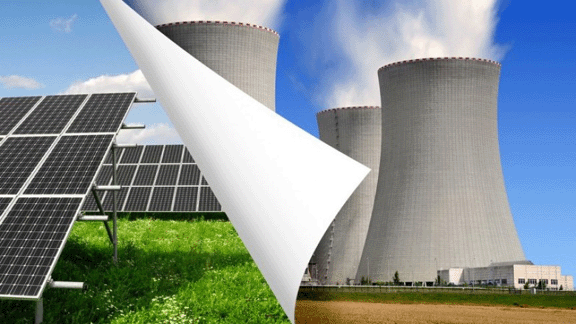 Replace nuclear with renewables http://www.jordantimes.com/opinion/editorial/replace-nuclear-renewables May 22,2019 Head of the Lower House’s Energy and Mineral Resources Committee Haytham Ziadin raised recently, and rightly so, the viability of the plan to build a nuclear plant to satisfy the energy needs of the country. Ziadin went as far as calling for ending altogether all plans to build such a plant, and called them simply as squandering of badly-needed funds.
The comments of the head of the Lower Houses’ Energy and Mineral Resources Committee must be seen against the backdrop of an earlier ambitious plan to construct a huge nuclear plant, by signing first an agreement to do so with Russia’s Rosaton agency in 2015 for this purpose that would cost $10 billion at a time when the country is dry of funds and nearly broke! The defunct nuclear plant project would have generated only 2,000 Megawatts of electricity anyway. The cancelled deal was replaced by a less ambitious project to build smaller nuclear reactors.
In retrospect though, the idea to go nuclear in the country was marred with strong objections from several well-informed sources in the country, which raised the spectrum of its safety and the non-availability of sufficient amounts of water anywhere in the country for cooling purpose.
The economic feasibility of any such project was always on the minds of various shades of opinion on a national nuclear plant. When Aqaba was dropped as a site for this purpose due to strong objections from different circles, the sponsors of the nuclear plant project shifted their attention to other regions of the country, despite the fact that water resources are scant and the country can ill-afford depleting whatever is left of precious water on a dubious nuclear plant.
An increasing number of developed countries with a wide experience in nuclear energy have begun to phase out nuclear energy plants for safety reasons, among them Germany, so why would Jordan opt to go the other way?
When all is considered, the limited financial resources available to the country, in addition to rising safety hazards associated with nuclear plants, Ziadin and like-minded cautious people are right in objecting to the construction of even small nuclear reactors.
According to the Minister of Energy and Minerals Resources Hala Zawati, the country is now producing 11 per cent of our electricity by renewable energy sources and is projected to produce no less than 20 per cent of its energy needs by solar and wind sources of energy by 2021.
On balance, whatever benefits that nuclear plants may have for Jordan, they are outweighed by lack of financial resources, high safety risks associated with nuclear plants, shortage of water resources in all parts of the country and the lack of an appropriate geographic area for any such nuclear project.
Since renewable sources of energy are getting more promising in the country, and domestic gas production has risen, it is time to close the door on nuclear projects and rely more on other sources of energy.
UK Labour’s bold energy policy on nationalising the grid
Ecologist 16th May 2019 The national grid would be nationalised under a Labour government so that
£13 billion would no longer be paid to shareholders each year and more
investment would be targeted at decarbonisation, the Shadow Business
Secretary, Rebecca Long Bailey, announced today. Heat and electricity would
be made a “human right for all” under the radical new policy which has the
personal support of Jeremy Corbyn, the Labour party leader. A Labour party
spokesperson said: “Privatisation of the UK’s energy grid is ripping off
customers. 25 percent of energy bills is paid out to network companies.
This is used to line the pockets of shareholders, with over £13 billion
paid out in dividends over the last five years.”
https://theecologist.org/2019/may/16/labours-green-industrial-revolution
UK Labour Party’s plan for a Green Industrial Revolution
Solar Power Portal 16th May 2019 The Labour Party has announced plans to install solar one 1.75 million homes as part of a huge energy sector shake-up. The plans would see solar
installed on 1 million social homes in a bid to tackle fuel poverty, while
a series of interest free loans, grants and regulatory changes will help
enable an additional 750,000 domestic installs. Full details of the plans
are to be announced by Labour Party leader Jeremy Corbyn later today. The
party said the policies stood to create nearly 17,000 jobs, while raising
as much as £66 million for local authorities through the export of surplus
generation. Corbyn said that the party’s self-styled Green Industrial
Revolution would benefit homeowners and revive parts of the country through
the creation of new industries.
UK’s Conservative govt increases tax on domestic solar, despite its goal to fight climate change
 The UK can’t fight the climate emergency when the Tories are entirely opposed to
renewables like solar. The party’s decision to increase tax on domestic
solar power shows that its head is still firmly in the sand.
power? The real reason for this tax hike is that domestic solar has proved
too popular. The cost of solar panels have plummeted and people
increasingly see them as desirable improvements to their homes.
largely centralised energy grid. It also butts up against seemingly
ideological opposition to renewable energy in the current Conservative
Party. The decision to increase tax on domestic solar power needs to be
considered alongside its support of fracking for gas, billions of pounds of
subsidies to continue to pump fossil fuels out of the North Sea, and
resistance to onshore wind turbines.
UK’s Committee on Climate Change sinks nuclear power in the UK in favour of renewables.
|
Dave Toke’s Blog 10th May 2019 Committee on Climate Change sinks nuclear power in the UK in favour of renewables. Few people seem to have noticed how the Committee on Climate
Change, in their ‘Net Zero’ report (net zero carbon emissions for 2050 for the UK), have effectively junked nuclear power in favour of renewable energy. Indeed a careful reading of the evidence produced by the CCC
completely upends the former received wisdom that renewable energy could not, on its own, achieve the UK’s long term carbon emission reduction targets. The late David McKay’s argument (see ‘Sustainable Energy without
hot air’) that large quantities of nuclear power were necessary have been quietly sidelined by the CCC. Rather, the evidence presented by the CCC says that not only can renewables do the whole job (on the supply side, having taken account of demand reduction measures), but renewables can do things much more cheaply than either nuclear power or carbon capture and storage. The CCC argues that investment in renewable energy will save
consumers money, whilst investment in nuclear power and carbon capture and storage will cost a lot of money (eg see Table 2.3 page 43). http://realfeed-intariffs.blogspot.com/2019/05/committee-on-climate-change-sinks.html |
|
Netherlands’ creative solar power initiative – archipelago of islands made up of sun-tracking solar panels
Guardian 21st April 2019 Dutch engineers are building what will be the world’s largest archipelago of islands made up of sun-tracking solar panels. Growing resistance to the
construction of wind turbines or fields of solar panels on land has led the
renewable energy industry to look for alternative options. Large islands of
solar panels are under construction or already in place in reservoirs and
lakes across the Netherlands, China, the UK and Japan. In a development
that is to become the largest of its type in the world, construction will
begin this year on 15 solar islands on the Andijk reservoir in north
Holland. The islands, containing 73,500 panels, will have the
sunflower-like ability to move to face the light.
Pumped storage hydro could fill nuclear nuclear energy gap
 Pumped storage hydro could fill nuclear nuclear energy gap https://www.thenational.scot/news/17588663.pumped-storage-hydro-could-fill-nuclear-nuclear-energy-gap/, A SCOTTISH company has called for the UK Government to put pumped storage hydro (PSH) at the heart of its strategy to meet the challenge of providing a secure, low-carbon electricity supply in the coming decades. Pumped storage hydro could fill nuclear nuclear energy gap https://www.thenational.scot/news/17588663.pumped-storage-hydro-could-fill-nuclear-nuclear-energy-gap/, A SCOTTISH company has called for the UK Government to put pumped storage hydro (PSH) at the heart of its strategy to meet the challenge of providing a secure, low-carbon electricity supply in the coming decades.
|
|
Indian Point nuclear station shut down for nearly two weeks: electricity maintained by gas and renewables
|
Behind the scenes, though, something occurred that made all that possible. In the days after Indian Point powered down — a rare occurrence prompted by a malfunction in one reactor and scheduled spring maintenance in the other — the state’s electric grid pivoted. With an assist from the grid’s overseers, the state’s energy resources shifted in a way that could offer a preview of what’s to come in the years ahead when Indian Point is scheduled to shut down for good…….. Nuclear power generated by three upstate plants decreased to 2,711 megawatts on March 18 from 4,240 megawatts on March 13, the data show. On just two of the seven days, the contribution from solar and wind power was more than 1,000 megawatts. “Natural gas is filling the gap,” said Darren Suarez, who keeps track of the state’s daily energy mix for the Business Council of New York state. “It’s the largest dispatchable resource that’s available at that point in time and we’d expect it to fill the gap.”…… those who monitor the state’s fuel mix say Indian Point’s shutdown provided a rare opportunity for a glimpse at what lies ahead unless renewable sources of power gain a larger percentage of the state’s energy mix. A snapshot in time taken from NYISO’s real-time dashboard, which is updated every five minutes, offers some insight into the state’s current fuel mix. For example, on April 1, wind and solar contributed about 6.5 percent of the state’s energy mix while another renewable, hydropower, was at 28.43 percent, NYISO data show. New York has the largest hydroelectric plant east of the Rockies in Niagara Falls……. Transmission of power problemGrid watchers say in order to add more renewables to the downstate grid, the state will need to resolve a transmission bottleneck that prevents upstate power from getting down into the Lower Hudson Valley and points south……… https://www.poughkeepsiejournal.com/story/news/2019/04/10/indian-point-shutdown-natural-gas-filled-nuclear-energy-gap/3417635002/ |
|

UK’s National Grid prepares for 100 per cent renewable energy by 2025.
to the Australian Energy Market Operator, says it is preparing to change
its systems so it can operate the electricity grid with 100 per cent
renewable energy by 2025.
transition to renewables, but the progress in other countries is usually
overlooked.
out coal completely by 2025 and the grid operator says it needs to develop
a system in which it doesn’t need coal or gas back-up. The document
identifies the areas where traditional generation has delivered services
such as inertia, frequency control and voltage, which will now have to come
from wind and solar, plus various storage technologies and other “demand
side” options. This will require a re-design of the markets to better
represent the new technologies and the passing of the old ones. It has now
set a work plan that sets various deadlines in coming years, and tenders
for providers of new technologies.
https://reneweconomy.com.au/uks-national-grid-operator-gets-ready-for-100-renewables-by-2025/
To increase energy self-sufficiency after the 2011 nuclear disaster, renewables are Japan’s only option.
|
Rethinking Japan’s Energy Security 8 Years After Fukushima
|
|
|
Britain now needs a Green New Deal
Times 7th March 2019 Britain needs a new economy that works for everyone and to move beyond the
old, broken systems and status quo that left many people behind. A green
new deal for the UK could give us just that. Climate change has muscled its
way back onto the political agenda. It was debated by MPs last week for the
first time in two years.
It seems that the momentum around Alexandria
Ocasio-Cortez and Senator Ed Markey’s green new deal in the US, the
audacious climate march on Westminster by schoolchildren last month and
increasingly rising temperatures may have finally jolted our politicians
out of their climate stupor.
Four months ago, a group of experts on the
Intergovernmental Panel on Climate Change (IPCC) delivered the news that
the world must halve carbon emissions in a little over a decade. Responding
would require an almighty push to green our economy – one that would touch
on every aspect of our lives.
Despite this stark warning from scientists,
the political establishment in Westminster barely flinched. There was no
commitment to redouble our efforts, no renewed urgency or call to action.
Instead, our politics continued to be consumed by Brexit. But the IPCC
report was a sobering wake-up call for many. A movement of activists in the
US, backed by a new generation of Democrats, including the Justice
Democrats, are reacting with the urgency needed. The green new deal – an
idea that came from organisations including the New Economics Foundation
(NEF) a decade ago – has emerged as a forceful response.
The idea is
simple: an unprecedented mobilisation of resources to achieve 100 per cent
renewable energy and eliminating greenhouse gas emissions within a decade
while creating millions of jobs and lifting living standards.
https://www.thetimes.co.uk/article/0ab3eb08-403c-11e9-aa0a-30b9d78dd63b
Atlanta Adopts Plan To Get Off Fossil Fuels And Nuclear By 2035
https://www.wabe.org/atlanta-adopts-plan-to-get-off-fossil-fuels-and-nuclear-by-2035/
The goal is to have Atlanta use renewable energy, like wind and solar, and move away from power sources like coal, natural gas and nuclear.
In the plan approved by City Council, both the city of Atlanta and all residences and businesses in it would achieve that goal by 2035. That’s a change from the original proposal that set a deadline of 2025 for city operations, and 2035 for everything and everyone else.
The City Council had already voted unanimously to transition to what it calls clean energy, but Monday’s vote officially adopts the plan laying out how to do, and modifies those earlier dates. The resolution emphasizes finding ways to save energy and to make sure the switch is affordable.
Energy companies should be planning for an industrial revolution driven by renewables
FT 4th March 2019 Nick Butler: A radical outlook needs strategy to match. Energy companies should be planning for an industrial revolution driven by renewables. By
2035, renewables (solar and wind) will account for more than 50 per of
global power generation; electric vehicles will be the low-cost option for
car, van and small-truck drivers; oil demand will be declining; and gas
demand will have peaked.
growing global economy and a still-rising population. This is not, as you
might imagine, the latest summary of aspirations from a campaign group such
as Greenpeace or Friends of the Earth. Nor is it an ambitious claim by one
of the renewables trade associations.
drawn from a serious, considered projection produced by McKinsey, the
global management consultancy. The key is the falling cost of renewables,
which are set “to become cheaper than existing coal and gas in most regions
by 2030”, McKinsey says. That will encourage electrification across the
global economy, driving efficiency by replacing less productive forms of
supply.
industrial revolution. The 20th-century energy economy, centred on coal and
oil, is giving way to something very different. And this transition has
ceased to be a matter for the distant future or something that can be
pushed off by industry leaders to the next generation of executives. The
complacency that smothers hard thinking in most of the major energy
companies is outdated. In an industry that thinks on a 20-year horizon,
2035 is within the immediate planning horizon.
now. Establishing a corporate strategy for producing value in very
different market conditions should be a priority for all in the sector. We
are entering the season when energy companies produce their annual reports
and hold their AGMs. Shareholders, large and small, would be well advised
to ask the managers and non-executives who work for them to set out in
detail their plans for the transition. I would be delighted to publish a
collection of the answers.
https://www.ft.com/content/f3a201d6-3a7b-11e9-b72b-2c7f526ca5d0
1 This Month



26 September – International Day for the Total Elimination of Nuclear Weapons


PLEASE OPPOSE HR 8255 AND S.3639 – bills would accelerate satellite deployment, with no environmental review or safeguards – https://ncstd5li.quorum.us/campaign/169331/
To see nuclear-related stories in greater depth and intensity – go to https://nuclearinformation.wordpress.com
-
Archives
- September 2026 (206)
- August 2026 (330)
- July 2026 (355)
- June 2026 (287)
- May 2026 (306)
- April 2026 (356)
- March 2026 (251)
- February 2026 (267)
- January 2026 (308)
- December 2025 (358)
- November 2025 (359)
- October 2025 (375)
-
Categories
- 1
- 1 NUCLEAR ISSUES
- business and costs
- climate change
- culture and arts
- ENERGY
- environment
- health
- history
- indigenous issues
- Legal
- marketing of nuclear
- media
- opposition to nuclear
- PERSONAL STORIES
- politics
- politics international
- Religion and ethics
- safety
- secrets,lies and civil liberties
- spinbuster
- technology
- Uranium
- wastes
- weapons and war
- Women
- 2 WORLD
- ACTION
- AFRICA
- Atrocities
- AUSTRALIA
- Christina's notes
- Christina's themes
- culture and arts
- Events
- Fuk 2022
- Fuk 2023
- Fukushima 2017
- Fukushima 2018
- fukushima 2019
- Fukushima 2020
- Fukushima 2021
- general
- global warming
- Humour (God we need it)
- Nuclear
- RARE EARTHS
- Reference
- resources – print
- Resources -audiovicual
- Weekly Newsletter
- World
- World Nuclear
- YouTube
-
RSS
Entries RSS
Comments RSS
 nuclear-news