Renewables – onshore wind from Europe- enough to power the world
|
Herald 19th Aug 2019, EUROPE can produce enough energy from onshore wind farms to power the whole
world for the next 30 years, according to a study. British and Danish researchers found the Continent could produce more than 100 times the energy it currently does from the farms. Analysis by scientists at Sussex
University and Aarhus University in Denmark identified three times as many areas suitable for turbines than previous studies. They said more than 11 million additional wind turbines could be installed over 1.2 million acres (4.9 square kilometres) of suitable terrain. This would generate 497 exajoule (EJ) of power – 67EJ more than the expected energy demand expected
by 2050. Study co-author Professor Benjamin Sovacool, of Sussex University,
said: “Obviously, we are not saying we should install turbines in all the identified sites. “But the study does show the huge wind power potential right across Europe that needs to be harnessed if we are to avert a climate catastrophe.” The paper, which has been published in Energy Policy, comes
after parts of southern Britain suffered a major blackout that caused travel chaos and affected nearly one million homes last week. Peter Enevoldsen, assistant professor in the Centre For Energy Technologies at Aarhus University, said: “Critics will no doubt argue the naturally intermittent supply of wind makes onshore wind energy unsuitable to meet the global demand. “But even without accounting for developments in wind
turbine technology in the upcoming decades, onshore wind power is the cheapest mature source of renewable energy, and utilising the different wind regions in Europe is the key to meet the demand for a 100 percent renewable and fully decarbonised energy system.” Mark Jacobson, Professor
of Civil and Environmental Engineering at Stanford University, America, said the study would allow better planning across Europe. “One of the most important findings of this study – aside from the fact it concludes the European onshore wind potential is larger than previously estimated – is that it facilitates the ability of countries to plan their onshore wind resource development more efficiently, so easing the way for commitments by these countries to move entirely to clean, renewable energy for all purposes.” https://www.heraldscotland.com/news/17845095.europe-onshore-windfarms-can-power-rest-world-30-years/ |
|
Solar power is now cheaper than grid electricity in cities across China
which could drive a surge in uptake, according to new research. Some
experts thought China would have to wait decades until solar generation
cost the same as electricity from the grid.
combination of technological advances and support from the government,
“grid parity” has already been reached. Scientists found that all of the
344 cities they looked at could have cheaper electricity powered by solar
energy, according to the study published in the journal Nature Energy.
Twenty-two per cent of cities could also have solar systems that would
generate lower cost electricity than coal, according to the researchers,
led by Jinyue Yan from the Royal Institute of Technology in Stockholm.
No it wasn’t the wind turbines that caused a UK blackout
likely to benefit from reaction In the aftermath of last Friday’s blackout
the usual suspects are blaming wind turbines’, but that’s not what the
electricity market nerds are saying.
power outages have happened before the age of large-scale renewable energy
penetration and that stories of crisis at the National Grid are well
overblown. I certainly remember the blackout of 2008 which was caused by
the near simultaneous disconnection of Sizewell B (nuclear) and Longannet
(coal), but then of course we did not see anything in the media about how
it was all the fault of nuclear or coal-fired power plant.
offshore windfarm. Now there is talk of how the grid has become more
unstable because of increasing renewable energy penetration (now around 35%
of electricity on an annual basis) and how, depending on people’s interest
a) we ought to stop this nonsense and get back to having real large power
plant or b) we need more batteries and/or other stuff.
Nigel Cornwall. He tweeted in response to stories that the National Grid
was beset with a splurge of ‘near misses’ and last-gasp efforts: “Near
misses” and “last minute contracts” is the way the system – and all
electricity systems – is designed to operate. (National Grid) has done a
huge amount to modernise its balancing services, and I am struggling to
understand whose agenda this is. Two large power stations failed at the
evening peak, when the system was already calling for more output/demand
turndown. This was almost an occurrence of Titanic probabilities. You can
of course contract for a huge amount of extra reserve but at immense cost
to consumers’
https://realfeed-intariffs.blogspot.com/2019/08/no-it-wasnt-wind-turbines-that-caused.html
Renewable energy providing more electricity than coal and nuclear power combined in Germany
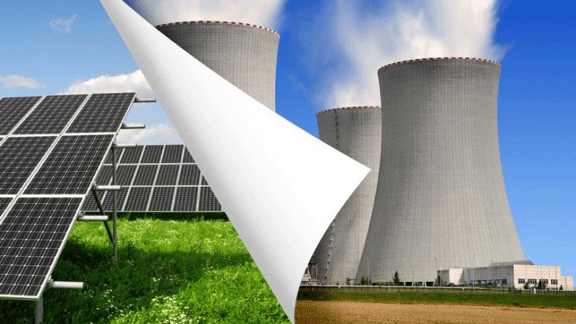 Renewable energy providing more electricity than coal and nuclear power combined in Germany Independent Solar, wind, biomass and hydroelectric power generates nearly half of country’s output. Emma Snaith, 25 Jul 19,
Renewable sources of energy produced more electricity than coal and nuclear power combined for the first time in Germany, according to new figures.
Solar, wind, biomass and hydroelectric power generation accounted for 47.3 per cent of the country’s electricity production in the first six months of 2019, while 43.4 per cent came from coal-fired and nuclearpower plants.
Around 15 per cent less carbon dioxide was produced than in the same period last year, according to figures published by the Fraunhofer Institute for Solar Energy Systems (ISE) in July.
However, some scientists have attributed the high renewable power output to favourable weather patterns and “market-driven events”.
Fabian Hein, from the think tank Agora Energiewende, told Deutsche Welle the 20 per cent increase in wind production was the result of particularly windy conditions in 2019……..
Renewables accounted for 40 per cent of Germany’s electricity consumption in 2018, according to government figures.
While in the UK, 29 per cent of electricity was sourced from renewables last year.
Germany is aiming to phase out its nuclear power plants by 2022. Its renewable energy has been rising steadily over the last two decades thanks in part to the Renewable Energy Act (EEG), which was reformed last year to cut costs for consumers.
But Germany still relies heavily on coal, gas and lignite for its energy needs.
Germany’s reluctance to end its dependence on coal saw hundreds of climate activists storm one of the country’s biggest open-pit coal mines in June to protest against fossil fuel use.
..electricity production from solar panels rose by six per cent, natural gas by 10 per cent, while the share of nuclear power in the country’s electricity production has remained virtually unchanged.
Great Britain GB electricity system operator – demand-side response (DSR) is more reliable than nuclear power
The Energyst 18th July 2019 The GB electricity system operator has suggested demand-side response (DSR) is more reliable than nuclear power in its latest Capacity Market auction
guidelines. National Grid ESO has given DSR a de-rating factor of 86 per
cent, while nuclear is de-rated to 81 per cent.
DSR is also deemed to be
marginally more reliable than biomass, coal and most interconnectors, per
the guidelines. Industry participants suggested the move reflected the
expertise of DSR providers in managing their portfolios. “Presumably [the
de-rating factors] reflects recent reliability of the UK nuclear fleet, and
superior performance of aggregators in delivering contracted response,”
wrote Jon Ferris, strategy director at energy blockchain firm Electron.
His comments were welcomed by the Association for Decentralised Energy.https://theenergyst.com/national-grid-dsr-more-reliable-than-nuclear/
In 2019, in Germany, renewables are providing more electricity than are coal and nuclear
 German renewables deliver more electricity than coal and nuclear power for the first time, DW,17July19
In Germany, sun, wind, water and biomass have so far produced more electricity in 2019 than coal and nuclear power combined. But it’s a snapshot of a special market situation and might not be a long-term trend.
In Lippendorf, Saxony, the energy supplier EnBW is temporarily taking part of a coal-fired power plant offline. Not because someone ordered it — it simply wasn’t paying off. Gas prices are low, CO2 prices are high, and with many hours of sunshine and wind, renewable methods are producing a great deal of electricity. And in the first half of the year there was plenty of sun and wind.
The result was a six-month period in which renewable energy sources produced more electricity than coal and nuclear power plants together. For the first time 47.3% of the electricity consumers used came from renewable sources, while 43.4% came from coal-fired and nuclear power plants.
In addition to solar and wind power, renewable sources also include hydropower and biomass. Gas supplied 9.3% while the remaining 0.4% came from other sources, such as oil, according to figures published by the Fraunhofer Institute for Solar Energy Systems in July.
A vision of the future
Fabian Hein from the think tank Agora Energiewende stresses that the situation is only a snapshot in time. For example, the first half of 2019 was particularly windy and wind power production rose by around 20% compared to the first half of 2018.
Electricity production from solar panels rose by 6%, natural gas by 10%, while the share of nuclear power in German electricity consumption has remained virtually unchanged.
Coal, on the other hand, declined. Black coal energy production fell by 30% compared to the first half of 2018, lignite fell by 20%. Some coal-fired power plants were even taken off the grid. It is difficult to say whether this was an effect of the current market situation or whether this is simply part of long-term planning, says Hein………
The increase in wind and solar power and the decline in nuclear power have also reduced CO2 emissions. In the first half of 2019, electricity generation emitted around 15% less CO2 than in the same period last year, reported BDEW. However, the association demands that the further expansion of renewable energies should not be hampered. The target of 65% renewable energy can only be achieved if the further expansion of renewable energy sources is accelerated. https://www.dw.com/en/german-renewables-deliver-more-electricity-than-coal-and-nuclear-power-for-the-first-time/a-49606644-0
UK reaching zero carbon emissions by 2050 – it is achievable
National Grid ESO 12th July 2019 Reaching net zero carbon emissions by 2050 is achievable but requires immediate action across the energy system. National Grid Electricity System
Operator’s Future Energy Scenarios report maps out credible pathways and
scenarios for the future of energy for the next 30 years and beyond.
Based on input from over 600 experts, it looks at the energy needed in Britain,
across electricity and gas – examining where it could come from, how it
needs to change and what this means for consumers, society and the energy
system itself.
The report outlines five potential energy futures –
including net zero by 2050 – and is intended to stimulate debate rather
than provide definitive predictions. It highlights the importance of
different parts of the energy industry working together and details the
critical actions needed to accelerate the decarbonization of the system.
The analysis shows the positive role electric vehicles can play in
decarbonization, with a predicted 35 million electric vehicles by 2050
providing greater flexibility and supporting increased energy from
renewable sources. During periods of oversupply EVs could be used to store
excess electricity with the potential to store roughly one fifth of GB’s
solar generation for when this energy is needed. It also outlines large
scale changes in how power is generated, including growth in wind and solar
generation as coal plants close. There are domestic actions too – homes in
2050 will need to use at least one third less energy for heating than
today, with over 7 million hybrid heat pumps installed by 2050 to provide
continued flexibility.
https://www.nationalgrideso.com/news/pathways-2050-national-grid-eso-publishes-2019-future-energy-scenarios
A Fukushima Ghost Town Seeks Rebirth Through Renewable Energy
A Fukushima Ghost Town Seeks Rebirth Through Renewable Energy
Devastated by Japanese nuclear plant’s meltdown in 2011, Namie hopes a new hydrogen-fuel facility can generate a turnaround. WSJ, By River Davis, July 12, 2019
NAMIE, Japan—Fukushima prefecture, a place synonymous in many minds with nuclear meltdown, is trying to reinvent itself as a hub for renewable energy.
One symbol is just outside Namie, less than five miles from the nuclear-power plant devastated by an earthquake and tsunami in 2011. At the end of a winding road through miles of barren land, construction is nearing completion on one of the world’s largest hydrogen plants.
The government hopes to show that hydrogen, a hard-to-handle fuel that hasn’t been used for large-scale power generation, can supplement intermittent solar and wind power.
……….. By 2040, Fukushima aims to cover 100% of its energy demand with non-nuclear renewable energy. Since 2011, the prefecture’s generating capacity from renewable energy, excluding large-scale hydropower, has more than quadrupled. More than a gigawatt of solar-energy capacity has been added—the equivalent of more than three million solar panels—while other projects are under way in offshore wind power and geothermal energy……… https://www.wsj.com/articles/a-fukushima-ghost-town-seeks-rebirth-through-renewable-energy-11562923802
Renewable energy racing ahead, close to beating nuclear power
 When you see an article like this, from a basically pro-nuclear writer, in a journal that is the propaganda voice of the nuclear industry – well, isn’t this a cause for some shadenfreude?
Nuclear power remains ahead of renewables, but just barely. Further, it is losing ground. In 2017, the world produced 22% more power from nuclear than it did from modern renewables. In 2018, the nuclear lead was less than 9%. Based on current trends, modern renewables will surpass nuclear power production either this year or next year.
Renewables Catching Nuclear Power In Global Energy Race Forbes, Robert Rapier 7 Jul 19, This article is the fifth in a series on BP’s recently-released Statistical Review of World Energy 2019
Today, I want to cover global trends in renewable energy.
The Review separates renewables into two categories called Hydroelectric and Renewables. The former consists of hydropower, which has been around for a long time. Hydropower still produces more electricity globally than the Renewables category, which consists primarily of rapidly-growing wind and solar power, as well as more mature renewable technologies like geothermal power and power produced from biomass
Coal is still the dominant source of electricity around the world, although natural gas has taken over the top spot in the U.S. But, renewables have grown rapidly over the past decade, and are on the cusp of overtaking nuclear globally.
In 2018, nuclear power was responsible for 2,701 Terawatt-hours (TWh) of electricity generation, compared to 4,193 TWh for hydropower and 2,480 for renewables. In comparison, coal produced more power than all three categories combined.
However, the growth rates of the different categories of electricity generation tell a different story. Over the past decade, from 2007 to 2017, global electricity generated by coal grew at an annual average of 1.7%. Nuclear generation over that time actually declined annually by 0.4%, a consequence of the Fukushima Daiichi nuclear disaster in 2011. Hydropower generation grew at an average annual rate of 2.8%. These growth rates are indicative of mature power sources.
But contrast those growth rates with those of modern renewables.
From 2007 to 2017, the Renewables category grew at an average annual rate of 16.4%. But within that category, power from geothermal and biomass grew at an annual average of 7.1%. Wind and solar power, by contrast, grew at an annual average of 20.8% and 50.2%, respectively, over the past decade.
What does a 50% average annual growth rate over the past decade look like? Here are the global trends in solar power since 2000: (in graph at top)
I will note that in 2007 I wrote an article called The Future is Solar, a few years before solar took off).
The world’s leading producer of solar power in 2018 was once again China, with a 30.4% share globally. China maintained a blistering growth rate in 2018, with solar generation increasing by 50.7% over 2017. From 2007 to 2017, China increased solar generation at an average annual rate of just over 100%.
The U.S. remains in second place globally with a 16.6% share. U.S. solar power generation increased by 24.4% over 2017, and over the decade the U.S. has increased solar power at an average annual rate of 53.2%. Rounding out the Top 5 countries in solar power generation are Japan (12.3% share), Germany (7.9% share), and India (5.3% share).
Wind power is still ahead of solar in global electricity generation. In 2018, wind power was used to generate 1,270 TWh of power, versus 585 TWh for solar power. But solar power is on a trajectory to surpass wind power during the next decade.
Globally, China was also the top producer of wind power with a 28.8% global share. Again, the U.S. was second with a 21.9% share, followed by Germany (8.8% share), India (4.7% share), and the UK (4.5% share).
Nuclear power remains ahead of renewables, but just barely. Further, it is losing ground. In 2017, the world produced 22% more power from nuclear than it did from modern renewables. In 2018, the nuclear lead was less than 9%. Based on current trends, modern renewables will surpass nuclear power production either this year or next year. (I will add that nuclear is firm power, and renewables are intermittent, and that is an important distinction).
The rapid growth rate for renewables is a positive development in a world trying to rein in carbon dioxide emissions. However, renewables have not yet reached a level at which they are actually causing fossil fuel demand to contract.
Modern renewable energy consumption (mainly wind and solar power) grew by 71 million metric tons of oil equivalent in 2018. But global energy consumption grew much faster than that, with fossil fuels carrying most of the load. Global consumption of coal, oil, and natural gas grew by 276 million metric tons in 2018, nearly four times the growth in renewables. As a result, global carbon dioxide emissions set a new all-time high in 2018…….https://www.forbes.com/sites/rrapier/2019/07/07/wind-and-solar-power-nearly-matched-nuclear-power-in-2018/#5494d17039ee
Nuclear power – unsustainable – half Scotland’s reactors offline – but renewables supplying the load
The simple reason why nuclear power is finished – Dr Richard Dixon https://www.scotsman.com/news/opinion/columnists/the-simple-reason-why-nuclear-power-is-finished-dr-richard-dixon-1-4957211
Half of Scotland’s nuclear reactors are off-line over safety concerns, but the lights still stayed on, writes Dr Richard Dixon. July 3 2019
Nuclear power is the ultimate unsustainable form of energy. For some electricity today, we are leaving a thousand generations of future humans dangerous radioactive waste.

I thought it was terribly clever but it took me quite a while to realise that Roman Britain was far too close at hand. To cover the generally accepted 25,000 years, it would need to have referred to Cro-Magnon humans.
The politics of Scotland mean that new reactors here are almost unthinkable and the price of the renewable energy alternatives has fallen so far below the cost of nuclear that you would have to be crazy to go for new nuclear.
Labour’s Jack McConnell was the First Minister who said he would block new nuclear plants until there was a solution to the waste problem (14 years later, there is none). And while it is in the SNP’s DNA to oppose nuclear power. EDF and some unions do still try to lobby Scottish Ministers and officials, but to no avail. Meanwhile the industry is doing a great job of showing how terrible a bet nuclear is.
The nuclear industry is almost unique in that every new reactor costs more than the last, while everything else gets cheaper, including offshore wind power which is now coming in at just over half the price of nuclear for a unit of energy.
Hinkley Point C, the only nuclear station under construction in the UK, was supposed to be cooking the Christmas turkey in 2017. It is now expected to be producing electricity at the end of 2025 at the earliest. The only way it could be built was for the UK Government to agree that electricity consumers would pay bills well over the odds for the next 35 years.
The same sort of reactor is being built in Finland. It may start producing electricity next year – 11 years late. The other one of the same design is in France and is currently running 12 years late, at twice the original budget.
The latest wheeze the industry has come up with is to ask the UK Government to agree to pay any costs more than 30 per cent above the original budget for any more reactors. Not a good bet given their history.
Of course we already have four reactors in Scotland. The two at Torness are the second newest in the UK, having been opened by Margaret Thatcher in 1989. The two at Hunterston in Ayrshire are already well past their sell-by date, having started up in 1976. They were supposed to have closed in 2006 but have had three extensions with planned closure now in 2023. Because of a large number of cracks in their cores one reactor stopped generating in March last year and the other in October. Owners EDF are arguing with regulators about whether they can safely restart.
Did you notice the lights going out across Scotland with Hunterston not producing a single electron for eight months? No, thanks largely to renewables having a record first quarter of 2019 and supplying nine out of ten households in Scotland.
We certainly don’t need new nuclear and, with renewables rapidly on the rise, we should not take the unnecessary risk of starting up the Hunterston reactors ever again.
Dr Richard Dixon is director of Friends of the Earth Scotland.
Nuclear power, fossil fuels finished? Los Angeles launches world’s cheapest solar + battery-storage project
 New Solar + Battery Price Crushes Fossil Fuels, Buries Nuclear, Forbes, Jeff McMahon ,2 July 19. Los Angeles Power and Water officials have struck a deal on the largest and cheapest solar + battery-storage project in the world, at prices that leave fossil fuels in the dust and may relegate nuclear power to the dustbin.Later this month the LA Board of Water and Power Commissioners is expected to approve a 25-year contract that will serve 7 percent of the city’s electricity demand at 1.997¢/kwh for solar energy and 1.3¢ for power from batteries.
“This is the lowest solar-photovoltaic price in the United States,” said James Barner, the agency’s manager for strategic initiatives, “and it is the largest and lowest-cost solar and high-capacity battery-storage project in the U.S. and we believe in the world today. So this is, I believe, truly revolutionary in the industry.”
It’s half the estimated cost of power from a new natural gas plant.
Mark Z. Jacobson, the Stanford professor who developed roadmaps for transitioning 139 countries to 100 percent renewables, hailed the development on Twitter Friday, saying, “Goodnight #naturalgas, goodnight #coal, goodnight #nuclear.”
The anti-nuclear activist Arnie Gunderson, who predicted storage prices under 2¢/kwh four years ago on the night Elon Musk unveiled the Tesla Powerpack, noted Saturday that his 2015 prediction was too high. He too said, “Goodbye coal, nukes, gas!”……….. https://www.forbes.com/sites/jeffmcmahon/2019/07/01/new-solar–battery-price-crushes-fossil-fuels-buries-nuclear/#59a3e2355971
The huge threat that air-conditioning poses to the global climate

Air conditioning is the world’s next big  threat https://www.smh.com.au/business/markets/air-conditioning-is-the-world-s-next-big-threat-20190629-p522hd.html , By Chris Bryant, June 29, 2019 The vast majority of Americans and many Australians have air conditioning, but in Germany almost nobody does. At least not yet.
So when temperatures in Berlin rose to an uncomfortable 37 Celsius this week – a record for the month of June – I was uncommonly delighted to go to the Bloomberg office, where it’s artificially and blissfully cool.
By letting people in overheated climates concentrate on their work and get a good night’s sleep, air conditioning has played a big part in driving global prosperity and happiness over the past few decades – and that revolution has still barely begun.
About half of Chinese households have this modern tool, but of the 1.6 billion people living in India and Indonesia, only 88 million have access to air conditioning at home, Bloomberg New Energy Finance noted in a recent report.
For many, relief is in sight. Because of the combination of population growth, rising incomes, falling equipment prices and urbanisation, the number of air-conditioning units installed globally is set to jump from about 1.6 billion today to 5.6 billion by the middle of the century, according to the International Energy Agency.
That’s encouraging news for US manufacturers of cooling systems such as Carrier (United Technologies Corp), Ingersoll-Rand and Johnson Controls International.
And because much of this growth will happen in Asia, Chinese companies such as Gree Electric Appliances, Qingdao Haier, Midea Group and Japan’s Daikin Industries Ltd should be big beneficiaries.
There’s just one glaring problem: What will all this extra demand for electricity do to the climate?
Carbon dioxide emissions rose another 2 per cent in 2018, the fastest pace in seven years. That increase was alarming in its own right, given what we know about the unfolding climate emergency.
But the proximate cause was especially troubling: Extreme weather led to more demand for air conditioning and heating in 2018, BP explained in its annual review of energy sector.
It’s not too hard to imagine a vicious cycle in which more hot weather begets ever more demand for air conditioning and thus even more need for power. That in turn means more emissions and even hotter temperatures.
That negative feedback loop exists at a local level too. Air-conditioning units funnel heat outside, exacerbating the so-called “urban heat island” effect, which makes cities warmer than the countryside.
BNEF expects electricity demand from residential and commercial air conditioning to increase by more than 140 per cent by 2050 – an increase that’s comparable to adding the European Union’s entire electricity consumption. Air conditioning will represent 12.7 per cent of electricity demand by the middle of the century, compared to almost 9 per cent now, it thinks.
Thankfully, much of that extra demand will be met by solar power (the need for cooling is highest during daylight hours). But because temperatures don’t always return to comfortable levels when the sun goes down, there’s a danger some will be supplied by fossil power.
‘Passivhaus’ and LED revolution
Buildings have long been a blind spot in climate discussions even though they account for about one-fifth of global energy consumption. The inefficiency of air-conditioning systems or badly designed homes and offices simply aren’t as eye-catching as electric cars and making people feel ashamed about flying.
At least Germany’s “passivhaus” movement, a way of building homes that require very little heating or cooling, voluntary standard for energy efficiency in buildings, shows some people are starting to recognise the danger.
There are lessons to be learned from the world of lighting too. The LED revolution was spurred by innovation but also by better energy efficiency labelling on products and the phasing out of out-of-date technology. Something similar needs to happen with air conditioning.
There was a big step forward in January when the Kigali Amendment to the Montreal Protocol came into force. Though not well known, its aim is to phase out the use of potent greenhouse gases called hydrofluorocarbons, which are used widely in air conditioning systems. Unless substituted, these alone could cause 0.4C of additional warming by the end of the century.
Yet true to form, President Donald Trump’s administration hasn’t yet submitted Kigali to the Senate for ratification, even though American manufacturers would benefit from demand for the new technologies that it would spawn.
Trump knows all about the importance of good air con. He spends much of his time at his Palm Beach country club, a place that couldn’t exist without it.
Chris Bryant is a Bloomberg Opinion columnist covering industrial companies. He previously worked for the Financial Times.
India’s nuclear power programme unlikely to progress. Ocean energy is a better way.
The problem is apparently nervousness about handling liquid Sodium, used as a coolant. If Sodium comes in contact with water it will explode; and the PFBR is being built on the humid coast of Tamil Nadu. The PFBR has always been a project that would go on stream “next year”. The PFBR has to come online, then more FBRs would need to be built, they should then operate for 30-40 years, and only then would begin the coveted ‘Thorium cycle’!
 Why nuclear when India has an ‘ocean’ of energy, https://www.thehindu.com/business/Industry/why-nuclear-when-india-has-an-ocean-of-energy/article28230036.ece
If it is right that nothing can stop an idea whose time has come, it must be true the other way too — nothing can hold back an idea whose time has passed.
Just blow the dust off, you’ll see the writing on the wall: nuclear energy is fast running out of sand, at least in India. And there is something that is waiting to take its place.
India’s 6,780 MW of nuclear power plants contributed to less than 3% of the country’s electricity generation, which will come down as other sources will generate more.
Perhaps India lost its nuclear game in 1970, when it refused to sign – even if with the best of reasons – the Non Proliferation Treaty, which left the country to bootstrap itself into nuclear energy. Only there never was enough strap in the boot to do so.
In the 1950s, the legendary physicist Dr. Homi Bhabha gave the country a roadmap for the development of nuclear energy.
Three-stage programme
In the now-famous ‘three-stage nuclear programme’, the roadmap laid out what needs to be done to eventually use the country’s almost inexhaustible Thorium resources. The first stage would see the creation of a fleet of ‘pressurised heavy water reactors’, which use scarce Uranium to produce some Plutonium. The second stage would see the setting up of several ‘fast breeder reactors’ (FBRs). These FBRs would use a mixture of Plutonium and the reprocessed ‘spent Uranium from the first stage, to produce energy and more Plutonium (hence ‘breeder’), because the Uranium would transmute into Plutonium. Alongside, the reactors would convert some of the Thorium into Uranium-233, which can also be used to produce energy. After 3-4 decades of operation, the FBRs would have produced enough Plutonium for use in the ‘third stage’. In this stage, Uranium-233 would be used in specially-designed reactors to produce energy and convert more Thorium into Uranium-233 —you can keep adding Thorium endlessly.
Seventy years down the line, India is still stuck in the first stage. For the second stage, you need the fast breeder reactors. A Prototype Fast Breeder Reactor (PFBR) of 500 MW capacity, construction of which began way back in 2004, is yet to come on stream.
The problem is apparently nervousness about handling liquid Sodium, used as a coolant. If Sodium comes in contact with water it will explode; and the PFBR is being built on the humid coast of Tamil Nadu. The PFBR has always been a project that would go on stream “next year”. The PFBR has to come online, then more FBRs would need to be built, they should then operate for 30-40 years, and only then would begin the coveted ‘Thorium cycle’! Nor is much capacity coming under the current, ‘first stage’. The 6,700 MW of plants under construction would, some day, add to the existing nuclear capacity of 6,780 MW. The government has sanctioned another 9,000 MW and there is no knowing when work on them will begin. These are the home-grown plants. Of course, thanks to the famous 2005 ‘Indo-U.S. nuclear deal’, there are plans for more projects with imported reactors, but a 2010 Indian ‘nuclear liability’ legislation has scared the foreigners away. With all this, it is difficult to see India’s nuclear capacity going beyond 20,000 MW over the next two decades.
Now, the question is, is nuclear energy worth it all?
There have been three arguments in favour of nuclear enFor Fergy: clean, cheap and can provide electricity 24×7 (base load). Clean it is, assuming that you could take care of the ticklish issue of putting away the highly harmful spent fuel.
But cheap, it no longer is. The average cost of electricity produced by the existing 22 reactors in the country is around ₹2.80 a kWhr, but the new plants, which cost ₹15-20 crore per MW to set up, will produce energy that cannot be sold commercially below at least ₹7 a unit. Nuclear power is pricing itself out of the market. A nuclear power plant takes a decade to come up, who knows where the cost will end up when it begins generation of electricity?
Nuclear plants can provide the ‘base load’ — they give a steady stream of electricity day and night, just like coal or gas plants. Wind and solar power plants produce energy much cheaper, but their power supply is irregular. With gas not available and coal on its way out due to reasons of cost and global warming concerns, nuclear is sometimes regarded as the saviour. But we don’t need that saviour any more; there is a now a better option.
Ocean energy
The seas are literally throbbing with energy. There are at least several sources of energy in the seas. One is the bobbing motion of the waters, or ocean swells — you can place a flat surface on the waters, with a mechanical arm attached to it, and it becomes a pump that can be used to drive water or compressed air through a turbine to produce electricity. Another is by tapping into tides, which flow during one part of the day and ebb in another. You can generate electricity by channelling the tide and place a series of turbines in its path. One more way is to keep turbines on the sea bed at places where there is a current — a river within the sea. Yet another way is to get the waves dash against pistons in, say, a pipe, so as to compress air at the other end. Sea water is dense and heavy, when it moves it can punch hard — and, it never stops moving.
All these methods have been tried in pilot plants in several parts of the world—Brazil, Denmark, U.K., Korea. There are only two commercial plants in the world—in France and Korea—but then ocean energy has engaged the world’s attention.
For sure, ocean energy is costly today.
India’s Gujarat State Power Corporation had a tie-up with U.K.’s Atlantic Resources for a 50 MW tidal project in the Gulf of Kutch, but the project was given up after they discovered they could sell the electricity only at ₹13 a kWhr. But then, even solar cost ₹18 a unit in 2009! When technology improves and scale-effect kicks-in, ocean energy will look real friendly.
Initially, ocean energy would need to be incentivised, as solar was. Where do you find the money for the incentives? By paring allocations to the Department of Atomic Energy, which got ₹13,971 crore for 2019-20.
Also, wind and solar now stand on their own legs and those subsidies could now be given to ocean energy.
Scotland’s renewable energy success
The National 28th June 2019 , SCOTLAND produced a record amount of renewable energy in the first three
months of 2019, with enough power generated to supply almost nine out of 10
homes. A total of 8877 Gigawatt hours (GWh) of green electricity were
generated in the first quarter of this year – 17% more than in the same
period of 2018. The bulk of this power – 5792 GWh – came from onshore wind
farms, the figures from the UK Department for Business, Energy and
Industrial Strategy (BEIS) show.
Overall, the amount of renewable energy
generated was enough to power around 88% of Scottish households for a year,
the Scottish Government said. Energy minister Paul Wheelhouse said the
sector is going from “strength to strength”. The BEIS data also shows
renewable energy capacity in Scotland rose from 10.4 Gigawatts (GW) in
March 2018 to 11.3 GW in March this year. Electricity exports from Scotland
were at their highest since the last three months of 2017, rising to 4543
GWh – the equivalent of enough energy to power more than 1.1 million homes
for a year. https://www.thenational.scot/news/17735413.scotland-producing-record-renewable-energy-output/
To comply with Paris climate agreement, France could switch to 100% renewables
Le Point 18th June 2019 “France could switch to 100% renewable energy” INTERVIEW. According to Rana
Adib, head of the network of experts REN21, the effort in favor of
renewable energies must be relaunched to comply with the Paris agreement.
1 This Month

of the week – Shut Down Drone Warfare!


Tell the Ukrainian Government to Drop Prosecution of Peace Activist Yurii Sheliazhenko

Petition to revoke the licensing of the Near Surface Nuclear Disposal Facility (NSDF) at Chalk River. https://www.ourcommons.ca/petitions/en/Petition/Details?Petition=e-7247
To see nuclear-related stories in greater depth and intensity – go to https://nuclearinformation.wordpress.com
-
Archives
- April 2026 (79)
- March 2026 (251)
- February 2026 (268)
- January 2026 (308)
- December 2025 (358)
- November 2025 (359)
- October 2025 (376)
- September 2025 (257)
- August 2025 (319)
- July 2025 (230)
- June 2025 (348)
- May 2025 (261)
-
Categories
- 1
- 1 NUCLEAR ISSUES
- business and costs
- climate change
- culture and arts
- ENERGY
- environment
- health
- history
- indigenous issues
- Legal
- marketing of nuclear
- media
- opposition to nuclear
- PERSONAL STORIES
- politics
- politics international
- Religion and ethics
- safety
- secrets,lies and civil liberties
- spinbuster
- technology
- Uranium
- wastes
- weapons and war
- Women
- 2 WORLD
- ACTION
- AFRICA
- Atrocities
- AUSTRALIA
- Christina's notes
- Christina's themes
- culture and arts
- Events
- Fuk 2022
- Fuk 2023
- Fukushima 2017
- Fukushima 2018
- fukushima 2019
- Fukushima 2020
- Fukushima 2021
- general
- global warming
- Humour (God we need it)
- Nuclear
- RARE EARTHS
- Reference
- resources – print
- Resources -audiovicual
- Weekly Newsletter
- World
- World Nuclear
- YouTube
-
RSS
Entries RSS
Comments RSS
 nuclear-news