Coronavirus recovery can pave the way to a green energy future

around the world, electricity demand has reduced in COVID-19 hotspots. This could have a knock-on effect for the renewable sector.China, where the outbreak first took hold, is the world’s biggest electricity consumer. Output from factories has been substantially diminished with many unable to return to their jobs in manufacturing. Due to the curtailing of industrial electricity use, cuts in energy consumption for 2020 could be equivalent to the power used by the whole of Chile, according to IHS Markit.
In Europe, peak power consumption has also gone down. Italy, Spain, and the UK have all seen an average 10 per cent drop in energy usage with bars, restaurants, offices and factories, which remain closed as social distancing measures continue.In particular, fossil fuel based sources of electricity have been impacted by reduced requirements. Coal, usually one of the cheapest options, has now become the most expensive fuel in the world in the face of cheap green alternatives and natural gas, according to Bloomberg Green.
PAVING THE WAY FOR A GREEN FUTURE?
Renewable energy sources seem to have been given an unexpected boost. Around 40 per cent of the electricity generated in the UK on Sunday 5th March came from wind farms, with nearly a fifth being provided by solar energy. This was due to the unusually sunny day, says the National Grid ESO carbon intensity tracker.
These conditions have meant that renewable sources generated more than enough energy to cover the country’s reduced needs. Green supplier, Octopus Energy, even paid some customers to use energy during the day, using a scheme that has previously only been available during the night when demand is very low.
“In most economies that have taken strong confinement measures in response to the coronavirus – and for which we have available data – electricity demand has declined by around 15%, largely as a result of factories and businesses halting operations,” Dr Fatih Birol, Executive Director of the International Energy Agency wrote in a blog post.
“In this way, the recent drop in electricity demand fast-forwarded some power systems 10 years into the future, suddenly giving them levels of wind and solar power they wouldn’t have had otherwise without another decade of investment in renewables.”
He went on to explain that this increase in renewable energy usage could even help some countries figure out how to deal with the drop in power that comes from the sun setting or a strong wind dying down. Previously, these kinds of fluctuating energy sources have proved challenging for those who work to keep our lights on. Managing them more ntelligently by shutting off solar panels at midday when there is more electricity than usual and slowing down wind power as demand decreases at night are just some options Dr Birol suggests.
These new findings have also put the spotlight on more reliable and often neglected sources of green energy, like hydropower, which are essential to making sure we have a consistent supply of energy. In exceptional situations like the current pandemic, where a fluctuation in energy supply could put lives and employment at even greater risk, this is particularly important.
Investment in green energy could drive Covid-19 recovery – International Renewable Energy Agency report
|
The agency’s director general, Francesco La Camera, said the global crisis ignited by the coronavirus outbreak exposed “the deep vulnerabilities of the current system” and urged governments to invest in renewable energy to kickstart economic growth and help meet climate targets. The agency’s landmark report found that accelerating investment in renewable energy would help tackle the climate crisis and would in effect pay for itself. Investing in renewable energy would deliver global GDP gains of $98tn above a business-as-usual scenario by 2050 by returning between $3 and $8 on every dollar invested. It would also quadruple the number of jobs in the sector to 42m over the next 30 years, and measurably improve global health and welfare scores, according to the report. “Governments are facing a difficult task of bringing the health emergency under control while introducing major stimulus and recovery measures,” La Camera said. “By accelerating renewables and making the energy transition an integral part of the wider recovery, governments can achieve multiple economic and social objectives in the pursuit of a resilient future that leaves nobody behind.” The report also found that renewable energy could curb the rise in global temperatures by helping to reduce the energy industry’s carbon dioxide emissions by 70% by 2050 by replacing fossil fuels. Renewables could play a greater role in cutting carbon emissions from heavy industry and transport to reach virtually zero emissions by 2050, particularly by investing in green hydrogen…… The call for a green economic recovery from the coronavirus crisis comes after a warning from Dr Fatih Birol, head of the International Energy Agency, that government policies must be put in place to avoid an investment hiatus in the energy transition. “We should not allow today’s crisis to compromise the clean energy transition,” he said. “We have an important window of opportunity.”….. https://www.theguardian.com/environment/2020/apr/20/green-energy-could-drive-covid-19-recovery-international-renewable-energy-agency |
|

Wind or solar technologies will provide UK with 100% energy, in a predominantly electric future
 Chartist 18th April 2020, Dave Toke: As offshore wind technology fully blooms as its own distinctmass industrial technology producing power at low prices, and as the prospect of floating wind turbines comes closer, the potential for the technology threatens to eclipse everything else – at least in countries with a large waterline, such as the UK.
another story. The story here is that on its own, the offshore wind available could generate over five times the anticipated total energy requirements for the UK in a ‘net zero carbon’ scenario – that is, based upon the Committee on Climate Change estimate that a mainly electric economy supplied from low carbon sources would require 645TWh of power generation in 2050. Wind power could do this as the cheapest electricity source available – apart from solar power of course, with which the competition will probably be intense in the future.
https://www.chartist.org.uk/offshore-wind-the-force-is-with-you/
Sweden’s wind power on the way to putting nuclear out of business
 Giant Wind Park Starting Up Is Another Blow to Nuclear Industry
A surge in renewable energy output in the Nordic region has sent power prices below the level where some nuclear plants are profitable. Bloomberg Green, By Lars Paulsson April 8, 2020, Sweden’s biggest wind farm began producing power this month, and the region’s nuclear reactors are feeling the heat.Vasa Vind AB’s Askalen started commercial output on April 1, increasing supplies in a market already bloated by a massive surplus of water for power generation. A day later, two units at Vattenfall AB’s Forsmark nuclear plant north of Stockholm curbed output by about 50%. Two reactors at the utility’s Ringhals plant are halted because of low power prices.
While there’s no direct link between those events, it’s the latest sign of how renewable energy is crowding out traditional power sources across Europe. The 288-megawatt facility in northern Sweden will boost the nation’s wind output further, after a 50% jump in the first quarter from a year earlier because of a very breezy winter.
“This could mean more frequent periods with rock bottom power prices, forcing conventional generators off the grid, especially when windy conditions coincide with high hydro output,” said Oliver Metcalfe, lead analyst for onshore wind research at BloombergNEF in London.
BNEF forecasts that global onshore wind capacity will gain 9% to more than 66 gigawatts this year, a forecast scaled back from the 24% expansion first anticipated.
That will help push out more traditional coal, gas and nuclear plants from the energy system. The German and U.K. coal power industries, among others, have already been decimated by a surge in green power.
Sweden will install more than 4.2 gigawatts of new onshore wind this year and next, according to BNEF. The Nordic region’s biggest economy will rely heavily on wind to replace old nuclear reactors in the future. The Askalen park has installed 80 Vestas A/S’s V136 turbines, which are as high as 112 meters……. https://www.bloomberg.com/news/articles/2020-04-08/giant-wind-park-starting-up-is-another-blow-to-nuclear-industry
A new low-cost solar technology for environmental cooling
A new low-cost solar technology for environmental cooling https://www.eurekalert.org/pub_releases/2020-03/pdt-anl032320.php POLITECNICO DI TORINO Space cooling and heating is a common need in most inhabited areas. In Europe, the energy consumed for air conditioning is rising, and the situation could get worse in the near future due to the temperature increase in different regions worldwide. The increasing cooling need in buildings especially during the summer season is satisfied by the popular air conditioners, which often make use of refrigerants with high environmental impact and also lead to high electricity consumption. So, how can we reduce the energy demand for building cooling?
A new study comes from a research group based at the Politecnico di Torino (SMaLL) and the National Institute of Metrological Research (INRiM), who has proposed a device capable of generating a cooling load without the use of electricity: the research has been published in Science Advances*. Like more traditional cooling devices, this new technology also exploits the evaporation of a liquid. However, the key idea proposed by the Turin researchers is to use simple water and common salt instead of chemicals that are potentially harmful for the environment. The environmental impact of the new device is also reduced because it is based on passive phenomena, i.e. spontaneous processes such as capillarity or evaporation, instead of on pumps and compressors that require energy and maintenance.
“Cooling by water evaporation has always been known. As an example, Nature makes use of sweat evaporation from the skin to cool down our body. However, this strategy is effective as long as air is not saturated with water vapour. Our idea was to come up with a low-cost technology capable to maximize the cooling effect regardless of the external water vapour conditions. Instead of being exposed to air, pure water is in contact with an impermeable membrane that keeps separated from a highly concentrated salty solution. The membrane can be imagined as a porous sieve with pore size in the order of one millionth of a meter. Owing to its water-repellent properties, our membrane liquid water does not pass through the membrane, whereas its vapour does. In this way, the fresh and salt water do not mix, while a constant water vapour flux occurs from one end of the membrane to the other. As a result, pure water gets cooled, with this effect being further amplified thanks to the presence of different evaporation stages. Clearly, the salty water concentration will constantly decrease and the cooling effect will diminish over time; however, the difference in salinity between the two solutions can be continuously – and sustainably – restored using solar energy, as also demonstrated in another recent study from our group**”, explains Matteo Alberghini, PhD student of the Energy Department of the Politecnico di Torino and first author of the research.
The interesting feature of the suggested device consists in its modular design made of cooling units, a few centimetres thick each, that can be stacked in series to increase the cooling effect in series, as happens with common batteries. In this way it is possible to finely tune the cooling power according to individual needs, possibly reaching cooling capacity comparable to those typically necessary for domestic use. Furthermore, water and salt do not need pumps or other auxiliaries to be transported within the device. On the contrary, it “moves” spontaneously thanks to capillary effects of some components which, like in kitchen paper, are capable of absorbing and transporting water also against gravity.
“Other technologies for passive cooling are also being tested in various labs and research centres worldwide, such as those based on infrared heat dissipation into the outer space – also known as radiative passive cooling. Those approaches, although promising and suitable for some applications, also present major limitations: the principle on which they are based may be ineffective in tropical climates and in general on very humid days, when, however, the need for conditioning would still be high; moreover, there is a theoretical limit for the maximum cooling power. Our passive prototype, based instead on evaporative cooling between two aqueous solutions with different salinities, could overcome this limit, creating a useful effect independent of external humidity. Moreover, we could obtain an even higher cooling capacity in the future by increasing the concentration of the saline solution or by resorting to a more sophisticated modular design of the device” commented the researchers.
Also due to the simplicity of the device assembly and the required materials, a rather low production cost can be envisioned, in the order of a few euros for each cooling stage. As such, the device could be ideal for installations in rural areas, where the possible lack of well-trained technicians can make operation and maintenance of traditional cooling systems difficult. Interesting applications can also be envisioned in regions with large availability in water with high saline concentration, such as coastal regions in the vicinity of large desalination plants or nearby salt marshes and salt mines.
As of now, the technology is not yet ready for an immediate commercial exploitation, and further developments (also subject to future funding or industrial partnerships) are necessary. In perspective, this technology could be used in combination with existing and more traditional cooling systems for effectively implementing energy saving strategies.
[*] Matteo Alberghini, Matteo Morciano, Matteo Fasano, Fabio Bertiglia, Vito Fernicola, Pietro Asinari, Eliodoro Chiavazzo. Multistage and passive cooling process driven by salinity difference, SCIENCE ADVANCES (2020), URL: https://advances.sciencemag.org/content/6/11/eaax5015
[**] Eliodoro Chiavazzo, Matteo Morciano, Francesca Viglino, Matteo Fasano, Pietro Asinari, Passive solar high-yield seawater desalination by modular and low-cost distillation, NATURE SUSTAINABILITY (2018), URL: https://www.nature.com/articles/s41893-018-0186-x
Why using hydrogen to supply heating would be a terrible choice
energy. Even if the hydrogen was sourced from renewable energy (and not much of it will be) the result would be a grandiose waste of renewable energy. This is because using hydrogen from renewable energy to heat buildings is around four times less energy efficient compared to using heat pumps (using renewable electricity) to supply heating in buildings.
enough to 100 per cent. Second, such a programme will provide support for a continued fossil fuel industry. A third reason is that using ‘blue’ hydrogen, in as much as it succeeds in paving the way for supply of renewable hydrogen, will lock in a huge wastage of renewable energy
compared to using this renewable energy much more efficiently.http://realfeed-intariffs.blogspot.com/2020/03/why-using-hydrogen-to-supply-heating.html
Renewables surpass coal and nuclear says USA’s Federal Energy Regulatory Commission (FERC)
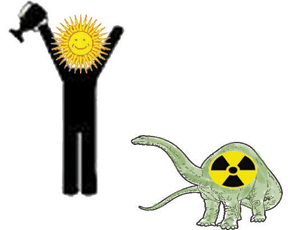
US: Renewables to rise above coal and nuclear says FERC https://www.smart-energy.com/renewable-energy/us-renewables-to-rise-above-coal-and-nuclear-says-ferc/ Renewables are estimated to add nearly 50,000 MW, being more than a quarter of the total capacity according to a review by the SUN DAY Campaign of data, issued last week by the Federal Energy Regulatory Commission (FERC). 13 Mar 20,
According to the report, the mix of renewable energy sources (i.e., biomass, geothermal, hydropower, solar, wind) provided 57.26% of new U.S. electrical generating capacity added in 2019 – swamping that provided by coal, natural gas, oil, and nuclear power combined.
FERC’s latest monthly “Energy Infrastructure Update” report (with data through to December 31, 2019) reveals renewable sources (i.e. biomass, geothermal, hydropower, solar, wind) accounted for 11,857 megawatts (MW) of new generating capacity by the end of the year. That is a third more (33.97%) more than that of natural gas (8,557 MW), nuclear (155 MW), oil (77 MW), and coal (62 MW) combined.
Renewables have now also surpassed 22% (i.e., 22.06%) of the US’ total available installed generating capacity – further expanding their lead over coal capacity (20.89%). Among renewables, wind can boast the largest installed electrical generating capacity – 8.51% of the U.S. total, followed by hydropower (8.41%), solar (3.49%) [2], biomass (1.33%), and geothermal (0.32%). Thus, wind and solar combined now account for 12.0% of the nation’s electrical generating capacity.
Moreover, the FERC foresees renewables dramatically expanding their lead over fossil fuels and nuclear power in terms of new capacity additions during the coming three years (i.e., by December 31, 2022). Net generating capacity additions (i.e., “proposed additions under construction” minus “proposed retirements”) for renewable sources total 48,254 MW: wind – 26,403 MW, solar – 19,973 MW, hydropower – 1,460 MW, biomass – 240 MW, and geothermal – 178 MW.
By comparison, net additions for natural gas total 21,090 MW while the installed capacities for coal, nuclear, and oil are projected to drop by 18,857 MW, 3,391 MW, and 3,085 MW respectively. In fact, FERC reports no new coal capacity in the pipeline over the next three years.
Thus, while net new renewable energy capacity is projected to be nearly 50,000 MW greater within three years, that of fossil fuels and nuclear power combined will decline by over 4,200 MW. Between now and the end of 2022, new wind capacity alone will be greater than that of natural gas while that of wind and solar combined will more than double new gas capacity.
Moreover, if FERC’s data prove correct, then by the end of 2022, renewable sources will account for more than a quarter (25.16%) of the nation’s total available installed generating capacity while coal will drop to 18.63% and that of nuclear and oil will decrease to 8.29% and 2.95% respectively. Natural gas will increase its share — but only slightly – from 44.67% today to 44.78%.
As the Executive Director of the SUN DAY Campaign, I believed that the rapid growth of renewables and corresponding drop in electrical production by coal and oil in 2019 provides a glimmer of hope for slowing down the pace of climate change. In addition, renewables’ continued expansion in the near future – as forecast by FERC – suggests that with supportive governmental policies, these technologies could provide an even greater share of total U.S. electrical generation.
Statistics presented in this article can be found here. Read the full FERC report.
Renewable energy push for Fukushima
|
Nine years since nuclear disaster, Fukushima looks to hydrogen as recovery efforts chug along, https://www.straitstimes.com/asia/east-asia/nine-years-since-nuclear-disaster-fukushima-looks-to-hydrogen-as-recovery-efforts11 Mar, 20 TOKYO – Fukushima is staking its future on renewable energy, taking the lead in a country that is not just squarely wedded to coal-fired power, but also reluctant to give up nuclear energy.This despite the anniversary on Wednesday (March 11) of the devastating triple tragedy nine years ago.
One of the world’s biggest renewable-based hydrogen power facilities was opened in Fukushima last Saturday, in the town of Namie that is home to just 1,100 people, or 5 per cent of the pre-disaster population. Many municipalities in the hardest-hit coastal areas of north-east Japan remain ghost towns, despite exclusion orders being gradually lifted, as former residents do not return. The full decommissioning of the crippled Fukushima Daiichi nuclear power plant is expected to continue until 2040 at best, while local fishermen despair over the increasing likelihood that water from the plant will be released into the Pacific Ocean. Japanese experts say all radioactive particles, except harmless tritium, would have been removed in the treatment process. Still, there are concerns that the move will further hurt a region already suffering from “toxic rumours” that have reduced demand for its produce despite stringent testing standards. Much of Japan observed a minute of silence at 2.46pm on Wednesday as emotions remain raw, especially among those directly affected by the catastrophe. It was the fateful time, down to the minute, when a magnitude 9.0 earthquake triggered 14m-high monster waves that caused nuclear meltdowns in three reactors at the Fukushima Daiichi plant. It was one of the world’s worst nuclear tragedies. Latest National Police Agency figures show a death toll of 15,899 people, with 2,529 missing. Another 3,739 people died owing to disaster-related causes, the Reconstruction Agency said. As many as 470,000 people fled their homes at the peak of the nuclear disaster, but more than 47,000 still have not returned. While many official memorial ceremonies were either scaled down or cancelled because of the coronavirus outbreak, Prime Minister Shinzo Abe vowed that the government will continue providing “seamless support to rebuild the lives of victims”. This involves not just physical infrastructure – including homes and retail businesses – to improve the living environment, but also support for new industries like that of renewables. The initial plan was to abolish the Reconstruction Agency in March 2021. But after 32 trillion yen (S$424.5 billion) was spent on rebuilding, the government decided to keep the organisation for another 10 years. Meanwhile, the Japanese government and Fukushima Daiichi operator Tokyo Electric Power Company (Tepco) continue to face civil lawsuits from Fukushima evacuees, although the sole criminal case arising from the disaster ended in a “not guilty” verdict last year. There are about 30 such civil lawsuits throughout the country. In the latest decision in favour of the plaintiffs, the Sapporo District Court on Tuesday ordered the government and Tepco to pay 52.9 million yen in damages to 89 people who evacuated to Hokkaido. Another judgment, by the Sendai High Court, is expected on Thursday. Still, Mr Abe has branded the upcoming Olympic Games as the “Reconstruction Olympics” to show the world how the region has recovered. The Olympic torch relay, which will pass through all 47 of Japan’s prefectures, is set to flag off on March 26 from the J-Village soccer training facility. It is just 20km from the nuclear plant and viewed as one of Fukushima’s key symbols of reconstruction. But environment group Greenpeace Japan had flagged in a report on Monday that typhoons like Hagibis, which battered the region last year, had created new radiation hot spots in areas that were previously cleared by the authorities. “It is vital to constantly monitor radiation levels and carry out decontamination work,” said Greenpeace representative Kazue Suzuki. Its survey found 40 hot spots with radiation levels more than four times the government’s decontamination standard of 0.23 microsievert per hour, including one with 71 microsieverts per hour near the J-Village complex. Long-term Fukushima residents, including Mr Nobuyoshi Ito, who lives in Iitate Village, have yielded similar results in grassroots surveys. “Perhaps, for runners passing through, the exposure is not very high, but the situation is still not ideal for those who have returned and are exposed to the radiation 24 hours a day, 365 days a year,” the 76-year-old said. “No matter how much money has been put into this, it is evident that full reconstruction or recovery back to how lives were before the disaster is not possible,” Mr Ito added. “That is the reality of a nuclear disaster.” |
|
Westinghouse nuclear reactors – a very poor deal for India
Pushing the wrong energy buttons, https://www.thehindu.com/opinion/op-ed/pushing-the-wrong-energy-buttons/article30965454.ece?fbclid=IwAR1ymOL6TLlSxlUKkVVSL6_ukPPeiSzDlI_JM-He3CMG2qBD4HaBU0vezog, M.V. Ramana, Suvrat Raju, MARCH 03, 2020
The idea of India importing nuclear reactors is a zombie one with serious concerns about their cost and safety
Red flags in the U.S. deal
Because of serious concerns about cost and safety, the two organisations should have been told to abandon, not finalise, the proposal.
Indeed, it has been clear for years that electricity from American reactors would be more expensive than competing sources of energy. Moreover, nuclear reactors can undergo serious accidents, as shown by the 2011 Fukushima disaster. Westinghouse has insisted on a prior assurance that India would not hold it responsible for the consequences of a nuclear disaster, which is effectively an admission that it is unable to guarantee the safety of its reactors.
The main beneficiaries from India’s import of reactors would be Westinghouse and India’s atomic energy establishment that is struggling to retain its relevance given the rapid growth of renewables. But Mr. Trump has reasons to press for the sale too. His re-election campaign for the U.S. presidential election in November, centrally involves the revival of U.S. manufacturing and he has been lobbied by several nuclear reactor vendors, including  Westinghouse, reportedly to “highlight the role U.S. nuclear developers can play in providing power to other countries”. Finally, he also has a conflict-of-interest, thanks to his son-in-law and adviser, Jared Kushner, who accompanied him during the India visit.
In 2018, the Kushner family’s real-estate business was bailed out by a Canadian company that invested at least $1.1-billion in a highly unprofitable building in New York. Earlier that year, Brookfield Business Partners, a subsidiary of that Canadian company, acquired Westinghouse Electric Company. It violates all norms of propriety for Mr. Kushner to be anywhere near a multi-billion dollar sale that would profit Brookfield enormously.
What renewables can offer
Analysts estimate that each of the two AP1000 units being constructed in the U.S. state of Georgia may cost about $13.8 billion. At these rates, the six reactors being offered to India by Westinghouse would cost almost ₹6 lakh crore. If India purchases these reactors, the economic burden will fall upon consumers and taxpayers. In 2013, we estimated that even after reducing these prices by 30%, to account for lower construction costs in India, the first year tariff for electricity would be about ₹25 per unit. On the other hand, recent solar energy bids in India are around ₹3 per unit. Lazard, the Wall Street firm, estimates that wind and solar energy costs have declined by around 70% to 90% in just the last 10 years and may decline further in the future.
How safe?
Nuclear power can also impose long-term costs. Large areas continue to be contaminated with radioactive materials from the 1986 Chernobyl accident and thousands of square kilometres remain closed off for human inhabitation. Nearly a decade after the 2011 disaster, the Fukushima prefecture retains radioactive hotspots and the cost of clean-up has been variously estimated to range from $200-billion to over $600-billion.
The Fukushima accident was partly caused by weaknesses in the General Electric company’s Mark I nuclear reactor design. But that company paid nothing towards clean-up costs, or as compensation to the victims, due to an indemnity clause in Japanese law. Westinghouse wants a similar arrangement with India. Although the Indian liability law is heavily skewed towards manufacturers, it still does not completely indemnify them. So nuclear vendors have tried to chip away at the law. Instead of resisting foreign suppliers, the Indian government has tacitly supported this process.
Starting with the Tarapur 1 and 2 reactors, in Maharashtra, India’s experiences with imported reactors have been poor. The Kudankulam 1 and 2 reactors, in Tamil Nadu, the only ones to have been imported and commissioned in the last decade, have been repeatedly shut down. In 2018-19, these reactors produced just 32% and 38%, respectively, of the electricity they were designed to produce. These difficulties are illustrative of the dismal history of India’s nuclear establishment. In spite of its tall claims, the fraction of electricity generated by nuclear power in India has remained stagnant at about 3% for decades.
The idea of importing nuclear reactors is a “zombie idea” that, from a rational viewpoint, should have been dead long ago. In fact an earlier plan to install AP1000s in Mithi Virdi, Gujarat was cancelled because of strong local opposition. In 2018, Gujarat Chief Minister Vijay Rupani declared that the reactors “will never come up” in Gujarat. The Prime Minister should take a cue from his own State and make a similar announcement for the rest of the country.
Bavaria’s renewable capacity growing as nuclear plant shutdown boosts power imports
|
Bavaria’s renewable capacity growing as nuclear plant shutdown boosts power imports, 21 Feb 2020, Benjamin Wehrmann, Clean Energy Wire
Power generation with solar panels and bioenergy plants has reached a new record level in Bavaria, the German state’s economy ministry has said. Final data for 2018 showed that solar power production grew by 4.5 percent that year to reach nearly 12 terawatt hours (TWh), while production with bioenergy reached 9.2 TWh, 0.2 percent more than in 2017. “The energy transition is right on our doorstep,” said Bavaria’s economy minister Hubert Aiwanger, adding that the looming solar power support cap had to be removed and new land designated for solar panel installation to ensure that renewables could continue to grow in the state. However, the shutdown of nuclear power plant Gundremmingen B and a particularly dry year in 2018, which substantially reduced hydropower production, meant that Bavaria had to import large volumes of electricity for the first time ever in that year. Gross power production dropped from nearly 85 TWh to just under 74 TWh between 2017 and 2018, meaning that the economic powerhouse state had to import 10 TWh to cover its demand, a situation “that has never existed before,” the ministry says. Aiwanger said the “power generation gap” would grow further once Bavaria’s two remaining nuclear plants go offline at the end of 2021 and 2022, respectively. “The figures show that we all need to pull together to ensure a sustainable energy supply,” Aiwanger said…….. https://www.cleanenergywire.org/news/bavarias-renewable-capacity-growing-nuclear-plant-shutdown-boosts-power-imports |
|
Correcting Anti-Renewable Energy Propaganda
Correcting Anti-Renewable Energy Propaganda, Clean Technica B1 By Georg Nitsche, 12 Feb 20, In 1989, pro-nuclear lobbyists claimed that wind power couldn’t even provide 1% of Germany’s electricity. A few years later, pro-nuclear lobbyists ran ads in German newspapers, claiming that renewables wouldn’t be able to meet 4% of German electricity demand.
After the renewable energy revolution took off, in 2015, the pro-nuclear power “Breakthrough Institute” published an article claiming solar would be limited to 10–20% and wind to 25–35% of a power system’s electricity.
In 2017, German (pro-nuclear power) economist Hans-Werner Sinn tweeted that more than 50% wind and solar would hardly be possible. And in 2018, Carnegie Science reported a study claiming that “wind and solar could meet most but not all U.S. electricity needs.” According to one of the authors, their research indicates that “huge amounts of storage” or natural gas would need to supplement solar and wind power.
From a pro-renewable perspective, this is encouraging. The claims about the limits of renewable energy have moved from “not even 1% of electricity” to “most but not all of the electricity.” And yet, the anti-renewables message has always been the same: renewables will lead to a dead end.
In order to underscore their point, anti-renewable energy propagandists now publish incorrect cost figures that claim a fully renewable electric grid would be unaffordable or way more expensive than other options, such as, you guessed it, nuclear power. Continue reading
The human species is devouring its home -endless resource use
And don’t let’s forget – the nuclear industry is counting on this!
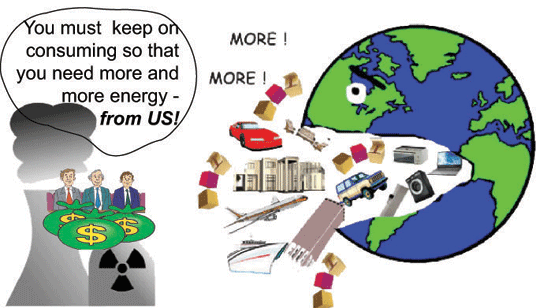
World’s consumption of materials hits record 100bn tonnes a year, https://www.theguardian.com/environment/2020/jan/22/worlds-consumption-of-materials-hits-record-100bn-tonnes-a-year Unsustainable use of resources is wrecking the planet but recycling is falling, report finds, Damian Carrington Environment editor @dpcarrington, Wed 22 Jan 2020 . The amount of material consumed by humanity has passed 100bn tonnes every year, a report has revealed, but the proportion being recycled is falling.
The climate and wildlife emergencies are driven by the unsustainable extraction of fossil fuels, metals, building materials and trees. The report’s authors warn that treating the world’s resources as limitless is leading towards global disaster.
The materials used by the global economy have quadrupled since 1970, far faster than the population, which has doubled. In the last two years, consumption has jumped by more than 8% but the reuse of resources has fallen from 9.1% to 8.6%.
The report, by the Circle Economy thinktank, was launched at the World Economic Forum in Davos. Continue reading
Australia May Add Record Amount of Renewable Power in 2020,
 Australia May Add Record Amount of Renewable Power in 2020, Bloomberg, By James Thornhill, January 21, 2020
-
Corporate demand for clean electricity driving growth: Rystad
- Policy uncertainty seen undermining longer term expansion
Australia is set to add a record amount of renewable power in 2020, driven by growing corporate demand for clean electricity and to fill generation gaps created by the retirement of aging coal-fired plants.
New markets are expected to unlock growth as pilot hydrogen projects start and oil, gas and mining projects invest in off-grid renewables generation, according to Rystad Energy. The positive outlook would be a rebound for Australia’s clean energy developers after a sharp drop in investment in 2019.
“We expect the industry to bounce back in the second half of 2020,” Rystad said in a media release, citing projects with corporate power purchase agreements and the winners of government auction schemes that are scheduled to start construction this year.
Nearly 2 gigawatts of large-scale solar projects and 1.6 gigawatts of wind power are due to complete commissioning in the year ahead, up nearly 40% on 2019 levels. Wind and solar developers are also lining up to replace the Liddell coal plant in New South Wales, which is due to close by April 2023.
Still, developers may face headwinds over the longer term. The industry has already met the government’s 2020 target for renewable generation and there is no new target to replace it. Meanwhile, the profitability of projects located a long way from major demand centers has been hit by marginal loss factors — the amount of power lost along transmission lines.
Losing Momentum
Australia renewables investment fell 38% last year “While the outlook for the commissioning of new projects still looks solid in 2020, there is a risk that activity tails off in the years ahead as the impact of falling investment starts to feed through,” said BloombergNEF analyst Leonard Quong. AT TOP https://www.bloomberg.com/news/articles/2020-01-21/australia-may-add-record-amount-of-renewable-power-in-2020

In Turkey, renewable energy rising, as nuclear partnership with Japan is scrapped
|
Turkey, Japan scrap partnership in Sinop nuclear plant in Turkey’s north, Hurriyet Daily News, 20 Jan 2020, Turkey is reassessing its major partner for the country’s second nuclear plant in the Black Sea province of Sinop, Energy Minister Fatih Dönmez said on Jan. 19.In an interview with state-run Anadolu Agency, Dönmez said that the time schedule and pricing of the nuclear power plant in Sinop fell short of the ministry’s expectations after the results of feasibility studies, carried out by Japanese Mitsubishi Heavy Industries, Ltd., came out.
“We agreed with the Japanese side to not continue our cooperation regarding this matter,” Dönmez said…….. An intergovernmental agreement was signed between Turkey and Russia in May 2010 for Akkuyu NPP, the first nuclear plant of Turkey that will have four VVER-1200 power reactors with a total installed capacity of 4,800 megawatts. …… Share of local and renewable energy increases to 62 pct Dönmez also said Turkey saw an increase in the share of local and renewable resources for the country’s electricity production. Electricity production from local and renewables sources in 2019 amounted to 62 percent compared to 49 percent in 2018, a 13 percent increase, he further elaborated……… http://www.hurriyetdailynews.com/turkey-japan-scrap-partnership-in-sinop-nuclear-plant-in-turkeys-north-151212 |
|
New report: China soon to join countries where renewables are cheaper than coal
Oil Price 19th Jan 2020, In September of last year Oilprice reported an incredible milestone for renewable energy when solar and wind power became cheaper than coal in most of the world. Now, a new report released this week by Wood Mackenzie Power and Renewables has heralded another milestone: China will soon be added to that list of countries in which coal is no longer more economical than renewable energy.
1 This Month

26 September – International Day for the Total Elimination of Nuclear Weapons


PLEASE OPPOSE HR 8255 AND S.3639 – bills would accelerate satellite deployment, with no environmental review or safeguards – https://ncstd5li.quorum.us/campaign/169331/
To see nuclear-related stories in greater depth and intensity – go to https://nuclearinformation.wordpress.com
-
Archives
- September 2026 (206)
- August 2026 (330)
- July 2026 (355)
- June 2026 (287)
- May 2026 (306)
- April 2026 (356)
- March 2026 (251)
- February 2026 (267)
- January 2026 (308)
- December 2025 (358)
- November 2025 (359)
- October 2025 (375)
-
Categories
- 1
- 1 NUCLEAR ISSUES
- business and costs
- climate change
- culture and arts
- ENERGY
- environment
- health
- history
- indigenous issues
- Legal
- marketing of nuclear
- media
- opposition to nuclear
- PERSONAL STORIES
- politics
- politics international
- Religion and ethics
- safety
- secrets,lies and civil liberties
- spinbuster
- technology
- Uranium
- wastes
- weapons and war
- Women
- 2 WORLD
- ACTION
- AFRICA
- Atrocities
- AUSTRALIA
- Christina's notes
- Christina's themes
- culture and arts
- Events
- Fuk 2022
- Fuk 2023
- Fukushima 2017
- Fukushima 2018
- fukushima 2019
- Fukushima 2020
- Fukushima 2021
- general
- global warming
- Humour (God we need it)
- Nuclear
- RARE EARTHS
- Reference
- resources – print
- Resources -audiovicual
- Weekly Newsletter
- World
- World Nuclear
- YouTube
-
RSS
Entries RSS
Comments RSS
 nuclear-news