Potential for clean energy at airports
Clean Energy At Airports Could Find Space Around Runways, Study Says HUFFINGTON POST 05/ 1/2012 From EarthTechling’s Beth Buczynski:  VIDEO a look at Denmark’s clean energy A new report by the U.S. Department of Agriculture shows that bustling airports could serve a vital new function, doubling as alternative energy factories.
The study findings, recently published in an Environmental Management article titled “Airports Offer Unrealized Potential for Alternative Energy Production [PDF],” indicate that airports might want to consider converting empty land into alternative fuel power plants where it is both economically and environmentally beneficial…… Alternative energy projects at major hubs like the Indianapolis and Denver airports, as well as smaller airports like the one in Chattanooga, Tenn., demonstrate the potential for benefits across the airport spectrum. Such efforts may be particularly beneficial for rural economic development, as many rural airport properties contain expansive grasslands that potentially could be converted to biofuel crops or other renewable energy sources… http://www.huffingtonpost.com/2012/05/01/clean-energy-airports-renewables-study_n_1468079.html
India at international Clean Energy Ministerial meeting
When the recession-hit coalition [UK] government tried to cut the subsidies – known as Feed In Tariffs – green energy producers and the environmental group Friends of the Earth took it to court. And won

 Montek’s message on clean energy, Hindustan Times, 1 May 12 The Planning Commission Deputy Chairman was in London last week for the Clean Energy Ministerial meeting – leading the Indian delegation in the absence of Dr Farooq Abdullah, the Minister for New and Renewable Energy. It was an important conference to attend, as India is a major partner in this 23-nation initiative. The CEM is a forum of 23 governments: Australia, Brazil, Canada, China, Denmark, the European Commission, Finland, France, Germany, India, Indonesia, Italy, Japan, South Korea, Mexico, Norway, Russia, South Africa, Spain, Sweden, the United Arab Emirates, the United Kingdom, and the United States.
So that’s pretty much most of the G-20, plus a few green worthies such as Sweden and Denmark. India’s importance is underscored by the fact that the summit in 2014 will be held in India. And that’s not a day too soon in a country that Montek Singh Ahluwalia estimates is on course to notching up a long-term economic growth rate of 8 to 9%. With a billion plus population, the environmental implications of India’s energy consumption are enormous…….
the two major clean energy sources India is looking at are solar and wind. There’s good news on both fronts: recent assessments of available resources in India are that they are much larger than previously estimated. And costs are coming down. Continue reading
The transition from nuclear energy, fossil fuels – to efficiency, renewables, and smart grids
The upshot of these events is an intensified focus on energy efficiency and renewables, two solutions that hold promise of bridging the supply-demand gap in the years ahead while simultaneously reducing the current heavy reliance on fossil fueled generation.
At the same time, new investments in smart grid technologies to manage demand and integrate renewable power supplies into the grid are increasing rapidly.


 Backfilling Nuclear Shutdowns With Efficiency And Renewables In Japan, Germany And California? Think Progress, Apr 29, 2012 by James Newcomb, via the Rocky Mountain Institute Electric utilities and policymakers in Japan and Germany have been scrambling for months to find ways to compensate for nuclear power plants shut down in the aftermath of Fukushima.
In both instances, fossil fuels are part of the stopgap solution to offset the declines in nuclear generation in the short term, but longer-term energy policies are shifting definitively toward efficiency and renewables. Now, the unexpected and indefinite shutdown of both units at the San Onofre Nuclear Generating Station in Southern California has raised questions about California’s short-term electricity supply options and long-term contingency plans. Continue reading
Low income households to get free solar power
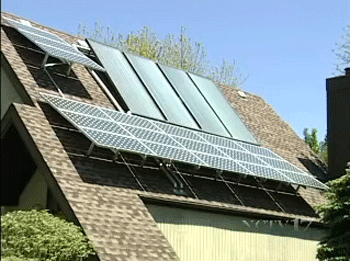
 Free Solar Power Systems For Cayman Islands Households, Energy Matters, 30 April 12, The Cayman Islands government is taking an interesting approach to helping low income families battle increasing electricity costs – by providing free solar panel systems.
Cayman Islands’ Premier, the Hon. McKeeva Bush, OBE, JP announced last week a free solar energy programme for 1500 households that will generate electricity bill savings of nearly 70% for beneficiaries and ensure these families will always have access to electricity for basic applications.
The $15 million programme will not only benefit the households, but also generate between 150 – 200 new job opportunities for Caymanians.
“We will be using reliable data from the Economic and Statistics Office, the Electricity Regulatory Authority and the Department of Social Services, in order to target those in most need of assistance. We will ensure that the myth is broken that renewable energy is only for the very wealthy and elite!” said Premier Bush. The Cayman Islands government has been pushing renewables uptake since revising its Electricity Regulatory Authority Law in 2010. A pilot feed in tariff program was launched in 2011, paying AUD 42c per kilowatt hour for all solar electricity produced by a system.
The Cayman Islands has a special interest in low emissions electricity generation. Like many small island nations around the world, the Caymans currently has a high dependence on electricity generated with expensive imported fossil fuels and is especially vulnerable to the projected impacts of climate change. The island of Grand Cayman was hit by Hurricane Ivan in 2004, flooding many areas and damaging an estimated 95% of the buildings on the island…. http://www.energymatters.com.au/index.php?main_page=news_article&article_id=3183
Iceland could supply renewable energy to Europe via submarine cable
Europe Could Receive Renewable Energy From Iceland via Submarine Cable Market watch, REYKJAVIK, ICELAND, Apr 27, 2012 (MARKETWIRE via COMTEX) — The Icelandic energy provider, Landsvirkjun, one of Europe’s leading renewable energy companies, may help supply Continental Europe with renewable energy via a North Atlantic submarine power cable. Continue reading
A solar energy business for two Tongan grandmothers
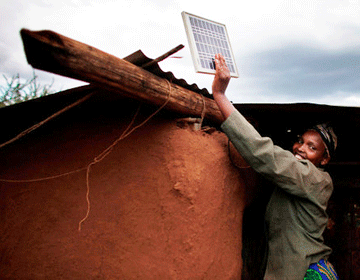 Tonga’s Solar Grandmothers, by Energy Matters, 27 April12, Two grandmothers from the island nation of Tonga have acquired the skills to install solar panel systems in the nation’s communities without access to mains grid electricity.
According to a report on Matangi Tonga Online , Siutiti Halatoa and Siale Leohau successfully completed a six months training course in solar power installation last year at Barefoot College, India, with the assistance of the Indian Government. The recently launched Kolomotu’a Women’s Solar Project in Nuku’alofa, the capital of the Kingdom of Tonga, will assist the women in their role of solar installers. The project is being supported under the Tonga Energy Roadmap.
The grandmothers are the first women to be trained in solar installation in Tonga and will begin their new careers by installing solar panels in over 30 homes, starting with households without electricity in ‘Isileli, Hala ‘o Vave and Sopu.
The solar panels and other equipment have been provided by an anonymous donor and each off-grid installation will generate enough electricity to power several light bulbs and a mobile phone ……. http://www.energymatters.com.au/index.php?main_page=news_article&article_id=3181
Solar energy- a new economy for Navajo tribes
 There’s a strong desire in Indian Country to step out of the role of just a landlord that is collecting rents to being involved in the equity ownership,” MacCourt said.Erny Zah, spokesman for Navajo
The 30-megawatt solar photovoltaic plant planned for the outlying Navajo community of To’Hajiilee would cover more than 200 acres.
Navajo community banks on proposed solar array, Bloomberg, By SUSAN MONTOYA BRYAN, 26 April 12, TO’HAJIILEE, N.M. This flat, dusty stretch of prairie in central New Mexico is where the leaders of a remote, sparsely populated American Indian community envision a sea of solar panels capable of producing enough electricity for more than 10,000 homes miles away from the reservation.
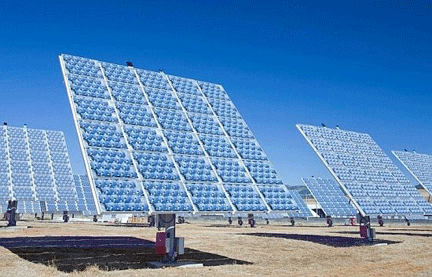
The To’Hajiilee solar project is one of 19 energy projects that will share in $6.5 million recently awarded by the U.S. Department of Energy to spur renewable energy development on tribal lands. About two-thirds of the money is earmarked for tribes in the West, and most of that will be going toward getting projects in New Mexico andArizona off the ground…… At stake is a wealth of untapped potential. Continue reading
35 Indian villages get solar street lighting
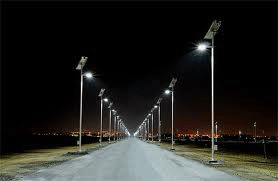 Solar street lights to illuminate 35 villages, Times of India, Kapil Dixit, TNN | Apr 27, 2012, ALLAHABAD: Finally, the wait is over. Solar streetlights are being installed in 54colonies of 35 villages spread over 13 blocks of the district.
With Center and state government authorities’ sanctioned adequate funds to install as many as 256 solar street lights, the UP New & Renewable Energy Development Authorities has done a remarkable job to illuminate villages with solar run streetlights in identified colonies.
The installation of solar streetlights have been taken up at Chaka, Dhanupur, Handia, Kaurihar, Koroan, Kotwa, Manda, Meja, Phulpur, Pratappur, Ram Nagar, Saidabad and Shankargarh blocks. The UPNEDA officials have taken up the project to install solar run street lights after identifying a total of 54 colonies/localities which lack proper lighting arrangements for years, and this was the first time, when such measures were being taken up to illuminate these colonies….. http://timesofindia.indiatimes.com/city/allahabad/Solar-street-lights-to-illuminate-35-villages/articleshow/12888592.cms
UK poll shows overwhelming support for renewable energy

 Poll: Nine out of 10 people want more renewables Friends of the Earth survey latest to show public support for renewables as green group launches new Clean British Energy campaign BusinessGreen 23 Apr 2012
Almost nine in 10 people want to see the government ramp up the UK’s use of clean domestic energy and reduce the country’s reliance on imported gas, a new YouGov poll reveals.
Just under two-thirds of the 2,884 people questioned on behalf of campaign group Friends of the Earth listed wind, wave, solar, or tidal as power sources they wanted to see playing a greater role in the UK’s electricity mix over the next decade, while just two per cent backed an increase in gas capacity. The survey is the latest to signal strong public backing for renewable energy, following Sunday’s YouGov poll for Scottish Renewables that found 71 per cent of Scots supported wind power, and a separate Ipsos MORI survey last week that reported 67 per cent of respondents were in favour of using more wind power….. http://www.businessgreen.com/bg/news/2169394/poll-people-renewables
Nuclear power had had its day, as wind energy blows in worldwide
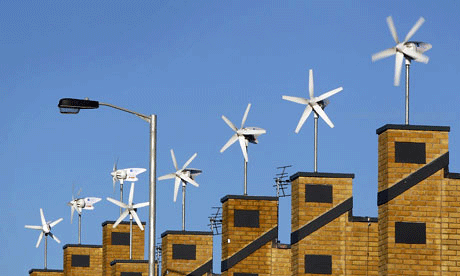 Small-scale wind power facilities could be used in developing countries and in remote areas. In developed countries, small-scale wind power turbines are also gaining in significance with consumers because the electricity generated with them costs less than that offered by many energy providers. Experts see a long-term growth potential in small wind technology.
More than half the wind turbines in Germany are run by private citizens, farmers and local communities.
Wind energy blowing away nuclear power, by Gero Rueter http://www.dw.de/dw/article/0,,15903703,00.html 23 April 12, Wind energy supplies 3 percent of global electricity needs and will soon supply more electricity than nuclear power. In 2011, some 50 billion euros were invested in wind, leading some to say it’s cheap and creates jobs.
Wind energy is booming and it is gaining in significance worldwide. It supplies some 20 percent of electricity in Spain and Denmark as well as about 10 percent in Germany. By 2020, the share of wind energy will have risen to between 20 percent and 25 percent in Germany, according to estimates.
Last year, new wind power plants with a total capacity of some 40 gigawatts (GW) were installed worldwide, according to the World Wind Energy Association (WWEA). This puts wind energy’s global capacity at 237 GW by the end of 2011- the equivalent of what some 280 nuclear power plants generate. Currently, there are some 380 nuclear power
plants producing electricity worldwide. Continue reading
India’s glowing renewable energy future
 Sun shines over renewable energy Business Line, N. RAMAKRISHNAN 22 April 12, Wind energy continues to be the single largest component of the RE portfolio, accounting for nearly 70 per cent of all Green power. The Indian renewable energy industry has never had it so good. Wind power installations in 2011-12 were the highest in a single financial year, at 3,163 MW, taking the total installed capacity to 17,320 MW.
The Centre has announced an ambitious national solar mission under which 20,000 MW of solar power capacity will be added in the next decade. The first phase of the solar mission envisages 1,000 MW of capacity, both solar thermal and solar photovoltaic. The installed renewable energy capacity in the country at the end of March 2012 stood at 24,500 MW, about 12 per cent of the total installed power capacity of 2,00,287 MW…..
http://www.thehindubusinessline.com/features/article3342620.ece
India’s Gujarit solar park- even bigger than China’s Golmud Solar Park.
Asia’s largest solar field switched on in India, THE ASSOCIATED PRESS April 19, 2012, By KATY DAIGLE Bloomberg, BUSINESSWEEK NEW DELHI The west Indian state of Gujarat is flipping the switch on Asia’s largest solar power field as part of its 600 megawatt solar energy addition to India’s power grid.
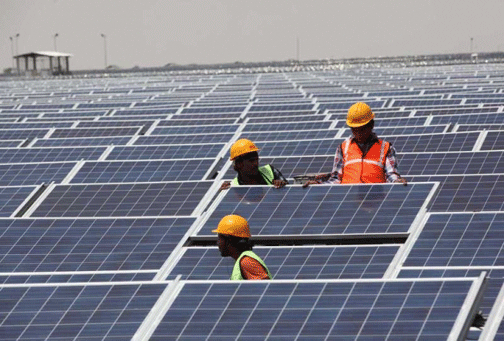
The Gujarat Solar Park, spread across a desolate 3,000-acre (1,200-hectare) swath of desert, can supply 214 megawatts of electricity, making it larger than China’s 200-megawatt Golmud Solar Park. Continue reading
Nuclear and coal energy in ‘cloud computing’
Apple, Twitter, Microsoft using ‘dirty’ cloud technology: Greenpeace, By Sheila Dabu Nonato, Postmedia News April 17, 2012 Cloud computing — the rapidly expanding practice of delivering data and applications over the Internet — is being fuelled by “dirty” energy, including coal and nuclear power, with some industry leaders like Facebook, Google and Yahoo leading the way in making the technology greener, while other big names such as Apple, Microsoft, Amazon and Twitter are lagging behind, Greenpeace says in a report released Tuesday. Continue reading
Australia launches renewable energy fund

 $10b fund for renewable energy firms http://www.perthnow.com.au/business/b-fund-for-renewable-energy-firms/story-e6frg2r3-1226330084361 AAP April 17, 2012 COMPANIES involved in renewable energy will soon be able to tap into a $10 billion federal pool. The Gillard government released today an independent review into the Clean Energy Finance Corporation (CEFC), which is due to start operating from July 2013.
The government accepted all recommendations made by the review.
The CEFC will provide $10 billion worth of financing to companies involved in renewable energy, low-emissions and energy efficiency technology. The review was led by Reserve Bank of Australia board member Jillian Broadbent.
The CEFC will encourage private investment and help overcome capital market barriers for cleaner energy technologies, the government said in a statement today.
The fund will apply “commercial rigor” to its investment decisions to make sure companies have a positive rate of return and are able to repay the loans.
Smart grids – we’d be dumb not to use them
Clever energy: why smart grids matter. The Green Piece. 17 April 2012. Smart grids-they’ve been in the news a lot lately and their importance is ever growing. The UK, like countries around the world, is seeking to increase the share that renewable sources play in its energy mix, while also striving for cleaner forms of transport such as electric
vehicles.
As a result, smart grids are set to play an important role in how we manage these changes to our energy generation and use. With increasing reliance on intermittent sources of power such as wind and solar, and increased demand on electricity supplies through the use of battery-powered cars, it is going to become ever more important to properly manage our energy use.
According to a new report from IDC Energy smart grid spending will increase 17.4 per cent globally between 2010-2015; with overall spending set to reach close to $46.4billion in 2015. What is a smart grid? Continue reading
1 This Month
26 April – Chernobyl: Inside the Meltdown airs on National Geographic on Sunday 26th April from 4pm

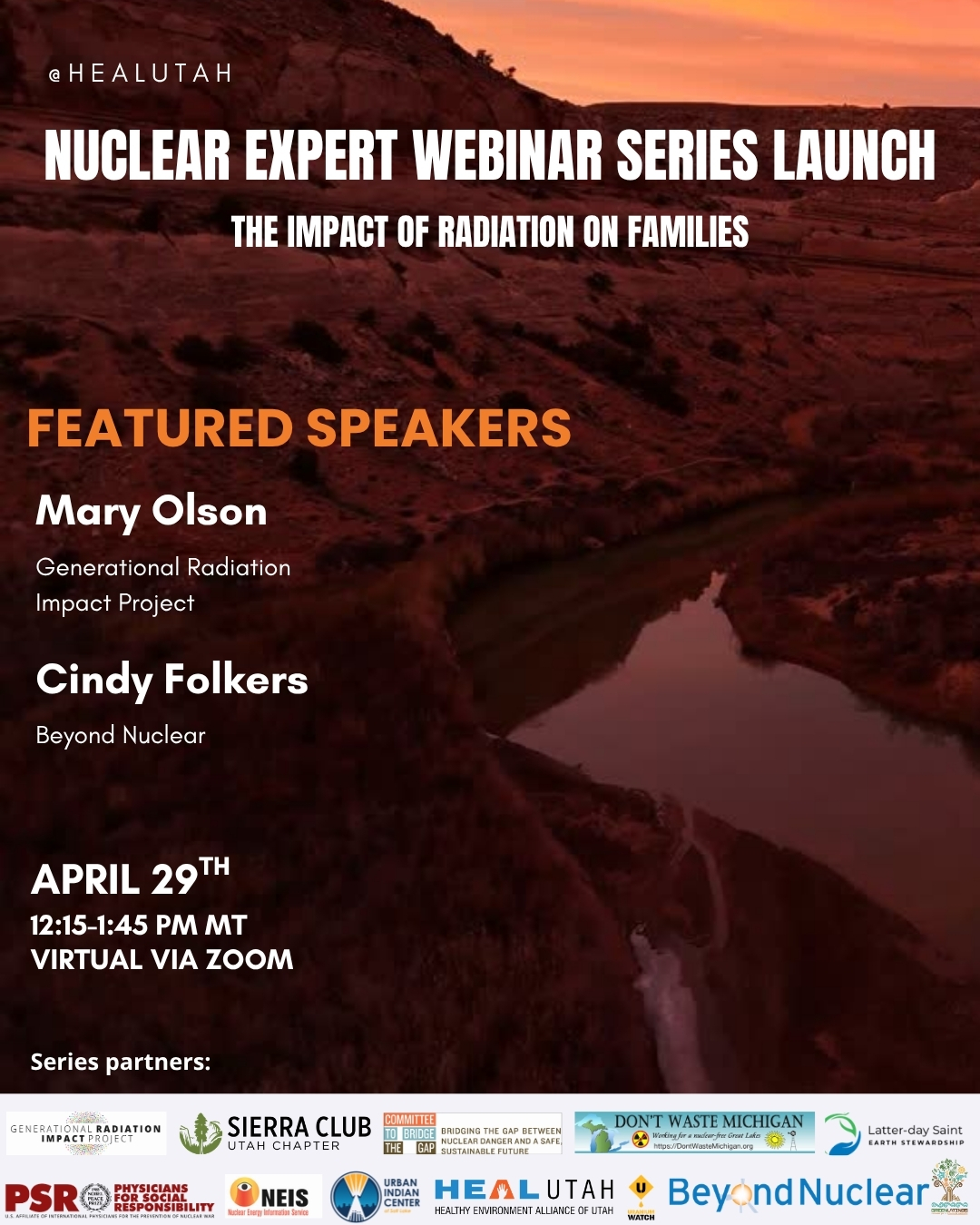
29 April – Nuclear Expert Webinar #1 – Radiation Impacts on Families with Mary Olson and Cindy Folkers
- 12:15 PM MT – 1:45 PM MT
- Location: Virtual – REGISTER TODAY

4 May -West Suburban Peace Coalition to discuss Iran war at May Educational Forum
Monday, May 4, 7:00 – 8:00 PM Central Standard Time
Title: : How Trump’s Narrative Tries to Shape the Reality of the War on Iran.
Contact Walt Zlotow, zlotow@hotmail.com 630 442 3045 for further information
14 May – online event From Bombs to Data Centres: the Face of Nuclear Colonialism


Pine Ridge Uranium is the real threat, not Tehran- Tell Burgum: Stop the Extraction.
Chernobyl: The Lost Tapes – A good documentary on Chernobyl on SBS available On Demand for the next 3 weeks– https://www.sbs.com.au/ondemand/tv-program/chernobyl-the-lost-tapes/2352741955560
To see nuclear-related stories in greater depth and intensity – go to https://nuclearinformation.wordpress.com
-
Archives
- April 2026 (300)
- March 2026 (251)
- February 2026 (268)
- January 2026 (308)
- December 2025 (358)
- November 2025 (359)
- October 2025 (376)
- September 2025 (257)
- August 2025 (319)
- July 2025 (230)
- June 2025 (348)
- May 2025 (261)
-
Categories
- 1
- 1 NUCLEAR ISSUES
- business and costs
- climate change
- culture and arts
- ENERGY
- environment
- health
- history
- indigenous issues
- Legal
- marketing of nuclear
- media
- opposition to nuclear
- PERSONAL STORIES
- politics
- politics international
- Religion and ethics
- safety
- secrets,lies and civil liberties
- spinbuster
- technology
- Uranium
- wastes
- weapons and war
- Women
- 2 WORLD
- ACTION
- AFRICA
- Atrocities
- AUSTRALIA
- Christina's notes
- Christina's themes
- culture and arts
- Events
- Fuk 2022
- Fuk 2023
- Fukushima 2017
- Fukushima 2018
- fukushima 2019
- Fukushima 2020
- Fukushima 2021
- general
- global warming
- Humour (God we need it)
- Nuclear
- RARE EARTHS
- Reference
- resources – print
- Resources -audiovicual
- Weekly Newsletter
- World
- World Nuclear
- YouTube
-
RSS
Entries RSS
Comments RSS
 nuclear-news