Energy Revolutions – time for a change
https://renewextraweekly.blogspot.com/2024/05/energy-revolutions-time-for-change.html
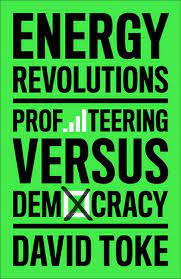
In this uncompromisingly radical Pluto book entitled Energy Revolutions, with the graphic subtitle Profiteering versus democracy, Dr David Toke argues that the energy crisis is an inevitable result of an industry run by and for corporate profit. He says ‘energy policy was never meant to favour sustainability or energy security – for decades, it has been shaped by corporate interests while hampering renewable alternatives. Now we suffer the cascading consequences’. He says there is an urgent need to radically increase state intervention, including public ownership, and deploy ‘energy democracy’ for the public interest.
However, he is not against market competition as such- it can speed change and help reduce costs. Thus, in his account of the early days of renewables, he says that, as a result of the adoption of Feed In Tariffs in the late 2000’s in Germany and elsewhere, markets were created that ‘meant that the wind and solar industries grew quickly. The costs of renewable energy plummeted, and today renewable energy is much cheaper than either fossil fuels or nuclear power. If things had been left as the anti-renewable incentive campaigners wanted, then of course the renewables industry would never have taken off. The world would be in a parlous position in terms of surviving the fossil fuel price spirals that we see in cycles (in both oil & natural gas price crises). Our ability to deal with the climate crisis would be almost destroyed’.
Toke though says that when markets are used to create monopolies, in pursuit of corporate profits and control, things go seriously awry- as we saw in 2022 and subsequently, with record profits being made by oil and gas companies. With energy prices escalating, Exxon made $55 bn, Shell $40 bn, Chevron $36.5 bn and Equinor $55 bn. Wind-fall taxes can claw back a tiny bit of this profiteering, but it is insignificant when you realise that, as Toke quotes an economist as saying ‘the oil and gas industry has delivered $2.8bn (£2.3bn) a day in pure profit for the last 50 years’. What’s needed is system change.
That of course is the familiar call of most radicals. Toke says, at present ‘the wealthy, who own the shares, get richer at the expense of ordinary people.’ In response, he says, while we can’t simply nationalise oil to solve this problem, since the compensation required would be huge, we can change the way the market works. Crucially, he says, ‘as the renewable energy revolution gathers pace, we need state intervention to ensure that the benefits of lower-cost green energy supplies go to the consumer & not the energy corporations’. In particular, ‘we need to extend government intervention & elements of state ownership of the retail energy supply sector to ensure that the consumer, not the big corporations, benefits from cheap renewable energy.’
The focus on ‘retail supply’ is linked to a proposed decentral shift away from seeing consumers as passive to one in which consumers may also be energy producers (via PV) and/or may also take an active role in managing their energy use (via DSM). Toke also sees them playing more of a role in shaping the system via an expansion of democratic participation, enabled by local energy co-ops, municipal projects & nationalisation of some of the energy systems. He says that public ownership ‘has an important role in delivering services in parts of energy systems where competition is itself either impossible or inefficient. It may be especially relevant to the retail electricity supply sector’. He adds ‘bringing in retail energy supply into public ownership should be cheap for the state to achieve since the companies involved have few tangible assets.’ But, he also looks to boosting competition ‘by the establishment of state companies to develop renewable energy alongside existing private companies’.
Some of this it may sound utopian or even naive, but Toke reminds us that the ‘alternative energy’ activists in the 1970s and 1980s ‘were seen as fringe oddballs by the energy mainstream. Today their vital role in developing niche renewable energy technologies and markets is airbrushed out of history since it contradicts the idea that big capitalism solves the big problems.’ Well yes, and now we live in a world in which renewables will soon dominate – supplying up to 100% of all global energy by 2050. However, as Toke says, it has to be done right. He provides us with, if not a blueprint of what to do, then at least a rough guide to the key political issues, with some very good insights on the situation in the UK, EU and USA. For example, it is amazing how expensive PV cells are in the US and how far France is behind on renewables due to its obsession with, now failing, nuclear.
In terms of technology choice, Toke backs most renewables strongly, though not all biomass, and seems convinced that domestic heat pumps are the best bet for using green power for home heating- whereas he says that green hydrogen, produced using renewable power, ‘needs to be used only for essential purposes, for example for storing renewable energy or for some industrial purposes for which electricity is not desirable. It should not be squandered in the provision of heating or cooling services’.
That’s now a common view: electric powered heat pumps are seen as much more efficient. Even if it does seem odd to abandon gas boilers and the existing gas pipeline system, which some wanted to repurpose for zero carbon green hydrogen use. Of course, some wanted to use fossil-derived blue hydrogen, a very different and very dire thing. But Toke notes that ‘the German coalition was divided when it came to debating a heating law about phasing out gas boilers in existing buildings. As part of a compromise, municipal authorities have been given the task of making plans for heat networks to be powered by large-scale heat pumps’. Well yes, as Toke admits, large heat pumps are more efficient. Although, dare I say, Combined Heat and Power plants, feeding heat nets and heat stores, can be even better and can help with grid balancing.
We can of course debate the pros and cons of each option and Toke takes us through some of the issues including, inevitably, nuclear, which he is clearly not fond of- not least since it is expensive and inflexible. Although his assertion that ‘once the current spurt of labour-intensive industrialism peters out in China, their drive in building nuclear power will fade, leaving nuclear in decline’, is maybe a bit too optimistic. Overall through, pronouncements like this aside, this is a good book if you want to get to grips with some of the key political and economic issues facing renewable energy and green politics- in a fast changing world.
Polish industry minister announces massive delay in nuclear power plant project

The anticipated opening of Poland’s first nuclear power plant may be postponed by up to seven years, with the new operation date set for 2039-2040, significantly later than previously planned.
BYGRZEGORZ ADAMCZYK 9 May 24 https://rmx.news/article/polish-industry-minister-announces-massive-delay-in-nuclear-power-plant-project/
Polish Industry Minister Marzena Czarnecka stated that the country’s first nuclear power facility is now expected to become operational in 2040, a seven-year delay from initial estimates.
The adjustment comes as a shock following Deputy Minister of Climate and Environment Miłosz Motyka’s earlier suggestion that only a one-year delay was likely in the nuclear plant’s preparation process. However, it has now become evident that the setbacks will be much more severe.
Minister Czarnecka, in an interview with Polish Radio on Tuesday, announced that the first nuclear unit in Poland would commence operations in 2039-2040, criticizing the previous government’s 2033 target as unrealistic. She highlighted what she said was her pragmatic approach, acknowledging that “all investments are subject to certain delays” and marked 2039 as a “breakthrough year” for the Choczewo nuclear plant.
The postponement in the completion of the next major investment after the Central Communication Port (CPK) transport hub has left energy specialists frozen in place. Immediately, voices began to arise that if Poland does not manage to complete the power plant by 2035, an energy disaster awaits the country.
As news of delays in implementing nuclear power in Poland began to heat up in the media and on the web, the minister decided to speak again and clarify what she had said the day before. In response to a publication on Energetyka24.pl, she noted that by mentioning 2039, she was referring to the complete end of construction of the first nuclear power plant. Minister Czarnecka also provided a planned work schedule, which assumes that physical construction will begin in 2028, and the first energy block will be put into operation by 2035. By 2039, the next two blocks are to be connected to the grid.
Recent weeks have also seen rumors of a potential change in location for Poland’s inaugural nuclear facility, which, according to Łukasz Młynarkiewicz, vice-president of Polish Nuclear Power Plants, would not invalidate previous decisions or halt preparatory work at the current site.
However, a relocation could mean additional years of delay. Experts already consider the Polish nuclear energy project to be about two years behind schedule, with every month of delay further widening the gap.
Media reports have also surfaced about requests for re-evaluation of the environmental decision concerning Poland’s first nuclear plant. These requests, submitted to the General Directorate for Environmental Protection (GDOŚ), have come from several environmental organizations and individuals, whose identities remain protected for privacy reasons.
Nuclear Energy: The New Geopolitical Battleground
Oil Price, By Haley Zaremba – May 10, 2024,
- Russia’s nuclear energy sector continues to generate significant revenue despite sanctions on its fossil fuels.
- Western nations are increasingly turning to China for nuclear energy supply chains, strengthening China’s economic and geopolitical power.
- This transition is part of a broader trend of China’s growing influence in the global energy landscape.
While the west has had a considerable amount of success imposing energy sanctions on Russia in response to the ongoing war in Ukraine, Russian nuclear sector exports have proven harder to kick. But now, as more western nations get serious about cutting Russia out of their nuclear energy supply chains, they are pushing more and more economic and geopolitical power into the hands of China. …………………………………………………………………………………………………………………
This is not the first time that nuclear energy has been a ‘geopolitical flashpoint’ between Russia and China. The two economic giants have also been facing off for nuclear dominance in emerging economies, and particularly in sub-Saharan Africa…………………………………………………………………
This potential transition of nuclear energy power and profit toward China is part of a much bigger trend in the global energy landscape…………… https://oilprice.com/Alternative-Energy/Nuclear-Power/Nuclear-Energy-The-New-Geopolitical-Battleground.html
We’ve barely scratched the surface of how energy efficiency can help the energy transition

Anne Delaney, SwitchedOn Editor, 6 May 24
Amory Lovins says energy efficiency is a continuous spectrum that keeps rapidly evolving, and better design is twice as efficient as the gains from just dropping fossil fuels.
Amory Lovins has been writing and talking about energy efficiency for over 50 years but he says the need to use energy more productively and efficiently is now more acute than ever.
At the same time, the scope for saving energy is also bigger than ever.
Lovins views have been crucial to our understanding of energy efficiency. He’s advised major firms and numerous governments, authored hundreds of papers and books, and taught at several universities most recently Stanford. Time magazine named him one of the world’s most influential people.
“We’ve barely scratched the surface of how much efficiency is available,” Lovins told the SwitchedOn podcast. “It’s about two to four times what I thought in the 70s, and as we learn more about it, especially what we can do with design, the potential just keeps getting bigger and cheaper.”
Whilst enormous gains have been made in energy efficiency through better operational practices and technical improvements – turning off appliances, insulating, plugging cracks and gaps, etc – Lovins says that energy efficiency is a continuous spectrum that keeps rapidly evolving.
He believes the key to better efficiency now is better design.
“What we haven’t yet really tackled is how to design buildings, factories, processes, equipment, vehicles, as whole systems for multiple benefits. That’s what we call integrative design,” says Lovins. “That is twice as powerful as the factor two or three efficiency gains that we can get just by switching from burning fossil fuels.”
In 1976 Lovins predicted that over the next 50 years the US could nesarly quadruple overall energy
“That’s now looking conservative as we learn more about integrative design…. the current evidence shows you could about quintuple end use efficiency by about 2060, or treble it by about 2040.”efficiency, but by 2010 in a study he called ‘Reinventing Fire,’ he found the savings were twice what he’d previously thought, but at a third of the cost.
A passive solar house in the middle of Colorado……………………………………………………………………………..
Making energy efficiency great again
nergy efficiency has been regarded as the poor cousin of renewable technology, which is more likely to grab the headlines in stories about the energy transition.
“Energy is invisible and the energy you don’t use is almost unimaginable,” says Lovins. “So even though in the US the energy savings since 1975 add up to 25 times more than the increase in renewable supply, the renewables get practically all the headlines, because you can see them there on the rooftop and the skyline.”
Thinking about energy efficiency is also hampered by a belief that we can’t get more efficient, that “we must already have wrung out all the work from our energy that’s worth doing.”
The growing electrification movement is however enabling many more people to realise the importance of efficiency gains – it’s unlocking people’s understanding that what makes these electrification technologies superior is their greater energy efficiency.
We see it with electric vehicles that are two to four times more efficient than the internal combustion engine, and the heat pump that is three to four times more efficient,” Daan Walter, Principle of Strategy at the Rocky Mountains Institute, told the SwitchedOn podcast.
Walter argues that electrification is the gateway into efficiency thinking – by encouraging us to move away from just thinking about the upfront costs of appliances, it provides an opportunity to change the narrative about efficiency.
“To turn fossils into something useful, you need to turn heat into something useful, and that is an incredibly inefficient process,” says Walter. “We lose about two thirds of the energy that goes into our system before we can turn it into something useful, like moving a car or creating a litre of hot water to shower.”
He says this is the ‘design fault’ of burning fossil fuels.
“If you convert it into a dollar value, that’s almost $5 trillion per year that we spend on energy that subsequently goes up in smoke, I mean, literally goes up in smoke because it’s fossil fuels that you’re burning. That’s 5% of global GDP.”
But Walter argues that “the arc of energy history bends towards efficiency.” He’s confident the greater energy efficiency inherent in renewable energy will win out over fossil fuels.
“Efficiency is not a topic that sits next to technology change – efficiency sits within technology change. The successful technologies are more efficient, and more efficient technologies are successful.”
Walter says this is a trend that can be seen over the past 150 years in energy history.
When gas boilers came into the British heating system, for example, they replaced coal, because they were about three to four times more efficient than the standard coal stove.”
“Even though gas was more expensive than coal, it didn’t matter, because you use much less of it.”
“Time and again in history, we see this shift where an efficiency gain leads to a technology change, and it goes to the core I think of how important efficiency is.”
You can hear the full interview with Amory Lovins and Daan Walter on the SwitchedOn podcast
Amory will also be in Australia to give the key note speech at the 2024 EEC National Conference, 14-16 May, in Sydney. You can find details here. https://switchedon.reneweconomy.com.au/content/weve-barely-scratched-the-surface-of-how-energy-efficiency-can-help-the-energy-transition
California hits stunning new solar and battery records in postcard from energy future
Giles Parkinson , 3 May 24, https://reneweconomy.com.au/california-hits-stunning-new-solar-and-battery-records-in-postcard-of-energy-future/—
The records on renewable and battery storage continue to tumble in the northern spring as the technologies plays an increasingly important role in two of the biggest state grids in the world – California and Texas.
In California, as Renew Economy has reported over the last week, battery storage has emerged as often the biggest supplier of power for multiple hours in the state’s evening peak, meeting as much as 27 per cent of demand from its fleet of more than 10,000 MW of big batteries.
On Tuesday, California time, battery output jumped about 7,000 MW for the first time, reaching a peak of 7,046 MW at 7.55pm local time, nearly 300 MW above the peak set just a day earlier, and more than 1GW above the record that stood just two weeks earlier.
In Texas, battery capacity is also setting new benchmarks, reaching above 2,000 MW for just the second time ever and for the first time this summer. That share will grow dramatically with another 5 GW of battery capacity being added to the grid this year.
Solar records are also tumbling in quick fashion on both grids, underlying the need for battery storage as the solar output ramps down leading into the evening peaks in both states.
In California, a new peak of 18.54 GW of solar was reached at 1.10pm on Thursday, when battery storage was soaking up 4.4 GW of this output. It was the third time the solar output record had occurred in the last week.
Over the past two months, the share of wind, water and solar has imposed itself on the grid, reaching more than 100 per cent of demand on the last 19 consecutive days, sometimes for nine hours or more, and for 48 out of the last 56 days.
In Texas, a new record for solar also occurred last month when it reached 18.8 GW. This week, the PJM grid in the mid-west of the US set a new solar output record of 7.05 GW, the first time it reached above 7GW, and nearly double its record output from a year ago.
Giles Parkinson is founder and editor of Renew Economy, and is also the founder of One Step Off The Grid and founder/editor of the EV-focused The Driven. He is the co-host of the weekly Energy Insiders Podcast. Giles has been a journalist for 40 years and is a former business and deputy editor of the Australian Financial Review.
Germany records 50 hours of negative electricity prices for April, largely due to renewables.

Average retail prices fell to €6.24 ($6.70)/kWh on the German electricity spot
market in April, largely due to renewables covering about 70% of the
network load. These low price levels in the electricity market can be
attributed to the high shares of renewables in Germany. According to Rabot
Charge, renewable energy systems covered 70% of the network load in April.
PV Magazine 3rd May 2024
Huge success of renewable energy in California – over 100% of demand for many days

Statistics and Graphs for the 48 of 56 Days From March 8-May 2, 2024,
Where Wind-Water-Solar (WWS) Supply Exceeded 100% of Demand on
California’s Main Grid for 0.25-9.92 Hours Per Day.
Stanford University 3rd May 2024
G7 Countries Task IRENA to Monitor Group’s Renewable Energy Progress

IRENA, Abu Dhabi, United Arab Emirates, 30 April 2024 – Today, G7 leaders tasked the International Renewable Energy Agency (IRENA) to track and monitor the group’s collective contribution toward the global renewable tripling target by 2030. The target was established by the UAE Consensus last November at COP28, aligning global climate ambitions with IRENA’s 1.5°C pathway, mapped out by the Agency’s World Energy Transitions Outlook.
“Trust and transparency go hand in hand,” said IRENA Director-General Francesco La Camera, who is attending the G7 Ministers’ Meeting on Climate, Energy and Environment. “IRENA will respond swiftly to the request by G7 members to track the group’s progress toward the global target to triple renewable power capacity by 2030.”
Citing an IRENA brief for the G7, the communiqué indicates that the group’s solar PV expansion target by 2030 is on track if some enhancements to existing policies are made in a timely manner. It notes the need for further acceleration in offshore wind deployment through enhanced and flexible policy efforts, faster permitting, and offshore grid extension.
“The G7 is making notable strides in accelerating solar PV deployment, and there is commitment to the development of offshore wind. Advancing all forms of renewables, along with infrastructure modernisation, will be essential for G7 nations to realise their energy transition aspirations,” Mr. La Camera added.
The G7 communiqué commits the group to increase system flexibility through grid reinforcement, in line with IRENA analysis of key metrics that suggests efforts need to be accelerated. The group also called for the significant expansion of energy storage capacity, by more than six-fold by 2030, from 230 GW in 2022. This falls within the range of IRENA’s recommendations for energy storage capacity by 2030.
I
It also calls on international organisations, including IRENA, to continue their work on industrial decarbonisation particularly standards and technology development for hard-to-abate sectors as outlined in a second brief published as a contribution to the G7 discussions.
G7 countries also recognised the urgent need to increase the group’s efforts in developing countries, committing to supporting the Accelerated Partnership for Renewable Energy in Africa (APRA). Under the auspices of APRA, Kenya and IRENA will convene the first APRA Investment Forum in September 2024 to accelerate the deployment of renewables-based energy systems and green industrialisation in APRA Member countries…………………………. more https://www.irena.org/News/pressreleases/2024/Apr/G7-Countries-Task-IRENA-to-Monitor-Groups-Renewable-Energy-Progress
The astonishing growth of renewable energy

Renewable energy is taking over the world!
Energy Revolutions, DAVID TOKE, APR 26, 2024
As I say in my forthcoming book. Energy Revolutions, Profiteering versus Democracy’ (PlutoPress): ‘if recent growth trends in renewable energy continue, then sustainable renewable energy sources (mostly wind and solar PV) will make up 100 per cent of world energy consumption (all energy, not just electricity) by the year 2050. ……..Based on trends over the last ten years, nuclear power would be projected to supply only around 3 per cent of world energy in 2050. There is a consistent trend in the last ten years of world growth in renewable energy (mostly wind and solar power) of 12.6 per cent per year…….By contrast, the total primary energy consumption (that is, all energy, not just electricity) is showing an average growth of 1.4 per cent per year over the previous ten years’ This is shown in a Table below [on original] taken from my Energy Revolutions book:
Nuclear power hardly needs to be included in such charts, since their contribution to world energy by 2050 is likely to be negligible. See the chart below, [on original] also taken from my forthcoming book Energy Revolutions
Nuclear power is actually declining as a proportion of total energy consumed in the world. This is because the amount of energy supplied by electricity is rapidly increasing whilst the volume of nuclear production is static. Increasingly the new electricity supplies are coming from renewable energy sources. Despite the ritualistic pronouncements from the nuclear industry about an imminent upsurge in nuclear power through a new ‘renaissance’ (which has been supposed to be happening for the last 20 years) renewables are triumphing.
Oil and gas corporations like Exxon produce their own fantasy pronoucements about how use of natural gas will increase in the future. Not only are renewables dominating deployments of electricity generation capacity, but the market for fossil fuels is being eaten away as electrification spreads through the world economy. Transport will become dominated by electric vehicles, electric trains and eventually also electric planes. Heating will be increasingly provided by electrically powered heat pumps.
As strong as they are, fossil fuel and nuclear interests cannot stop the renewables takeover. Sure, they can slow it down to an extent by misinformation about renewable energy and technologies like EVs and heat pumps, but green energy will win in the end. That is because there is an unbeatable combination of grassroots energy activists campaigning for renewable energy and also because renewable energy and renewable-friendly technologies are developing so fast! https://davidtoke.substack.com/p/the-astonishing-growth-of-renewable
Should we use nuclear energy?
Is nuclear energy the answer to the climate crisis or just a false solution? Here we separate fact from fiction and explore this controversial topic.
18 Apr 2024 , https://friendsoftheearth.uk/climate/should-we-use-nuclear-energy
What’s nuclear energy and is it renewable?
First off, a bit of science. Nuclear power uses nuclear reactions to generate electricity. Currently, this is mostly done through nuclear fission, where uranium and plutonium atoms are split in reactors to release large amounts of energy. The resulting heat is used to create steam, which turns turbines to generate electricity.
Nuclear energy doesn’t release greenhouse gases, making it a source of low-carbon energy. It’s often considered to be clean and sustainable, but is it renewable? Well, it’s not classified as such by the UK, and we’d argue that an energy source that creates a difficult and currently unsolved waste problem can’t be described as renewable.
What’s the problem with nuclear waste?
Nuclear power produces radioactive waste that’s dangerous for people and wildlife and lasts for thousands of years. If it isn’t disposed of or managed properly, the risks include contaminated groundwater and radiation exposure, which can have long-term implications for our health.
And nuclear waste management is a big problem. Decades after the first nuclear power station opened in the UK, safe storage for waste is still decades away at best, if ever. For example, Sellafield in Cumbria, the largest nuclear waste facility in Europe, currently has a worsening radioactive leak that could risk public safety. Plus, any new nuclear energy increases the amount of radioactive waste we have to deal with.
Is nuclear energy cheap?
In short, no. Nuclear is costly, especially in the UK, where new nuclear power would be more expensive than anywhere else in the world, according to a 2015 report. This is due to a number of factors, including the UK’s nuclear financing arrangements.
According to a 2017 review by Manchester University’s Tyndall Centre, the world’s leading climate energy and research institute, “claims that nuclear power is cheaper than other low-carbon options (including carbon capture and storage and wind) are unlikely to be borne out in reality”. And since the Centre’s review, the price of renewables has continued to fall quickly, making them much cheaper than nuclear energy.
Should nuclear energy replace fossil fuels?
To tackle the climate crisis, we need to urgently ditch fossil fuels like coal, oil and gas and replace them with clean, green alternatives. Nuclear energy is certainly less damaging for the environment than fossil fuels. But renewable energy, combined with energy efficiency and energy storage, is a faster and more cost-effective solution.
Alongside the higher costs outlined above, nuclear energy is also slower to build. For example, the Hinkley C plant being built in Somerset was announced in 2010 but may not start operating until 2027 at the earliest. By contrast, onshore wind and solar farms can take as little as 1 year to set up.
[Nuclear is] unlikely to make a relevant contribution to necessary climate change mitigation needed by the 2030s due to nuclear’s impracticably lengthy development and construction timelines, and the overwhelming construction costs of the very great volume of reactors that would be needed to make a difference.
Dr. Gregory Jaczko et al., Nuclear Consulting Group
It may be that better, more efficient forms of nuclear energy are developed in the future, but even so it’s unlikely we’d need this power. We believe it’s possible to transition from fossil fuels to renewable energy without resorting to nuclear. Renewable energy, as well as energy efficiency and storage, should be the focus of our efforts going forwards.
How can we solve the climate crisis without nuclear energy?
One word: renewables. The UK is blessed with huge resources of renewable energy such as wind, tidal and solar. These could provide all the energy we need, and then some.
Now, the UK will need more electricity than it currently consumes as we switch our transport and heating across from fossil fuels. But our research shows that if properly developed, onshore wind and solar farms alone could produce more than 2.5 times the electricity currently consumed by homes. And that’s not including the significant potential for offshore renewables. The UK not only has the resources to easily meet its own energy needs, but it could also become a green energy superpower exporting clean electricity to other countries.
Some argue that nuclear is better because it’s reliable, whereas wind and solar are dependent on the weather. Firstly, renewables are more consistent than they’re often given credit for. For example, solar panels work whenever it’s daylight, not just when the sun shines. But in instances where there are gaps, good energy storage and a mix of different types of renewables can ensure a continuous supply.
As we transition to a greener, fairer society, it’s important that no-one’s left behind. This includes those with jobs in the fossil fuel and nuclear industries. Green technologies, skills and services are creating ample opportunities for green jobs, allowing people to retrain in new sectors such as renewable installation.
Our verdict
In short, nuclear energy is a slow and costly solution to the climate crisis, and one that creates harmful waste we have no answer for. Rather than pursuing nuclear power, we need to invest in renewable energy, energy efficiency and energy storage for people and planet
Finland: Grid Limitations Force Olkiluoto-3 to Curtail Output
Energy Intelligence Group, Apr 5, 2024, Author Grace Symes, London
Finland’s 1,650 megawatt Olkiluoto-3 nuclear reactor has had to curtail
output more than a dozen times since it began regular electricity
generation in April 2023 due to Finnish electric grid limitations, as well
as low Finnish electricity prices and technical issues.
While Olkiluoto-3 has itself helped to lower these prices, Finland’s electric system does not
currently have enough resiliency to support such a large reactor, and
transmission system operator Fingrid has had to take special measures to
ensure that the Olkiluoto-3 EPR can operate near capacity.
These issues could call into question the rationale for building such a large reactor in
the first place.
https://www.energyintel.com/0000018e-a47c-d9cc-abce-ff7e089c0000
China’s quiet energy revolution: the switch from nuclear to renewable energy
By Derek Woolner and David Glynne Jones, Apr 6, 2024 https://johnmenadue.com/chinas-quiet-energy-revolution-the-switch-from-nuclear-to-renewable-energy/
There is now a policy dispute about the roles of nuclear and renewable energy in future Australian low emission energy systems. The experience of China over more than a decade provides compelling evidence on how this debate will be resolved. In December 2011 China’s National Energy Administration announced that China would make nuclear energy the foundation of its electricity generation system in the next “10 to 20 years”. Just over a decade later China has wound back those ambitious targets and reoriented its low emission energy strategy around the rapid deployment of renewable solar and wind energy at unprecedented rates.
Australia has seen a campaign against the use of renewable energy technologies and for the benefits of nuclear energy in developing Australia’s future low emission energy systems. The Federal Opposition has now adopted this position as their policy. The recent experience of China provides a compelling commentary on this decision.
In December 2011 China’s National Energy Administration (NEA) announced that China would make nuclear energy the foundation of its electricity generation system in the next “10 to 20 years”, adding as much as 300 gigawatts (GWe) of nuclear capacity over that period.
This was followed by a period of delay as China undertook a comprehensive review of nuclear safety in the aftermath of the Fukushima nuclear disaster.
Subsequently, moderated nuclear energy targets were established, aiming for a nuclear energy contribution of 15% of China’s total electricity generation by 2035, 20-25% by 2050 and 45% in the second half of the century.
However by 2023 it was becoming clear that China’s nuclear construction program was well behind schedule. The target for 2020 had not been achieved, and targets for subsequent 5-year plans were unlikely to be achieved.
In September 2023 the China Nuclear Energy Association (CNEA) reported that China was now aiming to achieve a nuclear energy contribution of 10% by 2035, increasing to around 18% by 2060.
The CNEA also indicated that ‘greenlighting’ of new construction would now be at the rate of 6-8 large nuclear power reactors per year – not the 10 per year previously targeted for 2020-2035 and beyond. This will result in new nuclear generation increasing by 60-80 terawatt-hours (TWh) annually.
Meanwhile the deployment of renewable energy (primarily solar and wind energy) was dramatically accelerated in 2023, with the installation of 217GWe of new solar capacity and 70GWe of new wind capacity.
This represents an increase of around 400TWh in annual low emission generation – the quantitative equivalent of 40 large nuclear power reactors, or four times the average annual output of the Three Gorges Dam hydroelectric system (the world’s largest power station).
In 2023 energy analysts started reporting that China was now expected to achieve or exceed its 2030 target of 1200GWe for the total installed capacity of solar and wind energy by 2025, and was now planning to triple the 2030 objective, to reach 3900GWe.
Previously China expected that its energy emissions would peak in 2030, but revised forecasts are now indicating that this could happen as early as 2024, 5-6 years ahead of target.
By the end of 2023 it was clear that nuclear energy was no longer going to be the foundation of China’s future electricity generation system, and that this task had shifted to renewable energy.
So what has happened? There’s no single answer, but two key factors appear to be at play.
The first is the emergence of renewable energy technologies at competitive scale and cost since 2011.
Between 2011 and 2022, the cost of solar PV modules declined by 85%, wind energy costs by 60-70%, and battery costs by 90%.
China now dominates the global production of solar PV panels, wind turbines and batteries, with costs expected to continue to decline significantly for the foreseeable future while performance improves.
The consequence is that renewable energy generation can now be deployed economically at rates five to eight times faster than nuclear energy, which is constrained by logistical and regulatory capability, safety, site availability and other factors.
The second is the slow delivery of new nuclear generation which contributed to continued ‘greenlighting’ of new coal-fired generation to underwrite energy security, as it became clear that deployment rates for new low emission electricity generation were insufficient to blunt demand from provincial governments for new coal-fired generators, even though many existing plants are operating at uneconomically low capacity factors
By 2035, under the original plan, combined nuclear, solar and wind generation would have been comparable to current coal generation but insufficient to meet significantly increased new electricity demand.
Under the new plans, combined solar, wind and nuclear generation is likely to match current coal generation and meet new demand, with solar and wind energy contributing around 85% of this low emission generation.
By 2030 another factor will come into play, with China’s battery giant CATL developing long duration utility battery systems that will provide dispatchable electricity from renewable sources at competitive or lower costs than either coal or nuclear generated electricity.
The central message here is that even in China – the world’s largest industrial economy and preeminent builder of advanced civil infrastructure in the 21st century – nuclear energy cannot compete with renewable energy to deliver low emission electricity generation at the deployment rates needed to meet mid-century emission targets.
1
Fukushima City: 100 MW solar farm
4 Apr 24, https://www.pveurope.eu/solar-parks/japan-fukushima-city-100-mw-solar-farm—
Juwi Shizen Energy, the joint venture founded in 2013 between the German project developer Juwi and the Japanese developer of wind and solar parks Shizen Energy, has successfully connected the largest single project in its history to the grid in Fukushima City and has already handed it over to the operator.
Construction of the Azuma Kofuji solar park began in August 2020, and the first kilowatt hour of clean electricity was fed into the grid at the end of September 2022. Annually, the solar park, which is spread over several sub-areas, will produce around 107 million kilowatt hours of electricity. This corresponds to the average consumption of around 31,000 Japanese households.
Juwi Shizen implemented the project as EPC service provider. With the largest project in the joint venture’s history, the project volume implemented since its foundation in 2013 now increases to a total of 602 megawatts. Another 140 megawatts of solar capacity is currently under construction.
Renewable energy plants on abondoned former agricultural land encouraged by law
The completed facility covers an area of approximately 186 acres, most of which is unused farmland. The construction of renewable energy plants on such abandoned former agricultural land is encouraged by law in Japan.
The solar park is located in Fukushima Prefecture, about 80 kilometers from the Fukushima Daiichi nuclear reactor. There, core meltdowns occurred in several reactor units in March 2011 as a result of an earthquake and a tsunami triggered by it, making it one of the largest nuclear disasters in history. (hcn)
Is Nuclear Fusion Really The Ultimate Solution to AI’s Crazy Power Use?

By Alex Kimani – Mar 29, 2024, https://oilprice.com/Energy/Energy-General/Is-Nuclear-Fusion-Really-The-Ultimate-Solution-to-AIs-Crazy-Power-Use.html
- A Boston Consulting Group analysis has predicted that data center electricity consumption will triple by 2030.
- Past trends in technology advances suggest that AI cons are very likely to outweigh the pros as far as power demand is concerned.
- OpenAI’s Altman: nuclear fusion is the ultimate solution to the AI energy puzzle
Two weeks ago, we reported how Artificial Intelligence (AI), cryptocurrency mining and clean energy manufacturing are powering the Fourth Industrial Revolution, or simply 4R, and driving disruptive trends including the rise of data and connectivity, analytics, human-machine interaction, and improvements in robotics. Unfortunately, these secular megatrends are pushing the U.S. power grid to its limits.

According to Sreedhar Sistu, vice president of artificial intelligence at Schneider Electric (OTCPK:SBGSF), excluding China, AI represents 4.3 GW of global power demand, and could grow almost five-fold by 2028. Another analysis has predicted that demand from AI will grow exponentially, increasing at least 10x between 2023 and 2026.

AI tasks typically demand more powerful hardware than traditional computing tasks. Meanwhile, bitcoin mining shows no signs of slowing down, with mining rates hitting 565 exahashes per second (EH/s) currently, a five-fold increase from three years ago.
Bitcoin mining consumes 148.63 TWh of electricity per year and emits 82.90 Mt CO2 per year, comparable to the power consumption of Malaysia. And, data center demand is not helping matters at all. Data center storage capacity is expected to grow from 10.1 zettabytes (ZB) in 2023 to 21.0 ZB in 2027, good for a 18.5% CAGR.

A Boston Consulting Group analysis has predicted that data center electricity consumption will triple by 2030, enough electricity to power 40 million U.S. homes.
The situation is already getting out of hand: U.S. power demand has started rising for the first time ever in 15 years. “We as a country are running out of energy,” Michael Khoo, climate disinformation program director at Friends of the Earth and co-author of a report on AI and climate, has told CNN.
To be fair, AI has been touted as one of the key technologies that will help tackle climate change. The revolutionary technology is already being used to track pollution, predict weather, monitor melting ice and map deforestation. A recent report commissioned by Google and published by the Boston Consulting Group claimed AI could help mitigate up to 10% of planet-heating pollution.
Unfortunately, past trends in technology advances suggest that AI cons are very likely to outweigh the pros as far as power demand is concerned.
“Efficiency gains have never reduced the energy consumption of cryptocurrency mining. When we make certain goods and services more efficient, we see increases in demand,” Alex de Vries, a data scientist and researcher at Vrije Universiteit Amsterdam, has pointed out.
At this point, nearly everybody agrees that we are incapable of developing renewable energy plants fast enough to meet this skyrocketing power demand. So, what other recourse do we have, short of saying let’s just build more natural gas and fossil fuel power plants?
Enter nuclear fusion, long regarded by scientists as the Holy Grail of clean and almost limitless energy. Sam Altman, head of ChatGPT creator OpenAI, says nuclear fusion is the ultimate solution to the AI energy puzzle, “There’s no way to get there without a breakthrough, we need fusion,” Altman said in a January interview. Altman reiterated this view a few weeks ago when podcaster and computer scientist Lex Fridman asked him about the AI energy conundrum.
Blue Sky Thinking

Unfortunately, Altman’s proposal is likely another case of overly optimistic blue-sky thinking, and we might not be any closer to building a commercial nuclear fusion reactor than we are to harvesting energy from blackholes.
For decades, nuclear fusion has been considered the “Holy Grail” of clean energy. If we were able to harness its power it would mean endless clean and sustainable energy. It’s what powers stars, and the theory is that it could be successfully applied to nuclear reactors–without the risk of a catastrophic meltdown disaster.
Scientists have been working on a viable nuclear fusion reactor since the 1950s–ever hopeful that a breakthrough is just around the corner. Unfortunately, the running joke has become that a practical nuclear fusion power plant could be decades or even centuries away, with milestone after milestone having fallen time and again
To be fair again, there’s been some promising glimpses into the possibilities here. Last year, a nuclear fusion reactor in California produced 3.15 megajoules of energy using only 2.05 megajoules of energy input, a rare instance where a fusion experiment produced more energy than it consumed. The vast majority of fusion experiments are energy negative, taking in more energy than they generate thus making them useless as a form of electricity generation. Despite growing hopes that fusion could soon play a part in climate change mitigation by providing vast amounts of clean power for energy-hungry technologies like AI, the world is “still a way off commercial fusion and it cannot help us with the climate crisis now”, Aneeqa Khan, research fellow in nuclear fusion at Manchester University, told the Guardian just after the initial December breakthrough.
You don’t have to look very far to get a healthy dose of reality check.
For decades, 35 countries have collaborated on the largest and most ambitious scientific experiments ever conceived: the International Thermonuclear Experimental Reactor (ITER), the biggest-ever fusion power machine. ITER plans to generate plasma at temperatures 10x higher than that of the sun’s core, and generate net energy for seconds at a time. As is usually the case with many nuclear power projects, ITER is already facing massive cost overruns that puts its future viability in question. W
When the ITER project formally commenced operations in 2006, its international partners agreed to fund an estimated €5 billion (then $6.3 billion) for a 10-year plan that would have seen the reactor come online in 2016. Charles Seife, director of the Arthur L. Carter Institute of Journalism at New York University, has sued ITER for lack of transparency on cost and incessant delays. According to him, the project’s latest official cost estimate now stands at more than €20 billion ($22 billion), with the project nowhere near achieving its key objectives. To make matters worse, none of ITER’s key players, including the U.S. Department of Energy, has been able to provide concrete answers of whether the team can overcome the technical challenges or estimates of the additional delays, much less the extra expenses.
Seife notes that whereas the Notre Dame took a century to complete, it eventually was used for its intended purpose less than a generation after construction began. However, he concludes by saying that the same can hardly be said about ITER, which looks less and less like a cathedral–and more like a mausoleum.
UK’s Energy Regulator ,Ofgem, flags concerns over Sizewell C costs

https://www.energylivenews.com/2024/03/21/ofgem-flags-concerns-over-sizewell-c-costs/
The energy regulator has highlighted concerns in a letter to the Energy Secretary regarding potential modifications to the Sizewell C project, emphasising the need for certainty in project costs
Ofgem has conveyed its concerns to the Energy Secretary regarding proposed modifications to the Sizewell C project’s Regulated Asset Base licence.
In a letter, Ofgem underscores the importance of certainty in underlying project costs and contracts for the economic regulatory regime’s fairness to consumers, taxpayers and potential investors.
The letter emphasises the need for thorough progress on all aspects of the project before implementing any licence modifications, especially in light of “challenges” faced by EDF with the construction of Hinkley Point C.
The energy regulator said: “It is important to ensure all aspects of the project are appropriately progressed before making licence modifications.
“This is especially pertinent given the ongoing challenges being experienced by EDF with the construction of Hinkley Point C, which shares many design elements with the proposed Sizewell C plant.
“When considering responses to this consultation, our expectation is that the Department for Energy Security and Net Zero (DESNZ) will continue to ensure that value for money for consumers is a priority consideration in any analysis and decision making around potential changes to the licence, and that any changes made are well justified and evidenced.
“In addition, it is vital that DESNZ also takes into account the effect of any potential changes on the overall operability of the licence and Ofgem’s ability to effectively discharge our obligations over time.”
1 This Month

18 March Webinar @ 1 PM EST: An Assessment of SMR Projects: The Case of Canada
register for the zoom:
https://us02web.zoom.us/webinar/register/WN_o8BIIOUvQ2ONJR1nta65DQ#/registration

of the week – STOP SMALL MODULAR REACTORS IN CANADA
To see nuclear-related stories in greater depth and intensity – go to https://nuclearinformation.wordpress.com
-
Archives
- February 2026 (256)
- January 2026 (308)
- December 2025 (358)
- November 2025 (359)
- October 2025 (376)
- September 2025 (258)
- August 2025 (319)
- July 2025 (230)
- June 2025 (348)
- May 2025 (261)
- April 2025 (305)
- March 2025 (319)
-
Categories
- 1
- 1 NUCLEAR ISSUES
- business and costs
- climate change
- culture and arts
- ENERGY
- environment
- health
- history
- indigenous issues
- Legal
- marketing of nuclear
- media
- opposition to nuclear
- PERSONAL STORIES
- politics
- politics international
- Religion and ethics
- safety
- secrets,lies and civil liberties
- spinbuster
- technology
- Uranium
- wastes
- weapons and war
- Women
- 2 WORLD
- ACTION
- AFRICA
- Atrocities
- AUSTRALIA
- Christina's notes
- Christina's themes
- culture and arts
- Events
- Fuk 2022
- Fuk 2023
- Fukushima 2017
- Fukushima 2018
- fukushima 2019
- Fukushima 2020
- Fukushima 2021
- general
- global warming
- Humour (God we need it)
- Nuclear
- RARE EARTHS
- Reference
- resources – print
- Resources -audiovicual
- Weekly Newsletter
- World
- World Nuclear
- YouTube
-
RSS
Entries RSS
Comments RSS
 nuclear-news