Barefoot power solar powering up remote villages
 Impact corner: innovative solutions in the renewable energy sector http://www.theguardian.com/sustainable-business/impact-corner-innovative-solutions-renewable-energy-sector Affordable, reliable renewable energy is still a luxury in many parts of the world. Barefoot Power and Hybrid Social Solutions tackle the challenges Tomohiro Nagasaki Guardian Professional, Friday 4 April 2014 Access to safe and affordable sources of energy still remains a luxury for 1.5 billion people in the world. Both product innovation and distribution innovation are challenges in ensuring off-grid access to clean, safe and affordable energy.
BCtA member Barefoot Power addresses this problem by offering solar lighting products which are simple to use and come with a complete set of solar panels, batteries, wires, and (in most products) phone charging adapters. Barefoot’s products are designed at their headquarters in Australia, and manufactured and assembled in China. In order to maintain high quality standards, the company works closely with factories to oversee the quality control process. Barefoot’s lighting products are expected to bring durable and efficient lighting systems to 10 million people by 2015.
In doing business with base of the pyramid populations, having the right strategy for product distribution is often the key to successfully reaching customers. Hybrid Social Solutions, based in the Philippines, specialises in last-mile distribution of solar appliances in the country’s rural communities. The company takes an innovative approach of combining product distribution with the provision of financing, training on the use of solar appliances, and technical support to end-users to ensure their sustainable use of solar products. The company is able to offer such a holistic solution to the end-users through its partnerships with community-based NGOs, cooperatives, and microfinance institutions for providing financing, capacity building, and maintenance support services.
Tomohiro Nagasaki provides impact measurement as a consultant for the Business Call to Action.
Launched at the United Nations, the Business Call to Action (BCtA) is a global alliance hosted by the United Nations Development ProgrammeHeadquarters in New York. Follow: @BCtAInitiative
Copy on this page is provided by Business Call to Action, supporter of the role of business in development hub
Wind energy blasts ahead in Germany

 Germany boosts wind power at green energy summit, DW 4 April 14, State and federal politicians have renegotiated planned reforms to Germany’s Renewable Energy Act at a summit in Berlin. They agreed to drop proposed limits on the country’s wind power facilities. Germany’s wind power industry has emerged victorious at Tuesday’s (01.04.2014) energy summit in Berlin. The talks brought together German Chancellor Angela Merkel and the country’s 16 state premiers.
The country is planning a shift away from fossil fuels and nuclear power. “We have now made the first big step to safeguard the energy transition,” said German Economics and Energy Minister, Sigmar Gabriel.
Gabriel’s initial plans to reform the country’s Renewable Energy Act (known locally as the EEG) had included drastically reducing subsidies for renewable energy power systems and capping the rollout of domestic wind power to 2500 megawatts per year.
But, southern German states like Baden-Württemberg rejected the plans. They argued that this would effectively destroy the renewable energy technology market they have built over years. States like Lower Saxony and Schleswig-Holstein were also angry, saying the new plans would reduce their ability to create power in the wind-intensive northern states.
Wind energy blasts ahead
According to Gabriel, federal and state ministers have now moved from a top limit to a flexible cap. That means more wind farms will profit from subsidies…….
The balancing act continues
German Chancellor Angela Merkel confirmed her view at the meeting that the “renewable energy surcharge needs to be limited, while at the same time a path for the energy turnaround needs to be ensured.”
Both goals have been met with this new compromise, says Merkel, but there are challenges ahead……..
So far, big energy users in Germany have been excluded from paying the surcharge. The European Commission in Brussels is investigating the EEG law on these grounds.
Sigmar Gabriel says that he will continue to support this exemption, in order to help German industry. After the summit Gabriel thanked the states for their support during the EU investigation. “We are in agreement on what we have to achieve with Brussels, namely, that we have to continue to exempt energy-intensive industry in Germany from this surcharge in a way that doesn’t breach competition regulations.”
The altered draft bill reforming the Renewable Energy Act will be discussed by the German cabinet next week. http://www.dw.de/germany-boosts-wind-power-at-green-energy-summit/a-17536470
A good business case for renewable energy
 IRENA: Making A Business Case for Renewable Energy , WSJ By ASA FITCH, 3 April 14 Solid progress has been made in the past three years promoting renewable energy as a policy choice, especially in parts of the developing world where demand is expected to grow rapidly, although more must be done to make clean energy a significant share of the global mix, according to the director general of the International Renewable Energy Agency.
Renewable technologies are quickly becoming cheaper, IRENA director general Adnan Amin said this week, which is making things like solar, wind and geothermal power increasingly practical.
IRENA, an organization established by international treaty and based in Abu Dhabi, has grown its membership from 70 countries when it started operations three years ago this month to more than 130 today, which Mr. Amin said was another way to measure how interest in renewables has grown.
“The secret to renewables is going to be how fast we can get to scale, draw down the costs of the technology, create business models that can work in different environments, and utilize the fast-moving innovation processes for renewables,” Mr. Amin said. “All of that is coming together, and what we are seeing is remarkable progress has already been made, but the rate of change is accelerating.” Continue reading
Strong start to USA renewable energy sources in 2014
|
by Renew Grid on March 26, 2014 For the first two months of this year, renewable energy sources accounted for 91.9% of the 568 MW of new installed U.S. electrical generating capacity, according to a report from the Federal Energy Regulatory Commission (FERC). Coal, oil and nuclear provided none, while natural gas and 1 MW of “other” resources provided the balance.
In February alone, wind and solar made up 80.9% of new domestic capacity, with five new “units” of wind providing 99 MW and 12 units of solar providing 92 MW. In addition, one new unit of natural gas provided 45 MW. Citing the FERC statistics, the SUN DAY Campaign, a renewable energy advocacy group, notes renewable energy sources, including hydropower, now account for 16.14% of total installed U.S. operating generating capacity: hydro – 8.45%, wind – 5.26%, biomass – 1.37%, solar – 0.73% and geothermal steam – 0.33%. This is more than nuclear (9.26%) and oil (4.05%) combined. |
Renewable energy projects funded jointly by India and UK
| UK and India jointly fund renewable energy R&D projects, Optic.org |
| 27 Mar 2014 |
| UK universities, Indian research center and Tata Steel aim “to revolutionize” solar energy collection and storage techniques. Researchers from the University of Surrey, UK, have been awarded funding “of the order of hundreds of thousands of pounds” by the UK and Indian governments to support two photonics-based R&D projects which will explore how nanotechnology can benefit the future of renewable energy – both in its generation and storage. Awarded to researchers from the Advanced Technology Institute (ATI) at the University of Surrey through the UK-India Education and Research Initiative, both programs, which commenced in the first quarter of 2014, will involve close collaboration between universities in the UK and India over the coming two years, as well as with Tata Steel Research and Development UK.
Project 1 – Solar energy The first project will bring together researchers from the University of Surrey and the University of Hyderabad, India, with collaborators from Tata Steel Research and Development UK to investigate how to better capture and store solar energy with an approach known as “inorganics-in-organics”, in which composite materials work together to increase efficiency. Tata Steel will provide its fuel cell expertise, partnering research with industry to provide technologies for improved energy generation and storage. Project 2 – ZnO gas sensors The second project will examine the use of zinc oxide nanomaterials in ultra-high sensitivity gas sensors. These gas sensors can be used in environmental monitoring devices to deliver improved sensitivity and increased energy efficiency…….http://optics.org/news/5/3/38 |
Wind farms flourishing in USA
Wind Farms Flourish Across The U.S. As Interest In Renewable Energy Skyrockets HUFFINGTON POST 26 march 14, From Climate Central’s Bobby Magill:In New York and many other cities across the U.S., you’re likely to have access to a program that will allow your home to be powered with wind energy through your local utility, reducing your home’s reliance on climate-changing fossil fuels for electricity.
But where are the wind farms that produce that energy?
Two new online interactive maps produced by the federal government show where the nation’s wind farms are, how quickly they were built and what impact they may have on the landscape.Wind energy is expected to make up about 4.6 percent of total U.S. electric power generation by 2015, totaling about 77,000 megawatts of wind power capacity nationwide, U.S. Energy Information Administration data show. That’s up from 3 percent in 2012, when total U.S. wind power generation capacity was about 60,000 megawatts. One megawatt of wind power is enough energy to provide electricity to roughly 300 homes.
A new interactive map featured on the U.S. Department of Energy’s website shows how fast all those wind farms were constructed………http://www.huffingtonpost.com/2014/03/26/wind-farms-us_n_5037512.html
Renewable energy booming in Nevada
Nevada’s renewable energy boom http://www.fierceenergy.com/story/nevadas-renewable-energy-boom/2014-03-26 By Barbara Vergetis Lundin Since 2010, Nevada has invested $5.5 billion in clean energy, creating a renewable energy boom that includes the state’s first utility-scale wind farm, according to a new report by the Clean Energy Project NV.Clean energy investment in Nevada has accelerated rapidly in the past five years, leveraging national resources and the support and leadership of local, state and federal officials. Thanks to Nevada’s widespread leadership and support for the clean energy economic sector, Nevada ranks sixth in the United States in installed solar capacity, representing an investment of more than $2.3 billion. As the sunniest state in the nation, Nevada has unlimited potential to expand its use of clean energy even further, creating more new jobs and drive the state’s economy.
Nevada’s renewable energy boom is catching the attention of the industry as several national energy industry events gravitate to the area, including the American Wind Energy Association, the Geothermal Energy Association, the National Clean Energy Summit and the Solar Energy Industries Association”Las Vegas and Nevada are leading the way on deploying clean renewable energy. These technologies are creating thousands of jobs, and they are strengthening our state’s electricity supply,” said U.S. Senate Majority Leader Harry Reid during a press conference at the “Welcome to Fabulous Las Vegas” sign, which has been solar-powered since January. “But, there is more we must do. From providing predictable and fair tax incentives that level the playing field, to quickly approving permits for projects on public lands, we can help clean energy grow in Nevada and nationwide.” For more:
– see this report
UK Chancellor’s deceitful war against renewable energy

 George Osborne is preparing to kill off Britain’s renewable energy revolution http://www.theguardian.com/business/economics-blog/2014/mar/20/george-osborne-budget-kill-renewable-energy-revolution-tax-break Ashley Seager 21 March 14,
California will use mainly renewables to replace nuclear energy
 California Mostly Sticks to Renewables to Replace Nuclear Energy http://www.sustainablebusiness.com/index.cfm/go/news.display/id/25596 20 Mar 14, While many feared California would turn to natural gas to replace the electricity from its shuttered San Onofre nuclear plant, the state is holding firm to its commitment to rely increasingly on renewable energy and efficiency.
In its final strategy, the California Public Utilities Commission (CPUC) sticks to “preferred resources” to provide much of the electricity to the Los Angeles/ San Diego area: energy efficiency technologies such as demand response, upgrades to the grid, energy storage and renewable energy. Continue reading
Renewed demand for solar PV in China
 Solar PV rebounds as demand comes back with ‘a vengeance’ SMH, March 20, 2014 Solar manufacturers are returning to profit as demand in China soaks up a supply glut that gutted margins for more than two years.
The largest solar-panel maker Yingli Green Energy said it expects to be profitable in the third quarter. It joins peers including JinkoSolar, Trina Solar and JA Solar in guiding investors to expect both income and higher shipments in 2014.
Climbing demand for solar panels is countering a global oversupply of production capacity that erased profits across the industry and bankrupted more than a dozen companies. Developers installed 37.5 gigawatts of panels worldwide last year, up 22 per cent from 2012, and that figure may increase as much as 39 per cent this year, according to data compiled by Bloomberg.
That growth is starting to “sponge up” much of the glut, especially among Chinese manufacturers, that resulted from a buildup in the late 2000s, Pavel Molchanov, an analyst at Raymond James & Associates in Houston, said in an interview. “That has made a real dent in the overcapacity.”
The largest solar manufacturers have cut expenses and are poised to take advantage of growth this year, said Nimal Vallipuram, an analyst at Gilford Securities Inc. in New York.
“They continue to do very well at reducing the costs and their volume is going up very strongly,” he said. “Demand has come back with a vengeance.” http://www.smh.com.au/business/carbon-economy/solar-pv-rebounds-as-demand-comes-back–with-a-vengeance-20140320-353ir.html
Stanford Uni research finds wind farms provide a surplus of clean reliable energy
Wind farms can provide society a surplus of reliable clean energy, Science Daily, March 20, 2014 Source: Stanford University
Summary:
Researchers have found that the wind industry can easily afford the energetic cost of building batteries and other grid-scale storage technologies. However, for the solar industry, scientists found that more work is needed to make grid-scale storage energetically sustainable. e worldwide demand for solar and wind power continues to skyrocket. Since 2009, global solar photovoltaic installations have increased about 40 percent a year on average, and the installed capacity of wind turbines has doubled.
The dramatic growth of the wind and solar industries has led utilities to begin testing large-scale technologies capable of storing surplus clean electricity and delivering it on demand when sunlight and wind are in short supply.
Now a team of Stanford researchers has looked at the “energetic cost” of manufacturing batteries and other storage technologies for the electrical grid. At issue is whether renewable energy supplies, such as wind power and solar photovoltaics, produce enough energy to fuel both their own growth and the growth of the necessary energy storage industry………..
One advantage of wind over solar power is that it has an enormous energy return on investment, Benson explained. “Within a few months, a wind turbine generates enough electricity to pay back all of the energy it took to build it,” she said. “But some photovoltaics have an energy payback time of almost two years. To sustainably support grid-scale storage will require continued reductions in the amount of fossil fuel used to manufacture photovoltaic cells.”
Other costs
The Stanford team’s primary focus was on the energetic cost of deploying storage on wind and solar farms. The researchers did not calculate how much energy would be required to build and replace grid-scale batteries every few years, nor did they consider the financial cost of building and installing large storage systems on the grid.
“People often ask, is storage a good or bad solution for intermittent renewable energy?” Benson said. “That question turns out to be way too simplistic. It’s neither good nor bad. Although grid-scale storage of wind power might not be cost effective compared to buying power from the grid, it is energetically affordable, even with the wind industry growing at a double-digit pace.
“The solar industry needs to continue to reduce the amount of energy it needs to build photovoltaic modules before it can afford as much storage as wind can today.”http://www.sciencedaily.com/releases/2014/03/140320140854.htm
China’s nuclear power ambitions fading?
Why China’s nuclear energy ambitions are falling flat http://qz.com/189731/why-chinas-nuclear-energy-ambitions-are-falling-flat/ By Lily Kuo @lilkuo March 19, 2014 At a time when other countries are scaling back their nuclear energy programs, China has been plowing ahead. Its largest nuclear energy companies are considering initial public offerings to raise over $2 billion, and Chinese researchers are racing to build the world’s first nuclear plant that runs on thorium. China’s nuclear reactors account for almost 40% of the world’s total. This year alone, the country plans to add 8.6 gigawatts of nuclear power capability—almost as much as the United Kingdom’s annual nuclear power capacity.
Thus, nuclear power’s contribution to China’s goal of reducing its reliance on coal—and, crucially, reducing the air pollution that is choking many of its major cities and contributing to global warming—is likely to be modest for decades to come.
Nuclear power has been underwhelming in China for many of the same reasons it has struggled elsewhere: it’s technically difficult, expensive, and resisted by parts of the public. Because nuclear power plants take so long to build, and China’s energy demands are imminent, other forms of renewable energy like wind and hydropower have taken precedence. (Nuclear reactors typically require at least six years to build, compared to around two years for geothermal power plants and just a few months for wind farms.)
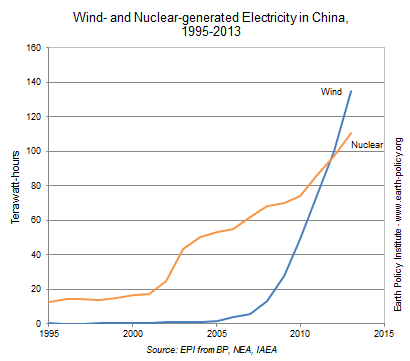
Engineering problems and delays are also a major culprit, and may prevent China from meeting its scaled-down nuclear power goals. As Grist points out, even if all Chinese nuclear capacity currently under construction were to become operational in the next six years, China would have reached only 45 gigawatts by 2020, well shy of its 58 gigawatts goal. Advanced plants that could bring higher efficiency, like a thorium reactor, will still require years of work to resolve engineering issues, researchers say.
Moreover, one of the benefits of nuclear power is that it can be installed close to where it is in demand—in contrast to wind and hydropower—lessening the distance that electricity has to travel along a power grid where some of the power is inevitably lost. But China is spending over 1 trillion yuan ($162.8 billion) to upgrade and expand its grid. As of last year, 84% of the country’s wind capacity was connected to the grid, from 72% in 2011, and the amount of wind-generated electricity wasted in transfer has fallen to 11% from 16% over the same period,according to Fitch Ratings.
European Union working through the costs associated with renewable energy introduction
EU mulls aid to industries to cope with cost of renewable energy SMH, March 18, 2014 The European Union is considering allowing state aid to 62 energy-intensive industries including aluminium- and petroleum-product manufacturers to help with the cost of boosting renewable energy, a draft EU document showed.
The European Commission, the EU regulatory arm, will approve support in the form of reductions in environmental taxes if the beneficiaries cover at least 20 per cent of the additional costs, according to state-aid guidelines for 2014-2020 obtained by Bloomberg News. Continue reading
Careful plan to replace San Onofre Nuclear Plant with Renewables and Efficiency
 How California Will Use Renewables to Replace Massive Nuclear Plant, Eco Watch Natural Resources Defense Council | March 17, 2014 By Sierra Martinez California took another major and symbolic step this month with its decision to rely significantly on energy efficiency and other clean energy resources to help replace electricity once generated by the San Onofre Nuclear Generation Station (SONGS) serving San Diego and the greater Los Angeles area.
The California Public Utilities Commission (CPUC) made official its strategy to address the loss of the huge nuclear plant, which had been offline since January 2012 and was officially retired last year. Fortunately, it closely resembles its proposal released last month.
The final plan uses efficiency and other “preferred resources”—those resources with lower environmental impacts—like demand response (ways customers can consume less energy at key times during the day) and renewable energy such as wind and solar, as well as some upgrades to the electric system, to replace the vast majority of the lost SONGS generation. Instead of turning directly to dirty gas-fired power to replace SONGS, this decision fills the gap left by SONGS with at least two-thirds of clean energy resources, and up to 100 percent clean energy. That means that dirty gas-fired power is limited to contributing, at most, one-third of the replacement energy and at best, zero. Continue reading
Dispelling the false story that Germany imports nuclear power
since the nuclear phaseout of March 2011, power exports in Germany have boomed. Germany remained a net power exporter in 2011 (PDF). 2012 was a record year. So was 2013. 2014 in shaping up to be a fierce competitor for the title (PDF).
So no, Germany has not imported more nuclear power from abroad during its nuclear phaseout.
German imports of nuclear power – the myth revisited REneweconomy, By Craig Morris on 13 March 2014 Energy Transition When Germany shut down nearly half of its nuclear capacity in the week after Fukushima, critics charged that the country would only be importing more nuclear power from its neighbors as a result. Craig Morris says it is a physical impossibility.
Perhaps the best example of such claims is an article published in September 2011 by Der Spiegel. The opening paragraph sums up the argument well: “the country is now merely buying atomic energy from neighbors like the Czech Republic in France.” Later, we read that “the Czech nuclear industry went into the export business. These days, it’s sending roughly 1.2 gigawatts-hours of electricity across the border every day.”
Embarrassingly, it gets worse from there: Continue reading
1 This Month
26 September – International Day for the Total Elimination of Nuclear Weapons





PLEASE OPPOSE HR 8255 AND S.3639 – bills would accelerate satellite deployment, with no environmental review or safeguards – https://ncstd5li.quorum.us/campaign/169331/
To see nuclear-related stories in greater depth and intensity – go to https://nuclearinformation.wordpress.com
-
Archives
- September 2026 (291)
- August 2026 (330)
- July 2026 (355)
- June 2026 (287)
- May 2026 (306)
- April 2026 (356)
- March 2026 (251)
- February 2026 (267)
- January 2026 (308)
- December 2025 (358)
- November 2025 (359)
- October 2025 (375)
-
Categories
- 1
- 1 NUCLEAR ISSUES
- business and costs
- climate change
- culture and arts
- ENERGY
- environment
- health
- history
- indigenous issues
- Legal
- marketing of nuclear
- media
- opposition to nuclear
- PERSONAL STORIES
- politics
- politics international
- Religion and ethics
- safety
- secrets,lies and civil liberties
- spinbuster
- technology
- Uranium
- wastes
- weapons and war
- Women
- 2 WORLD
- ACTION
- AFRICA
- Atrocities
- AUSTRALIA
- Christina's notes
- Christina's themes
- culture and arts
- Events
- Fuk 2022
- Fuk 2023
- Fukushima 2017
- Fukushima 2018
- fukushima 2019
- Fukushima 2020
- Fukushima 2021
- general
- global warming
- Humour (God we need it)
- Nuclear
- RARE EARTHS
- Reference
- resources – print
- Resources -audiovicual
- Weekly Newsletter
- World
- World Nuclear
- YouTube
-
RSS
Entries RSS
Comments RSS

